Last reviewed: April 2026
You've been looking at data engineering job descriptions, and something keeps nagging at you. The titles feel adjacent to your current work. The skills lists overlap. But the pay gap is real — and the hiring bar is not the same, even if both roles live inside the same data organization.
Here's the number most comparison articles hide inside a blended average: entry-level data engineers earn approximately $95K on average while entry-level data analysts average approximately $63K. That's a roughly $32K gap at the starting line — wider on a percentage basis than the senior-level gap, and it compounds through every raise and promotion that follows. Almost no other comparison article leads with it, because leading with it forces an honest conversation about skill requirements that most informational content avoids.
Get Remote Job Tips in Your Inbox
Weekly strategies, salary data, and new opportunities
Unsubscribe anytime. No spam.
What makes this choice genuinely hard is that both roles use SQL and Python, both live inside a data organization, and both can look like a fit depending on which job description you happen to be reading. This post isn't for students picking a major. It's for data professionals who already have skills and need to answer a concrete question: which role can I actually get hired for right now, what's the realistic salary at my current level, and if I'm on the wrong side of the gap, what does crossing it cost?
For this comparison, we synthesized salary data from Glassdoor's aggregated U.S. compensation pages (Q4 2025–Q1 2026), cross-referenced with Elevano's 2025 market-rate analysis and 365 Data Science's 2025 job posting study. Remote availability data — including the sharp decline in fully remote DE roles between 2024 and 2025 — comes from 365 Data Science's independent analysis of posting trends.
Data analysts are easier to break into — lower technical bar, better remote availability — and earn $63K–$121K base depending on level. Data engineers earn $80K–$170K+ but require production coding experience, cloud platform fluency, and pipeline ownership, and fully remote DE roles have become rare (approximately 2% of postings in 2025, down from approximately 10% in 2024). Before you send another application, score yourself on the RJA Data Career Fit Score to confirm you're targeting the right role for your current skill tier.
Here is what the data actually shows for both roles heading into mid-2026.
- Roughly $32K — entry-level salary gap between data engineers (approximately $95K avg) and data analysts (approximately $63K avg) (Glassdoor aggregated U.S. salary data, Q4 2025–Q1 2026)
- Approx. 2% of data engineer job postings listed as fully remote in 2025 — down from approximately 10% in 2024 (365 Data Science analysis of DE posting trends, 2025)
- $173,922 — average senior data engineer salary, with a range of $124,754–$288,080 (Glassdoor, 2025/2026)
- $131,224 — average senior data analyst salary, with a range of $105,797–$164,380 (Glassdoor, 2025/2026)
- 70% of data engineer job postings required Python (n=DE postings analyzed by 365 Data Science, 2025); 69% required SQL
- 22.89% year-over-year growth in data engineering job postings (electroiq.com analysis, 2025)
- 100 days to 12 months — reported transition timeline for data analysts moving to data engineer roles, depending on starting skill level and weekly hours available (DataEngineerAcademy practitioner accounts, 2025)
How We Collected This Data
The figures in this post come from a synthesis of multiple published datasets verified in Q1 2026. Salary data comes from Glassdoor's aggregated U.S. compensation pages for data analyst and data engineer role tiers, cross-referenced with Elevano's 2025 market-rate analysis and 365 Data Science's 2025 job posting analysis. Entry-level through director-level salary bands were pulled from Glassdoor's published salary pages for each role tier during Q4 2025–Q1 2026.
Remote availability data — specifically the decline from approximately 10% to approximately 2% of fully remote DE postings between 2024 and 2025 — comes from 365 Data Science's independent analysis of DE posting trends.
RemoteJobAssistant.com did not run an independent job posting scrape for this comparison. We synthesized, verified, and attributed existing research. Where sources disagree, we use the more conservative figure. Salary figures represent base salary for U.S.-based roles; total compensation including equity and bonus typically runs 15–30% higher at Series B and later companies. Figures reflect Q1 2026 data — verify current ranges against the Glassdoor salary pages linked above.
The RJA Data Career Fit Score: Which Role Can You Actually Get?
Most professionals stuck in the "data engineer vs data analyst" debate already have a clear answer sitting in their own skill set — they just haven't been given the right frame to read it. The RJA Data Career Fit Score is a three-tier rubric that maps your current technical depth to the role most likely to hire you in the next 90 days, and quantifies what switching paths will cost in time and salary.
The biggest hiring mistake data professionals make isn't applying to the wrong company — it's applying to the wrong role for their current skill tier.
Score 1–3: The Analyst Track
You write SQL fluently, work in Tableau or Power BI, and communicate findings to non-technical stakeholders. Your Python use is mostly Pandas for data wrangling — exploratory analysis, cleaning, and reshaping DataFrames. You've never designed a production pipeline, deployed to cloud infrastructure, or written code that other systems depend on to function.
Target role: Data analyst roles. Entry salary range: $63K–$80K. Remote availability: High.
Score 4–6: The Hybrid Track (Analytics Engineer)
You write dbt models, have basic exposure to orchestration tools like Airflow or Prefect, are comfortable with version-controlled SQL, and have contributed to data infrastructure in some capacity — even if you weren't the primary engineer. You sit between the two roles and are well-positioned for analytics engineer postings or senior DA roles at companies where the transformation layer is the main need.
Target role: Analytics engineer or senior data analyst. Salary range: $90K–$130K. Remote availability: Moderate.
Score 7–10: The Engineer Track
You write production Python — scripts that run on a schedule, log failures, and send alerts when something breaks. You've built or maintained ETL/ELT pipelines end-to-end. You have hands-on experience with at least one cloud platform (AWS, GCP, or Azure) at the infrastructure level, not just running queries. Spark or Kafka exposure is present, even if junior.
Target role: Data engineer positions. Entry-level DE salary: $80K–$110K. Mid-level: $111K–$140K. Senior: $141K–$170K+. Remote availability: Low — fully remote DE postings dropped to approximately 2% of listings in 2025.
How to use it: Score yourself honestly before applying. A Score 3 applying to DE roles won't get filtered out because they're unqualified as a person — they'll get filtered because the hiring bar requires demonstrable pipeline experience that Score 3 skills don't yet cover. Focus applications where your score matches the role, then upskill deliberately toward the next tier.
| If you have... | Apply for... | Starting salary | Remote? |
|---|---|---|---|
| SQL + BI tools + stakeholder communication | Data Analyst | $63K–$80K | Yes |
| SQL + dbt + light orchestration | Analytics Engineer | $90K–$130K | Moderate |
| Production Python + pipelines + cloud | Data Engineer | $80K–$110K entry | Rare (approx. 2% of postings) |
Once you know which tier you're targeting, aim for 10–15 focused applications per week — not mass-applying on job boards, but targeted outreach through Slack communities like Data Engineering Central and Locally Optimistic, plus warm referrals from your network. Most data roles are filled through referrals before they're ever posted publicly.
Stop Applying Manually
Our AI applies to hundreds of matching jobs while you sleep. Wake up to interviews, not more applications.
Salary Breakdown: What Each Role Pays at Every Level
Blended salary averages are nearly useless for career decisions. When roadmap.sh quotes a data analyst average of $83,916 and a data engineer average of $128,745, those numbers obscure the entry-level reality that determines your starting salary — and therefore your starting point for every raise that follows. Here's the actual breakdown by career stage.
Entry Level: Where the Gap Is Biggest
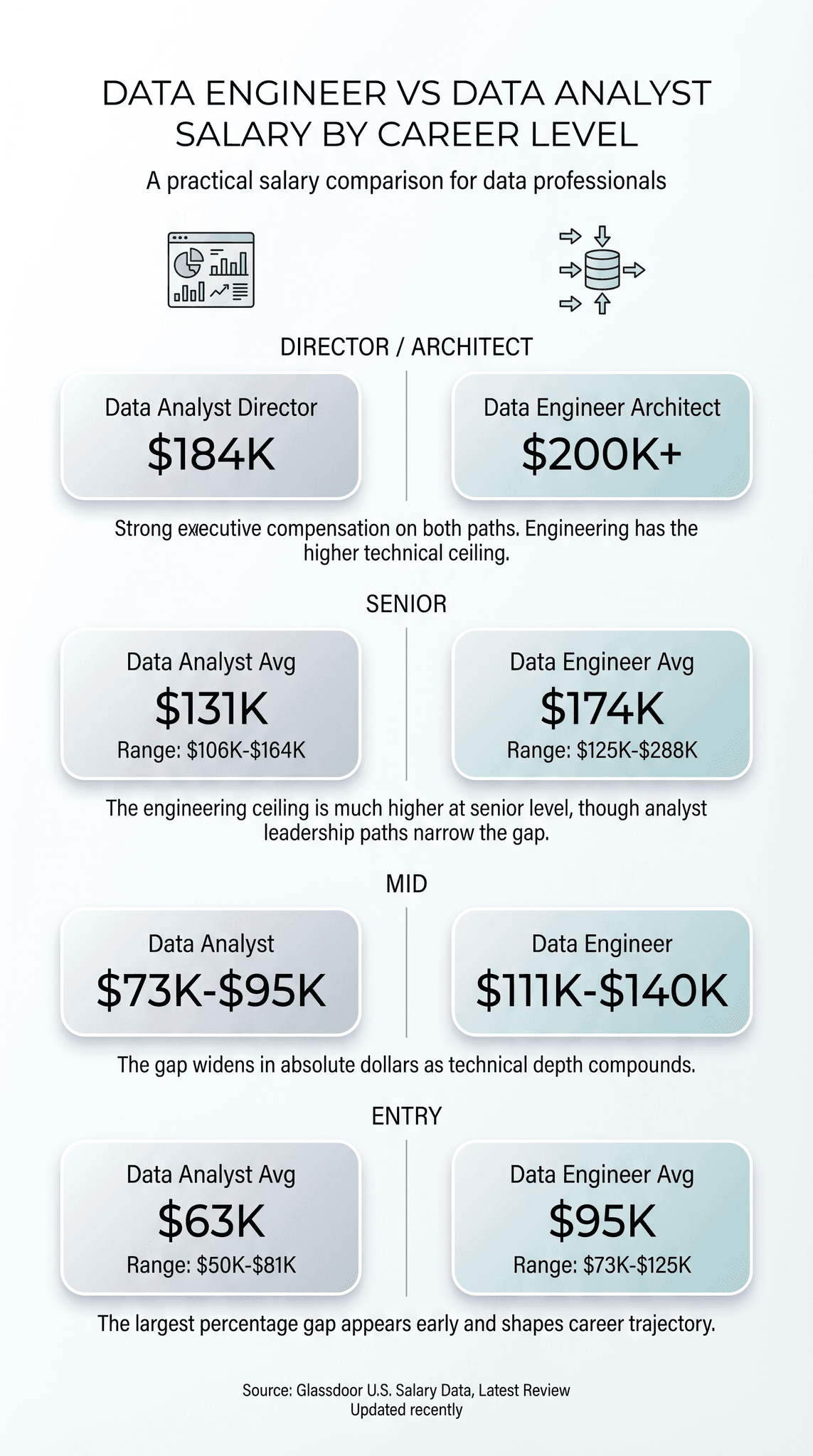
Entry-level data engineers average approximately $95K, with a typical range of $72K–$125K (Glassdoor, Q4 2025–Q1 2026). Entry-level data analysts average approximately $63K, with a range of $50K–$81K. The roughly $32K spread between these two starting points is the single most important number in this comparison — and it's the one most articles bury.
The salary gap between data engineer and data analyst isn't evenly distributed across career levels — it's largest at entry, where it determines your starting point for every raise that follows.
If you're a mid-level professional evaluating a pivot, this number matters more than the senior average gap. Whatever salary trajectory you're on starts from where you enter, and a $32K difference at entry level compounds substantially over a five-year arc.
One thing the salary table doesn't show: data engineers carry on-call rotations that analysts rarely see. You'll make $30K+ more — and you may spend Friday nights getting paged because a pipeline choked on malformed JSON.
One caveat on the analyst side: DA entry-level is crowded. Basic SQL and Tableau from a bootcamp is the floor — there are hundreds of applicants with the same certificate competing for the same postings. If you're targeting entry-level analyst roles, build a portfolio project around a real business question, not a Kaggle tutorial. A GitHub repo showing you analyzed actual sales data and surfaced an actual insight will outperform a certificate from a bootcamp every time.
Mid Level: The Gap Persists
At mid-level, data engineers earn $111K–$140K (Elevano, 2025) while data analysts earn $73K–$95K. The gap persists — and widens in absolute dollars — because data engineering requires a deeper technical investment that the market rewards faster. Pipelines you've built and owned are a more durable differentiator at the senior stage than dashboards you've delivered, even when both are genuinely valuable to the business.
Senior Level: Different Ceilings, Different Paths
Senior data engineers average $173,922 with a range of $124,754–$288,080 (Glassdoor, 2025/2026). Senior data analysts average $131,224 with a range of $105,797–$164,380. The ceiling is meaningfully higher on the DE side — but the DA path has a viable management track: Analytics Managers average $131,202 and Directors of Analytics reach $184,828.
If you're a strong communicator who moves toward leadership naturally, the DA path to Director of Analytics is well-compensated. The DE ceiling is higher for individual contributors who stay deeply technical.
The Industry Variable
Finance and FinTech, along with Tech and SaaS, pay top-of-range for both roles, according to Elevano's 2025 market-rate data. Remote roles may run 10–20% below on-site roles in major tech hubs — treat that as a directional signal, not a firm rule. The number that matters is the posted salary range on the specific job description in front of you, not an industry average from a blog post.
Salary ranges in this post derive from Glassdoor's aggregated compensation data for U.S. roles, cross-referenced with Elevano's 2025 market-rate analysis. We excluded outliers and postings without compensation disclosure. Ranges reflect base salary — total comp including equity and bonus typically runs 15–30% higher at Series B and later companies.
| Level | Data Analyst | Data Engineer | Gap |
|---|---|---|---|
| Entry | $63K avg ($50K–$81K range) | $95K avg ($73K–$125K range) | approx. $32K |
| Mid | $73K–$95K | $111K–$140K | approx. $35K–$45K |
| Senior | $131K avg ($106K–$164K) | $174K avg ($125K–$288K) | approx. $43K avg |
| Director/Architect | $184K (Director of Analytics) | $200K+ (Data Architect / VP Data) | varies |
Sources: Glassdoor salary pages, Elevano 2025, 365 Data Science 2025
If six-figure data roles are your target, both paths get you there — the question is timeline and which skill investments you're making to get there. For broader salary context, see high-paying remote jobs across all functions.
Stop Applying Manually
Our AI applies to hundreds of matching jobs while you sleep. Wake up to interviews, not more applications.
Remote Work Reality: Where Each Role Actually Hires
Every top-ranking comparison article on this topic ignores remote work entirely. That's a meaningful gap — because remote availability has diverged sharply between these two roles since 2024, and for professionals who moved to fully remote work and won't go back, this distinction is more practically important than the salary gap.
If remote work is a hard requirement, data engineering has gotten harder to pursue remotely since 2024. Fully remote DE postings dropped from roughly 10% to approximately 2% of listings in one year, according to 365 Data Science's 2025 analysis of DE posting trends. That doesn't mean remote DE jobs don't exist — it means you'll compete harder for fewer of them, and hybrid is now the dominant model for the role.
One more thing worth asking before you accept an offer: companies advertising "fully remote DE roles" sometimes quietly revise that expectation post-hire — expect "occasional on-site" to creep into contracts once you're past the 90-day mark. Ask directly in the final interview whether remote is truly permanent policy or just how they're recruiting right now. Get it in writing if it matters to you.
Why did remote DE availability collapse? The structural reason: data engineering work often requires proximity to infrastructure, real-time coordination with platform teams, and on-call coverage that becomes harder to manage across distributed time zones. Companies that experimented with remote DE hiring during 2020–2022 have pulled back — not because the work can't be done remotely in theory, but because the coordination costs accumulated over time and on-site infrastructure work requires physical presence in ways that data analysis does not.
Remote data analyst jobs have maintained comparatively stable availability. Business analysts, data analysts, and BI analysts transitioned well to remote because the output — reports, dashboards, presentations — is communicable asynchronously. You don't need to be in the same room as the pipeline to analyze what it produced.
The practical implication: if you have a Score 4–6 on the RJA Data Career Fit Score and remote work is a hard constraint, the analytics engineer path may be your highest-leverage option. It sits closer to the DA end of the stack in terms of work style, commands DE-adjacent pay, and has better remote availability than full data engineering.
For professionals with flexibility on location, the remote data engineer roles that do exist tend to concentrate at remote-native companies — startups and scale-ups that were built distributed from the beginning. Those roles exist and they're worth searching for, but they require a more targeted application strategy than simply filtering for "remote" on a job board.
Skills: What Each Role Actually Requires
The skills overlap between data analyst and data engineer is real — but it's shallow. Both roles use SQL and Python. The difference is what those tools are actually doing in the role.
A data analyst uses Python to analyze and wrangle a DataFrame: load a file, clean messy values, compute aggregates, output a chart. A data engineer uses Python to build a production system: a script that pulls data from an external API on a schedule, handles network failures gracefully, logs successes and errors, retries on transient failures, and sends an alert when something breaks downstream. The code is in the same language, but the engineering depth required — and what's expected in an interview — is fundamentally different.
Analysts use Python in notebooks — cleaning a CSV, running a query, building a quick plot for a deck. Engineers write Python that runs at 2am on a schedule, handles upstream failures, and sends a Slack alert when something breaks. Same language, completely different stakes.
Here's something hiring managers won't say out loud: the majority of DE job postings listing Kafka and Spark as "required" are copied verbatim from FAANG job descriptions by companies that have never run either system in production. A $15M Series B startup asking for "5+ years of Kafka experience" is screening for confidence, not that specific tool. If you've got solid Python and SQL with real pipeline work to show, apply anyway. In the interview, ask them how they're using Kafka — half the time, they'll admit they're planning to "add it later." The companies that genuinely need Kafka will be very specific about their architecture in the job posting itself.
According to 365 Data Science's 2025 analysis, 70% of data engineer job postings required Python for data engineering and 69% required SQL skills. Those are the same two tools data analysts use — but the DE job posting is asking for production-grade scripting and schema design, not notebook analysis and pivot tables.
| Skill Area | Data Analyst | Data Engineer |
|---|---|---|
| SQL | Essential — complex queries, aggregations | Essential + schema design, query optimization |
| Python | Pandas/NumPy for analysis | Production scripts, pipeline code, testing |
| Visualization | Tableau, Power BI, Looker | Not typically required |
| Cloud Platforms | Light exposure (query BigQuery/Redshift) | AWS/GCP/Azure — infrastructure-level |
| Orchestration | Rarely required | Airflow, Prefect, or similar |
| Streaming/Big Data | Not required | Kafka, Spark — common in mid+ roles |
| dbt | Growing requirement for senior DA | Core tool — expected |
| Excel/Sheets | Still required in many DA roles | Not required |
| Coding depth | Moderate — wrangle and query | Deep — build production systems |
The practical hiring filter: DE hiring managers screen for evidence of production code ownership. A GitHub profile showing notebooks and analysis scripts reads as data analyst. A profile showing a pipeline with error handling, unit tests, and a CI/CD configuration reads as competitive for DE roles. The difference is visible before the first interview question.
Day in the Life: What You're Actually Doing
Job descriptions list tools, not texture. Here's what a realistic day in each role looks like — with the friction included.
A Day as a Data Analyst
You start the morning with a stakeholder request: "What was conversion by channel last month?" Straightforward on the surface — except the marketing team, product team, and finance team all have different definitions of "conversion" depending on which funnel they're tracking. You spend an hour clarifying what the question actually means before writing a single query.
Afternoon: a Tableau dashboard that's been refreshing late. You trace it to an upstream table that changed schema last week without notice — a column was renamed, and your calculated field is now returning null. Fix it, document it, flag it to the data engineering team so they add the table to their schema change notification list.
End of day — except it started at 2pm. The analysis you delivered contradicts the finance team's revenue number for the same period by roughly $400K. You're right. They're right. You spend the next hour and a half in a Slack thread not doing analysis but arguing about what "revenue" means: you measured closed-won deals by invoice date; finance measured by cash receipt. Both numbers are defensible. Nobody defined the term upfront, and nobody thought to ask. By the time the thread resolves, the product review meeting has already started. The actual insight you were supposed to deliver sits untouched in a notebook tab.
A Day as a Data Engineer
An Airflow DAG ran successfully at 2:15am but produced empty output. The source system's REST API changed a response field without documenting it — a key your extraction code expected is no longer returned in the payload. Two hours of debugging before you find it. Fix deployed by 10am; backfill running by noon.
The failure mode that sticks: nightly sales pipeline for a retail client, built it myself, tested it extensively — and it silently failed on a Saturday because the source API rate-limited without warning. No alert fired. The analytics team showed up Monday morning to blank dashboards. I spent 6 hours backfilling data manually at 3am while getting Slack messages from people who'd missed their quarterly review. The actual fix took 20 minutes once I found the root cause. Lesson that I've passed on to every junior DE I've worked with since: code defensive retry logic before your first deploy, not after your first failure.
Afternoon: code review for a new ingestion pipeline a junior DE wrote for an e-commerce events stream. The retry logic doesn't account for rate limiting and will blow up in production under load. Three comments, a refactor request, and an explanation of why exponential backoff matters at scale before you can approve the PR.
End of day: a ticket from the analytics team asking why a core dashboard query slowed from 4 seconds to 45 seconds over the past week. You trace it to a missing partition key on a table that grew from 30 million to 800 million rows after a data retention policy changed upstream. Add the partition, rebuild the query plan, document the fix.
If the analyst day reads like your current job with better tooling — you're already there and should be applying to analyst roles now. If the engineer day sounds like where you'd thrive, the next section covers what it actually takes to cross the gap.
The Analytics Engineer: A Third Path Worth Considering
Most comparison guides treat analytics engineering as a footnote. It isn't. For professionals with a Score 4–6 on the RJA Data Career Fit Score, it may be the highest-leverage next step available — a role that doesn't require the full data engineering technical climb but pays significantly above the senior analyst ceiling.
An analytics engineer writes dbt models, owns the semantic data layer — the clean, business-ready tables that sit between raw warehouse data and the dashboards analysts build on top — and works with both the data engineering team (to understand what's available) and the analytics team (to understand what's needed). Primary tools: dbt, Snowflake or BigQuery, version-controlled SQL, and light orchestration exposure. No Kafka, no Spark, no production Python at scale.
If you're starting from scratch on dbt: the free Fundamentals course at courses.getdbt.com covers the core concepts and gets you to deployable models quickly. The dbt Slack community at getdbt.com/community is where practitioners share real project problems — more useful than most paid courses for getting unstuck on actual work. The Analytics Engineering Roundup newsletter (roundup.getdbt.com) covers the space weekly if you want to track where the role is heading.
Why it's worth taking seriously: the technical bar is meaningfully lower than full data engineering. Remote availability is closer to data analyst than data engineer. And the salary — typically $90K–$140K based on current market-rate data — sits above the senior analyst average without requiring the full DE investment.
One honest caveat: "analytics engineer" isn't a universal title. Some companies post the same role as "senior analytics engineer," "data transformation engineer," or "BI engineer." The signal to look for isn't the exact title — it's dbt in the requirements. If the job description lists dbt as required or preferred, you're looking at an analytics engineer role regardless of what it's called.
For context on the full data career spectrum, data analyst vs data scientist covers the other adjacent comparison — worth reading if you're evaluating all three paths simultaneously.
How to Move from Analyst to Engineer (and What It Actually Takes)
"It's possible to transition from analyst to engineer" is advice that helps no one. What's useful is the specific timeline, the skill order that actually matters, and what the salary looks like post-transition — details that most comparison articles skip entirely.
If you're a Score 3 on the RJA Data Career Fit Score today and want to be a Score 7 in 12 months, here's what that path actually requires.
The Realistic Timeline
Practitioner accounts from DataEngineerAcademy (2025) report two distinct timeline clusters: 100 days (aggressive — possible if you already have strong SQL and Python fundamentals and can dedicate 15–20 hours per week to focused upskilling) and 6–12 months (realistic with a full-time job). Neither is a weekend project.
The 100-day number assumes you're starting from a solid Pandas and SQL foundation, not from zero. If your Python experience is limited to adapting notebook cells from Stack Overflow, add 2–3 months to build genuine scripting fundamentals before attempting the rest of the stack.
The Skill Order That Matters
Don't try to learn Kafka before you can write a Python function that handles exceptions properly. The correct sequence:
- Production Python — scripts that run on a schedule, log failures, and send alerts. Not notebooks. Something that runs automatically and breaks gracefully when upstream data changes.
- SQL at scale — not just queries, but schema design and performance. Understand partitioning, indexing, and why a query slows down at 100 million rows.
- dbt — transformation layer, version control, testing. Many analysts already have partial exposure here, which is why Score 4–6 exists as a tier.
- Airflow — orchestration basics. Build and schedule a multi-step pipeline with real dependencies. For a hands-on path through the full stack without paying for a course: DataTalksClub's free Data Engineering Zoomcamp (github.com/DataTalksClub/data-engineering-zoomcamp) works through Airflow, pipelines, and cloud infrastructure with real project builds — closer to actual DE work than any tutorial series.
- One cloud platform — AWS first. Per 365 Data Science's 2025 data, AWS appears in the majority of DE job postings. Start with Redshift, S3, and Lambda.
- Spark or Kafka — only after steps 1–5 are solid. These are most efficiently learned on the job once you've landed the role.
The Salary Bump
At the transition point — moving from mid-level DA (approximately $85K) to entry-level DE — expect a modest step back to $80K–$95K. This is temporary. After 1–2 years in the DE role, mid-level DE pay ($111K–$140K) is a realistic target. The transition costs 6–12 months of opportunity cost, but the long-term ceiling justifies it for the right candidate at the right career stage.
When NOT to Make the Switch
If you're a senior data analyst already earning $115K–$130K who genuinely enjoys stakeholder communication, business context work, and translating findings into executive narratives — transitioning to DE means starting over at a junior level and spending two years rebuilding toward your current salary.
The switch makes the most financial sense at the mid-level DA stage ($73K–$95K), where the DE ceiling is clearly higher and the transition cost is recoverable within 2–3 years. At the senior DA level, the math is harder, the path back to seniority is longer, and there's a real question of whether the skills you'd be giving up — stakeholder management, communication, domain expertise — are actually the most valuable things you have.
Once you know your target role and have built the relevant skills, auto-apply to data roles at scale — RemoteJobAssistant's tool applies to every matching opening while you focus on building the portfolio that lands the interview.
Stop Applying Manually
Our AI applies to hundreds of matching jobs while you sleep. Wake up to interviews, not more applications.
Frequently Asked Questions
What's the entry-level salary difference between a data engineer and a data analyst?
Entry-level data engineers earn approximately $95K on average (Glassdoor, Q4 2025–Q1 2026) while entry-level data analysts average approximately $63K — a roughly $32K gap at the starting line. This spread is larger at entry than at any other career level, and it compounds through every subsequent raise. Data engineers maintain a 35–50% salary premium over data analysts throughout the career arc, though the DA path has a strong management track that closes the gap at the director level.
I'm a data analyst with 5 years of experience — should I transition to data engineering for the higher salary?
Not automatically. If you're a senior DA already earning $110K–$130K, transitioning to DE means starting as a junior DE at $80K–$95K before rebuilding to your current compensation level. The switch makes the most financial sense at the mid-level DA stage (approximately $75K–$95K), where the DE ceiling is clearly higher and the transition cost is recoverable within 2–3 years. Score yourself on the RJA Data Career Fit Score first — if you're at a 5 or below, you're not walking into a DE role at your current seniority level regardless of years of experience.
Are data engineer jobs actually remote in 2026?
Fully remote data engineer roles have become rare. According to 365 Data Science's 2025 analysis of DE posting trends, fully remote DE postings dropped from approximately 10% of listings in 2024 to approximately 2% in 2025. Hybrid is now the dominant model. Data analyst roles have maintained comparatively better remote availability because the output — reports and dashboards — is communicable asynchronously in a way that pipeline infrastructure work isn't. If remote work is a hard requirement, the data analyst path or analytics engineer path is more accessible right now.
What is an analytics engineer, and is it a better career path than data engineer or data analyst?
An analytics engineer sits between the two roles: they write dbt models, own the semantic data layer, and collaborate with both the engineering infrastructure and the analytics team. It's a genuine third path, not a consolation prize. Salary typically runs $90K–$140K, the technical bar is lower than full data engineering, and remote availability is closer to data analyst than data engineer. For professionals with a Score 4–6 on the RJA Data Career Fit Score, it's often the highest-leverage next step — you get DE-adjacent pay without the full DE technical investment, and you're actually competitive for the role based on your current skills.
How do I know which tier of the RJA Data Career Fit Score I'm at?
Score yourself on three observable behaviors: (1) Have you written production Python code that other systems depend on — not notebooks, but scheduled scripts that log failures and handle errors? (2) Have you built or maintained an ETL/ELT pipeline end-to-end? (3) Do you have hands-on cloud data platform experience beyond running queries — actual infrastructure setup or pipeline deployment? If all three are no, you're Score 1–3 (analyst track). If one or two are yes with some dbt or orchestration exposure, you're Score 4–6 (hybrid track). If all three are yes with cloud infrastructure depth, you're Score 7–10 (engineer track).
What skills do I need to break into data engineering from a data analyst background?
The fastest path: production Python first (not notebook Python — scripts that run on a schedule and handle failures), then SQL schema design (not just queries), then dbt, then Airflow, then one cloud platform. AWS is the right first choice — it appears in the majority of DE postings according to 365 Data Science's 2025 analysis. Learn Kafka and Spark after you've landed the role; the biggest mistake is trying to learn the full stack before applying, which adds months to the timeline without improving your interview odds.
How long does it take to go from data analyst to data engineer?
Practitioner accounts from DataEngineerAcademy (2025) report timelines from 100 days (aggressive — requires strong SQL and Python fundamentals already in place, plus 15–20 hours per week of focused upskilling) to 12 months (realistic with a full-time job and a structured learning plan). Most mid-level analysts land a DE role within 6–12 months of focused effort. Expect to take a step back in title or seniority at the transition point; this is standard and recoverable within 1–2 years as you build DE-specific experience.
Start Applying to the Right Role
The choice between these two paths comes down to three questions: where you score on the RJA Data Career Fit Score right now, what your remote work requirements actually are (the availability gap is real and has widened sharply for DE roles), and at what career stage you're making the decision. Apply to the role that matches where you are today — not where you plan to be six months from now.
Browse remote data analyst jobs if you're in the Score 1–3 range. Explore remote data engineer roles if you're at Score 7 or above. See all current data analyst openings or data engineer openings on the RemoteJobAssistant job board. Once you've identified your target role, apply consistently and at volume with Remote Job Assistant's auto-apply tool. Related reading: Data Analyst vs Data Scientist for the adjacent comparison, and the High-Paying Remote Jobs Guide 2026 for broader salary context across functions.
The data stack doesn't care which side of the pipeline you work on — it cares whether you can actually do the job. Figure out which job that is before you send the next application.
Ready to Find Your Remote Job?
Browse thousands of curated remote jobs or let AI apply for you.
Browse Remote JobsRelated Job Guides

Remote Brand Manager Jobs: What 829 Postings Pay (2026)
Remote brand manager jobs: we analyzed 829 US postings. Classic CPG roles paid $125K and rarely went remote; software and health roles paid about $170K.
23 min read

Remote UX Researcher Jobs: What 211 Postings Pay (2026)
Remote UX researcher jobs: we read 211 US postings. Remote seats paid $144K vs $176K hybrid; employer type, statistics and AI work set the $190K+ band.
38 min read
Remote Solutions Architect Jobs: Pay by Seat Type (2026)
Remote solutions architect jobs: we read 1,079 US postings. Vendor pre-sales seats post $205,000 and say remote 81% of the time. AWS listed 4 of 269 remote.
42 min read