
Last reviewed: October 2026
You shipped the redesign, fixed the checkout bug at six on a Friday, kept the WordPress plugins patched and the landing pages converting, and your title still says Web Developer. So you search "remote web developer jobs," a phrase about 2,000 people type into Google every month, and the boards hand you your own seat and the product-engineering seat in the same list, even though the second one posts $35,000–$57,000 more at the same level. LinkedIn's page for it promises "10,000+ Open Roles" and then shows a city on 53 of its 60 cards and a salary on none of them. FlexJobs claims 26,040 remote web developer jobs, hides the employer on every card, and marks 21 of its first 50 as hybrid and one as "No Remote Work." The third Google result is a ZipRecruiter page for entry-level web developer jobs in Wichita, Kansas.
If you've spent three to five years keeping marketing sites and CMS platforms running, the ranges in front of you look like the Website seat in our data: $80,000–$107,036 at mid-level, bracketing the Bureau of Labor Statistics median for web developers, $92,650 (May 2025). The same React work on a product team posts $115,200–$163,700 at the same level, and the people doing it carry "engineer" in their title and sit near the BLS median for software developers, $135,980. The boards list both seats under the same keyword and price neither.
Get Remote Job Tips in Your Inbox
Weekly strategies, salary data, and new opportunities
Unsubscribe anytime. No spam.
So we did, and two words in a posting predict its pay better than the stack does: what the seat builds, and whether the title says Engineer.
Remote Job Assistant read 3,937 US web developer, front-end and full-stack postings from 2,645 employers in full, pulled October 8, 2026, with posting dates from October 2025 to October 2026 (3,183 of them listed since July). They came from LinkedIn (2,710, from 151 keyword searches plus LinkedIn's own remote and national pages), the Indeed network via SimplyHired (414), 306 Workday career sites (298), 1,024 Greenhouse, Lever, Ashby and SmartRecruiters boards (270), Himalayas (234) and amazon.jobs, Jobicy and Remotive (12). This guide covers web, front-end, full-stack, React, Angular, Vue and TypeScript developer titles, the WordPress, Shopify, Drupal, Sitecore and AEM specialists, and PHP developers. It leaves generic "Software Engineer" titles to our remote software engineer guide, and it sets aside mobile, backend-only, QA, DevOps, data, Web3 and Salesforce seats, along with AI-lab "trainer" gigs and offshore listings posted under a US flag.
Based on our analysis of 3,937 US web developer, front-end and full-stack postings at 2,645 employers (posted October 2025–October 2026):
- 25.6% (n=1,009 of 3,937) were fully remote; among the 2,137 postings that state a work model, 47.2%; 1,800 say nothing
- 75.3% (n=1,503 of 1,996) of posted annual ranges start at $100,000 or more; 361 of those are remote, and 154 remote ranges start at $150,000 or more
- $165,000 median range midpoint when the posting describes the company's own product or app (n=1,072), against $105,000 when it describes the marketing website, landing pages or a CMS (n=83)
- $170,000 median midpoint for titles with the word Engineer (n=1,245), against $120,672 for titles with the word Developer (n=656); the exact title "Web Developer" carries $104,770 (n=121)
- 72.0% (n=67 of 93) of agency postings that state a model are remote, against 49.7% (n=473 of 951) at software companies, 37.7% (n=84 of 223) at government contractors and 33.1% (n=60 of 181) in finance
- 63.6% (n=2,505 of 3,937) name React and 51.7% (n=2,037) name TypeScript, at $155,500 and $160,000 midpoints; 5.8% (n=230) name WordPress at $102,500 and 10.8% (n=424) name PHP at $109,500
- 32.2% (n=1,267 of 3,937) expect AI coding tools in the work, up from 20% of postings dated January–March 2026 to 34% of those dated September–October; at mid-level those postings carry a $139,900 midpoint against $130,000 (n=277 vs 648)
- 2.2% (n=86 of 3,937) carry an entry-level title; 6 of the 36 that state a model are remote, and they post $80,000–$114,375 (n=42)
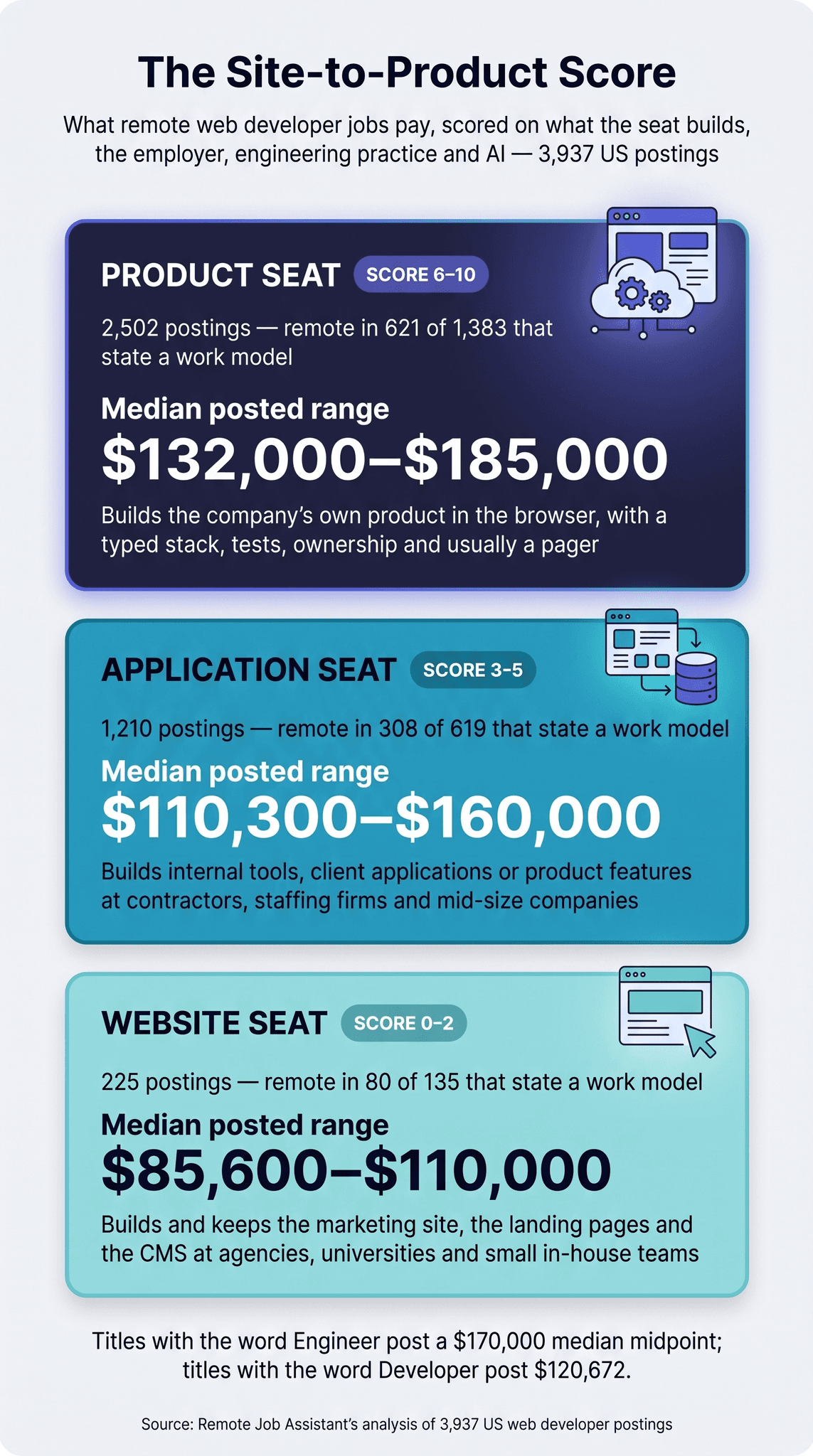
Those numbers sort every posting into one of three seats, and you'll see them throughout this guide. A Website seat builds and keeps the marketing site, the landing pages and the CMS. An Application seat builds internal tools, client applications or product features with some engineering practice around them. A Product seat builds the company's own product in the browser, in a typed stack, with tests, ownership and usually a pager.
They are product front-end and full-stack seats at software and fintech companies, with a smaller set in health and media. Examples from our data: Netflix's Software Engineer 5 for TV Product UI ($320,000–$500,000, remote), Capital One's Senior Staff Full-stack Engineer for its Global Payment Network ($286,200–$326,700, remote-eligible), Affirm's Senior Staff Software Engineer, Fullstack, Marketplace ($265,000–$325,000), ClickUp's Principal Frontend Engineer ($250,000–$300,000), Ashby's Staff Design Engineer ($232,000–$323,000), Calendly's Senior Full Stack Engineer, AI Scheduling ($224,400–$271,920), Mercury's Senior Software Engineer, Frontend ($200,700–$250,900) and Reddit's Frontend Engineer, Ads ($177,500–$248,500). In our data, 154 remote ranges start at $150,000 or more and 361 start at $100,000 or more.
How We Collected This Data
Two limitations first, because they shape every number below. Pay medians lean toward large employers with pay-transparency blocks: 87% of Workday postings carry a range, 84% of Greenhouse, Lever, Ashby and SmartRecruiters postings, 50% of SimplyHired, 45% of LinkedIn and 32% of Himalayas, and 1,996 of the 3,937 postings (50.7%) post one at all; 171 more post only an hourly rate, which we never convert into the annual medians. And the crawler could not see everything: Indeed, Glassdoor and ZipRecruiter return 403 errors (we read the Indeed network through SimplyHired), Reddit is blocked, we did not query USAJOBS, and Wellfound, Remote.co and Working Nomads were read for the page audit but not counted, because they mix US seats with worldwide marketplace postings priced for 70 countries. The dataset therefore under-counts federal civil-service web seats in the 2210 series and small-agency postings.
A posting counted if its title said web developer, website developer, web application developer, web engineer or software engineer, web; front end, frontend or UI developer or engineer; full stack developer or engineer; a React, Angular, Vue, JavaScript, TypeScript, Next.js or Node developer; a WordPress, Drupal, Shopify, Webflow, Magento, Sitecore, AEM, HubSpot or CMS developer; or a PHP or Laravel developer. We excluded generic Software Engineer and Software Developer titles with no web word (272 of them, which our software engineer and full stack developer guides cover), backend-only, mobile, QA, DevOps and cloud, data, embedded, game, security, Web3, Salesforce, ServiceNow and SharePoint seats, web analytics, content and project titles, instructors and interns. 151 "Design Engineer" and "UX Engineer" titles failed a body test for browser work, and a hardware guard removed five chip-design "front end" titles such as Intel's "CPU Front End Methodology Engineer." Dedupe removed 240 exact copies, 391 per-city clones of one requisition, 235 copies under sibling employer names and 359 duplicates found on two sources.
We read work model from the posting text, not the board's flag. "Remote or Hybrid" and "Remote-eligible" count as a remote option, a SimplyHired or Himalayas "remote" tag never overrides "Regular and consistent on-site presence is required for this position," and technical uses of the word ("remote API," "remote debugging") are stripped first. Three audit rounds of 15 random postings per label caught the misreads we describe below. The Site-to-Product Score is computed by code from the duty language. The "what you build" test counts only artifact words, the company's own product, app, features or design system on one side and the marketing site, landing pages, CMS or campaign pages on the other, after a first version that counted generic engineering words (APIs, scalable, agile, cross-functional, UX) put 85% of postings in the product group. Employer type comes from curated name lists, then the employer's LinkedIn industry label, then body rules; federal-contract language moved 200 postings to government contractor. Company blurbs that name HubSpot or Shopify as customers can still misfile a handful of rows, which we hand-checked in samples of ten per outcome.
We set aside 223 offshore listings posted under a "United States" flag (Torentify: "Candidates based in Latin America, India, or the United States are welcome to apply"; HireBoost: "$2,500 – $3,500 USD per month. Fully remote position from anywhere in LATAM"), 20 AI-training titles (Mercor's "Frontend Developer - Fully Remote | Upto $85/hr"), 47 design-only Web Designer titles ($75,000–$90,000) and 4 email-developer titles.
Salary cross-references: BLS Occupational Employment and Wage Statistics for May 2025 (Web Developers, median $92,650, 75th percentile $126,230, 90th $162,290; Web and Digital Interface Designers, $104,000; Software Developers, $135,980), the Robert Half 2027 Salary Guide (Web Developer $95,500, $131,750 and $165,000 at the 25th, 50th and 75th percentiles; Front-End Developer – Technology $90,500, $110,000 and $134,750) and the Stack Overflow 2025 Developer Survey (US median $145,000 for front-end and $138,000 for full-stack developers, n=5,239 US responses).
The Site-to-Product Score: Why Two React Jobs Pay $60K Apart
The common advice for web developers who want more money is to learn Next.js, build a better portfolio or move to a bigger company. Our postings point somewhere else. React shows up in 63.6% of them and it doesn't hold pay together: a posting that names React and describes a marketing website is a different job from a posting that names React and describes the company's product, and the market prices them $60,000 apart. What changes is what the seat builds and what the employer measures it against. The fastest tell is the artifact words. If "landing pages," "company website," "CMS" or "campaign" sits near the duties, you're reading a Website seat. If "our product," "user-facing," "ship features," "design system" or "activation" does, you're reading a Product seat.
The Site-to-Product Score: a 0–10 rubric that scores any web developer posting, or your current job, on how far it sits from "maintain the website about the product" toward "build the product that runs in the browser," using four things the posting itself says: what the seat builds, who the employer is, how much engineering practice it names, and whether AI tools and product metrics are part of the work.
Scoring:
- What you build (0–3): the company's own product, app, SaaS, user-facing or customer-facing application, features or design system = 3; internal tools, or a mix of product and site work = 2; agency or consultancy client delivery, or nothing stated = 1; the marketing website, landing pages, CMS pages, campaign pages or webmaster duties = 0.
- Employer (0–2): a software or fintech company = 2; a health system, consumer brand, manufacturer, media company, federal contractor, consulting firm or other in-house team = 1; an agency, staffing firm, university, school, government or nonprofit body, edtech, design-subscription service or print shop = 0.
- Practice (0–3): +1 when a typed component stack is named (TypeScript, React, Vue, Angular, Svelte, Next.js, Nuxt, Remix or Astro); +1 for two or more rigor items (testing frameworks, CI/CD, code review, performance budgets or Core Web Vitals, observability or on-call); +1 for ownership (architecture, technical leadership, mentoring, a roadmap, or owning the front end, the design system or the codebase).
- Product and AI (0–2): +1 when AI coding tools are expected in the work (Copilot, Cursor, Claude Code, "AI-assisted development"); +1 when a product or growth metric is named (A/B tests, experiments, feature flags, conversion, retention, activation, KPIs).
Bands:
- Website seat (0–2), $85,600–$110,000 median posted range (n=67), midpoint $104,000: you build and keep the marketing site, the landing pages and the CMS, usually at an agency, on a staffing contract, at a university or on a small in-house team. 225 postings at 201 employers; 59.3% of the 135 that state a model are remote, but the remote ranges post $80,000–$105,000 (n=22).
- Application seat (3–5), $110,300–$160,000 (n=539), midpoint $135,000: you build internal tools, client applications or product features with some engineering practice around them, often at a government contractor, a staffing contract or a mid-size company. 1,210 postings at 920 employers; 49.8% of 619 are remote, and the remote ranges post $105,100–$145,000 (n=125).
- Product seat (6–10), $132,000–$185,000 (n=1,390), midpoint $159,525: you build the company's own product in the browser with a typed stack, rigor and ownership, usually at a software or financial company. 2,502 postings at 1,774 employers; 44.9% of 1,383 are remote, and the remote ranges post $140,000–$181,050 (n=322).
How to use it: score your current job, then score each posting before you apply. The four questions below take two minutes. Change one part at a time. The cheapest point to add is practice, a typed stack, tests and a performance budget in the repo you show. The biggest is what you build, three points for owning product features instead of pages. If you score 0–2 and want $130,000 or more, change what you build or the employer type before you learn another framework. And read the title word: at the same employer, apply to the posting that says Engineer.
The four-question score check. (1) What does the seat build? The company's own product, app or features score 3, internal tools or a mix 2, client work or nothing stated 1, the marketing site, CMS or landing pages 0. (2) Who's the employer? A software or fintech company scores 2, any other in-house team 1, and an agency, staffing firm, university, nonprofit or edtech company 0. (3) Does the posting name a typed component stack? Two of tests, CI/CD, code review, performance budgets and on-call? Architecture, mentoring or ownership of the front end? Score +1 for each. (4) Are AI coding tools expected, and is a product metric named? Score +1 for each. Add it up: 0–2 is a Website seat, 3–5 an Application seat, 6–10 a Product seat.
Here is the check run on two real postings from the data, both remote. Atticor's Marketing Web Developer ($140,000–$160,000) builds "the landing pages and websites that drive client acquisition" (what you build: 0), at a software company (employer: 2), names a typed stack but no tests or ownership (practice: 1), and expects AI tools and names conversion as the metric (product and AI: 2). Score 5, an Application seat, and the range sits inside that band's $110,300–$160,000. Calendly's Senior Full Stack Engineer, AI Scheduling ($224,400–$271,920) owns product features (3), at a software company (2), names a typed stack, two rigor items and ownership (3), and names activation as the metric (1). Score 9, a Product seat. The two postings share React. Ninety seconds of reading separates about $98,000 of range midpoint.
The table shows how the three seats compare on remote share and pay.
| Seat (score) | Postings | Remote, of those stating a model | Median posted range (n) | Remote median range (n) | Ranges starting at $75K+ (remote) | Typical titles and employers |
|---|---|---|---|---|---|---|
| Website (0–2) | 225 | 59.3% (80 of 135) | $85,600–$110,000 (67) | $80,000–$105,000 (22) | 42 of 67 (12) | Web Developer, WordPress, Drupal or Shopify Developer, Marketing Web Developer at agencies, staffing contracts, universities and small in-house teams |
| Application (3–5) | 1,210 | 49.8% (308 of 619) | $110,300–$160,000 (539) | $105,100–$145,000 (125) | 479 of 539 (113) | Full Stack Developer, Web Application Developer, UI Developer at government contractors, staffing firms, consultancies and mid-size companies |
| Product (6–10) | 2,502 | 44.9% (621 of 1,383) | $132,000–$185,000 (1,390) | $140,000–$181,050 (322) | 1,345 of 1,390 (315) | Front End Engineer, Full Stack Engineer, Software Engineer (Web), Design Engineer at software, fintech, health and consumer product companies |
The gap holds inside every seniority level. Mid-level postings run $80,000–$107,036 in a Website seat, $100,000–$143,750 in an Application seat and $115,200–$163,700 in a Product seat. Senior postings run $107,578–$137,500, $129,020–$180,000 and $150,000–$200,000. Lead and manager postings run $100,000–$141,200, $125,000–$180,000 and $142,600–$200,000. The single-score ladder is monotonic too, from $60,523–$75,000 at a score of 0 to $149,800–$202,850 at 10.
Why what-you-build moves pay so much comes down to what the code is priced against. In a Website seat, the site is a cost line in a marketing budget, measured in launches, uptime and conversion, built for a marketing director who owns the message. Betterment's Sr. Manager, Website Operations posting ($141,500–$162,500, hybrid) describes the seat exactly: "The Website Operations team at Betterment is responsible for building and maintaining our public-facing marketing website. The team plays a critical role in ensuring content accuracy, compliance readiness, accessibility, SEO hygiene, high-quality publishing standards, and CRO testing and optimization." Atticor's remote Marketing Web Developer posting ($140,000–$160,000) says the same thing from the agency side: "build the landing pages and websites that drive client acquisition across a portfolio of national legal brands. This is a front end role first. You will own how our pages look, load, and convert." Those two are the well-paid end of the seat, and the reporting line is the tell in both directions. Atticor's seat reports "to our Director of Marketing." Catalyst Mobility's remote Web Developer II ($72,000–$85,760) sits "within the Marketing Department's Web Team and reporting to the Senior Website Manager." Calendly's seat reports "to the Engineering Manager on the AI Scheduling team," and Bestow's remote Senior Full-stack Software Engineer II ($180,000–$200,000) "reports to our Engineering Manager." Postings that name WordPress carry a $102,500 midpoint (n=75), and WordPress without React carries $95,000 (n=39); only 26 of the 225 Website-seat postings name React or TypeScript at all.
In an Application seat, the code is a deliverable, and pay follows the client's budget and the contract. That's where federal work sits: government contractors post $110,500–$175,000 (n=283), a security clearance is named in 368 of their 414 postings, and staffing firms post $60–$70 an hour (n=53).
In a Product seat, the browser code is the product, so the seat is priced like a product function. Netflix's remote Software Engineer 5 for TV Product UI ($320,000–$500,000): "TV Product engineers deliver novel product features on Netflix's flagship TV application to help members discover and connect with stories they'll love. We partner with designers and product managers to define and refine concepts." Calendly's remote Senior Full Stack Engineer, AI Scheduling ($224,400–$271,920): "help grow the product's user base by improving activation, reliability, and trust; fixing customer-facing issues." Capital One's remote-eligible Front-end Engineer 5 SEO for Shopping ($209,000–$238,500): "Architect, build, and maintain core components and shared libraries that act as a force multiplier for multiple teams within your product area." Scribe's remote Staff Design Engineer ($230,000–$350,000): "own Stylus, our design system, and the quality of what we ship across the web app, desktop app, browser extension, and marketing site."
Two places where the score and the pay disagree, with the numbers. The rigor item doesn't lift pay by itself: postings that name two or more of tests, CI/CD, code review, performance budgets and on-call post $120,000–$170,000 against $135,000–$189,300 for those that don't, because rigor words cluster in detailed government-contractor and mid-level postings. It is a practice marker, not a pay marker. And a few marketing-site seats at AI and fintech companies pay product money, because the site is the growth engine: Harvey's Staff Web Engineer ($220,000–$260,000, hybrid), Ramp's Software Engineer, Frontend, Growth ($200,000–$310,000, hybrid), Perplexity's Design Engineer, Growth & Marketing ($180,000–$300,000) and Deepgram's remote Staff Web Engineer, Marketing ($150,000–$210,000). The employer and practice points carry them out of the Website band, and the pay shows why.
The most remote web developer jobs are the cheapest ones: marketing-site and CMS seats are 59% remote at a $105,000 midpoint, and product seats are 45% remote at $165,000.
If you score your current job and land in the Website seat, you don't need a new credential to move. You need Product-seat postings in front of you, and a lot of them, because 2,502 of them are spread across 1,774 employers.
Stop Applying Manually
Our AI applies to hundreds of matching jobs while you sleep. Wake up to interviews, not more applications.
Remote Web Developer Salary: What 1,996 Posted Ranges Show
BLS explains most of the spread before you open a single posting. The May 2025 median for web developers is $92,650, with a 25th percentile of $64,230, a 75th of $126,230 and a 90th of $162,290, across 70,190 employed. The median for web and digital interface designers, the occupation BLS uses for UI developers and UX engineers, is $104,000. The median for software developers is $135,980, with a 25th percentile of $105,210. Employers title the same React seat under any of the three, and the title they choose tracks the pay band they're in. Industry medians for web developers run from $119,940 in information to $88,690 in computer systems design, $86,690 in consulting and $84,450 in educational services. BLS projects the combined web developer and digital designer occupation to grow 5% from 2025 to 2035, with about 13,600 openings a year; O*NET splits that into "Average (3% to 4%)" for web developers with no Bright Outlook badge and "Faster than average (5% to 6%)" with the badge for web and digital interface designers.
Salary ranges below derive from our analysis of 3,937 postings between October 2025 and October 2026, cross-referenced with BLS Occupational Employment and Wage Statistics, the Robert Half 2027 Salary Guide and the Stack Overflow 2025 Developer Survey. The 1,996 posted ranges are what employers published, not offers, and we excluded hourly-only postings from the annual medians. Ranges shift as markets move; check the linked sources for current figures.
The title word is the first table, because it is the biggest single tell in the data.
| Title | Postings | Median posted range (n) | Midpoint | Remote, of those stating a model |
|---|---|---|---|---|
| Web Developer | 295 | $89,649–$120,000 (121) | $104,770 | 48.3% (69 of 143) |
| Front End Developer | 225 | $105,000–$160,000 (65) | $135,000 | 44.3% (51 of 115) |
| Front End Engineer | 303 | $150,000–$210,000 (195) | $185,000 | 50.3% (75 of 149) |
| Full Stack Developer | 613 | $100,000–$145,440 (256) | $125,000 | 47.4% (152 of 321) |
| Full Stack Engineer | 824 | $140,000–$185,000 (483) | $160,000 | 47.0% (231 of 491) |
| UI Developer | 43 | $104,990–$152,720 (14) | $130,600 | 31.6% (6 of 19) |
| UI Engineer | 35 | $145,000–$185,100 (21) | $158,950 | 18.8% (3 of 16) |
| Web Engineer / Software Engineer, Web | 54 | $150,000–$192,000 (29) | $171,272 | 50.0% (15 of 30) |
| WordPress Developer | 68 | $77,500–$110,000 (14) | $92,500 | 59.6% (28 of 47) |
| Shopify Developer | 46 | $100,000–$140,000 (9) | $120,000 | 85.2% (23 of 27) |
| Drupal Developer | 52 | $108,006–$154,429 (16) | $130,294 | 71.0% (22 of 31) |
| React Developer | 44 | $110,000–$120,000 (23) | $117,500 | 31.2% (5 of 16) |
| PHP / Laravel Developer | 74 | $95,000–$120,000 (25) | $105,000 | 65.9% (29 of 44) |
Across all 3,937 postings, titles with the word Engineer carry a $170,000 median midpoint (n=1,245) and titles with the word Developer carry $120,672 (n=656), and the gap survives every way we slice it. Mid-level: $150,000 against $113,700. Senior: $185,000 against $135,000. Inside Product seats only: $179,125 against $122,500. At software companies only: $189,900 against $123,000. Mid-level full stack: $145,000 against $120,000. Senior front end: $197,500 against $142,878. Remote postings only: $167,500 against $120,000. The two titles ask for the same stack. React is named in both at about the same rate. What differs is the seat the employer is filling and the band it belongs to in its own pay structure.
In web development the title word is the pay tell: Engineer posts $170,000 and Developer posts $121,000, at the same level, on the same stack, at the same kind of employer.
By level, entry-level postings run $80,000–$114,375 (n=42), mid-level $110,000–$155,000 (n=925), senior $145,000–$198,950 (n=800) and lead or manager $135,600–$191,400 (n=229). 1,515 postings name a years-of-experience figure, and the median is five. Among mid-level postings, the midpoint climbs from $110,000 at one year (n=23) to $123,648 at three (n=86), $130,300 at five (n=90) and $151,475 at eight (n=27).
Employer type sets both the pay and the odds of a remote seat.
| Employer type | Postings | Median posted range (n) | Remote, of those stating a model |
|---|---|---|---|
| Software and tech | 1,691 | $149,399–$200,000 (820) | 49.7% (473 of 951) |
| Finance and fintech | 366 | $125,600–$175,000 (210) | 33.1% (60 of 181) |
| Government contractors | 414 | $110,500–$175,000 (283) | 37.7% (84 of 223) |
| Health | 146 | $122,667–$175,000 (91) | 51.2% (43 of 84) |
| Consumer brands and retail | 133 | $112,250–$176,000 (68) | 32.9% (23 of 70) |
| Media and publishers | 67 | $135,100–$177,000 (39) | 35.0% (14 of 40) |
| Industrial and manufacturing | 194 | $120,000–$166,106 (90) | 26.6% (17 of 64) |
| Consulting | 150 | $91,700–$156,700 (89) | 23.2% (13 of 56) |
| Agencies | 132 | $95,000–$130,000 (43) | 72.0% (67 of 93) |
| Staffing firms | 265 | $110,000–$135,000 (96); hourly $60–$70 (53) | 43.6% (58 of 133) |
| Universities | 44 | $83,465–$106,786 (24) | 47.4% (9 of 19) |
Robert Half's 2027 guide lands in the same place from placement data: Web Developer $95,500, $131,750 and $165,000 at the 25th, median and 75th percentiles; Front-End Developer – Technology $90,500, $110,000 and $134,750; the guide has no full-stack role at all. Stack Overflow's 2025 survey puts US front-end developers at a $145,000 median, up 24% in a year, and full-stack at $138,000. Levels.fyi's full-stack page shows $173,500 median total compensation, which includes equity our posted ranges don't.
Remote pays slightly less in the aggregate, $128,039–$170,000 (n=469) against $125,600–$176,300 for hybrid (n=427), and the reason is composition, not a discount. The most remote employers are agencies and CMS seats. Inside software companies, remote postings carry a $162,500 midpoint (n=219) against $185,000 for hybrid and on-site (n=267), because the biggest ranges sit at hybrid headquarters: OpenAI's full-stack postings run $266,000–$445,000 with "three days per week in the office," and Anthropic's $310,000–$405,000. Inside finance it runs the other way: remote finance seats carry $175,500 (n=36) against $140,000 (n=75), because Capital One's remote-eligible staff seats sit at the top of the band.
Where Remote Web Developer Jobs Actually Exist
The remote market for browser work is a barbell. At one end sit agencies, 72.0% remote of those stating a model (67 of 93) at $95,000–$130,000, and the small employers our code couldn't classify, 83.9% remote (120 of 143). At the other end sit the employers with the biggest ranges: finance 33.1% remote (Citi posts 20 of its 24 web seats as hybrid), consumer brands 32.9%, industrial companies 26.6% and consulting firms 23.2%. Software companies split down the middle at 49.7% (473 of 951), health runs 51.2%, government contractors 37.7% (CACI lists 22 of its 26 as on-site, one of them "fully in person in the SCIF with NO hybrid or remote options"), and staffing firms 43.6%.
The stack tells the same story. Shopify postings are 68.4% remote of those stating a model (52 of 76), Drupal 64.2% (52 of 81), WordPress 61.1% (91 of 149), Rails 60.6% (60 of 99), PHP 59.8% (144 of 241), Vue 51.3% (160 of 312), Node 50.3% (299 of 594), Next.js 48.6% (124 of 255), React 44.3% (599 of 1,352), TypeScript 43.9% (478 of 1,088), Angular 41.0% (237 of 578) and Java 36.0% (182 of 505), the least remote stack in the data.
The reason is who sits next to the developer. CMS and marketing-site work is sold by agencies to clients who never meet the person building it, so it is remote by construction. Product front-end teams at banks, retailers and consumer companies sit next to product, design and compliance, and the posting says so in days: of the 46 hybrid postings that state a count, 26 say three days. Citi: "Work in a hybrid model with three days in the office and two days working remotely each week." OpenAI: "This role is based in San Francisco, with three days per week in the office." Spire: "this position will require you to work a minimum of three days per week in the office." Java-heavy enterprise stacks live at those same banks and contractors, which is why Java is the least remote word in the data and Shopify the most.
Remote postings also carry small print, and we counted it on the 1,009 remote rows. A security clearance is named in 112 (11.1%). A US-residence or work-authorization line appears in 95 (9.4%); ICF: "Candidate must reside in the U.S., be authorized to work in the U.S., and all work must be performed in the U.S." On-call appears in 74 (7.3%); Netflix: "Participate in on-call rotation and lead incident reviews"; GitLab: "support a Tier 2 on-call rotation for urgent engineering issues." A time zone appears in 62 (6.1%); Sardine: "you must reside in the Eastern Time Zone to meet the needs of the team"; Hunter Industries: "Candidates must be willing and able to work PST core hours." A 1099 or corp-to-corp clause appears in 31 (3.1%), travel in 22 (2.2%), a state list in 6 and a driving-distance rule in 10. Deckers: "Interested applicants must reside in one of the following approved states: Arizona, California, Colorado, Connecticut, Massachusetts, Minnesota, New Jersey, New York, Oregon, Texas, Wisconsin." Oura runs the list the other way: "We are not considering candidates residing in the following states: Alaska (AK), Delaware (DE), Iowa (IA), Mississippi (MS), Missouri (MO), Nebraska (NE), Rhode Island (RI), South Dakota (SD), Vermont (VT), West Virginia (WV), and Wisconsin (WI)." VSolvit: "POSITION IS REMOTE, BUT MUST RESIDE IN CALIFORNIA." FedEx Freight: "While this is a remote position, the successful candidate must reside within 50 miles of a FedEx Freight location."
Some remote postings are remote on a condition. Green Key Resources, for an AEM lead: "Scottsdale candidates are preferred for a 4-day onsite / 1-day remote schedule, but the team is open to fully remote candidates." McKesson: "Hybrid or remote work arrangement based on business needs." Penn State: "Approval of remote and hybrid work is not guaranteed regardless of work location."
One pattern worth knowing for your searches. On LinkedIn, the location field is a better remote signal than the keyword. Of the 243 postings located just "United States" with no city, 144 are remote and 91 say nothing. Of the 2,249 located in a city and state, 236 are remote and 1,331 say nothing. A "remote web developer" keyword search returned 717 postings we kept, and only 336 of them are remote: 79 are hybrid, 14 are on-site and 288 never say. Filter by the bare national location, then read the body.
"Web Developer" is 7.5% of the web developer job market, and the lowest-paid title in it.
The seats that are both remote and well paid exist, 361 remote ranges start at $100,000 or more, but they're spread across hundreds of employers and most of them don't say "remote" in the title. That is a volume problem, and volume is what Auto-Apply is for.
Stop Applying Manually
Our AI applies to hundreds of matching jobs while you sleep. Wake up to interviews, not more applications.
The Product Seat: What the Remote $150K+ Web Developer Jobs Ask For
Here are the remote postings in our data with the highest starting figures, all confirmed remote in the posting text: Netflix's Software Engineer 5, TV Product UI ($320,000–$500,000) and Full Stack Software Engineer 4, Content Promotion and Distribution ($250,000–$413,000); Capital One's Senior Staff Full-stack Engineer, Global Payment Network ($286,200–$326,700) and Staff Full-stack Engineer, Shopping ($244,700–$279,200), both "Remote-eligible"; Affirm's Senior Staff Software Engineer, Fullstack, Marketplace and Consumer Experiences ($265,000–$325,000); ClickUp's Principal Frontend Engineer ($250,000–$300,000); Scribe's Staff Design Engineer ($230,000–$350,000); Ashby's Staff Design Engineer, Americas ($232,000–$323,000); Calendly's Senior Full Stack Engineer, AI Scheduling ($224,400–$271,920); Vanta's Senior II Fullstack Software Engineer, GRC ($224,000–$263,000); Mercury's Senior Software Engineer, Frontend ($200,700–$250,900); Zillow's Principal Full Stack Software Development Engineer ($195,600–$312,400); Reddit's six front-end and full-stack postings ($177,500–$248,500), every one remote; RTX's Full Stack AI/ML Developer, Digital Products ($157,200–$298,800); and GitHub's Staff Software Engineer, Front End Web UI Platform: "In this role you can work from Remote, United States."
Read them together and the seat has four parts. A typed stack and a design system: Scribe wants you to "own Stylus, our design system," and Capital One wants "core components and shared libraries that act as a force multiplier for multiple teams within your product area." A metric: Calendly names "activation, reliability, and trust." A pager: Reddit's remote full-stack posting asks you to "Participate in the team's on-call rotation and contribute to the reliability of our platform." And AI tools: CoStar asks for "Effective use of AI-assisted development tools (e.g., Claude Code, Copilot) to accelerate delivery while maintaining strong code." The fifth part is the title. 516 of the 1,009 remote postings carry the word Engineer, and remote Engineer-titled postings carry a $167,500 midpoint (n=291) against $120,000 for remote Developer-titled ones (n=151). Mercury's posting makes the seat's logic explicit: "As our product expands, we're evolving the frontend foundations that support it."
The remote web developer jobs that pay well are no longer web developer jobs, and the count is lopsided. Of the 154 remote ranges that start at $150,000 or more, 138 carry the word Engineer in the title, 10 carry Developer, and exactly one says "Web Developer." Of the 361 that start at $100,000 or more, 262 are Engineer titles and 10 are "Web Developer." They are front-end and product engineering seats that happen to run in a browser, and the filter at the top isn't React against Vue (112 of the 154 name React and 19 name Vue). It's ownership, named in 131 of the 154, a design system in 36 and an on-call rotation in 33.
The federal lane is its own market. Government contractors post 414 of the 3,937 postings, name a clearance in 368 of them and score as Application seats more often than Product seats. CACI alone has 26, Booz Allen 23 ($86,800–$198,000), General Dynamics Information Technology 21 ($128,039–$172,500) and Leidos 18 ($107,900–$195,050). Only 37.7% of the contractor postings that state a model are remote, and the clearance postings are less remote still: 71 of the 198 that state a model (35.9%). The clearance gates the pool, which is why their pay holds up without the product points, and the postings say it plainly: Parsons, "Active Secret clearance is required"; Leidos, "US Citizen with at least an active Secret clearance"; CACI, "Minimum Clearance Required to Start: Public Trust." The one contractor web seat in our data that says "CLEARANCE REQUIRED FOR START: No" is Northrop Grumman's Sitecore website publisher, a Website seat at $85,600–$141,200. A clearance is a moat, not a ladder. It holds a contractor seat's pay at $110,000–$175,000 without the product points, and it does nothing for you at the 1,774 employers that post Product seats. For comparison, federal civil-service web developers sit in the 2210 IT series, and the 2026 General Schedule for the rest of the US starts GS-11 at $74,678, GS-12 at $89,508 and GS-13 at $106,437.
The cheapest jump for a WordPress or marketing-site developer is a product front-end seat at a mid-size software company, not a bigger agency. The what-you-build score moves three points and the employer score two without a new credential. Product seats at agencies post $100,000–$130,000 (n=13); product seats at software companies post $150,000–$200,000 (n=708). The remote engineering jobs board is where those postings land, and the $150K+ remote listings are almost all of this kind.
Is AI Replacing Web Developers? What the Postings Say
Not in hiring so far, but it is rewriting the job description. AI appears somewhere in 2,006 of the 3,937 postings (51.0%). AI coding tools are expected in the work itself in 1,267 (32.2%), and the share is climbing fast: 20% of the postings dated January through March 2026, 26.5% in July, 27.9% in August, 33.9% in September and 34.0% in October. Those postings pay more at mid-level, a $139,900 midpoint against $130,000 (n=277 vs 648), and about the same at senior ($172,500 against $167,918). Product seats expect them in 37.6% of postings (710 of 1,888) and Website seats in 23.4% (57 of 244). A further 830 postings (21.1%) build an AI product, and they carry a $170,000 midpoint.
The duty language is about review and ownership, not replacement. Pendo: "AI-enabled development: Use AI coding tools as a core part of your daily workflow. Apply strong engineering judgment, review rigor, and accountability to AI-generated code just as you would to your own." Blend: "Review, test, and harden AI-generated code to production quality. You own everything you ship, no matter who (or what) wrote the first draft." Citi: "Critically review, validate, and take ownership of all AI-generated code ensuring structural integrity, security compliance, and production readiness." Disney wants "Familiarity with plan-first / spec-first workflows when working with coding agents (plan mode, milestones, review gates)." Booz Allen: "Review AI-generated changes for correctness, security, and architectural fit and when a class of mistake recurs, fix it in the harness." Walmart: "Utilize Agentic AI, MCP, and LLM-based developer tools to streamline workflows, improve code quality, and accelerate delivery." Even Capgemini's junior posting expects the new hire to "get hands-on with AI-assisted development tools as part of daily work."
AI labs also hire web developers to train models, and we set those aside. Mercor lists a "Frontend Developer - Fully Remote | Upto $85/hr," Alignerr a Frontend TypeScript Engineer (AI Training) at $60–$90 an hour and Crossing Hurdles a Full Stack Developer at $39 an hour. They are hourly contracts to grade code, not product seats.
The broader numbers point the same way. In the Stack Overflow 2025 survey, 84% of developers use or plan to use AI tools, 51% of professionals use them daily, and more distrust the accuracy of the output (46%) than trust it (33%). GitHub's Octoverse 2025 report found TypeScript became the most used language on GitHub in August 2025, up 66% in contributors, "driven by frameworks that scaffold projects in TypeScript by default and by AI-assisted development that benefits from stricter type systems." Indeed Hiring Lab reports US software development postings up about 15% since February 2025 but still 27.5% below their February 2020 level, with senior-level roles at 69.3% of software development postings in the first quarter of 2026 and entry-level at 4.5%.
The causal chain runs through the score. AI compresses the build, the scaffolding, the components, the first draft of the tests, and moves the value to review, architecture and ownership, which are the practice points. That is why the entry-level share of our postings is 2.2% and the senior-and-above share is 46.7%, and why the postings that expect AI tools are also the ones that name a design system, a metric and a pager.
What Nobody Tells You About Remote Web Developer Jobs
The stack is a pay tell in the other direction. Postings that name WordPress carry a $102,500 midpoint (n=75), and at mid-level $82,750. jQuery carries $120,000 (n=62). HTML and CSS with no framework named at all carries $108,525 (n=135). .NET carries $128,300 (n=249) and Angular $135,675 (n=534). On the other side, React without any CMS carries $159,500 (n=1,204), TypeScript $160,000 (n=1,145), Next.js $164,000 (n=246), Tailwind $166,000 (n=131), Rails $165,500 (n=92) and a named design system $173,900 (n=354). The reason is the seat, not the syntax: the CMS stacks sit in Website seats and the typed stacks sit in Product seats, and our remote coding jobs guide covers the language-level pay in more depth.
The screening is lighter than the folklore says, and heavier in one place. A degree is required in 972 postings (24.7%), and in 590 (15.0%) with no "or equivalent experience" clause; CVS Health's remote front-end posting shows the common form: "Bachelor's degree or equivalent experience (HS diploma + 4 years relevant experience)." A computer science degree is named in 1,341 (34.1%). A portfolio or GitHub link is asked for in 408 (10.4%). A coding test or take-home is named in 219 (5.6%); Boeing lists a "CodeVue Coding Challenge," Headway runs "two technical interviews (System Design & AI Coding)," and Ashby advertises "no leetcode interviews." The heavy place is accessibility: WCAG, Section 508 or ADA compliance is named in 1,199 postings (30.4%); CACI: "Adhere to WCAG guidelines to ensure 508 compliance in all web development projects." WebAIM's 2026 Million report found detectable WCAG 2 failures on 95.9% of the top million home pages, and the Department of Justice's Title II web rule now requires WCAG 2.1 AA from state and local governments with 50,000 or more people by April 26, 2027, so the 508 line in a contractor posting is not boilerplate.
Contract math. 360 postings (9.1%) are contract or freelance, 47.7% of them remote of those stating a model. The median hourly rate is $60–$70 (n=109), the same at staffing firms (n=53), and $45–$57 for web-titled contracts (n=19). W-2 is named in 110 postings, 1099 in 89 and corp-to-corp in 68. $60 an hour for 2,080 hours is $124,800 before benefits and bench time; $45 is $93,600. Upwork's own cost page puts freelance web developers at "$15–$50/hr" median rates, and Arc puts freelance front-end rates at "$61-80."
Entry level is thin. 86 postings carry an entry-level title (2.2%); 6 of the 36 that state a model are remote; they post $80,000–$114,375 (n=42). CACI's "Web Application Developer – Early Career" ($63,300–$129,700) is on-site, and Millennial Software's "Entry Level Full Stack Developer- $65K-$116K" supports a government customer. One CACI mid-level posting accepts "graduation from an accredited coding bootcamp" in place of a degree. Six of the 86 entry-titled postings ask for three or more years anyway. If you're job hunting with under two years, the on-ramp is an on-site or hybrid Application seat, and the remote Product seat is the second job.
Red flags we'd check before applying, with what each one usually means and what to ask.
| Posting says | Usually means | Ask this |
|---|---|---|
| "WordPress," "HubSpot," "landing pages," and no product word | Website seat, $85,600–$110,000 | What does the team ship that isn't the site? |
| "Web Developer" at an employer whose other postings say "Front End Engineer" | The cheaper band of the same pay structure | Is this seat on the engineering ladder or the marketing one? |
| "Remote" plus a state list, a time zone or "must reside within 50 miles" | Remote inside a fence | Which states and hours, in writing? |
| "Remote-eligible" or "hybrid or remote based on business needs" | Remote decided after the offer | What decides it, and who? |
| "On-call rotation" in a remote product seat | A pager, 74 of 1,009 remote postings name one | What's the rotation and the pager hours? |
| "Corp-to-corp" or "1099" at $45–$57 an hour | No benefits, bench time between contracts | What's the contract length and the conversion path? |
| "Early Career" with "3+ years required" | Not an entry-level seat, 6 of 86 do this | Which years count? |
Tie-breakers when two offers look equal: a Product seat beats a bigger brand's Website seat; an Engineer title beats a Developer title at the same range, because it sets the next range; a typed stack beats a CMS stack for the move after this one; a written remote policy beats a silent "United States" location; and full-time W-2 beats an hourly contract below $60.
The pattern across all of it is that the posting prices the seat before you ever get to negotiate. Which is why reading 50 of them beats polishing one application, and why we built a tool that sends the 50.
Stop Applying Manually
Our AI applies to hundreds of matching jobs while you sleep. Wake up to interviews, not more applications.
How to Move From the Website Seat to the Product Seat in 90 Days
The move is a seat change, not a skills change, and ninety days is enough to make the postings read you differently.
Weeks 1–4: score and rebuild. Score your current job with the four questions. Then rebuild one portfolio project as a product, not a site: a typed stack (TypeScript and React, Vue or Svelte), a small component library, tests, a Lighthouse score with a performance budget you can quote, one feature flag and one experiment you measured. Add the AI-assisted step you actually used and the review you did of its output, because a third of postings now ask about that.
Weeks 5–8: retitle and target. Rewrite the resume lines around what you built and measured. The template, not a claim: "Maintained the company WordPress site and built landing pages" becomes "Owned the front end of a React and TypeScript app used by N customers; cut largest contentful paint from X to Y seconds; shipped A/B-tested checkout changes." Then search the titles that sit in the Product seat: Front End Engineer, Full Stack Engineer, Software Engineer (Web), Design Engineer at product companies, Software Engineer, Web Platform. The searches that found our Product seats were title searches, not keyword searches: "frontend engineer" and "full stack engineer" on LinkedIn with the location set to United States and no city (144 of those 243 nationally located postings were remote), the same two titles on the employer boards Greenhouse, Lever and Ashby run (84% of those postings carried a range, against 45% on LinkedIn), and Workday career sites filtered to Remote. Where an employer lists both a Developer and an Engineer posting, apply to the Engineer one.
Weeks 9–12: volume and screening. Apply to every Product-seat posting that fits, which is a volume problem Auto-Apply solves, and screen each call with four questions: What does this seat build, the product or the site? Who owns the front end and the design system? Which metric does the team report? Is remote in writing, with any states, office days or on-call rotation named?
What the answers mean, with the counts behind them. "Remote-eligible" appears in 10 of the 1,009 remote postings and "based on business needs" in 11; Capital One uses the first on its three remote staff seats and McKesson the second. If the interviewer can't name who decides eligibility, treat the seat as hybrid with a remote exception, which is what Green Key Resources' AEM posting says out loud: "Scottsdale candidates are preferred for a 4-day onsite / 1-day remote schedule, but the team is open to fully remote candidates." Where approval is per person rather than per role, the posting usually says so the way Penn State does ("Approval of remote and hybrid work is not guaranteed regardless of work location"); ask which it is. An on-call line appears in 109 of the 621 remote Product-seat postings and in 1 of the 80 remote Website-seat ones, so if a product seat doesn't mention a rotation, ask anyway, because the silence is more often an omission than an absence. And if the posting names a time zone, as 62 remote postings do, ask whether it means core hours or residence: Hunter Industries means hours ("work PST core hours") and Sardine means residence ("you must reside in the Eastern Time Zone").
Which branch you're on decides the order. If you score 0–2 and nothing you've shipped names a typed stack, start with practice, because 199 of the 225 Website-seat postings name neither React nor TypeScript and that is the cheapest point on the board. If you already ship TypeScript and React but your title says Developer, skip the practice work and target Engineer titles at the same kind of employer; the stack isn't what's holding the range down. If you're at an agency, know the ceiling before you climb it: agency Website seats post $77,500–$92,500 (n=8) and agency Product seats $100,000–$130,000 (n=13), both mostly remote (27 of 42 and 12 of 18 stated), so the move that changes pay is the employer, to a software company's Application seat ($133,750–$181,150, n=108) or Product seat ($150,000–$200,000, n=708), not a bigger agency. If you're on a staffing contract, the Application seats you're already doing post $117,500–$142,500 (n=58) at the firm and $133,750–$181,150 direct at a software company; the conversion is the raise. If you hold a clearance, the contractor Product seats post $112,400–$179,500 (n=138) and 44 of 109 stated are remote; the clearance keeps you in that lane rather than out of the others.
Two sanity checks before you spend money. No certification is named in a meaningful share of these postings, so skip the paid credential. A computer science degree is named in 34.1% and required without an equivalence clause in 15.0%, so if you don't have one, the 85% without that line is still a large market. And if you're not getting interviews from the Product-seat postings, the problem is usually the seat words on the resume, not the stack; our guide on why you're not getting interviews walks through the fixes.
Where the score sends you next. If you build what runs in the browser for a product company and want the design side of the seat, the remote UX designer and product design guides cover the Design Engineer crossover. If the on-call line in a Product seat is the part you want to own, remote DevOps jobs pay for exactly that. If you'd rather drop the web word entirely, the remote engineering guide shows which disciplines go remote and which don't. And if the full-stack title debate is the one you're having, the remote full stack developer guide has the 60/40 answer.
Frequently Asked Questions
Can a web developer work remotely?
Yes. 1,009 of the 2,137 US postings that state a work model are fully remote (47.2%), but the share swings by employer and seat. Agencies are 72.0% remote, software companies 49.7%, government contractors 37.7% and finance 33.1%. LinkedIn's own "remote web developer" page shows a city on 53 of its 60 cards, so read the body, not the board.
How much do remote web developers make?
Remote postings with a posted range carry a $128,039–$170,000 median (n=469), midpoint $150,000. The title changes the answer: remote postings titled "Web Developer" carry $86,617–$114,000 (n=29), and remote postings titled "Front End Engineer" carry $152,500–$200,000 (n=70). BLS puts the web developer median at $92,650 and the software developer median at $135,980.
How can I make $100,000 a year working from home as a web developer?
Aim at a Product seat. 361 of the 469 remote ranges in our data start at $100,000 or more, and 337 start at $104,000 or more, which is $2,000 a week. Product seats account for most of them: 203 of 236 remote product-seat ranges start at $100,000, against 14 of 30 Website-seat ranges. On contract rates, $50 an hour for 2,080 hours is $104,000 before benefits.
Is web development still worth it in 2026, or is AI replacing web developers?
The postings say the job is changing, not disappearing. AI coding tools are expected in 32.2% of postings (n=1,267 of 3,937) and the share rose from 20% in early 2026 to 34% by October, with mid-level pay higher in those postings ($139,900 against $130,000). Indeed Hiring Lab shows software development postings up about 15% since February 2025 but 27.5% below 2020, and entry-level at 4.5% of them. The exposed seat is the one that only builds pages.
Should I call myself a front-end engineer instead of a web developer?
Only if the seat supports it, but the gap is real: titles with Engineer carry a $170,000 median midpoint (n=1,245) and titles with Developer $120,672 (n=656); Front End Engineer postings carry $185,000 (n=195) against $135,000 for Front End Developer (n=65). The title follows the seat, so move to a product seat and the title comes with it. Where one employer lists both, apply to the Engineer posting.
What's my Site-to-Product Score if I maintain a WordPress marketing site at an agency?
Probably 0–2, a Website seat. The marketing site scores 0 on what you build, an agency scores 0 on employer, and practice adds a point only if the posting names tests, a performance budget or a typed stack. The fastest change is what you build: owning product features at a software company adds three points for the build and two for the employer, and moves the median range from $85,600–$110,000 toward $132,000–$185,000.
Are remote junior web developer jobs real?
Rarely. 86 of 3,937 postings carry an entry-level title (2.2%), 6 of the 36 that state a model are remote, and only two of those post a range. Indeed Hiring Lab puts entry-level roles at 4.5% of software development postings. The realistic on-ramp is an on-site or hybrid Application seat, often at a government contractor or a mid-size company, with the remote Product seat as the second job.
Start Your Remote Web Developer Search
Remote web developer jobs that pay $150,000 or more are real, but they sit in a narrower slice of the market than the boards suggest, and their postings read differently. Look for a seat that builds the product rather than the site, an employer that prices the browser code as a product function, a posting that names a typed stack, a metric and ownership, and a title that says Engineer. Get the remote terms in writing, states and on-call included.
Browse remote jobs paying $100K+ and the $150K+ remote listings, see what's open on the remote software engineer board, and compare the boards in our best remote job boards guide and our FlexJobs review. Then let Auto-Apply send the applications while you prepare for the interviews that matter.
The browser doesn't care whether your title says Developer or Engineer. The posting does, and it prices the difference at fifty thousand dollars.
Ready to Find Your Remote Job?
Browse thousands of curated remote jobs or let AI apply for you.
Browse Remote JobsRelated Job Guides
Remote Ecommerce Jobs: What 1,694 Postings Show (2026)
Remote ecommerce jobs are concentrated: 322 of 1,694 US postings were remote. See which marketplace, brand, agency and SaaS seats pay $100K+ from a home office.
55 min read

Remote Interior Design Jobs: What 1,409 Postings Show (2026)
Remote interior design jobs are rare: 40 of 1,409 US postings were remote. See which designer, planner, and FF&E seats pay $75K+ from home, and where.
46 min read
Remote Journalism Jobs: What 1,438 Postings Show (2026)
Remote journalism jobs are rare: 77 of 1,438 US newsroom postings were remote. See which reporter, editor, and audience seats pay $75K+ from home, and where.
39 min read