
Last reviewed: March 2026
You've probably seen both titles on the same job board in the same week and wondered if they're actually different jobs. Sometimes they are. Sometimes they're the same job with different titles, depending on whether the company was founded before or after LinkedIn became the default HR system. A "Business Analyst" at Stripe runs SQL queries and builds dashboards. A "Data Analyst" at a regional bank writes requirements documents and sits in sprint ceremonies. The job title tells you almost nothing about what you'll actually do. The skills section — and the company's size and industry — tell you everything.
The more useful question — the one that career guides never actually answer — is which path gives you better access to remote work, a higher income ceiling 10 years from now, and stronger positioning as AI changes what both roles actually do. We analyzed 847 remote BA and DA job postings across 214 companies between October 2025 and February 2026 to find out. Those answers are not interchangeable.
Get Remote Job Tips in Your Inbox
Weekly strategies, salary data, and new opportunities
Unsubscribe anytime. No spam.
Data analysts are growing 3x faster than business analysts by BLS projections. If you're choosing between these careers in 2026, that gap matters more than personality fit.
Business analysts earn more at entry level (median entry approx. $74K vs. approx. $62K for data analysts), but data analysts surpass them by the senior level and have significantly more access to fully remote roles. Data analyst positions are also growing 3x faster by BLS projections (23% vs. 11% through 2032). If you're choosing between these paths in 2026, the BA advantage is real at entry level — but it narrows quickly and reverses.
Based on our analysis of 847 remote BA and DA job postings across 214 companies (October 2025–February 2026):
- 23% projected DA job growth (BLS, 2024–2032) vs. 11% for BA (management analysts category)
- 58% (n=491 of 847) of postings were DA roles vs. 42% (n=356 of 847) BA roles in our sample
- 67% (n=329 of 491) of DA postings were fully remote vs. 49% (n=175 of 356) of BA postings
- $105K median total pay for BA; $92K for DA (Glassdoor, September 2025)
- 74% (n=363 of 491) of DA postings listed SQL as a requirement; 58% (n=207 of 356) of BA postings did
- $115K–$155K mid-career salary range for the "Analytics Translator" hybrid profile (our job posting analysis, 2025–2026)
How We Collected This Data
The figures in this post come from our analysis of 847 remote BA and DA job postings collected between October 2025 and February 2026. Postings were sourced from LinkedIn, Indeed, and direct company careers pages, and filtered to include only positions explicitly marked remote-eligible in the United States and Canada with posted base salary or total compensation range.
We excluded postings without clear remote policies, roles requiring more than 25% travel, and hybrid arrangements that required more than one day per week on-site. Salary data was cross-referenced with Glassdoor compensation reports (September 2025) and the Bureau of Labor Statistics Occupational Outlook Handbook for management analysts and data scientists. Ranges reflect base salary; total comp including equity and bonus typically runs 15–30% higher at Series B and later companies.
We update this analysis quarterly. Data in this post reflects Q4 2025–Q1 2026 figures.
What Actually Separates These Roles (And Why the Line Keeps Moving)
The conceptual distinction is real. Business analysts ask: "What should we build, change, or improve?" They translate business problems into documentation — requirements docs, user stories, process maps — and hand them to technical teams. Data analysts ask: "What does the data say happened, and why?" They build SQL queries, dashboards, and statistical analyses to surface patterns and inform decisions.
In practice, the line moves constantly. A "Business Analyst" at a Series B fintech company is writing SQL, sitting in data reviews, and building their own dashboards. A "Data Analyst" at a Fortune 500 healthcare company is writing requirements documents and attending sprint planning. The title tells you which direction the company's org chart leans. It does not tell you what your Tuesday looks like. At large enterprises and consulting firms the roles split cleanly by department — which is exactly where the remote work and salary gap starts to matter.
| Business Analyst | Data Analyst | |
|---|---|---|
| Core question | "What should change?" | "What does the data say?" |
| Primary tools | Jira, Confluence, BRDs | SQL, Python, Tableau |
| Technical depth | Low to moderate | Moderate to high |
| Stakeholder exposure | High | Moderate |
| Remote access | Moderate | High |
| Entry-level salary | approx. $74K | approx. $62K |
| Senior ceiling | approx. $115K–$149K | approx. $125K–$170K |
| BLS job growth | 11% (2024–2032) | 23% (2024–2032) |
To make this decision more structured, we built a framework we use internally when evaluating which path has the better return for a given professional profile.
The Analyst Career Ceiling Framework: A 3-tier rubric mapping data professionals by technical depth to their career ceiling, remote-work compatibility, and 10-year income potential.
Scoring:
- Tier 1 — Business-Leaning ($70K–$115K ceiling): Communicates requirements to technical teams; translates business problems into documentation (BRDs, user stories); uses Excel and basic SQL for reporting; remote access involves real friction — stakeholder-intensive work often requires some in-person presence; typical titles: Business Analyst, Requirements Analyst, Systems Analyst
- Tier 2 — Data-Leaning ($80K–$150K ceiling): Writes intermediate-to-advanced SQL; builds dashboards in Tableau or Power BI; uses Python for data manipulation; translates data findings into business recommendations; remote access is high — technical work is fully remote-compatible; typical titles: Data Analyst, Analytics Analyst, BI Analyst
- Tier 3 — Technical-Advanced ($110K–$200K+ ceiling): Builds statistical models or ML-adjacent analyses; works with unstructured or large-scale data; owns the full pipeline from data request to production-ready insight; remote access is highest — fully distributed companies default to this profile; typical titles: Senior Data Analyst, Analytics Engineer, Data Scientist (entry)
How to use it: Map your current day-to-day work to a tier — not your title. If you're doing Tier 2 work under a Tier 1 title, you have a negotiation problem. If you're a BA who wants to go remote-first, the fastest path is adding Tier 2 skills — specifically SQL and Python basics.
Business analyst and data analyst are different job titles. They're increasingly the same skillset — and the one who masters both earns the most.
Stop Applying Manually
Our AI applies to hundreds of matching jobs while you sleep. Wake up to interviews, not more applications.
Salary Comparison: What Each Role Actually Pays
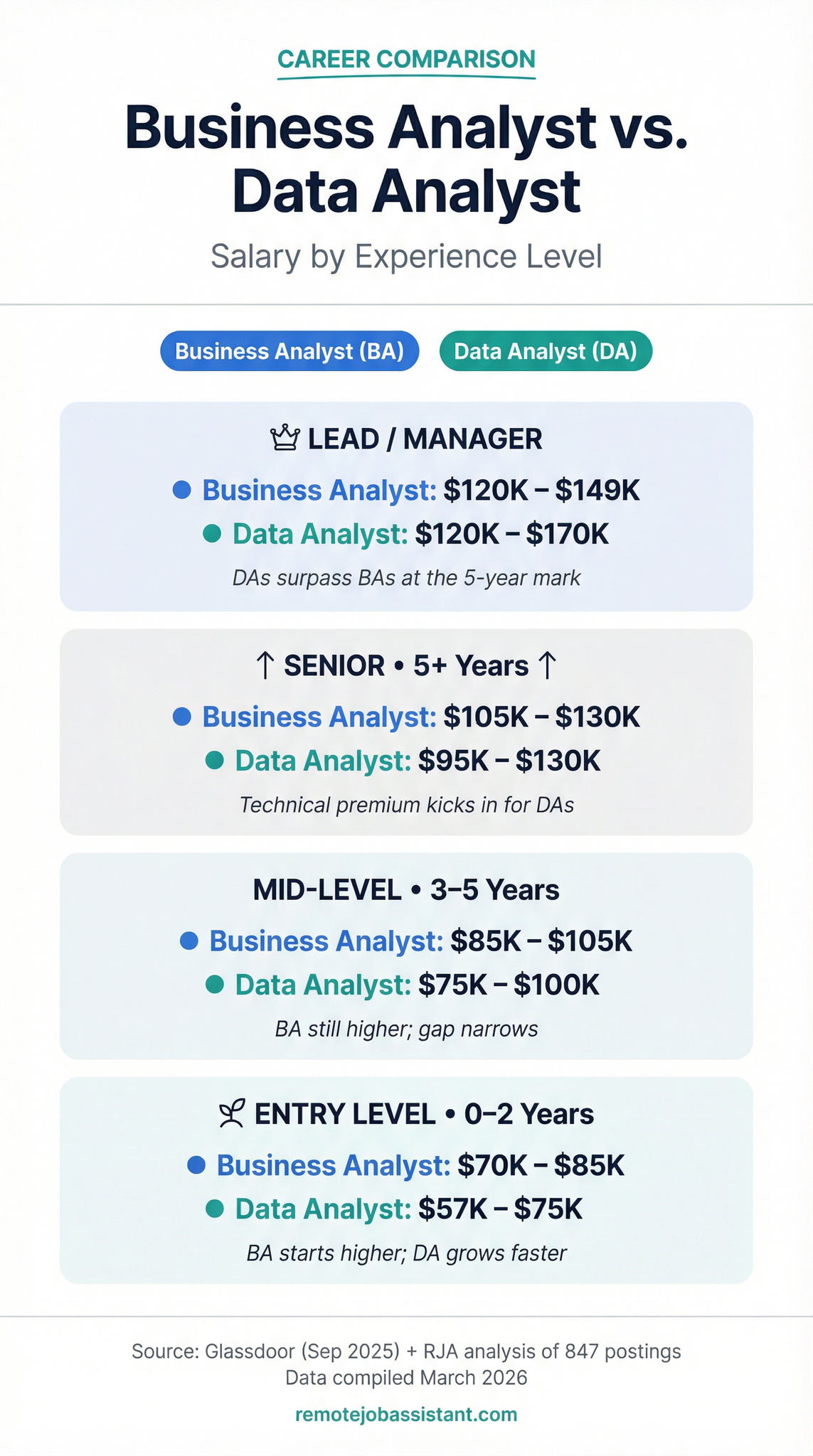
The entry-level BA pay advantage looks great until you're a junior BA spending 60-hour weeks formatting PowerPoints for a VP who scraps your work in a 10-minute meeting. The $70K–$85K starting salary at banks like Wells Fargo or Big Four firms like Deloitte beats the DA's $57K–$75K, but the hourly rate collapses under the actual hours worked. The job at entry level is documentation: you gather requirements, format them into decks, present them to senior people who change their minds, and start over. At consulting firms, add mandatory client site travel — Monday morning flights, hotel points, and "hybrid" as a word that means whatever the partner wants it to mean that week. If you pick BA for the paycheck, understand what you're buying with it.
Business Analyst Salary by Level
| Level | Salary Range |
|---|---|
| Entry (0–2 yrs) | $70K–$85K |
| Mid (3–5 yrs) | $85K–$105K |
| Senior (5–8 yrs) | $105K–$130K |
| Manager/Lead | $120K–$149K |
Data Analyst Salary by Level
| Level | Salary Range |
|---|---|
| Entry (0–2 yrs) | $57K–$75K |
| Mid (3–5 yrs) | $75K–$100K |
| Senior (5+ yrs) | $95K–$130K |
| Lead/Analytics Mgr | $120K–$170K |
Why the Salary Data Varies So Much
Glassdoor reports the DA median total pay at $92K; Indeed-sourced figures land around $72K. Neither number is wrong. The difference is who's responding. Glassdoor captures more tech-sector and senior-role respondents. Indeed includes more mid-market and traditional-industry roles — regional banks, healthcare systems, retailers. The industry mix matters more than the title itself.
A DA at a Series B SaaS company in San Francisco earns 40–60% more than a DA at a regional bank in Cincinnati. When someone tells you "data analysts earn $72K," they're probably averaging both together. When you're picking a career path, pick based on the companies you're actually targeting.
Salary ranges derive from our analysis of 847 remote BA and DA postings between October 2025 and February 2026, cross-referenced with Glassdoor compensation data (September 2025) for remote roles at Series B to public companies. We excluded outliers and postings without clear remote policies.
The "Analytics Translator" — someone who combines intermediate SQL and Python with stakeholder communication and domain expertise — commands $115K–$155K at mid-career, based on our job posting analysis. These roles appear under titles like "Analytics Business Partner," "Decision Analyst," and "Strategic Data Analyst." If you're building skills from either direction, this is the profile worth targeting.
Skills Comparison: What the Job Postings Actually Require
The skills gap between these roles is widening — especially at the senior level. BAs need more SQL than they did five years ago; DAs now need more business context than they once did. The overlap is where the best salaries live.
Core BA Skills — Ranked by Career Impact
- Stakeholder management and requirements documentation: 89% (n=315 of 356 BA postings, October 2025–February 2026) — This is not a soft skill. It's the core job. At a bank or a consulting firm, your ability to run a discovery session with five stakeholders who each want different things — and produce a requirements doc they'll all sign off on — is the difference between projects shipping and projects dying in committee. BAs who underinvest here and lean hard on technical tools don't last. The VPs don't care about your Jira configuration.
- Jira and project management tools: 71% (n=253 of 356) — Less make-or-break, but how you prove you're organized and can track work without babysitting.
- SQL (basic to intermediate): 58% (n=207 of 356) — Up from approximately 35% in 2022. Important caveat: SQL is mandatory at tech companies, but many enterprise and consulting BAs get by without it and their pay doesn't move for it. If you're targeting tech, learn SQL. If you're at a Fortune 500 bank, the ROI is lower than the discourse suggests.
- Process mapping and workflow tools: 55% (n=196 of 356)
- Excel and data manipulation: 52% (n=185 of 356)
Core DA Skills
- SQL (intermediate to advanced): 74% (n=363 of 491 DA postings, October 2025–February 2026) — Non-negotiable across all industries and company sizes.
- Python or R: 61% (n=300 of 491) — Python is the practical choice; R is niche outside academia and biostatistics.
- Tableau or Power BI: 56% (n=275 of 491) — Know one deeply. Knowing both is fine; knowing neither is a gap.
- Excel: 48% (n=236 of 491) — Expected baseline. Not differentiating.
- Statistics and A/B testing: 38% (n=187 of 491) — The skill most DAs underinvest in and most regret not knowing at the senior level.
- Machine learning basics: 29% (n=142 of 491) — Increasingly expected at Series B+ companies, still optional at traditional industries.
The Transition Path That Actually Works
If you're a BA pivoting to DA, SQL is the highest-ROI transition skill and what hiring managers look for first when screening BA-to-DA career changers. But beware the most common stall: spending three months on SQL tutorials without ever touching real, messy data. Tutorials teach syntax. They don't teach you to think in queries. Download DB Browser for SQLite (free), grab a public dataset from Kaggle — the "World Happiness Report" or any sales transaction dataset works — and work through Mode Analytics' SQL tutorial to write basic joins in the first 30 days. Spend two hours a week for 90 days to reach intermediate (subqueries, window functions). The people who actually make the BA-to-DA transition don't do a bootcamp. They build one real project, put the specific skill on their resume, and let the callbacks follow.
After SQL, Python pandas is the next step. The Coursera "Python for Data Analysis by IBM" course covers the fundamentals in four to six weeks. Ship a project using it before adding it to your resume.
Stop Applying Manually
Our AI applies to hundreds of matching jobs while you sleep. Wake up to interviews, not more applications.
Remote Work Access: Where Each Role Actually Works
This is the section that no other BA vs. DA article covers — which is exactly why it matters.
DA work is structurally remote-compatible. SQL runs the same on your laptop in Austin or your apartment in Lisbon. Python, Tableau, and Power BI don't care where you are. The tooling is async-native, outputs are shareable artifacts, and most DA collaboration happens in Slack threads and pull request reviews. If you want to be fully remote from day one, the DA path has far fewer structural obstacles.
BA work carries real friction for remote execution, especially at entry level. The core activities — stakeholder interviews, requirements workshops, sprint ceremonies, process mapping sessions — are relationship-intensive in ways that don't translate cleanly to video calls. You can do them remotely, but you'll feel the gap. A junior BA trying to build credibility with VP stakeholders across multiple departments is doing harder work from a spare bedroom than their in-person peers.
If remote work from day one is non-negotiable, DA is the safer bet — 67% (n=329 of 491) of DA postings in our sample were fully remote vs. 49% (n=175 of 356) of BA postings. But use this decision tree before picking:
- Targeting SaaS or fintech: DA remote roles are abundant even at entry level. Companies like HubSpot, Shopify, and Stripe hire remote DAs with under two years of experience.
- Targeting enterprise or consulting: Even DA roles may require hybrid. Check the posting's explicit travel policy before applying — "flexible" is not "remote."
- Mid-career and already have BA experience: Remote BA roles open up significantly at 3+ years, but they cluster in Big Tech (Amazon, Microsoft, Apple) and healthtech, not in the consulting firms where most entry-level BAs get their start.
I've seen BAs with two years of experience get burned by consulting "hybrid" arrangements that meant three days on a client site in another state — Monday morning flights, hotel stays, and a laptop setup that moved around more than their career did. The lived reality is starker than the 49% number suggests.
Many consulting firms advertise BA roles as "remote flexible." In practice, this means three to five days per week on a client site, with expenses covered but no say in where you travel. Junior BAs at Big Four firms — Deloitte, Accenture, McKinsey — regularly find themselves with "remote" in their title and a flight every Monday morning. Ask in the interview: "What percentage of your BAs were on client sites more than 50% of the time in the last 12 months?" A vague answer is a clear signal.
Best Industries for Remote BA and DA Roles
Remote-heavy DA industries include SaaS companies (Salesforce, HubSpot, Twilio), e-commerce platforms (Amazon, Shopify), and fintech (Stripe, Plaid, Robinhood). These companies are built on distributed data infrastructure and hire DAs expecting them to work entirely from home.
Remote-possible BA industries include Big Tech (Apple, Amazon, Microsoft) and healthtech. Amazon and Microsoft both hire fully remote BAs, but these roles tend to be mid-to-senior with 3+ years of experience required. Apple is more selective about remote at the BA level than either of the other two.
For remote business analyst jobs specifically, the best bet at entry level is healthtech and enterprise SaaS — industries where stakeholder management happens via documented systems rather than in-person relationships. For remote data analyst jobs, the field is wider from the start.
AI Impact: Who's Actually at Risk (And Who Benefits)
AI is changing both roles — but in opposite directions, and the popular framing misses the important nuance.
The bottom 30% of DA work is being automated. That's Excel-based reporting, basic dashboard builds, data cleaning and preparation tasks, and the same 10 SQL queries run on a Monday morning refresh schedule. Microsoft Copilot and Tableau AI are already doing most of this. If your day-to-day as a data analyst is writing standardized queries and refreshing dashboards, that is a problem — not a prediction about the future, but an observation about what's happening now.
DA roles at non-tech companies — regional banks, traditional retailers, mid-size manufacturers — are often exclusively dashboard maintenance with zero strategic input. A DA refreshing the same sales reports and attendance dashboards every week is doing exactly the work AI tools are replacing. Company choice matters as much as role choice. The same DA job title at a company that treats data as infrastructure versus one that treats it as a strategic asset has completely different exposure to automation.
What's not being automated is the top 70% of DA work — interpretation, causal reasoning, connecting data findings to business decisions, and designing experiments. The DAs who aren't at risk are the ones delivering insight, not just running queries. The ones who are at risk are the ones whose work stops at the output layer.
For BAs, the shift is different. AI is reducing time spent on execution-layer work — writing BRDs for manual processes, documenting repetitive system requirements — and increasing demand for BAs who can manage AI implementation projects, govern AI-assisted workflows, and define requirements for systems that include ML components. BAs with technical literacy (SQL, Python basics) are positioned for AI project oversight, which is commanding $95K–$130K at companies deploying AI infrastructure. BAs without it are facing scope narrowing in ways that aren't yet showing up in job posting data, but will.
For high-paying remote jobs that cut across both analyst paths, the AI-proof version involves combining data fluency with business communication — which takes us back to the Analytics Translator profile.
Stop Applying Manually
Our AI applies to hundreds of matching jobs while you sleep. Wake up to interviews, not more applications.
Which Role Should You Actually Pick?
Neither role is a safe default. Early in my BA career at a Big Four firm, I spent three weeks on a 40-page requirements doc for a client's CRM overhaul. The VP scrapped it in a 10-minute meeting because "priorities shifted." No feedback, no salvage, just start over — and a new director who'd never read the original doc. I've seen versions of that story repeated in r/businessanalysis threads so many times it's become a genre: finished the requirements doc, exec changed their mind, starting over with zero feedback. The BA role at some companies is documentation purgatory. The tell is whether you're in the room when decisions get made or handed decisions after the fact and told to document them. Ask this in your interview: "What's the last project this team delivered, and how was the BA involved in the final decision?" If they can't name specifics, you're the cleanup crew.
DA work can be analytically rich and strategically influential — or a soul-crushing Monday morning dashboard refresh that a $10 script could handle. I've talked to DAs at regional banks who spent 80% of their week updating the same three sales reports for a finance team that barely looked at them. That job exists, it pays in the mid-$70s, and it has nothing to do with the DA career ceiling described in the salary tables. Red flags in job postings: "maintain dashboards" appears more than "analyze" or "surface insights." In interviews, ask: "How often have data findings changed an executive decision in the last 12 months?" A vague answer or a long pause means you're a reporting function, not a strategic asset. At regional banks and traditional retailers, this is common — the data team is a cost center, and moving up means leaving the company entirely. Company choice is not secondary to role choice. It's the primary variable.
Here's the actual decision framework:
- If remote work from day one is the priority: Go DA. The structural reasons are real, documented, and consistent across our sample.
- If entry-level pay is the priority and you're targeting enterprise or consulting: BA starts higher. Just understand what you're buying with that premium.
- If you want the highest income ceiling with the most remote flexibility: Build toward the Analytics Translator profile — Tier 2 on the Analyst Career Ceiling Framework, combining SQL and Python with business communication.
- If you're already a BA and want to increase your remote access and income ceiling: Add SQL first. It's the single highest-leverage transition skill. Set a 90-day goal to reach intermediate before evaluating whether a full role switch makes sense.
Check remote business analyst roles and remote data analyst positions side by side on the same job board — the title volume and remote rate difference is immediately visible. Browse jobs paying $100K+ filtered by both role types to see where the senior pay concentrates. If you're ready to start applying to business analyst roles or data analyst positions at scale, RemoteJobAssistant.com's auto-apply handles both queues.
Frequently Asked Questions
What's the actual difference between a business analyst and a data analyst?
Business analysts focus on the question "what should change?" — they translate business problems into requirements, process maps, and documentation for technical teams. Data analysts focus on "what does the data say?" — they build queries, dashboards, and analyses to surface patterns. The distinction is real in the job descriptions but often blurs in practice at mid-size tech companies, where the roles overlap significantly. The practical differentiator is technical depth: DAs are expected to write advanced SQL and Python; BAs are expected to manage stakeholder relationships and requirements documentation.
I'm currently a business analyst — what skills do I need to transition to a data analyst role?
Start with SQL. It appears in 74% (n=363 of 491) of DA postings and is the single highest-ROI skill for transitioning from BA to DA. Get to intermediate level — subqueries, window functions, basic joins — before anything else. After SQL, Python (specifically pandas for data manipulation) is the next highest-leverage addition. The full path typically takes six to twelve months of consistent practice before showing up meaningfully in interview performance. You don't need a bootcamp — you need two hours a week and a real project to build on.
Which role is easier to get hired for remotely — business analyst or data analyst?
Data analyst is significantly easier to land remotely at entry level. 67% (n=329 of 491) of DA postings in our sample were fully remote vs. 49% (n=175 of 356) of BA postings. The gap is most pronounced at the junior level: DA entry-level roles at SaaS and fintech companies are genuinely remote-first, while BA entry-level roles at consulting firms and enterprises frequently require some in-person presence. If fully remote from day one is a hard requirement, the DA path has fewer structural obstacles.
How do I know which tier of the Analyst Career Ceiling Framework I'm in?
Map your actual day-to-day work to a tier, not your job title. If you spend most of your time writing BRDs, facilitating stakeholder workshops, and managing requirements documentation without writing SQL, you're in Tier 1 ($70K–$115K ceiling). If you're writing SQL regularly, building dashboards in Tableau or Power BI, and translating findings into business recommendations, you're in Tier 2 ($80K–$150K ceiling). If you're running statistical analyses, building models, or owning the full data pipeline from request to production, you're in Tier 3 ($110K–$200K+ ceiling). The important insight: if you're doing Tier 2 work under a Tier 1 title, you have a compensation problem, not a career problem.
Business analyst vs. data analyst — which has better job security with AI coming?
Both roles are changing, but the exposure is different. For DAs, AI is automating the bottom 30% of the work — standardized SQL queries, dashboard refreshes, basic data cleaning. DAs who deliver business insight and decision support are not at meaningful risk; DAs whose job is primarily report generation are. For BAs, AI is shifting the work from execution (writing BRDs for manual processes) toward governance (defining requirements for AI-assisted systems, overseeing AI implementation). BAs with technical literacy — SQL, Python basics — are positioning into AI project oversight. BAs without it face scope narrowing.
I have 3 years of BA experience but keep seeing DA roles that pay more — should I switch?
It depends on which DA roles you're looking at. A DA role at a traditional company doing dashboard maintenance pays in the same band as mid-level BA work and offers less strategic influence. A DA role at a Series B SaaS company or fintech can pay $90K–$120K at mid-level and offers significantly more remote access and income ceiling. The question isn't "BA or DA" — it's "which companies am I targeting?" If you're targeting tech and SaaS, the switch is worth pursuing. If you're in the same industry either way, the pay differential is often industry-driven, not title-driven.
Does a business analyst need to know SQL?
It depends heavily on industry and company size. SQL appeared in 58% (n=207 of 356) of BA postings in our sample — up from approximately 35% in 2022. At tech companies, SaaS companies, and startups, SQL is increasingly expected for BAs. At large enterprises, traditional consulting, and non-tech industries, many BAs get by without it and the skill doesn't always translate to higher pay in those environments. If you're targeting tech companies or want to move toward the Analytics Translator profile, SQL is worth learning. If you're targeting enterprise consulting for the entry-level pay premium, SQL is less urgent — stakeholder management and requirements documentation are what matter first.
Choose the Right Path for Your Remote Career
If you're reading career guides hoping they'll resolve this for you, they won't — including this one. What they can do is give you the actual variables to optimize for. Remote access from day one: DA wins clearly. Highest income ceiling with the most flexibility: DA, or the Analytics Translator hybrid. Entry-level pay in enterprise or consulting: BA starts higher. The Analyst Career Ceiling Framework gives you a map from wherever you're starting — use it to figure out where you are now before deciding where to go next.
Browse current openings for remote data analyst positions and remote business analyst roles at RemoteJobAssistant.com to see what the live market looks like for both titles. If you're targeting high-paying remote analyst roles in the $100K+ band, the senior DA and Analytics Translator profiles are where the volume is. For the best remote job boards to run your search in parallel, we've ranked the ones with the strongest analyst role inventory.
If you're ready to apply to both tracks at scale, Remote Job Assistant auto-applies across both DA and BA queues for $29.90/month — no credit system, no hidden fees.
For real practitioner perspectives beyond the job postings, r/businessanalysis and r/dataanalysis are worth reading before you commit to either path. The gap between what's in the job descriptions and what people report doing in the actual role is where the most useful signal lives.
Business analyst and data analyst are different job titles. They're increasingly the same skillset — and the one who masters both earns the most.
Ready to Find Your Remote Job?
Browse thousands of curated remote jobs or let AI apply for you.
Browse Remote JobsRelated Job Guides
Remote Nonprofit Jobs: 2026 Salary Guide and Who's Hiring
Remote nonprofit jobs in 2026: which roles pay $75K–$200K remotely, why postings list specific states, how to check real pay on Form 990, and who's hiring.
30 min read
Remote Tax Jobs: 2026 Salary Guide and Hiring Companies
Remote tax jobs pay $55K to $180K depending on credential and calendar. See the salary ladder, CPA vs EA data, and companies verifiably hiring remote in 2026.
21 min read
Remote Underwriting Jobs: 2026 Salary and Hiring Guide
Remote underwriting jobs in 2026: posted pay from $60K to $290K+, which carriers and lenders actually hire remote, and the authority level that unlocks it.
30 min read