Last reviewed: October 2026
You write the Python that keeps a bank's month-end reporting honest. You know which Airflow DAG falls over when the upstream file lands late, you replaced a VBA macro nobody else understood, and your title still says Python Developer, on a W-2 through a firm whose name isn't the bank's. So you search "remote python jobs." Google's first result is an Indeed page that no crawler can load; the only copy anyone has is a 2024 snapshot served in Spanish, with six Python titles in fifteen cards. The fifth result is a job board with exactly one listing, in the United Kingdom. The seventh is a contractor marketplace that promises "up to $200,000 USD/Year," requires "40 hours/week" on a time-tracking tool, and had zero open Python roles when we looked. LinkedIn's "Python Remote" page claims 10,000 or more open roles, shows a city on 47 of its 60 cards, pay on none of them, and 28 of the 60 aren't Python titles at all. The Python Software Foundation's own job board lists 11 telecommute jobs, three of them explicitly open to the United States, and one of the 11 is a single role posted three times.
The Bureau of Labor Statistics files the same Python seat under three occupations. Software developers earn a $135,980 median (May 2025) with 10% growth to 2035. Data scientists earn $120,230 with 35% growth and about 24,800 openings a year. Computer programmers, the occupation whose sample titles include "Python Developer," earn $100,390 and are projected to decline 7%. O*NET's posting data says Python is the single most-requested technology for two of those three (66% of data-scientist postings, 29% of software-developer postings) and the sixth most-requested software skill of any kind in 2025, behind only Microsoft Office, Excel, Outlook, PowerPoint and Word. The boards list all three occupations under one keyword and never tell you which one you're applying to.
Get Remote Job Tips in Your Inbox
Weekly strategies, salary data, and new opportunities
Unsubscribe anytime. No spam.
So we read the postings, all of them, and stopped counting libraries after the first few hundred, because the library list is the one thing every Python posting has and the one thing that barely moves its pay. Two things do: what the Python builds, and who posts the seat. Python is the language whose title tells you the least, and that is exactly why a posting has to be read rather than keyword-matched.
Remote Job Assistant read 580 US postings whose title names Python (Python Developer, Python Engineer, Software Engineer (Python), Python Backend, Python Full Stack, Django, Flask and FastAPI titles, Python Data Engineer, Machine Learning Engineer (Python), Python Automation) from 403 employers in full, pulled October 10, 2026, with posting dates from October 2025 to October 2026 (506 of them listed since July 1). They came from LinkedIn (402, from 99 national and 28 state-split keyword searches plus LinkedIn's own three Python pages), the Indeed network via SimplyHired (94), 312 Workday career sites (56), Himalayas (22), 941 Greenhouse, Lever, Ashby and SmartRecruiters boards (4, because startup boards put Python in the body, not the title) and python.org's job board (2). We read 645 generic "Software Engineer" and "Backend Engineer" postings and 426 generic "Data Engineer," "Machine Learning Engineer" and "Data Scientist" postings that require Python the same way and report them separately. This guide leaves generic engineering titles to our remote software engineer guide and the modelling seat to our remote data science guide, and it sets aside DevOps and security titles, instructors, 21 offshore listings posted under a US flag, and 25 AI-trainer gigs.
Based on our analysis of 580 US Python-titled postings at 403 employers (posted October 2025–October 2026):
- 21.9% (n=127 of 580) were fully remote; among the 312 postings that state a work model, 40.7%; 268 say nothing
- 44.5% (n=258 of 580) were posted by IT-services consultancies and staffing firms; consultancy postings carry a $117,250 median range midpoint (n=78) against $177,900 at banks, insurers and trading firms (n=61), $160,947 at software companies (n=44) and $187,162 at government contractors (n=34)
- $162,200 median midpoint for titles with the word Engineer (n=157) against $125,000 for titles with the word Developer (n=96); Developer titles are 29% contract (n=78 of 269), Engineer titles 12% (n=32 of 275)
- $195,000 median midpoint for the 645 generic Software Engineer postings that require Python in the body (n=513 with pay) and $212,000 for the 426 generic Data Engineer, ML Engineer and Data Scientist postings (n=365), against $153,300 for Python-titled postings (n=268); remote in 26.9% (n=109 of 405), 37.7% (n=116 of 308) and 40.7% (n=127 of 312) of those stating a model
- 46.2% (n=268 of 580) post an annual range: median $126,430–$180,000, midpoint $153,300; 209 start at $100,000 or more (34 remote) and 86 at $150,000 or more (12 remote); 46 more post only an hourly rate, $60–$70 an hour on the 36 contract rows
- 35.5% (n=206 of 580) score as Script seats at a $142,400 midpoint (n=79), 44.8% (n=260) as Service seats at $145,000 (n=114) and 19.7% (n=114) as System seats at $176,830 (n=75); the Script figure hides two markets, consultancy rows at $120,000 (n=46) and cleared government-contractor rows at $190,632 (n=19)
- 36.6% (n=212 of 580) expect AI coding tools in the work, at $159,550 against $152,500 without; 4 of 18 postings dated January–March 2026 did, against 193 of 506 dated July–October; 13.4% (n=78) carry AI, GenAI or LLM in the title
- Of the 127 remote postings, 19 require a security clearance, 15 US citizenship, 13 name contract terms, 10 say no sponsorship, 10 set a time zone, 6 name on-call, and none lists eligible states
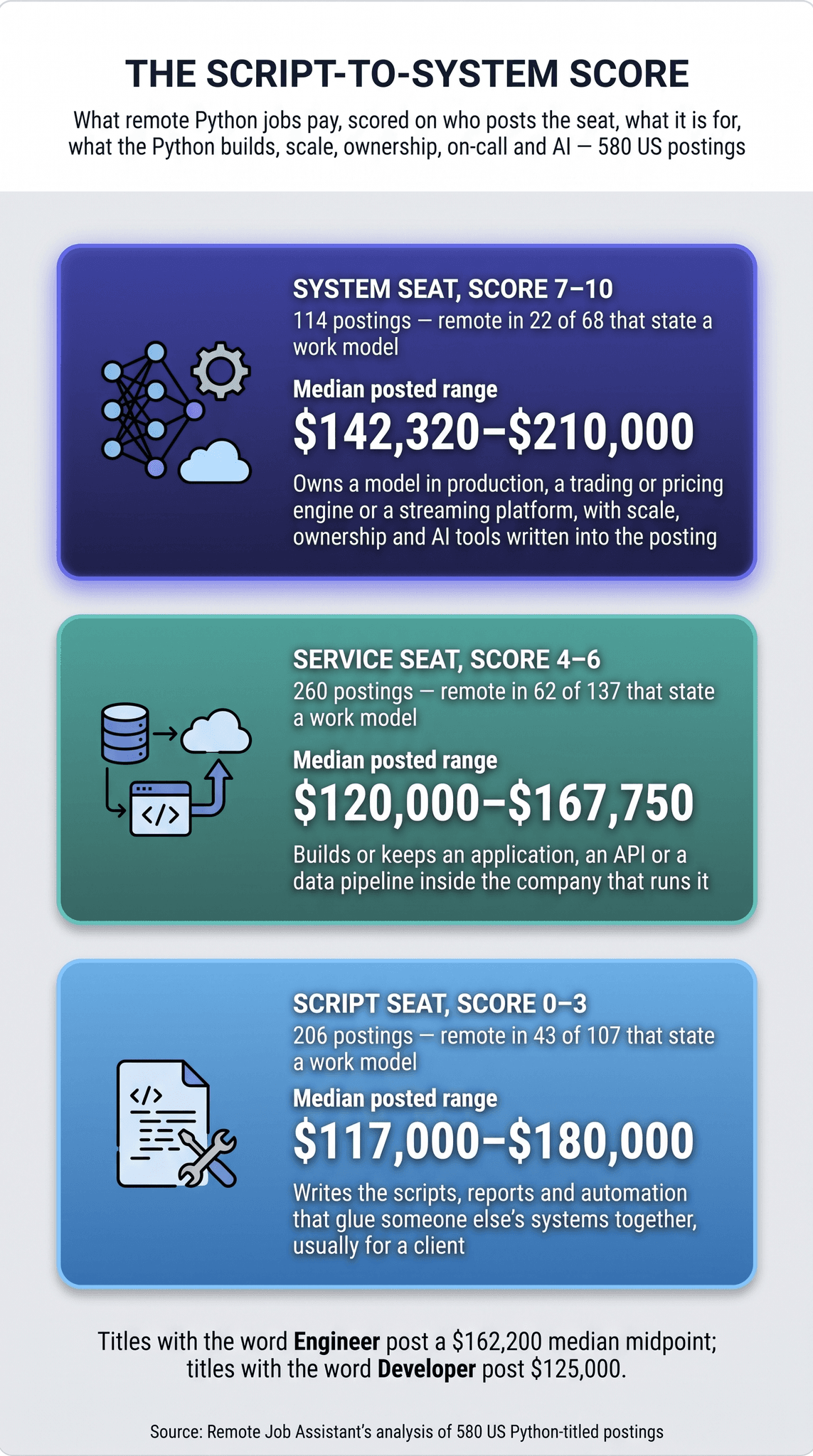
Three seats, then. A Script seat (206 postings) posts a $142,400 midpoint and is remote 40.2% of the time it states a model (43 of 107); a Service seat (260) posts $145,000 and 45.3% (62 of 137); a System seat (114) posts $176,830 and 32.4% (22 of 68). Pay climbs with the score. The remote share does not, because the System seats sit at banks that have written hybrid into policy.
Among Python-titled postings, 12 of the 44 remote ones with a posted range start at $150,000 or more, and none of the 12 has Developer in the title: Code Metal's Principal Python Engineer (Modeling & Simulation) at $250,000–$290,000 and its Staff Python Engineer at $200,000–$250,000, Voxel51's Senior Software Engineer (Python) at $200,000–$225,000, EvolutionIQ's Senior Software Engineer (Python / AI Insurance SaaS) at $200,000–$225,000, ServiceNow's Senior Staff Software Engineer, Security Data Platform at $190,900–$334,100, Edgewater's DevSecOps / Python Engineer at $190,000–$215,000 and NVIDIA's Senior Software Engineer, CUDA Python Core Libraries at $184,000–$287,500. The generic sets have 58 remote Software Engineer starts and 72 remote Data, ML and AI Engineer starts at $150,000 or more, led by Reddit's Senior Staff Machine Learning Engineer, Agentic AI Platform at $292,500–$409,500, Airbnb's Principal Machine Learning Engineer at $292,000–$365,000, Headway's Staff Software Engineer, Experimentation at $265,000–$331,000, Instacart's Staff Software Engineer, Data Governance & Foundations at $265,000–$279,500 and Discord's Staff Software Engineer, Consumer Revenue at $248,000–$310,000. None of those 130 says Python in the title.
How We Collected This Data
Two biases shape every number below. Pay is posted on 46.2% of postings (268 of 580: 89% of Workday rows, 44% of LinkedIn rows, 35% of SimplyHired rows, 18% of Himalayas rows; 65% at banks and insurers, 38% at consultancies, 26% at staffing firms), so medians lean toward employers with pay-transparency blocks and away from the small consultancies that never print a range. And 268 of the 580 postings (46.2%) say nothing about work model, so every "remote" share in this guide is a share of postings that state one. A third bias applies to the generic sets: 563 of the 645 generic Software Engineer postings and 407 of the 426 generic data and ML postings came from Greenhouse, Lever, Ashby and SmartRecruiters boards, which skews them toward product companies with posted pay, so wherever we compare them with the Python-titled set we also compare within one source (on LinkedIn, Python-titled $152,500, n=177, against generic $183,500, n=15) and within one employer kind (at software companies, $160,947, n=44, against $194,612, n=472). What we could not read: Indeed, Glassdoor and ZipRecruiter return 403 errors (the Indeed network came through SimplyHired, and Google's number-one Indeed page exists only as a 2024 snapshot), Reddit is blocked, and the Dice, Motion Recruitment, Built In, Wellfound, Arc, Remote Rocketship, web3.career and pyjobs pages were read by hand (9 to 50 cards each) and not counted.
A posting counted if its title named Python, a Python web framework (Django, Flask, FastAPI) or a Python library (pandas, PySpark, PyTorch) next to a developer, engineer, programmer, architect, scientist or tester word. We sorted those titles by the other words in them: backend and API, full stack, data (data engineer, ETL, SQL, PySpark), machine learning and AI (machine learning, AI, LLM, data scientist), automation (QA, SDET, test, scripting), and plain Python Developer or Python Engineer. We dropped DevOps, SRE and cloud-operations titles, security, embedded and hardware, Salesforce, SAP and ServiceNow platform seats, game and Web3, instructors and tutors, interns and recruiters, non-English titles, and the two homonyms a Python search also returns: Python-brand car remote starters and Python-the-snake. "Python Developer" postings whose bodies were test-automation seats (Selenium, test cases, regression suites) were moved to the automation segment. Generic Software Engineer, Backend Engineer, Data Engineer, Machine Learning Engineer and Data Scientist titles were kept only from the same Python keyword searches and only when the body requires Python as the primary language: a Python-ecosystem tool named alongside it, primary-language phrasing ("strong Python," "our backend is Python"), or two mentions with at least one outside a language list. A posting that merely lists Python among "Python, Java, Go or similar" is not a Python job, and we did not count it.
Dedupe started from 2,622 US rows across every source, removed 179 exact copies, 251 per-city clones of one requisition and 46 copies under sibling employer names, then collapsed 415 duplicates found on two sources, leaving 1,699 unique postings across the Python-titled and generic sets. One sampling choice needs saying: LinkedIn rate-limited job pages after our 127 keyword searches, so the LinkedIn core is a fixed-seed random sample of about 500 of the roughly 695 unique Python-titled cards those searches returned, with the cards on LinkedIn's own three Python pages read first. A random sample does not bias the shares; it only lowers the counts. We read work model from the posting text, not the board's flag: LinkedIn's "remote" keyword searches returned 99 kept rows, of which 50 are remote in the body, 7 hybrid, 2 on-site and 40 silent; the 10 postings with "Remote" in the title are remote in 9 bodies and on-site in 1; Workday's remote-type field was checked against the body's own sentence. Employer kind comes from curated name lists (the IT-services body shops named by hand), then the employer's own LinkedIn industry label ("IT Services and IT Consulting" is the consultancy label), then body rules for "our client," C2C and W-2 language.
The Script-to-System Score is computed by code from duty language, and the audit changed it twice. The first draft scored the Python era (Python 2 and legacy words against type hints, asyncio and Python 3.10-plus words), and the era does not move Python pay: modern-stack postings post a $152,500 midpoint (n=129), migration postings $155,635 (n=27), postings that name no era $158,750 (n=108), and the 4 legacy-only postings with pay $137,260. So the scored component became what the Python builds. The second change is a caveat rather than a cut: on-call language lowers the Python midpoint ($148,750 with it, n=28, against $156,068 without), unlike the Java market, and the score keeps it only as a marker that the code runs in production. We set aside 21 offshore listings posted under a "United States" flag (Busigence, Marktine, PradeepIT, Valce, MENA Alliances, AltexSoft, Toptal, ZettaMine and others), 25 AI-training contracts (Alignerr's seven at $50–$75 an hour, AuraOne Human Data's six, Terac's four "technical exam review" gigs, Turing's four, Crossing Hurdles' "$150/hr Remote" card, Prolific, an Upwork subsidiary) and 1 non-English role.
Salary cross-references: BLS Occupational Employment and Wage Statistics for May 2025 (Software Developers, median $135,980, 25th percentile $105,210, 75th $171,980; Data Scientists, median $120,230, 25th $85,660, 75th $158,880, 90th $199,130; Computer Programmers, median $100,390), Levels.fyi's October 10, 2026 total-compensation medians (backend software engineer $195,000, machine learning engineer $280,000, data engineer $157,300, data scientist $180,000, equity included), the Robert Half 2027 Salary Guide (Software Engineer $146,250, Data Scientist $158,750, Machine Learning Engineer $154,500, Data Engineer $160,500, AI Engineer $175,000 medians) and the Motion Recruitment 2026 guides (remote mid-level software engineer $110,486–$148,051; remote senior machine learning engineer $173,000–$227,000; remote mid-level data engineer $122,000–$153,000). Glassdoor's, Indeed's, ZipRecruiter's and Payscale's figures appear only in search snippets and are labelled that way below.
The Script-to-System Score: Why Two Python Jobs Pay $63K Apart
The advice on most career sites is to stack more frameworks: FastAPI, Airflow, PyTorch. Our postings say the bigger lever is whose name is on the paycheck. FastAPI appears in 144 of the 580 and carries a $129,485–$170,760 median range (n=65); the 297 postings that name no other language at all carry $120,000–$175,000 (n=139); the 174 that name no cloud and no containers carry $135,500–$189,821 (n=70), more than the 179 that name Kubernetes ($130,000–$181,800, n=95). The reason is who writes them. The consultancies list every tool the client's RFP mentioned; the banks write four terse lines and a pay-transparency block. What changes the number is who posts the seat, what the seat is for, what the Python builds, and whether scale, ownership and AI tools are written into the work.
The Script-to-System Score is a 0 to 10 rubric that scores any Python posting, or your current job, on how far it sits from "writing scripts that glue someone else's systems together" toward "owning a production system, a service, a data platform or a model, at the company that runs it." It uses only what the posting says: who posts the seat, what the seat is for, what the Python builds, and whether scale, ownership, on-call and AI coding tools are part of the work. The first draft also scored the Python era, Python 2 against type hints and asyncio, and dropped it when the data showed era does not move pay. Every component below stays in the score because posted pay rises with it, with one exception we flag.
Score a posting in four questions.
- Who posts it? A consultancy, a staffing firm, a gig platform or "our client": 0. An in-house team at a retailer, a hospital, a manufacturer, a telecom or a federal contractor: 1. A software company, an AI lab, a bank, an insurer, a payments or trading firm: 2.
- What is the seat for? A client's project, deliverables, an engagement: 0. Keeping existing applications running, production support, tickets, or nothing decisive: 1. The employer's own platform, product or models: 2.
- What does the Python build? Scripts, reports, dashboards, scraping, automation of someone else's process, an Excel or VBA replacement: 0. An application, an API or a pipeline (Django, Flask, FastAPI, REST, microservices, ETL, Airflow, pandas), or nothing decisive: 1. A production system with model, stream or scale semantics (model training and serving, MLOps, PyTorch, inference, GPUs, trading or pricing engines, Kafka or Flink streaming, distributed real-time systems): 2.
- Does it name scale (distributed systems, concurrency, low latency, millions of events), ownership (architecture, technical leadership, owning a service, pipeline or model), on-call (incident response, a rotation, 24/7), and AI coding tools expected in the work? One point each.
0 to 3 is a Script seat, 4 to 6 a Service seat, 7 to 10 a System seat.
What each point is worth, in posted midpoints:
- Employer (0–2): $122,500 at a consultancy, staffing firm or gig platform (n=98); $160,000 at an in-house team at a retailer, telecom, manufacturer or federal contractor (n=65); $170,000 at a software company, bank, insurer or trading firm (n=105).
- Seat (0–2): $115,228 for a client's project (n=67); $127,500 for keeping existing applications running (n=10); $157,500 for the employer's own product or platform (n=49). Postings that say nothing decisive post $165,000 (n=142), because the terse ones are the banks'.
- Output (0–2): $142,300 when the Python builds an application, API or pipeline (n=119) and $160,475 when it builds a system with model, stream or scale words (n=122). The 23 priced script seats post $162,500, and 13 of them are cleared federal "scripting" seats; at direct employers the output point works (software companies $171,000 for system against $150,265 for service; banks $177,900 against $142,300; staffing firms $154,750 against $125,000) and at consultancies it inverts ($110,000, n=27, against $125,000, n=42), because the body shops are the ones listing Kafka and model-serving words they do not own.
- Scale (0–1): $160,000 with it against $150,000 without. Ownership (0–1): $159,550 against $142,400. AI tools (0–1): $159,550 against $152,500. On-call (0–1): $148,750 with it (n=28) against $156,068 without. On-call stays in the score as the clearest sign the code runs in production, and it is the one component that does not raise Python pay on its own.
Bands:
- Script seat (0–3), $117,000–$180,000 median posted range (n=79), midpoint $142,400: you are billed to a client by a consultancy (131 of the 206) or a staffing firm (30), or you write scripts for a government contractor (22). 206 postings at 151 employers; hourly-only rows post $64–$72 an hour (n=29); 40.2% of the 107 that state a model are remote; 59 are contract. The range is wide because it is two markets: the 46 priced consultancy rows post $100,000–$140,500, midpoint $120,000, and the 19 cleared government-contractor rows post $143,750–$225,200, midpoint $190,632.
- Service seat (4–6), $120,000–$167,750 (n=114), midpoint $145,000: you sit inside the company that runs the application, or on a larger consultancy's better-written seat, building and keeping a Django, Flask or FastAPI service, an ETL pipeline or an internal tool, at a consultancy (75), a software company (52), a bank or insurer (45), a staffing firm (19) or a government contractor (18). 260 postings at 214 employers; 45.3% of 137 are remote; 52 are contract.
- System seat (7–10), $142,320–$210,000 (n=75), midpoint $176,830: you own a production system at a software company (49) or a bank, insurer or trading firm (48), with scale, ownership and AI expectations written into the posting; 47 are senior and 36 are lead titles. 114 postings at 76 employers; 32.4% of 68 are remote; 3 are contract.
How to use it. Score your current job first, then every posting before you apply; four questions take two minutes. Move one component at a time: the biggest single point is the employer, because leaving a bench for a product company, an AI lab or a bank is the $47,500 gap between employer 0 and employer 2; the cheapest points are the system, ownership and AI-tool words, which you can put on a resume this week if they are true. If you score 0 to 3 and want $150,000 or more, change what the Python builds and who posts the seat before you learn another framework; the consultancy half of the Script band tops out at a $140,500 median. And stop searching for "Python Developer." Search "Software Engineer," "Backend Engineer" and "Machine Learning Engineer" with Python in the requirements: those sets post $195,000 and $212,000 and are remote 26.9% and 37.7% of the time they state a model.
Here is the check run on two real postings that share a title and a work model. Synechron's Python Developer in a hybrid seat ($110,000–$120,000) is posted by a consultancy (employer: 0) for a client engagement (seat: 0), asks you to "Design, develop, test, and maintain Python-based applications and services" and "Build scalable RESTful APIs and microservices using Python frameworks such as FastAPI, Flask, or Django" (output: 1, a service), names ownership language (1) and nothing about scale, on-call or AI coding tools. Score 2, a Script seat. Citi's Python Developer - Vice President, also hybrid ($142,320–$213,480), is posted by a bank (2) for its own systems (1), asks for a "Strong background of ML/DL/LLM algorithms, model architectures, and training techniques" (output: 2, a system), names ownership ("ensure application design adheres to the overall architecture blueprint": 1) and "Experience in GenAI/LLMs projects" (AI: 1), and nothing about scale or on-call. Score 7, a System seat. Same title word, same hybrid model, five points on the score, and $62,900 of range midpoint between them, $115,000 against $177,900. The first two of those points are about who signs the paycheck.
The table shows how the three seats compare on remote share and pay.
| Seat (score) | Postings | Remote, of those stating a model | Median posted range (n) | Hourly-only rows (n) | Contract | Typical titles and employers |
|---|---|---|---|---|---|---|
| Script (0–3) | 206 | 40.2% (43 of 107) | $117,000–$180,000 (79) | $64–$72/hr (29) | 59 | Python Developer, Senior Python Developer, Python Software Engineer at Capgemini, TCS, CGI, Synechron, Cognizant, Shield Consulting, GliaCell and about 140 smaller consultancies, staffing firms and contractors |
| Service (4–6) | 260 | 45.3% (62 of 137) | $120,000–$167,750 (114) | $58–$66/hr (14) | 52 | Python Developer, Software Engineer, Senior Python Engineer, Full Stack Developer at TCS, Citi, Capgemini, Infosys, LTIMindtree, Travelers, Capital One |
| System (7–10) | 114 | 32.4% (22 of 68) | $142,320–$210,000 (75) | $60–$70/hr (3) | 3 | Senior Software Engineer (Python), Staff Software Engineer, Python Engineer, Lead Python AI Engineer at Citi, Comcast, JPMorganChase, Capital One, PayPal, Northbeam, Code Metal |
The gap holds inside each seniority level where the samples are large enough to read. Mid-level postings run $100,000–$147,450 in a Script seat (n=46), $100,000–$150,000 in a Service seat (n=51) and $120,306–$172,478 in a System seat (n=16). Senior postings run $155,000–$185,000, $125,000–$178,150 and $155,000–$210,000 (n=25, 42 and 33). Lead postings run $147,500–$182,500 (n=6), then $142,320–$213,480 in both the Service and System bands (n=17 and 26), because Citi's Vice President ladder posts the same band whichever team is hiring. The senior Script figure is the cleared federal seats again. The single-score ladder is not a staircase: it climbs from $110,000 at 0 (n=5) and $117,000 at 1 to $162,500 at 2, dips to $125,000 at 4 and $137,500 at 5, where the consultancies' better-written Service seats cluster, then runs $165,000 at 6, $184,700 at 8 and $195,250 at 10 (n=4). Read the bands, not the single digits.
Why who-posts-it moves pay so much comes down to what the seat is priced against. In a Script seat, the seat is a billable hour, and the posting says so. Matlen Silver's Python Developer in Plano, Charlotte or Jersey City: "Required Pay Scale: $60-$65/hr - W2 ONLY, NO C2C" and "Duration: 12-18 months." Vertisystem's on-site Python Developer: "Pay Rate: $50–$60/hour on W-2." Dexian's Senior Python Developer: "Pay Range: $80-$90/hr. on W2." Software Guidance & Assistance's Python Developer at $90.58–$108.70 an hour is "a right to hire assignment with one of our premier financial services clients in Rutherford, NJ." Tata Consultancy Services' Python Django Developer: "Must be US citizen to work on federal engagements," with "10+ years of software engineering experience with 5+ years of experience in Python" asked for a $94,000–$140,000 range. The client's bank is the real employer, the firm takes its margin, and the posting carries the client's office rules without the client's pay band.
In a Service seat, the Python keeps an application alive, and the posting reads like a maintenance contract. Bank of America's Python Developer III ($102,900–$179,900): "design, develop, enhance, and support business-critical applications and services built on the Quartz and legacy Python platform." iCapital's Python Engineer and Developer, Associate ($85,000–$110,000): "Develop, test, and maintain Python-based applications and scripts." Emonics' Backend Python Developer: "develop backend services and automation scripts." RemoteStar's Python Software Engineer: "The current backend is a Python / FastAPI monolith running on AWS with PostgreSQL and Redis."
In a System seat, the code moves money or serves traffic, and the posting prices it that way. JPMorganChase's Senior Lead Software Engineer - Python, Full Stack / AI ($175,750–$260,000): "lead the build out of an end-to-end data platform to manage Capital, Liquidity, Balance sheet, Funding and billing." NISA Investment Advisors' Senior Software Engineer, Python: "designing & implementing data pipelines to support quantitative research, including but not limited to backtesting, feature engineering, factor research, or portfolio analytics." Citi's Lead Python AI Engineer, Agentic Systems posts $125,760–$188,640; Capital One's Machine Learning Engineer 4 (Python, AWS, SQL, GenAI) posts $197,300–$225,100; NVIDIA's remote Senior Software Engineer, CUDA Python Core Libraries posts $184,000–$287,500. Code Metal's remote Senior Python Engineer ($170,000–$210,000) states the System-seat premise in one line: "As AI writes more of the world's code, the bottleneck in software has shifted from writing code to verifying it works."
Two places where the score and the pay disagree, with the numbers. Postings that name no cloud and no containers carry a $165,000 midpoint (n=70), more than postings that name Kubernetes ($155,635, n=95), because the terse postings come from banks and the tool lists come from body shops; the output component still scores the words, not the author, so read it as a tiebreaker rather than a verdict. And the cleared federal lane prices scripting like a system: Leidos' Senior Python Developer ($131,300–$237,350, "Expertise in scripting (Python, shell scripting)," "US Citizenship with TS/SCI and Counter-Intelligence Polygraph clearance") and Parsons' CNO Python Developer - TS/SCI w/Poly ($125,100–$225,200) both score 2, and both out-post most System seats, because the clearance is the asset and the Python is incidental.
Naming a framework does not raise a Python posting's pay; the postings that list every library are written by the firms that bill you out, and the postings that list almost nothing are written by the banks and software companies that pay the most.
If you score your current job and land in the Script band, you don't need a new credential to move. You need direct-employer postings in front of you, and a lot of them, because the 374 Service and System seats are spread across 281 employers, and the best-paid version of the same seat usually drops Python from the title altogether.
Stop Applying Manually
Our AI applies to hundreds of matching jobs while you sleep. Wake up to interviews, not more applications.
Remote Python Developer Salary: What 268 Posted Ranges Show
The spread in Python pay has a structural cause before it has a skills cause. The Bureau of Labor Statistics does not have a Python occupation; it has three occupations that all hire Python, and they point in different directions. Software developers (occupation 15-1252) earn a $135,980 median, $105,210 at the 25th percentile and $171,980 at the 75th, with employment projected to grow 10% from 2025 to 2035 and about 106,100 openings a year. Data scientists (15-2051) earn $120,230 at the median but $158,880 at the 75th percentile and $199,130 at the 90th, with 35% projected growth, about 24,800 openings a year, and a bachelor's degree as the typical entry requirement. Computer programmers (15-1251), the occupation whose sample titles include "Python Developer," earn $100,390 at the median and are projected to decline 7%, with about 4,400 openings a year and no Bright Outlook tag. O*NET's posting data ranks Python the number-one hot technology for the first two (in 66% of data-scientist postings and 29% of software-developer postings) and number three for programmers (13%). The industry split is just as wide: data scientists at software publishers post a $156,220 median against $107,680 at insurance carriers; software developers at software publishers $164,550 against $130,840 at insurers. A posting titled "Python Developer" can sit in any of those cells, and the pay range in it tells you which one.
A note on reading the tables. Every range is the median of posted lows and posted highs across the postings in the row; "midpoint" is the median of each posting's own midpoint; n is the number of postings in the row that posted an annual range. Hourly-only postings are counted separately. Rows with fewer than ten priced postings are printed because the title is common, and should be read as a sample, not a market.
What the title says the Python is for moves pay less than who says it, but it moves the remote share.
| Segment (title words) | Postings | Median posted range (n) | Midpoint | Remote, of those stating a model | Contract |
|---|---|---|---|---|---|
| Plain Python Developer or Engineer | 320 | $130,000–$180,159 (148) | $158,750 | 38.5% (67 of 174) | 70 |
| Machine learning, AI, LLM, data scientist | 93 | $119,600–$163,522 (46) | $141,150 | 37.5% (18 of 48) | 18 |
| Full stack | 58 | $144,426–$165,000 (23) | $160,000 | 45.7% (16 of 35) | 13 |
| Data (data engineer, ETL, SQL, PySpark) | 51 | $115,920–$157,880 (20) | $133,650 | 52.4% (11 of 21) | 6 |
| Backend and API | 39 | $135,000–$187,950 (24) | $160,197 | 50.0% (11 of 22) | 5 |
| Automation, QA, SDET, scripting | 18 | $117,000–$184,000 (7) | $156,500 | 33.3% (4 of 12) | 2 |
The data and machine-learning segments are the ones that read as a bargain: the Python-titled data seat posts $133,650 and the Python-titled ML seat $141,150, against $212,000 for the generic Data Engineer, Machine Learning Engineer and Data Scientist titles that require Python. By level the gap is wider: mid-level Python data and ML titles post $112,500 (n=23) against $195,000 for the generic set, senior $161,375 against $215,625, lead $169,500 against $240,250.
The exact title is the second tell, and the word after Python is the whole of it.
| Exact title or title family | Postings | Median posted range (n) | Midpoint | Remote, of stated | Contract |
|---|---|---|---|---|---|
| "Python Developer" | 163 | $102,900–$140,000 (49) | $125,000 | 31.5% (29 of 92) | 54; hourly $60–$67 (29) |
| "Senior Python Developer" | 34 | $113,840–$130,000 (7) | |||
| "Python Engineer" | 48 | $140,000–$185,000 (29) | $160,000 | 45.2% (14 of 31) | 6 |
| "Python Software Engineer" | 21 | $160,000–$200,000 (15) | $175,000 | ||
| "Software Engineer (Python)" or "Software Engineer - Python" | 112 | $141,750–$200,000 (70) | $170,500 | 46.2% | |
| "Python Full Stack Developer" | $112,148–$144,426 (15) | $125,000 | |||
| "Full Stack Engineer (Python)" | $156,750–$180,000 (13) | $170,000 | |||
| "Python Backend Developer" | $100,000–$150,000 (5) | ||||
| "Backend Engineer (Python)" | $137,500–$200,736 (16) | $167,700 | |||
| Django in the title | 15 | $109,759–$150,000 (9) | $125,000 | 75.0% (6 of 8) | 2 |
| "Python Data Engineer" | 25 | $120,000–$180,000 (9) | $144,750 | 60.0% (6 of 10) | 2 |
| AI, GenAI or LLM in the title | 78 | $125,000–$165,500 (41) | $144,750 | 30.8% (12 of 39); 21 hybrid | 15 |
| Automation, SDET, QA or Test in the title | 16 | $113,500–$178,000 (6) | $138,250 | 45.5% (5 of 11) | 4 |
| Lead or Tech Lead | 50 | $142,320–$213,480 (23) | $177,900 | 36.0% (9 of 25) | 8 |
| Staff, Principal or Distinguished | 24 | $160,000–$220,000 (21) | $200,000 | 63.6% (7 of 11) | 0 |
Across all 580, titles with the word Engineer post a $162,200 median midpoint (n=157) and titles with the word Developer post $125,000 (n=96); at mid-level the gap is $148,750 against $115,000, at senior $171,000 against $125,000, and at lead the two words meet at $177,900. Developer titles are contract 29% of the time (78 of 269) and Engineer titles 12% (32 of 275). The consultancies write Developer 130 times and Engineer 60; the direct employers write Engineer 187 times and Developer 102. The word is not a skill. It is a signature.
Seniority moves pay the way you would expect, and the years asked do not.
| Level (from the title) | Postings | Median posted range (n) | Midpoint | Remote, of stated | Contract |
|---|---|---|---|---|---|
| Entry, junior, associate, I | 12 | $94,550–$135,000 (6) | $118,125 | 33.3% (2 of 6) | 0 |
| Mid (no level word) | 286 | $109,759–$160,000 (113) | $137,198 | 40.1% (59 of 147) | 62 |
| Senior | 199 | $140,000–$187,500 (100) | $162,750 | 43.0% (49 of 114) | 43 |
| Lead, principal, staff, manager, VP | 83 | $142,320–$213,480 (49) | $177,900 | 37.8% (17 of 45) | 9 |
212 postings state a years figure; the median is 5, and it is 5 at the mid level and 5 at the senior level, with 6 at lead. 28 ask for 0 to 2 years, 49 for 3 to 4, 94 for 5 to 7, 41 for 8 or more and 24 for 10 or more. The 12 entry-level titles are 2.1% of the market; 2 of the 6 that state a model are remote, and neither of those two posts pay. The priced ones are hybrid or silent: Travelers' Data Engineer I (AWS, Python, GenAI) at $109,300–$180,200 and Software Engineer I at $99,100–$163,400, Jefferies' Associate, Software Developer at $125,000–$150,000, Truist's Associate Software Engineer at $90,000–$120,000, iCapital's Python Engineer and Developer, Associate at $85,000–$110,000 and NIKSUN's Junior Engineer, Products (Python) at $55,000–$60,000.
Who posts the seat is the first tell and the biggest.
| Who posts it | Postings | Median posted range (n) | Midpoint | Hourly-only (n) | Remote, of stated | Contract |
|---|---|---|---|---|---|---|
| IT-services consultancies | 208 | $100,000–$140,000 (78) | $117,250 | $60–$65 (15) | 38.8% (38 of 98) | 53 |
| Staffing firms | 50 | $120,000–$165,000 (13) | $140,000 | $65–$72.50 (18) | 20.0% (7 of 35) | 30 |
| Banks, insurers, payments and trading firms | 94 | $142,320–$211,900 (61) | $177,900 | $72.50–$77.50 (2) | 11.5% (6 of 52); 43 hybrid | 6 |
| Software, internet and AI companies | 104 | $135,500–$187,000 (44) | $160,947 | $54.80–$62.87 (6) | 67.2% (43 of 64) | 16 |
| Government contractors | 45 | $155,000–$218,664 (34) | $187,162 | 63.2% (12 of 19) | 2 | |
| Manufacturers, airlines and other industrials | 17 | $116,240–$170,000 (12) | $145,000 | 40.0% (2 of 5) | 1 | |
| Consumer, health, publishers, nonprofits, other | 62 | consumer 0 of 6; health 3 of 4 | 6 |
The consultancies and staffing firms together post 258 of the 580 (44.5%) at a $122,500 midpoint (n=91), with hourly rates of $64–$72 on the 33 hourly-only rows and contract terms on 83; the 305 direct-employer postings post $162,500 (n=171), contract terms on 28, and remote on 44.5% of the 164 that state a model. The hourly math is the part the salary sites leave out. 114 of the 580 postings (19.7%) are contracts, and the 36 that post an hourly rate post $60–$70 an hour: $60 times 2,080 hours is $124,800 and $70 is $145,600, before health insurance, paid time off, a 401(k) match and the bench weeks between assignments, which is why ZipRecruiter's own $58.62 an hour becomes its $121,932 "remote Python developer salary." The four remote postings that price by the hour run from VITS Consulting's $50–$60 and NTT DATA's $65–$75 to KPG99's $80–$85 and Vraify's $100–$150; the lowest hourly rate on a consultancy or staffing row is FormativGroup's $45–$50 for a hybrid Senior Python / Machine Learning Engineer, and the highest is Software Guidance & Assistance's $90.58–$108.70 for a right-to-hire Python Developer in Rutherford, New Jersey.
Three other sources bracket our figures. Levels.fyi's October 10, 2026 medians are total compensation with equity: backend software engineer $195,000, data engineer $157,300, data scientist $180,000, and machine learning engineer $280,000 (25th percentile $200,000, 90th $495,000). The Robert Half 2027 Salary Guide prints base medians of $146,250 for Software Engineer, $158,750 for Data Scientist, $154,500 for Machine Learning Engineer, $160,500 for Data Engineer and $175,000 for AI Engineer, and has no "Python Developer" row at all. Motion Recruitment's 2026 guides put remote mid-level software engineers at $110,486–$148,051, remote senior machine learning engineers at $173,000–$227,000 and remote mid-level data engineers at $122,000–$153,000, with the note that "postings for fully remote Software Developers remain rare." The salary sites agree on the shape and disagree on the level: Glassdoor's snippet says $130,779 for a Python Developer ($100,019 to $172,874), Indeed's says $62.27 an hour (updated September 2026), ZipRecruiter's says $121,932 for a remote Python developer as of July 15, 2026, and adds the line the job pages never show: "33% Full Time and 67% Contract." Payscale's Python-skill average is $102,357. None of those pages can be loaded by a crawler, so the figures are search snippets, not verified pages.
Remote does not pay less here; hybrid pays more, and for a composition reason. Remote postings post a $130,500–$180,000 median range (n=44), midpoint $154,068; hybrid postings post $137,700–$184,500 (n=56), midpoint $160,000; on-site postings post $113,566–$164,638 (n=30), midpoint $139,849. Hybrid leads because 43 of the 113 hybrid postings are banks and insurers, where the midpoint is $177,900 and the policy is three days. The 44 priced remote postings are a barbell of their own: government-contractor seats at $202,500 (n=9) and software-company seats at $162,500 (n=11) at one end, consultancy seats at $112,500 (n=13) at the other, with staffing ($159,500, n=3) and finance ($160,000, n=3) in between. By seat, remote Script postings post $120,000–$173,760 (n=16), remote Service postings $122,500–$160,000 (n=18) and remote System postings $187,450–$225,000 (n=10). Engineer-titled remote postings post $140,000–$189,500 (n=28); the four remote "Python Developer" postings with a range post $95,000–$125,000. A remote Python seat at a direct employer is priced like the office seat. A remote Python seat at a consultancy is priced like the bill rate.
Where Remote Python Jobs Actually Exist
Remote Python work is a barbell, and the weight is at the ends. Software, internet and AI companies state remote on 67.2% of the Python postings that state a model (43 of 64), at a $160,947 midpoint; government contractors on 63.2% (12 of 19), at $187,162. Banks, insurers and trading firms state remote on 11.5% (6 of 52) and hybrid on 43, at $177,900. The consultancies that post more Python titles than anyone (208) sit in the middle at 38.8% (38 of 98) and $117,250, and the staffing firms at 20.0% (7 of 35). Consumer companies posted remote on 0 of 6; health systems on 3 of 4. Of the 127 remote postings, 43 are at software companies, 38 at consultancies, 12 at government contractors, 7 at staffing firms and 6 at banks. Full-time postings state remote 43.1% of the time (100 of 232); contracts 33.8% (27 of 80). By what the title says the Python is for, data titles are remote 52.4% of the time they state a model, backend 50.0%, full stack 45.7%, plain Python 38.5%, machine learning 37.5% and automation 33.3%, and the data segment, the most remote of the six, is also the lowest paid, which is the trade the market is offering.
The biggest Python employers have written their office policies down, and the memos are more reliable than any "Remote" tag. JPMorgan Chase moved to five days a week in March 2025; Amazon on January 2, 2025; Instagram's U.S. employees on February 2, 2026, with New York and already-remote staff exempt, on top of Meta's three-day baseline since 2023. Uber went to three days (Tuesday through Thursday) in June 2025 and pulled back staff who had been approved for remote work. Microsoft asked for three days from the end of February 2026 for anyone within 50 miles of an office; Google did the same for some remote staff, team by team. Citi, Wells Fargo and Capital One are at three days; Bank of America is at three (five for client-facing roles) and, as of September 8, 2026, requires remote days to be non-consecutive. Salesforce runs three to five days depending on the team. NBCUniversal moved its hybrid staff to four days on January 5, 2026, and TikTok announced five days for 2026. Against those memos, the same employers' Python postings in our data say: Citi's 15 are all hybrid ("hybrid working model with 3 days in the office and 2 days working remotely"); JPMorganChase's 10 are silent on 9 and on-site on 1; Capital One's 6 are silent; Travelers' 4, PayPal's 3 ("3 days in the office"), BlackRock's 2 ("at least 4 days in the office per week") and Nationwide's 1 ("two days per week" in Columbus) are hybrid; Comcast's 9 are on-site on 7 and remote on 2; Wells Fargo's 1 is on-site and Bank of America's 1 is silent. Of the 10 hybrid Python postings that state a day count, 5 say three days, 3 say four, 1 says five and 1 says two. None of the named employers' Python postings contradicts its memo. The 6 remote postings from banks and insurers are Allstate's Software Engineering Manager (Java & Python), Reserv's Sr Software Engineer - Python, TaxGPT's Sr. Backend Engineer, Django, US Remote at $140,000–$160,000, Chubb's AVP, Rating Platform Software Engineer (Python) at $131,000–$189,000, Fidelity's Principal Software Engineer (Python, KDB+, Electronic Trading, AWS) at $107,000–$216,000, with the line that Fidelity "is transitioning to a full-time onsite working model through a phased rollout across regions and roles," and one Python Full Stack Developer seat posted by a services firm.
The small print on the 127 remote postings is mostly about who you are, not where you sit. 19 require a security clearance (GliaCell Technologies: "An active or rein-statable TS/SCI with Polygraph security clearance is REQUIRED. Please do not apply if you currently do not possess this level of clearance."), 15 require US citizenship, 13 name contract terms (OPENDataJobs: "This is a full-time W-2 position with a salary of $78,000 to $147,000 per year"; Astir IT Solutions: "Only w2"), 10 say no sponsorship (Bright Vision Technologies: "unable to sponsor new H-1B visa petitions"; ATG: "Applicants must be authorized to work in the U.S. without company sponsorship"), 10 set a time zone (Braintrust: "At least 20 hours per week, including four hours of daily overlap with Pacific Time"; DeweyLearn: "at least six hours of daily overlap with 9:00–17:00 ET"; Resourceful Talent Group: "US business hours (Eastern Time Zone)"), 10 say US-only (Gi4: "Must reside in and be authorized to work in the United States"), 6 name on-call, 5 name travel (Voxel51: "fully remote," with "travel to at least 2 in-person retreats per year"), 4 make remote conditional (Code Metal: "Flexible hybrid or remote work arrangement"; BIP: "Remote/hybrid work environment support"), 3 ask you to supply your own equipment, and 1 wants you near an office. None lists the eligible states the way insurers and health systems do; the closest is Reserv's exclusion list: "We are unable to hire candidates residing in California, Alaska, Hawaii, U.S. territories, or outside the United States." The clearance line alone closes 19 of the 127 remote Python postings, 15.0%, to anyone who cannot hold one, and those 19 include the Code Metal and GliaCell rows at the top of the remote pay list.
LinkedIn's "Python Remote Jobs in United States" page is the second Google result and the one most people land on. On October 10, 2026 it said "10,000+" at the top and showed 60 cards: 32 with Python in the title, 21 generic Software Engineer, Data Engineer or ML Engineer titles, a city on 47 of the 60, pay on none, and the word "Remote" in 3 titles. Its sibling page, "Remote Python Developer Jobs," also said "10,000+" and was 29 of 60 Python-titled; the all-Python page said "11,000+." A "remote" count that is 90% of the total is a keyword page, not a filter. Our 402 LinkedIn rows tell the same story from the inside: 177 state a work model and 61 of those are remote (34.5%). The 41 rows posted to the bare "United States" location are remote on 20, silent on 20 and hybrid on 1; the 328 rows posted to a city are remote on 33, hybrid on 62, on-site on 43 and silent on 190. The 99 rows our "remote" keyword searches returned are remote in 50 bodies, hybrid in 7, on-site in 2 and silent in 40. The word "Remote" in a title was right 9 times in 10. The Python Software Foundation's own job board is the honest end of the market and the small one: 24 jobs in total, 11 marked telecommute, 9 of those Python-titled, 3 explicitly open to US residents ("100% Remote - USA Only," "Any US State"), 5 worldwide, 3 outside the US, pay stated on 6 ("$70,000 - 120,000 USD" three times for one Evaboot role posted on three dates, "$135,000 - $185,000," "$50–$65 per hour"), and "No Agencies Please" on 7 of the 11.
Remote Python jobs are a barbell: software companies and cleared government contractors state remote on about two Python postings in three, banks on one in nine, and the consultancies and staffing firms that post 44.5% of all Python titles sit between them at one in three.
That is the map. The seat you want is at one end of it, posted under a title that may not say Python, and the only way to find enough of them is to stop reading boards one card at a time.
Stop Applying Manually
Our AI applies to hundreds of matching jobs while you sleep. Wake up to interviews, not more applications.
The Python in the Body: What the Software Engineer and ML Engineer Postings Pay
The best-paid Python jobs in this research do not say Python in the title. We read 645 generic Software Engineer and Backend Engineer postings and 426 generic Data Engineer, Machine Learning Engineer, Data Scientist, AI Engineer and Applied Scientist postings that require Python in the body, from the same keyword searches, and they post $195,000 (n=513; median range $165,000–$226,600) and $212,000 (n=365; $180,000–$242,000) against $153,300 for the 580 Python-titled postings. By level: mid-level $175,000 and $195,000 against $137,198; senior $205,000 and $215,625 against $162,750; lead $235,175 and $240,250 against $177,900. They are remote 26.9% (109 of 405) and 37.7% (116 of 308) of the time they state a model, against 40.7%, and contract on 2 and 1 postings, against 114. The caveat prints next to every one of those numbers: 563 of the 645 and 407 of the 426 came from Greenhouse, Lever, Ashby and SmartRecruiters boards, which are startup and product-company boards with pay-transparency blocks. Compared within one source and one employer kind the gap shrinks and does not close: on LinkedIn, Python-titled postings post $152,500 (n=177) and generic ones $183,500 (n=15); at software companies, Python-titled postings post $160,947 (n=44) and generic ones $194,612 (n=472); at banks and insurers, $177,900 against $214,500 (n=22).
The Python requirement in those postings is one line, and it is the line a Python developer already satisfies. Discord's Senior Software Engineer, Ads ($196,000–$245,000): "Expertise with Python and/or Rust, Typescript, React, React Native." Robinhood's Senior Software Engineer, Cloud Networking ($196,000–$230,000): "Build automation, tooling, and paved roads in Python and Go (Golang) to improve developer productivity, operational safety, and release velocity." Pinterest's Sr. Systems Engineer, Sales & Marketing ($132,415–$272,619, remote): "Strong proficiency in Python and experience with at least one of: Java, Node." Instacart's remote Staff Software Engineer, Data Governance & Foundations ($265,000–$279,500): "Our stack includes technologies such as Apache Iceberg, Apache Flink, Trino, ClickHouse, Apache Kafka, Apache Spark, Snowflake, Databricks, Confluent, Airflow, dbt, Delta Lake, Scala, Python, Postgres, and AWS." On the data side, Discord's remote Senior Data Engineer, Ads ($220,500–$245,000): "Expert-level SQL and Python." Instacart's remote Senior Machine Learning Engineer II, Ads Response Prediction ($240,000–$253,500): "Proficiency in Python and deep learning frameworks (PyTorch, Tensorflow, JAX)." Reddit's remote Senior Staff Machine Learning Engineer, Agentic AI Platform ($292,500–$409,500): "Strong coding ability in Python and fluency with modern ML frameworks and data tooling." Twitch's Applied Scientist ($171,600–$222,200): "Expertise with: Python and SQL, modern open source ML libraries."
What the generic postings share is the rest of the sentence. Among the 645 Software Engineer postings, 207 name distributed systems, 151 name Go alongside Python, 128 name LLM or generative-AI work and 99 name on-call; the median generic data or ML posting mentions Python once, and 250 of the 426 name LLM work, 249 name SQL, 163 name PyTorch, TensorFlow or scikit-learn and 114 name Spark. The most common generic titles are Data Engineer (29), Machine Learning Engineer (25), Data Scientist (23), AI Engineer (8), Analytics Engineer (8) and Applied Scientist (7). The Python-titled data and ML seats are the same work with the language moved into the title and about $70,000 taken out of the range.
The remote list among the generic sets runs long. The 58 remote Software Engineer starts at $150,000 or more include Headway's Staff Software Engineer, Experimentation ($265,000–$331,000), Instacart's Staff Software Engineer, Data Governance & Foundations ($265,000–$279,500), Discord's Staff Software Engineer, Consumer Revenue ($248,000–$310,000), Motional's Principal Engineer, Team Lead, Behaviors ($240,000–$330,000), Zocdoc's Principal Software Engineer, Experimentation Platform ($235,000–$300,000), Robinhood's Staff Software Engineer, DevX ($230,000–$270,000) and Hex's Staff Software Engineer, Backend (Platform) ($221,250–$348,500). The 72 remote data, ML and AI starts at $150,000 or more include Reddit's Senior Staff Machine Learning Engineer ($292,500–$409,500), Airbnb's Principal Machine Learning Engineer, LLM Fine-tuning and Optimization ($292,000–$365,000) and Senior Staff Data Engineer, Foundational Data ($248,000–$310,000), AssemblyAI's Senior Research Engineer ($270,000–$310,000), Mercury's Staff Data Scientist, Risk ML ($239,000–$298,800) and Upstart's Staff/Principal Machine Learning Engineer ($220,700–$300,000). Against those 130, the Python-titled set has 12.
The federal lane is the one place a Python title pays like a generic one. Government contractors posted 45 Python-titled postings at $155,000–$218,664 (n=34), midpoint $187,162, remote 63.2% of the time they state a model (12 of 19), and the price is the clearance: 87 of the 580 postings name one (37 at government contractors, 37 at consultancies working federal engagements), and the priced clearance rows post $141,375–$198,250 (n=62). Parsons' CNO Python Developer - TS/SCI w/Poly posts $125,100–$225,200 with "Active TS/SCI w/ Poly is required"; Leidos' Senior Python Developer posts $131,300–$237,350; Shield Consulting Solutions' Senior Backend Software Engineer (Python) posts $210,000–$220,000 with "Active TS/SCI w/Polygraph REQUIRED." The civil-service version of the same seat is on the General Schedule: a 2026 GS-12 starts at $89,508, a GS-13 at $106,437 and a GS-14 at $125,776 on the rest-of-US table, which is why the cleared contractor seat exists.
Our read, with the counts: the cheapest jump for a Script-seat Python developer is not a bigger consultancy or another library. It is any direct employer that writes "Software Engineer" or "Machine Learning Engineer" above a Python requirement. Consultancy postings post $117,250 (n=78); direct-employer Python-titled postings post $162,500 (n=171); the generic sets post $195,000 and $212,000. A Python developer who only searches for "Python Developer" never sees the last two numbers.
Is AI Replacing Python Developers? What the Postings Say
The question has two answers in the postings, and they point the same way. 212 of the 580 (36.6%) expect AI coding tools in the work, and they post a $159,550 midpoint against $152,500 for the 368 that do not. The expectation arrived this year: 4 of the 18 postings dated January to March 2026 named the tools; 193 of the 506 dated July to October did (79 of 216 in September, 78 of 200 in October). It is also a seat marker. 136 of the 244 postings whose Python builds a system expect the tools (55.7%), against 72 of 272 service seats (26.5%) and 6 of 46 script seats. The premium is a seniority premium: among senior titles the tool-expecting postings post $165,000 (n=41) against $162,500 (n=59); among mid-level titles it reverses, $125,000 (n=34) against $139,550 (n=79), a reminder that the tools are a seat marker, not a price. 78 postings (13.4%) carry AI, GenAI or LLM in the title, and they are not the best paid: $125,000–$165,500 (n=41), midpoint $144,750, 33 of them at consultancies, 17 at banks, 13 at software companies, remote 30.8% of the time they state a model and hybrid 21 times. Synechron's Senior Python Developer with AI ML Experience posts $95,000–$105,000; Tata Consultancy Services' Senior GenAI/Python Engineer posts $90,000–$130,000; Mphasis' AI Developer with Python posts $90,000–$110,000; Capgemini's AI Developer - Python - GCP posts $68,911–$161,544. The 195 postings that name LLM or generative-AI work in the body, title or not, post $140,000–$183,400 (n=92), midpoint $162,350. The word in the title is a consultancy's marketing; the work in the body is a bank's or a software company's budget.
The second answer is what the postings ask you to do with the tools. Travelers' Software Engineer I ($99,100–$163,400): "Comfortable using AI coding assistants as part of everyday engineering work." Citi ($176,720–$265,080): "AI-assisted/virtual developers (e.g., Devin.AI, GitHub Copilot)." CACI: "Experience using agentic coding tools and AI-assisted development." DQE Communications' remote Senior Full-Stack Python Developer wants "hands-on experience in agentic coding frameworks such as Claude Code, Replit Agent, or similar platforms." Follett Higher Education's Team Lead, Python/Django Engineer ($135,000–$140,000): "Own the team's AI-assisted development practice - already a heavy part of the workflow (Claude, Claude Code, GitHub Copilot) - and push it further: tooling choices, workflow patterns, and review standards for AI-assisted and AI-generated code." TechWish's Backend (Python) Senior Engineer: "Use AI-powered tools to quickly generate boilerplate code, write tests, and automate code documentation." Travelers again, at $139,400–$230,000: "at least 1 year shipping production systems built on LLMs or AI agents (not prototypes or demos)." And the line that says what the seat is now for, from CornerStone Technology Talent Services' remote Python Developer: "Apply engineering judgment when reviewing, testing, and refining AI-generated code rather than treating AI output as production-ready by default." System One asks for the "Ability to critically evaluate and adapt AI-generated code"; EPAM asks for "validation of AI-generated code, and agent-based tools (e.g., LangGraph, Claude Code)." One employer, Altinity, now screens for the opposite: "You are able to pass a technical interview without using AI and are open to in-person interviews."
The demand data does not support the "Python is being replaced" reading; it supports a narrower one. Dice's 2026 Tech Sentiment Report, drawn from more than 7 million US postings pulled on January 30, 2026, found Python posting volume up 18% and SQL up 5% "due to AI/data science applications," while JavaScript and project-management postings fell 4 to 6% and Java Developer postings fell 4%; the roles growing fastest were AI Engineers (+208%) and Machine Learning Engineers (+52%), and the report's advice to recruiters was to look for "Python + Machine Learning" rather than isolated legacy skills. Indeed Hiring Lab put AI terms in 45% of data and analytics postings in December 2025 and in more than 20% of software-development postings, and found that 37% of the growth in software-development postings between May 2025 and May 2026 came from jobs with AI in the title. GitHub's Octoverse 2025 counted Python second by contributors (about 850,000 added, up 48.8%), 9.26 million Python repositories (up 53%), "nearly half of all new AI repositories" in Python, and Jupyter notebook repositories up 75%. Stack Overflow's 2025 survey had Python at 57.9% of all respondents, up 7 points in a year, "the go-to language for AI, data science, and back-end development," and first among people learning to code at 71.8%. The one index that fell is TIOBE: Python is still first at 17.76% in the September 2026 index, down 8.22 points on the year, which says more about how TIOBE counts search results than about hiring (PYPL has Python at 53.9%, and IEEE Spectrum ranks it first in both its general and its jobs ranking).
The same sources carry the caution. Octoverse's security section notes that "Broken Access Control now leads in Python, Go, Java, and C++ (languages where AI-assisted 'vibe coding' sometimes scaffolds endpoints that look correct but lack critical auth checks)." Stack Overflow's respondents are using AI tools (84% using or planning, 51% of professionals daily) and distrusting them (46% distrust the accuracy, 33% trust it). The Python Developers Survey, run by the Python Software Foundation and JetBrains with more than 30,000 respondents, found 82% had used ChatGPT and 39% GitHub Copilot, and also that half of all Python developers have under two years of professional coding experience, which is the population an AI tool displaces first. The language itself keeps moving: Python 3.14 (October 7, 2025) made the free-threaded build official, Python 3.15 shipped on October 9, 2026, the day before this research, and Python 3.10 reached end of life on October 1, 2026, while 4% of surveyed developers still run Python 2.
Put the two answers together and the "replacement" story resolves into a seat story. The occupation that is shrinking is Computer Programmer (BLS: 7% decline to 2035), the title whose sample job is "Python Developer" and whose work is writing code to someone else's specification; the occupations that are growing are the ones that own the specification. The postings that expect AI tools pay more because they are System seats at direct employers, and the postings that put AI in the title pay less because they are consultancy seats selling the word. What AI tools write most of is the Script seat's output, the glue script, the report, the test scaffold, which is why the seats at the bottom of the score are the ones the tools reach first and why 25 of the postings a Python search returns are not jobs at all but AI-training gigs: Alignerr's seven at $50–$75 an hour, AuraOne Human Data's six, Terac's four "technical exam review" postings, Turing's four, Crossing Hurdles' "$150/hr Remote" card, Prolific and an Upwork subsidiary, plus, on the boards we read by hand, Mindrift's $45-an-hour card posted three times on Remote Rocketship. Indeed Hiring Lab's split is the same split from the other side: 69.3% of software-development postings in the first quarter of 2026 were senior, 4.5% entry-level. If your Python reviews, tests and ships what a model drafted, the postings are paying for that. If your Python is what the model drafts, change the seat before the seat changes you.
Stop Applying Manually
Our AI applies to hundreds of matching jobs while you sleep. Wake up to interviews, not more applications.
What Nobody Tells You About Remote Python Jobs
The boards do not label any of this. The postings do, if you know the line to look for.
| Red flag in the posting | What it means | What to look for instead |
|---|---|---|
| An hourly rate and no benefits sentence ("Pay Rate: $50–$60/hour on W-2," "$60.00 - $65.00/hr") | Contractor economics. 46 of the 580 post only an hourly rate, $60–$70 on the 36 contract rows; $60 times 2,080 hours is $124,800 with no paid leave, no 401(k) match and bench weeks between assignments. ZipRecruiter's own remote Python page says "67% Contract." | An annual range with a benefits line, and equity if it is a product company (83 postings name equity, $130,650–$194,000, n=58). |
| "W2 only, no C2C," "Third Party," "only open to USC or GC candidates" | The firm is pricing visa status and its margin, not your skill. 39 postings name W-2, 17 name corp-to-corp, 19 name 1099; Matlen Silver: "Due to client requirements this role is only open to USC or GC candidates." | The employer of record is the company whose product you would work on. |
| "Locals only," "100% Onsite," "Must live in Metro Atlanta area" on a card a board tagged remote | The client's office is the real location. 16 titles carry the word Onsite and 0 of the 16 are remote; Cognizant's Senior Python Backend Developer: "Work Model: 100% Onsite – 5 days/week" at $80,000–$118,000. | Remote in the body with a time zone or an eligible-state line. |
| "Duration: 12-18 months," "Duration: 2-3 Months," "Contract to Hire" | A project, not a seat. 25 postings name a duration; 7 of the 127 remote ones do. | Full-time, with the team and the system named. |
| Scripts, reports, dashboards, scraping or Excel words with no service or system words, at a consultancy | A Script seat. The 46 priced consultancy Script rows post $100,000–$140,500; Cognizant asks for "Experience with Excel processing/integration using Python." | A named service, pipeline or model that runs in production. |
| "10+ years" asked for a range that starts near $100,000 | The consultancy is reselling seniority. 24 postings ask for 10 or more years; Tata Consultancy Services asks for "10+ years of software engineering experience with 5+ years of experience in Python" at $94,000–$140,000 and 10-plus years at $100,000–$115,000. | Years that match the ladder: the median ask is 5 at both mid and senior level, and senior posts $140,000–$187,500. |
| "Remote" with "TS/SCI" or "US Citizenship" in the same posting | The federal lane. 19 of the 127 remote postings require a clearance and 15 require citizenship; GliaCell: "Please do not apply if you currently do not possess this level of clearance." | If you hold one, this is the best-paid remote lane in the set: cleared contractor Script rows post a $190,632 midpoint. If you don't, skip it. |
| "Earn up to $200,000 USD/Year" on a contractor marketplace; "$12k–$16k" senior rows on a board that mixes countries; 11 of 15 listings past their own expiry date | A lead-capture page, an offshore rate under a US search, a board that is not counting open seats. Crossover's page had "40 hours/week" on a time-tracking tool and no open Python role; Wellfound's remote page had 7 India locations in 25; web3.career's rows were mostly expired; Built In NYC marked 14 of 25 "Reposted." | A posting with a date, an employer, a range and a body. |
Four decision rules, labelled as our opinion and backed by the counts. First: a $60-an-hour W-2 remote contract ($124,800 at 2,080 hours, no benefits) against a $142,320–$211,900 hybrid bank seat (n=61; 11.5% remote). Take the bank if you can commute three days, because 48 of the 94 bank and insurer postings score as System seats and the hybrid is written into policy rather than into the recruiter's mood. Keep the contract only if it names the end client and the client is a software or AI company, one of the two employer kinds that state remote two times in three. Second: a Script seat at a software company against a Service seat at a consultancy. Take the software company; the employer point is worth $47,500 and the band point is worth $2,600. Third: the data lane against the ML lane against the backend lane. Backend is the lane that pays and stays remote ($160,197 and 50.0% remote); the Python-titled data and ML seats post $133,650 and $141,150, and the generic Data Engineer and Machine Learning Engineer titles that require Python post $212,000, so a Python-titled ML seat is where you enter the lane, not where you stay. Fourth: Developer against Engineer at the same employer. The same bank posts both ladders, and the Engineer ladder is where the pay is.
On the recruiter call, the if-then version. If the recruiter cannot name the end client, you are being priced as a bench seat; ask the bill rate, because the margin between it and your rate is the number the posting hid. If the posting says "our client" and "W2 only," the same. If the title says Developer at a bank, ask whether the Engineer ladder exists on the same team: Citi posts Python Developer - Vice President at $142,320–$213,480 and Lead Python AI Engineer, Agentic Systems at $125,760–$188,640 on the same careers site, and the first is the System seat. If the posting lists pandas and "reports" and nothing about a service, ask what runs in production and who gets paged when it fails. If the title says AI at a consultancy (33 of the 78 AI-titled postings are consultancies', at a $144,750 midpoint), ask which model is in production today.
Two sanity checks against the things people pay for. No certification moves this market: the word appears in 74 of 580 bodies, "AWS Certified" in 12, and a Python certification (PCEP, PCAP, PCPP) in 2. A computer-science degree is named in 209 postings and required with no equivalent-experience clause in 86 (24 at consultancies, 18 at banks, 15 at government contractors, 12 at software companies); 29 name a coding test and 33 ask for a portfolio or GitHub. The degree line is the one filter in this market that no amount of searching routes around, and it is one posting in seven.
How to Move From the Script Seat to a System Seat in 90 Days
Weeks 1 to 4: score and rewrite. Score your current job on the four questions and write the number down; most people who search this keyword are sitting at 2 or 3. Then rewrite the top five lines of your resume around what the seat owned, not what it used. "Built Python automation scripts for reporting" is a Script-seat line. "Owned the FastAPI service behind [feature], 1.2M requests a day, on the on-call rotation" or "Trained and served the fraud model that scores every transaction, reviewing AI-generated code before merge" is a System-seat line, and only if it is true. (Illustrative lines; use your own numbers.)
Weeks 5 to 8: retitle the search. The searches that returned the best-paid rows were not "python developer." On LinkedIn, search "software engineer python," "backend engineer python" and "machine learning engineer python" with the location set to United States and no city: 41 of our Python-titled LinkedIn rows were posted to the bare "United States" location and 20 of those stated remote, against 33 remote of 328 city-located rows. On Workday career sites, the only Python postings that stated remote were NVIDIA's, Allstate's and 2 of Comcast's 9; Citi's 15, Travelers' 4, PayPal's 3 and BlackRock's 2 are hybrid in writing, so use the site's own remote filter and believe it. On Greenhouse, Lever and Ashby boards, Python lives in the body, not the title: across 941 live boards we found 4 Python-titled postings against 563 Software Engineer and 407 Data, ML and AI Engineer postings that require Python, so search those boards by requirement, not title. python.org's own board is small but honest, and 7 of its 11 telecommute postings say "No Agencies Please."
Weeks 9 to 12: apply in volume, screen on the call. Apply to every generic-titled Service and System posting that scores 5 or higher; Auto-Apply solves the volume. On the recruiter call, ask four questions: who is the employer of record; what does the Python build and does it run in production; is remote written down, with the time zone, the states and the on-call expectation; and which Python, because a "legacy scripts" answer prices the seat. What the answers mean, with counts: of the hybrid postings that state a day count, 5 say three days, 3 say four, 1 says five and 1 says two, so "flexible hybrid" without a number usually means three; 15 of the 127 remote postings require citizenship and 19 a clearance, so ask before the application, not after; 6 remote postings name on-call and 4 make remote conditional, and the conditional ones say so in a sentence you can find ("Flexible hybrid or remote work arrangement"); 0 postings name Python 2 and only 11 name a legacy-only stack, so the "which Python" answer is about the output point, not the version.
Branch by where you are sitting now:
- A W-2 contractor at a consultancy: the move is to a direct in-house Service seat, not a bigger consultancy. Consultancy postings post $117,250; software companies post $160,947 and banks $177,900 for the same Python, and the direct employers write Engineer 187 times to Developer 102.
- In-house script and reporting Python at a bank or insurer: the move is internal, to the platform and AI teams the same employer is hiring for. Citi posts Python Developer - Vice President at $142,320–$213,480 and Lead Python AI Engineer, Agentic Systems at $125,760–$188,640; JPMorganChase posts Senior Lead Software Engineer - Python, Full Stack / AI at $175,750–$260,000.
- A cleared developer: the federal lane posts $155,000–$218,664 (n=34) and states remote 63.2% of the time, with Code Metal's three remote postings at $170,000–$290,000 at the top.
- Mid-level backend Python with no scale words: add distributed, streaming or model-serving evidence to the resume, then target software companies' generic titles, which post $194,612 (n=472) against $160,947 for Python-titled seats at the same kind of employer.
- Data-segment Python: move to the generic Data Engineer title at a product company rather than to a Python-titled ML seat; the Python-titled data seat posts $133,650, the Python-titled ML seat $141,150, and the generic data and ML set $212,000.
Tie-breakers when two postings look alike: direct beats bench at equal pay; Engineer beats Developer at equal range; a named end client beats "a leading bank"; a written remote policy with a time zone beats a "Remote" card; a seat that runs in production beats a seat that produces reports; W-2 full-time beats hourly under $75.
Where the score sends you next. The generic engineering seat is covered in our remote software engineer guide, and the same seat question in another language in the remote Java developer guide. The modelling and pipeline lanes are in remote data science jobs, remote data engineer jobs and remote data analyst jobs, with data analyst vs data scientist for the title question. Remote coding jobs covers the language choice, remote web developer jobs the Django and full-stack lane, remote DevOps jobs and remote cloud engineer jobs the on-call crossover, remote QA engineer jobs the automation lane, and the remote engineering jobs hub the rest.
Frequently Asked Questions
What remote jobs can you get with Python?
In our 580 Python-titled postings, 320 are plain Python Developer or Engineer titles, 93 are machine learning, AI or data-scientist titles, 58 full stack, 51 data engineering, 39 backend and 18 automation or test, and they state remote 38.5%, 37.5%, 45.7%, 52.4%, 50.0% and 33.3% of the time they state a model. The larger remote market is the generic one: 645 Software Engineer and 426 Data, ML and AI Engineer postings that require Python without saying it in the title, with 58 and 72 remote starts at $150,000 or more. O*NET links Python to 132 occupations and ranks it the number-one hot technology for data scientists (66% of postings) and software developers (29%).
Can you work remotely as a Python developer?
Yes, at 40.7% of the Python-titled postings that state a work model (127 of 312), and the odds depend on the employer more than the language: software companies state remote on 67.2%, government contractors on 63.2%, consultancies on 38.8%, banks on 11.5%. The exact title "Python Developer" is remote 31.5% of the time it states a model (29 of 92); the Software Engineer (Python) family 45.8% (27 of 59). LinkedIn's "10,000+" remote Python page shows a city on 47 of its 60 cards, so read the body, not the tag.
How much do remote Python developers make?
The 44 remote Python-titled postings with a posted range run $130,500–$180,000 at the median, midpoint $154,068; Engineer-titled remote postings post $140,000–$189,500 (n=28) and the four remote postings titled exactly "Python Developer" post $95,000–$125,000. Contract rows post $60–$70 an hour, and the four remote hourly rows run from $50 to $150. The BLS medians the same seat falls under are $135,980 for software developers, $120,230 for data scientists and $100,390 for computer programmers; ZipRecruiter's $121,932 for a remote Python developer comes with its own note that the market it measured is "67% Contract."
Is Python still in demand in 2026?
Yes, and the counts are not close. O*NET's posting data has Python in 814,960 US job postings in 2025, the most of any programming language and the sixth most-requested software skill of any kind; Dice's 2026 report has Python posting volume up 18% while Java Developer postings fell 4%; Stack Overflow's 2025 survey has Python at 57.9% of developers, up 7 points in a year. Our own count is 580 Python-titled and 1,071 generic Python-requiring US postings in a year, 506 of the Python-titled ones since July 1, with Citi alone posting 15. What is declining is a title, not the language: BLS projects computer programmers, the occupation whose sample titles include "Python Developer," down 7% to 2035, while software developers grow 10% and data scientists 35%.
Will AI replace Python developers?
The postings say the opposite so far: 212 of 580 (36.6%) expect AI coding tools in the work, at $159,550 against $152,500 without, up from 4 of 18 dated January to March 2026 to 193 of 506 dated July to October; 16.0% of Python-titled postings are themselves machine-learning seats and 13.4% carry AI in the title. GitHub's Octoverse 2025 counts Python in "nearly half of all new AI repositories," and Indeed Hiring Lab found that 37% of the growth in software-development postings between May 2025 and May 2026 came from jobs with AI in the title. The seats that shrink are the ones that produce reports and scripts, which is also where AI tools write the most of the code; the seats that grow own the model, the service or the pipeline that AI-generated code has to run inside, which is why CornerStone's remote Python Developer asks you to "Apply engineering judgment when reviewing, testing, and refining AI-generated code rather than treating AI output as production-ready by default."
I'm a Python developer on a W-2 contract through a consultancy. How do I get a direct remote job?
Change the title you search before the skills you list. Consultancy postings post $117,250 (n=78) and are 44.5% of all Python titles; direct-employer Python-titled postings post $162,500 (n=171); the generic Software Engineer and Machine Learning Engineer postings that require Python post $195,000 and $212,000, with 130 remote starts at $150,000 or more between them. Your $60-an-hour contract is $124,800 at 2,080 hours with no benefits, and the direct seats are not asking for a credential you lack: a degree with no equivalence clause is required in 86 of 580 postings, and only 74 so much as mention a certification. Score the posting, apply to every generic-titled seat at 5 or higher, and let Auto-Apply carry the volume.
What's my Script-to-System Score if I write pandas reports and automation scripts at a consultancy for a bank client?
Zero for the employer (a consultancy), zero for the seat (a client's project), zero for the output (reports and scripts), and nothing for scale, ownership, on-call or AI tools unless the posting or your job actually names them: a Script seat, score 0 to 1. The 46 priced consultancy Script postings run $100,000–$140,500, midpoint $120,000, and consultancies state remote 38.8% of the time. The component to change first is the employer, not the library: a Service seat at a bank or insurer posts $142,300 and a System seat $177,900, and the same person titled Software Engineer at a software company posts $194,612. Learning FastAPI moves the output point only if the service you build runs in production.
Start Your Remote Python Search
What to look for, in order: a direct employer; a Software Engineer or Machine Learning Engineer title with Python in the requirements; a seat whose Python runs in production (a service, a pipeline with an SLA, a model that serves traffic), not one that produces reports; scale, ownership and AI-tool language; and remote in writing, with the states and the sponsorship line. Start with the remote jobs paying $100,000 or more and the $150,000-plus remote listings, scan the remote software engineer board, the engineering and technical category and the data and analytics category, and read the best remote job boards guide and the FlexJobs review before paying for a board. If your applications go out and nothing comes back, why you're not getting interviews is the next read, and Auto-Apply sends the fifty that pass the score.
Python doesn't care whether it is gluing a report together or serving a model to a million users. The posting does, and it prices the difference at $34,430 a year between the median Script seat and the median System seat, and at $62,900 between two postings that share the title Python Developer a year.
Ready to Find Your Remote Job?
Browse thousands of curated remote jobs or let AI apply for you.
Browse Remote JobsRelated Job Guides
Remote Java Developer Jobs: What 1,384 Postings Pay (2026)
Remote Java developer jobs: we read 1,384 US postings. 32% of those stating a model are remote, 57% come from consultancies, and the best-paid don't say Java.
48 min read
Remote Web Developer Jobs: What 3,937 Postings Pay (2026)
Remote web developer jobs: we read 3,937 US postings. 47% of those stating a model are remote, and the word "Engineer" in the title tracks $50K of pay.
46 min read
Remote Ecommerce Jobs: What 1,694 Postings Show (2026)
Remote ecommerce jobs are concentrated: 322 of 1,694 US postings were remote. See which marketplace, brand, agency and SaaS seats pay $100K+ from a home office.
55 min read