

Last reviewed: September 2026
You have the doctorate. You have the first-author paper. The posting says "Senior Medical Writer," the location field says "Remote – USA," and the pay range says $90,000–$100,000. Four lines down it says the role "requires working eastern US hours" and is "hybrid, based in any of our US offices, or remotely within the US, depending on team and business needs." That posting is real. It is on Real Chemistry's board as this is written, and it is an honest description of one of the three jobs that share the title "medical writer." It is not the one that pays $200,000.
Here is the reframe most career pages skip: "medical writer" is not one job with one salary curve. It is a promotional and medical communications job at agencies, a publications job that mostly gets posted at director level, and a regulatory-documents job at drug, device, and contract research companies. They share a title and almost nothing else. The regulatory track posts the widest pay bands, the most "United States – Remote" location fields, and, counterintuitively, the lowest formal degree bar in the postings we read. The doctorate-required language lives at the agencies, in the $75K–$125K band. Picking your first seat is picking a track, not a $10K difference.
Get Remote Job Tips in Your Inbox
Weekly strategies, salary data, and new opportunities
Unsubscribe anytime. No spam.
We pulled 68 US medical writing and medical communications postings from 20 employers' own applicant tracking systems on September 17, 2026, from AbbVie and Amgen to Precision AQ and Veeva, and read the work-model sentence and the pay sentence in every one. What follows is what those sentences actually say, which is not always what the location field says.
Based on 68 US medical writing and medical communications postings across 20 employers, read from their ATS feeds on September 17, 2026:
- 53% (n=36 of 68) allow a remote arrangement once you read the work-model sentence; only 35% (n=24 of 68) state fully remote outright
- 72% (n=49 of 68) post a base salary range; agency writer bands run $75K–$125K, sponsor and CRO regulatory writer bands run $96.5K–$211K
- 10% (n=7 of 68) are below "Senior"; 72% (n=49 of 68) are principal, manager, or director seats
- 68% (n=43 of 63 postings with body text) mention a PhD, PharmD, or MD; 14% (n=9 of 63) require one, and none of those nine is a sponsor regulatory writer role
- 38% (n=24 of 63) mention travel; 3 require or prefer Eastern-time hours, all at agencies
- $166,457 mean base for employed regulatory writers versus $109,626 for marketing and advertising writers (AMWA 2024 Compensation Survey, n=671 employed respondents, tax year 2023)
How We Collected This Data
Start with what this data cannot see. Reddit blocks crawlers, so there is not one forum quote in this post. Glassdoor's page text will not load for anything that is not a browser, so its numbers are not here either. And the seats that fill through a referral before a requisition is ever published are invisible to any method. What is left is the one source nobody polishes for marketing: the employer's own applicant tracking system feed.
On September 17, 2026, we queried the public job feeds of Greenhouse, Lever, Ashby, and SmartRecruiters for 741 life-sciences, agency, and health-tech employers (603 boards answered, 7,487 live postings scanned) and the Workday search endpoint for 28 verified pharmaceutical, CRO, device, and publisher tenants (43,563 live postings on those boards). That is 631 employer boards and approximately 51,000 postings scanned. A title filter for medical writing, regulatory writing, scientific and medical communications, publications, medical information, and medical copy returned 170 postings worldwide; 68 of them are located in the United States, at 20 employers we name throughout this post.
We classified each US posting by reading its work-model sentence, not its location field, because the two disagree often enough to matter. Pay ranges come from the posting body; the two AbbVie ranges come from the ATS compensation field rather than the body text and are flagged as such. Salary figures were cross-referenced with the AMWA 2024 Medical Communication Compensation Survey and with Bureau of Labor Statistics wage data for technical writers (SOC 27-3042, which lists "Medical Writer" as a reported title), accessed through O*NET OnLine.
Two caveats on the numbers. Every percentage here is a one-day snapshot of what was live; the counts will move week to week, and the pattern is the point, not the third digit. And bls.gov refuses non-browser requests, which is why BLS figures are cited through O*NET. Nucleus Global's Senior Medical Writer posting carries a compensation field reading "$1 to $1 USD," so it appears in the count but not in any range.
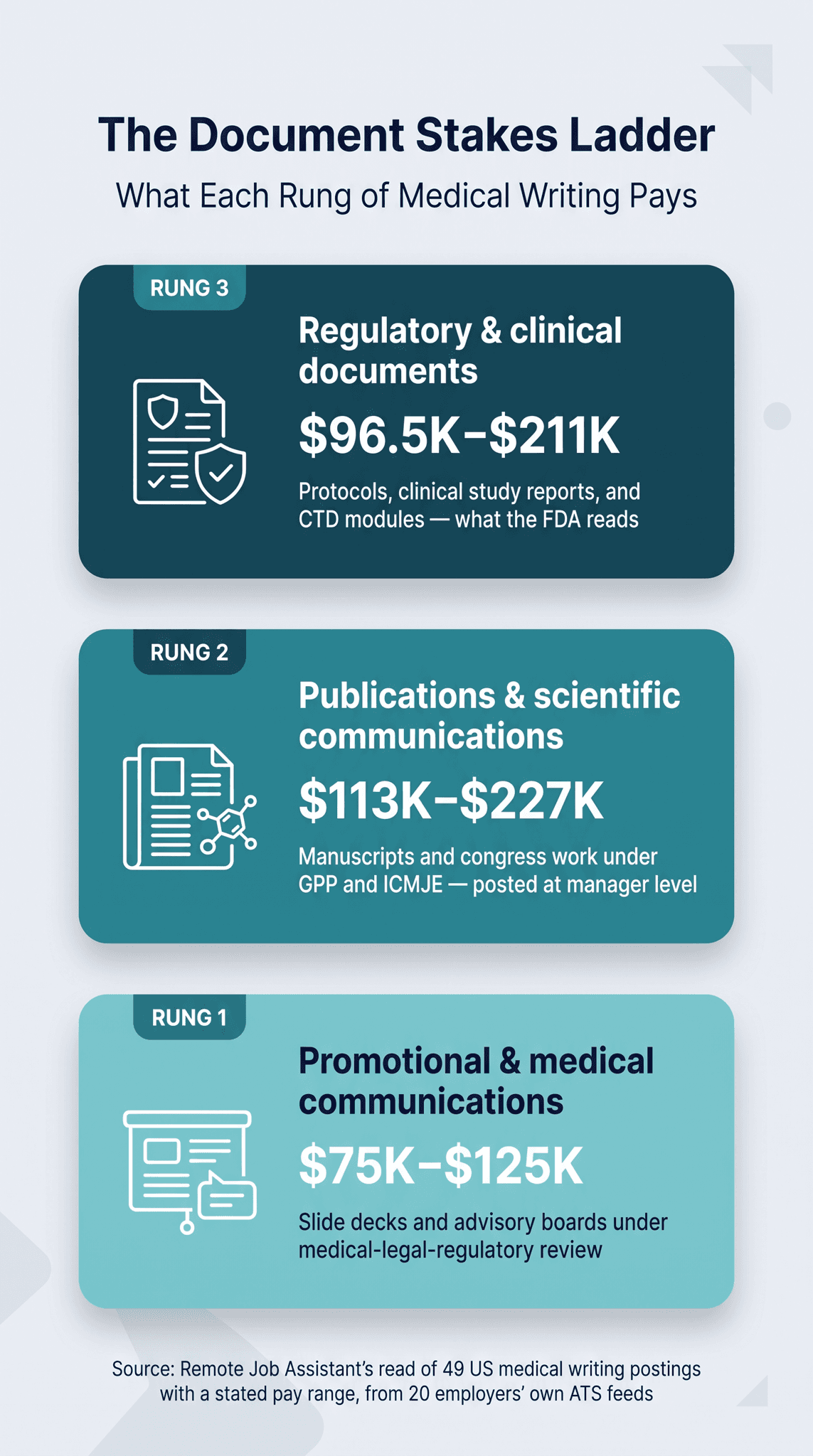
The Document Stakes Ladder: Three Jobs That Share One Title
The Document Stakes Ladder: A three-rung rubric that scores a medical writing seat by what happens when the document is wrong. Pay, remote policy, and the degree bar all track the stakes, not the title.
Scoring:
- Rung 1 — Promotional and medical communications ($75K–$125K for writer titles; $110K–$165K for agency scientific directors): Slide decks, advisory-board materials, product theaters, annotated references for medical-legal-regulatory review in Veeva PromoMats. When it is wrong, MLR pulls the claim and a client account wobbles. You will see "command of AMA style," "PubMed and Google Scholar," "under limited supervision," Eastern-hours requirements, and a PhD or PharmD listed as required. Precision AQ's Senior Medical Writer in promotional writing posts at $75,000–$112,500; Avalere Health's Senior Medical Writer at $100,000–$115,000; Real Chemistry's Senior Medical Writer at $90,000–$100,000.
- Rung 2 — Publications and scientific communications ($113K–$227K as posted, almost all at manager or director level): Manuscripts, congress abstracts, posters, and the publication plan behind them, governed by Good Publication Practice and the ICMJE authorship criteria. You are named in the acknowledgments with your employer and the funder. When it is wrong, the paper is corrected or retracted and someone says "ghostwriting." Writer-level publications work exists, but it sits inside agencies at Rung 1 pay; sponsors post this rung as Abbott's Sr. Clinical Publication Manager ($113,300–$226,700) or GSK's Global Publication Director ($172,425–$287,375).
- Rung 3 — Regulatory and clinical documents ($96.5K–$211K for senior and principal writers; $137K–$289K for managers and directors): Protocols, investigator's brochures, ICH E3 clinical study reports, the clinical overview and summary in CTD Modules 2.5 and 2.7, briefing books, periodic safety reports. When it is wrong, the agency issues a refuse-to-file letter, the trial goes on clinical hold, or the flawed report is published with redactions on the European Medicines Agency's website. You will see "ICH guidelines, GCP," "Veeva Vault," "BLA/NDA/MAA," "QC review," and "Bachelor's degree or higher required; scientific discipline preferred." AbbVie's Senior Strategic Medical Writer (Remote) carries $96,500–$183,500; Stryker's Senior Staff Medical Writer (Remote) $110,100–$183,400; Amgen's Regulatory Writing Sr Mgr (United States – Remote) $139,581–$188,846.
How to use it: Map a posting to a rung by the documents it lists, not its title. "Scientific Director" that lists slide decks and ad boards is Rung 1. "Medical Writer" that lists CSRs and IND modules is Rung 3. Moving up a rung requires one document from the next rung in your portfolio, not another degree.
The reason pay climbs the ladder is not that regulatory writing is harder prose. It is that the reader changes. A client's brand team can be annoyed. A journal editor can demand a correction. The FDA can refuse to file, and a refusal on a $2 billion program is a delay measured in quarters. Companies pay for the person who prevents that, and they pay in proportion to what the reader can do to them.
| Rung 1: Promotional / MedComms | Rung 2: Publications | Rung 3: Regulatory | |
|---|---|---|---|
| Core documents | Slide decks, ad boards, promotional claims, training | Manuscripts, abstracts, posters, publication plans | Protocols, IBs, CSRs, CTD modules, briefing books |
| Governing standard | MLR review, PhRMA Code | GPP 2022, ICMJE | ICH E3, ICH M4, GCP |
| Who posts it | Agencies (Precision AQ, Avalere, Real Chemistry, Nucleus) | Sponsors at director level; agencies at writer level | Sponsors (AbbVie, Amgen, Vertex, Gilead), CROs and FSPs (IQVIA, Thermo Fisher/PPD, Syner-G) |
| Degree language in postings | "Doctoral-level degree required" (Precision), "Advanced degree required" (Real Chemistry) | "Advanced degree preferred," 8+ years | "Bachelor's or higher; scientific discipline preferred" plus 4–11 years |
| Posted writer bands | $75K–$125K | (writer seats priced at Rung 1) | $96.5K–$211K |
| Remote pattern | "Remote or hybrid depending on team needs," Eastern hours | Mostly hybrid or onsite | "United States – Remote" and FSP home-based, or hybrid at Boston biotechs |
In medical writing, the degree gates the agency door and the document gates the sponsor door. Of the nine US postings that explicitly require a doctorate, all nine are agency medcomms seats or director-level sponsor communications roles. Not one is a sponsor regulatory writer role. AbbVie's two remote strategic medical writer postings, the highest-paying writer-titled seats in our pull, ask for a bachelor's degree "or higher" and four to five years writing clinical and regulatory documents. The real filter at a good regulatory shop is not the degree. It is whether your name is in the document history of a submission that went in.
Choosing a rung, as a decision rule:
- You have a doctorate and no industry record, and you want remote this year: Rung 1 at an agency. Take the $75K–$125K band and the Eastern hours, and set a two-year clock.
- You want the highest ceiling and the cleanest remote language, and you can wait: Rung 3 through a CRO or FSP seat first. Two years of protocols and CSRs across several clients, then a sponsor.
- You already have a BLA, NDA, or MAA module with your name on it: skip the agency entirely and apply to sponsor and device regulatory seats. You are the candidate AbbVie, Stryker, and Amgen are describing.
- You want to run authorship and publication strategy: Rung 2 is a destination, not an entry. It is posted at manager and director level, mostly hybrid, and it is reached from Rung 1 agency publications work or from a sponsor medical affairs seat.
- You cannot do Eastern hours or occasional travel: cross agencies off. Thirty-eight percent of postings mention travel and every Eastern-hours clause in the pull is at an agency.
Stop Applying Manually
Our AI applies to hundreds of matching jobs while you sleep. Wake up to interviews, not more applications.
Remote Medical Writer Salary: What Employers Actually Post
The phrase "average medical writer salary" is close to meaningless, because the three rungs barely overlap and because sponsors and agencies post ranges that mean different things. Here is what the 49 US postings with a pay range said on the day we pulled them, grouped by rung. Individual postings will have closed by the time you read this; the bands by rung are the durable part.
Rung 3, regulatory and clinical documents (15 postings with a range):
| Employer | Title | Work model, as written in the posting | Posted base range |
|---|---|---|---|
| Thermo Fisher / PPD | Senior Regulatory Medical Writer, client-embedded FSP | "remote-based Senior Medical Writer within the FSP team" | $105,000–$125,000 (Massachusetts basis) |
| AbbVie | Senior Strategic Medical Writer – Remote | Remote (title and ATS flag) | $96,500–$183,500 (ATS field) |
| Stryker | Senior Staff Medical Writer (Remote), Endoscopy | "based remotely anywhere within the United States" | $110,100–$183,400 (USN tier) |
| AbbVie | Principal Strategic Medical Writer | Remote (ATS flag) | $109,500–$208,500 (ATS field) |
| Vertex | Medical Writing Manager (Hybrid) | Hybrid: remote up to two days per week, Boston | $120,200–$180,400 |
| Amgen | Regulatory Writing Sr Mgr | "United States – Remote" | $139,581–$188,846 |
| AstraZeneca | Associate Director, Clinical Regulatory Writing | Gaithersburg; work model not stated | $136,784–$205,177 |
| Gilead | Manager, Content Strategy and Development (Medical Writing) | Foster City; not stated | $146,540–$189,640 |
| Bristol Myers Squibb | Associate Director, Global Scientific and Regulatory Documentation | Princeton; not stated | $170,880–$207,061 |
| Vertex | Director, Medical Writing (Hybrid) | Hybrid, Boston | $192,700–$289,100 |
| Revolution Medicines | Principal Medical Writer | Location "Remote (United States)" but tagged hybrid; pay quoted for onsite Redwood City | $211,000–$264,000 |
Rung 1, promotional and medical communications (writer and director titles, 14 of the 22 with a range):
| Employer | Title | Work model, as written | Posted base range |
|---|---|---|---|
| Precision AQ | Senior Medical Writer – Promotional Medical Writing | "Remote, United States" | $75,000–$112,500 |
| Precision AQ | Medical Writer, Medical Communications (doctoral degree required) | "Remote, United States" | $80,000–$110,000 |
| Real Chemistry | Senior Medical Writer | Hybrid or remote "depending on team and business needs"; Eastern hours | $90,000–$100,000 |
| Precision AQ | Senior Medical Writer, Medical Communications | "Remote, United States" | $95,000–$125,000 |
| Avalere Health | Senior Medical Writer – Medical Communications | In-office or at home "based on team and client need"; "ideally East Coast" | $100,000–$115,000 |
| Real Chemistry | Senior Medical Copywriter (21GRAMS) | Hybrid or remote depending on team needs | $100,000–$120,000 |
| Avalere Health | Lead Medical Writer – Medical Communications | Flexible, East Coast preferred | $110,000–$125,000 |
| Precision AQ | Associate Scientific Director, Medical Communications | Remote | $110,000–$140,000 |
| Precision AQ | Director, Medical Writing – Market Access Promotional Agency | Remote | $117,000–$165,000 |
| Precision AQ | Scientific Director, Medical Communications | Remote | $125,000–$155,000 |
| Bristol Myers Squibb | Senior Manager, Global Medical Oncology, Medical Communications | Princeton; not stated | $135,750–$164,491 |
| Bristol Myers Squibb | Senior Director, Medical Communications | Hybrid/onsite | $213,690–$258,942 |
Rung 2, publications and scientific communications (posted at manager level and above): Abbott's Sr. Clinical Publication Manager in Plymouth, MN at $113,300–$226,700; GSK's Global Publication Director for oncology, hybrid across four US offices, at $172,425–$287,375; AstraZeneca's Director of Global Scientific Communications in Boston at $230,870–$260,678 with the sentence "Fully remote work is not offered"; IQVIA's home-based Practice Lead for Medical and Scientific Communications at an annualized $159,300–$443,600.
Salary ranges derive from the 49 of 68 US postings in our September 17, 2026 ATS pull that state a base range, cross-referenced with the AMWA 2024 Medical Communication Compensation Survey and BLS occupational wage data via O*NET. Every figure is base pay. AbbVie's senior seat is "eligible to participate in our short-term incentive programs" and its principal seat in the long-term program; Amgen lists a discretionary annual bonus and stock-based long-term incentives; Revolution Medicines adds equity awards. The agency postings describe base and benefits, not bonus or equity. That is a second gap between a $110,000 agency offer and a $110,000 sponsor offer, and it does not show up in any range.
A sponsor's posted range is a grade band. An agency's posted range is a budget. Negotiate them differently. Precision AQ's bands are $30,000 to $37,500 wide because the agency has budgeted a seat. AbbVie's $96,500–$183,500 and IQVIA's $84,400–$211,100 for a Principal Medical Writer are $87,000 to $127,000 wide because they cover every geography and sub-level in a job grade. Stryker makes this explicit: its single "remote anywhere" posting lists six geographic tiers, from $110,100–$183,400 in the base tier to $143,100–$238,400 in the highest-cost tier, and tells you to look up your ZIP code. When a sponsor recruiter says "the range is $96,500 to $183,500," the useful reply is "which tier and which sub-level is this requisition coded to?"
The public salary sources disagree, and the disagreement is instructive:
| Source | Figure | What it actually measures |
|---|---|---|
| BLS OEWS via O*NET, Technical Writers (SOC 27-3042), 2025 | $90,390 median | Every technical writer in the US, most of whom document software, not drugs; projected growth 1–2% for 2024–2034 with 4,500 openings |
| Indeed, updated September 5, 2026 | $118,740 average from 1.2k salaries; $76,487–$184,334 | Posted ranges over 36 months, including staffing-agency contract rates |
| Salary.com, Regulatory Medical Writer, September 1, 2026 | $116,214 median; 25th–75th $101,224–$123,287 | Modeled percentiles for one specialty |
| AMWA 2024 Compensation Survey, employed writers | $149,846 mean; regulatory $166,457; publications $124,736; continuing education $115,785; marketing/advertising $109,626 | 671 employed AMWA respondents reporting 2023 income; 69% have six or more years of experience, 31% work in pharma or biotech |
| AMWA 2024, full-time freelancers | $214,227 mean gross for writing; regulatory $242,971 | 124 freelancers, gross revenue before expenses, not comparable to salary |
Each source sits higher on the seniority and specialty ladder than the one above it. The BLS median mixes medical writers with software documentation. Indeed reflects whatever is open, which skews mid-level. AMWA is a membership survey where 69% of respondents have six-plus years and regulatory writers are over-represented. None of them is wrong. They are measuring different rungs.
What Moves the Number Inside a Band
- A submission on your CV. Revolution Medicines' Principal Medical Writer posting asks for "prior experience working as a medical writer for a BLA/NDA/MAA" and posts $211,000–$264,000. That one line is the difference between a $125,000 FSP seat and a $200,000 sponsor seat.
- Sponsor versus CRO versus agency. The same senior regulatory title posts at $105,000–$125,000 in Thermo Fisher's client-embedded FSP group and $96,500–$183,500 at AbbVie. The FSP seat is the on-ramp; the sponsor seat is the destination.
- Individual contributor versus manager. Amgen's Regulatory Writing Sr Mgr at $139,581–$188,846 and Vertex's Director at $192,700–$289,100 are management bands. Writer-titled seats top out near $211,000 at principal level, which is where medical writing enters the $150K-plus remote tier.
- Geography tier, even when remote. Stryker's six tiers span $33,000 at the low end of the band. Amgen and IQVIA state that location adjusts the offer.
- Therapeutic area. Oncology and hematology dominate the director-level publications and communications postings (GSK, AstraZeneca, BMS, Amgen's obesity leads). Agencies staff by account; sponsors staff by program.
Stop Applying Manually
Our AI applies to hundreds of matching jobs while you sleep. Wake up to interviews, not more applications.
Who's Hiring Remote Medical Writers, and What the Posting Really Says
The employers below hire medical writers into remote or partly remote seats in our pull. The quoted phrases are from their own postings, because the work-model sentence is where the truth lives.
Sponsors: pharma, biotech, and device
- AbbVie hires strategic medical writers for clinical and regulatory documents at senior and principal level, both flagged remote and both titled with "Remote" or coded remote in the ATS. The qualifications say "Bachelor's Degree or higher required; scientific discipline preferred," "ICH guidelines, GCP," and "familiarity with industry standards like CONSORT and PRISMA." Four-plus years for senior, five-plus for principal.
- Amgen posts regulatory writing management and global scientific communications leads with the location field "United States – Remote," which is the cleanest remote signal in the dataset, and lists "flexible work models, including remote work arrangements, where possible" in its benefits boilerplate. Ignore the boilerplate; it appears on every Amgen posting, including the site-based ones. The location field is the signal.
- Stryker hires a Senior Staff Medical Writer for its endoscopy division "to be based remotely anywhere within the United States," which is device regulatory writing (clinical evaluation reports and submissions) rather than drug writing, and publishes all six pay tiers on the posting.
- Bristol Myers Squibb is the most transparent about the ambiguity: its postings state that "our roles are structured across four work models: site-essential, site-by-design, field-based and remote-by-design" but do not always say which model a given requisition is. Its Head of Medical Information is "remote considered with travel to corporate office."
- Vertex posts its entire medical writing ladder in Boston as "Hybrid-Eligible," defined as "work remotely up to two days per week." AstraZeneca says "Fully remote work is not offered" on a Boston scientific communications directorship. Gilead and Sanofi post medical writing and publications seats at named sites without a work-model sentence at all.
CROs and functional service providers
- Thermo Fisher Scientific (PPD) shows both faces of the FSP model in the same team: a "remote-based Senior Medical Writer within the FSP team" at $105,000–$125,000, and an FSP Senior Scientist–Scientific Writer that is "a fully onsite role based at our customer's site in Collegeville, PA." Same employer, same function, opposite work models. Read the sentence.
- IQVIA hires medical and scientific communications leads into "home-based" positions with the condition "you must reside in the same country where the job is located," and posts its Durham medical writing seats without a work-model sentence.
- Syner-G BioPharma posts a Consultant I, Medical Writing that "is eligible for remote work based on company requirements, with no minimum in-office requirement," authoring CSRs, protocols, and submission materials for early-stage clients.
Agencies: medical communications
- Precision AQ posts eight seats with the location "Remote, United States" and the #LI-Remote tag, from a $80,000–$110,000 Medical Writer that requires a doctoral degree up to a $125,000–$155,000 Scientific Director. It is the largest source of writer-level remote seats in the pull, and the one place where entry-with-a-PhD is written into the posting.
- Avalere Health lets teams "decide where they want to work, whether in-office or at home based on team and client need," with "ideally East Coast based" on its senior medical writer roles.
- Real Chemistry lists "Remote – USA" in the location field and "hybrid, based in any of our US offices, or remotely within the US, depending on team and business needs" in the body, plus "this role requires working eastern US hours" on its Senior Medical Writer. Two of its "postings" are "Future Opportunities" talent-pool collectors, not open requisitions.
- Nucleus Global (Inizio) posts a Senior Medical Writer in Yardley, PA with a compensation field reading "$1 to $1 USD." That is a posting error, but it is also the only pay signal on the page.
Software
- Veeva Systems, whose Vault platform appears in 9 of the 63 US postings with body text, is itself hiring a Principal Medical Writing Domain Expert for a product it describes as automating "primary clinical documents (such as CSRs and summaries)." Veeva calls itself a "Work Anywhere company." More on what that posting means for the field below.
Red flags in medical writer postings, with the mechanism:
- "Remote – USA" in the location field, "depending on team and business needs" in the body. The location field is filled in by the recruiter; the sentence is written by the team. The team wins.
- A remote location with a hybrid tag and pay quoted "for candidates working onsite at our headquarters." Revolution Medicines does exactly this. Expect a market adjustment off the posted $211,000–$264,000.
- "Remote considered with travel to corporate office." Considered is not offered. Ask how many trips per quarter and who pays.
- A location city and no work-model sentence at all. Nineteen of 68 US postings are silent. Silence at a sponsor with a named site usually means site-based; ask before you apply.
- Eastern-hours language on a "remote" agency seat. Three postings carry it. If you are in Denver, that is a 6:00 a.m. start.
- A pay field that reads "$1 to $1." The posting was published without the band. Ask for it in the first screen; the recruiter has it.
Ask a sponsor "Which work model is this requisition coded as, and which geographic pay tier applies to my ZIP code?" Ask an agency "Is Eastern-hours coverage a firm policy or this team's preference, and how many accounts will I carry?" Ask a CRO or FSP "Am I embedded on one client or pooled across several, and is the client site expecting me onsite?" Each answer is in the posting body somewhere between 38% and 53% of the time; the rest of the time you have to ask.
Skills, Degrees, and the MWC: What Actually Gates the Offer
Everyone past the resume screen can write a clear sentence, and writing is the one skill every posting lists. What separates a $95,000 agency seat from a $180,000 sponsor seat is document literacy: which documents you have produced, under which standard, and with whose signature at the bottom.
The degree question, answered by the postings. Sixty-eight percent (n=43 of 63 US postings with body text) mention a PhD, PharmD, or MD. Only 14% (n=9 of 63) require one, and those nine are agency medcomms seats (Real Chemistry's Senior Medical Writer, Precision AQ's Medical Writer, Senior Medical Writer, Associate Scientific Director, and Strategic Account Manager) or director-level sponsor communications roles (BMS Head of Medical Information, Abbott Sr. Clinical Publication Manager, GSK Director, IQVIA Medical Director and Associate Medical Director). The sponsor regulatory writer postings, the best-paid writer-titled seats in the pull, say "Bachelor's degree or higher; scientific discipline preferred." This matches the AMWA survey, where 52% of employed respondents hold a PhD or other advanced degree, 28% a master's, and 19% a bachelor's: the doctorate is common in the profession and required in one corner of it.
Document literacy that appears in the postings. Ten of 63 US postings name the clinical study report; eight name GPP or ICMJE; six name MLR review; nine name Veeva Vault; four name AMA style; three name ICH or GCP explicitly. One posting, Precision AQ's, mentions certification, and only as "licensure and certification" boilerplate inside a pay-factors sentence. If you want to know what a sponsor means by "clinical documents," read ICH E3, the 1995 guideline that still defines the clinical study report: sixteen numbered sections from title page to appendices, with a synopsis that is "usually limited to 3 pages" and "should include numerical data to illustrate results, not just text or p-values." That synopsis is the single document that most reviewers actually read, and it is the sample a sponsor hiring manager will ask you to write in an interview exercise.
The authorship rules that govern Rung 2. The ICMJE recommendations set four criteria for authorship and state that "writing assistance, technical editing, language editing, and proofreading" alone do not qualify. Contributors who do not meet all four are acknowledged with their contribution specified, and "use of AI for writing assistance should be reported in the acknowledgment section." The 2017 AMWA–EMWA–ISMPP joint position statement adds that professional medical writers must be acknowledged by name, employer, and funding source, and defines ghostwriting, writing or substantially contributing without acknowledgment, as unacceptable. A publications writer who cannot recite these rules will not pass a sponsor interview; one who can explain them to a nervous key opinion leader is worth a director's salary.
| Table stakes (gets you screened in) | Differentiators (gets you the band's upper half) |
|---|---|
| AMA style; EndNote or similar; PubMed searching | A submission on your CV: BLA, NDA, or MAA module authorship |
| Microsoft Word at the template-and-styles level; PowerPoint | ICH E3 CSR authorship from shell to final QC |
| Life-sciences degree; therapeutic-area reading fluency | Protocol and investigator's brochure authorship |
| Literature summaries with annotated references | GPP 2022 and ICMJE fluency, including AI-assistance disclosure |
| Familiarity with MLR review | Veeva Vault RIM or PromoMats workflow ownership |
| Meeting deadlines across three or four projects | QC review of other writers' regulatory documents |
AMWA's Medical Writer Certified (MWC) credential, by the handbook
- Eligibility: a bachelor's degree in any field plus at least 2 years of full-time paid medical writing in the past 5 years (or 4 years part-time at 20 hours a week). Without the degree, 5 verifiable full-time years in the past 10.
- Cost: $175 application fee (including a nonrefundable $75) and $555 US exam registration (also including $75 nonrefundable); $570 outside the US; $35 to reschedule with five business days' notice.
- Format: 125 multiple-choice questions in 2.5 hours, at one of 300-plus test centers or remote-proctored, across five domains: gathering, evaluating, organizing, interpreting, presenting.
- Windows: two per year, December 1–21 and June 1–21, with registration closing about three weeks before each window. Approval buys you two years, which the handbook translates as "4 exam windows," and you pay the registration fee for every attempt.
- Maintenance: the credential expires at the end of the calendar year of its fifth anniversary; recertify by re-examination ($555) or by 50 continuing-education points ($400).
- AMWA's own words: "Certification is voluntary and is not required for a medical writer to be employed in the field."
A decision rule for the MWC, since the postings will not give you one: sit for it if you are an agency writer with two to four years who wants to cross to a sponsor or CRO regulatory seat and does not yet have a submission on your CV, because the exam's regulatory-writing domain is a credible proxy while you build the document record. Skip it if you already have a BLA, NDA, or MAA module with your name in the document history; not one of the 68 US postings asks for the credential, and one sponsor hiring manager's question, "which submission?", outranks any acronym after your name.
Stop Applying Manually
Our AI applies to hundreds of matching jobs while you sleep. Wake up to interviews, not more applications.
How to Break In or Switch Tracks, Remote
There are three working on-ramps in the postings, and each lands on a different rung.
From the bench, with a doctorate. Precision AQ's Medical Writer seat is the clearest written invitation in the pull: "Doctoral-level degree in life sciences (PhD, PharmD, MD, or equivalent)," "familiarity with or willingness to learn AMA style," remote, $80,000–$110,000. That is Rung 1 by design. The move most PhDs miss is the second step: after two years of slide decks and ad boards, take a CRO or FSP regulatory seat like Thermo Fisher's remote client-embedded Senior Regulatory Medical Writer ($105,000–$125,000) or Syner-G's Consultant I, Medical Writing, and spend two years on protocols and CSRs. Rung 3 at a sponsor opens after that, not before.
From technical writing or clinical research. If you are a technical writer, the docs-as-code and structured-authoring habits in our remote technical writer jobs guide transfer directly to Veeva Vault templates and the ICH E3 shell, and BLS files both jobs under the same occupation code. If you are a clinical research coordinator or associate, you already know what a protocol deviation and a trial master file are, which is why our remote clinical research jobs guide calls medical writing "the better-paid exit for strong writers." Either background lands you at Rung 3 directly, usually through a CRO.
From pharmacy or medicine. PharmDs and MDs are the population that agency medcomms and sponsor medical information actively write into postings ("PharmD, PhD or MD preferred," BMS; "advanced degree (MD, PhD, PharmD, MPH, MS) in a healthcare-related field required," Real Chemistry). If you are weighing a writing exit from practice, our guides to remote pharmacist jobs and remote physician jobs cover the adjacent seats; the writing seats pay less than practice at entry and more than practice at director level.
A portfolio that proves the rung, not the prose. Build three samples. One: a three-page CSR synopsis written from a published trial, in ICH E3 order, numbers not adjectives, with the primary endpoint's effect size and confidence interval in the first paragraph. Two: a ten-slide scientific deck on the same trial with reference call-outs annotated the way MLR reviewers expect. Three: a plain-language summary for patients. The first proves Rung 3, the second Rung 1, the third proves you can change register. Hosting them on a personal site is fine; naming the trial and the source is what makes them credible.
Two documents are worth an evening each before you write those samples. The MWC Applicant and Candidate Handbook is the best free description of what the profession considers core competence, whether or not you sit the exam, and its Appendix 1 defines what counts as paid medical writing experience, which matters when a recruiter asks. The AMWA–EMWA–ISMPP joint position statement is four pages on what a medical writer is allowed to do on a manuscript and how they must be credited; a publications interviewer will assume you have read it. AMWA's own job board and the ISMPP job listings carry seats that never reach the aggregators, particularly agency publications roles.
| Agency (Rung 1) | CRO / FSP (Rung 3 on-ramp) | Sponsor (Rung 3) | |
|---|---|---|---|
| Posted writer bands | $75K–$125K | $105K–$125K senior; $84K–$211K principal grade band | $96.5K–$211K senior to principal |
| Remote certainty | "Depending on team needs"; Eastern hours common | Split: "remote-based" or "fully onsite at the customer's site," by seat | "United States – Remote" at AbbVie, Amgen, Stryker; hybrid at Boston biotechs |
| Degree bar | Doctorate often required | Advanced degree preferred | Bachelor's or higher; scientific discipline preferred |
| Document exposure | Decks, ad boards, claims | CSRs, protocols, submissions across many clients | One program, deep; submission authorship |
| Accounts or programs per writer | Three to four accounts (Precision's director seat supervises "2–4 medical writers" over "3–4 assigned accounts") | Pooled or embedded | One or two programs |
Once you know which column you are aiming at, the remaining bottleneck is application volume, not preparation. Seats like Precision AQ's and Stryker's collect hundreds of applicants in the first week; pointing Auto-Apply at a filtered list of remote medical writing roles keeps you in the first hundred.
What Nobody Tells You About Remote Medical Writing
Seventy-two percent (n=49 of 68) of the US postings in our pull are principal, manager, or director seats, and only 10% (n=7 of 68) are below "Senior." The field hires experienced writers remotely and trains junior ones in person: Parexel's own medical writing careers page describes a seven-level ladder from Associate Medical Writer to Consultant and "a 6-month training course" for entry writers. The reason is structural. Document risk sits with the sponsor, so juniors are supervised where supervision is cheap, which is next to a senior writer. If you have under two years, the realistic remote entry is an agency seat with a doctorate or an FSP seat with a clinical-research background, not a sponsor.
Your CSR will be published, redacted, with your anonymisation report attached. Under the European Medicines Agency's clinical data publication policy, the clinical overview, clinical summary, and individual clinical study reports for new active substances are posted 60 days after the European Commission decision, with personal data redacted in light-blue "PPD" boxes and any commercially confidential redactions justified in black "CCI" boxes. The policy resumed for products with CHMP opinions from September 2023 and packages went live in January 2024. Sponsors now staff for a report that a competitor's medical writer will read line by line. That is a Rung 3 skill, and it is why "publication-ready CSR" has started appearing in regulatory writing postings.
Agency remote is real but conditional. The agency sentence, "hybrid, based in any of our US offices, or remotely within the US, depending on team and business needs," is not evasive. Agencies staff by account, and an account with a Philadelphia client and a New York creative team wants Eastern hours and an occasional in-person workshop. Thirty-eight percent (n=24 of 63) of US postings mention travel; Nucleus Global's Senior Medical Writer says "travel as needed, including weekends." Sponsor regulatory writing has less of this because the reader is an agency in Silver Spring or Amsterdam, and nobody flies to meet a document.
The automation is aimed at Rung 3's tables first, and its argument last. Veeva's posting for a Principal Medical Writing Domain Expert describes a platform "that automates primary clinical documents (such as CSRs and summaries)" and invites a master-level writer to "step away from repetitive manual drafting." Read the ICH E3 section list again: sections 10 through 12, patients, efficacy, and safety, are largely tables and listings rendered into prose, and that is what a template engine does well. Sections 2 and 13, the synopsis and the discussion and overall conclusions, are the benefit-risk argument, and that is what a regulator argues with. The writers who own the argument get more valuable as the tables automate; the writers who only render tables do not. The clinical study report is the only document in this field that regulators read, Europe publishes, and an agency can reject. That is why it is the only one with a $200K rung.
What the responsibilities section tells you about life after the offer. Postings describe the job more honestly in the duties list than in the pitch, and a few lines are worth reading twice. Real Chemistry's Senior Medical Writer must "support Veeva submissions of all medical communication deliverables for client medical/legal/regulatory reviews by highlighting all relevant references and creating detailed reference notes," which means every claim on every slide gets an anchored citation and the writer builds the reference package that MLR reviewers tear apart; that is the job, and the deck is the byproduct. Precision AQ's medical writing director seat runs "generally 3 to 4 assigned accounts" and supervises "2 to 4 medical writers," so the arithmetic for a writer under that director is a share of three or four brands at once. AbbVie's senior regulatory writer "works closely with leadership and R&D Quality Assurance to address inquiries and draft responses, supporting an inspection-ready approach," which is the polite way of saying you may be answering an inspector's question about a document you finished two years ago. Revolution Medicines expects its principal writer to perform "QC reviews of clinical regulatory documents," so at that level you are the person who finds the transposed number in someone else's table at 9 p.m. before a submission. Abbott wants "up to 25%" travel; Nucleus Global wants "travel as needed, including weekends." And AbbVie states, in the physical requirements, that "continuous sitting for prolonged periods (more than 2 consecutive hours in an 8 hr day) is required," which is the most accurate single sentence about remote medical writing in the entire dataset.
A sponsor's remote designation is a requisition attribute, not a contract term. Bristol Myers Squibb's postings say roles are "structured across four work models," assigned per role. Anything assigned per role can be reassigned per role, and a new head of medical writing who wants the team in one time zone does not need to renegotiate your offer to do it. Get the work model into the offer letter, not just the posting.
Nobody posts a junior regulatory seat remote, and nobody posts a senior agency seat above $125K. Those two facts explain most of the salary confusion in this field. The $75K–$120K figure most guides quote is the agency writer band, the same corridor as the senior end of general remote writing roles. The $150K-plus figures are regulatory and management bands. Both are true. They are different jobs.
Frequently Asked Questions
I have a PhD and no industry experience. Which medical writing track should I apply to first, and what will it pay remote?
Apply to agency medical communications first, because it is the one track that writes a no-experience doctorate into the posting: Precision AQ's Medical Writer seat requires a doctoral degree, is listed "Remote, United States," and posts $80,000–$110,000. Plan the second move from day one. After two years of decks and advisory boards, take a CRO or FSP regulatory seat (Thermo Fisher's remote client-embedded senior regulatory writer posts $105,000–$125,000) and build a protocol and CSR record. Sponsor regulatory seats at $96,500–$211,000 open after that. In our pull only 7 of 68 US postings were below "Senior," so the agency door is also the widest.
Do I need the AMWA MWC certification to get a remote medical writer job?
No. None of the 68 US postings we read asks for it, and AMWA's own handbook says certification "is not required for a medical writer to be employed in the field." It costs $175 to apply and $555 to sit, requires two years of paid medical writing, and is offered in two windows a year (December 1–21 and June 1–21). It is worth sitting if you are an agency writer trying to cross to a regulatory seat without a submission on your CV; it is not worth it if you already have a BLA, NDA, or MAA module with your name in the document history.
What is the real difference between a regulatory medical writer and a medical communications writer, in pay and in daily work?
A regulatory writer produces protocols, investigator's brochures, clinical study reports in ICH E3 format, and CTD summary modules for regulators; a medical communications writer produces slide decks, advisory-board materials, and promotional claims for clients under MLR review. In our pull, writer-titled regulatory seats post $96,500–$211,000 and writer-titled medcomms seats post $75,000–$125,000. AMWA's 2024 survey shows the same gap among employed writers: $166,457 mean for regulatory versus $109,626 for marketing and advertising. The regulatory postings ask for a bachelor's degree or higher plus four to eleven years on clinical documents; the medcomms postings more often require a doctorate.
A sponsor posting shows $96,500–$183,500 for one title. What will they actually offer a remote candidate?
A sponsor range that wide is a job-grade band covering every geographic tier and sub-level, not a negotiating range. Stryker's remote medical writer posting makes this visible by listing six tiers on one page, from $110,100–$183,400 to $143,100–$238,400 by location. Ask the recruiter which sub-level and which geographic tier the requisition is coded to; the answer usually narrows the band to a $30,000 window. Agencies work the other way: Precision AQ's $30,000-to-$37,500-wide bands are the budget for the seat, and the top of the band is reachable with the right document record.
How can I tell whether a "remote" medical writer posting is actually remote?
Read the work-model sentence in the body, not the location field. In our pull 53% (n=36 of 68) of US postings allow some remote arrangement, but only 35% (n=24 of 68) say fully remote outright; 19 postings say nothing at all. The reliable signals are "United States – Remote" in the location field at Amgen, "based remotely anywhere within the United States" at Stryker, and "home-based position" at IQVIA. The unreliable ones are "Remote – USA" followed by "depending on team and business needs," a remote location with a hybrid tag and pay quoted for headquarters, and "remote considered with travel."
How do I score a job offer on the Document Stakes Ladder?
List the documents named in the posting and ask what happens if each one is wrong. If the worst outcome is a pulled claim or an unhappy client (decks, ad boards, promotional materials), the seat is Rung 1 and will post $75,000–$125,000 for a writer. If the worst outcome is a correction or retraction (manuscripts, abstracts, publication plans), it is Rung 2 and is usually posted at manager level or above. If the worst outcome is a refuse-to-file, a clinical hold, or a published-and-redacted report (protocols, CSRs, CTD modules, briefing books), it is Rung 3 and posts $96,500–$211,000 for a writer. Score the seat by the documents, not the title, because "Scientific Director" seats at agencies list Rung 1 documents.
Can I move from technical writing or clinical research into medical writing without another degree?
Yes, and the postings say so. Sponsor regulatory writer roles at AbbVie ask for a bachelor's degree "or higher" with a scientific discipline preferred, not a doctorate. A technical writer brings structured authoring, templates, and version discipline that map directly to Veeva Vault and the ICH E3 shell; a clinical research coordinator brings protocol, deviation, and trial-master-file fluency. The realistic first seat for either is a CRO or FSP regulatory writing role, where you learn the document set across several clients before a sponsor hires you for one program.
Will AI replace medical writers, and which track is safest?
The automation is already in the postings: Veeva is hiring a principal-level medical writer to help build a product that "automates primary clinical documents (such as CSRs and summaries)." What it automates first is the tabular middle of the clinical study report, the patient, efficacy, and safety sections that render listings into prose. What it does not automate is the synopsis and the discussion, the benefit-risk argument a regulator pushes back on, or the judgment calls in a publication plan under ICMJE rules that now require AI assistance to be disclosed. The safest seats are the ones that own the argument: regulatory writers who author the synopsis and Module 2.5, and publications leads who run authorship. The most exposed are seats that only reformat tables or reference lists.
Start Your Remote Medical Writing Career
The gap between a $90,000 agency seat and a $180,000 sponsor seat is not prose quality. It is which document your name is on and who reads it. Decide the rung, write the one sample that proves it (a three-page ICH E3 synopsis for regulatory, an annotated deck for medcomms), and read the work-model sentence in every posting before you spend an hour on the application, because roughly half of the seats that look remote commit to it in the body and the other half leave it to the team.
After that the bottleneck is volume. Remote seats at Precision AQ, AbbVie, Amgen, and Stryker fill within weeks. Browse current remote medical writer openings on RemoteJobAssistant.com, filter to the $100K-plus remote roles if you are targeting Rung 3, and let Auto-Apply submit to the matching seats while you write the synopsis sample. Our guide to the best remote job boards covers the pharma-specific boards worth adding, and if you are getting screens but no offers, why you're not getting interviews walks through the fixes.
Regulators do not care where the clinical study report was written. They care whether it is right. So does the salary.
Ready to Find Your Remote Job?
Browse thousands of curated remote jobs or let AI apply for you.
Browse Remote JobsRelated Job Guides

Remote Creative Director Jobs: Pay & Who's Hiring (2026)
Remote creative director jobs: we read 79 US creative-leadership postings from 38 employers. Only 18 are remote, and agency pay bands run 2.3x wide. What pays.
24 min read
Remote Controller Jobs: What the Market Pays in 2026
Remote controller jobs pay $172K-$260K, but only 5 of 25 US postings we swept are truly remote. Salary data, the plant-controller trap, and where to look.
22 min read

Remote Biotech Jobs: What Actually Goes Remote in 2026
We analyzed 1,244 US biotech postings across 53 company boards. Which functions are genuinely remote, what they pay, and which roles travel 50% of the time.
23 min read