

Last reviewed: September 2026
You watched a colleague in clinical data management go fully remote two years ago and never come back to the building, and you drew the obvious conclusion: biotech finally moved. Then you searched for remote biotech jobs and got nine job-board grids and one number — an aggregator quoting an average of about $28 an hour for "remote biotech." For a scientist eight years into a career, that number reads like a demotion.
It isn't measuring you. That average is built from lab techs, accessioning staff, and contract sample handlers, most of whom are not remote at all. The real question was never whether biotech goes remote. It's which part of it does, and the answer splits the industry in a way no job board shows you: the functions with the highest remote rates are frequently the ones where "remote" means home-based and on a plane.
Get Remote Job Tips in Your Inbox
Weekly strategies, salary data, and new opportunities
Unsubscribe anytime. No spam.
We analyzed 1,244 US biotech and life-sciences job postings pulled from 53 verified company job boards on September 19, 2026, reading every remote claim against the posting body rather than trusting the location field. This guide covers which functions are genuinely remote, which "remote" roles are travel roles in disguise, what each rung actually pays, and who is hiring.
Based on our analysis of 1,244 US life-sciences postings across 53 verified company boards (September 2026):
- 33% (n=414 of 1,244) of US life-sciences postings were remote-eligible
- 22.5% (n=237 of 1,055) once Veeva Systems is removed — one employer supplies 43% of the remote postings in this sample
- 50% median stated travel requirement on remote postings that name a figure (n=77); 67 of 77 required 25% or more
- 60% (n=6 of 10) of biostatistics postings and 59% (n=10 of 17) of bioinformatics postings were remote-eligible
- 18% (n=4 of 22) of quality and GxP compliance postings and 21% (n=4 of 19) of regulatory affairs postings were remote-eligible — the two lowest rates in the dataset
- 22% (n=275 of 1,244) of US postings published a salary range; only 13% (n=54 of 414) of remote ones did
- 36 postings were tagged remote in the location field while their body text required on-site time
Hold two of those numbers next to each other. Biostatistics: 60% remote. Quality assurance: 18% remote. Both are desk jobs. Both sit in front of a laptop all day. The gap between them is the whole subject of this post.
The Bench Distance Test
Remote eligibility in life sciences has almost nothing to do with seniority, and less than you'd think to do with company policy. It tracks one thing: how many steps your deliverable sits from a physical, regulated location.
We call this The Bench Distance Test — a 10-point rubric for predicting whether a life-sciences role can actually be done from your house, based on where its output has to physically exist.
Scoring:
- 0–3 Bench-Bound: Your output requires you to touch something. Lab work, manufacturing and fill-finish, sample accessioning, field service engineering, on-site monitoring visits. The equipment is expensive, validated in place, and not coming to you. Measured remote share in our dataset: effectively zero.
- 4–7 Site-Tethered: Your output is documents and systems — but they are audited, inspected, or signed where they live. Regulatory submissions, QA and GxP compliance, computerized systems validation, clinical site management. Measured remote share: 18% to 33%.
- 8–10 Data-Native: Your output is analysis, code, or written argument that never needs a physical address. Biostatistics, statistical programming, bioinformatics, clinical data management, health economics. Measured remote share: 43% to 67%.
How to use it: Score your current role honestly, then notice what the rubric implies. Moving up a band is a function change, not a title change. A Senior QA Specialist who wants band-8 remote eligibility does not get there by becoming a QA Manager — every rung of that ladder is still site-tethered. They get there by moving into computerized systems validation or quality data analytics. Identify the adjacent band-8 function for your background before you start applying, because applying harder inside band 4 will not change your odds.
Stop Applying Manually
Our AI applies to hundreds of matching jobs while you sleep. Wake up to interviews, not more applications.
How We Collected This Data
The figures in this post come from a snapshot of 1,244 US life-sciences job postings collected on September 19, 2026. Postings were pulled directly from public applicant tracking system APIs — Greenhouse (boards-api.greenhouse.io), Lever (api.lever.co), and Ashby (api.ashbyhq.com) — across roughly 430 candidate company identifiers, of which 436 boards responded. All three endpoints are public and unauthenticated, so any of these counts can be reproduced.
Two filtering steps matter for reproducibility. First, company name collisions were removed by reading a posting body from every contributing board. Twenty-two boards matched a biotech company's name but belonged to an entirely different company: kodiak is Kodiak Robotics, not Kodiak Sciences; pliant is a German fintech, not Pliant Therapeutics; verve is an advertising technology firm, not Verve Therapeutics; caribou is an auto-refinancing company, not Caribou Biosciences. All twenty-two were excluded, leaving 53 verified life-sciences employers. Second, postings were deduplicated on employer, title, and description fingerprint, because a single requisition is frequently posted against a dozen city rows.
Remote status was determined by reading the description prose, not the ATS checkbox. A posting flagged remote whose body required a set number of office days per week, a percentage of time in a hub office, or relocation was reclassified — 36 postings failed this check.
The thing that changed our read during manual review was how often a posting's location field and its body were written by different parts of the company. The location field is maintained by whoever configures the ATS; the travel clause is written by the hiring manager. When they disagree, the hiring manager is right — which is why we stopped trusting the field entirely partway through and re-read all 414.
Salary figures are posted base ranges taken from the postings themselves, cross-referenced against O*NET's publication of the Bureau of Labor Statistics' 2025 occupational wage series. Reddit, BLS.gov directly, and Glassdoor blocked automated access during this collection, so no figure in this post comes from those sources.
One limit worth stating plainly: Greenhouse, Lever, and Ashby skew toward biotech companies and startups. The largest pharmaceutical employers run Workday boards that are not in this count. Read these numbers as a picture of biotech and life-sciences tools companies, not of Pfizer and Merck.
Which Biotech Functions Actually Go Remote
The remote rate varies by more than a factor of three across functions, and the ranking is not the one most people would guess.
| Function | Remote | US postings | Share | Bench Distance band |
|---|---|---|---|---|
| Market access & HEOR | 6 | 9 | 67% | Data-Native |
| Biostatistics & statistical programming | 6 | 10 | 60% | Data-Native |
| Bioinformatics & computational biology | 10 | 17 | 59% | Data-Native |
| Medical affairs & MSL | 20 | 38 | 53% | Field (see below) |
| Clinical data management | 3 | 7 | 43% | Data-Native |
| Clinical operations | 6 | 18 | 33% | Site-Tethered |
| Data science & software engineering | 20 | 73 | 27% | Data-Native |
| Commercial & field sales | 32 | 153 | 21% | Field (see below) |
| Regulatory affairs | 4 | 19 | 21% | Site-Tethered |
| Quality assurance & GxP compliance | 4 | 22 | 18% | Site-Tethered |
Several of these denominators are small. Treat them as direction, not precision — and notice that the direction contradicts the conventional wisdom in three places.
Regulatory affairs and quality sit at the bottom despite being pure desk work. The causal reason is inspection readiness. A regulatory or QA function is the part of the company an FDA investigator walks into. Batch records, validation protocols, and deviation files are reviewed where they are stored, signatures are witnessed, and internal audits are walked in person. Companies keep those teams physically near the site not because the typing requires it, but because the inspection does. This is also why the remote openings that do exist in these functions cluster in submissions publishing and systems validation — the two sub-specialties furthest from the floor.
Clinical operations is lower than its reputation at 33%. Site monitoring visits are not an administrative appendage to a CRA job; they are the job. A remote clinical research role that genuinely never travels is usually a study start-up, feasibility, or centralized monitoring seat, and those titles are a minority of clinical operations hiring.
The data functions top the list because the deliverable is a file. A statistical analysis plan, a validated SDTM dataset, a variant-calling pipeline, and a budget impact model are all complete when the file is correct. Nothing about their review requires a shared room, which is why biostatistics and bioinformatics clear 59% while the functions one floor away clear 20%.
The functions biotech professionals assume are laptop work — regulatory affairs and quality — have the two lowest remote rates in the dataset. Documents that get audited on site keep people on site.
The "Remote" Roles That Are Actually Travel Roles
Look again at medical affairs and MSL: 53% remote-eligible, one of the highest rates in the table. Then read what those postings say.
Of the 414 remote-eligible postings in our sample, 77 stated a specific travel percentage. The median was 50%. Sixty-seven of those 77 required 25% or more. One Freenome account executive posting puts it about as plainly as it can be put: the role "will be a Remote role within the Pacific Northwest and will require the ability to travel 50% of working time away from work location." A Nuvalent thought leader liaison posting asks for "willingness to travel up to 50% domestically." A Revolution Medicines area business director posting lists "50% travel required" alongside a valid driver's license.
None of those are mislabeled. They are accurately described roles that a job board filter cannot distinguish from a biostatistics job, and the reason is structural rather than deceptive. A Greenhouse or Lever location field answers one question: does this role have an assigned desk in a company building? For a Medical Science Liaison covering six states, the honest answer is no. The system records "remote," and a filter that means "I want to work from my house" returns a job that means "you will live in airports."
That's also where the 36 contradicted postings come from — roles tagged remote in the location field whose body text turns out to require a set number of office days, hub-office time, or relocation. The tag is a location field. It was never a work-style promise.
An ATS "remote" tag is a work-location field, not a work-style promise. In life sciences it is the difference between a laptop and a boarding pass.
Three checks will tell you which one you're looking at in under a minute:
- Search the body for "travel." If a percentage appears anywhere, that percentage is the job. There is no version of a 50% travel role that quietly turns into a desk role after you sign.
- Check whether a territory or region is named. "Remote — Southeast" and "Remote — US" are different jobs. A named region means coverage, and coverage means driving.
- Check whether the posting says "home-based" rather than "remote." In life sciences, "home-based" is the field organization's term of art. It means your house is the office you leave from.
Beyond travel, four clauses showed up often enough in the remote postings we read to be worth searching for by name before you apply.
| Clause to search for | Found in | What it actually means |
|---|---|---|
| "valid driver's license" | 10 of 414 remote postings | A driving job. No desk role has ever needed your license. |
| "must reside within the assigned territory" / "must reside in the state of" | 3 of 414 | Remote, but the company picks your state. BridgeBio's Florida regional sales posting says exactly that. |
| "occasional travel to headquarters" / "periodic travel" | 5 of 414 | Genuinely remote with a real-but-bounded onsite tail. BridgeBio scopes one statistical genetics role as "periodic travel (quarterly or as needed) to BridgeBio's San Francisco office" — that is the honest version, and it is fine. |
| "overnight travel" | 1 of 414 | Rare in writing, common in practice. Its absence proves nothing; its presence is decisive. |
The third row is the one to calibrate on. "Remote with quarterly travel to headquarters" is not a red flag — it is a well-written remote job, and a company that bothers to quantify the tail is usually telling you the truth about the rest.
Stop Applying Manually
Our AI applies to hundreds of matching jobs while you sleep. Wake up to interviews, not more applications.
What Remote Biotech Roles Pay
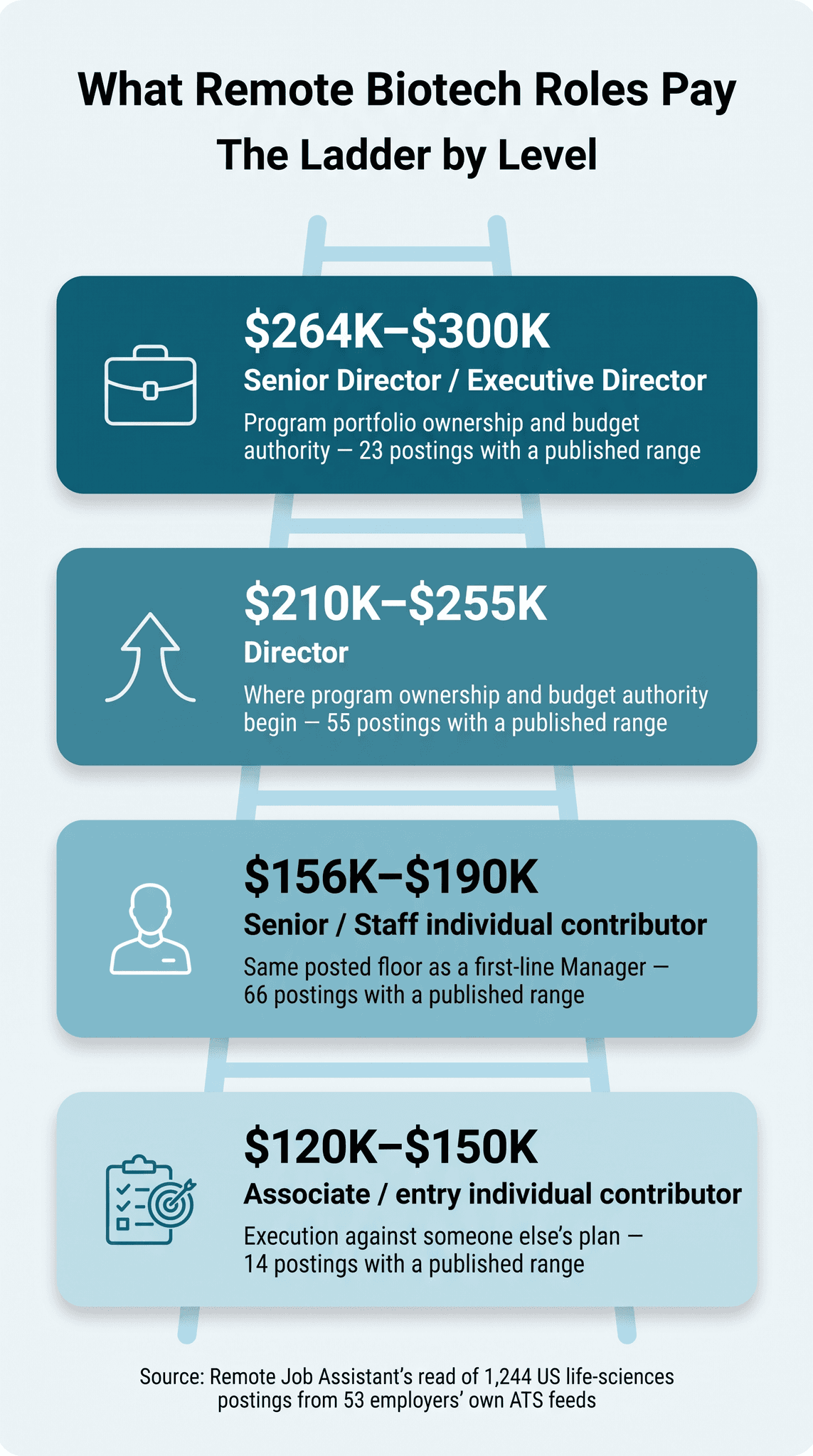
Two hundred seventy-five of the 1,244 US postings published a base range. Here is what they show, by seniority.
| Level | n | Typical posted base range |
|---|---|---|
| Associate / entry individual contributor | 14 | $120K–$150K |
| Senior IC (Senior, Staff, II–III) | 66 | $156K–$190K |
| Manager | 30 | $154K–$202K |
| Director | 55 | $210K–$255K |
| Senior Director / Executive Director | 23 | $264K–$300K |
| VP / Head of function | 12 | $290K–$333K |
Ranges are posted base salaries drawn from our September 2026 snapshot of 1,244 US life-sciences postings, using the median floor and median ceiling at each level. They exclude bonus and equity, which add meaningfully at Director and above. Levels with fewer than 20 postings are shown with their n for a reason — read those as indicative.
Now compare two rows. Senior IC: $156K–$190K, from 66 postings. Manager: $154K–$202K, from 30. The floors are within $2,000 of each other. For anyone who has been told that the way to earn more is to start managing people, that's worth sitting with.
The reason is specific to how life-sciences organizations are built. A first-line manager in biotech typically takes on span of control over the same scientific scope they already owned — two direct reports, the same program, the same deliverables, plus performance reviews. Nothing about the company's cost model says that's worth another $40,000. Director is where the shape of the job actually changes: program ownership, budget authority, and accountability for decisions that get made without you in the room — and it is the rung where life-sciences roles start clearing the $150K-plus band consistently. That's the step the pay data rewards, and it's roughly a $55,000 one.
In remote biotech, the first management title is not a raise. Manager and senior individual-contributor postings land within $2,000 of each other at the floor — the money is at Director.
For context outside our sample, O*NET's publication of BLS 2025 wage data puts the median annual wage for Medical Scientists at $103,410, with employment growth projected at 7% or higher through 2034. Statisticians show a $105,650 median on the same basis, and Regulatory Affairs Specialists $80,730. Those medians sit well below the posted ranges above, and the gap is not a contradiction. BLS covers every employment level and geography in the occupation, including academic and government employers. Posted ranges come from companies that publish them — which skews toward larger, coastal, venture-funded employers hiring at senior levels. Use BLS to sanity-check an offer against the whole occupation; use posted ranges to calibrate against the specific market you're applying into.
One more number changes how you should negotiate. Only 13% (n=54 of 414) of remote postings published a range at all, against 22% across all US postings. Fully-remote postings are less transparent than on-site ones, which is the opposite of what most candidates expect.
Pay-transparency laws are triggered by jurisdiction — where the employer is, or where the role can be performed. A posting scoped to "Remote — US" potentially touches every state with a disclosure law, so some employers respond by scoping the posting narrowly or omitting the range entirely. The practical consequence: on remote roles you are more likely to be asked for a number first, with less public data to anchor it.
The defense is to arrive with the range already in hand. If the posting doesn't publish one, find the same title at the same company posted to a Colorado, New York City, or Washington address — the range in that version is the range.
Who's Actually Hiring Remotely
| Employer | Remote postings | US postings | What they do |
|---|---|---|---|
| Veeva Systems | 177 | 189 | Life-sciences software |
| Revolution Medicines | 53 | 171 | Oncology drug development |
| Natera | 49 | 199 | Genetic testing and diagnostics |
| BridgeBio | 38 | 67 | Genetic disease therapeutics |
| Freenome | 13 | 14 | Blood-based cancer screening |
| Twist Bioscience | 12 | 39 | Synthetic DNA manufacturing |
| Erasca | 7 | 7 | Precision oncology |
| Absci | 6 | 6 | AI-driven drug creation |
| Butterfly Network | 6 | 20 | Handheld medical imaging |
| Dotmatics | 5 | 5 | Scientific R&D software |
Veeva deserves a caveat rather than applause. It operates a published Work Anywhere policy, which is why 177 of its 189 US postings are remote-eligible — and it supplies 43% of every remote posting in this sample. It is also a software company that sells to life sciences, not a company that develops drugs. Remove it and the industry-wide remote rate falls from 33% to 22.5% (n=237 of 1,055). Both numbers are true; the second one is the one to plan your job search around.
The pattern underneath the table is more useful than the ranking. Clinical-stage companies with heavy field organizations — Revolution Medicines, Natera, BridgeBio — generate remote postings largely through commercial and medical affairs roles, which circles back to the travel question. Tools and software companies — Twist, Dotmatics, Absci — generate them through engineering and data roles that are genuinely desk-based. Knowing which kind of company you're looking at tells you what kind of "remote" you're about to get.
Stop Applying Manually
Our AI applies to hundreds of matching jobs while you sleep. Wake up to interviews, not more applications.
Moving Into a Remote Biotech Role
If the Bench Distance Test put you in band 0–7, the move is a function change. These are the shortest bridges we see actually working, each with its honest cost.
Bench scientist to bioinformatics or computational biology. The portfolio artifact that actually moves interviews is one reproducible end-to-end reanalysis of a public dataset — pull a series from NCBI GEO or the Sequence Read Archive, run it through a standard workflow, and publish the repository with the environment pinned and a written interpretation of what the result means biologically. One finished analysis beats four tutorials. Budget 9 to 18 months alongside a full-time job, and learn Python and R in that order. The friction: your first title is usually a lateral step, and you will compete against people with a computational degree. Your advantage is that you can say why a batch effect is biological rather than technical, which is the exact judgment most pipeline engineers lack. If you're weighing computational paths against each other, the data analyst versus data scientist distinction maps closely onto the same tradeoff in biotech.
CRA or clinical operations to clinical data management. Learn the CDISC standards — SDTM for tabulation, ADaM for analysis datasets — and one EDC platform deeply rather than three shallowly. CDISC publishes the implementation guides directly, and knowing why a variable is derived the way it is will out-interview anyone who has only clicked through the software. The decision rule: if you have already written or reviewed edit checks, you are closer than you think and should target a data manager posting now; if you have not, spend six months getting that exposure inside your current role first, because it is the one line of experience that gets the interview. The friction: the first move is often to a smaller sponsor or a CRO, and pay can flatten for a year before it resumes.
QA or GxP specialist to computerized systems validation. Stay in quality, move to the systems side — the regulatory basis is 21 CFR Part 11 and Annex 11, and the practical skill is writing and executing IQ/OQ/PQ protocols against a system rather than a process. This is the only band-4 to band-8 move on this list that does not require leaving your function, which is why it is the highest-probability transition here. The friction: it is the least glamorous path on this list. It is also the most reliably remote.
Lab operations to LIMS or scientific informatics. Your knowledge of how the lab actually runs is the product — vendors and software teams are chronically short of people who have used the system under real sample pressure. The test interviewers apply: can you configure a workflow and script against the API, or have you only ever been a user? If it is the latter, ask to own your site's next instrument integration or LIMS configuration change. That single project is usually enough. The friction: expect to be interviewed by software people who will not grade you on lab credibility.
One realistic caution. The band-8 functions are the most remote-eligible functions, which means they are also the ones collecting applications from every other person who ran this same analysis. A genuinely desk-remote biostatistics posting at a name-brand company can draw hundreds of applicants within a week of going live. That is the actual bottleneck — not whether you're qualified, but whether you can consistently be early across 53 different company boards, each with its own ATS and its own login.
That's the arithmetic that breaks manual job searching in this industry specifically. The remote openings are real, but they are scattered thin: 414 postings across 53 employers, with no single board carrying more than a fraction of them. Our auto-apply service monitors those boards and submits on your behalf, so being early stops depending on which morning you happened to check. For related paths, we also track remote data science roles, remote data analyst positions, and remote pharmacist openings.
Frequently Asked Questions
I'm a bench scientist with 6 years of experience — can I move into a remote biotech role without going back to school?
Yes, and a second degree is rarely the bottleneck. The bottleneck is a portfolio that proves you can produce the band-8 deliverable — one reproducible reanalysis of a public GEO or SRA dataset, a validated dataset built to CDISC standards, or a written statistical analysis plan. The decision rule we would apply: if you can already script your own analyses, start applying now and treat the portfolio as the cover letter; if you cannot, give it nine to twelve months on one finished project rather than a certificate. Bench experience is an asset in these interviews because you know how the data can be wrong, which is exactly what purely computational candidates miss.
Is a remote MSL job actually remote, or do you travel constantly?
Constantly is closer to the truth. Of the 414 remote-eligible postings in our sample, 77 named a travel percentage, the median was 50%, and 67 of the 77 required 25% or more — with medical affairs and field commercial roles supplying most of them. "Remote" on an MSL posting means home-based, not desk-based. Read the travel clause before you read the salary.
Which biotech functions can I realistically do fully remote?
In our data, the highest remote-eligibility rates were market access and HEOR (n=6 of 9), biostatistics and statistical programming (n=6 of 10), bioinformatics and computational biology (n=10 of 17), and clinical data management (n=3 of 7). What these share is that the deliverable is a file rather than a physical or witnessed activity. Denominators are small, so treat the ordering as direction rather than precision.
How do I score my own role on the Bench Distance Test?
Ask where your output has to physically exist to be considered complete. If it requires you to touch equipment or be present at a site, you're 0–3. If it's documents or systems that get audited, inspected, or signed where they live, you're 4–7. If it's analysis, code, or written argument that is finished when the file is correct, you're 8–10. The score predicts your remote options better than your title does.
Why do so few remote biotech postings list a salary?
Only 13% of the remote postings in our sample (n=54 of 414) published a range, against 22% of US postings overall (n=275 of 1,244). Pay-transparency laws attach to jurisdiction, so a posting open to the whole country potentially triggers several at once — and some employers respond by omitting the range. The practical workaround: search the same company and title filtered to Colorado, New York City, or Washington. If a version of the role exists there, its published range is the range for the remote one too, and you can walk into the first call already anchored.
Is Veeva a biotech company or a software company?
Software. Veeva sells clinical, regulatory, and commercial systems to life-sciences companies, and it runs a published Work Anywhere policy — which is why it accounted for 177 of the 414 remote postings in our sample. That is worth knowing before you generalize: strip Veeva out and the remote rate across the rest of the industry drops from 33% to 22.5%.
Do remote biotech jobs pay less than on-site ones?
Not in the postings we read. The posted ranges above are drawn from remote-eligible and on-site postings alike and show no remote discount at any level. The widely-circulated figure of roughly $28 an hour for "remote biotech" comes from aggregator averages that pool lab technicians and contract sample handlers with professional roles, and it does not describe the market a mid-career scientist is actually applying into.
Start Your Remote Biotech Job Search
The decision rule from all of this fits in three steps. Score your current function on the Bench Distance Test and be honest about the band. If you're in 0–7, pick the adjacent band-8 function for your background and build the one portfolio artifact it asks for. And on every posting you open, read the travel clause before the salary — because in this industry the difference between a great remote job and a grinding one is a single sentence most candidates skip.
From there, it's a volume problem. Compare what you're seeing against roles paying over $100K, check the healthcare and life sciences category and data scientist openings for roles across employers, and read our guide to high-paying remote roles if you're weighing a function change against an industry change. If you're not sure where to look first, our roundup of the best remote job boards covers which ones carry life-sciences listings at all.
The lab has to stay where it is. The analysis doesn't.
Ready to Find Your Remote Job?
Browse thousands of curated remote jobs or let AI apply for you.
Browse Remote JobsRelated Job Guides

Remote Creative Director Jobs: Pay & Who's Hiring (2026)
Remote creative director jobs: we read 79 US creative-leadership postings from 38 employers. Only 18 are remote, and agency pay bands run 2.3x wide. What pays.
24 min read
Remote Controller Jobs: What the Market Pays in 2026
Remote controller jobs pay $172K-$260K, but only 5 of 25 US postings we swept are truly remote. Salary data, the plant-controller trap, and where to look.
22 min read

Remote Medical Writer Jobs: Salary & Who's Hiring (2026)
Remote medical writer jobs pay $75K–$210K+ by track. We read 68 US postings from 20 employers to show which seats go remote, what they pay, and who hires.
39 min read