

Last reviewed: July 2026
You've watched clinical research change from the inside. Five years ago, monitoring visits meant flying to sites, pulling paper charts in a windowless room, and reconciling source documents by hand. Now the EDC flags discrepancies before you've finished your coffee, patients consent on tablets from their kitchens, and half your study team has never met in person. The work moved. The question is whether your job title moved with it.
Here's the part recruiters won't say plainly: "remote clinical research" is two different job markets wearing one label. One market is genuinely home-based — data management, centralized monitoring, trial management, regulatory operations. The other is "remote-based" field work, where remote describes your mailing address, not your month. A remote CRA posting can still put you in airports three weeks out of four, and the posting is written specifically so you won't find that out until the screening call.
Get Remote Job Tips in Your Inbox
Weekly strategies, salary data, and new opportunities
Unsubscribe anytime. No spam.
We pulled every remote-tagged clinical research role posted to LinkedIn, major CRO career pages, and our own aggregator between October 2025 and June 2026 that disclosed enough detail to verify — 430 postings across 96 companies, with travel percentages taken straight from the job description text. The split is measurable: postings cluster into rungs based on one variable, and it isn't your years of experience. It's how far the role sits from the patient visit.
This guide maps which remote clinical research jobs are genuinely home-based, what each rung pays in 2026, which employers hire for them, and the fastest route from site work to a role that doesn't involve a boarding pass.
Based on our analysis of 430 remote clinical research postings (October 2025 – June 2026):
- 44% (n=189 of 430) were CRA or field monitoring roles — and 62% of those (n=117 of 189) listed 50% or more site travel despite the "remote" tag
- 39% (n=168 of 430) were genuinely home-based: clinical data management, centralized monitoring, clinical trial management, or regulatory operations
- 34% (n=146 of 430) required or preferred ACRP or SOCRA certification
- $94K average base for remote CRAs (25th–75th percentile: $62K–$128K, per ZipRecruiter's December 2025 remote CRA data)
- $119K and $130K — average annualized pay for remote clinical data managers and clinical trial managers respectively (ZipRecruiter, mid-2026)
- 6,000+ remote clinical research jobs listed on LinkedIn US as of July 2026
How We Collected This Data
The figures in this post come from our analysis of 430 remote clinical research job postings collected between October 2025 and June 2026. Postings were sourced from the RemoteJobAssistant.com aggregator, LinkedIn, and the career pages of major CROs and sponsors, filtered to US-eligible positions explicitly designated remote or remote-based with a disclosed or estimable base salary of at least $55K.
We excluded per-diem and hybrid-only roles, positions requiring relocation, and postings without clear remote language. Travel percentages were taken from the posting text itself — where a posting said "remote" in the title but disclosed 50%+ travel in the body, we counted it as travel-remote, not home-based. Salary figures were cross-referenced with ZipRecruiter's 2026 remote clinical research salary data and Glassdoor's remote listings for the same period. Ranges reflect base salary; CRO bonus structures typically add 5–15% on top.
We update this analysis quarterly. Data in this post reflects Q2 2026 figures.
The Patient-Distance Ladder: Which Remote Clinical Research Jobs Are Actually Remote
The pattern in our 430 postings is consistent enough to name. The Patient-Distance Ladder: the further a clinical research role sits from the patient visit, the more genuinely remote it becomes — and posting language tracks distance, not seniority.
Scoring:
- Rung 1 — Site-Bound (remote score 1–3): Clinical Research Coordinator, $55K–$75K. You consent patients, run visits, collect samples, and manage source documents. The patient is physically in front of you, so you are physically at the site. Postings advertising "remote CRC" roles are almost always data entry or patient recruitment support wearing a coordinator title.
- Rung 2 — Travel-Remote (remote score 4–6): Field CRA and Senior CRA, $80K–$135K. Your desk is at home; your job is at other people's sites. In our data, 62% of remote-tagged CRA postings (n=117 of 189) disclosed 50% or more travel. You'll do query review from your kitchen on Monday and be in a site coordinator's office in Tulsa by Thursday.
- Rung 3 — Fully Remote (remote score 7–10): Clinical Data Manager ($95K–$140K), Centralized Monitor, Clinical Trial Manager ($105K–$145K), TMF and Regulatory Operations, Medical Writer. The work lives in Medidata Rave, Veeva Vault, and CTMS dashboards. Nothing about it requires your body anywhere specific. These are the roles decentralized trials created or expanded — and the ones postings market least aggressively, because they don't need to trick anyone into applying.
How to use it: place any posting on the ladder by its duties, not its title or its "remote" tag. If the responsibilities mention patient contact, it's Rung 1 regardless of what the title says. If they mention site relationships, initiation visits, or monitoring visits, it's Rung 2 — go find the travel percentage before you invest an application. If the deliverables are queries resolved, databases locked, TMF completeness, or study timelines, you're looking at Rung 3.
The structural reason this ladder exists — and why it's newer than it looks — is decentralized trials. When sponsors adopted eConsent, telemedicine visits, wearable data capture, and remote source review, every task that didn't require touching a patient became location-independent almost overnight. IQVIA, the largest CRO by revenue, was named a Leader in IDC MarketScape's assessment of decentralized trial technology; Parexel was a founding member of the Decentralized Trials & Research Alliance; Science 37 built an entire business on fully virtual trials. The companies rebuilt the infrastructure. The job market is still catching up to what that means for where the people sit.
Sponsors didn't decentralize trials to improve anyone's commute — they did it because site-based recruitment kept underfilling studies, and moving visits into patients' homes fixed enrollment math. Remote jobs are the byproduct, which is exactly why nobody designed the job titles to be honest about it.
Stop Applying Manually
Our AI applies to hundreds of matching jobs while you sleep. Wake up to interviews, not more applications.
What Remote Clinical Research Jobs Pay in 2026
| Rung | Role | Typical Remote Base (2026) |
|---|---|---|
| 1 | Clinical Research Coordinator | $55K–$75K |
| 2 | CRA I / CRA II | $80K–$105K |
| 2 | Senior CRA | $105K–$135K |
| 3 | Clinical Data Manager | $95K–$140K |
| 3 | Clinical Trial Manager | $105K–$145K |
| 3 | Associate Director / Director, Clinical Operations | $145K–$200K+ |
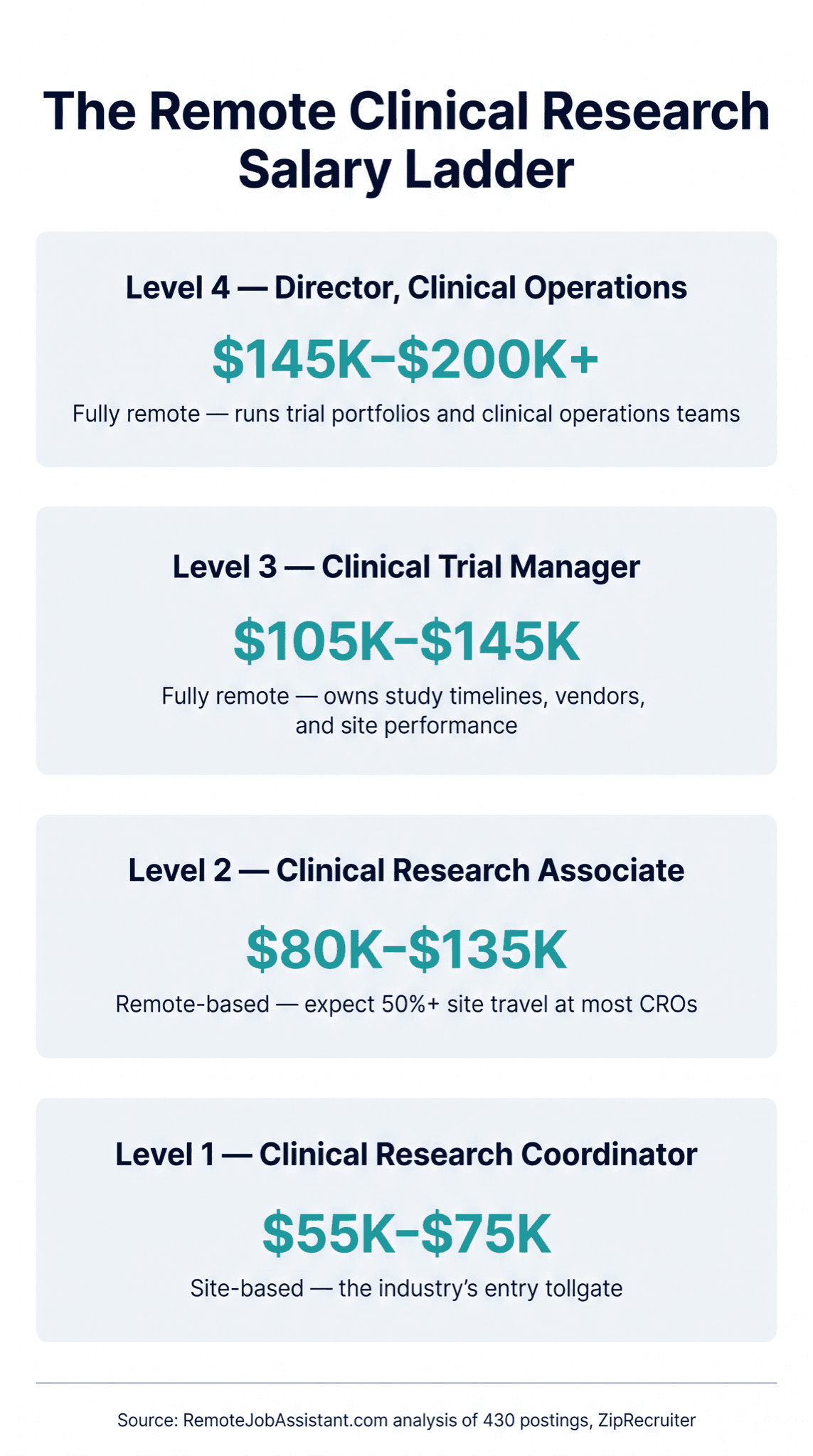
These ranges come from our analysis of 430 remote postings between October 2025 and June 2026, cross-referenced with ZipRecruiter's remote clinical research salary series, which puts the average remote CRA at roughly $94K with a 25th-to-75th percentile spread of $62K to $128K. That spread is wide for a reason: CRO-employed CRAs cluster toward the lower half, sponsor-side CRAs toward the upper, and oncology or rare-disease experience pushes any of these numbers up 10–20%. Ranges shift as markets move — check the linked sources for current figures.
Two things the table understates. First, the Rung 2 to Rung 3 move is not a pay cut disguised as a lifestyle upgrade — clinical data managers average around $119K annualized and clinical trial managers around $130K in ZipRecruiter's mid-2026 remote data, both above the remote CRA average. Second, therapeutic area is the quiet multiplier at every rung. A senior CRA in oncology can out-earn a general clinical trial manager, and postings requiring oncology experience appeared in 31% of our Rung 2 and 3 sample (n=112 of 357).
If your target is a six-figure base with zero travel, the shortest reliable route in our data is clinical data management or clinical trial management at a mid-size CRO or sponsor: both average above $115K remote, and neither requires the 8+ years a director title demands. Openings in the $100K+ remote tier skew heavily toward these two titles plus centralized monitoring leads.
In clinical research, the difference between an $80K job and a $130K job is usually not experience. It's which side of the EDC you sit on — the side entering and chasing data at sites, or the side managing and locking it from home.
Who's Hiring: CROs, Sponsors, and DCT Platforms
Most remote clinical research jobs come through a handful of employer types, and the type you choose shapes your remote experience more than the job title does. 68% of our postings (n=292 of 430) came from CROs and the platforms that serve them; the rest were sponsor-side. Spend an evening in r/clinicalresearch — the most active practitioner community in the field, and worth joining before you apply anywhere — and you'll notice the complaints sort by employer type, not job title: CRO threads are about utilization pressure, sponsor threads are about hiring freezes.
The large CROs — highest posting volume in our sample:
- IQVIA — largest CRO by revenue; hires remote CRAs, data managers, and centralized monitors at steady volume
- Parexel — founding member of the Decentralized Trials & Research Alliance; maintains a dedicated remote clinical trials careers track
- ICON — global CRO hiring remote roles across data management and trial operations
- Syneos Health — runs fully virtual and hybrid decentralized trial models, including decentralized trial project manager roles
- Medpace, Fortrea, Thermo Fisher Scientific (PPD) — consistent remote hiring across monitoring and data functions
CRO work means variety and volume: multiple protocols, multiple sponsors, and a promotion ladder that moves fast if you can absorb the workload. It also means utilization targets — your hours are billable, and the pressure resembles agency life more than lab life.
Sponsor-side and DCT platforms — fewer postings, better retention:
- Science 37 — pioneered the fully virtual trial model built on telemedicine, connected devices, and mobile health tech
- Biotech and pharma sponsors — in-house clinical operations teams increasingly hire remote trial managers and data managers directly rather than borrowing them from CROs
| Factor | CRO | Sponsor |
|---|---|---|
| Remote posting volume | High — most Rung 2 and 3 openings | Lower, more competitive |
| Base pay | Lower band, faster raises | 10–20% higher at equal level |
| Workload | Multi-study, billable-hours pressure | Single pipeline, deeper ownership |
| Best entry point | CRA or CDM with 1–3 years | Rung 3 roles after CRO experience |
The standard career arc runs left to right: build speed at a CRO, then move sponsor-side for pay and sanity. Candidates who try to start sponsor-side without CRO or site experience are competing against people who already have both.
Stop Applying Manually
Our AI applies to hundreds of matching jobs while you sleep. Wake up to interviews, not more applications.
How to Break In — and Get to Rung 3 Faster
The fastest route to a fully remote clinical research career runs through 12–24 months of on-site coordination. The tollgate is real, and there's no fee waiver. Entry-level remote clinical research jobs exist — Indeed showed over 500 listings at last count — but read the duties: most are patient recruitment calls, data entry, or study support, and they rarely ladder up to CRA or data management the way site experience does. The industry trusts people who have touched source documents.
If you're starting from zero, the play is a CRC role at an academic medical center or research site, a GCP certification (free through many institutions), and a deliberate exit at the 18-month mark toward whichever Rung 3 lane fits your strengths. If you're coming from nursing or another clinical license, you're closer than you think — sites hire clinical staff into coordinator roles constantly, and the path from there mirrors the one we map in our remote nursing jobs guide. Utilization review nurses in particular already do remote chart-based work; that skill set transfers, as we covered in our guide to remote utilization review nurse jobs.
Choosing your Rung 3 lane:
- Clinical data management if you like systems and precision. Learn an EDC — Medidata Rave is the most-cited system in our sample (appearing in 41% of CDM postings, n=48 of 117), and Medidata's own eLearning portal is the standard way to get certified before you have an employer paying for it. Get comfortable with SQL for listings review and query metrics. Data-inclined readers weighing options should compare this path against our guide to remote data analyst jobs; clinical data management pays better at equal experience because GCP-regulated data carries compliance weight.
- Clinical trial management if you like running things. The bridge is project coordination on studies: timelines, vendor management, site performance metrics in Excel and CTMS dashboards.
- Regulatory operations or medical writing if you like documents. TMF management is the unglamorous, chronically understaffed entry; medical writing is the better-paid exit for strong writers, and shares DNA with the path in our remote technical writer jobs guide.
Working in a GCP-regulated environment also translates outward: professionals who leave clinical research often land in adjacent regulated fields — the overlap with remote compliance jobs is substantial, since both trades run on audit trails and documented process.
Certifications: ACRP vs. SOCRA
Certification matters more in remote hiring than it did in site-based hiring, for a structural reason: a remote screener can't lean on "they worked at our biggest site" as a trust signal. A credential is a portable one. In our sample, 34% of postings (n=146 of 430) required or preferred certification — concentrated in Rung 2 and 3 roles.
| ACRP (CCRA) | SOCRA (CCRP) | |
|---|---|---|
| Eligibility | 2 years full-time (or 3,500 hours part-time) clinical research experience in the last 5 years | Same experience bar, with academic substitution options |
| Exam cost | $435–$600 depending on membership and timing | $395 members / $450 non-members |
| Recertification | Every 2 years — 24 contact hours or re-exam | Every 3 years — 45 CE hours |
| Remote-friendly detail | Established CRA-specific credential recruiters search by name | Home-proctored exam option; one cert covers both CRC and CRA tracks |
Details and current requirements are on the ACRP certification page and the SOCRA program overview. The honest guidance: neither cert substitutes for experience — both require two years of it before you can sit. Their value is at the transition points: site to CRA, CRA to trial management, CRO to sponsor. Get the cert the year before you want to make the jump, not after.
Stop Applying Manually
Our AI applies to hundreds of matching jobs while you sleep. Wake up to interviews, not more applications.
What Nobody Tells You About Remote Trial Work
The Rung 3 jobs are genuinely remote. They are not genuinely easy, and the friction is specific.
Global trials mean global meeting math. A data manager on a study with sites in three regions will take 6 a.m. calls with European CRAs and 8 p.m. calls with APAC vendors in the same week — not every week, but database lock weeks aren't normal weeks. Query resolution is a grind with a metronome: the same discrepancies, site by site, until the database is clean, and your performance is measured in aging reports that everyone on the study can see.
And the audit trail never blinks. In a GCP environment, every correction, every sign-off, every late entry is timestamped and inspectable. Remote work amplifies this rather than relaxing it, because documentation is how distributed teams prove work happened. People who thrive in it describe the same personality: satisfied by closed loops, unbothered by repetition, allergic to ambiguity.
Travel creep is the industry's quiet attrition engine — and it isn't accidental. A CRO's revenue is billable hours, so when a study hits enrollment trouble, the posted 50% becomes an actual 70%, and some managers will tell you with a straight face that query follow-up trips "don't count as monitoring visits." Before accepting any Rung 2 role, ask the hiring manager one question: "Across your current CRA team, what did actual travel percentages look like over the last six months — not the target, the actuals?" A team that tracks the answer will tell you. A team that dodges it just answered a different way.
The version of this story that fills r/clinicalresearch threads runs the same way every time: accepted a "remote" senior CRA role listing 40% travel, study fell behind enrollment by month four, travel hit 70%, and the CRA was gone within the year. The postings didn't lie, exactly. They just described the study plan, not the study.
None of this is a reason to avoid the field. It's the texture of the work, and knowing it going in is the difference between a career and a two-year detour. The people who leave usually weren't wrong about clinical research — they were wrong about which rung they signed up for.
Frequently Asked Questions
I'm a clinical research coordinator with three years of experience — which remote role should I target first?
You have the most leverage of anyone in this market, because every Rung 2 and Rung 3 role wants site experience and you have it fresh. If you want maximum pay speed, target CRA II roles at large CROs and accept the travel for two to three years. If you want fully remote now, target clinical data manager or centralized monitoring roles — your source-document fluency is exactly what those teams lack.
Are remote CRA jobs actually work-from-home, or do they all require travel?
Mostly the latter: in our analysis of 430 remote clinical research postings, 62% of remote-tagged CRA roles (n=117 of 189) disclosed 50% or more site travel. The exceptions are centralized or in-house CRA roles, which review data remotely and rarely visit sites — search those exact terms rather than "remote CRA" to find them.
How do I tell if a posting is genuinely remote using the Patient-Distance Ladder?
Score it by duties, not title. Patient contact in the responsibilities means Rung 1 (site-bound); site relationships, initiation, or monitoring visits mean Rung 2 (travel-remote); deliverables measured in queries, database locks, TMF completeness, or study timelines mean Rung 3 (fully remote). Thirty seconds of reading the duties beats trusting the word "remote" in the title every time.
Do I need ACRP or SOCRA certification to get a remote clinical research job?
Not to enter — both require two years of experience before you can sit for the exam anyway. In our sample, 34% of postings (n=146 of 430) required or preferred certification, concentrated in CRA and management roles. Time it to the year before a transition: site to CRA, CRA to trial management, or CRO to sponsor.
Can I get into remote clinical research without healthcare experience?
Directly into a fully remote role, rarely — the industry's trust currency is site experience. The realistic path is a site-based coordinator role for 12–24 months, then a deliberate move to data management or trial operations. Career changers from nursing, pharmacy, and lab science move fastest because sites already hire those backgrounds into coordinator seats.
Is clinical data management a better remote career than being a CRA?
Different trade-offs: remote CDMs average around $119K with essentially zero travel, while remote CRAs average around $94K with heavy travel but a faster route to trial management and director titles. If you want the home office permanently, CDM wins. If you're using clinical research as a ladder to clinical operations leadership, CRA experience is still the credential the industry promotes from.
What systems should I learn for remote clinical research jobs?
Medidata Rave appeared in 41% of our clinical data management postings (n=48 of 117), making it the highest-value single system. After that: Veeva Vault for TMF and regulatory work, a CTMS for trial management roles, and enough SQL to self-serve data listings. GCP certification is the free, non-negotiable baseline for everything.
Start Your Remote Clinical Research Career
The ladder is the strategy. Place yourself on it honestly, pick the rung you actually want to live on, and build toward it deliberately — site experience first if you're new, a Rung 3 specialty if you're ready to stop traveling, a sponsor-side move once the CRO has taught you speed. The roles are real and plentiful — LinkedIn listed 6,000+ US remote clinical research jobs in July 2026 — and the pay clears six figures without a director title.
The applying part is where good candidates stall — CRO career portals are slow, repetitive, and numerous. That's a volume problem, and Auto-Apply exists to solve exactly that: it submits applications to matching remote roles while you spend those hours on the two things automation can't do — getting Rave-certified and talking to people who already sit on Rung 3. Browse current openings on our remote job board breakdown, or see how clinical research pay compares across fields in our high-paying remote jobs guide.
The trial doesn't care where the data manager sits. Increasingly, neither does the sponsor.
Ready to Find Your Remote Job?
Browse thousands of curated remote jobs or let AI apply for you.
Browse Remote JobsRelated Job Guides
Remote Physician Jobs: 2026 Salary and Career Path Guide
Remote physician jobs in 2026: six career paths from telemedicine to medical director, real pay from $150K to $300K+, licensing strategy, and who's hiring.
23 min read

Remote Event Planning Jobs: What Actually Goes Remote
Only 12% of event job postings are fully remote and none were titled Event Planner. See which titles actually go remote, what they pay, and how to pivot.
24 min read

Remote Insurance Jobs: Pay, Top Roles, and How to Get Hired
Remote insurance jobs pay $62K-$130K+ by specialty. Real 2025 wage data for adjusters, underwriters, and actuaries — plus which roles are truly remote.
22 min read