
Last reviewed: June 2026
You typed "remote engineering jobs" into a search bar and got a wall of software listings. If you write code, that wall tells you nothing about which specialty pays best from home. If you're a mechanical, electrical, or civil engineer, it quietly tells you that you don't belong here at all.
Both readings are wrong, and the reason is the same. The pages ranking for this term either dump you into a job board or average five unrelated careers into a single number — ZipRecruiter's published average — $115,864 for remote engineers — blends a $250K remote ML engineer with an $80K mostly-onsite civil engineer. Like any single average spanning five unrelated careers, it describes no real job. A blended average is a misleading benchmark, no matter who publishes it.
Get Remote Job Tips in Your Inbox
Weekly strategies, salary data, and new opportunities
Unsubscribe anytime. No spam.
Here's the reframe that actually helps you decide: remote-ability has almost nothing to do with your engineering discipline and almost everything to do with where your work output physically lives. We analyzed 1,420 remote-tagged engineering job postings across 290 companies between January 2025 and May 2026 to map exactly where that line falls — and which roles let you work from anywhere while clearing $120K.
Engineering disciplines whose deliverable is digital — software, DevOps, data, ML, and security — go fully remote and pay $120K–$250K base. Disciplines tied to physical hardware or a job site — hardware bring-up, mechanical, civil — are mostly hybrid or onsite, no matter what the listing claims. The deciding factor isn't your title; it's where your work output lives.
The numbers behind that split are worth keeping handy.
Based on our analysis of 1,420 remote-tagged engineering postings (January 2025–May 2026):
- 78% (n=1,108 of 1,420) were in software, DevOps, data, ML, or security — the disciplines whose deliverable is digital
- 61% (n=190 of 312) of "remote" hardware, electrical, and mechanical postings actually described hybrid schedules with required onsite lab or site time
- 71% (n=1,008 of 1,420) required hands-on experience with at least one cloud platform (AWS, GCP, or Azure)
- 19% median base premium for ML/AI roles over generalist software roles (n=146 ML vs n=520 software postings)
- $120K–$250K median base band across the five remote-native disciplines, cross-referenced with BLS and Levels.fyi
The Artifact Test: Why Some Engineering Goes Remote and Some Doesn't
Stop asking "is my discipline remote-friendly?" It's the wrong question. The right one is: where does my primary deliverable live?
If what you produce is code, a model file, a Terraform config, a schematic in EDA software, or a CAD assembly — anything that lives in a repo, a cloud console, or a design tool — you can produce it from a kitchen table in Boise as easily as a desk in Boston. If what you produce requires you to physically touch a circuit board, calibrate a machine, walk a job site, or stand on a factory floor, no amount of seniority moves that work to your living room.
That's The Artifact Test: a role's remote-ability is set by where its primary deliverable lives, not by its job title. Score any engineering role from 0 to 10.
8–10 — Remote-Native. The deliverable is fully digital and the tools are cloud-based. No physical presence is required to do the core work. Code reviews, model training, infrastructure, and design verification all happen through a screen. Disciplines: software, DevOps/SRE, data, ML/AI, cloud, security, chip front-end and EDA.
4–7 — Remote-Possible (the hybrid reality). The design phase is digital, but the work hits a wall that requires periodic physical validation — hardware bring-up, lab measurement, field calibration. You can be remote three weeks a month and onsite for the fourth. Disciplines: firmware, hardware design, controls, RF, some electrical.
0–3 — Location-Bound. The output requires continuous physical presence. A construction site, a manufacturing line, and a physical prototype don't load over Zoom. Disciplines: civil field engineering, manufacturing/process, structural inspection, plant.
How to use it: Before you apply, score the actual deliverables described in the job posting, not the word "remote" in the title. A "remote" mechanical role that mentions lab access or prototype testing is a 5, not a 9 — expect hybrid. A fake-remote job almost always reveals itself in the responsibilities, never in the headline.
The reason the line falls exactly here is structural, not cultural. Over the last decade, software engineering's entire toolchain moved into the browser — version control, CI/CD, observability, and even IDEs now run in the cloud. A backend engineer's "lab" is a cloud account anyone with credentials can reach. Hardware never got that migration. You cannot SSH into an oscilloscope hooked to a prototype that exists in exactly one building. The disciplines that went remote are the ones whose physical infrastructure dematerialized.
Stop Applying Manually
Our AI applies to hundreds of matching jobs while you sleep. Wake up to interviews, not more applications.
How We Collected This Data
The figures in this post come from our analysis of 1,420 remote-tagged engineering job postings collected between January 2025 and May 2026. Postings were sourced from company career pages and major remote job boards, then filtered to include only positions explicitly marked remote-eligible in the United States and Canada with a posted base salary at or above $75K.
We excluded postings without clear remote policies, roles requiring more than 25% travel, and positions below our target compensation range. We also manually re-read every posting tagged "remote" in hardware, electrical, and mechanical categories to check whether the schedule was genuinely remote or hybrid-with-onsite — that distinction is the difference between 190 of those 312 postings being honestly labeled or not. Salary data was cross-referenced with U.S. Bureau of Labor Statistics and Levels.fyi compensation reports for the same period. Treat the percentages here as directional, not gospel — job postings are a noisy signal, titles mean different things at different companies, and a sample drawn from public boards skews toward roles that companies struggle to fill. The shape of the finding is sturdy; the second decimal place is not. We update this analysis quarterly; data here reflects Q2 2026 figures.
The Remote-Native Engineering Disciplines (and What They Pay)
These are the five engineering specialties that score 8 or higher on The Artifact Test. If you're already in one of them, fully remote work is the default, not a perk you have to negotiate for. If you're trying to choose a direction, this is the menu of remote engineering jobs worth targeting.
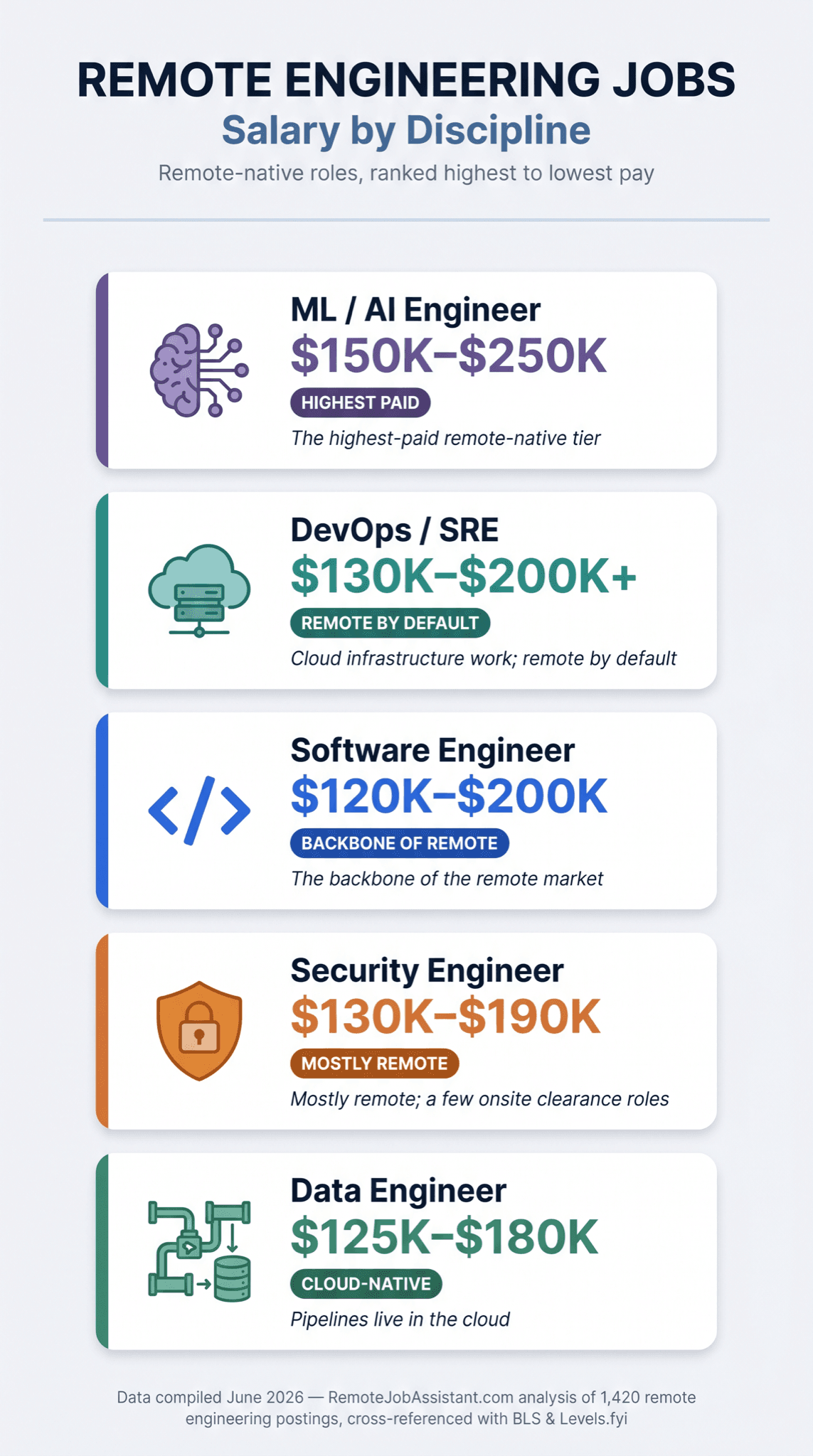
Remote Software Engineering: $120K–$200K
Software engineering is the backbone of the remote market and the anchor everyone else is measured against. The BLS reports a median wage of $133,080 for software developers as of May 2024, and remote-specific bands run higher because a company hiring without a zip-code filter is bidding against every other remote shop for the same engineer. Expect $120K–$200K base, more with specialization — though the high end of that range is increasingly gated behind a single skill (distributed systems, AI infra) rather than years on a resume. Start with our remote software engineer hiring guide or browse live remote software engineer roles.
Remote DevOps and SRE: $130K–$200K+
DevOps and SRE are arguably more remote-native than software itself, because the entire job is managing infrastructure that already lives nowhere physical. Base bands run $130K–$200K+, and the jump to Site Reliability Engineering at scaled companies regularly clears $200K. Our remote DevOps career breakdown covers the on-call tradeoff that actually drives that premium.
Remote Data Engineering: $125K–$180K
Data engineering sits at $125K–$180K. The pipelines you build run in cloud warehouses, so the work is location-indifferent by construction. If you're weighing it against adjacent roles, our remote data engineer guide maps the day-to-day.
Remote ML and AI Engineering: $150K–$250K
ML/AI engineering is the highest-paid tier and the fastest-growing. Our data shows a 19% median base premium over generalist software roles, and Levels.fyi data puts total compensation for senior MLEs well past $250K at the top end. Base bands of $150K–$250K are normal for production ML experience.
Remote Security Engineering: $130K–$190K
Security engineering runs $130K–$190K. Most of it is remote, with a caveat: a subset of roles touching classified systems or specific compliance regimes still require onsite presence. Our remote cybersecurity guide flags which is which.
| Discipline | Artifact Test | Remote base range | Remote reality |
|---|---|---|---|
| Software engineer | 9 | $120K–$200K | Fully remote is standard |
| DevOps / SRE | 9 | $130K–$200K+ | Cloud-native; remote by default |
| ML / AI engineer | 8 | $150K–$250K | Remote-native, highest band |
| Data engineer | 8 | $125K–$180K | Pipelines live in the cloud |
| Security engineer | 8 | $130K–$190K | Mostly remote; some clearance roles onsite |
| Hardware / firmware | 5 | $110K–$170K | Design remote, bring-up onsite |
| Electrical / controls | 5 | $100K–$160K | Simulation remote, validation onsite |
| Mechanical | 4 | approx. $100K | CAD/FEA remote; most roles lab-bound |
| Civil | 2 | approx. $80K | Field-bound; only estimating/BIM subsets remote |
Salary ranges derive from our analysis of 1,420 remote engineering postings between January 2025 and May 2026, cross-referenced with BLS and Levels.fyi compensation data for remote roles at Series B to public companies. We excluded outliers and postings without clear remote policies. Ranges shift as markets move — check the linked sources for current figures.
Stop Applying Manually
Our AI applies to hundreds of matching jobs while you sleep. Wake up to interviews, not more applications.
The Hybrid Disciplines: Where "Remote" Has an Asterisk
This is the section the job boards skip, and it's the one that matters most if you're not a software engineer. These disciplines score 4–7 on The Artifact Test. Remote is possible for part of the work — sometimes most of it — but a fully-remote listing in these fields deserves a hard second look.
Remote Hardware and Firmware Engineering
Hardware and firmware engineers can do schematic capture, RTL, and firmware development from anywhere. The wall arrives at bring-up: the first time real silicon or a real board exists, someone has to sit in front of it with a logic analyzer. Most "remote" firmware roles are genuinely remote for the design cycle and onsite for integration weeks. Base bands of $110K–$170K hold, but plan for a desk somewhere within driving distance of a lab.
Watch for the bait-and-switch here, because it's the most common one in our sample. Spend ten minutes in r/cscareerquestions or on Blind and the same story repeats: a "remote" firmware role that turns into a standing expectation to be in the lab by the end of every quarter. The listing says remote, the recruiter says remote, and the requirement to fly to the lab every three weeks for bring-up surfaces only after you've signed. By the fourth trip it's quietly become "hybrid, permanently." A genuinely remote hardware role tells you exactly how often you're expected onsite — and if the posting won't put a number on it, assume the number is high. Be honest about the incentive driving some of these listings, too: a few "remote" hardware roles exist because a company wants software-market output from someone willing to live near its lab for a lab-market salary. That isn't remote work. It's a relocation with extra steps.
Remote Electrical, RF, and Controls Engineering
Electrical, RF, and controls engineering follows the same pattern. Simulation, modeling, and PCB layout are remote-friendly. Validation against physical equipment is not. A controls engineer can write and test PLC logic in a simulator remotely, then has to commission it on the actual line.
Remote Mechanical Engineering
Mechanical engineering is the hardest case to call. CAD modeling and finite-element analysis are perfectly remote-compatible, and a real niche of simulation and design-verification roles runs fully remote. But BLS data pegs the median near $100K, and the majority of mechanical roles stay tethered to a lab or shop floor where prototypes get built and broken.
If you're a civil, manufacturing, or process engineer, the "remote engineering jobs" you see in your field are usually a narrow subset — estimating, BIM coordination, or design — not the core role. Civil field engineering scores a 2 on The Artifact Test for a reason a job board will never tell you: you cannot inspect a bridge from your couch. Chasing fully-remote listings in a location-bound discipline is how you spend six months applying to roles that were always going to want you onsite by month three.
What Remote-Native Engineering Roles Actually Require
Scoring high on The Artifact Test gets a role into the remote-eligible pile. Getting hired into it is a separate filter, and remote-native teams screen for things in-office teams don't.
The cloud baseline is non-negotiable. Across our sample, 71% (n=1,008 of 1,420) of postings required hands-on experience with AWS, GCP, or Azure — and in the remote-native disciplines, that number is effectively universal. Put plainly: if you can't operate in one of the three big clouds, you're not in the conversation for a remote engineering role right now. The cloud account is the office, and you're asking to work somewhere you can't badge into. If you're targeting engineering and technical roles or data and analytics positions, a current cloud certification is the cheapest credibility you can buy.
Async communication is a hard skill here, not a soft one. Distributed engineering teams make decisions in writing — in pull request descriptions, design docs, and incident retros — because the team spans time zones and nobody can call a meeting that works for everyone. The gap shows up in a single pull request. "Fixed the bug" tells a reviewer in another time zone nothing; they have to wait twelve hours just to ask which bug. "Fixes the race condition in the payment retry loop — root cause was a missing idempotency key; repro steps and the failing test are linked below" closes the loop without a meeting. The pull request description is the new whiteboard, and the engineer who writes the second version ships across time zones while the one who writes the first is still waiting for someone to wake up and reply.
Your portfolio has to survive the ATS before it survives a human. Remote roles pull national applicant pools — hundreds of resumes per posting — so the first reader is a keyword filter. Repo links, specific tool names from the job description, and quantified outcomes beat adjectives. "Built event-driven pipelines in Kafka and Snowflake processing 40M daily events" gets through; "passionate problem-solver" does not.
Stop Applying Manually
Our AI applies to hundreds of matching jobs while you sleep. Wake up to interviews, not more applications.
Breaking Into Remote Engineering: Moving Up The Artifact Test
If you're in a 4–7 discipline and you want fully-remote work, the move isn't to quit engineering — it's to shift your deliverable toward the digital end of your own field. The Artifact Test is a ladder, not a verdict.
A mechanical engineer who pivots into simulation, PLM tooling, or CAE automation moves from a 4 to an 8 without leaving mechanical engineering. An electrical engineer who moves from board bring-up into embedded firmware or EDA tooling does the same. A controls engineer who specializes in digital-twin modeling trades the commissioning trip for a remote seat. In each case you're not abandoning your domain expertise — you're relocating the artifact from the physical world to the repo, and your remote-ability score climbs with it.
That shift usually comes with a raise, too, because you're moving toward the compensation gravity of the software market. Roles in the $100K-plus and $150K-plus bands cluster heavily in the remote-native disciplines for exactly the reason this whole post has been making: when your output lives in the cloud, your employer pool stops being "companies within commuting distance" and becomes "companies, period."
One caveat nobody likes to say out loud: as remote engineering matured, a lot of companies quietly swapped "we pay the best rate" for "we pay your metro's rate." Geo-banded comp claws back part of the remote premium for engineers in lower-cost areas, and it's spreading. The leverage is still real — but it's strongest for the people whose skills are scarce enough that a company will break its own pay bands to land them. "Remote" got you a national job market; it didn't guarantee you a national salary. The specialists still set their own price; the generalists increasingly get priced by their zip code.
Frequently Asked Questions
I'm a mechanical engineer — are there genuinely remote roles, or is it all hybrid?
Both exist, but the split is uneven. Fully-remote mechanical roles cluster in simulation, finite-element analysis, CAE automation, and design verification — work whose deliverable is a model file, not a physical prototype. The majority of mechanical postings stay hybrid or onsite because prototype building and lab testing require your hands on hardware. If a "remote" mechanical listing mentions lab access or prototype work, treat it as hybrid.
Which engineering discipline is easiest to do fully remote and still pay six figures?
DevOps and SRE, closely followed by software and data engineering. DevOps scores a 9 on The Artifact Test because the entire job is managing cloud infrastructure that has no physical location — there's literally nothing to be onsite for. Base bands run $130K–$200K+, and the work is remote by default rather than by negotiation.
How do I tell if a "remote" engineering job is actually remote before I apply?
Read the responsibilities, not the headline, and run them through The Artifact Test. If the core deliverables are code, models, configs, or cloud infrastructure, it's genuinely remote. If you see "lab access," "prototype testing," "field measurement," "onsite commissioning," or "hardware bring-up," it's hybrid wearing a remote label. In our sample, 61% (n=190 of 312) of remote-tagged hardware and mechanical roles were actually hybrid on close reading.
What does an Artifact Test score of 5 mean for my day-to-day?
A 5 means remote-possible with a recurring onsite requirement. You'll do design, simulation, and documentation from home — typically the bulk of your hours — but you'll need to be physically present for validation phases like hardware bring-up or equipment commissioning. Practically, plan to live within driving distance of a lab or facility and expect onsite weeks clustered around project milestones.
Do remote engineers get paid less than in-office engineers?
No — in the remote-native disciplines, the opposite is common. Remote-first companies compete in a national talent pool, which pushes bands up rather than down. Our analysis found a $120K–$250K median base across the five remote-native disciplines, and ML/AI roles carried a 19% median premium over generalist software roles (n=146 of 1,420 postings). The pay penalty shows up only in location-bound fields where "remote" was never the core role.
Is it too late to switch from a location-bound engineering field into a remote-native one?
It's rarely too late, and you don't have to start over. The efficient move is to relocate your deliverable toward the digital end of your existing discipline — mechanical into simulation, electrical into embedded firmware, controls into digital-twin modeling. You keep your domain expertise and climb The Artifact Test at the same time, usually with a salary bump as you move toward the software market's compensation gravity.
Start Your Remote Engineering Job Search
The "average remote engineer salary" you'll see quoted everywhere is a fiction — it blends careers that have nothing in common except a word on a business card. The useful question was never "what do remote engineers make." It's "where does my work live, and can I move it somewhere a job site can't reach."
If your answer puts you in the remote-native tier, the roles are real and the pay is real. Skip the job-board scroll and let our auto-apply tool put your application in front of remote-first engineering teams while you sleep, or browse current remote software engineer openings and engineering and technical roles to see what's live right now.
Your title doesn't decide where you work. Your deliverables do — and increasingly, they live somewhere a job site can't reach.
Ready to Find Your Remote Job?
Browse thousands of curated remote jobs or let AI apply for you.
Browse Remote JobsRelated Job Guides
Remote Physician Jobs: 2026 Salary and Career Path Guide
Remote physician jobs in 2026: six career paths from telemedicine to medical director, real pay from $150K to $300K+, licensing strategy, and who's hiring.
23 min read
Remote Event Planning Jobs: What Actually Goes Remote
Only 12% of event job postings are fully remote and none were titled Event Planner. See which titles actually go remote, what they pay, and how to pivot.
24 min read

Remote Insurance Jobs: Pay, Top Roles, and How to Get Hired
Remote insurance jobs pay $62K-$130K+ by specialty. Real 2025 wage data for adjusters, underwriters, and actuaries — plus which roles are truly remote.
22 min read