
Last reviewed: September 2026
You run onboarding for people you may never meet in person. You have verified an I-9 over a video call, rebuilt a Workday business process the night before payroll locked, and walked a manager through a performance conversation from your kitchen table. Then the memo lands, or the layoff does, and you type "remote people operations jobs" into a search bar expecting a market built for exactly what you do.
What comes back is a grid. Glassdoor says 18,961 openings. ZipRecruiter prices the whole thing at "$17–$41/hr." Wellfound shows 1,360 listings. None of them tells you the one thing that decides your odds: people operations is not one job, and the seat most people mean when they say "people ops" is the one least likely to be remote.
Get Remote Job Tips in Your Inbox
Weekly strategies, salary data, and new opportunities
Unsubscribe anytime. No spam.
The remote seats exist. They sit on one side of a line that runs through every People team, and the employers who post them say so in the fourth paragraph of the job description, not in the location field.
We read 259 US people-operations postings across 137 employers on public Greenhouse, Lever, Ashby and SmartRecruiters boards on September 22, 2026, and classified every one from the description body, not the location tag. Here is what they say.
Based on 259 US people-function postings at 137 employers, read from their ATS feeds on September 22, 2026:
- 17% (n=44 of 259) are remote at the role level after reading the body; 87 are hybrid, 20 are explicitly on-site, and 92 list an office with no work-model statement
- Generalist core (people ops associate/specialist/generalist/manager, HR generalist) is remote in 9% (n=4 of 44); HRIS and people systems 27% (n=12 of 45); total rewards 22% (n=18 of 81); HR business partners 14% (n=8 of 59); employee relations 0 of 11
- 68% of the remote postings (n=30 of 44) are total rewards or HRIS roles
- 16 of 259 say remote somewhere the body does not back up: 12 carry only an ATS remote flag, 4 pair a remote location with a hybrid body
- Posted base medians: generalist core $87K–$111K (n=22), HRBP $125K–$185K (n=33), HRIS $127K–$192K (n=32), total rewards $138K–$197K (n=53)
- Workday is named in 92 of 259 postings; any HR certification (SHRM, PHR/HRCI, CCP/CBP) in 25 of 259
- 60% (n=155 of 259) publish a pay range; 80% of the remote ones do (n=35 of 44)
The Spreadsheet Line
Every People team has two kinds of work. One kind ends in a file: a merit-cycle model, a benefits renewal, a Workday business process, a headcount dashboard, a leave-policy SOP. The other kind ends in a room: an employee-relations interview, a site walk, a new hire's first morning, the manager who needs to be told something face to face. The first kind moved to laptops years ago and stayed there. The second kind is what companies mean when they say they want HR "present."
The Spreadsheet Line is our 1–10 score for how remote-portable a people-ops seat is, read from two things a posting tells you: where the role's output lives, and what the employer writes about office days.
8–10: Spreadsheet Side (remote-portable; remote medians of $115K–$160K in total rewards and $126K–$193K in HRIS). The deliverable is a model, a configured system, or a report. The posting names a tool (Workday, Pave, Carta, SQL, Tableau) in its first half, has no day count, and the location reads "Remote - US" or "Anywhere in the United States." Figma's HRIS Analyst "can be held from one of our US hubs or remotely in the United States." Measured: HRIS 12 of 45 remote, total rewards 18 of 81.
4–7: On the Line (remote at remote-first employers, hybrid elsewhere; HRBP posted median $125K–$185K). The deliverable is advice to leaders. Coinbase posts its HRBP as "remote-first, but not remote-only" with quarterly in-person "surges"; Stripe posts its People Partner at "50% on-site presence." The same title scores a 7 at one and a 4 at the other. Measured: HRBP 8 of 59 remote.
1–3: Room Side (office-anchored; posted medians run $66K–$73K for workplace roles and $120K–$175K for employee relations). The deliverable is a conversation or a physical space: investigations, workplace experience, site HR, in-person onboarding, and the generalist seat that absorbs all of them. The posting states a day count, "on-site," or a plant or HQ city. SpaceX's HR investigator postings say "Remote or hybrid work will NOT be considered." Measured: generalist core 4 of 44, employee relations 0 of 11, workplace 0 of 8.
How to use it: score your current seat by where your last ten deliverables lived, then score each posting the same way before you look at the employer's reputation for flexibility. A 3 at a remote-first company is still a 3.
Why is the generalist seat on the room side even at companies that let engineers stay home? Because the generalist is the company's in-person safety net. Employee-relations intake, leave cases, badge and onboarding logistics, and the manager who walks over after a bad one-on-one all land on that desk. And when a company decides to bring people back, the People team writes the memo, enforces it, and is usually the first function held to it. Verkada's People Operations Associate posting says it plainly: "This role requires that you be on-site at our office in San Mateo, CA 5 days a week."
The exception shows the rule. Chainguard posts a remote Director of People Operations whose job includes managing an Employer of Record "given our reliance on remote employees across roughly 19 countries." When the whole company is distributed, there is no room to be in, and the generalist seat crosses the line with everyone else.
Stop Applying Manually
Our AI applies to hundreds of matching jobs while you sleep. Wake up to interviews, not more applications.
How We Collected This Data
This is a tech-sector sample, so read it as one. The four ATS platforms we can query openly are where venture-backed software, fintech and SaaS companies post. Enterprise employers on Workday's own career sites and mid-market employers on iCIMS, ADP, Paycom and UKG are mostly missing, which means hospital, manufacturing and school-district HR is barely here. Reddit, Glassdoor and ZipRecruiter detail pages block automated reading, so their numbers appear only as the headline counts on their search pages.
On September 22, 2026 we queried the public job APIs of Greenhouse, Lever, Ashby and SmartRecruiters for 1,998 company names. 2,588 boards answered with 46,553 live postings. We kept people-function titles (people operations, HR generalist, HR business partner and people partner, total rewards, compensation and benefits, HRIS, people systems and analytics, employee relations, workplace experience, and people leadership) and removed "people" and "benefits" titles that are not HR jobs: home-care aides, restaurant shifts, and insurance-product benefits roles. We dropped non-US and intern postings and deduplicated. That left 259 postings at 137 employers.
Work model came from the description body first. A negation ("This is not a remote position") counted as on-site. A role-specific statement ("This role is remote," "or remotely in the United States") counted as remote. A day count, a percentage on-site, or a "#LI-Hybrid" tag counted as hybrid. Twelve postings with only an ATS remote flag were not counted as remote. Pay figures are employer-posted base ranges only (n=155), cross-referenced with O*NET's summary of BLS wage data for HR specialists and the HR manager and compensation manager series. We will re-run the sweep quarterly.
Which People Ops Specialties Actually Go Remote
The split is by specialty, and it is not close. Sort the function by the Spreadsheet Line and the remote share falls in almost exactly that order.
| Specialty | US postings | Remote | Remote share | Posted base median (n) | Spreadsheet Line band |
|---|---|---|---|---|---|
| HRIS / people systems & analytics | 45 | 12 | 27% | $127K–$192K (32) | 8–10 |
| Total rewards (comp & benefits) | 81 | 18 | 22% | $138K–$197K (53) | 8–10 |
| People leadership (Head, VP, Director) | 11 | 2 | 18% | $200K–$270K (8) | 4–7 |
| HR business partner / people partner | 59 | 8 | 14% | $125K–$185K (33) | 4–7 |
| Generalist core | 44 | 4 | 9% | $87K–$111K (22) | 1–3 |
| Employee relations | 11 | 0 | 0% | $120K–$175K (5) | 1–3 |
| Workplace / employee experience | 8 | 0 | 0% | $66K–$73K (2) | 1–3 |
HRIS and people systems is the most remote corner of the function: 27% (n=12 of 45). Workday appears in 34 of those 45 postings. The remote ones came from Figma, Oura, Pie Insurance, Twilio, Consensys, Greenhouse, Samsara, Smartsheet, GitLab, Mercury and Ro. The reason is structural: the output is a configured tenant, and the tenant is the office. Nobody needs to watch you build a calculated field.
Total rewards is the largest remote pool by count, 18 of 81 postings. Chainguard, Webflow, Cloudflare, ZipRecruiter, MongoDB, 1Password, 6sense, Pie Insurance, Cision, KnowBe4, Experian, Samsara and Highwire all posted remote compensation or benefits roles, and Ashby, Bestow, Mixpanel, Paxos and Tekion posted remote roles without a range. Sales compensation is the most remote slice inside it, because the sales teams it pays are already spread across the country. A merit cycle is a spreadsheet and a calendar.
HR business partners sit on the line. 8 of 59 are remote: Coinbase, Instacart, Pie Insurance, Bloomreach, Fivetran, Customer.io, KnowBe4 and Salesloft. Stripe, Smartsheet, Chime, Brex and Toast posted theirs hybrid. What decides it is where your client group sits. An HRBP supporting a distributed go-to-market team can be remote; one supporting an R&D org that badges in four days a week cannot.
The generalist core is the thin end. Only Oklo ("This role can be remote but, we are seeking someone who is located in the Eastern Standard Timezone"), Mixpanel, Headway and Stripe posted remote generalist-track roles. Employee relations was 0 of 11, and workplace experience 0 of 8: Stripe's Workplace Experience Manager runs "20+ global office locations," which is the job description of someone who has to be in one of them.
The generalist seat is the least remote job in People Operations: 4 of 44 postings. The remote seats sit on the spreadsheet side of the function, where comp and HRIS hold 30 of the 44.
Why "Remote, USA" Doesn't Always Mean Remote
Sixteen of the 259 postings say remote somewhere the body does not support. Reading one paragraph further saves you the application.
The location says remote; the body says days. Smartsheet lists its People Business Partner at "-REMOTE, USA-" and then writes, "This is a hybrid role requiring three days per week in our Bellevue, WA office." Salesloft lists a People Operations Generalist at "United States, Remote" and tags the body "#LI-HYBRID." Toast lists "Remote - USA" above "We embrace a hybrid work model." Form Energy lists "Remote (USA)" and tags "#LI-Hybrid."
The ATS flag has nothing behind it. Twelve postings, including roles at Airwallex, Harvey, Ironclad, Plaid, Ramp, OpenAI and Socure, were flagged remote by the applicant tracking system while listing a single city and saying nothing about remote in the text. Where the body does speak, it says the opposite. Harvey's People Business Partner needs the "ability to work from our San Francisco office at least three days per week." Replit's Director of Compensation Strategy carries "an in-office requirement of Monday, Wednesday, and Friday."
Remote, with conditions. Oura's remote Senior HRIS Analyst is "not considering candidates residing in" eight states: Alaska, Delaware, Iowa, Mississippi, Nebraska, South Dakota, West Virginia and Wisconsin. Samsara's remote Sales Compensation Manager is open to anyone "in the US except SF Bay Area Metro (CA), NYC Metro (NY), or Washington DC Metro." Coinbase expects you at quarterly in-person sessions, and 1Password says "travel for in-person engagement is a part of almost all roles."
Why are people-ops postings written this way? One requisition gets posted to several office locations plus a "Remote" row to widen the candidate pool, while the actual work-model rule lives in the People team's own policy and gets pasted lower in the description. The location field is a search filter. The state exclusions are something else: each new state means payroll registration, unemployment insurance and a new set of leave and pay laws, and a People team that lists eight states it will not hire in is showing you its compliance budget.
"days per week" finds the office rule when it exists (Smartsheet: three, Lyft: three, Chime: four). "on-site" and "onsite" find the flat no (Verkada, SpaceX). "#LI-" finds the LinkedIn tag, which usually tells the truth even when the location field doesn't: Salesloft's "Remote" generalist carries #LI-HYBRID. "residing in" or "not considering candidates" finds state and metro exclusions (Oura, Samsara). If none of the four appears and the location is a single city, treat the job as office-based until a recruiter says otherwise.
A people-ops posting that says "Remote, USA" in the location and "three days per week in our Bellevue office" in paragraph four is a hybrid job with a wider recruiting funnel.
Stop Applying Manually
Our AI applies to hundreds of matching jobs while you sleep. Wake up to interviews, not more applications.
What Remote People Operations Jobs Actually Pay
The pay gap in people ops runs between specialties, not between remote and office. At the midpoint of the posted medians, the generalist core sits about $56K below HR business partners and about $68K below total rewards.
| Specialty | All US posted median (n) | Remote posted median (n) | Remote examples with posted base |
|---|---|---|---|
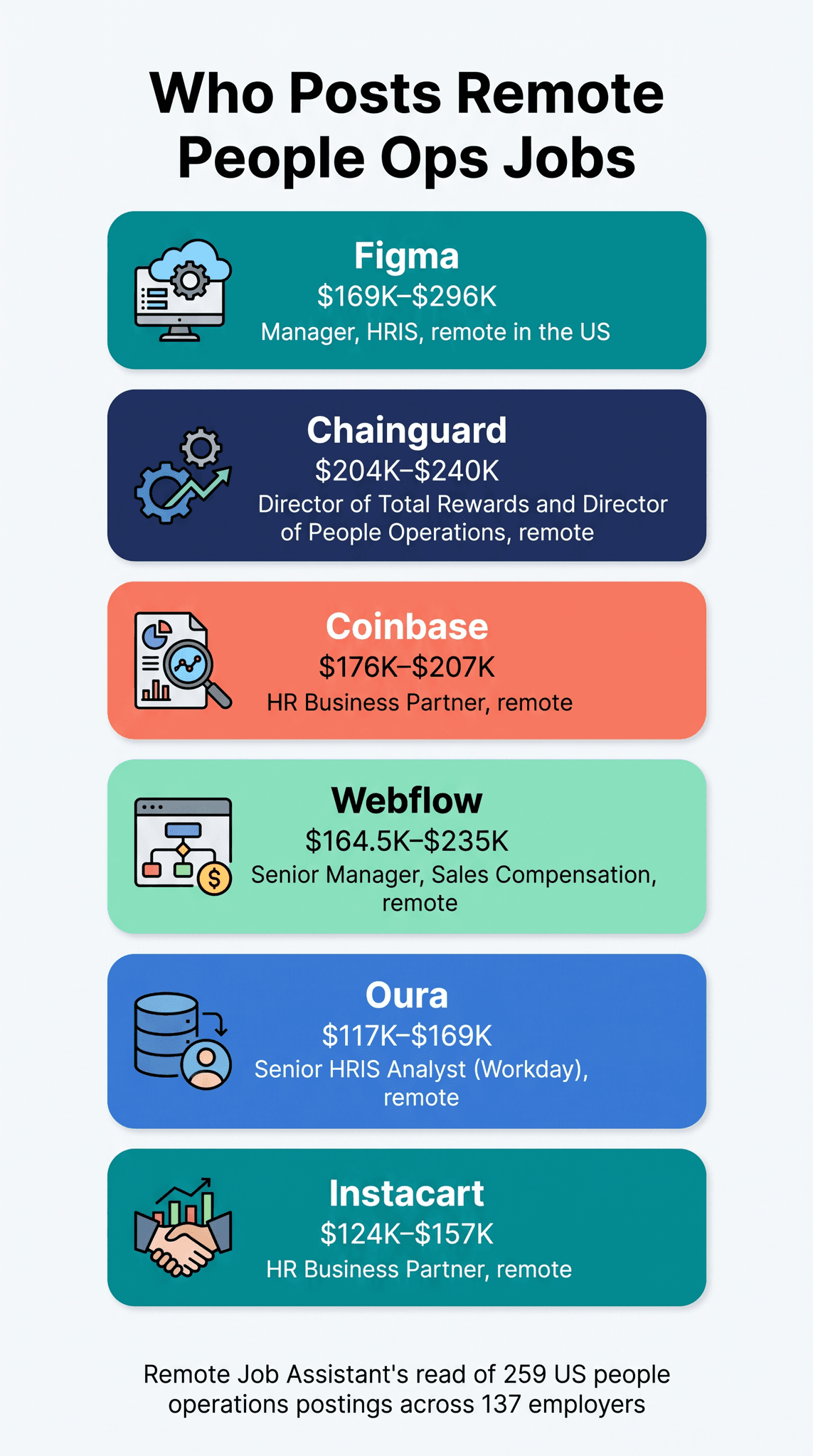
| Total rewards | $138K–$197K (53) | $115K–$160K (13) | Chainguard Director of Total Rewards $204K–$240K; Webflow Sr. Manager, Sales Comp $164.5K–$235K; KnowBe4 Total Rewards Analyst $95K–$115K |
| HRIS / people systems | $127K–$192K (32) | $126K–$193K (11) | Figma Manager, HRIS $169K–$296K; Oura Sr. HRIS Analyst $117K–$169K; Pie Insurance Sr. HRIS Analyst $110K–$140K |
| HR business partner | $125K–$185K (33) | $120K–$148K (8) | Coinbase HRBP $176K–$207K; Instacart HRBP $124K–$157K; Customer.io People Partner $100K–$130K |
| Generalist core | $87K–$111K (22) | one posting | Oklo People Operations Associate $85K–$105K |
| People leadership | $200K–$270K (8) | two postings | Affirm VP, People BP & Employee Relations $340K–$380K; Chainguard Director of People Operations $204K–$240K |
These are employer-posted base ranges from the 155 of 259 postings that publish one, collected September 22, 2026. Where a posting lists regional bands, we used the lowest low and the highest high. Bonus and equity are excluded. These are tech-sector numbers, from tech-sector employers.
Why do remote total-rewards medians sit below the all-US figure? Composition. The remote pool includes analyst-level seats at KnowBe4 and Experian and a benefits manager at Cision; the office-listed pool is heavier with senior compensation managers at Databricks, Block and Airbnb. At the same rung, remote and office pay line up: Webflow's remote Senior Manager of Sales Compensation posts $164.5K–$235K, and Okta's office-listed Senior Manager of GTM Compensation Strategy posts $155K–$239K.
ZipRecruiter's "$17–$41/hr" works out to roughly $35K–$85K a year. That band describes HR assistants and coordinators, not the people-ops seats employers post with a range. According to O*NET's BLS-sourced figures for human resources managers, the 2025 national median was $149,280, and HR specialists sat at $75,940. Compensation and benefits managers posted a $149,230 median, while compensation, benefits and job analysis specialists sat at $78,210. The posted ranges above run higher than the specialist medians because the BLS series counts every hospital, school district and plant, and our sample is software companies that pay to compete for engineers.
Watch for regional bands. Eight postings, from Block, Databricks, Oura, Toast and Webflow, publish pay by geography. Oura's remote HRIS role posts Region 1 at $143,650–$169,000 and Region 3 at $117,300–$138,000, about 18% lower for the same job. Ask which region your address maps to before you name a number. If you are comparing offers across this family, our guide to roles paying over $150K and the broader list of remote roles above $100K show where these bands sit against other functions.
SHRM, PHR, or Workday: What to Learn Next
Postings reward systems fluency far more than certifications. Here is what the 259 postings name:
| Named in the posting | Postings (of 259) |
|---|---|
| Workday | 92 |
| Excel | 49 |
| Greenhouse (ATS) | 30 |
| SQL | 21 |
| Pave | 16 |
| Google Sheets | 16 |
| SHRM (any) | 17 |
| PHR / HRCI | 14 |
| CCP / CBP / WorldatWork | 8 |
| Any HR certification | 25 |
Workday shows up by specialty in 34 of 45 HRIS postings, 25 of 81 total-rewards postings, 13 of 44 generalist postings and 12 of 59 HRBP postings. Why the gap with certifications? At a venture-backed company, people ops runs on a system of record. The certification proves you know employment law, which the hiring manager already assumes from your years. The system is what you will touch on day one, and the thing that breaks if you don't know it.
Workday showed up in 92 of 259 people-ops postings. Every HR certification combined showed up in 25. If you have one weekend to spend, spend it in Workday.
"Knows Workday" means something specific in these postings, and it isn't running reports. Oura's remote Senior HRIS Analyst will "configure, test, and deploy Workday business processes (e.g., hire, job changes, compensation, terminations, absence, performance) end-to-end, including conditional rules, routing, notifications, and approval chains." Figma's HRIS Analyst covers "reporting, security, EIBs, notifications, and alerts" and maintains "Workday security roles and role assignments… with SOX and security best practices." If you can explain how you'd add an approval step to a job-change business process, load a mass change through an EIB, and scope a security group so a manager sees comp for their own team only, you can hold the interview. If you've only ever clicked "Run Report," you have a weekend of sandbox work ahead of you.
Generalist aiming at HRIS: learn Workday configuration (business processes, EIB loads, calculated fields) plus one reporting tool, SQL or Tableau. A certification is optional.
Generalist aiming at total rewards: build Excel or Sheets modeling to merit-cycle depth, and get exposure to Pave or Carta. The WorldatWork Certified Compensation Professional credential matters mainly for comp-only teams; 8 of 259 postings mention it.
Aiming at HRBP: keep SHRM-CP or PHR if you already hold it. Don't sit for it to land a remote job: SHRM appears in 17 of 259 postings, and in 4 of the 44 remote ones.
Always: never let a "preferred" certification line stop an application.
If your applications are going out and nothing is coming back, the problem is usually upstream of the resume. Our breakdown of why you're not getting interviews covers the filters most people never see.
Stop Applying Manually
Our AI applies to hundreds of matching jobs while you sleep. Wake up to interviews, not more applications.
Moving Across the Spreadsheet Line
The fastest route to a remote people-ops seat is a specialty move, not a title move. Each bridge has a specific cost.
Generalist to HRIS analyst. You already own the business processes you would be configuring, which is the part most HRIS candidates have to learn. The cost is a lateral-looking title: you will likely move from "Manager" to "Analyst," but into a higher band ($127K–$192K posted median against $87K–$111K for the generalist core). The second cost is the work itself. Figma's HRIS Analyst posting includes "Manage the HRIS support ticket queue, triaging requests, resolving system issues," and 7 of 45 HRIS postings mention tickets, a queue, or ServiceNow. Once the implementation is done, a lot of HRIS work is a queue. Ask how many tickets the team closes a week and who else works them. Bring proof: a business process you rebuilt, an integration you owned end to end, and a report leadership actually used.
Generalist to total rewards. Start with benefits, not comp. Open enrollment and broker renewals are already generalist work, and 17 of 259 postings name a broker relationship. The cost is the analytics bar: SQL appears in 21 of 259 postings, and merit-cycle modeling is assumed. KnowBe4's remote Total Rewards Analyst at $95K–$115K is what the entry door looks like: "Manage the benefits renewal process across Americas countries, coordinating with brokers, vendors," plus "the annual merit increase cycle, including data validation, calculations, and communications." That is a generalist's benefits calendar with a spreadsheet attached.
Generalist to HRBP at a remote-first company. Target client groups that are already distributed: sales, customer success, support. The cost is the interview loop, which tests business judgment and employee-relations calls rather than process knowledge. Bring two investigations you ran and one org design you led, and our notes on remote operations jobs cover the adjacent seats where the same skills transfer.
Check the years before you apply. The median experience ask (the first "N+ years" in each posting) was 4 years for the generalist core (n=35 postings stating one), 5 for HRIS (n=36), 7 for total rewards (n=66) and 8 for HRBP (n=45). HRIS is the shortest step up from a generalist seat; an HRBP move usually means applying one level below your current title.
If most of your last ten deliverables were investigations, onboarding logistics, and manager escalations, a move to HRIS or total rewards is a restart on the tools, not a promotion. Budget for a title that reads one level lower and a first year spent proving the system or model work you haven't been paid to do yet. The pay band usually rises anyway, because the lane you're moving into is priced higher.
Remote people ops carries operational work an office team never sees, and knowing it is how you show you've done the job. Remote I-9 verification is one example. Under the USCIS rule on remote examination of documents, only an employer that participates in E-Verify "in good standing" can examine documents remotely. It must review copies, hold a live video interaction with the employee, and keep clear copies on file. It may offer the procedure "for remote hires only" as long as it applies it consistently at a site. Seven of the 44 remote postings carry an E-Verify participation notice, and Mixpanel and Oklo put I-9 administration directly in the duties. Multi-state compliance shows up in 12 of 259 postings; Oklo asks you to "support compliance with federal, multi-state, and local employment laws."
Ask one question per band in your interviews:
- Room Side (1–3): "Which parts of this role need someone in the building each week, and how many days is that?"
- On the Line (4–7): "Where do the leaders I'd support sit, and how often are they together?"
- Spreadsheet Side (8–10): "Which system is the source of truth, and who owns its configuration today?"
For the recruiting side of the People team, see our guide to remote recruiter jobs. Payroll specialists should read our remote payroll jobs breakdown, and if you are weighing a move into training, start with remote learning and development roles.
Frequently Asked Questions
I'm an HR generalist with five years of experience. Why can't I find a remote people operations job?
Because the generalist seat is the least remote job in the function. In our September 2026 sweep, only 9% of generalist-track postings were remote (n=4 of 44), while total rewards and HRIS accounted for 30 of the 44 remote postings. Your experience is an asset for moving into HRIS, benefits, or an HRBP seat at a remote-first company, and those are where the remote openings are.
Is total rewards or HRIS the better path if I want to stay remote in HR?
Both work. HRIS has the higher remote share (27%, n=12 of 45) and total rewards has more remote openings by count (18 of 81). Posted medians are close, $127K–$192K for HRIS and $138K–$197K for total rewards. Pick HRIS if you like configuring systems; pick total rewards if you like modeling and vendor work.
Do I need SHRM-CP or PHR to get a remote people ops job?
Rarely. Any HR certification appeared in 25 of 259 postings, and SHRM in 4 of the 44 remote ones, while Workday appeared in 92 of 259. A certification helps most for HRBP roles at companies that ask for it; for remote HRIS and total rewards seats, system and modeling skills matter more.
How much does a remote HR business partner make?
Across 33 US HRBP postings with a published range, the median was $125K–$185K base; the 8 remote ones had a median of $120K–$148K. Examples include Coinbase at $176K–$207K and Instacart at $124K–$157K. Senior and principal HRBP titles run higher.
Where does my current role fall on the Spreadsheet Line?
Look at your last ten deliverables. If most were models, system changes, or reports, you're on the Spreadsheet Side (8–10) and remote-portable. If most were advice to leaders, you're On the Line (4–7), and remote depends on where your client group sits. If most were conversations, investigations, or in-person logistics, you're on the Room Side (1–3), and a remote search starts with a specialty move.
What's the difference between people operations and HR, and does the title change the pay?
"People operations" is mostly a startup name for the HR function, and the title alone changes little. The specialty inside it drives pay: generalist-core postings had a median of $87K–$111K (n=22) against $125K–$185K for HRBPs and $138K–$197K for total rewards. The BLS medians show the same split, $75,940 for HR specialists against $149,280 for HR managers.
How can I tell if a remote HR job is actually remote?
Read past the location field. 16 of 259 postings said remote somewhere the body didn't support. Search the description for "days per week," "on-site," the "#LI-" tag, and "residing in," which is where state and metro exclusions hide.
Start Your Remote People Operations Job Search
Score the seat before you score the employer. Search the four strings before you apply. Then pick the specialty you can credibly move into in six months, whether that's HRIS, benefits, or an HRBP seat supporting a distributed team, and aim your applications there.
Browse current HR and recruiting openings and operations manager roles, and if people analytics is the bridge you want, the data analyst openings use the same SQL and dashboard skills. Our remote HR jobs guide covers the wider function, the remote compliance jobs guide covers the employment-law side, and if benefits are part of what you're negotiating, see our list of remote jobs with strong benefits. When you're ready to apply at volume without losing your evenings to forms, Remote Job Assistant's auto-apply sends applications to roles that match your filters.
The room-side work of HR still needs a room. The spreadsheet-side work only needs the spreadsheet, and that's where the remote people-ops jobs went.
Ready to Find Your Remote Job?
Browse thousands of curated remote jobs or let AI apply for you.
Browse Remote JobsRelated Job Guides
Remote Business Development Jobs: Four Jobs, One Title
We read 286 US business development postings across 138 employer boards. Four jobs share the title; only one is reliably remote. Pay by seat and the 3-day trap.
32 min read

Remote Regulatory Affairs Jobs: Who Actually Posts Them
We read 184 US regulatory affairs postings on 47 employer boards. Only 14% were remote, none at the 12 biggest posters. Pay by level, plus the hub-office trap.
32 min read
Remote Actuary Jobs: Which Lines of Insurance Go Remote
We analyzed 153 US actuarial postings across 42 insurer boards. Health plans post 70% of roles remote, carriers 15%. Real pay by level and the hub-office trap.
32 min read