
Last reviewed: November 2026
You've run the kickoff, cleaned the customer's CSV twice, and sat on the 6 a.m. go-live call while their admin found the one field nobody mapped. So you search "remote implementation specialist jobs." LinkedIn's results page says 11,000+, but only 29 of its first 60 cards carry the word "implementation." The rest are SAP, NetSuite, Dynamics, UKG and Workday consultant seats doing the same work under a product name. The posted ranges in our set run from $41,300-$58,000 for Paylocity's on-site talent-and-HR implementation desk in Meridian, Idaho, to $100,400-$205,300 for Crowe's hybrid HCM payroll implementation lead.
Then two postings land in the same feed. Both are titled Implementation Specialist, both are remote, and both sell software to hospitals. FSI, which makes maintenance software for hospital facilities teams, pays $65,000 to $80,000 and describes the seat this way: "This role is execution-focused and centers on translating approved designs and requirements into accurately configured, tested, and deployable solutions." Medicom, an enterprise imaging company, pays $95,000 to $110,000 and is hiring someone "to own the technical delivery of our enterprise imaging platform at new customer sites." That person builds "the DICOM, HL7, and FHIR interfaces" and leads the go-lives. Same title, same buyers, $30,000 apart at the midpoint.
Get Remote Job Tips in Your Inbox
Weekly strategies, salary data, and new opportunities
Unsubscribe anytime. No spam.
The title doesn't sort these jobs. Four lines in the posting do, and they predict the pay without costing you the remote option.
We analyzed 481 US implementation specialist job postings across 392 employers, listed between May and November 2026, to see whether that pattern holds. It does. This guide covers which seats are remote, what each level pays, what actually moves the number, and a four-line test for reading a posting before you apply.
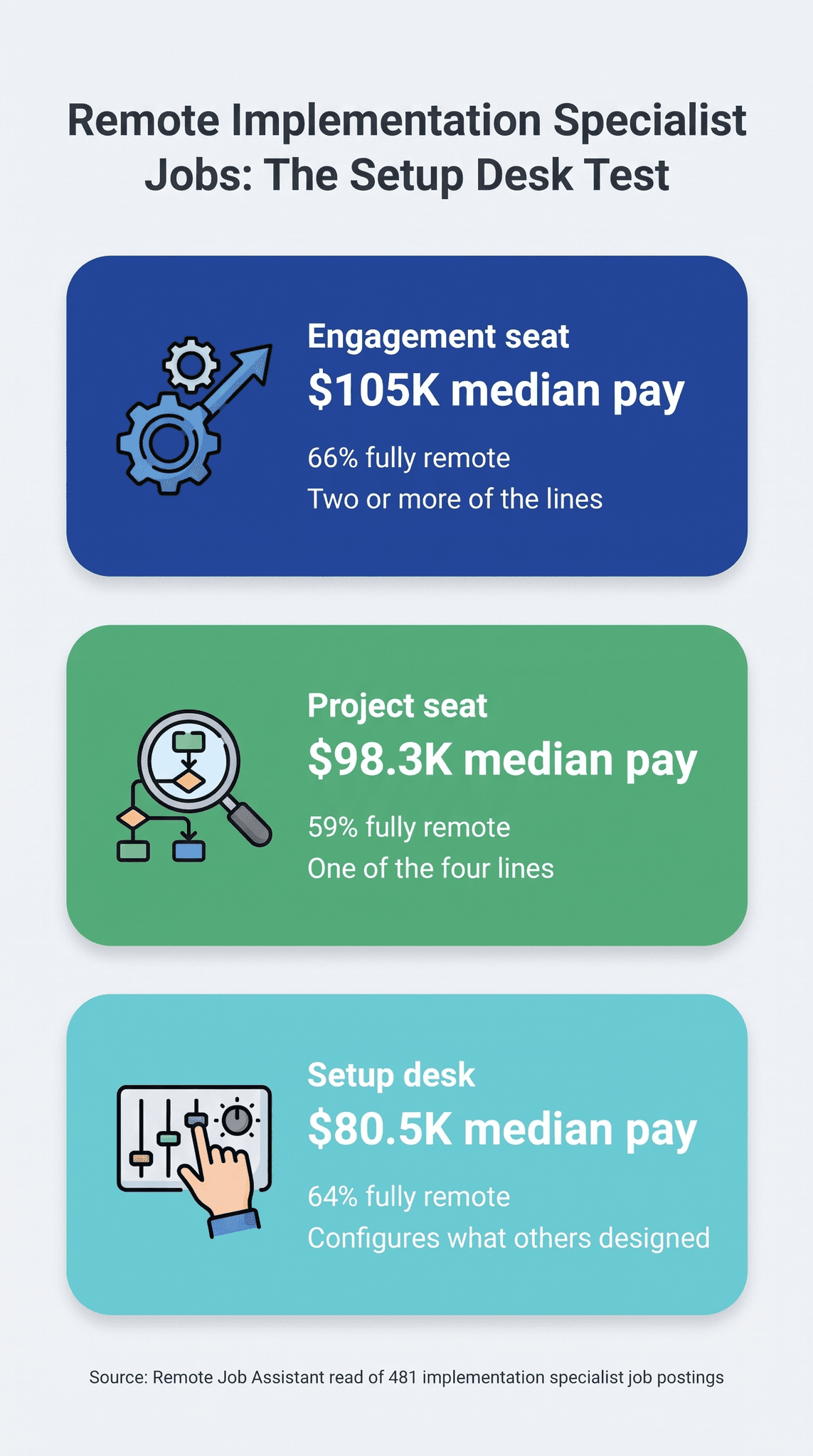
Close to a third of implementation specialist postings (148 of 481) are setup desks: configure what someone else designed, train the users, work the tickets. They post a median of about $80,500. Postings that add one of four lines (you own the go-live, you build the integrations, the customers are enterprise accounts, or you handle scope and money) post about $98,000, and postings with two or more post about $105,000. The remote share holds: 64.0% of setup desks that state a work model are fully remote, against 65.5% of the best-paid group. SQL in a posting adds about $2,000 at the median. Excel in a posting marks a desk: $80,000 against $100,000.
These are the figures behind that answer, all from the same postings.
Based on 481 US implementation specialist postings at 392 employers (May-November 2026):
- 62.7% (n=225 of 359 that state a work model) are fully remote; 37.2% (n=64 of 172) among postings found without a remote search term
- 30.8% (n=148 of 481) are setup desks, with a $80,500 median posted midpoint (n=70)
- $105,025 median (n=86) for postings with two or more of the four pay lines
- $80,000 median when the posting names Excel (n=47), vs $100,000 when it doesn't (n=215)
- $74,000 median for payroll and HR software implementation (n=27), vs $115,000 for ERP and finance systems (n=25)
- 10.7% (n=24 of 225) of remote postings state 25% travel or more
- 77.9% (n=204 of 262) of posted midpoints are $75,000 or more; 46.9% (n=123 of 262) are $100,000 or more
The Setup Desk Test: Four Lines That Price an Implementation Job
FSI and Medicom hire for the same title, sell into the same hospitals and both let you work from home. The difference is where the seat sits relative to the decisions. FSI's specialist works from designs someone else approved, alongside the company's Implementation Project Managers. Medicom's specialist owns the delivery, builds the data connections between hospital systems and runs the cutover. Read enough postings and the same four lines keep showing up next to the higher pay bands. That is the framework we use for the rest of this guide.
The Setup Desk Test: a 0-4 count of four lines in an implementation posting that say whether the seat carries risk or executes a template. One point each if the posting (1) gives you ownership of the go-live: the full implementation, onboarding or deployment, start to finish; (2) has you build integrations: APIs, HL7 or FHIR interfaces, EDI or SFTP file feeds, middleware; (3) names enterprise or complex customers; (4) puts scope and money on your desk: statements of work, scoping, change orders, renewals, upsell or billable hours.
Scoring (481 US postings, May-November 2026):
- Setup desk, 0 checks (median $80,500, n=70; remote 73 of 114, 64.0%): You configure what the project manager and the customer already decided, train end users, and work the support queue. FSI's "execution-focused" seat sits here. Mid-level median $80,000 (n=55). 148 postings at 130 employers, and only 28.6% of posted midpoints (20 of 70) reach $100,000.
- Project seat, 1 check (median $98,250, n=106; remote 78 of 132, 59.1%): Usually the go-live line on its own (114 of 189). You run the project and the customer calls you, but the interfaces and the commercial scope belong to someone else. Mid-level $92,500 (n=79). Half of posted midpoints (52 of 106) reach $100,000.
- Engagement seat, 2-4 checks (median $105,025, n=86; remote 74 of 113, 65.5%): Most of these (125 of 144) give you the go-live plus at least one of the hard parts: the interfaces, the big account or the scope. Medicom's seat sits here. Mid-level $100,000 (n=52), senior $107,750 (n=20), lead $135,000 (n=11). 77 of 86 posted midpoints are $75,000 or more.
How to use it: Count the four lines before you apply. A 0 is a setup desk whatever the title says, so price it like one. A 2 is the trade worth making, and it doesn't cost remote odds.
Here is each line on its own. The remote columns leave out the remote-only job board in our sources, because every posting there is remote by definition.
| Line in the posting | Share of postings | Median with it | Median without | Remote with / without (stated, excluding remote-only board) |
|---|---|---|---|---|
| Owns the go-live | 49.7% (239 of 481) | $100,000 (n=127) | $92,500 (n=135) | 52.8% (66 of 125) / 51.9% (70 of 135) |
| Builds integrations | 26.0% (125 of 481) | $103,750 (n=66) | $94,300 (n=196) | 62.5% (35 of 56) / 49.5% (101 of 204) |
| Enterprise customers | 17.5% (84 of 481) | $111,784 (n=50) | $92,500 (n=212) | 45.1% (23 of 51) / 54.1% (113 of 209) |
| Scope and money | 13.5% (65 of 481) | $100,000 (n=49) | $95,000 (n=213) | 51.4% (18 of 35) / 52.4% (118 of 225) |
The title doesn't tell you which job you're applying for. Four lines in the posting do.
Some postings draw the desk boundary themselves. BirdEye's AI implementation specialist posting has a section titled What This Role Does NOT Own, and it lists "Backend tooling or custom backend logic Building or modifying APIs or engineering tools Custom engineering/SOW development." That's checks 2 and 4 written out as exclusions. At the other end, Enzo Health's consultant posting says "This is a consultant role, not a back-office one."
Why does a setup desk pay like support? Because it sits after the decisions. Sales sold the scope, a project manager set the date, and a solutions engineer designed the build. The specialist executes a known template at volume, so the employer can price the seat against its support team. The pay moves to whoever carries risk: the go-live date that slips, the interface that breaks at cutover, the enterprise account with a contract value attached, or the scope conversation that turns into a change order.
The enterprise line is the only one that costs remote odds: 45.1% remote with it, 54.1% without. Large accounts buy discovery workshops and go-live support in their own building, and the seat follows the account.
The unpopular part: most of the remote implementation market is the cheaper two-thirds. 337 of 481 postings (70.1%) are a setup desk or a one-line project seat, and only 144 carry two or more lines. A remote implementation job is easy to find. A remote one that owns something is the narrower search.
There's also a tell in the other direction. Postings that name two of these three things (support tickets or troubleshooting, Excel, end-user training) post a median of $81,000 (n=35). Postings that name none of them post $102,350 (n=89).
A setup desk pays like support because it sits after the decisions. The pay moves to whoever owns the date, the interface or the scope.
If you're scanning a lot of postings, the two filters that save the most time are a salary floor and the title variants. Implementation Consultant, Implementation Analyst and Implementation Engineer carry the same work under different names.
Stop Applying Manually
Our AI applies to hundreds of matching jobs while you sleep. Wake up to interviews, not more applications.
How We Collected This Data
The figures in this guide come from 481 US implementation specialist requisitions at 392 employers, collapsed from 617 copies of those postings, listed between May 5 and November 2, 2026. 455 of the 481 were listed after August 1. Sources, counted by the requisitions each one carried: LinkedIn's public job search (195), the Himalayas remote job board (167), SimplyHired, which republishes Indeed-network listings (134), Workday career sites (55, from 792 employer sites swept), and Greenhouse, Lever and Ashby job boards (32, from 4,471 boards tried).
We kept titles built on implementation plus specialist, consultant, analyst, engineer or lead, including variants like "Consultant - Software Implementation." We excluded postings where "implementation" means something else: implementation science research, program, curriculum or policy implementation, paid-media trafficking, PMO portfolio roles, and HR new-hire onboarding. Implementation managers (215 postings), directors (29) and coordinators (16) were kept as a separate ladder set.
Work model comes from the posting text, and the first pass got some wrong in ways worth knowing as a reader. A hand read of 46 postings (28 labeled remote, 18 unclear) found 6 wrong labels: a "Field-Based" seat with 75% travel, a remote seat that required living near Lincoln, Nebraska, and an in-office Monday-to-Friday seat among them. One job board showed Qlik's commission range ($34,205-$46,250) as the salary; the base in the posting is $102,615-$138,750. Two employers appeared under two names each (FSI and FSI Services; CSI and Computer Services, Inc.), and one oncology-practice seat was reposted by two recruiters. All of it was fixed before the counts. Postings asking for 60% travel or more count as field seats, not remote. Pay is the midpoint of the posted range, with hourly ranges annualized at 2,080 hours; 262 of the 481 postings published one.
What this data can't see: Indeed and Glassdoor listing pages, Reddit, referral-only openings and actual offers. The remote-only board and remote-keyword searches lift the remote share, so we also report it for postings found without a remote term (37.2%, n=64 of 172) and for direct career-site sweeps (30.2%, n=19 of 63). Treat 62.7% as the ceiling for a remote-focused search, not the market average.
Read an Implementation Specialist Posting in Two Minutes
Before the market tour, here's the test as a branch you can run on any posting. Each question maps to a line in the framework, and the counts show what each answer has paid in our data.
1. Does someone else own the go-live? If the posting has you working "closely with" or "under" an implementation project manager, the date is theirs: 36 postings say so, at a median of $87,500 (n=20). Go to question 2 only if the posting gives you the full implementation start to finish. If it doesn't, you're reading a desk; skip to question 5 and decide on price and travel alone.
2. Does it name the interfaces? APIs, HL7, FHIR, EDI, SFTP file feeds. If yes, you've found the best trade on this board: postings that pair go-live ownership with integration work (71 of 481) post $105,000 (n=32), and 41 of the 54 that state a work model are remote. If no, owning the go-live alone posts $90,000 (n=57), so keep going.
3. Who are the customers? Enterprise accounts post $111,784 (n=50), with lower remote odds. Postings that name small or mid-market customers and never mention enterprise post $92,500 (n=17). High-volume SMB onboarding is where the desk work lives.
4. Is scope or money on your desk? Statements of work, change orders, renewals, utilization targets. 65 postings carry at least one, at $100,000 (n=49).
5. What's the travel line? Postings that state 25% travel or more post $95,000 (n=40). Those that state under 25% post $106,804 (n=20). Heavy travel is common in hospital, pharmacy and banking conversions, and it doesn't come with a pay premium in our data.
Zero yeses on the first four questions: it's a desk, so negotiate it like one or pass. Two or more yeses with a travel line under 25%: that's the seat to chase.
A desk is still worth taking in one case: you're coming from support or payroll administration and need the first implementation title. The setup-desk median ($80,500) sits about $18,600 above the BLS median for computer user support specialists, and 64.0% of desks that state a work model are remote. Take it for a year, then use the go-live you ran there to apply for project seats. Just don't expect the desk to grow into the better seat. Only 20 of the 148 desks carry a senior or lead title, against 49 of the 144 engagement seats, so the way up is usually a different seat, not more years in the same one.
Where Remote Implementation Specialist Jobs Are
Implementation work lives wherever software has to be switched on inside someone else's business. The lane you pick sets the pay range before your experience does.
| Lane (from the posting text) | Postings | Remote (of those that state a work model) | Median posted midpoint |
|---|---|---|---|
| General SaaS and B2B software | 255 | 61.6% (114 of 185) | $100,000 (n=137) |
| Health IT (EHR, imaging, pharmacy, practice software) | 65 | 71.2% (37 of 52) | $89,688 (n=36) |
| Payroll and HR software | 46 | 63.9% (23 of 36) | $74,000 (n=27) |
| ERP and finance systems | 43 | 73.3% (22 of 30) | $115,000 (n=25) |
| Banking, payments and insurance | 43 | 50.0% (15 of 30) | $107,750 (n=22) |
| Public-sector software | 15 | 46.2% (6 of 13) | $95,000 (n=10) |
Payroll is the lowest-paid lane, and the split inside it matters. Implementation specialists at payroll software vendors (Paylocity, ADP, OnPay, Insperity, Asure Software) post midpoints from $49,650 to $71,387. The same payroll knowledge pointed at a consultancy or a payroll API company posts far more: Next Generation's Dayforce implementation consultant at $90,000 to $100,000, Salsa's payroll implementation lead at $120,000 to $140,000, and Crowe's HCM payroll implementation seats at $113,600 and $152,850 midpoints. If you're on a payroll vendor's onboarding desk, the fastest raise in this data isn't a promotion there. It's the same payroll knowledge sold to a consultancy or a payroll API company. Our remote payroll jobs guide covers the operations side of that market.
ERP pays most and is among the most remote. NetSuite, Sage Intacct, Acumatica, Dynamics and Epicor implementation consultants post a $115,000 median, and 22 of the 30 that state a work model are remote. This is also the lane where about half of LinkedIn's first page (31 of 60 cards) doesn't use the word "implementation" at all, so search the product name plus "consultant."
Health IT is the most remote lane on paper and the one with the most travel in practice. Dentsply Sirona's clinical implementation posting reads "Work Model: Field-Based Travel Requirement: Up to 75%." RxSafe's says "The Implementation Specialist is a remote position that requires travel to pharmacies, healthcare organizations, and the corporate home office" and puts on-site time at 75%. If your background is clinical, our remote health informatics jobs guide covers the analyst seats on the provider side.
Two employer types sit at the edges. Consulting firms (PwC, Deloitte, Crowe, RSM, Accenture and others) post the highest median at $143,700 (n=13), but only 2 of the 6 that state a work model outside the remote-only board are remote. Financial-services employers posted 4 remote seats out of 16 that state a work model there, and none of the 4 belong to a bank or insurer: First Citizens, Huntington, Regions, GEICO and Chubb all posted hybrid. Software vendors are where the remote seats are: Veeva Systems, Ashby, Alkami, Block, Motorola Solutions, NEOGOV, Karbon, ECI Software Solutions and Medicom all posted remote implementation roles in our window. The customer success and support category on our board collects recent openings at many of the same vendors.
Implementation Specialist Salary by Level
Salary figures below come from the 262 postings in our set that published a pay range, May to November 2026, annualized to the midpoint. BLS doesn't track implementation specialists as an occupation, so we cross-checked against the neighbors on either side of the job. Bonus and commission sit on top where the posting mentions them.
| Rung | Postings | Median posted midpoint | Remote (stated, excluding remote-only board) |
|---|---|---|---|
| Implementation coordinator or associate | 16 | $75,000 (n=12) | 3 of 8 |
| Implementation specialist, mid-level | 350 | $92,500 (n=186) | 52.3% (102 of 195) |
| Senior implementation specialist or consultant | 67 | $105,050 (n=39) | 62.8% (27 of 43) |
| Lead or principal | 34 | $134,000 (n=20) | 4 of 10 |
| Implementation manager or implementation project manager | 215 | $115,189 (n=138) | 34.5% (30 of 87) |
| Director or head of implementation | 29 | $188,750 (n=18) | 5 of 10 |
Experience asked moves pay in a straight line: postings asking for 0-2 years post $87,875 (n=68), 3-4 years $100,000 (n=49), 5-7 years $111,785 (n=51), and 8 or more $133,558 (n=8). There is no remote discount at the median: fully remote postings post $97,000 (n=125), hybrid and on-site postings $97,500 (n=65).
The BLS neighbors bracket the job neatly. According to the Bureau of Labor Statistics, computer user support specialists earned a median of $61,860 in May 2025, and BLS expects that occupation to shrink as chatbots take over troubleshooting. Above the job, computer systems analysts earned $105,850 and project management specialists $102,320. O*NET lists "Implementation Project Manager" as a reported title for project management specialists. A setup desk is priced near the support end of that bracket; an engagement seat is priced like a systems analyst. The Setup Desk Test is, in effect, a read on which neighbor the employer is benchmarking you against.
If you're targeting the $100,000 line, the remote jobs paying $100K+ page filters for it, and it's the threshold where engagement seats start to outnumber desks.
Stop Applying Manually
Our AI applies to hundreds of matching jobs while you sleep. Wake up to interviews, not more applications.
What Moves Implementation Pay (and What Doesn't)
Most advice for implementation specialists says to get more technical. The postings say something narrower.
| Line in the posting | Share of postings | Median with it | Median without |
|---|---|---|---|
| SQL | 18.9% (91 of 481) | $97,500 (n=43) | $95,500 (n=219) |
| Integrations or APIs | 26.0% (125 of 481) | $103,750 (n=66) | $94,300 (n=196) |
| Scripting (Python, JavaScript) | 16.0% (77 of 481) | $97,500 (n=41) | $95,000 (n=221) |
| Data migration or conversion | 24.9% (120 of 481) | $97,500 (n=54) | $95,250 (n=208) |
| Excel | 19.5% (94 of 481) | $80,000 (n=47) | $100,000 (n=215) |
| Time-to-value, CSAT or NPS named | 8.7% (42 of 481) | $107,298 (n=26) | $95,000 (n=236) |
| PMP, CAPM or Scrum named | 8.7% (42 of 481) | $100,000 (n=21) | $95,000 (n=241) |
| Bachelor's degree asked | 52.6% (253 of 481) | $92,500 (n=139) | $100,000 (n=123) |
In implementation, integrations pay and SQL barely registers: about $9,000 at the median for the interfaces, about $2,000 for the query language.
Skip the SQL course if the goal is a raise. SQL appears in 91 postings and moves the median about $2,000. Where postings say what it's for, it's mostly checking somebody else's data: Clearwave's engineer reviews "complex configurations, SQL, data mappings," and Stord wants "Experience with data validation, reporting, or SQL-based tooling." Another 20 of the 91 call SQL a plus, preferred, or basic familiarity. Integration work is different: you connect the customer's systems, and the go-live waits on you. It moves the median about $9,000, and those postings are more often remote (62.5% against 49.5%), because interface work happens in test environments, not conference rooms.
Excel is the clearest desk tell in the data. MaintainX's analyst posting asks for "Proficiency in Microsoft Excel, including data cleanup, validation, manipulation, and functions such as XLOOKUP, PivotTables, and formulas used to prepare and migrate customer data." That's real work, and it's the work employers price at the bottom of the range: import prep at volume. If your resume leads with Excel, our remote Excel jobs guide shows where that skill pays more.
The degree line isn't a pay signal either way. Overall, postings that ask for a bachelor's post $92,500 and postings that don't post $100,000, but the gap flips by level: at mid-level the degree postings pay less ($89,688, n=94, against $97,750, n=92), and at senior level they pay more ($107,750, n=20, against $100,000, n=19). The level prices the seat, not the diploma.
AI shows up in 76 postings, at a $109,500 median (n=44) against $95,000. Look closer before you chase it. By our read, 47 of the 76 only use it to describe the employer's product ("AI-powered," "AI-native," "agentic"). Where it is a duty, it means using AI tools to speed up the desk work. Jeppesen ForeFlight's posting asks you to "Use AI-powered tools to speed up configuration, documentation, and troubleshooting work, and help the broader team adopt them." The premium mostly reflects working for newer software companies, not a credential you can add.
If you want to build toward the interface work, learn what the postings name. Salesforce appears in 42 postings, Jira in 24, HL7 in 14, SFTP in 11, EDI in 10, Postman in 9 and FHIR in 8. For health IT, the HL7 FHIR specification is free to read and is the standard Medicom's posting asks you to build against.
Vendor certifications follow the job rather than open the door to it. Only 11 postings name a vendor certification. Workday's training, for example, "was only available to Workday customers and partners" until Arizona State University opened a public program in 2025, according to ASU's W. P. Carey School of Business. Expect the employer to put you through the certification after you're hired.
The Remote Small Print in Implementation Postings
"Remote" on an implementation posting means the desk is at home. It doesn't always mean the job is.
Concurrent load. 118 postings say you'll juggle multiple, several or a portfolio of implementations. Only 7 put a number on it, and those range widely. NISC: "Assigned 1-2 implementations at one time." Accordant's Acumatica implementation lead: "Manage 4-6 projects concurrently." A healthcare staffing posting for an oncology practice specialist: "You will be managing anywhere from 6-8 implementations at a time and each project typically lasts 2-3 months." Expel's implementation engineer will "Manage a portfolio of 15–20+ implementations simultaneously." Medicom's specialist will "manage a portfolio of 17–25 active customer projects while supporting 30–40 installs, kickoffs, connection calls, and training sessions each month." One rung up, PetDesk's implementation project manager runs "approximately 30-40 customers at any one time" with "3-4 customer calls a day."
Travel. 103 of 481 postings state a travel percentage. Another 46 require travel and never say how much, and 27 of those 46 are labeled remote. "Travel will be required" with no number is the line to ask about first. 24 of the 225 remote postings ask for 25% or more, and 13 postings asked for so much travel (60% or more, or a stated field-based model) that we counted them as field seats. Tenth Revolution Group's Epicor posting puts it in the location line: "Location: Remote (50% Travel)." CSI, whose specialists move financial institutions onto its NuPoint core banking platform, explains the pattern: "Travel generally consists of two-to-five-day customer visits occurring several times per month."
Go-live windows. 15 postings mention evening, weekend, overnight or after-hours work, and 4 tie it directly to launches. Medicom's specialist will "Lead go-lives and cutovers, including scheduled early-morning, evening, or overnight windows." CSI's will "Support customers during testing, conversion weekends, and go-live activities."
Where you live. 27 of the 225 remote postings limit the states, metro area or time zone you can work from. NRC Health's posting says "While this position may allow for a work from home environment, candidates must live in the Lincoln , Nebraska and surrounding areas."
Commission. Scope and money can be literal. Qlik's senior implementation consultant for federal projects lists a base range of $102,615 to $138,750 and adds: "This position is eligible for a commission within a range of $34,205.00- $46,250.00 USD, subject to meeting targets set forth in a sales compensation plan."
Handoff. 47 postings describe handing the customer to support or customer success after launch, and those post $92,500 (n=28). Only 9 name a hypercare period at all. If the posting doesn't say when the account leaves you, ask before you sign, because that date sets how many customers you carry at once.
Before you accept, ask four questions. How many implementations will I carry at once, and how long does each one run? A good answer is a number, like NISC's "1-2 implementations at one time" or the oncology posting's "6-8 implementations at a time," not "it varies." Who owns the go-live date, me or a project manager? If it's a project manager, you're at the desk end of the pay range. Who builds the integrations, me or an engineering team? Who signs off on go-live, and what happens when the customer won't? 58 postings mention sign-off, user acceptance testing or acceptance criteria, and they post $102,500 (n=24), because a seat that has to get a signature carries the slip. What happens at handoff: do I stay on through hypercare, or does support take the account the day after launch? The answers place the seat on the Setup Desk Test faster than the title does.
Once you know which seat you want, applying to enough of them is a volume problem.
Stop Applying Manually
Our AI applies to hundreds of matching jobs while you sleep. Wake up to interviews, not more applications.
Moving Up From Implementation Specialist
The obvious next rung is implementation manager, and it pays: about $115,000 at the median (n=138). It also costs remote odds. Only 30 of 87 implementation manager postings that state a work model outside the remote-only board are fully remote (34.5%), against 52.3% for mid-level specialists. Directors post about $189,000 (n=18). For most people, moving up the manager track is a move toward the office.
The better move depends on which line you already own.
If you own the go-live but not the interfaces, you're in the biggest single group: 114 postings carry the go-live line alone, at a $90,000 median (n=57). The cheapest step up is to take the integrations, not the title. Postings that add the interfaces to the go-live post $105,000 (n=32).
If you already build the interfaces, you're one step from design work. If you handle scope or renewals, the account side is the natural next seat. Three lateral moves keep the remote option and use the same skills.
Toward the interfaces. If you already build integrations, the step is solutions engineering or architecture: you design what the next implementation specialist configures. Our remote solutions architect jobs guide covers how those seats are priced. Search the engineering and technical category with "implementation engineer" and "solutions engineer" together.
Toward the account. Customer success picks up the customer the day after go-live. The remote customer success jobs guide covers that market, and remote customer success manager openings are the most common next title for implementation people at SaaS companies.
Toward the project. Implementation project managers own the date across several specialists. If you've been running projects without the title, the remote project manager listings and the operations and project management category are where those seats post. Our remote project coordinator jobs guide covers the rung below if you're coming from an operations or support role.
Breaking in? Postings asking for 0-2 years of experience post $87,875 (n=68), and support, customer success and payroll administration are the usual feeders. Lead your resume with one go-live you owned end to end, the integration you got working, and the size of the customer. Those are the three lines the higher bands ask for. The $75K+ remote jobs page is a sensible floor to filter on while you build that story.
Frequently Asked Questions
I've been an implementation specialist at a payroll software company for three years. Why am I still under $75K?
Because payroll vendor onboarding is the lowest-paid lane in the market, not because of your experience. Payroll and HR software implementation posts a $74,000 median (n=27), and vendor desks at Paylocity, ADP, OnPay, Insperity and Asure post midpoints from $49,650 to $71,387. The same payroll knowledge at an HCM consultancy or a payroll API company posts $95,000 to $152,850.
Is a remote implementation specialist job actually remote, or will I be traveling to customer sites?
Most are home-based: 62.7% (n=225 of 359) of postings that state a work model are fully remote. But 24 of those 225 remote postings ask for 25% travel or more, often for hospital, pharmacy and banking conversions, and 15 postings mention evening, weekend or overnight work. Read the travel line before the location line.
What's the difference between an implementation specialist and an implementation manager in pay and remote odds?
Implementation managers post a $115,189 median (n=138) against $92,500 for mid-level specialists and $105,050 for seniors. The manager rung is less remote: 34.5% (30 of 87) of manager postings outside the remote-only board are fully remote, against 52.3% (102 of 195) for mid-level specialists. Managers own dates across several specialists; specialists own the configuration and, in the better-paid seats, the go-live.
How do I tell if an implementation specialist posting is a setup desk?
Use the Setup Desk Test: count whether the posting gives you the go-live, has you build integrations, names enterprise customers, or puts scope and money on your desk. A score of 0 is a setup desk, with a median of $80,500 (n=70). One line lifts the median to $98,250, and two or more to $105,025, with the remote share between 59% and 66% at every score.
Should I learn SQL or get a certification to get a higher-paying implementation role?
Neither is the lever the postings reward. SQL in an implementation posting moves the median by about $2,000 ($97,500 against $95,500), and only 11 of 481 postings name a vendor certification. Integration work moves it by about $9,000 ($103,750 against $94,300), and owning the go-live by $7,500.
Can I move from customer support or customer success into a remote implementation role?
Yes, and it's the most common route in. Postings asking for 0-2 years of experience post an $87,875 median (n=68). Lead with a launch you owned, the systems you connected, and the size of the customer, because those three lines separate a $98,000 seat from an $80,500 desk.
Find a Remote Implementation Role That Owns the Go-Live
The market for remote implementation specialists is real and mostly remote, but the title covers two different jobs. Count the four lines before you apply, skip the desks unless the price is right, and aim for the seat that owns the date and the interfaces.
- Filter for the pay line: remote jobs paying $100K+
- Browse implementation project seats: operations and project management jobs
- Look for engineering-side implementation roles: engineering and technical jobs
- Plan the next step: remote customer success manager openings
Anyone can configure a template from home. The money goes to the person whose name is on the go-live date.
Ready to Find Your Remote Job?
Browse thousands of curated remote jobs or let AI apply for you.
Browse Remote JobsRelated Job Guides

Remote Contract Specialist Jobs: What 826 Postings Pay
We read 826 US contract specialist postings. Federal 1102 seats: 0 of 52 remote. Elsewhere, four lines in the posting predict both the pay and the remote odds.
28 min read
Remote Excel Jobs: What 7,465 Postings Pay for Excel Work
We read 7,465 Excel-heavy job postings. 22.5% of those that state a work model are fully remote, and seats that build the model pay $21K more than keeper seats.
27 min read
Remote Tableau Jobs: What 3,835 Postings Pay for Tableau
We read 3,835 analytics postings. Tableau shows up in 1,511, almost never in the title, and seats upstream of the dashboard pay $26K more than request desks.
29 min read