
Last reviewed: July 2026
You built the onboarding program that cut new-hire ramp time by six weeks, and your company still files you under "the training department" — somewhere between office management and the people who order catering. Then you Google what your job pays, see a $66K average, and wonder if you picked the wrong field.
You didn't. You Googled the wrong market. That average includes every in-person compliance trainer at every hospital, factory, and call center in the country — jobs that can't go remote and don't pay like yours. Remote learning and development jobs are a different market: corporate, program-level, and concentrated in the industries that pay the most for capability building.
Get Remote Job Tips in Your Inbox
Weekly strategies, salary data, and new opportunities
Unsubscribe anytime. No spam.
We pulled every remote L&D role posted with a salary range on LinkedIn, Glassdoor, Indeed, ZipRecruiter, and company career pages between February and July 2026, then removed duplicates and travel-heavy roles. That left 412 postings from 268 companies, read line by line. The average posted salary across remote L&D openings runs around $103K, roughly $37K above the occupation-wide median. This guide breaks down why that gap exists, what each level of remote L&D actually pays, which skills move you up, and how to land one of these roles without sending 200 applications into the void.
Based on our analysis of 412 remote L&D postings (February–July 2026):
- 71% (n=293 of 412) required at least one e-learning authoring tool by name — Articulate Storyline and Rise appeared most often
- 58% (n=239 of 412) required hands-on LMS administration (Cornerstone, Docebo, Workday Learning, or SAP SuccessFactors)
- 34% (n=140 of 412) explicitly mentioned AI tools for content development — nearly all posted after January 2026
- Only 9% (n=37 of 412) were coordinator-level roles — the entry rung barely exists remotely
- $72K–$108K is the 25th–75th percentile base band for L&D specialists (ZipRecruiter, April 2026)
- 11% projected growth for training and development specialists from 2024 to 2034, with about 43,900 openings per year (BLS Occupational Outlook Handbook)
Why Remote L&D Pays More Than Google Says
The confusing thing about L&D salary research is that two contradictory numbers are both true. The U.S. Bureau of Labor Statistics puts the median for training and development specialists at $65,850 (May 2024). Remote postings for what looks like the same job average around $103,430 across 1,466 openings. That is not a rounding error — it's a 57% gap.
Here's the structural reason. The BLS median covers the entire occupation: the safety trainer walking a warehouse floor in a reflective vest, the hospital educator running in-person CPR recertification, the retail trainer onboarding seasonal staff in a stockroom. Those jobs anchor the low end of the pay distribution, and none of them can go remote — the work is physically attached to a site.
Corporate L&D went the other direction. The actual work — course design in Articulate, program management in an LMS, facilitation over Zoom, stakeholder reviews in Slack — moved into the browser years ago. When you filter for "remote," you're not filtering for a perk. You're filtering out the lower-paying half of the occupation and keeping the corporate, program-level half.
Remote L&D pays more than L&D as a whole — not because remote is a perk, but because the remote jobs cluster in the industries and role levels that pay most.
Within that remote market, pay tracks one variable more reliably than years of experience or certifications: the metric you own. We call this the Metric Ownership Ladder.
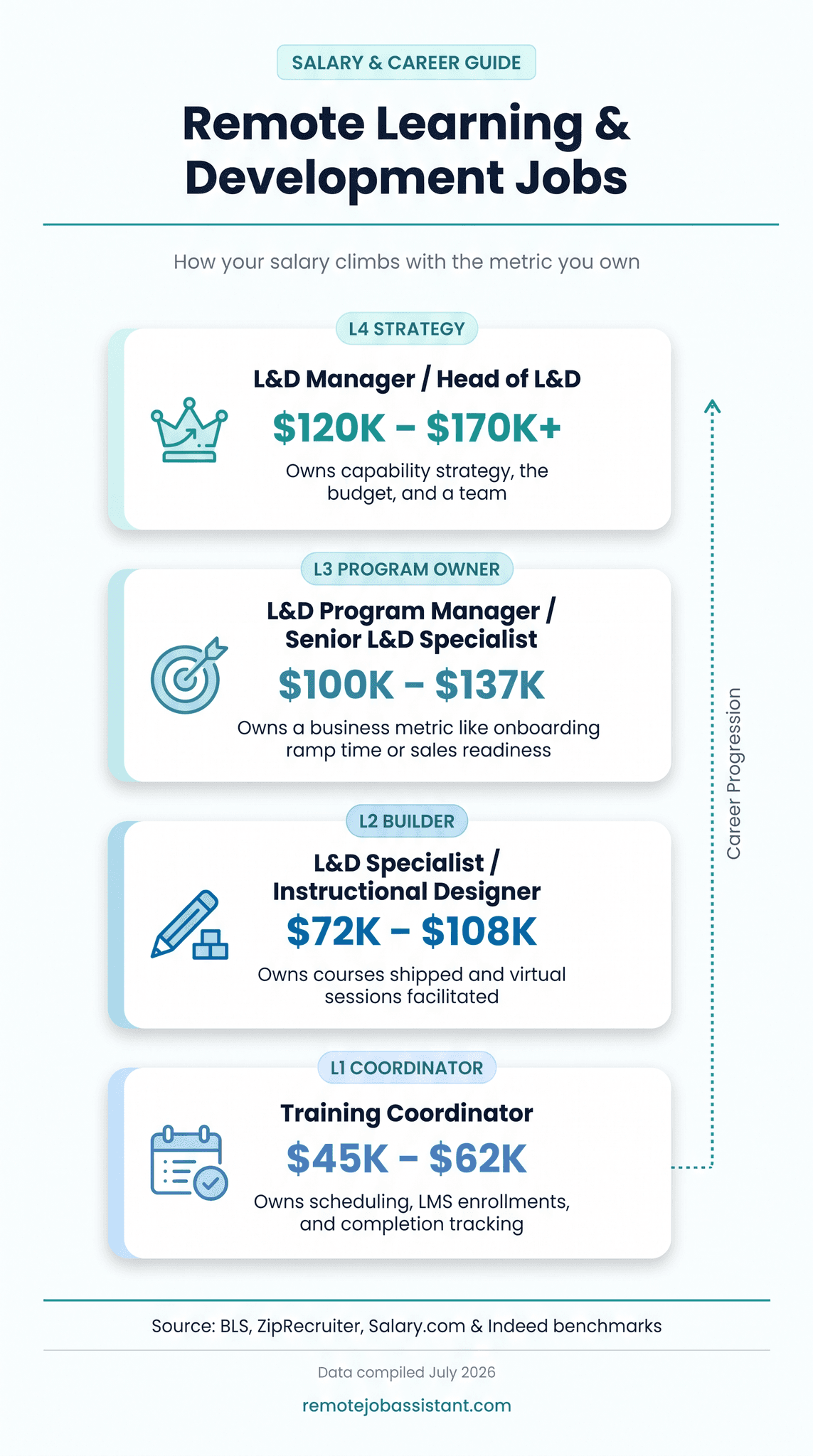
The Metric Ownership Ladder: a four-level rubric that maps L&D compensation to which metric you own, not your title.
- L1 — Training Coordinator ($45K–$62K): You own logistics metrics: LMS enrollments, session scheduling, completion tracking. The work is real but invisible to executives, and it's the first budget line cut in a downturn.
- L2 — Course Builder / L&D Specialist ($72K–$108K): You own deliverables: courses shipped in Storyline or Rise, virtual sessions facilitated, curricula maintained. This is the band ZipRecruiter's 25th–75th percentile describes, and it's where remote hiring volume is heaviest.
- L3 — Program Owner / L&D Program Manager ($100K–$137K): You own a performance metric with a dollar sign attached — onboarding time-to-productivity, sales ramp time, internal promotion rate. First level where you present results to executives instead of completion dashboards.
- L4 — L&D Manager / Head of L&D ($120K–$170K+): You own capability strategy, a budget, and a team. The BLS pegs the manager median at $127,090, with the top 10% above $219,990.
How to use it: find the metric that appeared in your last performance review — that's your current level. Then write your resume bullets and interview stories around the next level's metric. That gap is the entire promotion conversation.
Stop Applying Manually
Our AI applies to hundreds of matching jobs while you sleep. Wake up to interviews, not more applications.
How We Collected This Data
The figures in this post come from our analysis of 412 remote learning and development job postings across 268 companies, collected between February 2026 and July 2026. Postings were sourced from LinkedIn, Glassdoor, Indeed, and ZipRecruiter remote filters, plus direct career pages, and limited to positions explicitly marked remote-eligible in the United States with a posted salary or compensation range.
We excluded postings requiring more than 25% travel, roles without a clear remote policy, and duplicate listings syndicated across boards. Titles were normalized into the four ladder levels above — a "Learning Experience Designer III" and a "Senior L&D Specialist" doing program-level work both count as L3.
Salary data was cross-referenced with BLS Occupational Outlook Handbook figures (May 2024), ZipRecruiter, Salary.com, and Indeed compensation reports from April–July 2026. We update this analysis quarterly; the figures here reflect July 2026 data.
Remote L&D Salaries by Level
Titles in this field are noise. We found the same $115K program-owner job posted as "Senior Learning Specialist," "L&D Program Manager," and "Learning Experience Lead" at three different companies. Map any posting to what you'd actually own, and the pay bands get predictable.
| Level | Typical titles | Base range | What you own |
|---|---|---|---|
| L1 Coordinator | Training Coordinator, L&D Coordinator | $45K–$62K | Scheduling, enrollments, completion tracking |
| L2 Builder | L&D Specialist, Instructional Designer | $72K–$108K | Courses shipped, sessions facilitated |
| L3 Program Owner | Senior L&D Specialist, L&D Program Manager | $100K–$137K | A business metric: ramp time, sales readiness |
| L4 Strategy | L&D Manager, Head of L&D | $120K–$170K+ | Capability strategy, budget, team |
Salary ranges derive from our analysis of 412 remote L&D postings (February–July 2026), cross-referenced with BLS, ZipRecruiter, Salary.com, and Indeed compensation data. We excluded outliers and postings without posted comp. Ranges shift as markets move — check the linked sources for current figures.
Industry moves you within each band more than negotiation does. According to Glassdoor's 2026 compensation data, L&D managers in information technology earn a median total pay of $181,467 — against $153,800 in aerospace and defense, $150,802 in financial services, and $146,628 in consulting. Education and nonprofits sit at the bottom of every band. The same program-owner job pays 30-40% more when the capability being built is sales capacity at a software company instead of volunteer onboarding at a nonprofit.
Two more data points worth calibrating against. Indeed puts senior L&D specialists at an average of $102,597 — right at the L2/L3 boundary, which matches what we saw in postings: "senior" usually signals the transition from shipping courses to owning a metric. And Salary.com's July 2026 average for L&D managers is $121,428, with typical ranges reaching $169K — consistent with our L4 band before equity and bonus.
There's also a contract lane most guides skip: companies increasingly staff AI-forward L&D contractors at $55–$65 per hour for Fortune 100 engagements. Annualized, that's $110K–$135K — L3 money without the headcount. If you're between roles, six months of contract program work often outperforms a permanent L2 title on your resume. Roles paying in the upper bands cluster in our $100K+ remote listings.
In L&D, your salary tracks the metric you own: completion rates pay $60K, time-to-productivity pays $120K.
The Job Titles Hiding Under "Learning and Development"
Search "remote learning and development jobs" on any board and you'll get six genuinely different jobs in the same results page. They pay differently, they're screened differently, and applying to the wrong lane wastes your best applications.
| Title | Focus | Remote availability | Typical base |
|---|---|---|---|
| Training Coordinator | Logistics, LMS admin, scheduling | Low — often hybrid | $45K–$62K |
| L&D Specialist | Program delivery + course building | High | $72K–$108K |
| Instructional Designer | Course/curriculum artifacts | High | $75K–$105K |
| Learning Experience Designer (LXD) | Instructional design with UX methods | High — mostly tech | $85K–$120K |
| L&D Program Manager | Owns a capability program + metric | High | $100K–$137K |
| L&D Manager / Head of L&D | Strategy, budget, team | Moderate — some hybrid | $120K–$170K+ |
The distinction that trips up the most applicants: instructional designer versus L&D specialist. An instructional designer builds the artifact — the course, the curriculum, the assessment. An L&D specialist runs the program the artifact lives in — needs analysis, facilitation, stakeholder management, iteration. Plenty of people do both, but postings screen for one, and your portfolio of writing samples should lead with whichever the posting screens for.
"Learning Experience Designer" is instructional design that borrowed UX vocabulary — learner personas, journey mapping, usability testing on courses. It reads as a rebrand, but it carries a real 10-15% premium in tech because it signals you design from evidence rather than templates.
One adjacent lane deserves a mention: sales enablement. It's L3 program-owner work — ramp time, quota attainment — filed under a revenue title, and it routinely pays above the L&D band for the same skill set. If your background includes sales training, apply in both lanes.
Stop Applying Manually
Our AI applies to hundreds of matching jobs while you sleep. Wake up to interviews, not more applications.
Skills That Move You Up the Ladder
Remote L&D postings screen for three skill clusters, and they map cleanly to ladder levels. The mistake is treating all three as equally important at every stage. Production gets you hired at L2. Measurement gets you promoted to L3. Systems experience keeps you in every shortlist along the way.
Production — gets you hired at L2. Articulate Storyline and Rise (named in most authoring-tool requirements we counted), Adobe Captivate, video editing basics, and virtual facilitation that doesn't feel like a hostage situation. In our analysis, 71% (n=293 of 412) of remote postings named at least one authoring tool.
Systems — keeps you shortlisted. LMS administration appeared in 58% (n=239 of 412) of postings: Cornerstone, Docebo, Workday Learning, SAP SuccessFactors. Nobody loves this work, which is exactly why demonstrated LMS competence filters so well.
Measurement — gets you promoted to L3. Training needs analysis, Kirkpatrick levels 3 and 4 (behavior change and business results, not smile sheets), and enough data literacy to connect a program to a number a CFO cares about. This cluster shows up least in junior resumes and most in program-manager offer letters.
A quick self-test against the Metric Ownership Ladder: if your last three performance reviews only mention courses shipped, you're L2 regardless of what your title says. If you can show one before/after business metric you owned, you can credibly interview for L3. If you've never killed a program — never made the case that a training request shouldn't exist — you're not L3-ready yet, because half of program ownership is saying no with evidence.
And be clear-eyed about the measurement cluster before you romanticize it — a lot of Kirkpatrick Level 4 reporting in the wild is post-hoc rationalization, because executives want the appearance of rigor more than a controlled study. The harder truth underneath: a chunk of L&D requests exist so HR can look responsive to what are actually compensation or org-design problems, and no course fixes those. That's not a reason to skip measurement. It's the reason a genuinely defensible before/after number — or a documented "we investigated and killed it" — is rare enough to carry an entire interview loop.
One example of what that number actually looks like in practice. An L&D program manager we spoke with spent six weeks building a sales onboarding program before discovering the real bottleneck: reps couldn't access the pricing tool without filing a ticket to finance. The "training problem" was a permissions problem. Fixing it took two days and one very uncomfortable meeting — finance had built that approval step deliberately after a discounting mess, and unwinding it meant her VP had to spend political capital he hadn't planned on. Ramp time still dropped three weeks, and the one-page write-up of that diagnosis did more for her next salary negotiation than any course she ever shipped. That's the measurement cluster — most of it happens outside the authoring tool, and some of it makes you temporarily unpopular.
The same pattern is a running theme wherever working designers compare notes — the r/instructionaldesign version is the specialist who builds a manager-coaching program that gets glowing feedback forms and changes nothing, because the managers were promoted without the authority to act on any of it. The lesson experienced practitioners converge on: don't accept a training request that doesn't come with a business owner who can change the underlying system.
The ADDIE-versus-SAM debate that dominates L&D forums matters less than practitioners think — we found postings name frameworks far less often than tools. What postings increasingly do name is AI. A third of the postings in our sample — 34% (n=140 of 412) — explicitly mentioned AI tools for content development, and nearly all of those went up after January 2026.
Read that trend correctly, because the field is going to be brutal on pure course builders. AI compressed the course-production half of the job: a first-draft module that took a week in Storyline now takes a day with AI-assisted drafting. What it didn't compress is the diagnostic half — figuring out whether the sales team is missing product knowledge or missing a working pricing sheet. If your entire value proposition is assembling modules from SME notes, you're competing with a prompt. The professionals moving up right now use AI to shrink production time and reinvest it in measurement, which is project-management-shaped work as much as design work.
AI didn't shrink L&D work; it shrank the course-production half of it. The diagnostic half — figuring out why performance is broken — just became the whole job.
On certifications: the BLS notes certification is not usually required for these roles, and our posting data agrees — they appeared as "preferred," almost never "required." ATD's APTD and CPTD are the recognizable ones, plus the CPTM for training operations. Treat them as tiebreakers that signal L3 intent, not door-openers. A CPTD with no metric on the resume loses to no CPTD and "cut onboarding ramp from 12 weeks to 6" every single time.
Who Hires Remote L&D Professionals
Four employer archetypes account for most of the remote L&D hiring we tracked, and they want noticeably different things.
Tech and SaaS. The top of the pay range, heavy on enablement and LXD titles, and the most likely to test for measurement thinking in interviews. They're building capability for revenue teams, so they pay revenue-team money.
Healthcare systems. Enormous training organizations with steady remote demand — Mass General Brigham, for instance, hires remote L&D specialists for revenue-cycle operations. Compliance-heavy, stable, and less flashy than tech but reliably at the middle of the band.
Financial services and consulting. Leadership development budgets live here. Expect polish requirements — executive-facing facilitation, strong written communication — and pay near the top of each band.
The contract market. Staffing partners place AI-forward L&D contractors into Fortune 100 engagements at $55–$65 per hour. Fastest route to program-level work if your permanent title hasn't caught up to your skills.
One thing to weigh when choosing among these archetypes: L&D's organizational power varies more than its pay. In revenue-led companies, enablement-flavored L&D sits close to the money and gets protected; in cost-center configurations, L&D is politically weak — first budget frozen, last headcount approved — no matter how good the work is. Ask who L&D reports to. A team under a CRO or COO has structurally more leverage than one three layers deep in HR.
Adjacent people-team roles are worth watching too — L&D sits organizationally next to talent acquisition roles, and companies scaling one usually scale the other within two quarters. You can browse both in our HR and recruiting listings, which include recent remote L&D openings.
How to Land a Remote L&D Job
The remote L&D interview process has one open secret: the portfolio does the filtering, not the resume. Hiring managers told the same story across our research — they can't tell from a resume whether "designed onboarding curriculum" means built something excellent or reformatted a predecessor's slides. So here's the playbook.
Build a three-piece portfolio. One short Rise or Storyline course (15 minutes of seat time, polished), one facilitation artifact (a session deck plus a two-line summary of what changed after), and one measurement one-pager — a before/after write-up of a program you improved, with the metric. Which piece leads depends on where you are on the ladder: breaking in from teaching, lead with the course, because production skill is what's unproven. Sitting at L2 trying to reach L3, lead with the measurement one-pager, because a hiring manager needs L3 evidence to defend paying above the midpoint. The Articulate community's template gallery and the r/instructionaldesign portfolio threads are where working designers actually pressure-test these — worth an evening before you build. Host all three on a simple site; nobody at the L2 level and above should be attaching PDFs.
Rewrite your bullets around metrics owned, not courses shipped. "Built 14 compliance modules" is L2 forever. "Owned onboarding for a 200-person org; time-to-first-deal dropped from 11 weeks to 7" is an L3 interview. If you're getting screened out despite solid experience, this reframe — not more applications — is usually the fix. (If that sounds familiar, our breakdown of why you're not getting interviews goes deeper.)
Name exact tools. ATS keyword matching is unforgiving here. "E-learning software" matches nothing; "Articulate Storyline, Rise 360, Docebo, Workday Learning" matches the requirements in the posting. Mirror the posting's exact tool names wherever they're true.
Prepare the AI answer. With 34% (n=140 of 412) of remote postings now naming AI tools, interview loops have added a predictable question: how do you use AI in production, and what do you do with the hours it saves? Candidates who answer "I use ChatGPT for first drafts" stall out. Candidates who answer "AI cut my module drafting from five days to one, and I reinvested the time in stakeholder interviews that killed two courses nobody needed" get offers.
And be honest about what the day-to-day is before you commit to the field harder: SME reviews that sit untouched for two weeks and then come back demanding a full restructure the day before launch, the compliance course with a 40% completion rate that somehow becomes your metric, the LMS integration that breaks the morning of a program launch. Plenty of remote L&D openings are not blank-canvas capability building — they're "make the existing training suck less" roles, and the posting won't tell you which one you're walking into. Remote L&D is managed friction, not a content studio. The people who thrive treat the friction as the job.
Know when to walk away from a posting. Three red flags that reliably predict a maintenance shop: every metric mentioned is a completion rate; the requirements list six or more authoring tools (they're replacing a team with one person); and nobody in the interview loop can name a program the team has sunsetted. Teams that have never killed a program don't do diagnosis — they take orders. A fourth, subtler one: if the role reports three layers deep into HR with no dotted line to a business unit, you're being hired to make HR look responsive, not to move a metric. ATD's member forums and the r/instructionaldesign weekly threads are full of people who learned each of these the slow way — read a few before your next interview loop.
Coordinator-level remote roles barely exist — 9% (n=37 of 412) of the remote postings we analyzed. Companies hire remotely for output they can see, and coordination output is invisible. The realistic entry path is facilitation or teaching experience plus a portfolio that proves L2 production skill — not applying to a remote coordinator queue hundreds deep.
Then there's the volume problem. L2 and L3 remote L&D postings draw applicants from every timezone, and the good ones close fast. This is exactly the search that rewards automation: our Auto-Apply service submits tailored applications to matching remote roles while you spend your hours on the portfolio and the interviews — the two things automation can't do for you. Pair it with a disciplined follow-up system and you're running the search most candidates only think they're running.
Stop Applying Manually
Our AI applies to hundreds of matching jobs while you sleep. Wake up to interviews, not more applications.
Career Paths From Remote L&D
L&D is a hub role, and the exits are better than the field's reputation suggests. Program owners who can put dollar figures on capability building move into Head of Talent Development seats and from there into HR leadership — the modern HR generalist-to-CHRO track increasingly runs through talent development rather than around it.
The enablement lane leads to revenue organizations, and it's where a striking number of the best L&D people end up — not just for the pay. Sales enablement leads report into CROs, out-earn their L&D peers doing identical work, and fight fewer political battles, because nobody argues with quota attainment the way they argue with a training budget. The program-management lane converts directly — an L&D program manager is a program manager whose product happens to be human capability, and the transition costs you nothing but a title change.
And the contract lane compounds: two or three strong engagements at $55–$65 per hour become an independent consulting practice with Fortune 500 references. For a broader map of where six-figure remote careers cluster, see our high-paying remote jobs guide.
Frequently Asked Questions
I've been a teacher or in-person trainer for years — can I move into remote L&D without starting over?
Yes, and the entry point is L2, not the bottom. Facilitation is the hardest L&D skill to teach and you already have it; what you're missing is production evidence. Build two portfolio pieces in Rise (free trial) around content you've already taught, and apply to L&D specialist roles — not coordinator roles, which barely exist remotely and would underprice your experience.
What's the difference between an instructional designer and an L&D specialist in pay and day-to-day work?
An instructional designer builds artifacts — courses, curricula, assessments — and typically earns $75K–$105K remotely. An L&D specialist runs programs: needs analysis, facilitation, stakeholder management, plus some course building, at $72K–$108K. The pay bands overlap almost completely; the difference is whether your week is spent in an authoring tool or in meetings about what the authoring tool should produce.
Do I need the CPTD or APTD certification to get hired in remote L&D?
No. The BLS notes certification is not usually required, and in our analysis of 412 remote postings it appeared as "preferred" rather than "required" almost everywhere it appeared at all. A CPTD is a tiebreaker that signals seriousness about program-level work — useful at the L2-to-L3 jump, worthless as a substitute for a metric on your resume.
Which tools should I learn first for remote L&D — Articulate Storyline, Captivate, or an LMS?
Rise first, Storyline second, one major LMS third. In our sample, 71% (n=293 of 412) of remote postings named an authoring tool, with Articulate products dominating, and 58% required LMS administration. Captivate appears mostly in legacy and government-adjacent shops. You don't need to administer an LMS at an expert level — a free trial of Docebo or 360Learning plus a weekend of building is enough to say true, specific things about one in an interview.
Is AI going to replace instructional design and L&D jobs?
The data says no — BLS projects 11% growth for training and development specialists from 2024 to 2034, much faster than average, with about 43,900 openings per year. What AI is doing is compressing course production, which shifts the value to diagnosis and measurement. If your entire value is assembling modules from SME notes, that's the exposed part of the job. If you can identify why performance is broken and prove your program fixed it, AI made you faster, not replaceable.
How do I figure out which level of the Metric Ownership Ladder I'm on?
Look at the metric in your last performance review. If it was completions or sessions delivered, you're L1–L2. If it was a business outcome — ramp time, sales readiness, promotion rate — you're L3. If it was a budget and a team's output, L4. Your resume should be written one level above wherever the review metric puts you, using whatever partial evidence you have for the next level's criteria.
Why do remote L&D salaries look so different on Glassdoor, ZipRecruiter, and BLS?
Because they measure different markets. BLS's $65,850 median (May 2024) covers all training and development specialists, including in-person trainers in healthcare, manufacturing, and retail. Remote postings average around $103,430 across 1,466 openings because filtering for remote removes the site-bound, lower-paying half of the occupation. Neither number is wrong — one describes the occupation, the other describes the market you'd actually apply in.
Start Your Remote L&D Career
The remote learning and development jobs market rewards one move above all others: shifting from owning deliverables to owning a metric. Everything in this guide — the portfolio, the resume reframe, the tool list, the certification math — is in service of making that shift legible to a hiring manager in the eight seconds they spend on your application.
Start with the three-piece portfolio, rewrite your bullets around the metric you own, and let Auto-Apply handle application volume across our remote HR and people-team listings while you prepare for the interviews that matter.
Companies will always need someone who can turn "our team can't do this yet" into "now they can." Remote just means you can build that capability from anywhere.
Ready to Find Your Remote Job?
Browse thousands of curated remote jobs or let AI apply for you.
Browse Remote JobsRelated Job Guides
Remote Physician Jobs: 2026 Salary and Career Path Guide
Remote physician jobs in 2026: six career paths from telemedicine to medical director, real pay from $150K to $300K+, licensing strategy, and who's hiring.
23 min read
Remote Event Planning Jobs: What Actually Goes Remote
Only 12% of event job postings are fully remote and none were titled Event Planner. See which titles actually go remote, what they pay, and how to pivot.
24 min read

Remote Insurance Jobs: Pay, Top Roles, and How to Get Hired
Remote insurance jobs pay $62K-$130K+ by specialty. Real 2025 wage data for adjusters, underwriters, and actuaries — plus which roles are truly remote.
22 min read