

Last reviewed: November 2026
You've written the modification, priced the subcontractor's proposal and caught the flowdown clause the customer forgot. So you search "remote contract specialist jobs." LinkedIn says 9,000+, but only 8 of the first 60 cards say remote in the title or location. USAJOBS lists dozens of 1102 openings and none of them is remote. The posted ranges in our set run from about $56,000 at the bottom of a remote site-contracts band to $187,000 at the top of a GS-14 band.
Then two postings land in the same feed. Syneos Health wants a Sr Site Contracts Specialist, "US Home-based/Remote," at $56,400 to $95,900. The seat coordinates contract development and negotiation with clinical trial sites. GovCIO wants a Sr. Subcontracts Administrator who "will be fully remote within the United States," at $110,000 to $130,000. That seat evaluates subcontractor proposals, runs price analysis and negotiates terms under the FAR and DFARS. Both senior, both remote, about $44,000 apart at the midpoint.
Get Remote Job Tips in Your Inbox
Weekly strategies, salary data, and new opportunities
Unsubscribe anytime. No spam.
The title doesn't sort these jobs. The paper does: what you'd sign, under which rules, and who's allowed to see it. Four lines in a posting tell you which paper it is, and they predict both the pay and the remote odds.
We analyzed 826 US contract specialist job postings across 594 employers, listed between May and November 2026. This guide covers where the remote seats are, why the federal 1102 track has none right now, what each level pays, and a four-check test for pricing a posting before you apply.
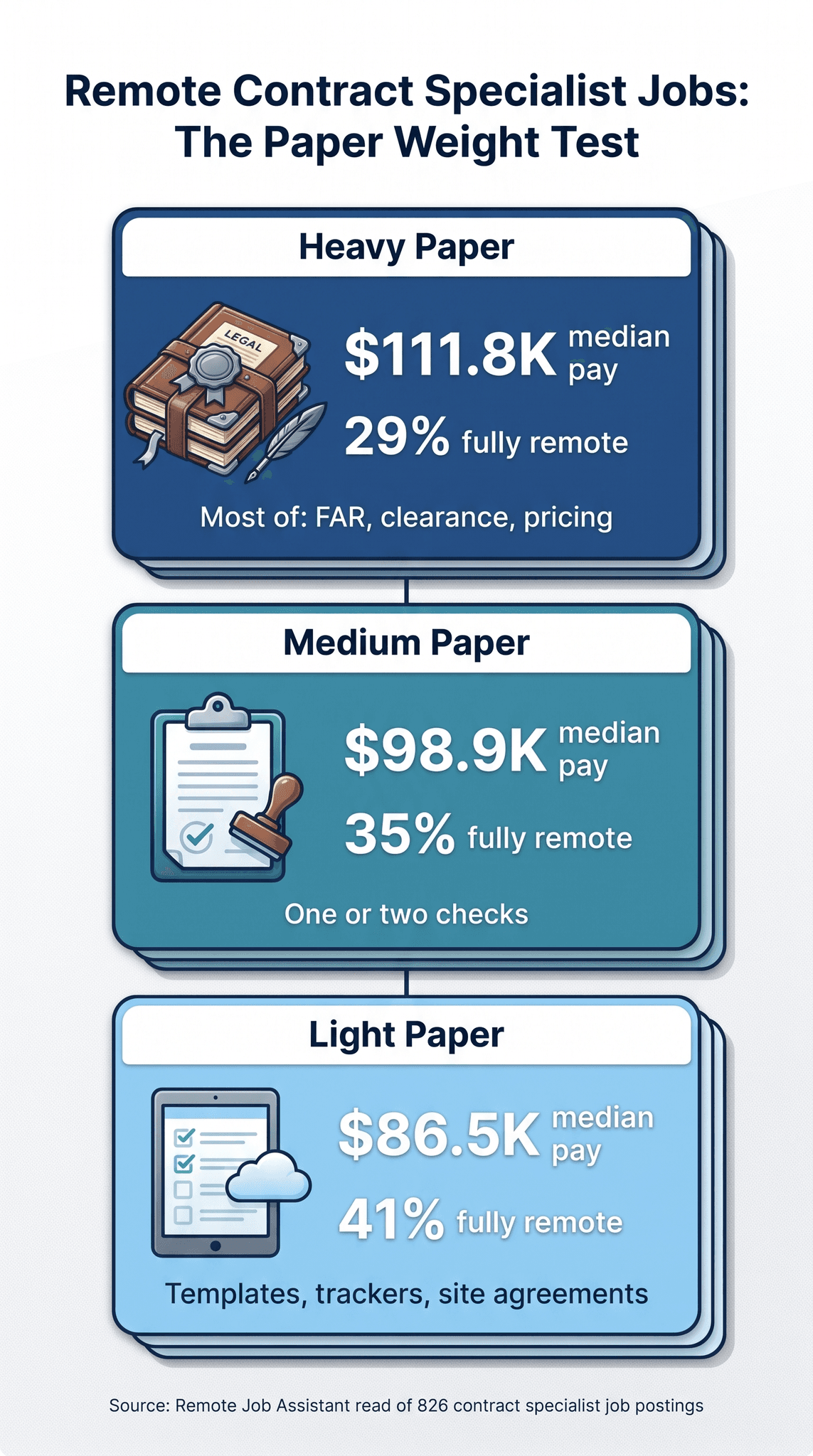
Federal agencies posted 52 contract specialist announcements in our window and made none of them remote, though 38 offer telework. Outside government, the paper sets both the pay and the remote odds. Private postings that name none of four heavy-paper signals (the FAR, a clearance or citizenship gate, a contracts credential, price analysis or signing authority) post a median of about $86,500, and 40.7% of those stating a work model are fully remote. Postings with three or four post about $111,750, and 29.3% are remote. The clearance gate is what cuts remote odds (22.9% remote with it, 43.5% without). Price analysis is the one signal that comes with both higher pay and higher remote odds.
These are the figures behind that answer, all from the same postings.
Based on 826 US contract specialist postings at 594 employers (May-November 2026):
- 32.7% (n=163 of 499 that state a work model) are fully remote; 22.6% (n=96 of 424) among postings found without a remote search term
- 0 of 52 federal announcements are remote; 38 of 52 offer telework
- 85.7% (n=12 of 14) of clinical site-contract postings are remote, at a $77,985 median posted midpoint (n=10)
- 21.4% (n=25 of 117) of defense and federal-contractor postings that name a clearance are remote, vs 51.6% (n=47 of 91) that don't
- $86,500 median for light-paper postings (n=193) vs $111,751 for heavy-paper postings (n=109)
- 22.1% (n=36 of 163) of remote postings limit where you can live or which hours you work
- 83.8% (n=451 of 538) of posted midpoints are $75,000 or more; 47.6% (n=256 of 538) are $100,000 or more
The Paper Weight Test: Four Lines That Price a Contract Specialist Job
The Syneos and GovCIO seats share a rung, a work model and most of a title. What separates them is the regulatory weight of the documents. One works clinical trial site agreements for a contract research organization. The other prices and awards subcontracts under federal acquisition rules for a federal technology contractor. Read enough postings and the same four lines keep showing up next to the higher pay bands. That is the framework we use for the rest of this guide.
The Paper Weight Test: a 0-4 score for how heavy the paper is that a contract specialist seat works, read from four lines in the posting. One point each if the posting (1) names the FAR, DFARS or 2 CFR 200, the Uniform Guidance for federal grants; (2) requires a security clearance, public trust, US citizenship or ITAR eligibility; (3) names a contracts credential (CFCM, CPCM, CCCM, FAC-C, DAWIA or NCMA certification); (4) asks for cost or price analysis, or gives the seat signature or warrant authority.
Scoring (774 non-federal postings, May-November 2026):
- Light paper, 0 checks (median $86,500, n=193; remote 79 of 194, 40.7%): Templates, trackers and counterparties spread across the map. Clinical trial agreements, provider and payer contracts, customer agreements routed through a contract lifecycle management (CLM) system. Fortrea's site budget seat will "Develop Clinical Trial Agreements (CTAs) utilizing standard templates and information from Contract Information Sheets." Flywheel's will "Manage contract tracking and reporting within Salesforce and Conga CLM." Mid-level median $82,993; senior $99,000. 346 postings at 304 employers, and 29.0% of posted midpoints reach $100,000.
- Medium paper, 1-2 checks (median $98,935, n=184; remote 60 of 171, 35.1%): Unclassified federal paper, or regulated commercial paper with a price line. The posting names the FAR but no clearance, or asks for a credential and pricing. GovCIO's seat sits here. Mid-level $90,000; senior $108,912. Half of posted midpoints (91 of 184) reach $100,000.
- Heavy paper, 3-4 checks (median $111,751, n=109; remote 24 of 82, 29.3%): Cleared federal paper with pricing or authority. Northrop Grumman's contracts postings print a structured field, "CLEARANCE REQUIRED FOR START: Yes CLEARANCE TYPE: SCI," and Parsons writes "An active Top Secret SCI security clearance is required for this position." Mid-level $99,000; senior $113,500. 64.2% of posted midpoints (70 of 109) reach $100,000.
How to use it: Score the posting in two minutes before you apply. Check 2 tells you the remote odds, check 4 tells you the pay ceiling, and checks 1 and 3 tell you how the employer will screen your resume. If you want remote and pay, the best trade on this board is a seat that passes checks 1 and 4 without check 2.
Each check moves pay on its own. Only two move the remote odds much, and they move them in opposite directions. Here is each check taken one at a time across the same 774 non-federal postings:
| Check in the posting | Share of postings | Median with | Median without | Remote with | Remote without |
|---|---|---|---|---|---|
| Names the FAR, DFARS or 2 CFR 200 | 43.8% (339 of 774) | $105,000 | $88,600 | 32.8% (67 of 204) | 39.5% (96 of 243) |
| Clearance, citizenship or ITAR gate | 33.1% (256 of 774) | $109,654 | $89,268 | 22.9% (35 of 153) | 43.5% (128 of 294) |
| Names a contracts credential | 18.6% (144 of 774) | $103,112 | $95,000 | 34.1% (28 of 82) | 37.0% (135 of 365) |
| Cost or price analysis, or signing authority | 22.5% (174 of 774) | $107,000 | $94,800 | 45.3% (43 of 95) | 34.1% (120 of 352) |
Medians are annualized posted midpoints. Remote shares count postings that state a work model.
The reason the gate matters more than the regulation is physical. Classified program data can only be handled in accredited space, and contracts staff on a classified program work alongside the people and systems that handle it. So the security office, not the contracts manager, decides where the seat sits. An unclassified FAR seat has no such constraint. Its documents are a solicitation package, a proposal and a price analysis memo, and they can sit on an approved laptop at home. That is why FAR paper with no gate is remote 53.2% of the time (41 of 77) and FAR paper behind a gate is remote 20.5% of the time (26 of 127).
Heavier paper pays more for a reason that has nothing to do with location: the seat is defending a number. A price analysis memo, a cost-realism call or a warrant-level signature is something an auditor or a contracting officer can challenge later, and employers pay for the person who can stand behind it. Light-paper seats move agreements through a process someone else designed.
Light paper travels: 40.7% remote at a $86,500 median. Heavy paper pays: $111,751, remote 29.3% of the time. Pick the trade on purpose, because the title won't tell you which one you're applying to.
If you're filtering for seats that pass the price check without the clearance gate, it helps to have the search running every day instead of every weekend.
Stop Applying Manually
Our AI applies to hundreds of matching jobs while you sleep. Wake up to interviews, not more applications.
How We Collected This Data
The figures in this post come from 826 US contract specialist requisitions at 594 employers, deduplicated from 1,088 copies of postings listed between May 6 and November 1, 2026 (759 of them since August 1). Sources: LinkedIn's public job search (460 copies), SimplyHired, which carries Indeed-network listings (263), 782 Workday career sites (146), Greenhouse, Lever, Ashby and SmartRecruiters boards (4,471 board names tried, 12 copies), the Himalayas remote job board (55) and USAJOBS (52 federal announcements).
A posting is in the set if its title is a contract, contracts, contracting or subcontracts specialist, administrator, analyst, negotiator or officer, a grants and contracts administrator or a CLM specialist, or if it is a USAJOBS announcement in the 1102 contracting series. We excluded postings where "contract" is the employment type ("Data Analyst (Contract)", contract recruiters, contract nurses), contract manufacturing and research roles, contracting officer's representatives and real-estate "contract to close" coordinators. Contracts managers, coordinators and attorneys are counted separately for the salary ladder.
Work model comes from the posting text, read by rules and checked by hand. A hand read of 47 remote-labeled postings found 6 problems (3 wrong work-model labels, 1 test requisition and 2 titles outside the frame), all fixed. Pay is the annualized midpoint of the posted range; 538 of the 826 postings published one. We cross-checked against the Bureau of Labor Statistics median for buyers and purchasing agents ($77,710 in May 2025; $95,780 in government), the BLS occupation that O*NET lists contract administrators under.
What this data can't see: offers, Reddit threads, cleared-only job boards and referral-only requisitions. Cleared-only boards exist because the work behind them is cleared, so treat our remote share for cleared work as a ceiling. If you're deciding whether to chase a clearance, that means the remote cost we measured is the floor. We update this analysis quarterly.
Where Remote Contract Specialist Jobs Actually Are
The remote seats cluster by who's on the other side of the paper. Here is the market by employer type:
| Employer type | Postings | Remote (of those stating a model) | Median posted midpoint |
|---|---|---|---|
| Defense and federal contractors | 343 | 34.6% (72 of 208) | $105,900 (n=244) |
| Federal agencies (USAJOBS) | 52 | 0% (0 of 52) | see GS table below |
| Health systems | 52 | 55.2% (16 of 29) | $93,548 (n=27) |
| Contract research organizations (CROs) | 19 | 73.3% (11 of 15) | $76,150 (n=6) |
| Universities | 37 | 33.3% (8 of 24) | $79,932 (n=18) |
| Technology companies | 37 | 40.9% (9 of 22) | $93,600 (n=21) |
| Industrial, energy and other B2B | 127 | 23.1% (12 of 52) | $95,840 (n=64) |
Three lanes stand out once you split by title. Subcontracts seats (subcontracts administrator, subcontract specialist) are the best-paid remote lane: 43.9% remote (29 of 66) at a $106,812 median (n=85). These are prime contractors buying from their own suppliers, and the unclassified ones can sit wherever the program allows. Clinical site-contract seats are the most remote, 12 of 14, but post a $77,985 median (n=10). If you're coming from remote clinical research jobs, that's the lane you already know. It's also the lane where Medpace still hires "full-time, office-based Site Contract Specialists" in Cincinnati, so check the posting, not the company type. Provider and payer contracting titles are remote 12 of 20 times at a $92,553 median (n=20).
Choosing between the remote-heavy lanes comes down to what you'll trade. Clinical site contracts give you the best remote odds and the lowest pay. Provider and payer contracting sits in the middle. Subcontracts pays the most, $112,063 for senior titles (n=36), at 43.9% remote, and it's the lane where the price check lives. Seats heavy on commercial agreements and CLM tools are the least remote of the four, 16 of 52 (30.8%) at a $95,680 median.
Remote doesn't always mean anywhere. 36 of the 163 remote postings (22.1%) limit where you can live, set an area or name a time zone. CommonSpirit Health: "While this is a remote position, the person needs to be located in California." Abbott: "This is a remote position; candidates must reside in the state of Wisconsin." MIT Lincoln Laboratory: "THIS POSITION IS REMOTE AND THE CANDIDATE NEEDS TO BE WITHIN 100 MILES OF THE LAB AND COME IN AS NEEDED." Advantage Technical lists "Location: Remote (Lorton, VA area preferred)," and Olgoonik describes its seat as "100% remote using company provided equipment with some occasional ad-hoc in office work." Read the location line before you read the duties.
You can browse the legal and compliance job category for contracts seats posted outside defense work, where the light and medium paper lanes live.
Federal 1102 Contract Specialist Jobs: Telework Yes, Remote No
The federal contracting series is the best-structured ladder in this field and, right now, the least remote. USAJOBS's own search for "contract specialist" returned 177 results on November 1, 2026: 0 remote, 102 telework-eligible. In our deduplicated set, none of the 52 federal announcements (51 in series 1102) was remote: 50 print "Remote job: No" and two print no remote field at all. 38 offered telework, most of it "as determined by the agency policy." The Department of the Navy posted 11 of the 52, Defense-wide agencies 9, and the Army and Homeland Security 6 each.
Telework is narrower than it sounds. The Western Area Power Administration's posting reads "Telework eligible Yes—This is an Onsite position." Naval Air Systems Command writes "This position is eligible for ad-hoc/situational telework at the discretion of management." That's a sick-kid day, not a home office.
The January 20, 2025 presidential memorandum on returning to in-person work told agency heads to "terminate remote work arrangements and require employees to return to work in-person at their respective duty stations on a full-time basis," with exemptions at their discretion. In our window, no agency used that discretion for a contract specialist posting. If you need remote, the 1102 track isn't offering it.
The pay is strong once you're on the ladder. Here are the single-grade postings in our set (median of the posted ranges, which vary with locality pay and step):
| Grade | Postings | Median posted range |
|---|---|---|
| GS-11 | 3 | $74,768-$111,087 |
| GS-12 | 6 | $89,508-$131,442 |
| GS-13 | 8 | $113,902-$156,922 |
| GS-14 | 9 | $143,913-$187,093 |
Getting in has a rule most private seats don't. The OPM 1102 qualification standard requires a bachelor's degree or at least 24 semester hours in accounting, business, finance, law, contracts, purchasing, economics, industrial management, marketing, quantitative methods or organization and management for GS-5 through GS-12. At GS-13 and above you need both, plus at least four years in contracting and the agency's mandatory training. Civilian-agency 1102s also work toward the FAC-C (Professional), which the Federal Acquisition Institute ties to 12 months of contracting experience, five CON courses and a 150-question proctored exam passed at 70%, then 80 continuous learning points every two years.
The remote federal paper sits on the contractor side. Grey Street Consulting posted a mid-level contract specialist seat supporting the Department of Transportation's transit agency that is "performed in a remote capacity full-time," with a warning that "Candidates need to be agreeable to the possibility of the government returning staff on-site, potentially multiple days per pay period in the future." That sentence is the honest version of every contractor remote seat tied to a federal customer. Grey Street's is one of three remote postings in our set that put a condition on the remote part itself; MIT Lincoln Laboratory's come-in-as-needed line and Olgoonik's ad-hoc office line are the others. Seven remote postings, Grey Street's among them, are contingent on a contract award, so the seat itself may never start.
Federal agencies posted 52 contract specialist jobs in our window and made none of them remote. Telework is the ceiling on the 1102 track right now.
If you're moving from an agency seat to a contractor seat, the search is wide: 343 contractor postings in six months, under more than 100 title variants. A daily search filtered by those titles and your salary floor keeps you from missing the remote ones.
Stop Applying Manually
Our AI applies to hundreds of matching jobs while you sleep. Wake up to interviews, not more applications.
Contract Specialist Salary by Level
Here is what the ladder posts, from coordinator to director. Remote shares count postings that state a work model.
| Rung | Median posted midpoint | Remote share |
|---|---|---|
| Contracts coordinator titles | $75,000 (n=17) | - |
| Entry-level contract specialist | $76,500 (n=19) | 5 of 15 |
| Contract specialist / administrator | $90,000 (n=332) | 30.1% (96 of 319) |
| Senior contract specialist | $107,445 (n=132) | 43.1% (53 of 123) |
| Principal, lead or supervisory specialist | $133,000 (n=54) | 21.4% (9 of 42) |
| Contracts manager titles | $141,850 (n=205) | 47.1% (80 of 170) |
| Contracts director titles | $191,800 (n=48) | 36.7% (18 of 49) |
Salary ranges come from our analysis of 538 US contract specialist postings that published pay between May and November 2026, annualized at the midpoint of each posted range. The BLS profile for buyers and purchasing agents puts the May 2025 median at $77,710, and $95,780 in government; contract specialist postings run above that because they carry the regulated and negotiated end of purchasing. Ranges shift as markets move, so check the source for current figures.
Experience moves pay in steps. Postings asking for 0-2 years post a $87,100 median (n=102); 3-4 years, $96,300 (n=111); 5-7 years, $110,000 (n=103); 8 or more, $127,500 (n=45). Remote odds move late. Outside government, 32.3% of postings asking 3-4 years are remote (31 of 96) and 31.8% at 5-7 years (28 of 88), then 52.6% at 8 or more (20 of 38).
At 5-7 years the market splits on the gate. Private postings in that band without a clearance line post $107,890 (n=49) and are remote 44.9% of the time (22 of 49). Postings with one post $115,033 (n=54) and are remote 15.4% of the time (6 of 39). That's about $7,000 at the median for two-thirds of your remote odds. The senior rung is also the most remote rung below management (43.1%), but the title alone doesn't set the band: 57 of 188 senior-titled private postings score 0 on the Paper Weight Test.
Remote seats post a little less: $90,500 (n=98) against $95,000 (n=198) for hybrid and on-site seats outside government. Most of that gap is the paper mix, not a remote discount. Remote seats skew toward light paper, and inside the heavy band the remote seats actually post more ($103,112, n=17, vs $94,254, n=43). Almost half of all posted midpoints (256 of 538) reach $100,000, which is where the remote jobs paying $100K+ page starts.
The Clearance Trade: More Pay, Fewer Remote Seats
Clearance is the biggest single sorter in this market. 196 of the 343 contractor postings name one. Among contractor postings that state a work model, 21.4% of those with a clearance line are remote (25 of 117), against 51.6% without one (47 of 91). Across all private postings, the gate comes with a $109,654 median against $89,268.
The usable middle is unclassified federal paper. 120 private postings name the FAR, DFARS or 2 CFR 200 without a clearance or citizenship gate. They're remote 53.2% of the time (41 of 77) at a $94,300 median (n=68). Contractors that posted remote seats in this group include ASRC Federal ("This position is eligible for remote work within the United States"), GovCIO, SAIC, Agile Defense, ERG, Jefferson Solutions Group, BryceTech, Maximus, Trinzic and ActioNet. Add the gate and you get 26 of 127 remote at a $110,876 median.
This runs against the usual advice: if remote is the goal, a clearance is the wrong credential to chase. It adds about $20,000 at the median and cuts your remote odds roughly in half. Price analysis adds about $12,000 and comes with higher remote odds. Learn to price a subcontract before you sit for a polygraph.
If you already hold a clearance, the math flips. Heavy paper is where senior specialists post $113,500 and principal or lead specialists about $135,000 (n=14). The trade is that you'll badge in. The program managers you'd support work under the same security rules; browse remote program manager jobs to see which program-side seats are open.
What Raises Contract Specialist Pay Without Costing Remote
Two skills raise pay without lowering your remote odds. A third, the one everyone lists, doesn't sort anything.
Price analysis. 174 of 774 private postings ask for cost or price analysis or give the seat signing authority. They post $107,000 against $94,800, and 45.3% of them are remote (43 of 95) against 34.1% of the rest. V2X's remote Subcontract Specialist III will "perform Price Analysis, negotiate subcontract pricing & provisions." GovCIO lists "price analysis, negotiations of terms and conditions, award of subcontracts, subcontract administration, issue resolution and closeout activities." Price analysis is portable work: a spreadsheet, a proposal and a memo. The memo stands on its own, so a remote manager can review it without watching it get made.
A contracts credential. Postings that name one post $103,112 against $95,000, with remote odds about flat (34.1% vs 37.0%). Most credential lines are preferences, not gates: of 127 private postings that name a specific credential, 84 call it preferred, desired or a plus, and 11 require it. It breaks ties; it rarely gets you screened out. Postings that name NCMA specifically post $117,700 (n=42). For private seats, NCMA's CFCM needs a bachelor's degree (or 5 years plus 24 college credits by waiver), 2 years of contract work and 80 hours of continuing education; the application costs $165 for members or $365 for nonmembers, plus a $135 exam fee, and you get a year and three attempts to pass. If you're federal or plan to be, the FAC-C (Professional) is the federal certification, and postings at contractors name it too.
CLM fluency is table stakes, not a raise. 99 of 826 postings name a contract lifecycle management tool (Ironclad, Icertis, Conga, Agiloft, LinkSquares, DocuSign CLM, Coupa or Ariba). They post $95,000 against $97,500 without. aPriori's senior seat wants someone to "Serve as primary administrator and power user of aPriori's CLM system (currently Linksquares)," and it posts $100,000 to $140,000. The same posting also passes the price check, which is where the pay comes from, not the software.
"Negotiate" doesn't sort anything. It appears in 649 of 826 postings (78.6%). The tell that a seat really negotiates is a price line or a named counterparty, not the verb.
Pick your next move by where you are now:
- You want remote and $100K+: target subcontracts seats that name the FAR and price analysis with no clearance line. Senior medium-paper seats post $108,912, and 45.6% of them are remote (26 of 57).
- You hold an active clearance and want the top of the band: stay in heavy paper. Expect hybrid or on-site: 29.3% remote.
- You're a federal 1102 who needs remote: the agency won't offer it right now; the contractor side will, usually below GS-13 and GS-14 midpoints.
- You're in clinical site contracts under $80K: add cost or price analysis (check 4) to your budget work, then move toward FAR subcontracts. Unclassified FAR seats are remote 53.2% of the time and post $94,300.
- You're on a commercial CLM desk: pricing and a credential move pay. More CLM configuration work doesn't.
Price analysis is the contract skill that pays more and travels: postings that ask for it pay $12,000 more and are more often remote.
Once you know which checks you pass, the search is mostly volume. Only 32.7% of postings that state a work model are remote, so filter by title, salary and job type every day instead of scrolling the full feed.
Stop Applying Manually
Our AI applies to hundreds of matching jobs while you sleep. Wake up to interviews, not more applications.
How to Read a Contract Specialist Posting in Two Minutes
Read it in this order: the location line, the gate, the price line, then the duties. Each step changes what the next one means.
Two-minute posting check:
- Location line says remote but names a state, an area or a radius? You're in the 36 of 163 remote postings with a limit. Confirm you qualify before you read further. MIT Lincoln Laboratory's remote seat requires living within 100 miles of the lab.
- A clearance, citizenship or ITAR line? Expect hybrid or on-site. Private postings with that gate are remote 22.9% of the time and post a $109,654 median. Without it, 43.5% are remote at $89,268.
- A price line and no routing language? This is the best trade on the board. Postings that ask for cost or price analysis (or give signing authority) without intake, tracking or repository duties post $105,525 (n=50) and are remote 52.0% of the time (26 of 50).
- Routing language and no price line? You're looking at a desk that moves paper through someone else's process: $90,000 (n=167), remote 37.7%. A senior title doesn't change that. 57 of 188 senior-titled private postings score 0 on the Paper Weight Test, and senior light-paper seats post $99,000 against $113,500 for senior heavy-paper seats.
- "Contingent upon contract award"? The seat exists if the bid wins. 14 postings say this, and 7 of them are remote. BryceTech: "Position is contingent upon contract award." Jefferson Solutions Group: "this position is contingent upon contract award and funding approval."
Two more lines change the band. Postings that count contracts per month or say "high-volume" post $86,404 (n=33). And 73 postings mention overtime, extended hours, quarter-end or fiscal year-end pressure, but only 6 of the 47 that state a work model are remote. Surge work in this field is office work. Contract employment is common too: 140 of 826 postings (16.9%) are temp, contract-to-hire or staffing-firm seats at a $95,004 median, so read the duration line before the pay line.
Two 2026 changes are worth asking about. The FAR is being rewritten in plain language under the Revolutionary FAR Overhaul, with agencies working from class deviations and the formal regulatory changes published in June 2026, so "strong knowledge of the FAR" means something different this year. And the DoD CIO's CMMC page says Phase II, originally scheduled for November 10, 2026, was suspended on July 13, 2026, while Phase 1 self-assessments and DFARS clause 252.204-7012 stay in force. Only 7 postings in our set name CMMC at all, so don't assume a subcontracts seat owns cybersecurity flowdowns until you ask.
What the Posting Won't Tell You
Ask these on the first call, and listen for a number rather than an adjective:
- "What can this seat sign without escalating, and what was the last thing it had to escalate?" A dollar threshold means a specialist. "It depends" means a router with a specialist's title.
- "Who writes the price analysis memo, and who signs it?" If a separate pricing team writes it, the price check doesn't apply, and neither does the pay that comes with it.
- "If the customer pulls staff back on site or the program moves to a classified system, what happens to this seat?" Grey Street Consulting put the answer in its posting. Most employers won't until you ask.
- "Is this requisition tied to a bid, and when is the award decision?" A seat contingent on an award can start in two weeks or never.
From Contract Specialist to Contract Manager
The next rung pays a third more. Senior contract specialist postings post $107,445; contracts manager titles post $141,850 (n=205). And the remote odds improve: 80 of 170 manager-rung postings that state a work model are remote (47.1%), against 43.1% at senior specialist.
What changes is the sign-off and the counterparty. A manager owns the relationship with the customer's contracting officer, the subcontractor's leadership or the hospital system, and signs the deviation instead of drafting it. Our guide to remote contract manager jobs scores those seats with the Counterparty Test, which reads remote odds from who sits across the table.
If you're coming from the buying side, subcontracts work is the bridge, and our remote procurement jobs guide covers the sourcing seats. If you're coming from legal, commercial contract review is the bridge; see remote paralegal jobs. If you like the regulation more than the negotiation, remote compliance jobs are the adjacent seat. The operations and project management category is where many program-side contract seats get listed.
Frequently Asked Questions
Can a GS-1102 contract specialist work fully remote in 2026?
Not in an agency seat right now. All 52 federal contract specialist announcements in our May-November 2026 set said "Remote job: No," though 38 of 52 offered telework, usually at management's discretion. Remote federal contracting work exists on the contractor side, where 41 of 77 unclassified FAR postings that state a work model are remote.
I'm a contracts administrator at a defense contractor making $85K. How do I get a remote seat that pays $110K or more?
Stop applying to cleared program seats if remote is the requirement; they're remote about one time in five. Move toward subcontracts seats that name the FAR and price analysis but no clearance. Senior medium-paper postings post $108,912 and are remote 45.6% of the time (26 of 57). Put price analysis and proposal evaluation in your first two resume bullets, ahead of the CLM tools, and add a CFCM if you don't have one.
Is contract specialist a good career, and what does it pay?
For experienced specialists, yes: 451 of 538 posted midpoints (83.8%) are $75,000 or more. Mid-level postings post a $90,000 median, senior $107,445 and principal or lead $133,000. Experience pays in clear steps, from $87,100 for 0-2 years to $127,500 for 8 or more.
How do I score a posting on the Paper Weight Test?
Give one point each for the FAR or 2 CFR 200, a clearance or citizenship gate, a named contracts credential, and price analysis or signing authority. A 0 posts a median of about $86,500 and is remote 40.7% of the time; a 3 or 4 posts about $111,750 and is remote 29.3%. A high score without the gate is the best pay-to-remote trade.
Do remote contract specialist jobs require a security clearance?
Usually not, and when they do, read twice. 27 of 163 remote postings in our set name a clearance. A clearance line roughly halves remote odds: 22.9% of private postings with one are remote, against 43.5% without. If a remote posting does name a clearance, ask which parts of the work need a cleared space and how often you'd be in one.
Should I get the CFCM or the FAC-C?
If you work for or want to work for a federal agency, the FAC-C (Professional) is the federal certification. For contractor and commercial seats, the CFCM or CPCM is what most postings name. Postings that name a contracts credential post $103,112 against $95,000 without, with no drop in remote odds.
Find Remote Contract Specialist Jobs That Pay for the Paper
Score the posting before you apply. Check the gate first if you want remote, the price line if you want the pay, and the location line before either. Start with contracts seats in the legal and compliance job category and the remote jobs paying $75K+ page, and use Auto-Apply to send applications to the seats that pass every day. If you're ready for the next rung, our remote contract manager jobs guide picks up where this one stops. Finance-side contract roles, like contract analysts in revenue and billing, list under the finance and accounting category.
Find the clearance line and the price line before you read anything else. Between them, they tell you what the title won't.
Ready to Find Your Remote Job?
Browse thousands of curated remote jobs or let AI apply for you.
Browse Remote JobsRelated Job Guides

Remote Excel Jobs: What 7,465 Postings Pay for Excel Work
We read 7,465 Excel-heavy job postings. 22.5% of those that state a work model are fully remote, and seats that build the model pay $21K more than keeper seats.
27 min read

Remote Tableau Jobs: What 3,835 Postings Pay for Tableau
We read 3,835 analytics postings. Tableau shows up in 1,511, almost never in the title, and seats upstream of the dashboard pay $26K more than request desks.
29 min read
Remote Media Jobs: 1,843 Postings, 320 Fully Remote
We read 1,843 media job postings. 320 are fully remote, and almost none sit at holding-company agencies. The Login Test shows which media seats go remote.
24 min read