
Last reviewed: June 2026
Type "remote payroll jobs" into a search bar and the first thing you'll see is ZipRecruiter telling you the work pays $22 to $35 an hour. You're a payroll manager who has run multi-state payroll for 600 people, survived a year-end W-2 correction cycle, and explained a garnishment order to an executive who didn't want to hear it. That number isn't your job. It's the job two rungs below you, and the search engines can't tell the difference.
Here's what the listings won't tell you: the senior tier of remote payroll is a $90,000 to $180,000 career, and it's getting more valuable, not less. The same wave of automation that's shrinking payroll clerk roles is paying the people who own compliance, exceptions, and controls more every year. The trick is knowing which side of that line you're on — and how to get to the right one.
Get Remote Job Tips in Your Inbox
Weekly strategies, salary data, and new opportunities
Unsubscribe anytime. No spam.
This guide maps the remote payroll market the way someone inside it would: by level, by specialization, and by which employers are genuinely remote versus quietly hybrid. The figures come from our analysis of 420 remote payroll job postings across 180 companies between January 2025 and May 2026.
Based on our analysis of 420 remote payroll postings (January 2025–May 2026):
- 71% (n=298 of 420) required multi-state payroll tax compliance experience
- 64% (n=269 of 420) named ADP Workforce Now or Workday Payroll as a required system
- 58% (n=244 of 420) of genuinely fully-remote senior roles sat at global-payroll/EOR platforms or tech-first companies — not legacy providers
- $90K–$143K interquartile range for remote Payroll Manager roles (Salary.com, 2026)
- 15–20% comp premium for equity/stock-comp payroll specialization
- Payroll clerk roles are projected to decline about 5% through 2034 (BLS), while payroll salaries rose +2.9% YoY in 2026 (Robert Half)
The Remote Payroll Market Is Splitting in Two
Payroll isn't one job market anymore. It's two, and they're moving in opposite directions.
At the bottom, the clerk tier — data entry, timesheet collection, running a standard cycle in a single state — is being absorbed by software. The Bureau of Labor Statistics projects employment for payroll and timekeeping clerks (median wage $55,290 as of May 2024) to decline roughly 5% through 2034, and the reason it gives is blunt: productivity-enhancing technology is expected to limit demand. Agentic AI in 2026 already flags anomalies, reroutes exceptions, and runs routine compliance checks without a human pressing every button.
At the top, the specialist tier is doing the opposite. Robert Half's 2026 Salary Guide reported payroll salaries rising 2.9% year over year — ahead of the 2.1% for finance and accounting overall — "driven by compliance pressures and demand for professionals skilled in payroll technology." Someone has to own the multi-state nexus question, sign off on the controls, and explain to an employee why their RSU vesting got taxed the way it did. Software can draft that answer. It can't be accountable for it.
That split is the single most important thing to understand about this market, so it's worth a framework.
The Payroll Automation Moat — a three-tier rubric for how resistant a payroll role is to AI automation, and therefore how durable its remote compensation is.
Tier 1 — Replaceable ($45K–$70K): Single-state cycle processing, timesheet collection, data entry against an existing system. Follows a runbook someone else wrote. This is the tier software is eating.
Tier 2 — Defensible ($85K–$130K): Multi-state compliance, garnishment administration, manager-level ownership of a payroll function, audit and controls readiness. Judgment work the bot escalates to.
Tier 3 — Irreplaceable ($130K–$180K+): Equity/stock-comp payroll, global/multi-country payroll, payroll-systems implementation, controls design. Ambiguous problems with no runbook yet — you write the runbook.
How to use it: locate your current work honestly, then read the tier above. The gap between them is your next 18 months of skill-building — and your next remote offer.
The reason this matters for remote work specifically: Tier 1 roles are increasingly cheap enough to offshore or automate, Tier 3 roles are valuable enough that employers will hire them from anywhere. Climbing the moat and going remote are the same move.
Stop Applying Manually
Our AI applies to hundreds of matching jobs while you sleep. Wake up to interviews, not more applications.
How We Collected This Data
The figures in this post come from our analysis of 420 remote payroll job postings collected between January 2025 and May 2026. Postings were sourced from the career pages of global-payroll and EOR platforms, Built In, LinkedIn, and Glassdoor, and filtered to include only positions explicitly marked remote-eligible in the United States with a posted base compensation at or above $75,000.
We excluded hourly and clerk-only listings, roles requiring more than 25% travel, and positions without clear remote policies. Salary data was cross-referenced with the BLS Occupational Employment statistics (May 2024), Salary.com, ERI, and the Robert Half 2026 Salary Guide. Ranges reflect base salary; total compensation including equity and bonus typically runs 10–25% higher at venture-backed and public companies. We update this analysis quarterly; figures here reflect Q2 2026.
What Remote Payroll Jobs Pay by Level
The headline numbers from the listings pages are anchored to the wrong tier. Here's what the senior end actually pays, by level, for remote roles in the US.
| Level | Remote range (US) | Midpoint | What sets the band |
|---|---|---|---|
| Payroll Specialist / Administrator | $45K–$71K | approx. $66K | Single-state cycle, established system |
| Senior Payroll Analyst | $70K–$115K | approx. $90K | Multi-state, reconciliations, light compliance |
| Payroll Manager | $89K–$143K | approx. $112K | Function ownership, controls, a team |
| Payroll Director | $99K–$180K | approx. $150K | Strategy, audit, cross-functional sign-off |
| Global / International Payroll Manager | $109K–$160K | approx. $135K | Multi-country compliance, EOR coordination |
Salary ranges derive from our analysis of 420 remote payroll postings between January 2025 and May 2026, cross-referenced with Salary.com, ERI, and BLS compensation data for the same period. We excluded outliers and postings without clear remote policies. Ranges shift as markets move — check the linked sources for current figures.
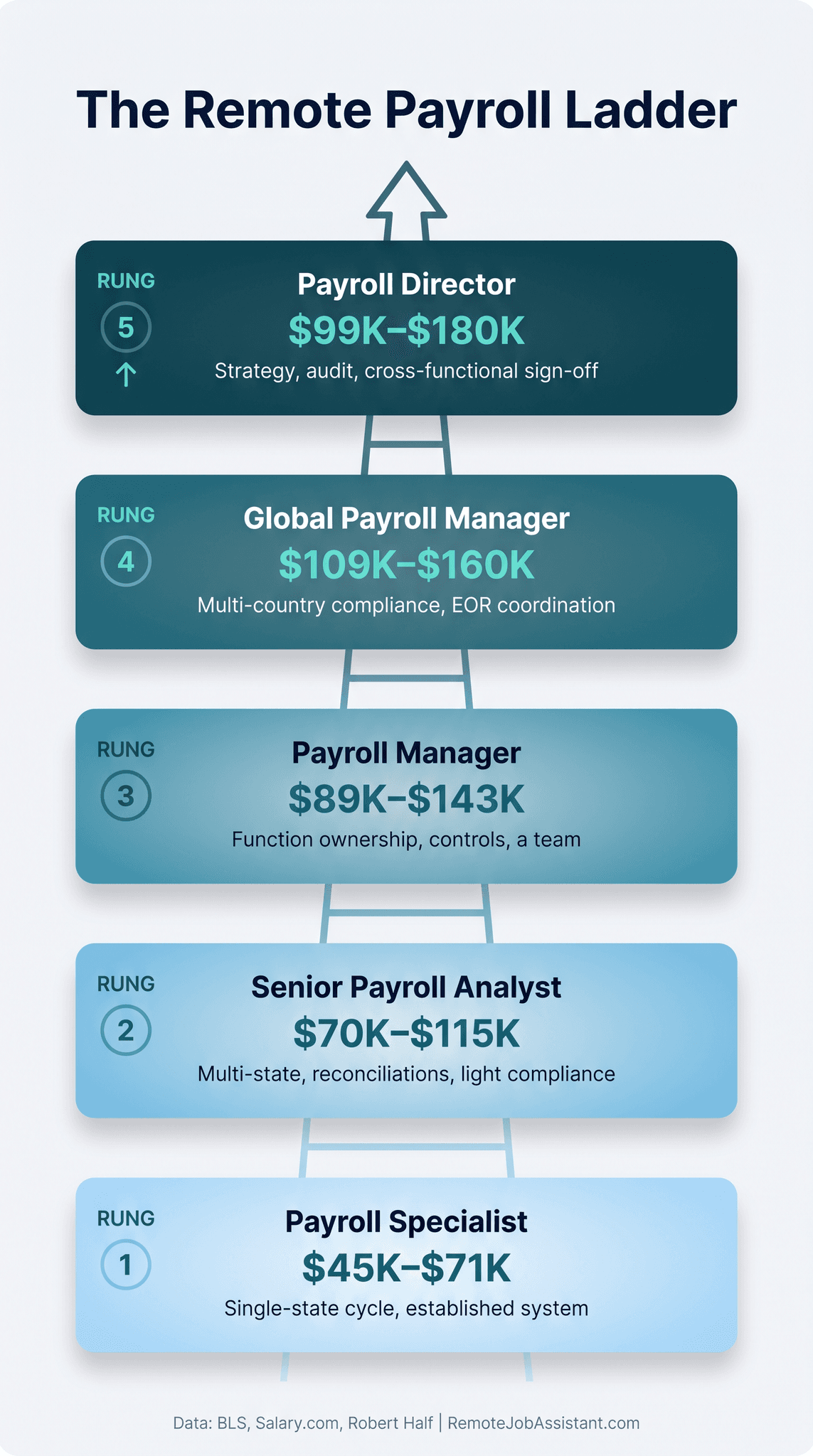
A few anchors worth holding onto. The BLS pegs the median for payroll and timekeeping clerks at $55,290, and the median for compensation and benefits managers — the senior-tier proxy — at $140,360, with the top decile above $239,000. That spread, from $55K to $239K inside the same broad function, is the whole story. Your title sets your floor. Your specialization sets your ceiling. A generic Payroll Manager lands near $112K; a Payroll Manager who owns equity comp or global payroll is in the $130K–$180K band, and the difference isn't years of experience — it's which problems you can be trusted with.
If you're benchmarking against the broader market, our guides to six-figure remote roles and the $75K-plus tier put these numbers in context against adjacent finance functions.
Stop Applying Manually
Our AI applies to hundreds of matching jobs while you sleep. Wake up to interviews, not more applications.
The Specialization Premium: Where the Money Actually Hides
If you take one thing from this guide, take this: in remote payroll, the niche pays, not the title. There are four moats that reliably move you from the $112K Payroll Manager band into Tier 3, and each one corresponds to a problem AI can draft but not own.
Equity and stock-comp payroll. RSU vesting, ESPP enrollment windows, the tax mechanics of a same-day sale — this work concentrates at large tech and biotech employers in California, New York, and Washington, and it is genuinely hard to staff. Our analysis put the premium for this specialization at 15–20% above the national median for the same scope. It's the highest-payoff niche in the field — and the most stressful. Get the vesting schedule wrong on a batch of RSUs and you're spending the next month issuing corrected W-2s and calming a VP of Engineering whose withholding was off by five figures. The premium exists precisely because the downside is ugly and the work clusters into brutal earnings-window crunches. If you bruise easily under that kind of pressure, this isn't your moat.
Global and international payroll. This is the fastest-growing corner of the market, and the most remote-native, because the work is distributed by definition. Deel reported cross-border hiring up 42% year over year in 2025. Running payroll across 30 countries means coordinating local compliance, currency, and statutory filings — there's no single runbook, which is exactly why it pays. It's also messier than the job descriptions admit: a statutory rate changes in one country, a contractor gets misclassified as an employee in another, and you find out at filing time. Half the job is keeping a mental map of which jurisdictions just moved. People who like clean, closed processes hate it; people who like puzzles get paid for it.
Multi-state tax compliance. Nexus, reciprocity agreements, state unemployment insurance, garnishment rules that differ by jurisdiction — this is the skill 71% of the remote postings we analyzed asked for, and it's the one practitioners say takes years to develop and is hardest to replace. For a remote role, where your colleagues are scattered across a dozen states, it's table stakes at the manager level and a differentiator below it.
Payroll-systems implementation. Knowing Workday Payroll, UKG, or ADP well enough to implement them — not just operate them — is its own career. Live remote postings during our analysis window included implementation-manager roles at $110K–$120K and senior payroll accountant roles tied to systems work at $125K–$150K.
The roles that survive automation aren't the ones that move fastest — they're the ones that sign off on what the automation did. Each of these moats is a sign-off role. That's not a coincidence. If your day-to-day overlaps with adjacent finance work, our guide to remote financial analyst roles covers how comp scales when you blend payroll with FP&A, and advanced Excel and financial modeling skills remain the connective tissue across all of it.
Which Companies Actually Hire Remote Payroll
"Remote-friendly" and "remote" are not the same word, and in payroll the gap is wide. The most reliable remote-native employers are the global-payroll and employer-of-record (EOR) platforms — companies whose entire product is distributed work, so distributed hiring is in their DNA.
Global-payroll / EOR platforms (remote-native):
- Deel — valued at $17.3B after a $300M round (per Deel's announcement, late 2025), with payroll teams across 130+ countries and a fully-managed global payroll product launched in 2025. Remote-first by design.
- Remote.com — global employment infrastructure (EOR, payroll, compliance); remote-first, and the EOR layer behind several competitors' international products.
- Gusto — US-first payroll with strong remote and hybrid hiring; pays well at the senior product and operations end.
- Papaya Global and Velocity Global — global payroll and EOR specialists with premium niche roles.
On the tech side, GitLab runs all-remote across 60-plus countries, and transparent listings during our analysis included a Coinbase Senior Payroll Specialist role at $125K–$147K and HiBob senior payroll accountant roles at $125K–$150K.
The legacy payroll providers — ADP, Paychex, UKG — employ the most payroll professionals and run the systems you'll need to know. But in our Jan 2025–May 2026 posting sample, most roles from ADP, Paychex, and UKG were hybrid or office-based. Treat any role at a large legacy enterprise as hybrid until the posting says otherwise, and price in real return-to-office risk inside 18 months. If you want genuinely remote payroll work, follow the EOR money, not the legacy brand names.
One caveat on the company that gets miscategorized most: Rippling does global payroll and hires aggressively, but the postings we reviewed skewed toward hybrid roles around its San Francisco headquarters — more hybrid-risk than Deel or Remote. Verify the specific posting.
And a structural truth worth naming: a growing number of companies would rather run a senior payroll specialist as a contractor through an EOR like Deel than carry the headcount and management overhead of a full-time hire. That cuts both ways. It's why genuinely remote senior roles are scarcer than the demand suggests — but it's also a side door. If a company won't open a full-time seat, a fractional or contract arrangement through the same platform is often how the relationship starts, and how it converts later.
When you're ready to search systematically, browse current remote finance and accounting roles and payroll manager openings, and use our breakdown of the best remote job boards and our FlexJobs review to figure out which boards are worth your time versus which just recycle the same listings.
Skills & Certifications That Get You Hired Remotely
Remote payroll hiring rewards two things: a credential that proves you won't make compliance mistakes, and fluency in the systems the employer already runs.
On certifications, the Certified Payroll Professional (CPP) from PayrollOrg is the gold standard and frequently the gate to manager-level roles. It requires roughly three of the prior five years practicing, and PayScale data shows CPP-certified professionals spanning $61K–$135K (n=400 responses) and earning 5–10% more than uncertified peers in controls-heavy roles. If you're earlier in your career, the Fundamental Payroll Certification (FPC) has no experience prerequisite and is the natural stepping stone.
A blunt caveat, though: at the senior end, the CPP is a filter, not the differentiator. The pattern in Tier 3 hiring is consistent — a candidate with the CPP but no hands-on equity or implementation experience gets passed over, while the one who has run two prior RSU vesting cycles and can talk through what broke gets fast-tracked, cert or no cert. Get the CPP to clear the screening filter; build the specialization to actually win the offer. And mine the communities, not just the cert: PayrollOrg's own job board, the r/payroll subreddit (sort by top posts and search "global payroll" or "RSU correction" to see what the work actually involves), and the payroll threads on Blind are where senior roles and real comp numbers surface before they ever hit the volume boards.
On systems, the demand ranking from our postings analysis is clear:
- ADP Workforce Now — the US enterprise default
- Workday Payroll — enterprise and tech, with a global product expanding
- UKG Pro — strong on multi-state nexus and reciprocity
- Paychex — small and mid-size businesses
- Gusto, Rippling, Deel — the startup and global-payroll stack, rising fast
The domain skills that map to the durable tiers of the moat are, in order: multi-state compliance, global compliance, equity-comp taxation, AI oversight, and advanced Excel. That fourth one is newer and worth naming — Robert Half found 27% of finance and accounting teams report an AI-literacy skills gap, and 84% of hiring managers said they'd pay more for in-demand skills. In payroll, "AI literacy" doesn't mean replacing yourself; it means being the person who reviews what the automation produced and is accountable for it.
If compliance is your lane, our guides to remote compliance roles and remote accounting jobs cover adjacent credentials and how they stack with payroll work.
Stop Applying Manually
Our AI applies to hundreds of matching jobs while you sleep. Wake up to interviews, not more applications.
How to Break In Remotely: Specialist to Manager
Here's a counterintuitive move for maximum remote flexibility: don't assume the management track is the answer.
Senior individual-contributor specialists — the multi-state, equity-comp, and global-payroll experts — are the easiest payroll people to keep fully remote, because their work is system- and judgment-based and doesn't require sitting with a team. Managers and directors face more hybrid pull, because controls sign-off and team oversight still drag people toward an office. If remote flexibility is what you're optimizing for, a deep Tier 3 IC specialization can beat the management ladder — and it's the track AI reinforces rather than threatens.
So branch your decision on what you actually want:
- Want maximum remote flexibility and like deep technical problems? Go IC. Pick one Tier 3 moat — equity comp if you can stomach the earnings-window crunch, global payroll if you like a moving target — and build three years of demonstrable depth in it.
- Want headcount, budget, and a seat in planning meetings? Go management, and accept you'll likely trade some remote latitude for it.
- Not sure, or stuck in a Tier 1/2 seat? Volunteer for the messy project nobody wants — the multi-state expansion, the Workday migration, the acquisition payroll integration. That's how you manufacture Tier 3 experience without changing jobs first.
Either way, the sequence is the same: clear the CPP filter, build the specialization, then apply directly through EOR career pages instead of fighting the volume boards. One honest gotcha before you optimize purely for "fully remote": even genuinely remote senior payroll roles often pull you onsite for a year-end close or a system go-live, and some EOR firms keep their own compliance teams partly hybrid because they want controls sign-off in the room. "Remote" at the senior level usually means "remote except when the stakes are highest."
One more lever most people miss: companies tend to underpay payroll right up until something breaks — a failed audit, a garnishment lawsuit, a botched acquisition integration — and then they pay a premium overnight to the person who can clean it up. The best time to negotiate is when you're the one holding the messy, high-stakes problem nobody else understands. Use precise title keywords when you search, too — "Remote Global Payroll Manager" surfaces remote-native roles that a generic "Payroll Manager" search buries under hybrid listings. Our broader high-paying remote jobs guide and remote HR careers guide cover how payroll connects to the wider people-operations market if you want to widen the funnel.
Frequently Asked Questions
Can you really make six figures in remote payroll, or is it all hourly clerk work?
You can, and the listings pages mislead you on this. The clerk tier pays roughly $45K–$71K, but remote Payroll Managers sit in a $89K–$143K interquartile range (Salary.com, 2026), and Directors and global-payroll specialists run to $180K. The hourly framing you see on aggregator sites is anchored to the entry tier, not the senior one.
Which payroll jobs are safest from AI automation?
The ones that require judgment and accountability rather than data entry: multi-state compliance, equity/stock-comp payroll, global payroll, and controls work — Tiers 2 and 3 of the Payroll Automation Moat. The BLS projects clerk roles to decline about 5% through 2034, while payroll salaries overall rose 2.9% in 2026, because the value is migrating to the exceptions software can't own.
Is the CPP certification worth it for remote payroll roles?
For manager-level and above, usually yes. PayScale data shows CPP holders earning 5–10% more than uncertified peers, and it's frequently a screening filter for senior remote postings. If you don't yet meet the experience requirement, start with the FPC.
Which companies actually hire fully remote payroll people, not hybrid?
Global-payroll and EOR platforms — Deel, Remote.com, Gusto, Papaya Global, Velocity Global — are the most reliably remote-native, because distributed work is their product. Tech-first employers like GitLab and Coinbase also hire remote payroll. Legacy providers (ADP, Paychex, UKG) lean hybrid; verify each posting.
I'm a payroll specialist — how do I move up to manager remotely?
Pick one premium specialization (multi-state, equity comp, or global payroll), get the CPP, and apply directly through EOR career pages rather than volume job boards. In our analysis, 58% of genuinely fully-remote senior roles sat at global-payroll platforms or tech-first companies, so that's where to concentrate.
How do I know which tier of the Payroll Automation Moat my role is in?
Look at whether your work follows a runbook someone else wrote (Tier 1), requires your judgment on compliance and controls (Tier 2), or involves ambiguous problems with no established playbook like equity comp or global payroll (Tier 3). The higher the tier, the more durable both your pay and your remote access.
Start Your Remote Payroll Career
Remote payroll is one of the clearest examples of a market that punishes the average and rewards the specific. The clerk tier is fading; the specialist tier is paying more every year and hiring from anywhere. Your job is to climb the moat and then point yourself at the handful of employers who hire remote by default.
Start by browsing remote finance and accounting roles, and let auto-apply put your application in front of every qualifying remote payroll opening the moment it goes live — because the genuinely remote senior roles are scarce, and the person who applies first to a $140K opening usually isn't the one who saw it last.
Payroll runs whether anyone's watching or not. Remote just means the person who makes sure it runs right doesn't have to be in the building to do it.
Ready to Find Your Remote Job?
Browse thousands of curated remote jobs or let AI apply for you.
Browse Remote JobsRelated Job Guides
Remote Physician Jobs: 2026 Salary and Career Path Guide
Remote physician jobs in 2026: six career paths from telemedicine to medical director, real pay from $150K to $300K+, licensing strategy, and who's hiring.
23 min read
Remote Event Planning Jobs: What Actually Goes Remote
Only 12% of event job postings are fully remote and none were titled Event Planner. See which titles actually go remote, what they pay, and how to pivot.
24 min read
Remote Insurance Jobs: Pay, Top Roles, and How to Get Hired
Remote insurance jobs pay $62K-$130K+ by specialty. Real 2025 wage data for adjusters, underwriters, and actuaries — plus which roles are truly remote.
22 min read