
Last reviewed: October 2026
You've chaired the quality committee, signed off on the QAPI minutes, and covered the call schedule nobody else wanted. So you search "remote medical director jobs," and LinkedIn tells you there are 7,000+ of them. Two of the first 60 cards on that page are for veterinary hospitals.
The title "medical director" is printed on very different jobs. A hospice needs a named physician who certifies terminal illness and answers for its patient care. A Medicare Advantage plan needs a physician who signs coverage decisions, and the federal rule only asks for a license "in a State." A drug sponsor needs a physician who can answer questions about a trial. Only some of those signatures can be made from home, and that has little to do with the title or the pay.
Get Remote Job Tips in Your Inbox
Weekly strategies, salary data, and new opportunities
Unsubscribe anytime. No spam.
We read 1,860 medical-director-titled US job postings across 854 employers, all first listed between January and October 2026. 305 were fully remote, and another 239 let you work from home part of the week. Not one of the 1,040 jobs tied to a building (a hospital department, hospice, nursing facility, clinic or urgent care center) was fully remote. Below are the five kinds of medical director seats, what each pays, the license rule that comes with each, and the posting lines that tell you which one you're reading.
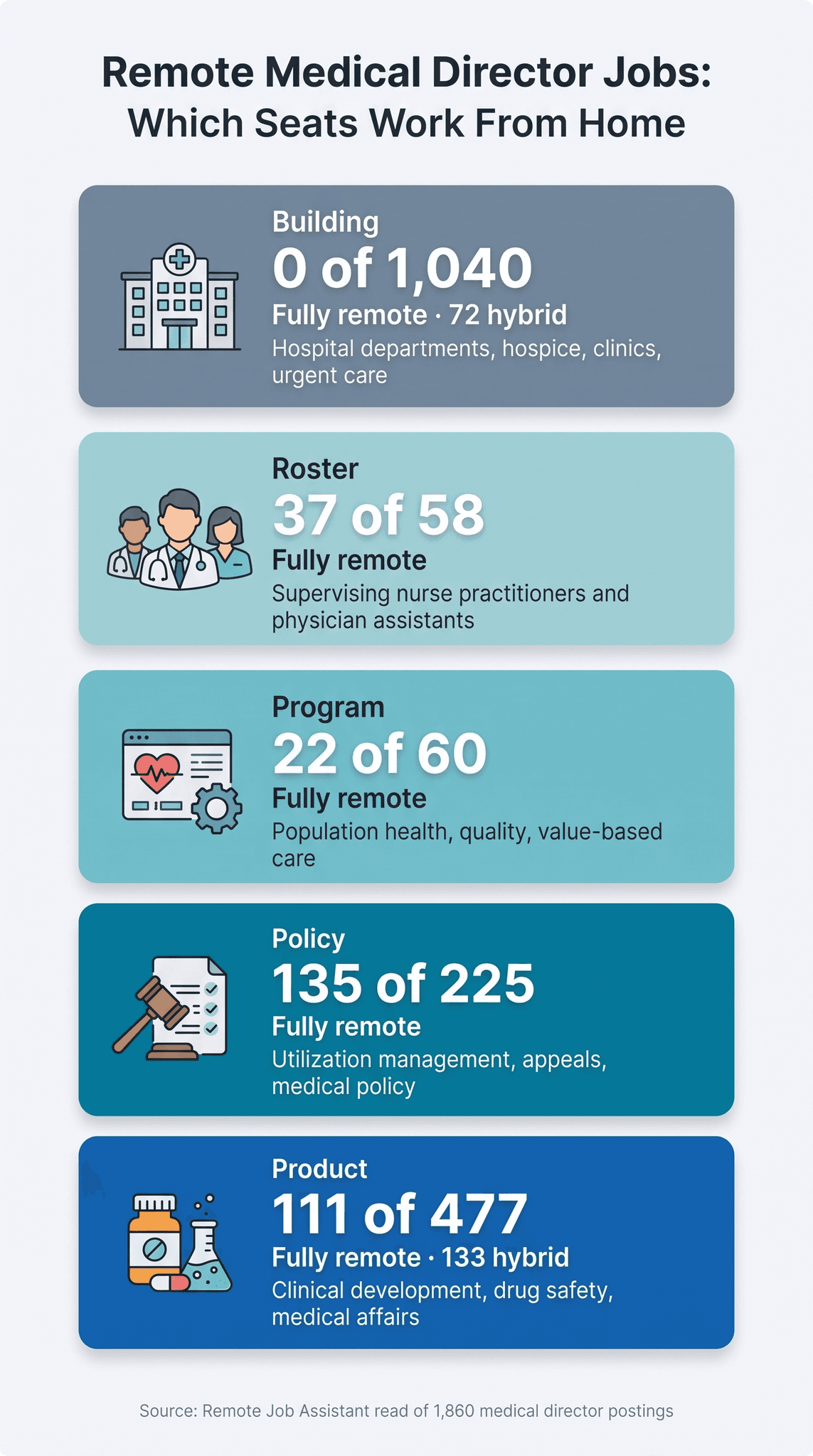
Yes, medical directors can work from home, but almost only in two kinds of seats. Coverage seats at health plans and review companies (utilization management, appeals, medical policy) were fully remote 135 of 225 times. Drug-development seats at pharma companies and contract research organizations were remote 111 of 477 times and hybrid 133 more. Seats tied to a facility were remote 0 of 1,040 times. The common remote seat pays close to the median physician wage, about $279K posted for coverage work, and its license rule depends on which program the plan runs.
Every figure below comes from the posting text, not from the listing's location tag.
Based on our read of 1,860 medical-director-titled US physician postings at 854 employers, first listed January–October 2026:
- 16.4% (n=305 of 1,860) were fully remote after reading the full text; 29.2% (n=544 of 1,860) let you work from home at least part of the week
- 0 of 1,040 facility-based seats were fully remote, against 60.0% (n=135 of 225) of coverage seats at health plans and review vendors
- 60.2% (n=103 of 171) of health plan postings were remote, against 1.5% (n=8 of 527) at hospitals and health systems
- 73.8% (n=31 of 42) of contract research organization (CRO) seats were remote, against 16.1% (n=58 of 360) at drug and device sponsors, which posted 119 hybrid seats
- $284K is the median posted midpoint for remote seats (n=183 with salary ranges), against $300K on site (n=319)
- 81.1% (n=90 of 111) of remote drug-development seats name no license requirement; 88.9% (n=120 of 135) of remote coverage seats require board certification
- 22.6% (n=69 of 305) of the remote jobs say "remote" or "virtual" in the title
- $275,930 is the BLS median wage for physicians and surgeons (May 2025)
How We Collected This Data
Listing tags were wrong often enough that we read every posting. Froedtert ThedaCare's employer-health posting uses "WFH" throughout, and it means Workforce Health, the on-site clinics it runs for local employers. Hospice postings describe "home-based settings," which is where the patients are, not where the physician works. Hospitals advertise a "hybrid OR." A keyword filter counts all of those as remote or hybrid jobs. None of them are.
We pulled from six places. LinkedIn's public job search returned 3,314 unique listing cards across 887 result pages for 55 medical-director searches, plus its remote landing page, and we read 1,999 of those jobs in full. SimplyHired, which carries Indeed's network, added 642 job pages from 46 searches. We searched 95 Workday career sites directly (health plans, pharma companies, CROs and health systems), read UnitedHealth Group's and Molina Healthcare's own career sites, 83 company boards on Greenhouse, Lever, Ashby and SmartRecruiters, and the federal USAJOBS site.
A posting counted if "medical director" was in the title, including associate, senior, regional and executive versions, at a US employer hiring a physician. We set aside 75 veterinary hospital listings, 15 "non-MD" twins of physician postings, 93 listings first posted before 2026, 68 non-US jobs and 9 expired listings. Copies of the same job were collapsed into one: the same employer, title and location; one remote job cloned across state pages; or the same text on two sites. That removed 735 copies.
We read the work-model language in the posting body and the structured location fields, then hand-checked every remote facility seat, every on-site supervision and coverage seat, the hybrid facility seats, and random samples of the remote coverage and drug-development seats (59 hand calls in all). 236 postings never say where the work happens, so they stay out of the remote count. Pay is the posted salary range; ranges wider than 2.2 times are excluded, and medians are rounded. Indeed, Glassdoor, ZipRecruiter and Reddit block automated reading, and we didn't sweep physician recruiting boards such as PracticeLink, so facility seats are under-counted. Remote-ranked searches over-sample remote jobs, and we can measure by how much: of the 1,179 LinkedIn postings we reached through searches that never mentioned remote work, 31 were remote (2.6%), against 92 of 175 (52.6%) reached through remote searches. Read our 16.4% as a ceiling for the title, not a floor. This is a snapshot of live listings on October 21, 2026, updated quarterly.
The Signature Map: What You Sign Decides Where You Sit
"Is it remote?" is the wrong first question for a medical director job. Ask what your signature covers. Every one of these seats exists because a rule wants a physician's name on something, and the rule decides where that physician has to be. Medicare's hospice rule says "the hospice must designate a physician to serve as medical director," who certifies that a patient's life expectancy "is 6 months or less" (42 CFR 418.102). Nursing facilities, dialysis units and PACE programs carry the same kind of rule. Those signatures belong to a building. A coverage decision or a trial protocol doesn't have a building.
The Signature Map sorts a medical director seat by what your signature covers: a building, a roster of clinicians, a care program, a coverage decision, or a product. Each lane has its own remote odds, pay band, license rule and hiring gate.
Scoring, from the lane with the lowest remote odds to the most common remote seats (pay is the median posted salary range, rounded):
- Building (remote 0 of 1,040; home part of the week 6.9%; $265K–$335K posted, midpoint $299K, n=282). Hospital departments, emergency and hospitalist groups, hospice, nursing facilities, urgent care, community clinics, behavioral health programs and correctional health. The tells are hospital privileges or credentialing (named in 337 postings), a call schedule (251) and a clinical split. Oak Street Health's center medical directors "practice primary care in our clinics ... at 80% clinical time and 20% administrative time."
- Roster (remote 37 of 58; $240K–$270K posted, n=10). You co-sign for clinicians you rarely meet: nurse practitioners and physician assistants at telehealth companies, med spas, IV and weight clinics, and virtual psychiatry practices. Oversight of NPs or PAs is named in 34 of 58 postings, a multi-state license demand in 20, and hours per week or month in 21.
- Program (remote 22 of 60; $246K–$325K posted, n=30). You answer for outcomes across a population: value-based care, quality, care management and clinical AI programs at companies like Included Health, Aledade and UnitedHealthcare.
- Policy (remote 135 of 225, or 76.3% of postings that state a work model; $224K–$363K posted, midpoint $279K, n=141). You sign coverage decisions: utilization management (UM, a plan's process for approving or denying care before or after it happens), appeals, medical policy, claims and payment integrity. The tells are "peer-to-peer" (70 of 135 remote seats), "medical necessity" (78) and a specialty in the title.
- Product (remote 111 of 477 and hybrid 133; 34.2% remote of postings that state a work model; $255K–$350K posted, midpoint $304K, n=316). Clinical development, drug safety, medical affairs and field medical work at drug sponsors, CROs, diagnostics companies and medical communications agencies. The tells are a therapeutic area in the title, "protocol," "safety signals" and a travel percentage.
How to use it: before you apply, ask four questions of the posting. Is there a building in the title? Are you co-signing other clinicians' care? Is the work a coverage decision? Is there a drug, device, test or protocol? The first yes puts the job in a lane, and the lane tells you the likely work model, pay and screening gate before the recruiter does.
| Lane | What you sign for | Postings | Remote | Hybrid | Remote, of stated work models | Posted midpoint (median) | Phrase to look for |
|---|---|---|---|---|---|---|---|
| Building | A facility's patient care | 1,040 | 0 | 72 | 0 of 1,019 | $299K (n=282) | "privileges," "call," "% clinical" |
| Roster | Other clinicians' charts and orders | 58 | 37 | 4 | 37 of 49 | $255K (n=10) | "oversee NP/PAs," "50-state licensure" |
| Program | A population's outcomes | 60 | 22 | 9 | 22 of 54 | $285K (n=30) | "population health," "quality," "value-based" |
| Policy | A coverage decision | 225 | 135 | 21 | 135 of 177 | $279K (n=141) | "peer-to-peer," "medical necessity" |
| Product | A drug, device, test or protocol | 477 | 111 | 133 | 111 of 325 | $304K (n=316) | "protocol," "safety," "travel %" |
The map isn't a ladder. Roster seats are the most remote, but there are few of them and fewer post a salary. Product seats pay the most but split between remote and hybrid. And the lane that holds most of the jobs, Building, holds none of the remote ones.
A medical director job goes remote when the thing you sign for has no front door.
Stop Applying Manually
Our AI applies to hundreds of matching jobs while you sleep. Wake up to interviews, not more applications.
The next three sections take the lanes in order of how many remote seats they hold, starting with the one that holds none.
Why Building Seats Don't Go Home
Federal Conditions of Participation, the rules a facility must meet to bill Medicare, attach the medical director to the facility. Hospice medical directors certify terminal illness and carry "responsibility for the medical component of the hospice's patient care program." A nursing facility's medical director is responsible for "implementation of resident care policies" and "the coordination of medical care in the facility." A dialysis unit's medical director needs board certification and "at least 12-months of experience providing care to patients receiving dialysis." None of those rules says "be in the building," but the duties sit there, and so do the privileges and the call schedule.
The counts follow. Hospice seats: 52 postings, none fully remote. Emergency medicine: 58, none. Hospitalist, inpatient and ICU leadership: 72, none. Primary care and community clinics: 137, none. Behavioral health and addiction programs: 103, none fully remote and 16 hybrid, the most flexible facility setting we saw.
Most building seats are part clinical job, part leadership job. 113 of 1,040 state the split outright: Mass General Brigham's Express Care director is "Full-time (70% clinical) & (30 % Administrative/leadership position)." 122 name a stipend, often on top of a clinical salary, as in Sentara's "$30K Medical Director Stipend & $75K Signing Bonus!" for an anesthesiology medical director. 234 are part-time, per diem or 1099 directorships.
The 72 hybrid facility seats give you a day or two at home for the administrative half. The American Red Cross calls its blood-services medical director "a remote role" and then requires "8-10 hours of onsite work per week." Centurion Health titles a correctional primary care job "REMOTE Position," and the schedule reads "3 Days Onsite and 2 Days Remote."
Federal postings follow the same rule. USAJOBS returned 866 results for "medical director" on October 21 and flagged 11 of them as remote, but the 13 jobs actually titled medical director were VA facility seats (community living centers, primary care, pain and substance use services), and all 13 were on site.
A building seat is where you earn the leadership line on your CV. It won't get you home, and it was never meant to.
Policy Seats: Where Most Remote Medical Directors Work
Coverage decisions make up 135 of the 305 remote seats, more than any other lane. Health plans posted 95 of them and review vendors 16. The remote employers, in order: UnitedHealth Group's Optum and UnitedHealthcare (21), CVS Health's Aetna (13), Cigna's Evernorth and EviCore (9), Cohere Health (6), Elevance Health (6), Centene (6), Alignment Health and Humana (4 each), and Independence Blue Cross and BlueCross BlueShield of South Carolina (3 each).
The work in the postings' own words:
- Peer-to-peer calls. 70 of 135 remote seats name them: a scheduled call with the treating physician before or after a denial.
- Criteria sets. "Medical necessity" appears in 78 postings, CMS or Medicare coverage guidelines in 40, and InterQual or MCG, the two commercial criteria sets, in 24.
- Production standards. 32 name productivity, turnaround or inter-rater testing. Medical Review Institute of America asks you to "Maintain productivity score per company standard" and "Complete annual inter-rater reliability testing."
- Weekends. 29 name weekend or holiday coverage. Independence Blue Cross's remote seat lists "Mon-Fri, 8:30-5p," then an "on-call requirement: Saturday and Sunday full workday, approx." Centene's says you "May be required to work weekends and holidays in support of business operations, as needed."
- Specialty reviewers. 52 of 135 remote titles name a specialty, led by orthopedic and spine surgery, behavioral health, vascular surgery and radiation oncology. EviCore's specialty reviewers are "100% work from home."
The license rule is where policy seats split. Medicare Advantage plans must employ a medical director with "a current and unrestricted license to practice medicine in a State" (42 CFR 422.562). Any state will do. Medicaid plans answer to state contracts, and state utilization-review laws can be stricter: Texas requires utilization review "under the direction of a physician licensed to practice medicine in this state" and won't accept the state's administrative-medicine license for it (Texas Insurance Code §4201.152). Our counts track that. Remote coverage seats that mention Medicaid named a specific state's license (or carried a state tag in the title) in 10 of 22 postings. Seats that mention Medicare but not Medicaid did so in 3 of 18. Judi Health's "Medical Director - Texas Licensed (5pm-9pm CT)" requires an "Active Texas medical license." Alignment Health's remote UM directors "Must reside in Texas preferably San Antonio or El Paso," or in North Carolina for another opening.
The remote coverage seat is a desk job with a queue: 70 of 135 postings name peer-to-peer calls and 29 name weekend or holiday coverage. It pays about what the median physician already earns, a $279K posted midpoint against the BLS physician median of $275,930. And it wants you current: 120 of 135 require board certification, 87 state a minimum of clinical years (median 5), and Centene's postings list "Actively practices medicine" as a requirement. 32 postings mention a productivity or turnaround standard, and none of the 225 coverage postings puts a number on it, so ask for the daily case target before you sign.
The gate is board certification plus about five years of practice, not administrative experience. Managed-care or utilization-review experience is named in 72 of 135 remote postings, so it helps, but the other 63 don't ask for it.
Two counted takes before you spend money or move. First, don't buy a utilization-review certificate to get in. Across all 225 coverage postings, ABQAURP's quality and utilization credential is named 3 times, the CPHQ 7 times and an MBA, MPH or MHA 12 times, while board certification is required in 120 of the 135 remote ones. Second, the coverage seats that pin you to a state or metro pay more, not less: remote coverage seats with a residence or commuting rule posted a $298K midpoint (n=14), against $277K (n=81) for those without one. Alignment Health's openings named Texas, North Carolina and the Fresno area. If you live where a plan's posting points, read the residence rule as a pay signal, not a hurdle.
If you've never read a coverage policy, spend an evening in CMS's Medicare Coverage Database. 40 of 135 remote coverage postings name CMS or Medicare coverage guidelines, and the national and local coverage determinations there are the documents you'll quote on a peer-to-peer call.
Product Seats: Remote at the CRO, Hybrid at the Sponsor
Drug-development seats are the second home for remote medical directors, with one twist: the remote ones sit mostly at contract research organizations, the companies that run trials for drug sponsors. CROs posted 31 remote seats out of 42. Drug and device sponsors posted 58 remote out of 360, plus 119 hybrid and 124 that never said. Thermo Fisher's PPD (9 remote seats), Medpace (8), IQVIA (4), Worldwide Clinical Trials (3), Fortrea and Syneos Health hire remote medical directors as study physicians, medical monitors and therapeutic-area leads. Sponsors that did post remote seats include Bristol Myers Squibb ("Remote - United States - US: $306,814 - $371,787"), Amgen, BeOne Medicines and the diagnostics company Natera.
The license line is the other surprise. 90 of 111 remote product seats name no license requirement. Thermo Fisher's postings read "Active medical licensure preferred but not required." IQVIA asks for a "medical license or equivalent, from the country or region in which he/she resides and works." Medpace wants you "eligible to obtain a medical license." The trial rules explain it. Good clinical practice guidance asks a sponsor to have "medical personnel readily available who will be able to advise on specific trial-related medical questions or problems" (ICH E6(R3), section 3.4.1). That calls for expertise, not a license to treat. Eli Lilly goes further: "Physicians trained outside the US who are not US board eligible or certified may be hired directly for employment in the US at the discretion of the hiring manager."
The gate moves from license to industry time. 58 of 111 remote product postings name a number of years in pharmaceutical, CRO, clinical research or drug development work. 115 of 477 product postings accept a PharmD or PhD alongside the MD, and Pfizer posts some of its medical director jobs twice, once as "MD" and once as "non-MD." Travel is the price of home: 42 remote postings state a travel share, with a median of 22.5%. Natera's skin and immuno-oncology medical director is remote with about 40% domestic and international travel.
The CRO door has a price too. Only 4 of the 31 remote CRO seats posted a salary range, and those 4 had a $220K midpoint, against $305K for the 51 remote sponsor seats that posted one. Four ranges is too few to call it a rule, but ask the CRO recruiter for the band on the first call, because the posting usually won't tell you.
Payer seats screen for a current license and a recent clinic; pharma seats screen for trial experience and often don't ask for a license at all.
In pharma, the remote medical director seat is mostly at the CRO, not at the company that owns the drug.
Stop Applying Manually
Our AI applies to hundreds of matching jobs while you sleep. Wake up to interviews, not more applications.
The two smaller lanes are where licensing math, not the job description, decides whether a remote seat is worth taking.
Roster and Program Seats: Small, Remote and License-Hungry
Roster seats were remote 37 of 58 times, the highest share on the map, and they're the easiest to misjudge. The job is usually supervision: West Coast Wound & Skin Care's posting is "a remote Medical Director position to oversee NP/PAs who are in the field practicing wound care services," with "No in person requirements, nights or weekends." Many are part-time. Activate Hydration estimates "5 hours per month plus on-call availability by phone during operating hours."
The catch is the license count. 20 of 58 roster postings demand multiple state licenses. Anywhere Clinic's title asks for a psychiatrist "with 30 to 50 State Licensure." Trust Medical requires 50-state licensure for "a remote, independent contractor position with expected annual compensation of approximately $260,000, depending on clinical volume and supervisory responsibilities." Med spa seats go the other way and pin you to one state: Moxie wants a physician who will "reside or have a primary office in California, and hold an active CA license."
Licensing math belongs in the offer comparison. The Interstate Medical Licensure Compact charges $700 to apply, plus each member board's own fee, from $35 in Pennsylvania to $895 in Texas, with renewals set by each board. Ten licenses through the compact cost about $2,500 in initial fees if you pick the ten cheapest states and about $7,900 for the ten most expensive. All 43 MD boards on its fee list come to about $19,200. A 1099 roster seat that pays by volume has to cover that before it covers your time, so ask whether the company pays the fees and who keeps the licenses if you leave.
Program seats were remote 22 of 60 times. They sit at value-based care and digital health companies (Included Health, Aledade, Wheel, Matter Health, Karoo Health) and at health plans' clinical programs teams (UnitedHealthcare's clinical AI and surgical programs seats). Matter Health's market medical director is "a fully remote physician leadership position," and "routine daily travel and regularly scheduled in-home patient visits are not expected." The gate looks like the policy lane's: five or more years of practice, plus quality or value-based care experience.
Here is where the 305 remote seats sat, by lane, so you can build a target list:
Policy (135 remote): Optum and UnitedHealthcare (21), CVS Health/Aetna (13), Cigna's Evernorth and EviCore (9), Cohere Health, Elevance Health and Centene (6 each), Alignment Health and Humana (4 each), Independence Blue Cross, BlueCross BlueShield of South Carolina, CareSource and Evolent (3 each).
Product (111 remote): Thermo Fisher's PPD (9), Medpace (8), IQVIA, Amgen, BeOne Medicines and Natera (4 each), Bristol Myers Squibb and Worldwide Clinical Trials (3 each), plus ICON, Labcorp, Tempus and Menarini Stemline.
Roster (37 remote): telehealth and virtual-care companies such as Teladoc Health, Boulder Care, Included Health and Devoted Health, med spa groups such as Fresh Clinics and LaserAway, and supervision-only practices.
Program (22 remote): Included Health (3), CVS Health and UnitedHealthcare (2 each), Aledade, Wheel, Matter Health, Karoo Health and Sharecare.
Staffing firms and job aggregators reposted another slice of these seats, often without the employer's name, so check the posting body for the real company before you apply twice.
What Remote Medical Directors Get Paid
Salary ranges come from 778 postings with a full-time posted range no wider than 2.2 times, out of 1,860 read between January and October 2026. Medians are rounded to the nearest thousand and checked against the BLS Occupational Outlook for physicians and surgeons. Posted ranges are base pay, so bonus, equity and clinical shift pay sit on top.
| Lane | Postings with a salary range | Median low | Median high | Midpoint | Remote midpoint |
|---|---|---|---|---|---|
| Building | 282 | $265K | $335K | $299K | too few to report |
| Roster | 10 | $240K | $270K | $255K | $248K (n=8) |
| Program | 30 | $246K | $325K | $285K | $275K (n=13) |
| Policy | 141 | $224K | $363K | $279K | $279K (n=95) |
| Product | 316 | $255K | $350K | $304K | $294K (n=67) |
| All seats | 778 | $250K | $350K | $298K | $284K (n=183) |
The BLS puts the median physician wage at $275,930 for May 2025, with family medicine at $244,180, internal medicine at $256,560, psychiatry at $281,870 and emergency medicine at $335,550. Read against that, a remote coverage seat pays roughly what a mid-career internist or psychiatrist earns, a raise for family medicine and a cut for emergency medicine. Building seats post higher midpoints because most of them pay for clinical work and call as well as leadership. Product seats pay the most and climb with level: associate medical directors posted a $227K midpoint (n=35), medical directors $296K (n=157), senior medical directors $338K (n=99) and executive directors $350K (n=25).
Specialists get the sharpest version of this trade. Remote coverage seats with a specialty in the title posted a $311K midpoint (n=36), against $274K for generalist seats (n=52), so your specialty is worth naming. But the 19 surgeon-titled reviewer seats that posted pay also came in around $311K, below the BLS median for orthopedic surgeons of $358,550. For a surgeon, the coverage desk buys back nights and weekends. It doesn't buy a raise.
Some posted ranges, so you can calibrate an offer:
- Optum UM medical directors: $248,500–$373,000
- Alignment Health UM: $262,145–$393,217
- Elevance Health medical director: $247,840–$427,524
- Centene remote behavioral medical director: $236,500–$449,300
- Bristol Myers Squibb remote senior medical director: $306,814–$371,787
- Boulder Care telehealth addiction medicine: $200,000–$240,000
- Contract coverage work by the hour: Elevance $89.44–$170.79, Cambia $105.80–$143.20
Across all lanes, remote seats posted a $284K midpoint against $300K on site. If your current pay depends on procedures or shift differentials, going remote will cost you money. If you're in a primary care specialty, it may not.
Stop Applying Manually
Our AI applies to hundreds of matching jobs while you sleep. Wake up to interviews, not more applications.
Which lane you can enter comes down to three things you either have or don't: an active license, recent clinical time and trial experience.
How to Move Into a Remote Seat From Where You Are
Start with one question: do you want to keep procedures, call pay or shift differentials? If yes, stay in the Building lane and take a hybrid leadership seat (72 of 1,040 offer some home days). Going remote would cost you: emergency physicians earn a BLS median of $335,550, and remote coverage seats post a $279K midpoint.
If no, do you hold an active, unrestricted license and have you practiced in the last two years? If yes, go to the Policy lane. Surgeons and other specialists should apply to specialty reviewer seats (52 of 135 remote coverage titles name a specialty; EviCore and Optum post separate seats for spine, orthopedic and vascular surgeons). Hospitalists, emergency and primary care physicians fit the generalist UM seats (55 of 135 name those specialties). The trade-off is the queue: peer-to-peer calls in 70 of 135 postings and weekend coverage in 29. If the posting asks for active practice, keep one clinical shift a month until you've started.
If your license is current but your clinic isn't, go to the Product lane. 90 of 111 remote product seats don't name a license requirement. With investigator or trial experience, apply to sponsors too, where 51 remote seats posted a $305K midpoint. Without it, start at a CRO (PPD, Medpace, IQVIA, Fortrea, Syneos Health), where 31 of 42 seats are remote and the pay is less often posted.
If you're a psychiatrist, compare behavioral health medical director seats at plans (8 of 135 remote coverage titles) with virtual psychiatry roster seats, and count the licenses each one needs before you count the pay.
If you want a part-time remote seat on top of your clinical job, the Roster lane fits, but price the licenses first: ten states through the compact cost about $2,500 to $7,900 in initial fees.
When two offers tie, break the tie on what you'd miss. If pay matters most, a sponsor's product seat posts the highest remote midpoint ($305K, n=51) and asks for a median 22.5% travel. If sleeping at home every night matters most, take the coverage seat, accept weekend duty in about one posting in five (29 of 135), and ask for the case target in writing. If you already hold several licenses, a roster or program seat turns them into income without the queue.
Your CV needs a vocabulary change more than a new credential. Building postings talk about quality and peer review: 509 of 1,040 mention quality improvement or QAPI, and only 11 mention medical necessity. Remote coverage postings talk about medical necessity (78 of 135), appeals (77) and peer-to-peer calls (70). Optum asks its UM physicians to "remain current and proficient in CMS criteria hierarchy and organizational determination processes," and Alignment Health's seats "conduct peer-to-peer consultations and medical necessity reviews." Borrow those words for the one bullet that matters:
- Before: "Chaired the hospital's utilization review committee and led quality improvement for the hospitalist group."
- After: "Made inpatient and observation status determinations against InterQual and CMS criteria, held peer-to-peer discussions with attending physicians on contested admissions, and signed [your number] reviews a month."
Put your own volume in the bracket. A count of signed reviews is the closest thing a coverage interviewer has to a procedure log.
Search by duty words, not by "remote." Only 69 of 305 remote seats say "remote" or "virtual" in the title, and 51 of those are coverage jobs. Employer sites don't filter for you either: searching UnitedHealth Group's careers site for "medical director" on October 21 returned 1,983 results, and 24 of them were medical director jobs. Try "utilization management medical director," "appeals medical director," "medical director clinical development" and "medical monitor." Then read the posting for the license and the weekend line before the pay. If you're coming from nursing-side review work, our guide to remote utilization review jobs shows how the same criteria sets are used on the RN side. For the trial side, see remote clinical research jobs and remote regulatory affairs jobs.
Small Print in Remote Medical Director Postings
Most surprises are in plain sight in the posting. Here is what we counted on the 135 remote coverage seats:
- A home-state rule. 21 name a residence or commuting rule, and 12 name a time zone. Optum's posting tells local hires near a hub that they'll be "required to work in the office a minimum of four days per week."
- Training on site. Elevance's virtual medical directors work "virtually full-time, except for required in-person training sessions."
- Weekends. 29 name weekend or holiday coverage, and the Independence Blue Cross seat asks for a full Saturday and Sunday on call.
- Contract terms. 26 are contract, per diem or part-time seats, and the hourly ones post rates such as Elevance's $89.44–$170.79.
- A "remote" title that isn't. Centurion's "REMOTE Position" schedules three days on site.
- Remote with travel built in. 8 of the 305 remote seats schedule in-person time: Elevance's training sessions, Cohere Health's onboarding trip to Boston and "occasional in-person team meetings," and SCAN Health Plan's trip to headquarters "approximately once per month" for staff who live outside the area.
Aggregator counts carry their own noise: 75 of the listings we pulled were veterinary hospital medical directors, and 15 more were "non-MD" twins of physician postings.
Centene lists "Actively practices medicine" as a requirement, so ask how many clinical hours a month count and whether anyone checks. 32 coverage postings mention a productivity standard and none print the number, so ask for the daily case target and how it's measured. Optum sends local hires to the office four days a week, so ask which office counts as local and what happens if you move.
The answers tell you which lane you're really in, and whether the remote part survives the first reorganization.
Frequently Asked Questions
I've been a hospitalist for eight years. Can I get a remote medical director job without prior administrative experience?
Yes, if you aim at coverage seats. Remote utilization management and appeals postings screen for board certification (120 of 135 require it) and clinical years (87 of 135 state a minimum, median 5), not for a prior leadership title. 55 of 135 remote coverage postings name hospital medicine, internal medicine, family medicine, emergency medicine or pediatrics as a fit.
Do remote medical directors have to keep practicing clinically?
Coverage seats often want you current: Centene lists "Actively practices medicine" as a requirement, and 10 of 135 remote coverage postings ask for current or recent practice. Drug-development seats rarely do. 90 of 111 remote product postings name no license requirement at all.
How do I tell which lane of the Signature Map a medical director job is in?
Ask what your signature covers. A building in the title, a call schedule or hospital privileges means a Building seat (0 of 1,040 remote). Co-signing NPs or PAs means Roster, a coverage decision means Policy (135 of 225 remote), and a drug, device, test or trial protocol means Product (111 of 477 remote, 133 hybrid).
Do I need licenses in multiple states for a remote medical director job?
Usually not for coverage or drug-development work. Medicare Advantage plans need a medical director licensed "in a State," and remote Medicare-focused postings named a specific state in 3 of 18 cases, against 10 of 22 for Medicaid-focused ones. Supervision seats are different: 20 of 58 roster postings demand several state licenses, some up to all 50.
How much does a remote utilization management medical director make?
Remote coverage seats posted a median midpoint of about $279K (n=95), close to the BLS physician median of $275,930. Large plans post wide bands, such as Optum's $248,500–$373,000 and Alignment Health's $262,145–$393,217, and some contract reviewer seats post hourly rates instead.
Can I become a pharma medical director without trial experience?
It's harder than the license question suggests. 58 of 111 remote product postings name years of pharmaceutical, CRO or clinical research experience. CROs are the most open door, with 31 remote seats out of 42, and 17 of those 42 postings mention investigator or sub-investigator work, so running trials at a site counts.
Are hospice medical director jobs ever remote?
Not in our data. 52 hospice medical director postings, none fully remote and 5 hybrid. The federal hospice rule makes the medical director responsible for certifying terminal illness and for the hospice's patient care program, so the seat stays with the team.
Find the Remote Medical Director Seat That Fits
Pick the lane first, then the employer. If you want home on day one, coverage seats at health plans and review companies hold 135 of the 305 remote jobs, and drug-development seats at CROs hold most of the rest. Bring a current license, board certification and a CV written in coverage language. Building seats pay well and build your leadership record, but none of the 1,040 we read was fully remote.
Use the $200K-plus remote jobs list to see current openings at this level, and the $150K-plus remote roles if you're weighing an associate seat. If you're sending applications to several plans and CROs at once, Auto-Apply can file them while you finish your shifts. For the other physician paths, see our guide to remote physician jobs. For neighboring roles, see remote clinical pharmacist jobs, remote health informatics jobs, remote medical writer jobs and remote biotech jobs.
The hospice needs your name on the wall. The coverage decision only needs your name.
Ready to Find Your Remote Job?
Browse thousands of curated remote jobs or let AI apply for you.
Browse Remote JobsRelated Job Guides
Remote Clinical Pharmacist Jobs: 74 of 1,587 Are Remote
We read 1,587 clinical pharmacist postings. 74 are fully remote, mostly payer and PBM claim review. See which seats go home, their pay and the license catch.
29 min read

Remote Epidemiologist Jobs: 1 of 44 Public Seats Is Remote
We read 138 epidemiologist job postings: 15 are remote, and only 1 of 44 at health departments. See who hires remote epis, what they pay, and how to get there.
26 min read
Remote Health Informatics Jobs: Only 1 in 9 Is Fully Remote
Remote health and nursing informatics jobs: 49 of 453 postings were fully remote, mostly at payers and vendors. What they pay, what they ask, how to get one.
30 min read