
Last reviewed: October 2026
You round with the team at 7 a.m., work the verification queue between pages, and you have the PGY1 and the BCPS to show for it. So you search "remote clinical pharmacist jobs," and LinkedIn tells you there are 9,000+ of them. The top Google result for that search in late September wasn't a pharmacy job at all. It was an AI-training contract paying $75–$120 an hour to check a model's dosing and interaction findings.
The title "clinical pharmacist" covers two jobs that rarely share a building: the one at the bedside and the one that decides whether a drug gets covered. Only the second one usually goes home. Hospitals posted 1,295 of the clinical pharmacist jobs we read, and 14 of them were fully remote.
Get Remote Job Tips in Your Inbox
Weekly strategies, salary data, and new opportunities
Unsubscribe anytime. No spam.
We read 1,587 clinical-pharmacist-titled US job postings across 464 employers, all first listed between January and October 2026. Seventy-four were fully remote. Another 105 let you work from home part of the week. What decided it wasn't the title. It was what the seat touches: a patient in a bed, a patient on a clinic schedule, a list of plan members, or a coverage decision. Below is the ladder those four seats form, what each pays, the license rules that come with the remote ones, and the posting lines that tell you which seat you're looking at.
Yes, clinical pharmacists can work remotely, but mostly away from the bedside. In our read of 1,587 postings, 74 (4.7%) were fully remote. Seats built around coverage decisions, such as prior authorization, utilization management and formulary review, were remote 35 of 79 times, while hospital floor seats were remote 2 of 1,091 times. The common remote seat posts a lower midpoint than the hospital floor, about $135K against $152K, and 30 of the 74 require a license in one named state.
Every figure below comes from the posting text, not from listing tags.
Based on our read of 1,587 clinical-pharmacist-titled US postings at 464 employers, first listed January–October 2026:
- 4.7% (n=74 of 1,587) were fully remote after reading the full text; 11.3% (n=179 of 1,587) let you work from home at least part of the week
- 1.1% (n=14 of 1,295) of hospital and health-system postings were remote, against 42.7% (n=38 of 89) at health plans, PBMs and review vendors
- 44.3% (n=35 of 79) of claim-review seats were remote, against 0.2% (n=2 of 1,091) of hospital floor seats
- $135K is the median posted midpoint for remote seats (n=43 with pay), against $152K on site (n=539)
- 40.5% (n=30 of 74) of remote seats require a license in a named state; for remote seats that see patients by appointment it's 10 of 11
- 84.4% (n=254 of 301) of clinic-visit seats name residency training as a qualification, against 30.4% (n=24 of 79) of claim seats; 65.8% (n=52 of 79) of claim seats name managed-care experience
- $140,910 is the BLS median pay for pharmacists (May 2025); hospital pharmacists earn a median $157,290
How We Collected This Data
Listing tags were wrong often enough that we read every posting instead. Intermountain Health prints "If applying for a remote or hybrid role..." on its inpatient jobs, Corewell Health's vaccine policy mentions a "hybrid workplace category," and several hospitals call a job "hybrid" when it mixes staffing and clinical duties. A keyword filter counts all of those as hybrid jobs. None of them are.
We pulled from five places. LinkedIn's public job search returned 2,825 unique listing cards across 50 clinical pharmacist searches plus its remote landing page, and we read 1,438 of those jobs in full. SimplyHired, which carries Indeed's network, added 461 job pages from 46 searches. We searched 64 Workday career sites directly (health systems, health plans, PBMs and specialty pharmacies) and ran remote-filter pulls on 9 health plan, PBM and drug-distributor boards. We also read 36 boards on Greenhouse, Lever, Ashby and SmartRecruiters, and 61 federal postings from USAJOBS.
A posting counted if its title paired "clinical" with a pharmacist role or named a clinical pharmacy specialist, clinical pharmacist practitioner or ambulatory care pharmacist at a US employer. We excluded technicians, interns, residents, fellows, faculty, sales and medical science liaison roles, and clinical pharmacology science jobs. We set aside 1 AI-evaluation contract, 43 listings first posted before 2026, 2 expired listings and 1 non-US job. Copies of the same job were collapsed into one: the same employer, title and location; one remote job cloned across city pages; or the same text on two sites. That removed 556 copies.
We read the work-model language in every remote, hybrid or unclear posting and in every on-site posting that used a remote or hybrid word. Eight postings whose text didn't settle the work model (a country-only location with a silent body, a remote "option" with no detail, or a hub never said to be home) stay out of the remote count. Pay is the posted range, annualized (hourly rates times 2,080 hours), with ranges wider than 2.2 times excluded, and checked against BLS. We coded the license rule on all 74 remote jobs by hand. Indeed, Glassdoor, ZipRecruiter and Reddit block automated reading, and UnitedHealth Group's careers site reached us only through LinkedIn and SimplyHired copies. Remote-ranked searches over-sample remote jobs, so the true remote share is probably lower than ours. This is a snapshot of live listings on October 21, 2026, updated quarterly.
The Touchpoint Ladder: What the Seat Touches Decides Where You Sit
"Is it remote?" is the wrong first question for a clinical pharmacist job. Ask what the seat touches. A floor pharmacist needs the drug, the unit and the people in it: the IV room, the code cart, the nurse who can't find the vancomycin level. State boards can tie even the order queue to a license in the hospital's state. South Carolina's remote order processing policy lets a pharmacist work "from a physical location in or outside South Carolina," but adds that "the pharmacist must be a SC licensed pharmacist" (Policy #147). A coverage review needs a criteria set, a fax queue and a claims system, and all three log in from a spare bedroom.
The Touchpoint Ladder sorts a clinical pharmacist seat by what you touch: a patient in a bed, a patient on a clinic schedule, a list of plan members, or a coverage decision. Each rung moves you further from the patient and closer to home.
Scoring, from the rung closest to the patient to the one farthest away (pay is the median posted range, rounded):
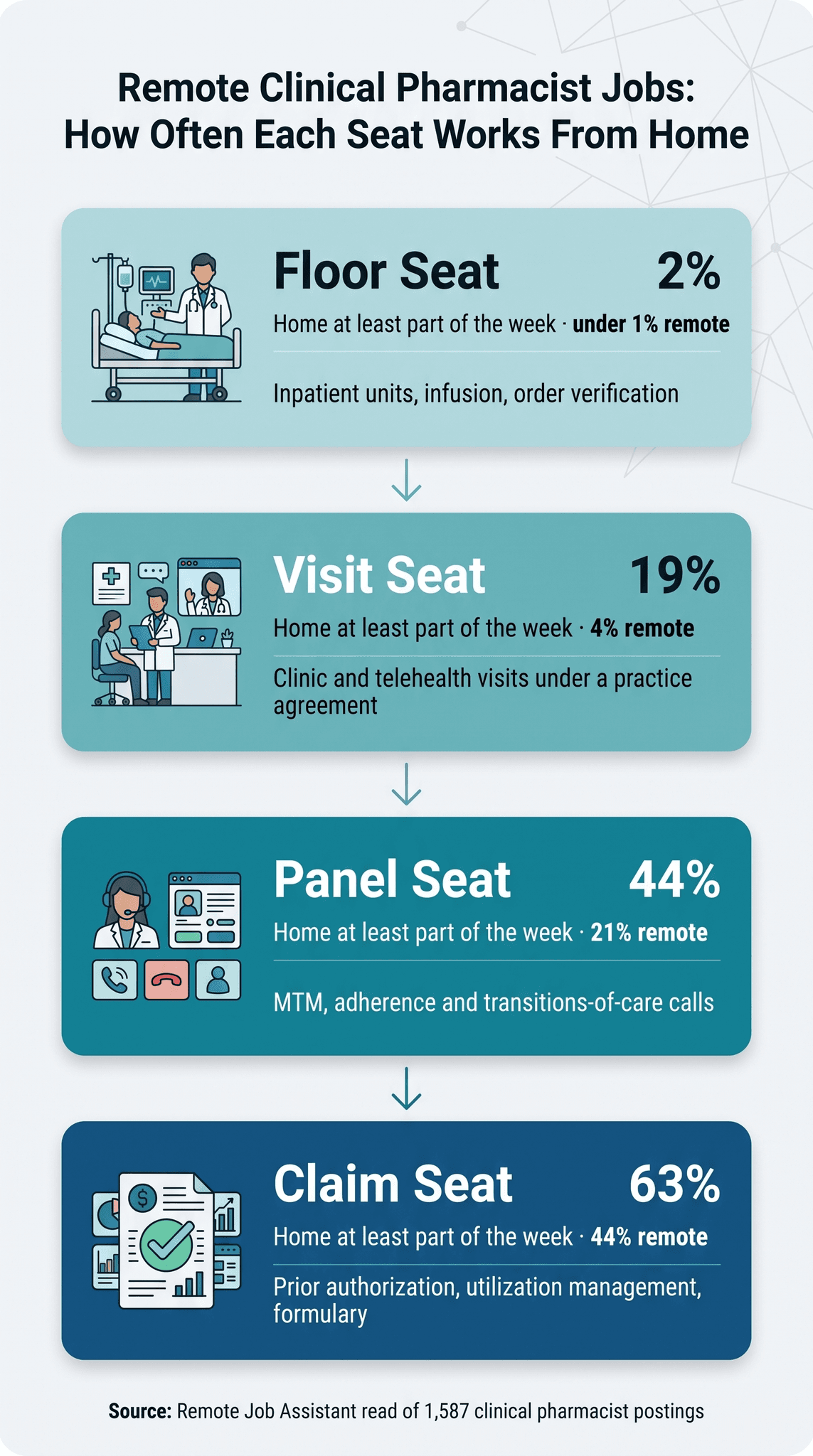
- Rung 1: Floor seat (score 1; $124K–$182K posted; remote 2 of 1,091; home part of the week 1.8%). Inpatient units, emergency department, ICU, infusion, central order verification and specialty dispensing. The tells are "decentralized," "rounds," "7 on/7 off" and a shift name in the title. Nights, evenings, weekends or a holiday rotation appear in 29.9% of these postings (326 of 1,091), and 63.9% (697) name residency training as a qualification. Most post hourly rates (258 of 412 posted ranges).
- Rung 2: Visit seat (score 2; $125K–$181K posted; remote 11 of 301; home part of the week 18.6%). Ambulatory clinics, anticoagulation services, specialty clinics and telehealth visits, usually under a collaborative practice agreement (CPA), the protocol that lets a pharmacist adjust therapy for a physician's patients. CPAs are named in 86 of 301 postings, and residency training in 254. The 10 remote visit seats with posted pay have a median midpoint of $162K.
- Rung 3: Panel seat (score 3; $122K–$159K posted; remote 18 of 87; home part of the week 43.7%). Medication therapy management (MTM), adherence outreach for quality measures such as HEDIS, transitions-of-care calls, care management and specialty-pharmacy caseloads. The tells are "outreach," "telephonic" and "gaps in care." Remote panel seats posted a median midpoint of about $126K (n=9).
- Rung 4: Claim seat (score 4; $115K–$165K posted; remote 35 of 79; home part of the week 63.3%). Prior authorization (PA), utilization management (UM, the plan's process for approving or denying coverage), appeals, formulary and clinical programs at health plans and PBMs (pharmacy benefit managers), plus hospital revenue-cycle seats that fight claim denials. The tells are "coverage determination," "criteria" and "turnaround time." Managed-care experience appears in 52 of 79 postings, residency in 24, and an explicit production or turnaround standard in 11.
How to use it: before you apply, ask four questions of the posting. Is there a bed? A clinic schedule? A list of members to call? A coverage queue? The first yes puts the job on a rung, and the rung tells you the likely work model, pay and screening gate before the recruiter does.
| Rung | What you touch | Postings | Remote | Home part of week | Posted midpoint (median) | Phrase to look for |
|---|---|---|---|---|---|---|
| 1 Floor seat | A patient in a bed, the drug in the building | 1,091 | 2 (0.2%) | 20 (1.8%) | $152K (n=412) | "decentralized," "7 on/7 off" |
| 2 Visit seat | A patient on the clinic schedule | 301 | 11 (3.7%) | 56 (18.6%) | $152K (n=131) | "collaborative practice agreement" |
| 3 Panel seat | A list of members to call | 87 | 18 (20.7%) | 38 (43.7%) | $142K (n=35) | "outreach," "gaps in care" |
| 4 Claim seat | A coverage decision | 79 | 35 (44.3%) | 50 (63.3%) | $142K (n=39) | "coverage determination" |
Twenty-nine systems jobs sit beside the ladder: Epic Willow informatics, medication-use policy, clinical content and accreditation. Eight of them were remote and 7 hybrid, at a median posted midpoint of about $160K (n=12).
Home odds rise on every rung. Pay doesn't follow. The two floor seats that were remote show why: an Omnicare long-term-care intervention seat at CVS Health that "does not acquire, receive, store, dispense or administer drug products," and a Stormont Vail job whose committee and stewardship work is done "remotely."
In clinical pharmacy, the title doesn't decide whether you can work from home. What the seat touches does.
If you're aiming at Claim and Panel seats, you'll be applying across health plans, PBMs and vendors with different license rules at the same time. Remote Job Assistant's Auto-Apply runs those applications in parallel so the license-specific seats don't close while you're tailoring the first résumé.
Stop Applying Manually
Our AI applies to hundreds of matching jobs while you sleep. Wake up to interviews, not more applications.
What Remote Clinical Pharmacists Get Paid
The national figure hides the trade. The Bureau of Labor Statistics puts the median pay for pharmacists at $140,910 in May 2025, and $157,290 for those working in hospitals, against $132,940 in pharmacies and drug stores. Hospitals are where the floor and visit seats sit, and they pay at the top of that range. The remote seats mostly don't.
| Rung | Posted ranges | Median low | Median high | Median midpoint | Remote midpoint (n) |
|---|---|---|---|---|---|
| 1 Floor seat | 412 | $124K | $182K | $152K | $126K (1) |
| 2 Visit seat | 131 | $125K | $181K | $152K | $162K (10) |
| 3 Panel seat | 35 | $122K | $159K | $142K | $126K (9) |
| 4 Claim seat | 39 | $115K | $165K | $142K | $128K (20) |
| All postings | 629 | $124K | $181K | $152K | $135K (43) |
These ranges come from the 629 postings that published pay, out of the 1,587 we read between January and October 2026, annualized and rounded to the nearest $1K, with bands wider than 2.2 times excluded. Only 43 of the 74 remote seats posted a range, so the remote medians rest on small counts. The hospital figures sit close to BLS's $157,290 hospital median. Ranges move with each posting cycle, so check the live listing.
Why the gap? Floor seats carry the parts of pharmacy nobody wants to do from home: nights, weekends, codes and the 3 a.m. phone. Hospitals price that in and post hourly. Claim seats are salaried weekday desk jobs priced against PBM pay scales, and some of the work is contracted out: three of the 35 remote claim seats came through staffing firms. Examples from the set: Humana's part-time UM pharmacist posts $104K–$143K, Navitus's remote PA pharmacist $101K–$118K, and a temp seat at WellSense Health Plan $89K–$129K. At the top, SmithRx's senior clinical review operations pharmacist posts $173K–$204K.
What the remote claim day looks like. The postings are blunt about it. Alignment Health calls its Part D seat "a remote, full-production managed care pharmacy role" on a Monday–Friday, 8-to-5 Pacific schedule. Rightway's care-team pharmacist is "responsible for achieving productivity and quality of work metrics," Lumicera's consult pharmacists must "meet department production metrics and service levels," and CommunityCare's reviewers "approve or deny medication requests within established turnaround time requirements." Eleven of the 79 claim postings name a production or turnaround standard, against 13 of the 1,091 floor postings. MedOne wants a home office "visibly secure from others during work hours (closed door)." Our read: most remote clinical pharmacist jobs are coverage review run on a clock, so ask for the daily case target before the final interview.
The remote seats that pay most are the ones that still see patients. Kaiser Permanente's remote dermatology and biologic-therapy clinical pharmacist posts $192K–$222K, and Sutter Health's Ambulatory Clinical Pharmacist IV, "eligible to work from home but must be available to go on-site as needed," posts $191K–$267K. Both are clinic-based ambulatory roles.
The best-paid remote clinical seats are the ones that still see patients, and almost all of them are tied to one state's license.
That tie is the hidden cost. Ten of the 11 remote visit seats require a named state's license, Shields' remote seats each support one clinic area, and Sutter's top-paying seat must still "go on-site as needed."
The ladder below shows how often each seat lets you work from home.
If you're leaving the floor, know what you're giving up: a claim seat swaps the rounding team for a criteria document, and you may never meet a patient. Plenty of pharmacists want exactly that. If you don't, the Visit rung keeps the patient and still gets you home part of the week.
Who Hires Remote Clinical Pharmacists
The 74 remote seats came from 57 employers, and very few were hospitals.
| Employer kind | Postings | Remote | Hybrid | On site |
|---|---|---|---|---|
| Hospitals and health systems | 1,295 | 14 | 75 | 1,202 |
| Specialty, infusion and long-term-care pharmacies | 63 | 9 | 9 | 45 |
| Staffing and contract firms | 45 | 6 | 2 | 37 |
| Health plans | 40 | 13 | 10 | 17 |
| Government (VA, IHS, DoD, counties) | 34 | 1 | 1 | 32 |
| Value-based care and medical groups | 29 | 4 | 4 | 19 |
| Review, MTM and oncology-network vendors | 25 | 9 | 1 | 13 |
| PBMs and pharmacy benefit firms | 24 | 16 | 2 | 6 |
| Community health centers and tribal clinics | 23 | 0 | 0 | 23 |
| Retail and mail pharmacies | 7 | 2 | 1 | 4 |
Where a row's columns fall short of its total, the difference is postings whose text didn't settle the work model (8 in all). Two postings from other employer types, both on site, aren't shown.
Every remote seat in the set is below. Treat it as a map of where to look, not a promise these jobs are still open.
Claim seats (35): health plans Humana (UM pharmacist and senior clinical programs), Elevance Health (prior authorization), Centene (Indiana formulary and quality), Healthfirst (UM), Alignment Health (Medicare Part D prior auth), Oscar Health (PA supervisor), Premera Blue Cross (trend management), WellSense, Arkansas Blue Cross and Blue Shield, and two at viva; PBMs SmithRx, Rightway, Navitus and its Archimedes specialty-drug business, TruDataRx, MedOne, SlateRx, Ventegra, TrueScripts, WellDyne and Maxcare; review vendors Sagility and Dane Street; plus WVU Medicine's health plan UM seat, UChicago Medicine's revenue-cycle denials seat, Dragonfly Health, Leap Health and three staffing-firm PA contracts.
Panel seats (18): Guidehealth (HEDIS adherence), Arine (two), Outcomes, MedWatchers, Tria Health, Healthfirst (bilingual Spanish MTM), Rightway's care team and specialty team, Lumicera's specialty consultation (two), Shields Health Solutions, Vanscoy Rare Pharmacy, AnewHealth, Thrifty White, two Equity Staffing Group contracts and a temporary MTM seat.
Visit seats (11): Shields Health Solutions (four, in Washington, California and Colorado), Ascension (Indiana and Wisconsin specialty clinics), Cityblock Health (Massachusetts), Kaiser Permanente (Georgia), UNC Health (a clinical pharmacist practitioner in community oncology), Sutter Health and Parkview Health.
Floor and systems seats (10): CVS Health's Omnicare intervention center, Stormont Vail, two Baptist Health system specialists, McKesson's US Oncology Network, Methodist Healthcare's transplant specialist, Dana-Farber and University Hospitals informatics, the Accreditation Commission for Health Care, and one VA informatics seat.
Three things in that list don't show up on any aggregator page.
The federal market barely has remote clinical seats. On October 21, USAJOBS returned 87 results for "clinical pharmacist," with a remote filter count of 1: a VA Informatics Clinical Pharmacist Practitioner at GS-13, $139,388–$181,207, "Anywhere in the U.S." The VA's floor and patient-aligned care team seats mostly list telework as "Not available" or "ad-hoc only."
The remote order-entry queue mostly hides outside the clinical title. Cardinal Health's "Pharmacist 7on/7off Overnight" is a work-from-home hospital order-verification seat at $54.60–$77.89 an hour, but it requires a California license and California residence, and it isn't titled "clinical," so it sits outside our count. Search for "remote order entry" separately.
One job can look like two. Summit Access Solutions reposted Vanscoy Rare Pharmacy's Orlando remote seat nearly word for word, and Ladders reposted McKesson's oncology seat. We counted each once; apply through the employer when you can.
Stop Applying Manually
Our AI applies to hundreds of matching jobs while you sleep. Wake up to interviews, not more applications.
The License Leash: Remote Usually Means Remote Inside One State
Remote doesn't mean anywhere. We coded the license line on all 74 remote seats.
Thirty of the 74 remote seats (41%) require a pharmacist license in a named state, 14 (19%) want one in your state of residence, and 30 (41%) accept any state or don't specify. For remote seats that see patients by appointment, it's 10 of 11. Eight remote postings also limit where you can live.
The reason is that state boards generally regulate pharmacy where the patient is. A clinic seat practicing under a CPA in Washington needs a Washington license, wherever the pharmacist's kitchen table happens to be. Medicaid and state health plans buy services state by state, so their reviewers need that state's license too. Centene's Indiana Medicaid formulary seat is "a remote opportunity for an Indiana-licensed Pharmacist." Hospital order processing follows the hospital's state board, as South Carolina's policy shows.
Here's how the leash shows up in real postings:
- Licensed in one state, live in many. Healthfirst's remote UM seat lists remote locations in about 40 states, from Louisiana to Wyoming, but its title says "NY License Required." Elevance's prior-authorization seat wants pharmacists "licensed in North Carolina or Kansas."
- Remote, supporting one area. Shields Health Solutions posts a "Remote role supporting the Centralia/Olympia/Lacey area" that requires a Washington license. Cityblock Health's ambulatory seat is "100% REMOTE (MA licensed required)."
- Remote, but only from certain states. Oscar Health's PA supervisor is "fully remote" for candidates in the US "excluding Alaska; Delaware; Hawaii; Louisiana; Montana; North Dakota; Oklahoma; West Virginia; Wyoming." Navitus and its specialty pharmacy, Lumicera, list the states they can employ remote workers in. Dragonfly Health's consulting seat says "must reside in PA or TN."
- Licenses the employer will pay for. Guidehealth asks its HEDIS adherence pharmacists to obtain licenses in Texas, Tennessee, Alabama and Pennsylvania, "company paid."
The one clean exception is federal. A VA rule, 38 CFR 17.417, lets VA clinicians practice telehealth "in any State irrespective of the State or location within a State where the health care professional or the beneficiary is physically located." The VA's one remote clinical pharmacist seat accepts a license from any state, territory or DC.
Ask three questions on the first call. Which state license does this seat need on day one? If it's one you don't hold, ask whether they'll wait for it; Centene and Stormont Vail give 90 days. Are there states you can't hire remote workers in? If yours is listed, it ends there. Will you pay for additional licenses? A yes tells you the employer serves several states.
Hybrid Is the Realistic Route for Hospital Clinical Pharmacists
If you want to stay in a health system and still get time at home, hybrid is where the seats are. Hospitals posted 75 hybrid clinical pharmacist jobs against 14 fully remote ones, and 45 of the 105 hybrid jobs in the set were visit seats.
The schedules are specific when they're written down. Seventeen of the 105 hybrid postings state a day count: The University of Kansas Health System's ambulatory pharmacists are "embedded within our clinics in addition to having remote opportunities on average at least 1 day per week," ChristianaCare's population health seat "may work remotely up to two (2) days per week," and UChicago Medicine's oncology specialty pharmacists "rotate through the Hyde Park campus for one week every 6 to 7 weeks and work from home the remainder of the weeks." Health plans run office schedules: Independence Blue Cross's Medicare pharmacist works three office days and two remote, and the remote days "must be performed in the Tri-State Area of Delaware, New Jersey or Pennsylvania."
Hybrid is often earned. Seven hybrid postings set a wait before the first home day. Mass General Brigham's specialty oncology seat is "100% onsite for the first 90 days, average 1-2 days per week after 90 days." MaineHealth's specialty pharmacy seat offers a hybrid model "following the 6-month probationary period," and UVA Health, the University of Iowa and Advanced Rx all wait until orientation or 90 days are done. Some put a border on it too: Michigan Medicine's Troy specialty-care lead says "remote work must be done inside the state of Michigan."
So when should you take the hybrid seat and when should you hold out? If you want to keep patient care, take the hybrid: hospitals posted 75 hybrid jobs to 14 remote ones, and visit seats ran 45 hybrid to 11 remote. If you're willing to do coverage review, hold out for fully remote: claim seats ran 35 remote to 15 hybrid.
How to Move From the Floor to a Remote Seat
The screening gate changes as you climb the ladder. Residency training is named in 84.4% of visit seats (254 of 301) and 63.9% of floor seats, but in only 30.4% of claim seats (24 of 79), where managed-care experience appears in 65.8% (52 of 79). A PGY1 and a BCPS get you into the hospital. They don't automatically get you into a PBM.
If you're an inpatient generalist with a PGY1: target claim seats at health plans and PBMs. Lead with the review work you already do: criteria-based decisions, renal and interaction screening, documented interventions. Elevance's PA posting asks for a "Minimum of 2 years of managed care pharmacy (PBM) experience or residency in lieu of work experience," and that "or" is your opening. Expect a salaried weekday schedule and a lower midpoint (remote claim seats posted about $128K, n=20).
If you're an ambulatory or CPP pharmacist with a CPA: target remote visit seats in the state you're licensed in. Shields, Cityblock, Ascension and Kaiser posted them, and 10 of the 11 required a specific state license. Expect the residency question: Shields' Colorado seat requires a residency in which "at least 50% of the experience included the provision of direct patient care." If your state has none open, a hybrid clinic seat is the fallback; 45 of the 105 hybrid jobs were visit seats.
If you work in specialty pharmacy: you're one step from a panel seat. Lumicera, Vanscoy, Rightway's specialty team and Shields posted remote specialty caseload jobs, and Lumicera's only offers remote work to residents of the states on its list.
If you're the pharmacist who builds order sets: look at the systems lane. Informatics and medication-use policy seats were home at least part of the week in 15 of 29 postings. Our remote health informatics jobs guide covers Epic Willow and the rest of that market.
If you're a night-shift order verifier: remote order-entry vendors are the closest match to your day. They post under plain "pharmacist" titles with state-residence rules, and Cardinal Health's overnight seat prefers "2-4 years of clinical hospital inpatient experience."
Three trade-off rules fall out of the counts. If production metrics are a dealbreaker but you need remote, favor panel and visit seats: 5 of 87 panel postings and 1 of 301 visit postings name a production or turnaround standard, against 11 of 79 claim postings. If patient contact matters more than pay, the Visit rung costs you nothing on pay: its remote seats posted the highest midpoint of any rung ($162K, n=10), though only 11 exist and 10 are tied to one state's license. If pay matters most and you can be on site, floor and visit seats posted $152K midpoints and the systems lane about $160K (n=12).
The translation that matters most is turning hospital language into managed-care language. Claim postings use a small vocabulary: "prior authorization" appears in 48 of the 79, "formulary" in 42, "criteria" in 34, "appeals" in 29 and "coverage determination" in 21. Write in it. Before: "Verified 250 orders per shift; rounded with the internal medicine team." After: "Reviewed 250 medication orders per shift against renal, interaction and formulary criteria; documented the clinical rationale for each intervention in Epic; met turnaround targets on STAT reviews." The second version reads like a coverage reviewer, because it describes the same judgment a UM queue runs on. If your résumé still leads with rounds and codes, notice that only 7 of the 79 claim postings mention either.
A claim seat asks about your managed-care years twice as often as it asks about your residency.
Search the duty, not the work model. Only 14 of the 74 remote seats say "remote" in the title, so scanning result titles for "remote" misses most of them. These are the title words that found remote and hybrid seats in our read:
| Word in the job title | Postings | Remote | Hybrid |
|---|---|---|---|
| "Utilization management" or "UM" | 12 | 8 | 2 |
| "Prior authorization" | 5 | 4 | 0 |
| "Clinical review" or "reviewer" | 5 | 4 | 0 |
| "MTM" or "medication therapy management" | 7 | 3 | 1 |
| "Informatics" | 10 | 3 | 2 |
| "Specialty pharmacy" | 30 | 3 | 9 |
| "Ambulatory" | 156 | 5 | 24 |
| "Remote" | 16 | 14 | 2 |
"Ambulatory" finds the most hybrid seats; add your state to it, because remote visit seats want that state's license. The Academy of Managed Care Pharmacy runs a career center for health plan and PBM jobs. Nurses walk the same path into review work, and our remote utilization review nurse guide shows how those queues are organized. For the broader remote pharmacy market, including MTM and specialty roles outside the clinical title, see our remote pharmacist jobs guide.
Stop Applying Manually
Our AI applies to hundreds of matching jobs while you sleep. Wake up to interviews, not more applications.
How to Spot a Real Remote Clinical Pharmacist Posting
The work model is often buried. These are the lines that settled it in our read.
Green flags: a "Location: Remote" line plus a license rule you already meet; a posted pay range (43 of the 74 remote seats had one); remote work written into the duties ("You'll work remotely... to conduct virtual patient assessments," from Shields).
Red flags, with what we found:
- AI-evaluation contracts. The top Google result for this search was Mercor's "Clinical Pharmacist - Fully Remote," a contract at $75–$120 an hour reviewing AI answers. We set aside one more, AuraOne's "Clinical Pharmacist AI Evaluator." They can be decent side income. They aren't clinical pharmacist jobs.
- Pipelines and short contracts. Navitus's "Future Talent Posting" collects résumés for future openings. Four of the 74 remote titles say temp, contract or temp-to-hire, including SmithRx's 6-month contract and a 3-to-4-month MTM job.
- "Remote" with a territory. AnewHealth's care pharmacist says "This is a remote position" and also "Must be able to commute to multiple site locations within assigned territory." We counted it as hybrid.
- A hub that isn't your home. Mount Sinai's command center pharmacists verify orders "from a centralized hub." The posting never says the hub is your house, so we left it out of the remote count.
- Boilerplate that names every work model. Inova advertises "remote and hybrid career opportunities" on its retail floater job. Read the job's own location line, not the benefits paragraph.
Ask the recruiter: "Which state license does this seat need on day one, and will home-based be written into the offer?" Two clear answers save you an interview loop for a job you can't take.
The same rules apply to clinical research and medical writing seats, if you're weighing those too; our guides to remote clinical research jobs and remote medical writer jobs cover them.
Frequently Asked Questions
Can a hospital clinical pharmacist find a fully remote job, or is it only prior authorization?
Mostly coverage review, but not only. Claim seats such as prior authorization, utilization management and formulary review were remote 35 of 79 times in our read, against 2 of 1,091 hospital floor seats. The other remote routes are MTM and adherence panels (18 of 87 remote) and telehealth clinic seats (11 of 301), which usually require a license in the patients' state.
I have a PGY1 and BCPS but no managed care experience. Will payers and PBMs hire me remotely?
Some will, but you'll compete with candidates who have it. Managed-care experience appears in 52 of 79 claim-seat postings, while residency training appears in 24. Elevance's PA posting accepts "residency in lieu of work experience," so read each requirement line, and rewrite your résumé around criteria-based review and documented interventions.
Do remote clinical pharmacists make less than hospital clinical pharmacists?
Usually. The median posted midpoint for remote seats was about $135K (n=43), against $152K for on-site seats (n=539). Remote claim seats posted about $128K. The exception is remote visit seats that still see patients, about $162K (n=10). BLS puts the hospital pharmacist median at $157,290 (May 2025).
Do I need a pharmacy license in more than one state to work remotely?
Not always, but you'll often need a specific one. Of 74 remote seats, 30 required a license in a named state, 14 in your state of residence, and 30 accepted any state or didn't say. Some employers, such as Guidehealth, pay for additional licenses. VA telehealth seats are the exception: a federal rule lets VA clinicians practice across states with one license.
How do I tell which rung of the Touchpoint Ladder a job is on?
Ask what the seat touches. A bed or the hospital's order queue is a Floor seat (rung 1, remote 2 of 1,091); a clinic schedule under a collaborative practice agreement is a Visit seat (rung 2); a list of members to call for MTM or adherence is a Panel seat (rung 3); and a coverage decision is a Claim seat (rung 4, remote 35 of 79).
Are VA clinical pharmacist jobs remote?
Rarely. On October 21, 2026, USAJOBS returned 87 results for "clinical pharmacist," and its remote filter matched one: an Informatics Clinical Pharmacist Practitioner at GS-13, $139,388–$181,207, open anywhere in the US. The VA's floor and patient-aligned care team seats list telework as not available or ad-hoc only.
Is remote order entry a clinical pharmacist job, and is it worth it?
It's hospital clinical review under a plain "pharmacist" title, usually overnight. Cardinal Health's work-from-home order-entry seat posts $54.60–$77.89 an hour on a 7-on/7-off overnight schedule and requires a California license and California residence. It suits pharmacists who want home-based hospital work and can live with nights.
Find the Remote Clinical Pharmacist Seat That Fits
Put your current job on the Touchpoint Ladder first, then search the rung you want next. If you want home on day one, the claim and panel seats at health plans, PBMs and review vendors are where the remote jobs are, and they screen for managed-care experience. If you want to keep seeing patients, hunt remote visit seats in the state you're licensed in, or take a hybrid clinic seat and earn the home days.
Our jobs paying $100K and up cover most of the claim and panel market, and the jobs paying $150K and up list catches the visit and systems seats at the top of the range. Informatics-minded pharmacists can also browse our data and analytics jobs. Physicians weighing the same trade can read our remote physician jobs guide, and if regulatory work appeals, start with remote regulatory affairs jobs. When you're ready to send the applications, Auto-Apply handles the volume.
If home is the goal, you're applying for a different job, not the same job from a different room.
Ready to Find Your Remote Job?
Browse thousands of curated remote jobs or let AI apply for you.
Browse Remote JobsRelated Job Guides
Remote Epidemiologist Jobs: 1 of 44 Public Seats Is Remote
We read 138 epidemiologist job postings: 15 are remote, and only 1 of 44 at health departments. See who hires remote epis, what they pay, and how to get there.
26 min read
Remote Health Informatics Jobs: Only 1 in 9 Is Fully Remote
Remote health and nursing informatics jobs: 49 of 453 postings were fully remote, mostly at payers and vendors. What they pay, what they ask, how to get one.
30 min read
Remote School Psychologist Jobs: Vendors Hire, Not Districts
Remote and virtual school psychologist jobs: 87 of 682 postings were fully remote, every one through a vendor. Hourly pay vs. district salary, and the catch.
33 min read