
Last reviewed: October 2026
You've built the line list at 7 a.m., cleaned the lab feed before the 10 o'clock call, and written the case definition everyone else now quotes. You have the MPH and the SAS. So you search "remote epidemiologist jobs," and LinkedIn tells you there are 6,000+ of them. We opened that page on October 20, 2026. Of the first 60 listings, 19 had an epidemiology job title. The rest were biostatisticians, outcomes researchers and data scientists. The same day, a USAJOBS search for "epidemiologist" returned one open federal job, an Indian Health Service physician seat.
If you want fully remote epidemiology work in 2026, you are almost certainly leaving government public health. Fourteen of the 15 remote seats we found were outside it. That cuts against where the jobs are: the Bureau of Labor Statistics counts 55% of epidemiologists in state and local government.
Get Remote Job Tips in Your Inbox
Weekly strategies, salary data, and new opportunities
Unsubscribe anytime. No spam.
We read 138 epidemiology-titled US job postings across 107 employers, all first listed between January and October 2026, to find out which seats go remote and why. Fifteen were remote. One of the 44 public-sector seats was, and it was a 20-hour-a-week county job. Ten of the 15 sat in private industry. The pattern comes down to two questions: who owns the data you'd be analyzing, and who answers the phone when there's an outbreak? Below are the four kinds of epidemiology seat that answer them differently, what each pays, the skills that move you from one to the next, and the posting lines that tell you which one you're looking at before you spend an evening on the application.
Yes, epidemiologists can work remotely, but mostly outside government. In our read of 138 postings, 15 (10.9%) were remote, 1 of 44 health-department and federal seats was remote, and 0 of 19 hospital seats were. Ten of the 15 remote seats were at drug companies, contract research firms, consultancies, staffing firms placing epidemiologists at pharma clients, and a health plan. Remote non-physician seats posted a median range of roughly $130K–$177K, though only six of them posted pay; on-site seats posted $80K–$101K (n=36).
Every figure below comes from the posting text, not from listing tags.
Based on our read of 138 epidemiology-titled US postings at 107 employers, first listed January–October 2026:
- 10.9% (n=15 of 138) were remote or listed remote after reading the full text; 39.9% (n=55 of 138) let you work from home at least part of the week
- 2.3% (n=1 of 44) of state, county, city, tribal and federal postings were remote; hospitals: 0 of 19
- 10 of 15 remote seats were in private industry; 4 of 15 were federal contractors
- 0 of 15 remote seats mention outbreaks, case investigation or contact tracing, against 25 of 79 on-site seats
- $130K–$177K is the median posted range for remote non-physician seats (n=6), against $80K–$101K on site (n=36)
- 0 of 63 health-department and hospital postings name Python; 14 of 36 contractor and staffing seats name SQL
- At least 18 of 138 postings state an end date, grant funding or a contract term
- $87,220 is the BLS median pay for epidemiologists (May 2025); 55% of the 12,800 jobs are in state and local government
How We Collected This Data
Listing tags lie in both directions, which is why we read the text of every posting instead. The CDC Foundation posted the same Nevada dialysis-safety epidemiologist seat twice. The August 25 version says "This is a remote position, but Nevada residency is preferred." The September 1 version says "This is a hybrid position." We kept the newer one.
We read about 600 job pages. LinkedIn's public job search returned 1,803 listings across 32 epidemiology searches, run nationally and again state by state, and we read 259 of them in full. SimplyHired, which carries Indeed's network, added 190 job pages from 48 searches. We searched 81 Workday career sites directly (state and county health departments, drug companies, contract research organizations, health plans, federal contractors and hospitals), probed 41 boards on Greenhouse, Lever, Ashby and SmartRecruiters, read all 28 open jobs on the CDC Foundation's board, and searched NEOGOV government boards and USAJOBS.
A posting counted if its title said epidemiologist, or used epidemiology or pharmacoepidemiology with a role word such as analyst, scientist, manager or director, at a US employer. We excluded interns, fellows, postdocs, faculty, coordinators and biostatisticians. We set aside 19 Syneos Health "talent pipeline" listings that say "there is no immediate opening," 7 AI-training gigs, 19 non-US jobs and 11 first listed before 2026. Repeats of the same job, whether the same employer and title or the same text on another site, were collapsed into one, which removed 116 copies. One pharma contract job posted by four staffing agencies counted once.
We read the work-model language in every remote, hybrid or unclear posting, and in every on-site posting that used a remote or telework word. Four that list only a country or city and say nothing about work location stay out of the remote count. Pay is the posted range, annualized (hourly rates times 2,080 hours), and cross-checked against BLS and the Council of State and Territorial Epidemiologists (CSTE). Indeed, Glassdoor, ZipRecruiter and Reddit block automated reading, so we couldn't use them. This is a snapshot of live listings on October 20, 2026, and the counts per seat type are small. We update this analysis quarterly.
The Data Custody Ladder: Why Some Epidemiology Seats Go Home
"Is it remote?" is the wrong first question for an epidemiology job. The better question is who holds the data. A health department epidemiologist works on identifiable case reports in the state's surveillance system (NEDSS, EpiTrax and their cousins), interviews patients, keeps a line list (the row-per-case spreadsheet every outbreak runs on), and takes a turn on the after-hours phone. That data and that phone stay inside the agency, and so does the seat. A pharma or contract research epidemiologist works on licensed claims, electronic health record (EHR) and registry databases that are usually de-identified and hosted in the cloud. Those can be queried from a kitchen table, so employers staff those seats from anywhere.
The Data Custody Ladder ranks an epidemiology seat by who holds the data you work on. The further the data sits from identifiable patients and the outbreak phone, the more often the seat goes home.
Scoring, from the rung closest to the case data to the one farthest away (pay is the median posted range for non-physician seats):
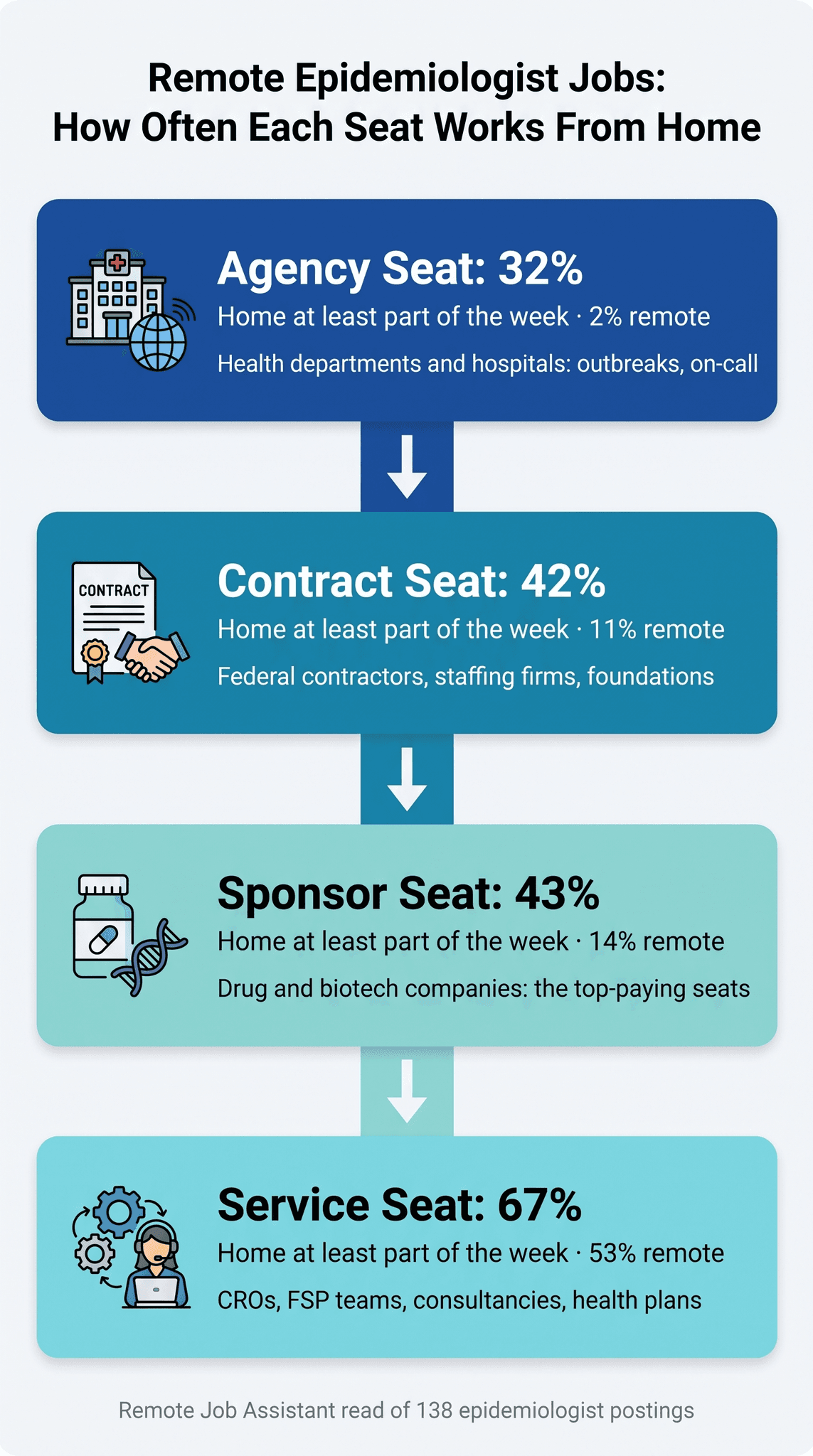
- Rung 1: Agency seat ($73K–$96K posted; remote 1 of 63; home part of the week 31.7%). A state, county, city, tribal or federal health agency, or a hospital infection-prevention team. The posting names outbreaks, case investigation, contact tracing or a line list (30 of 63) or an on-call rotation (9 of 63). SAS shows up in 23 of 63; Python in none.
- Rung 2: Contract seat ($84K–$107K posted; remote 4 of 36; home part of the week 41.7%). A federal contractor, a staffing firm placing epidemiologists at a state health department, or a foundation. The posting names the client (CDC, a Defense Department program, a state department of health), asks for public trust or a security clearance (11 of 36), and often carries an end date. SQL appears in 14 of 36, R in 22.
- Rung 3: Sponsor seat ($177K–$260K posted; remote 2 of 14, both as an option; home part of the week 42.9%). The drug or biotech company that pays for the studies. Real-world data sources (claims, EHR, registries) appear in 14 of 14 postings, a PhD or doctorate in 13 of 14, and causal-inference methods in 6. Expect three or four office days.
- Rung 4: Service seat ($116K–$187K posted, n=4; remote 8 of 15; home part of the week 66.7%). A contract research organization (CRO) or functional service provider (FSP, a firm that rents out whole teams to a drug company), a staffing firm with pharma or device clients, a consultancy, or a health plan. Ten of 15 postings talk about the client, the sponsor or the FSP model. "Home-based" is the tell.
How to use it: before you apply, answer four questions from the posting. Who owns the data? Who covers the on-call phone? Who is the client? Who gets billed for your hours? Those answers put the job on a rung, and the rung tells you the likely work model and pay before the recruiter does.
| Rung | Who holds the data | Postings | Remote | Home part of week | Posted pay (non-physician median) | Phrase to look for |
|---|---|---|---|---|---|---|
| 1 Agency seat | Health department or hospital | 63 | 1 (1.6%) | 20 (31.7%) | $73K–$96K (n=30) | "outbreak," "on-call rotation" |
| 2 Contract seat | The agency; you're placed by a contractor | 36 | 4 (11.1%) | 15 (41.7%) | $84K–$107K (n=16) | "public trust," "position end date" |
| 3 Sponsor seat | The drug company licenses it | 14 | 2 (14.3%) | 6 (42.9%) | $177K–$260K (n=11) | "real-world evidence," "3 days onsite" |
| 4 Service seat | The client's licensed data, run by a vendor | 15 | 8 (53.3%) | 10 (66.7%) | $116K–$187K (n=4) | "FSP," "home-based" |
Ten university research postings sit outside the ladder: none were remote, and 4 of 10 were hybrid.
Home odds rise on every rung. Pay doesn't. It peaks at rung 3, because the drug company's own epidemiologists sit closest to regulatory and launch decisions, and those seats want you in Cambridge, Sleepy Hollow or Indianapolis most of the week.
In epidemiology, remote work follows the data, not the job title.
Stop Applying Manually
Our AI applies to hundreds of matching jobs while you sleep. Wake up to interviews, not more applications.
Where the Remote Epidemiologist Jobs Actually Are
The 15 remote seats weren't spread evenly. Here is where the 138 postings came from.
| Employer kind | Postings | Remote or listed remote | Hybrid | On site |
|---|---|---|---|---|
| County and city health departments | 21 | 1 | 10 | 10 |
| Federal contractors | 21 | 4 | 1 | 14 |
| Hospitals and health systems | 19 | 0 | 4 | 15 |
| State health departments | 17 | 0 | 5 | 12 |
| Pharma and biotech | 14 | 2 | 4 | 7 |
| Universities | 10 | 0 | 4 | 6 |
| Staffing firms placing epis at state health departments | 10 | 0 | 6 | 4 |
| CROs and RWE service firms | 5 | 3 | 2 | 0 |
| Environmental and litigation consultancies | 5 | 1 | 0 | 3 |
| Foundations | 5 | 0 | 4 | 1 |
| Staffing firms and consultancies with pharma or device clients | 4 | 3 | 0 | 1 |
| Tribal epidemiology centers and health boards | 4 | 0 | 0 | 4 |
| Federal agencies | 2 | 0 | 0 | 2 |
| Health plans | 1 | 1 | 0 | 0 |
Four unclear postings (country or city only, silent body) make up the rest.
Every remote seat in the set is on this list. Read it as a map of where to look, not as a promise that these exact jobs are still open.
Service seats (8): IQVIA, three FSP "Sponsor Dedicated" real-world evidence seats, each "United States, home-based" or "fully remote"; a UnitedHealthcare epidemiologist who works "remotely from anywhere within the U.S."; Integral Consulting's principal epidemiologist (remote is one of three options); Kelly's "remote opportunity supporting our Medical Device client"; one 12-month pharma contract job posted by four staffing agencies; and Invoti's part-time wastewater-surveillance expert, 25–35% time from November 2026 to July 2027.
Sponsor seats (2): Vertex's Epidemiology Forecasting Director, where staff can choose "Remote: work remotely five days per week"; and Valo Health's machine-learning-in-epidemiology data scientist, which posts a separate remote salary range.
Federal contractors (4): Goldbelt's Epidemiologist IV supporting CDC ($120,000–$130,000, CDC public trust); IHRC's Epidemiologist II supporting CDC's respiratory-virus work; BRS's research epidemiologist on a Defense Department trauma contract; and International Consulting Associates' real-world evidence epidemiologist, which requires public trust and trips to the Arlington office.
Public sector (1): Cochise County, Arizona's part-time diabetes epidemiologist, "BISBEE/REMOTE," up to 20 hours a week, $35,880, grant-funded through May 31, 2031.
Three things in that list don't show up on any aggregator page.
The federal market runs through contractors now. USAJOBS had one epidemiologist posting on October 20, while federal contractors posted 21 of our 138. Fourteen of those 21 contractor seats are on site, and 11 of the 36 contractor, staffing and foundation seats ask for public trust or a security clearance. Seats tied to a base, such as BRS's and LTSi's Wright-Patterson Air Force Base jobs, sit on the customer site. And contract seats are only as permanent as the contract: 11 of the 36 state an end date, a contract term or a pending award (Goldbelt Apex's job is "contingent upon the successful award of a contract currently under bid"), against 0 of the 14 drug-company postings.
One job can look like four. A 12-month pharmacoepidemiology contract showed up under SPECTRAFORCE ("Location: Remote"), Spark Life ("Remote (USA)"), Synectics ($37.94–$45.79 an hour) and US Tech Solutions ("North Chicago, IL"). Same duties, same client team, one job, and the agencies don't even agree where it's based. Apply once, through the agency that states the rate.
Some listings aren't jobs. Syneos Health's "Dir, Epidemiology Pipeline" listings for oncology, virology and immunology filled 109 LinkedIn cards across state locations. Each one says "there is no immediate opening." They're resume collectors.
How to Spot a Real Remote Epidemiology Posting
Most epidemiology postings don't say "remote" in the title, and many that do are hedged in the body. These are the lines that settled the work model in our read.
The postings that were truly remote said so in plain words: "home-based" (IQVIA), "remotely from anywhere within the U.S." (UnitedHealthcare), a separate remote salary range (Valo), or a named contract plus "full-time, remote" (BRS). FSP or "sponsor dedicated" in the title was the best single tell.
The warning signs were just as consistent. Skip anything that says "no immediate opening." When one job appears under several staffing agencies with different locations, apply once. Read "telework eligible" with no days attached as hybrid at best. Watch for remote that starts later (South Carolina offers partial remote "after 12 months of employment") or never fully starts (Montana: "Full-time telework is not available"). And check residency, clearance and citizenship rules before you write the cover letter: "Tennessee residents only" ends the conversation for everyone else.
Remote also doesn't always mean you never leave home. Four of the 15 remote seats mention travel or in-person meetings: International Consulting Associates expects "occasional team/client meetings" in Arlington and 5% travel, Invoti wants "periodic travel to Kansas City," and Goldbelt's CDC seat includes travel to healthcare facilities. Two of IQVIA's home-based seats prefer a West Coast location.
The hybrid wording varies more than the remote wording. New York City's health department says "you may be able to work up to two days during the week from home" on all nine of its postings in our set. The University of Washington Medical Center's infection-prevention epidemiologist gets "Up to 3 days per week of telework," but only "once fully trained." Texas's Chief State Epidemiologist posting says "Not Eligible for Telework."
Ask the recruiter: "Is this seat remote from day one, and will that be written into the offer?" If the answer is "after training," "at the supervisor's discretion," or "we're reviewing our policy," treat it as hybrid. If it's "yes, the offer letter says remote," ask which state you're allowed to live in.
What Remote Epidemiologists Get Paid
Pay tracks the ladder until rung 3, then the remote rung pays a little less than the sponsor rung. Physician epidemiologists, the hospital epidemiologists and medical epidemiologists who run infection prevention, are a separate market: 11 titles, 9 with posted pay at a median $250K–$350K, 10 of 11 on site and one hybrid.
| Seat | Postings with pay | Median posted range | Midpoint | Example |
|---|---|---|---|---|
| Agency seat (non-physician) | 30 of 52 | $73K–$96K | $84K | Virginia Department of Health Epidemiologist, $48,258–$66,538 |
| Contract seat | 16 of 36 | $84K–$107K | $96K | Goldbelt Epidemiologist IV (CDC), $120,000–$130,000 |
| Sponsor seat | 11 of 14 | $177K–$260K | $228K | Regeneron Senior Manager, $150,500–$245,500 |
| Service seat | 4 of 15 | $116K–$187K | $151K | UnitedHealthcare Epidemiologist (remote), $91,700–$163,700 |
| Physician epidemiologists | 9 of 11 | $250K–$350K | $304K | Mount Sinai associate hospital epidemiologist, $250,000–$350,000 |
Be skeptical of the remote pay figure. Only six of the 15 remote seats posted a usable range, five posted none (Kelly, Invoti, BRS, ICA, IHRC), IQVIA's three posted a band from $109,200 to $273,000, and one of the six (Synectics, hourly, on a 12-month contract) comes from a staffing agency. These ranges come from the 73 of 138 postings that publish pay, annualized (hourly times 2,080, weekly times 52, monthly times 12). We left out bands where the top is more than 2.2 times the bottom, such as IQVIA's $109,200–$273,000 for its three home-based FSP seats, and cross-checked the public-sector ranges against the BLS occupational outlook for epidemiologists and CSTE's state salary survey. Treat each row as directional: the service-seat median rests on four postings.
According to BLS, epidemiologists earned a median $87,220 in May 2025, with the top 10% above $138,800. The industry split explains the ladder: $127,410 in scientific research and development services, against $84,410 in state government and $80,680 in local government. CSTE's 2024 Epidemiology Capacity Assessment puts the typical state pay band for an entry-level epidemiologist at $54K–$80K and a senior epidemiologist at $75K–$117K, and found that federal money covers 84% of state epidemiology personnel costs. Health-department pay is set by civil-service grades and grant budgets, so a better offer elsewhere rarely gets matched.
The posted public ranges look like that survey. Kansas's epidemiologist pays $27.51–$31.82 an hour. New York City's zoonotic-disease epidemiologist posts $87,743–$100,904. Tennessee's Epidemiologist 2 runs $6,610–$10,467 a month. On the sponsor side, Alkermes posts $210,000–$245,000 for a director who works three office days a week, and Vertex posts $204,200–$306,200 for a director who can choose to work from home.
The highest-paying epidemiology seats aren't the most remote ones: sponsors pay the most, and their vendors let you stay home.
Stop Applying Manually
Our AI applies to hundreds of matching jobs while you sleep. Wake up to interviews, not more applications.
The Health Department Reality: Hybrid, On-Call and Term-Limited
If you work at a state or county health department now, you may know colleagues who work from home most of the week. That's real, and it's also not what the agencies are posting.
Health departments sell remote work as a perk: "opportunity to work remotely" was cited 26 times as a recruiting asset by the 50 states and DC in CSTE's 2024 assessment, second only to job interest. In the PH WINS 2024 workforce survey, 51.9% of state-government public health staff said they worked mostly or fully remote. Yet 0 of the 17 state health department postings we read in 2026 were remote, and 5 were hybrid. Staff who already have telework agreements keep them. New hires get on-site or part-week seats.
Three reasons sit behind that gap, and they are in the postings. First, the work comes with a phone. Kansas wants its epidemiologist to "participate in the epidemiologist on-call rotation providing 24-hour technical assistance," and Los Angeles County's epidemiology analyst list says "Any shift, including evenings, nights, weekends and holidays." Second, the data is identifiable and tied to state systems: case investigations, lab feeds and line lists. Third, the money is temporary. CSTE found 83% of state epidemiology activity runs on federal funds, and warned that health departments "are poised to lose nearly 1,020 positions" as pandemic-era funding ends.
That third reason shows up as term limits. At least 18 of our 138 postings state an end date, grant funding or a contract term: Denton County ("THIS IS A GRANT-FUNDED POSITION"), Minnesota's birth-defect epidemiologist ("Temporary Unclassified - Anticipated to end 04/30/2028"), all four CDC Foundation seats, and six of the nine Tennessee contract seats. Tennessee's Department of Health had nine contract epidemiologist seats through seven staffing agencies, with rules such as "5 in-office days per month" (STI) and "Tennessee residents only" (Centstone).
The PH WINS 2024 remote-work study also found 46.2% of government public health staff work only in person, and the share is highest at small local health departments (67.2%). If you want part-week remote inside government, big-city and state agencies are the better bet: 10 of 21 county and city postings and 5 of 17 state postings were hybrid.
How to Move Up the Ladder From Where You Sit
Your fastest route depends on where you start. These are the routes the postings support.
If you do case investigation and take on-call shifts at a state or county health department (rung 1): add SQL and R or Python first, then apply to contractor seats on CDC programs. Contract postings name SQL 14 times in 36 and Python 8 times; agency postings name SQL 3 times in 63 and Python never. Pay is about the same ($84K–$107K posted), remote odds rise from 1 in 63 to 4 in 36, and you trade a permanent line for an end date.
If you're a hospital infection-prevention epidemiologist with CIC: don't expect fully remote. Hospital seats were 0 of 19 remote, and the state healthcare-associated infection (HAI) and NHSN coordinator jobs closest to your work (NHSN is CDC's infection-reporting network) were hybrid in our set.
If you have an MPH and have worked with claims or EHR data: go straight to service seats. Twelve of the 15 remote seats accept a master's degree or don't require a doctorate (Kelly: "Master's required, Ph.D. preferred"; Synectics: "MPH or MS with more than 2 years of experience"). Only IQVIA's three FSP seats require a PhD.
If you have no real-world data experience yet: skip sponsor seats for now. All 14 drug-company postings name real-world data sources, and 13 of 14 mention a PhD or doctorate.
If you're a PhD pharmacoepidemiologist: decide what you want more. Sponsor seats pay the most ($177K–$260K posted) and want you in the office three or four days. Service seats posted less in our small sample and were remote far more often (8 of 15, against 2 of 14).
If you're a physician epidemiologist: the hospital and medical epidemiologist track is on site (10 of 11). Our remote physician jobs guide covers the remote physician work that exists.
Should you take the hybrid health-department offer or hold out for remote? If you need the paycheck within a few months, take the part-week seat: 30 of the 99 agency and contract postings were hybrid, and only 15 service seats were posted across the whole set. If you can wait, have claims or EHR experience, and want the higher pay, hold out for a service or sponsor seat, and apply to every one you qualify for, because there won't be many.
On degrees, the PhD question is about time, not a closed door. Nine of 14 sponsor postings accept a degree below a doctorate, but the master's route usually costs extra years: Vertex asks for a PhD and 10 years or an MPH and 12, and AbbVie's director posting asks for a PhD and 3 years or an MPH and 10.
On skills, the gap between rungs is specific. Python appears in 0 of 63 agency postings and in 8 of 36 contract postings; Goldbelt's CDC seat lists "Professional working knowledge of R and/or Python is required." SQL appears in 3 of 63 agency postings and 14 of 36 contract postings. If you're coming from a health department, our guides to remote SQL jobs and remote Python jobs show what those postings expect. Two free, epidemiology-specific places to build the R side are The Epidemiologist R Handbook and R for Epidemiology.
Rewrite your resume in the next rung's language. An outbreak line list becomes cohort definition. A surveillance case definition becomes a phenotype or algorithm you validated. A typical health-department bullet reads "Conducted surveillance and case investigation for reportable enteric diseases in NEDSS." For a CRO or FSP application, the same work reads "Built and maintained case-level analysis datasets from a statewide surveillance system with lab and case feeds; wrote and validated the case-definition logic; produced weekly trend reports in SAS and R." Sponsors want study design, protocols and real-world data. Contractors want the CDC program name and your clearance status.
The trade is real, so make it on purpose. None of the 29 private-industry postings mention outbreaks, case investigation or contact tracing. On the sponsor and service rungs you'd be measuring disease burden and drug safety for a company, not stopping a cluster. Some epidemiologists want exactly that trade; some don't, and the 1-in-63 remote odds in agency seats are the price of staying.
Search the plain title, not the remote filter. A simple "epidemiologist" search on LinkedIn or SimplyHired found 12 of the 15 remote seats. Searches with "remote" in them also found 12, but not the same 12: they missed the Synectics contract, one of IQVIA's FSP seats (it showed up only on IQVIA's own Workday board) and the Cochise County job (only on the county's NEOGOV board). Remote epidemiology work also hides under titles like "Clinical Application Specialist," "Clinical Epidemiology Data Specialist" and "Staff Data Scientist, Machine Learning in Epidemiology," so add "FSP epidemiologist," "sponsor dedicated epidemiologist" and "real world evidence epidemiologist" to your saved searches, and check the big CROs' career sites directly. Neighbor fields worth a look: remote clinical research jobs, remote health informatics jobs and remote data science jobs.
The hard part of this market is volume. Fifteen remote seats across 107 employers, posted under 15 different titles, by agencies that may list one job four times. That's the job Remote Job Assistant's Auto-Apply is built for: it keeps applying to the matching seats while you're on the outbreak call.
Stop Applying Manually
Our AI applies to hundreds of matching jobs while you sleep. Wake up to interviews, not more applications.
Frequently Asked Questions
Can an epidemiologist really work from home, or was that a pandemic thing?
Both. Staff who got telework during the pandemic often kept it, but new public-sector postings rarely offer it: 1 of 44 health department and federal seats we read was remote. Remote epidemiology work today sits mostly at drug companies' vendors, contract research firms, consultancies, health plans and federal contractors (14 of the 15 remote seats).
I'm a state health department epidemiologist with an MPH. Which jobs should I target if I want to work remotely?
Contract seats on CDC programs and service seats at contract research firms. Contract postings were remote 4 of 36 times and ask for R, Python or SQL more often than agency postings do; service seats were remote 8 of 15 times. Twelve of the 15 remote seats accept a master's degree or don't require a doctorate.
Do I need a PhD to get a remote pharmacoepidemiology job?
Not always. IQVIA's three home-based FSP seats require a PhD, but Kelly's medical-device seat requires a master's, and a contract pharma seat accepts an MPH or MS with more than two years of experience. At the drug companies themselves, 9 of 14 postings accept a degree below a doctorate; where both routes are spelled out, the master's route asks for two to seven more years of experience.
How much do remote epidemiologists make compared with health department epidemiologists?
Remote non-physician seats posted a median of about $130K–$177K, though only six posted pay, against $73K–$96K for non-physician health department and hospital seats (n=30). BLS puts the median for all epidemiologists at $87,220 (May 2025), and $80,680 in local government. The gap is mostly employer type: private-industry seats pay more and go remote more often.
How do I tell which rung of the Data Custody Ladder a job is on?
Ask who holds the data. If the posting mentions outbreaks, case investigation or an on-call rotation, it's an agency seat (rung 1), which was remote 1 of 63 times. A named government client and public trust means a contract seat (rung 2); a drug company running studies on licensed claims or EHR data is a sponsor seat (rung 3); a vendor serving that drug company is a service seat (rung 4), which was remote 8 of 15 times.
Is CDC or the federal government hiring remote epidemiologists right now?
Barely, and mostly through contractors. On October 20, 2026, USAJOBS listed one open federal job with "epidemiologist" in the title, an Indian Health Service physician seat starting at $123,077. Federal contractors posted 21 of the 138 epidemiology jobs we read, 4 of them remote, often requiring public trust or US citizenship.
What's the difference between an FSP epidemiologist and an epidemiologist at the drug company itself?
An FSP (functional service provider) epidemiologist is employed by a vendor such as IQVIA and assigned to one drug company's team, often home-based. The sponsor's own epidemiologist is on the drug company's payroll, usually works three or four office days a week, and posted a median of about $177K–$260K in our set. Service seats were remote 8 of 15 times; sponsor seats 2 of 14.
Find Remote Epidemiology Work at the Right Rung
Start by putting your current job on the Data Custody Ladder, then search the rung you want next. If you want to stay in public health and get part of the week at home, big-city and state agencies post the hybrid seats, and contractors on CDC programs post the few remote ones. If you want fully remote and higher pay, the vendors and sponsors that work on real-world data are where the seats are, and our remote biotech jobs guide covers the rest of that market.
The remote data analyst roles and data and analytics jobs on our board are where many unlabeled epidemiology seats land. Our jobs paying $100K and up list is the shortcut to the service and sponsor seats. And if you'd rather not hand-apply to fifteen versions of the same title, Auto-Apply can do that part.
Outbreaks need someone in the building. Claims databases don't.
Ready to Find Your Remote Job?
Browse thousands of curated remote jobs or let AI apply for you.
Browse Remote JobsRelated Job Guides
Remote Health Informatics Jobs: Only 1 in 9 Is Fully Remote
Remote health and nursing informatics jobs: 49 of 453 postings were fully remote, mostly at payers and vendors. What they pay, what they ask, how to get one.
30 min read
Remote School Psychologist Jobs: Vendors Hire, Not Districts
Remote and virtual school psychologist jobs: 87 of 682 postings were fully remote, every one through a vendor. Hourly pay vs. district salary, and the catch.
33 min read
Remote Dentist Jobs: 10 Real Seats in 1,399 Postings (2026)
Remote dentist jobs are payer jobs. We read 1,399 dentist postings and found 10 remote or hybrid seats. Here's what they pay and which licenses they need.
30 min read