

Last reviewed: August 2026
You have been scrolling remote digital marketing listings long enough to notice the thing nobody explains: the exact same title — Digital Marketing Manager — shows up on a $70K job and a $130K job in the same afternoon. Same channels in the bullet points. Same tools. Sometimes the same three paragraphs of boilerplate about owning the funnel.
The instinct is to assume the gap is experience. It mostly isn't. Built In's own remote salary curve for that title moves from an average of $75,000 at under a year of experience to $145,305 at seven-plus years — roughly $70K across an entire career. Meanwhile, four reputable salary platforms currently disagree by $41,110 about what one remote Digital Marketing Manager makes right now. ZipRecruiter says $87,719. Glassdoor says $128,829. Neither is wrong.
Get Remote Job Tips in Your Inbox
Weekly strategies, salary data, and new opportunities
Unsubscribe anytime. No spam.
That disagreement is the most useful thing in this post, because it isn't noise. It's a map of who is doing the hiring. And it points at a second, more expensive problem: the keyword you are searching is capping your salary. The roles at the top of this band do not get posted as "digital marketing." They get posted as Growth Marketing Manager, Performance Marketing Manager, Demand Generation Manager, User Acquisition Manager — and they sit one synonym away from the search you have been running.
Below: what remote digital marketing roles actually pay by tier, why the platforms disagree, the title translations that move you up a band, and the four capabilities that carry a measurable pay premium. All figures are US, full-time, remote-marked roles, sourced to named platforms with dates.
US remote roles, compensation and posting data collected August 2026 (sources and methodology below):
- 3,090 digital marketing jobs listed as remote on Glassdoor, and roughly 3,116 employers posting remote digital marketer roles on Indeed (August 2026)
- $87,719 vs $128,829 — average remote Digital Marketing Manager salary per ZipRecruiter (July 2026) versus Glassdoor (2026). Same title, $41,110 apart
- $65,418 average for a remote Digital Marketing Specialist, with the middle half between $50,000 (25th percentile) and $74,500 (75th percentile) (ZipRecruiter, May 2026)
- $130,449 average for a Growth Marketing Manager, 75th percentile $176,771, 90th percentile $230,285 (Glassdoor, 2026)
- $168,394 average base for a remote Director of Marketing, $195,564 including additional cash compensation (Built In, 2026)
- 20-30% higher compensation for professionals with hands-on AI, Python, SQL and personalization experience versus peers without them (Addison Group, 2026 hiring guide)
- 25% below pre-pandemic levels — where overall digital marketing hiring volume currently sits (Addison Group, 2026)
Two numbers in that block do the heavy lifting: the $41,110 title gap and the $65,418-to-$130,449 climb from specialist to growth manager. The rest of this guide is about how to move across both. Start with where the numbers came from.
How We Collected This Data
The figures here come from published compensation and posting data for US remote roles, collected in August 2026 and cross-referenced across seven sources rather than averaged into one number.
Posting counts were pulled from Glassdoor's remote digital marketing listings (3,090, August 2026) and Indeed's remote digital marketer employer count (approx. 3,116, August 2026). Salary bands come from ZipRecruiter's remote Digital Marketing Manager data (July 2026) and its remote Digital Marketing Specialist data (May 2026), Built In's remote Digital Marketing Manager report and its remote Director of Marketing report (both 2026), Glassdoor's remote Digital Marketing Manager and Growth Marketing Manager pages (2026), Robert Half's 2026 salary guide, and Payscale's Director of Digital Marketing data. Hiring-market figures — budget contraction, offer speed, and the skills premium — come from Addison Group's 2026 digital marketing hiring trends guide. For occupational context, the Bureau of Labor Statistics put the median annual wage for marketing managers at $166,790 in May 2025.
We included only roles explicitly marked remote in the United States. Figures are base salary unless labeled as total compensation.
Two limitations worth stating plainly. First, self-reported salary platforms skew toward whoever is motivated to report, which is usually people checking whether they are underpaid. Second, "digital marketing" is a bundle term, so each platform buckets senior roles differently — which is exactly why we report the spread and explain it rather than collapsing it into one misleading average. Figures reflect mid-to-late 2026 and shift as the market moves; the linked sources carry the current numbers.
What Remote Digital Marketing Jobs Actually Pay in 2026
The honest range is $50K to $195K+. Most people place themselves near the middle of it and are wrong, because they locate themselves by their title instead of by their measurement line — and titles inflate about two years faster than pay does. So here is a way to locate yourself that a hiring manager would agree with.
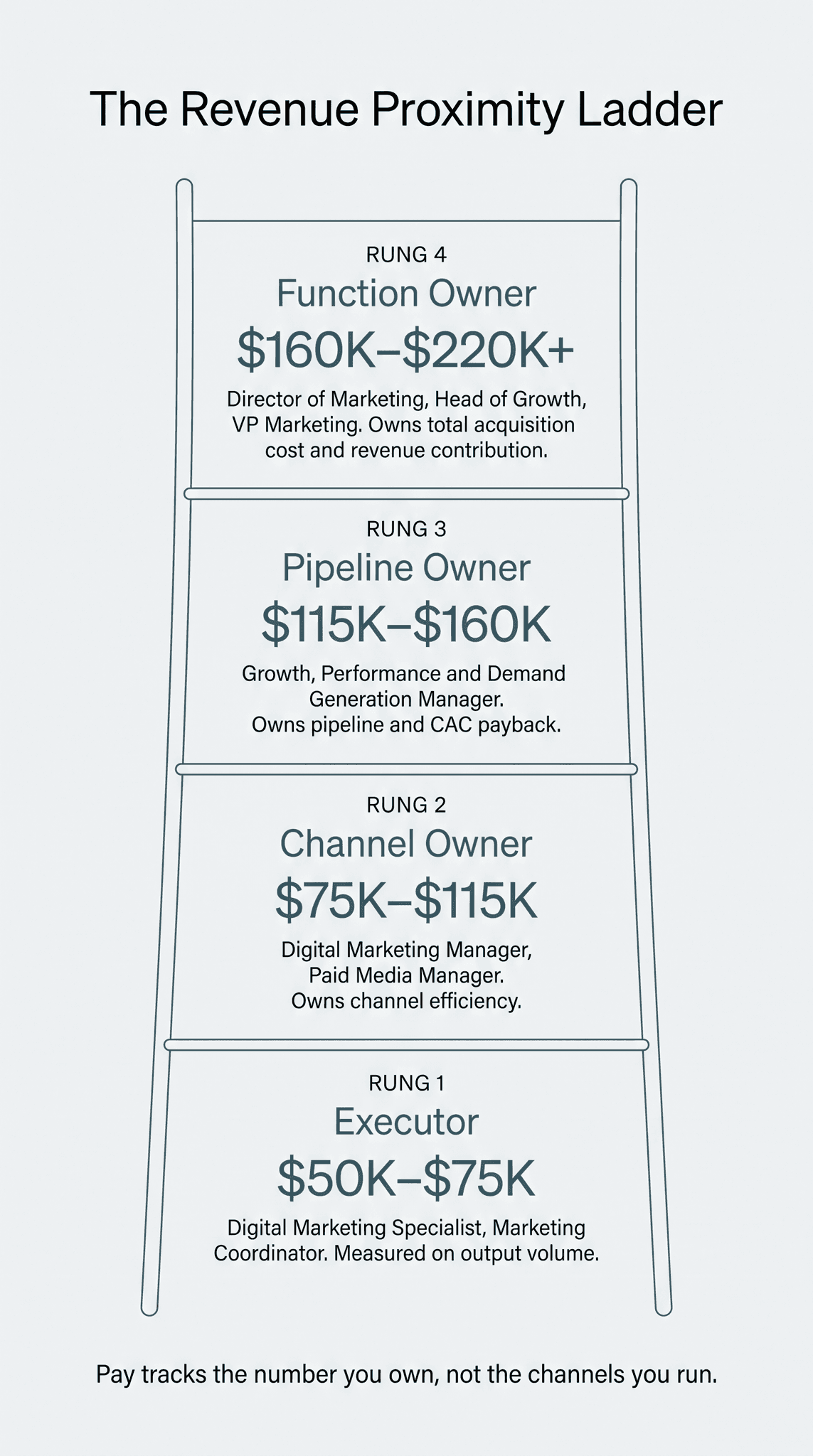
We call it The Revenue Proximity Ladder: in remote digital marketing, pay tracks how directly you are accountable for a revenue number — not your years of experience, and not how many channels you can name.
Scoring:
- Tier 1 — Executor ($50K-$75K): You run channels someone else planned. Your week is campaign builds, publishing, and reporting activity upward for someone else to interpret. Measured on output — emails sent, campaigns launched, posts shipped. Titles: Digital Marketing Specialist, Marketing Coordinator. Anchor: ZipRecruiter puts the remote Digital Marketing Specialist average at $65,418, with the middle half between $50,000 and $74,500 (May 2026).
- Tier 2 — Channel Owner ($75K-$115K): You own one channel end to end and hold a budget for it. You set the strategy for your channel, spend against it, and answer for its efficiency. Measured on channel metrics — cost per acquisition, click-through rate, organic sessions. Titles: Digital Marketing Manager, SEO Manager, Paid Media Manager, Email Marketing Manager. Anchor: ZipRecruiter's remote Digital Marketing Manager average is $87,719, 25th percentile $68,500 and 90th percentile $122,000 (July 2026); Built In reports the most common remote band for the same title at $110,000-$120,000.
- Tier 3 — Pipeline Owner ($115K-$160K): You are accountable for a number that appears in a board deck — pipeline sourced, customer acquisition cost payback, MQL-to-SQL conversion, blended CAC. Channels are your instruments, not your job. Titles: Growth Marketing Manager, Performance Marketing Manager, Demand Generation Manager, User Acquisition Manager. Anchor: Glassdoor's Growth Marketing Manager average is $130,449, with the 75th percentile at $176,771 (2026).
- Tier 4 — Function Owner ($160K-$220K+): You own the acquisition function, its budget, and the people running it. You are in the room where the number gets set, not just the room where it gets reported. Titles: Director of Marketing, Head of Growth, VP Marketing. Anchor: Built In puts remote Director of Marketing base pay at an average of $168,394 and total compensation at $195,564 (2026); BLS reported a $166,790 median for marketing managers in May 2025.
How to use it: find your tier by what you are measured on, not by what your business card says. Then read the measurement line one tier up. That sentence is two things at once — the interview answer you need to be able to give, and the set of job titles you should be searching instead of the one you have been.
| Tier | Representative titles | Base band | Measured on | Anchor figure |
|---|---|---|---|---|
| 1 — Executor | Digital Marketing Specialist, Marketing Coordinator | $50K-$75K | Output volume | $65,418 avg (ZipRecruiter, May 2026) |
| 2 — Channel Owner | Digital Marketing Manager, SEO Manager, Paid Media Manager | $75K-$115K | Channel efficiency (CPA, CTR, sessions) | $87,719 avg (ZipRecruiter, Jul 2026) |
| 3 — Pipeline Owner | Growth, Performance, Demand Gen, User Acquisition Manager | $115K-$160K | Pipeline, CAC payback, conversion | $130,449 avg (Glassdoor, 2026) |
| 4 — Function Owner | Director of Marketing, Head of Growth, VP Marketing | $160K-$220K+ | Total acquisition cost and revenue contribution | $168,394 base / $195,564 total (Built In, 2026) |
Those anchors are platform averages for US remote roles, drawn from the sources listed in the methodology above and current as of mid-to-late 2026. They are base figures except where total compensation is labeled, and each platform's number reflects the mix of employers it aggregates — which is the subject of the next section.
Nobody gets promoted out of the executor tier for running more channels. They get promoted for owning one number.
Stop Applying Manually
Our AI applies to hundreds of matching jobs while you sleep. Wake up to interviews, not more applications.
Why Four Salary Sources Disagree by $41,000
Put the platforms side by side for one title — remote Digital Marketing Manager — and the spread is absurd on its face.
| Source | Average (remote Digital Marketing Manager) | What the platform mostly aggregates |
|---|---|---|
| ZipRecruiter (Jul 2026) | $87,719 | Long tail of agency, SMB, and contract postings |
| Addison Group (2026 guide) | $112,794 | Staffing-firm placements across mixed industries |
| Built In (2026) | $114,265 base / $133,362 total | Tech and venture-backed companies |
| Glassdoor (2026) | $128,829 | Self-reported, skewed to larger tech and B2B employers |
There is a structural reason for the ordering, and it isn't data quality. It's who counts as an employer on each platform.
At an agency, marketing is the product being sold, so a marketing manager is a billable cost center — and margin pressure on the agency lands directly on that salary. At a B2B SaaS company, marketing is a funded growth function whose budget is defended in the same meeting as the revenue forecast. The work looks nearly identical from the outside. The economics that set the salary are not remotely the same.
Which produces the single most underrated fact in this field. Put concretely: if you are choosing between a $90K agency role and a $125K B2B SaaS role with the same title, take the SaaS role even when the agency job looks more interesting on paper. The agency will still be pricing you as a billable cost three years from now, and the SaaS role will have handed you a CAC number to put on a résumé.
The highest-paid decision in digital marketing is not which channel you specialize in — it is which kind of company you take the job at.
| Employer type | Typical manager band | Channel scope | Measured on | Trade-off |
|---|---|---|---|---|
| Agency | $65K-$95K | Broadest — many clients, many channels | Client retention and billable output | Best training, worst pay ceiling |
| B2B SaaS | $100K-$150K | Narrow and deep — usually 2-3 channels | Pipeline sourced and CAC payback | Highest pay, board-level scrutiny |
| E-commerce / DTC | $85K-$135K | Paid media and lifecycle heavy | Blended ROAS and contribution margin | Pay tracks the P&L, good and bad |
| Enterprise / non-tech in-house | $80K-$120K | Fragmented across teams | Program delivery and brand metrics | Stable and slow; titles inflate faster than pay |
Notice what happens to an agency career against the ladder. You can spend eight years there, run every channel that exists, and still price as a Tier 2, because you never once owned the client's revenue number — the client owned it. That is not a knock on agency work, which remains the fastest channel education available. It is a warning about staying past the point where the education stops, which is usually somewhere around year four.
There is a harder version of that warning that in-house hiring managers say to each other and rarely to candidates: long agency tenure gets quietly discounted. The reasoning is that agency incentives train you to optimize for client comfort — the deck that reassures, the metric that looks good in a QBR — rather than for the efficiency of a budget you have to live with next quarter. Fair or not, that is the read you are interviewing against after year four or five, and the counter is specific: bring one story about a number you held that went the wrong way and what you cut.
The Titles That Pay $40K More Than "Digital Marketing Manager"
Here is the part that changes what you do tomorrow morning.
When marketing budgets tightened — Addison Group's 2026 guide reports more than 60% of advertisers expecting a 6-10% budget decline, with overall hiring volume roughly 25% below pre-pandemic levels — companies stopped funding generalist headcount. A req titled "Digital Marketing Manager" is hard to defend in a budget review because it describes activity. A req titled "Demand Generation Manager" is easy to defend because it describes a number the CFO already cares about.
So the roles got renamed. And the money moved with the name.
| What you are searching | What the same work is called at the top of the band | Salary anchor | What the job description asks you to own |
|---|---|---|---|
| Digital Marketing Manager | Growth Marketing Manager | $130,449 avg, $176,771 at 75th percentile (Glassdoor, 2026) | Pipeline sourced, activation, retention loops |
| Paid Media Manager | Performance Marketing Manager | $75,000-$131,000 (Robert Half, 2026) | Blended CAC and return on ad spend |
| Marketing Manager (B2B) | Demand Generation Manager | Overlaps the Tier 3 band | MQL-to-SQL conversion and pipeline targets |
| Digital Marketing Manager (consumer app) | User Acquisition Manager | $120,000-$145,000 for one recent remote posting at Underdog Fantasy | Install cost, payback window, LTV-to-CAC |
| Email Marketing Manager | Lifecycle Marketing Manager | Tier 2 to Tier 3 depending on revenue ownership | Revenue per send, retention cohorts |
Run those as separate searches. Not as a keyword variation exercise — as four genuinely different job markets that happen to want your existing skill set.
Then screen what comes back, because renaming a req is free and plenty of companies did exactly that without moving the budget. A meaningful share of "Growth Marketing Manager" postings at Series B and C companies are paid acquisition jobs with a better title and a worse on-call culture — the title got upgraded during a fundraise, the scope never did. The same trick shows up under "Performance Marketing Manager," where the actual ask is often spend our Google and Meta budget and do not raise awkward questions about incrementality.
The tell is fast enough to run in thirty seconds:
- Read the first three bullets. A real Tier 3 description names a metric there — pipeline, CAC, payback, retention. A Tier 2 description names channels and tools.
- Check whether a budget number appears anywhere. No number, no ownership.
- Find who the role reports to. Reporting into a Director of Demand Gen or a VP Marketing is real. Reporting into a Marketing Manager means you are the execution layer.
- Count the tools. Twelve platforms, three analytics suites and a marketing automation stack listed with no definition of success is a Tier 2 role wearing a Tier 3 title.
Ask the scope question in the screening call rather than round three: what number does this role get evaluated on at the end of the first year? A hiring manager with a real Tier 3 req answers in one sentence. A hiring manager with a renamed Tier 2 req talks about collaboration.
Some phrasings are reliable enough to treat as red flags on sight:
- "Wear many hats" in a Tier 3 posting means the budget for two roles was approved as one.
- "Own the full funnel" with no metric attached usually means own the execution of the full funnel. Ownership language is cheap; a target number is not.
- "Fast-growing startup" paired with a band $20K under the market anchors in this post is asking you to price equity you have not been shown terms for.
- "Reporting to the founder" is genuinely good at seed stage and a warning at Series C — it means marketing has no functional leadership and every decision routes through someone with no time.
- "Data-driven" appearing three or more times while no analytics ownership appears in the responsibilities is aspiration, not practice.
- "Rockstar" or "ninja" in 2026 tells you the job description was not rewritten in a decade, which is a decent proxy for how the compensation band was set.
Stop Applying Manually
Our AI applies to hundreds of matching jobs while you sleep. Wake up to interviews, not more applications.
The Skills That Actually Move the Number
Channel breadth is table stakes now. Every candidate in the pile can list Meta, Google, LinkedIn, HubSpot and GA4. Listing them adds nothing to an offer.
What carries a measurable premium is narrower and harder to fake. Addison Group's 2026 hiring guide puts it at 20-30% higher compensation for professionals with hands-on experience in AI, Python, SQL and personalization compared with peers without them. The word doing the work in that sentence is hands-on.
One honest caveat before the list, because the premium is softer than the number suggests. Part of what companies are buying is signal — a marketing org that hires an AI-fluent operator gets to describe itself as an AI-fluent marketing org, and the interview for those skills is frequently shallower than the pay bump implies. That cuts in your favour on the way in and against you afterward: the premium is easy to clear at offer stage and hard to keep if the first quarter shows you cannot actually do it. Treat the four below as things to be able to demonstrate live, not to claim.
Each one has a version that gets said in interviews and a version that gets paid for.
GA4 diagnosis, not GA4 familiarity. The question is whether you can open a property cold, find the step where conversion is leaking, and say what to change. Everyone has "experience with GA4." Almost nobody can narrate a diagnosis out loud.
Budget you have personally held. Not "managed campaigns across paid social." A number, a period, and a result: "$180K a quarter across Meta and Google, held CAC under $240 through Q2." Budget size is the cleanest Tier 2 to Tier 3 signal that exists.
SQL at warehouse level. The ability to pull your own numbers instead of filing a ticket with a data analyst and waiting four days. This is the single most common capability separating people who get invited into planning meetings from people who get sent the outputs afterward. If you are building this from scratch, the same query skills show up across remote data analyst roles and transfer directly.
Lifecycle automation you built, not briefed. Welcome flows, re-engagement, cart abandonment, expansion sequences — constructed by you, with the branching logic and the holdout test. Briefing an agency to build it is Tier 1 work described in Tier 2 language.
There is a single question underneath all four, and it is the one that sorts the pile: can you name the exact CAC, payback or pipeline number you personally moved last quarter, and by how much? If the answer is no, you are Tier 2 regardless of how many tools appear on the résumé, and no certification changes that. Certifications matter at Tier 1, where a hiring manager has nothing else to evaluate. Above it, a Google Ads certificate against a candidate who can quote their own payback window is not a close contest.
Tier 1 is not disappearing — it is being repriced. AI has absorbed the first-draft copy, template builds, basic design, and reporting assembly that used to justify a full-time junior headcount, so that work is drifting toward contract and hourly arrangements. The tier still exists. It just stopped being a salaried career step you can safely spend three years on.
The uncomfortable part is what that does to the rung above it. Tier 1 used to be where you learned the craft on someone else's payroll before moving up. If those seats convert to contract work, the apprenticeship goes with them, and the people who make Tier 2 in 2027 will disproportionately be the ones who bought their own reps — a side project with real spend, a freelance client, an internal transfer. That is a worse system and it is the one that exists.
That compression is also why the middle of this market is crowded, which brings us to what you are actually competing against.
What the Remote Market Looks Like Right Now
Volume is fine. Competition is not.
Glassdoor listed 3,090 remote digital marketing jobs in August 2026, and roughly 3,116 employers were posting remote digital marketer roles on Indeed in the same period. That is a healthy market by any absolute measure.
The problem is arithmetic. Overall hiring volume sits about 25% below pre-pandemic levels while the applicant pool for any remote listing is national rather than metropolitan. Fewer reqs, wider funnel per req. The per-posting competition is meaningfully worse than the headline count suggests, and it is worst exactly where this post's readers are looking — the well-titled Tier 2 and Tier 3 roles that everyone else also recognizes as good.
Speed compounds it. Addison Group reports that top candidates are off the market within 10 days of receiving an offer. That is the real clock on a remote search: not how long the posting stays up, but how quickly the shortlist fills. Applying to five carefully chosen roles a week loses to a competitor applying to forty, and the difference is rarely quality of fit — it is arrival time.
Two things follow. First, the Tier 3 roles tend to surface on company career pages and specialised boards before they reach the aggregators, which is why working from a shortlist of the best remote job boards beats refreshing one search page. Curated boards like the ones covered in our Remotive review skew toward funded companies posting the titles in the translation table above. Second, if your applications are going out but nothing is coming back, the problem is usually the framing rather than the volume — why applications get no response covers the diagnostic.
Recent remote openings give a feel for the real shape of the band: a User Acquisition Manager role at Underdog Fantasy posted at $120,000-$145,000, and a Digital Marketing Manager for paid channels at OnBoard at $85,000-$120,000. Same broad field. One tier apart. Roughly $35,000 of difference explained almost entirely by which number the role answers for.
Stop Applying Manually
Our AI applies to hundreds of matching jobs while you sleep. Wake up to interviews, not more applications.
How to Move Up a Tier
Moving up the Revenue Proximity Ladder is a reframing exercise before it is a skills exercise. Most people at the top of Tier 2 already do enough Tier 3 work to qualify. They just describe it in activity language, so they get priced as activity.
Three steps, in order.
Identify the number one tier up. In your current company, someone already owns pipeline, CAC or payback. Find out who, and find out what the target is this quarter. If you cannot name that number, you cannot claim proximity to it.
Attach yourself to it before you have the title. This is the step that takes real effort, and it will not go smoothly the first time. The realistic version: you ask to own the reporting line connecting your channel to that number, and someone tells you it is not your remit. The workaround is almost always volunteering for the reporting nobody enjoys — the weekly attribution pull, the CAC-by-source breakdown that currently gets assembled by hand. Do that for two quarters and you own the narrative around the number whether or not anyone updated your title.
Rewrite the résumé in owned-number language. The rewrite is smaller than people expect and matters more than anything else on the page:
- Before: "Managed paid search, paid social, and email campaigns across a $2M annual budget."
- After: "Owned $2M in annual paid spend against a $310 blended CAC target; held CAC at $286 across four quarters while growing sourced pipeline 34%."
Same job. The first version describes channels. The second one answers the only question a Tier 3 interviewer is really asking, which arrives in one of two forms: what were you measured on, and what did you do when it went the wrong way.
The translation is mechanical once you see it. When you get asked what you were measured on, most Tier 2 candidates answer with a job description — "I owned paid search and paid social, plus the email calendar." That answer prices you where you already are. The shape that moves you is number, target, outcome, decision:
"I was measured on blended CAC against a $310 target across paid search and paid social. We ran $2M a year. I held it at $286 for four quarters, and in Q3 when CPMs jumped and CAC went to $340, I cut non-brand search first because it had the worst payback, moved 30% of that budget into retargeting, and got back under target in six weeks."
That is the same career as the bad answer. It just states a number, a target, a miss, and a decision — in that order. Note the miss is doing most of the work: candidates with four clean quarters and no failure story read as people who have never actually held the number, because anyone who has held one has blown it at least once. If you are reworking how the whole document reads, resume title examples is a useful starting point for the top of the page.
One caveat about the top of the ladder, since career guides rarely say it. The jump from Tier 3 to a $160K+ Director seat is only partly about performance. A large share of people holding those titles got them by being the first or second marketer at a company that subsequently raised a large round — the scope grew underneath them faster than they could have earned it by promotion elsewhere. That is not an argument against trying; it is an argument for weighting company trajectory heavily when you choose between Tier 3 offers, because the org that triples headcount is the one that manufactures Tier 4 roles internally.
If your résumé lists channels and your interview answers list activities, you will be priced as a Tier 1 no matter how many years you have.
Frequently Asked Questions
I'm a remote digital marketing manager making about $85K — what actually gets me to $120K?
Change what you are accountable for, then change what you search for. At $85K you are sitting near the ZipRecruiter average for the title ($87,719, July 2026), which is the middle of Tier 2. The $120K+ roles are Tier 3 and they post as Growth, Performance, Demand Generation or User Acquisition Manager — Glassdoor's Growth Marketing Manager average is $130,449. Before you apply, get one quarter of owning a pipeline or CAC number, even informally, so you can answer the "what number did you own" question with something real.
How do I know which tier of the Revenue Proximity Ladder I'm actually on?
Ignore your title and answer one question: what number does your manager evaluate you against? If it is output volume, you are Tier 1. If it is channel efficiency — CPA, CTR, organic sessions — you are Tier 2. If it is pipeline, CAC payback or conversion between funnel stages, you are Tier 3. If it is total acquisition cost and revenue contribution for the whole function, you are Tier 4. People consistently guess one tier higher than their measurement line supports, which is why the interview conversation stalls.
Why do ZipRecruiter and Glassdoor show such different salaries for the same remote marketing title?
Because they aggregate different employers. ZipRecruiter's $87,719 average for a remote Digital Marketing Manager (July 2026) pulls in a long tail of agency, small-business and contract postings. Glassdoor's $128,829 skews toward larger tech and B2B companies where marketing is a funded growth function rather than an overhead line. The $41,110 gap is not a measurement error — it is the price difference between two kinds of employer, and it is worth more than several years of experience.
Is digital marketing still a good remote career in 2026 with AI absorbing so much of the work?
Yes at the top of the ladder, and increasingly not at the bottom. Overall hiring sits roughly 25% below pre-pandemic levels and AI has absorbed most first-draft copy, template builds and reporting assembly, which is compressing Tier 1 toward contract work. But Addison Group's 2026 guide puts the premium for hands-on AI, Python, SQL and personalization experience at 20-30% over peers without it, and projects 6% job growth for digital marketing professionals through 2032. The judgment work is getting more valuable as the production work gets cheaper.
What's the real difference between a digital marketing manager and a growth marketing manager?
Scope of accountability, which is why the pay differs by roughly $40K. A digital marketing manager owns channels and answers for channel efficiency. A growth marketing manager owns a business outcome — pipeline, activation, retention, payback — and treats channels as interchangeable means to it. In practice the growth role also involves more experimentation infrastructure and more time defending numbers to a leadership team. Glassdoor's averages sit at $128,829 and $130,449 respectively, but the 75th percentiles diverge sharply, with growth reaching $176,771.
Should I take a remote marketing job at an agency or in-house?
Agency for the first three to four years, in-house after that, and the reason is structural rather than cultural. Agencies give you channel breadth and reps across many businesses faster than any in-house role will, but you never own the client's revenue number — the client does — so agency careers tend to price as Tier 2 indefinitely. In-house at a B2B SaaS or DTC company is where budget ownership and revenue accountability actually transfer to you. Take the agency education, then leave before it stops compounding.
Do I need a marketing degree or certifications for remote roles above $100K?
No. Certifications are useful at Tier 1, where a hiring manager has little else to evaluate, and close to worthless above it. At $100K+ the evaluation is entirely about owned numbers: budget size you have personally held, the CAC or payback figure you were accountable for, and what you did in the quarter it moved the wrong way. A candidate with a Google Ads certificate loses to a candidate who can quote their own payback window, every time.
Start Your Remote Digital Marketing Job Search
Remote digital marketing will keep paying anywhere from $50K to $195K+ under nearly identical job titles, and no listing will tell you which end it sits on. The Revenue Proximity Ladder will. Read every posting for the number it asks you to own, search the Tier 3 titles rather than the one on your current business card, and target the employer types whose economics fund the role instead of tolerating it.
Then solve the volume problem, because it is the one part of this fully within your control. Browse remote marketing job listings with salary transparency, filter for remote roles above $100K, or let auto-apply handle the arrival-time problem — when the shortlist fills in ten days, being early beats being polished. For a wider view of where the money sits across remote work, our guide to remote marketing roles paying six figures and the broader highest-paying remote jobs guide are the natural next reads, and the adjacent specialisms — remote social media roles and remote copywriting positions — map onto the same ladder.
The channels change every eighteen months. The number you owned is the only line on your résumé that keeps its value.
Ready to Find Your Remote Job?
Browse thousands of curated remote jobs or let AI apply for you.
Browse Remote JobsRelated Job Guides
Remote Java Developer Jobs: What 1,384 Postings Pay (2026)
Remote Java developer jobs: we read 1,384 US postings. 32% of those stating a model are remote, 57% come from consultancies, and the best-paid don't say Java.
48 min read
Remote Python Jobs: What 580 Postings Actually Pay (2026)
580 US Python-titled postings read in full: who posts them, the $126K–$180K median range, which are remote, and the four-question score behind the pay gap.
65 min read
Remote Web Developer Jobs: What 3,937 Postings Pay (2026)
Remote web developer jobs: we read 3,937 US postings. 47% of those stating a model are remote, and the word "Engineer" in the title tracks $50K of pay.
46 min read