
Last reviewed: September 2026
You open the posting. "Enterprise Account Executive. Remote – US. $290,000–$330,000." You open the next one. "Enterprise Account Executive. Remote – Florida. $120,000–$170,000." Same title, same word "remote," and a $170,000 gap. Nothing on either page tells you the first number is on-target earnings and the second is base salary only.
Elastic is one of the few employers that shows all three numbers on the same page. Its Enterprise Account Executive postings publish a base range of $113,300–$179,200, a target variable range of $113,300–$179,200, and an on-target earnings range of $226,500–$358,300, with a sentence explaining that the OTE is "based on a 50/50 pay mix (base salary / target variable)." Zscaler publishes base only and says so. Samsara publishes OTE only and doesn't. Every one of those postings is legally compliant, and no two of them are quoting the same unit.
Get Remote Job Tips in Your Inbox
Weekly strategies, salary data, and new opportunities
Unsubscribe anytime. No spam.
Here is the reframe that changes how you read the market: the number in an AE job ad is not a salary. It is a salary plus a bet, and in this dataset the salary half is almost exactly half. There is a second reframe underneath it that costs people more time. Remote eligibility in this role does not rise with seniority — it rises with deal size. The rung most job seekers can actually reach from where they stand, small-business and commercial sales, is the least remote-friendly rung on the ladder. The seats that go remote are the ones carrying six-month enterprise cycles.
We pulled 1,125 US Account Executive postings from 155 employers' own applicant tracking systems on September 18, 2026 — 33,096 live postings scanned across 1,132 employer boards — and read the work-model sentence and the pay-disclosure sentence in every one. What follows is what those sentences say, which is frequently not what the location field says.
Based on 1,125 US Account Executive postings across 155 employers, read from their ATS feeds on September 18, 2026:
- 27% (n=304 of 1,125) state a remote arrangement, spread across 78 of the 155 employers
- 62% (n=693 of 1,125) never state a work model at all — and 657 of those 693 name a specific city or state in the location field
- Base salary is a median 50% of OTE (n=31 postings that publish both figures separately; observed spread 47%–50%), and 59 postings state a "50/50" pay mix in words
- 56% (n=635 of 1,125) publish any labelled pay range; among remote-stated postings it rises to 63% (n=191 of 304)
- Remote share climbs with deal size: 9% small-business and commercial (n=25 of 285), 30% mid-market (n=33 of 109), 32% enterprise (n=93 of 288), 37% strategic and named accounts (n=61 of 166)
- 0.4% (n=4 of 1,093 postings with body text) require a bachelor's degree; the median stated experience minimum is 5 years (n=728 of 1,125 state one)
How We Collected This Data
Start with what this data cannot see. Reddit blocks automated access at every mirror, so there is not one forum quote in this post. Glassdoor and ZipRecruiter return 403 to anything that is not a browser, so their headline numbers — 18,433 jobs, "$54k-$110k" — appear here only as an example of why aggregator figures disagree, never as sourced data. RepVue returned rate-limit errors on two attempts and is not quoted. And the AE seats that get filled through a referral before a requisition is ever posted are invisible to any method, including this one.
What is left is the source nobody polishes for marketing: the employer's own applicant tracking system feed. On September 18, 2026, we queried the public, no-authentication job feeds of Greenhouse, Lever, Ashby, and SmartRecruiters across 725 employer tokens. 1,132 boards answered with 33,096 live postings. A title filter for "account executive," excluding interns, apprentices, and trainees, returned 2,056 matched postings worldwide; 1,125 of those are located in the United States, at 155 employers named throughout this post.
Work model was classified by reading the location field and the posting prose together, never by trusting an ATS remote flag — those flags are wrong in both directions often enough to matter. Pay ranges required more care than usual. AE postings routinely publish two or three different ranges on the same page, so every range was assigned to base, target variable, or OTE by its nearest disclosure label rather than by a first-range-wins parse. That single methodological choice is the difference between reporting Elastic's base as $113,300 and reporting it as $226,500.
Freshness: 820 of the 1,100 dated postings were updated in September 2026, and 984 of 1,100 in July through September 2026. This is a live snapshot, not an archive. Salary figures were cross-referenced with Bureau of Labor Statistics wage data for technical and scientific sales representatives, accessed through O*NET OnLine, and with published sales compensation benchmarks.
Three caveats. Every percentage here describes one day of live postings, so the counts will move week to week. Where one employer posted many near-identical requisitions, segment medians are computed as the median of per-employer medians so a single board cannot move the number. And a handful of employers publish ranges under labels that do not identify the unit — Databricks uses "Local Pay Range," Mixpanel uses "Mixpanel Compensation Range" — so those postings are counted but excluded from the base and OTE medians.
The Deal Size Ladder: Four Rungs, Four Different Jobs
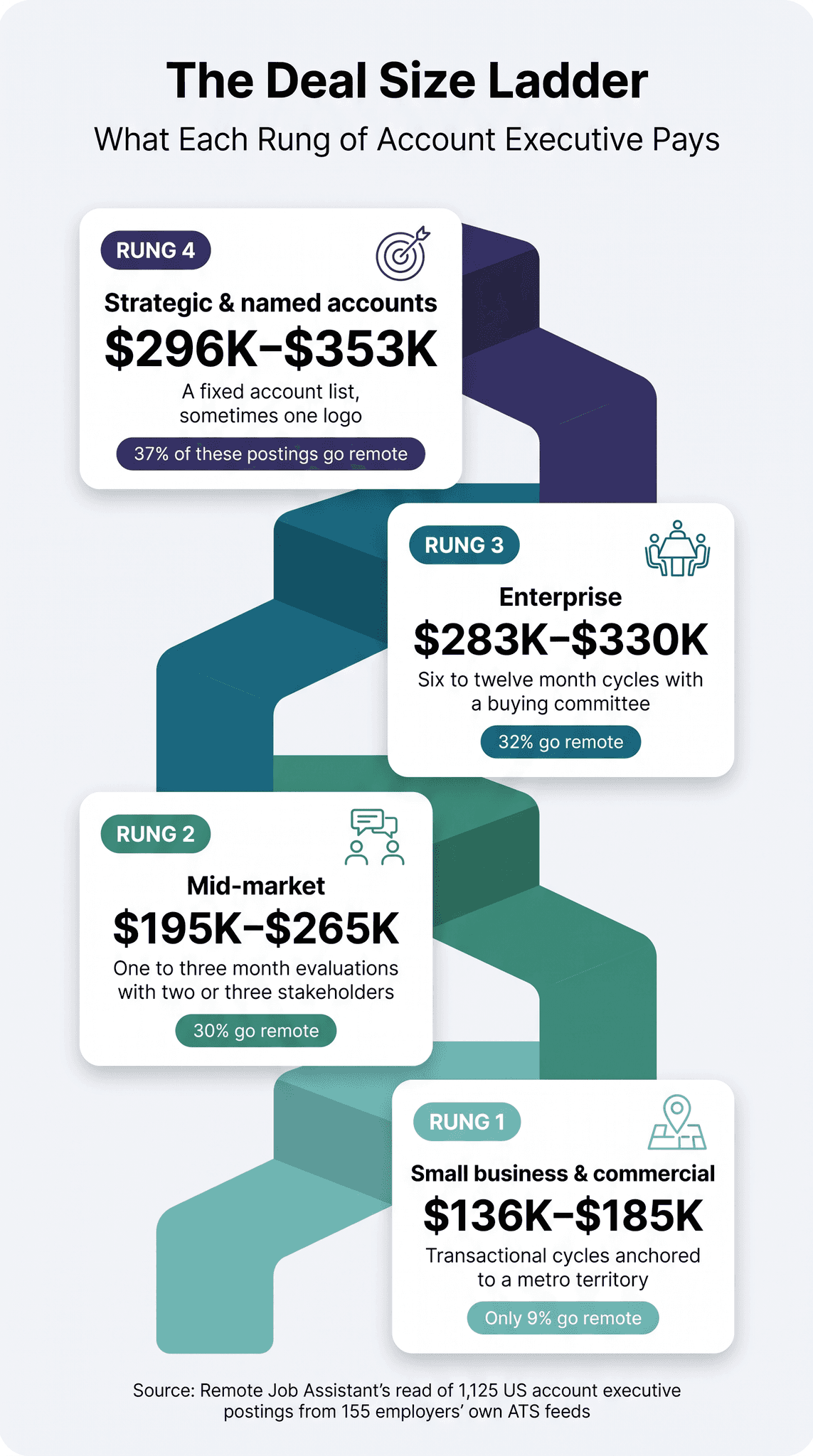
The Deal Size Ladder: a four-rung rubric that scores a remote AE seat by the deal size it carries. Base pay, OTE, and remote eligibility all track the rung — not your years in seat.
Scoring:
- Rung 1 — Small business and commercial (base $77K–$104K; OTE $136K–$185K; remote 9%, n=25 of 285). Transactional cycles measured in days or weeks, high volume, self-generated pipeline. The tell is a metro in the title: "Territory Account Executive, Fort Worth," "Account Executive, Commercial – Chicago." Experience asked is usually one to three years. Brex posts an Account Executive, Small Business at $100,000–$125,000 OTE; Zscaler's Account Executive, Commercial – Chicago posts a base of $90,300–$129,000. This is where most people enter, and it is the rung least likely to let you work from anywhere.
- Rung 2 — Mid-market (base $80K–$105K; OTE $195K–$265K; remote 30%, n=33 of 109). Cycles of one to three months, a real evaluation process, two or three stakeholders. This is the first rung where remote stops being an exception. Samsara's Account Executive, Mid Market (Midwest) posts $152,000–$190,000 OTE as "Remote - US"; LaunchDarkly's Mid-Market AE posts $116,000–$159,000; Bloomreach's Senior AE, MidMarket posts $200,000–$270,000; Toast's Mid Market AE for Toast Retail posts $217,000–$347,000 in total targeted cash.
- Rung 3 — Enterprise (base $120K–$155K; OTE $283K–$330K; remote 32%, n=93 of 288). Six- to twelve-month cycles, a buying committee, procurement and security review. MEDDIC or MEDDPICC shows up in the requirements. Okta's Enterprise Account Executive for Auth0 posts $260,000–$358,000 OTE; Drata's Enterprise AE – Southeast posts $270,000–$315,000; Axonius posts $275,000–$305,000 for an Ohio/Michigan enterprise patch; Neo4j posts $280,000–$340,000 for a financial services enterprise seat.
- Rung 4 — Strategic and named accounts (base $144K–$177K; OTE $296K–$353K; remote 37%, n=61 of 166). A fixed list of accounts, sometimes a single logo, and a mandate that reads more like partnership management than hunting. Asana posts a Strategic Enterprise Account Executive dedicated to Amazon at $355,000–$380,000 OTE against a base of $177,500–$190,000 — one of the few postings in the dataset that publishes both halves of its own split. Airtable's Strategic Accounts AE posts $272,000–$354,000; Algolia's Strategic AE posts $296,000–$320,000; Okta's Strategic AE for Auth0 posts $308,000–$462,000.
How to use it: read the rung off the posting's own language before you read the money. A metro name in the title is Rung 1. "Named accounts" or a single company in the title is Rung 4. Then check that rung's remote share against the table below before you spend forty minutes filling in a Greenhouse form — at Rung 1 you are applying into a 9% pool.
Remote eligibility in AE hiring does not track seniority. It tracks deal size.
Stop Applying Manually
Our AI applies to hundreds of matching jobs while you sleep. Wake up to interviews, not more applications.
What Remote Account Executive Jobs Actually Pay
The honest version of this section starts with an admission: for roughly half the market, nobody can tell you what a posting pays, because the posting does not say what it is measuring.
Elastic's disclosure is the model of what a complete one looks like. Its postings state outright that "Compensation for this role is in the form of base salary plus a variable component, that together comprise the On-Target Earnings (OTE)," and that the OTE is "based on a 50/50 pay mix (base salary / target variable)." Then it publishes all three numbers. On its Enterprise Account Executive postings that reads: base $113,300–$179,200, target variable $113,300–$179,200, OTE $226,500–$358,300. You know exactly what you are being offered and exactly how much of it you have to earn.
Across the 31 postings in our dataset that publish a base range and an OTE range as separate figures, the base sits at a median 50% of OTE, and the entire observed spread is 47% to 50%. A separate 59 postings state a "50/50" mix in words without publishing both numbers. That is remarkably tight for a market this fragmented, and it matches the published benchmarks: according to Apollo's compensation guide, "Account Executives typically see a 50:50 or 60:40 split," with Bridge Group research cited at a 53:47 base-to-variable split.
In a 50/50 plan, the only number you are contractually owed is half of the number in the job ad.
On-target earnings by rung
| Rung | Postings with a posted OTE | Employers | Employer-median OTE | Raw posting median |
|---|---|---|---|---|
| Small business / commercial | 161 | 16 | $136K–$185K | $115K–$185K |
| Mid-market | 28 | 12 | $195K–$265K | $173K–$246K |
| Enterprise | 81 | 24 | $283K–$330K | $243K–$325K |
| Strategic / named | 72 | 14 | $296K–$353K | $148K–$237K |
Base salary by rung
| Rung | Postings with a posted base | Employers | Employer-median base |
|---|---|---|---|
| Small business / commercial | 23 | 13 | $77K–$104K |
| Mid-market | 33 | 13 | $80K–$105K |
| Enterprise | 65 | 17 | $120K–$155K |
| Strategic / named | 27 | 10 | $144K–$177K |
| Public sector | 11 | 3 | $133K–$190K |
Both tables come from the 1,125 US Account Executive postings read on September 18, 2026. Employer-median figures are the median of per-employer medians, which prevents one company posting thirty near-identical requisitions from setting the number; raw posting medians are shown alongside so you can see where the two diverge. Base figures exclude agency-side AE roles, which are a different job entirely — more on that below.
The reason disclosure is this inconsistent is structural rather than sneaky. State pay-transparency laws require employers to publish a range; almost none of them define the unit. So a compliant posting can quote base salary, on-target earnings, or a blended figure, and all three satisfy the law. Toast calls its number "Total Targeted Cash" and explains that it "includes base salary, commission, and bonus." Mixpanel calls its number TTCC. Databricks calls its number "Local Pay Range" and mentions commissionable roles in the preceding paragraph. Zscaler is explicit in the other direction: "The base salary range listed for this full-time position excludes commission/ bonus/ equity (if applicable) + benefits." Four employers, four units, one legal standard.
For a national baseline, the Bureau of Labor Statistics reports a median wage of $104,920 a year ($50.44 an hour) for Sales Representatives, Wholesale and Manufacturing, Technical and Scientific Products, using 2025 wage data, with 303,200 people employed as of 2024 and 27,200 projected annual openings through 2034 — accessed through O*NET OnLine, since bls.gov refuses non-browser requests. The broader services sales category, Sales Representatives of Services, reports a $69,990 median across 1,226,700 workers.
Hold those next to a $283K–$330K enterprise OTE band and the gap looks absurd. It isn't. The BLS series covers every technical and wholesale sales rep in the country, most of whom are not selling software to buying committees. The posting data covers a self-selected slice of venture-funded and public technology employers. Both numbers are accurate about different populations, and if you are reading this you are almost certainly shopping in the second one. Apollo's guide also reports an average quota attainment of 42.7% for account executives, though it gives no source for that figure — treat it as directional, and ask the hiring manager for their team's actual number instead.
Four things that quietly move the number
These are the disclosure patterns that cost people money after they accept, and every one of them is visible on the posting before you apply.
A "range" with identical endpoints is not a range. 44 of the 1,125 postings publish a band whose low and high are the same number: Figma's Account Executive, Mid-Market at $110,000–$110,000, its SMB AE at $70,500–$70,500, MongoDB's Enterprise AE at $150,000–$150,000, Samsara's Enterprise AE at a flat $350,000. Some of those are bases with no negotiating room by design and some are OTE quoted as a single figure. The endpoint tells you nothing; the label above it tells you everything.
Geographic pay zones apply to remote jobs too. 256 of the 1,093 postings with body text (23%) tie the published band to a location tier — Toast, Databricks, LaunchDarkly, Checkr, Block, Dropbox, Klaviyo, Justworks, Sprout Social, and Webflow all do it explicitly. LaunchDarkly publishes the arithmetic: Zone 1 (San Francisco, New York, Boston, Seattle) $269,400–$370,480, Zone 2 (Los Angeles, Austin, Chicago, Philadelphia, Portland) $242,500–$333,410, Zone 3 (everywhere else in the US) $229,000–$314,930. Moving somewhere cheaper can cost you 15% of the band on the same job.
Accelerators are where the upside actually lives, and 364 of 1,093 postings (33%) mention them without publishing the threshold. The threshold is the question: accelerators that start at 100% of quota behave very differently from accelerators that start at 110%, and a plan that pays uncapped commission — 248 of 1,093 postings say so — is only uncapped above whatever that line is.
When an employer refuses to name the unit, take it as the answer. Checkr labels its band "On-target Earnings OR Base Salary range (San Francisco, CA)," which is an employer telling you in writing that it will decide later which one it meant. That is a legitimate thing to clarify in the first screen rather than the offer call.
Only 27% of AE Postings Are Remote — and the Bottom Rung Is the Worst
| Rung | US postings | Remote-stated | Remote share |
|---|---|---|---|
| Small business / commercial | 285 | 25 | 9% |
| Mid-market | 109 | 33 | 30% |
| Enterprise | 288 | 93 | 32% |
| Strategic / named | 166 | 61 | 37% |
| Public sector | 23 | 7 | 30% |
| Rung not stated in title | 254 | 85 | 33% |
The inversion has a cause, and it is about where the customer is rather than how much the company trusts you.
Small-business sales is still substantially field sales. A Toast territory AE walks into restaurants. The deal closes because someone stood in the kitchen at 3pm between service windows. That work requires a rep who lives in the patch, so the posting says "Territory Account Executive, Prattville, AL" and the work model is implied by the town in the title. Toast posts 172 US Account Executive roles in this dataset and six of them state remote.
Enterprise sales inverted years ago. A twelve-month cycle with a buying committee spread across four offices, a security review, a procurement negotiation and a legal redline is conducted over Zoom and email regardless of where the rep sits. There is no single place for the seller to be near, so the location constraint quietly dissolves — and the company gets to recruit from a national pool for a seat it badly needs filled. That is why remote share climbs from 9% at Rung 1 to 37% at Rung 4.
693 of the 1,125 US postings never state a work model at all, and 657 of those 693 name a specific city or state in the location field. Silence is not a remote posting. When a listing says "Chicago" and says nothing else, the answer is Chicago.
One honest limit on that number: 46 of those 693 silent postings describe the company as distributed or remote-first in the body without ever saying the role is remote. Elastic is the clearest case — its posting bodies say "As a distributed company, diversity drives our identity" while the location field reads "United States." Companies like that are almost certainly remote in practice and are counted as unstated here, which means 27% is a floor rather than a ceiling.
Stop Applying Manually
Our AI applies to hundreds of matching jobs while you sleep. Wake up to interviews, not more applications.
"Remote" Usually Means "Remote Inside a Territory"
Of the 304 remote-stated postings, 138 name a state, metro, or region in the location or title: "Remote - Florida," "Remote: Northeast US," "Enterprise Account Executive, Ohio/Michigan," "Core Enterprise Account Executive TOLA." Only 215 say "Remote - US" or "United States" with no geographic constraint attached, and those two groups overlap where a posting lists several states.
The location field on an AE role is a coverage map, not a permission slip. "Remote - Colorado" means you may work from your house and your accounts are in Colorado. Move to Portland and the job stops making sense, because 37% of postings (n=403 of 1,093 with body text) mention travel, and the travel is to the patch.
This matters most when you are comparing two offers that both say remote. One is a national named-account list you could run from anywhere with an airport. The other is a metro patch that quietly requires you to keep living in that metro. And at the enterprise end, the binding constraint on where you live usually isn't an office at all — it's the airport, because 37% of these postings expect you to be in front of customers some of the time and nobody is flying you from Missoula twice a month by choice.
Ask this in the first screen: "Is this territory assigned by geography, by vertical, or by named account list?" Geography means your zip code is in the job description — follow up with "what happens to the patch if I move?" Vertical or named accounts means location is negotiable — follow up with "which pay zone would I be in?" If the recruiter can't answer either question, the plan isn't finalized, and anything you're told about earnings before it is finalized is a forecast.
Account Executive Is Two Different Jobs
39 of the 1,125 US postings are agency-side AE roles — public relations, advertising, and media shops where "Account Executive" is a junior client-services coordinator rather than a closer. The employers include Highwire, Method Communications, 5WPR, Bospar, Axios, and 6sense's advertising sales team. Their base median is $54,000–$72,000 (n=30 of the 39 with a posted base). An enterprise software AE's employer-median base is $120,000–$155,000. Same two words.
| Agency Account Executive | B2B / SaaS Account Executive | |
|---|---|---|
| What you own | Client deliverables, timelines, media lists | A quota and a close |
| Who you report into | An Account Supervisor or Account Director | A sales manager or VP of Sales |
| How you're paid | Salary, occasional bonus | Base plus commission, typically a 50/50 split |
| What's measured | Coverage, client retention, deadlines | Bookings against quota |
| Typical posted base | $54K–$72K (n=30 of 39 agency postings) | $77K–$177K by rung (n=148 non-agency postings with base) |
| Next title up | Senior AE, Account Supervisor | Senior AE, Enterprise AE, Sales Manager |
The collision persists because the word "account" points in opposite directions. In agency work, an account is a client you serve, and the AE is the most junior person serving it. In software, an account is a company you sell into, and the AE is the person who owns the outcome. Identical etymology, opposite altitude, and search engines treat them as one job — which is why a query for remote account executive jobs returns both, and why it is worth reading two sentences of the posting before you apply.
If client-side relationship work is what you actually want, remote account manager jobs and remote customer success roles are the better search terms, and both pay closer to the software curve than agency AE work does.
Stop Applying Manually
Our AI applies to hundreds of matching jobs while you sleep. Wake up to interviews, not more applications.
Who's Actually Hiring Remote Account Executives
| Employer | Remote-stated US AE postings | Pay published on those postings |
|---|---|---|
| Zscaler | 30 | Base $72.5K–$415K |
| Samsara | 22 | OTE $106K–$350K |
| Mixpanel | 17 | Range published without a base/OTE label |
| GitLab | 14 | Base $68.8K–$205K |
| Datadog | 11 | None posted |
| Smartsheet | 11 | Base $75K–$193K |
| Databricks | 10 | Labelled "Local Pay Range," commissionable |
| Highwire | 9 | Base $54K–$90K (agency AE) |
| Brex | 8 | OTE $100K–$325K |
| Hightouch | 8 | OTE $200K–$335K |
| Snowflake | 7 | None posted |
| Toast | 6 | OTE $148K–$347K |
Now compare that with the employers posting the most US AE roles overall, remote or not. Toast posts 172 and six are remote. Braze posts 50 and none state remote. Stripe posts 39 with five remote, Axon 37 with six, Block 36 with none, Verkada 31 with none, Anthropic 23 with none. Samsara is the outlier in the other direction: 22 US AE postings and all 22 state remote.
Volume and remote-friendliness are close to inversely related in this role. The companies generating the most AE listings are the ones running dense metro field-sales motions, which is exactly the motion that keeps a rep anchored to a city. If you sort a job board by "most results," you are sorting toward the jobs you can't do from home. Infrastructure, security, and data-platform companies — Zscaler, Samsara, GitLab, Databricks, Snowflake, Hightouch — post fewer AE roles and a much higher share of them remote.
Treat those counts as a snapshot of hiring posture, not a live inventory. The durable read is that Samsara, Zscaler, GitLab, and Smartsheet hire remote AEs as a matter of policy, while Toast and Verkada hire them into cities. You can check what is live right now across remote account executive listings and the broader sales and business development roles.
What the Postings Actually Require
| Signal | Postings mentioning it | Share |
|---|---|---|
| States a years-of-experience minimum | 728 of 1,125 | 65% |
| Equity, stock, or RSUs | 729 of 1,093 | 67% |
| Salesforce | 538 of 1,093 | 49% |
| SaaS experience | 510 of 1,093 | 47% |
| Quota, explicitly | 401 of 1,093 | 37% |
| Travel | 403 of 1,093 | 37% |
| Cold calling, outbound, or pipeline generation | 250 of 1,093 | 23% |
| Uncapped commission | 248 of 1,093 | 23% |
| MEDDIC or MEDDPICC | 201 of 1,093 | 18% |
| Command of the Message / Force Management | 57 of 1,093 | 5% |
| Challenger methodology | 24 of 1,093 | 2% |
| President's Club | 10 of 1,093 | 1% |
| Mentions a bachelor's degree at all | 87 of 1,093 | 8% |
| Requires a bachelor's degree | 4 of 1,093 | 0.4% |
The median stated experience minimum is five years, and five is also the single most common number (189 postings), followed by two years (112), three (93), seven (74), eight (67), and ten (59). The remote subset behaves the same way at the median, with seven- and eight-year minimums appearing slightly more often — consistent with remote seats clustering at the enterprise end of the ladder.
A degree requirement appears in 4 of 1,093 AE postings. Quota attainment is the credential. What replaces it is a specific, checkable number: what you carried, what you closed, and what percentage of quota that came to, for each of the last two or three years. If your resume says "consistently exceeded targets" instead of "$1.4M quota, 118% attainment FY25," you are competing against people whose resumes say the second thing.
Tooling expectations are narrower than the job ads make them look. Salesforce appears in roughly half of postings and is worth listing by name if you have used it; the Salesforce-based remote roles on our board are a reasonable sample of how often it gates a screen. Named sales methodologies are rarer than sales Twitter suggests — MEDDIC or MEDDPICC in 18%, Command of the Message in 5%, Challenger in 2%.
Seniority is the other thing worth seeing plainly. Of the 1,125 US postings, 984 are a plain "Account Executive," 124 carry a senior modifier, six are principal or lead, and 11 are associate or junior — exactly one of which is remote. The structural reason is unglamorous: junior AE seats exist to be coached in person off a sales floor, with a manager listening to calls at the next desk, so they are the last seats any company converts to remote. If you are trying to enter the role, the realistic paths are an SDR or BDR seat that promotes internally — the distinctions are covered in how SDR, BDR, and AE roles differ — or a lateral move from account management or customer success. Breaking into remote sales covers that path in more detail.
How to Read a Remote AE Posting in Ninety Seconds
Read the label, not the number. If it says "Base Pay Range," halve nothing and double nothing — that is the floor, and the plan doubles it. If it says "On-Target Earnings" or "Total Targeted Cash," halve it, because that half is the part you are owed. If the label is generic — "Compensation Range," "Local Pay Range" — search the body for the word "commission." If commission appears, treat the number as blended and ask which it is before the second interview.
Place the rung, then check the rung's odds. A metro in the title is Rung 1 of the Deal Size Ladder, and Rung 1 is a 9% remote pool — if you need remote, that application is a lottery ticket and should be treated as one. "Mid-Market" is Rung 2 at 30%. "Enterprise" is Rung 3 at 32%. "Strategic," "Named," or a single customer's name in the title is Rung 4 at 37%. Spend your application hours where the pool is.
Read the location field as a coverage map. If a state or region follows the word "Remote," that is a territory. If you already live in it, apply. If you don't and you can't move, the posting is not for you no matter what the first word says.
Search the body for two strings before anything else. "#LI-Hybrid" and "days in office" override whatever the location field claims. A posting listed as "Remote - US" with "three days per week in the office" in paragraph nine is a hybrid job, and finding that string takes four seconds.
Treat silence as a city. If the posting names a city and never states a work model — 657 of the 1,125 we read — assume the city is the answer. You can still apply, but ask the work-model question in the first message rather than the fourth round, because the answer decides whether the other three rounds were worth anything.
Those five reads take about ninety seconds. The problem is that they have to happen 1,125 times, because the 62% of postings that never state a work model cannot be filtered — you have to open each one to find out whether the job is even possible for you. That is the specific tax on an AE job search, and it is the reason a mid-market rep applying across forty SaaS companies fills in the same Greenhouse form forty times to discover that eleven of them wanted someone in Austin. Our auto-apply service exists to remove that step, and the six-figure remote openings and remote roles above $150K filters are where most AE searches should start.
Frequently Asked Questions
I'm an SMB account executive with three years of closing experience — how do I get a remote mid-market seat?
Target mid-market explicitly rather than applying up into enterprise, because that is where remote eligibility first becomes normal: 30% of mid-market postings state remote (n=33 of 109) versus 9% at the small-business rung (n=25 of 285). The gap you need to close on paper is cycle length and stakeholder count, not years — mid-market postings want evidence you have run a one-to-three month evaluation with a technical evaluator and an economic buyer in the room. Lead your resume with quota carried and attainment percentage for each year, and name the largest deal you closed by ACV.
Is the OTE on a remote account executive job posting what I'll actually take home?
No. OTE is base salary plus your variable compensation at 100% of quota, and in this dataset the base is a median 50% of that number (n=31 postings publishing both figures separately, spread 47%–50%). If a posting says $300,000 OTE with no further detail, assume roughly $150,000 is contractual and the rest depends on attainment. Ask two questions before you accept: what percentage of the team hit quota last year, and is the plan capped.
How can I tell if a remote account executive job is actually remote?
Read the body, not the location field. 693 of 1,125 US postings state no work model at all, and 657 of those name a specific city or state — treat that as an office job unless a recruiter says otherwise. Then check for a territory: 138 of the 304 remote-stated postings pin the role to a named state, metro, or region, so "Remote - Florida" means remote if you live in Florida. Finally, search the body for "#LI-Hybrid" and "days in office," which override anything the location field claims.
Which rung of the Deal Size Ladder am I on?
Read it off the deals, not the title. If your cycles close in days or weeks and you generate most of your own pipeline, you are on Rung 1 regardless of what your business card says. One to three month cycles with two or three stakeholders is Rung 2. Six to twelve month cycles with a buying committee, security review, and procurement is Rung 3, and a fixed named-account list with a partnership mandate is Rung 4. Your next move is the rung above your current one, and each step up also raises your odds of a remote seat.
What's the difference between an account executive at a PR agency and one at a SaaS company?
They are different jobs that share a title. An agency AE is a junior client-services role supporting an Account Supervisor, posting a base median of $54,000–$72,000 across the 39 agency-side postings in our dataset. A SaaS AE carries a quota and owns the close, with an employer-median base of $120,000–$155,000 at the enterprise rung. If a posting mentions media lists, client deliverables, or coverage reports, it is the first job; if it mentions quota, pipeline, or ACV, it is the second.
Do I need a college degree to get a remote account executive job?
Effectively no. Only 4 of 1,093 US AE postings with body text require a bachelor's degree, and just 87 mention one at all. What functions as the credential is documented quota attainment — the number you carried and the percentage you hit, ideally for two or three consecutive years. Hiring managers verify that in a back-channel reference far more often than they verify a diploma.
Start Your Remote Account Executive Job Search
Three moves, in order. First, decide which rung of the Deal Size Ladder you are targeting and apply into that rung's remote share rather than into the whole market — at Rung 1 you are fishing in a 9% pool, and at Rung 3 or 4 you are fishing in roughly a third of the postings. Second, rewrite the top third of your resume around quota carried and attainment percentage — with only 4 of 1,093 postings requiring a degree, that number is the credential this market actually reads. Third, filter your search toward the employers that hire remote as policy rather than as an exception, then stop filling out the same form forty times.
Live listings sit on our remote account executive listings page and across sales and business development roles, with compensation filters for six-figure remote openings. If you are still mapping the territory, the remote sales jobs guide covers the adjacent seats, and how SDR, BDR, and AE roles differ is the fastest way to work out which one you are actually qualified for today.
Nobody has ever asked which room a signature was closed from. The only company that still cares is one that hasn't worked out what it's actually paying you for.
Ready to Find Your Remote Job?
Browse thousands of curated remote jobs or let AI apply for you.
Browse Remote JobsRelated Job Guides
Remote Risk Management Jobs: Pay, Specialties, Reality
Only 22% of US risk management postings are genuinely remote. We analyzed 112 live roles across 46 employers for real pay by specialty and who is hiring.
26 min read

Remote Public Relations Jobs: 2026 Salary & Hiring Guide
Remote public relations jobs in 2026: only 16% of in-house comms postings are truly remote. See what they pay ($58K–$245K), the fine print, and who's hiring.
29 min read
Remote Mechanical Engineering Jobs: 2026 Salary Guide
Remote mechanical engineering jobs are rare: 3% of 287 postings. See which ME specialties go remote, what they pay ($100K–$350K), and who's hiring in 2026.
28 min read