
Last reviewed: August 2026
You searched the title, and the first result told you a remote case manager makes $51,494 a year, or somewhere between $19 and $35 an hour. If you're currently carrying a caseload at a hospital or a health plan, that number reads like a demotion, and you probably closed the tab.
Keep it open. That figure is real, and it is almost certainly not your number. In the same market, in the same month, Sedgwick's telephonic nurse case managers show a 75th percentile of $102,916. Both numbers are live in August 2026. Nothing on the first page of Google reconciles them, which is how a whole profession ends up believing its remote version is a pay cut.
Get Remote Job Tips in Your Inbox
Weekly strategies, salary data, and new opportunities
Unsubscribe anytime. No spam.
The spread isn't seniority, and it isn't a certificate. It's whose money the job protects. Case management funded by grants and county contracts is a cost center, and it gets paid like one. Case management funded by an insurer's medical loss ratio or a claim reserve is a margin lever, and it gets paid like one. We analyzed 1,140 remote case manager job postings across 236 employers between March 2026 and August 2026 to map exactly where that line falls, what each side pays, and what it takes in licensure to cross it.
Based on our analysis of 1,140 remote case manager postings (March 2026–August 2026; full methodology below):
- 63% (n=718/1,140) required an active clinical or human-services license — RN, LPN, LCSW, LMSW, or equivalent
- 34% (n=388/1,140) were payer-side roles at a health plan, third-party administrator, or workers' compensation carrier
- 22% (n=251/1,140) posted a base range topping out at or above $100,000, and 84% of those (n=211/251) were payer-side or workers' compensation roles
- 41% (n=467/1,140) named the CCM credential as required or preferred
- 29% (n=331/1,140) required or preferred a multistate compact nursing license
- $45,120 / $68,090 / $93,600 / $117,960 — the four BLS May 2024 medians for the occupational codes "case manager" gets posted under
- $51,494 vs $66,474 — ZipRecruiter's and Glassdoor's 2026 national averages for the identical job title
How We Collected This Data
The figures in this post come from our analysis of 1,140 remote case manager job postings collected across 236 employers between March 2026 and August 2026. Postings were sourced from health plan and third-party administrator career pages, workers' compensation carrier job boards, health system postings, Remote Job Assistant's own board, and public aggregators including Indeed, Glassdoor, and LinkedIn.
We deliberately captured title variants rather than searching the bare phrase, because the bare phrase hides most of the market. Included titles: Case Manager, RN Case Manager, Telephonic Case Manager, Care Manager, Nurse Case Manager, Utilization Management Nurse, Workers' Compensation Case Manager, Disability Case Manager, and Catastrophic Case Manager. We filtered to US-based roles explicitly marked remote-eligible or telephonic, and excluded field-based positions requiring more than 25% travel, postings with no duty detail, and contract assignments under six months.
Two things made the classification harder than expected, and they're worth stating because they affect how much weight the percentages deserve. First, a large share of carrier postings label themselves "remote" while burying territory travel in the duties list, so we had to read every workers' compensation posting to the bottom rather than trust the header — that read is why the field-based exclusion exists at all. Second, "Care Manager" is used at both L1 and L3 by different employers with no reliable tell in the title, so roughly one posting in eight had to be classified by reading the licensure requirement instead. Postings that stayed ambiguous after that were dropped rather than guessed at.
Salary data was cross-referenced against Bureau of Labor Statistics May 2024 wage data for registered nurses and for social workers, ZipRecruiter and Glassdoor 2026 compensation pages, and posted employer ranges from Sedgwick, CorVel, and Optum. Ranges were last verified in August 2026 and are updated quarterly.
Why "Case Manager" Means Four Different Jobs
Put the 2026 numbers next to each other and the problem is obvious. ZipRecruiter's national average for a remote case manager is $51,494. Glassdoor's, for the same title, is $66,474. PayScale puts nurse case managers at $83,067. Glassdoor's employer-specific estimate for a Sedgwick telephonic nurse case manager is $89,807. Four sources, one job title, a $38,000 spread.
None of these sources is wrong. They're averaging a bimodal distribution, which is a statistical way of saying they're describing two unrelated populations as though they were one. The first mode is community and program case management — housing, benefits navigation, county contracts, nonprofit caseloads. BLS files that work under Social and Human Service Assistants, median $45,120. The second mode is clinical case management funded by payers and carriers, staffed by licensed nurses. That sits under Registered Nurses, median $93,600. An average drawn across both describes nobody who actually holds the job.
Once you know that, the useful question stops being "what does a remote case manager make" and becomes "who is paying for this caseload, and what do they get back." That question sorts the entire market.
The Payer Ladder
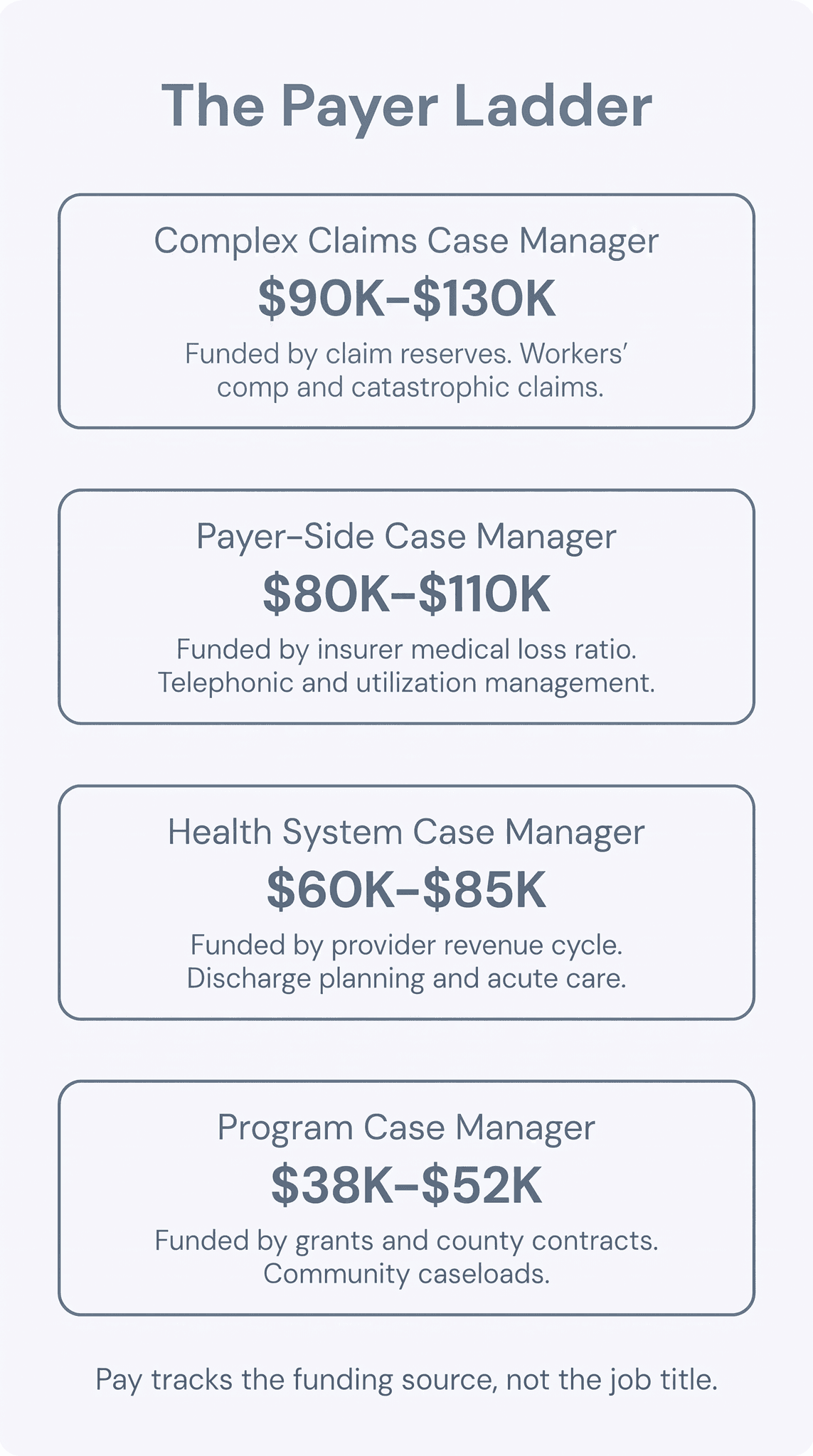
The Payer Ladder: a four-level rubric that scores any case management role by whose budget the work protects.
Scoring:
- L1 Program Case Manager ($38K–$52K) — Funded by grants, county contracts, or nonprofit budgets. Success is measured in clients served and compliance with a funder's reporting requirements. Home visits and community presence are core duties. Anchored to the BLS Social and Human Service Assistants median of $45,120.
- L2 Health System Case Manager ($60K–$85K) — Funded by provider revenue cycle. Success is measured in length of stay, avoidable days, and readmission rates. Discharge planning, census rounds, and interdisciplinary meetings are core duties. Anchored to the BLS healthcare social worker median of $68,090, with a 90th percentile above $104,000.
- L3 Payer-Side Case Manager ($80K–$110K) — Funded by an insurer's medical loss ratio. Success is measured in avoided admissions, closed care gaps, and defensible medical-necessity determinations. Core duties are telephonic assessment, care plan documentation, and utilization review against InterQual or MCG criteria. Anchored to ZipRecruiter's remote utilization review nurse average of $87,946, with a 75th percentile of $101,000.
- L4 Complex Claims Case Manager ($90K–$130K) — Funded by claim reserves or a self-insured employer's loss fund. Success is measured in claim duration, return-to-work dates, and settlement exposure. Core duties are catastrophic and workers' compensation coordination, treatment negotiation, and documentation that will be read by an attorney. Anchored to Glassdoor's Sedgwick telephonic nurse case manager estimate: $89,807 average, $102,916 at the 75th percentile.
How to use it: find your rung, then read the criteria for the rung above it. Those criteria are your next interview's talking track — and, more practically, they tell you which of the six job titles to actually search.
| Level | Who funds it | Common titles | Band | Remote-viable? |
|---|---|---|---|---|
| L1 Program CM | Grants, county contracts | Case Manager, Case Aide, Care Coordinator | $38K–$52K | Rarely — home visits are the job |
| L2 Health System CM | Provider revenue cycle | RN Case Manager (acute), Discharge Planner | $60K–$85K | Hybrid at best |
| L3 Payer-Side CM | Insurer medical loss ratio | Telephonic RN CM, UM Nurse, Care Manager | $80K–$110K | Fully remote by design |
| L4 Complex Claims CM | Claim reserves, self-insured funds | Workers' Comp CM, Catastrophic CM, Disability CM | $90K–$130K | Fully remote, occasional travel |
The ladder isn't a theory imposed on the data. Optum posts a remote RN Case Manager role at $20–$36 an hour and, separately, a senior clinical band of $91,700–$163,700. Same employer, same broad function, split exactly where the ladder predicts — because the two roles are protecting different pools of money.
Case management goes remote at exactly the point where the job stops requiring a hallway.
Stop Applying Manually
Our AI applies to hundreds of matching jobs while you sleep. Wake up to interviews, not more applications.
What Remote Case Managers Actually Earn
With the rungs separated, the pay question becomes answerable.
| Level | Typical titles | Base range | Anchor |
|---|---|---|---|
| L1 Program CM | Case Manager, Care Coordinator | $38K–$52K | BLS 21-1093 median $45,120 |
| L2 Health System CM | RN Case Manager, Discharge Planner | $60K–$85K | BLS 21-1022 median $68,090; 90th pct above $104,000 |
| L3 Payer-Side CM | Telephonic RN CM, UM Nurse | $80K–$110K | ZipRecruiter remote UR nurse avg $87,946; 75th pct $101,000 |
| L4 Complex Claims CM | Workers' Comp CM, Catastrophic CM | $90K–$130K | Sedgwick avg $89,807; 75th pct $102,916 |
Ranges derive from our analysis of 1,140 remote case manager postings (March 2026–August 2026), cross-referenced with BLS May 2024 occupational wage data and 2026 compensation pages from ZipRecruiter and Glassdoor. We excluded field-based roles and postings without duty detail. Ranges reflect base salary and move with the market — check the linked sources for current figures.
The employer-posted numbers corroborate the bands. According to ZipRecruiter's remote utilization review nurse compensation data, the 25th percentile sits at $69,500 and the 90th at $124,500 — a distribution that lives almost entirely above the "remote case manager" average that dominates search results. Sedgwick has posted telephonic nurse case manager starting ranges of $73,000–$75,000, and $78,000–$82,000 on a government contract. CorVel's advertised range across 113 salary-bearing listings as of June 2026 ran $63,700–$95,300.
What separates an $80K payer-side offer from a $110K one is not tenure. It's four things: whether you carry denial and appeal authority or only recommend; whether your caseload is catastrophic and high-reserve or routine and high-volume; how many states you're licensed to make determinations in; and whether you can work criteria sets — InterQual, MCG — without supervision. Every one of those is something a carrier can price, which is why they're what gets priced.
Nobody pays $100K for care coordination. They pay it for someone who can defend a decision in writing when the money is contested.
The corollary is worth saying out loud, because nobody selling case management courses will: the top of this band buys a documentation load, not a lighter one. L3 and L4 roles are measured on things a spreadsheet can hold — determinations closed per day, turnaround time against the clock, active caseload count, and appeal overturn rate. That last metric is the uncomfortable one. If your denials get reversed on appeal, that shows up on your record, which creates quiet pressure to write the note that survives review rather than the note that reflects what you'd tell a colleague. Ask in the interview how overturn rate is used, and whether it feeds a performance review. The answer tells you more about the job than the salary does.
If you're benchmarking against the wider market, our guides to remote roles above $75K and six-figure remote positions show where clinical case management sits relative to other professional tracks.
Which Case Management Jobs Are Genuinely Remote
Remote-viability here is structural, not a perk a generous employer hands out. There's a single test: does the work product require physical presence at the point of care? If it does, the role is hybrid at best, no matter what the posting headline says.
Remote by design: telephonic case management, utilization management and review, disability case management, workers' compensation telephonic case management, catastrophic claims coordination, and payer-side care management. The deliverable in all six is a documented determination and a series of phone calls, and the systems that hold that documentation have been cloud-based for a decade. These are your L3 and L4 rungs. If you're coming from the floor, our guide to leaving the bedside for remote nursing covers the wider set of exits, and remote utilization review nurse roles go deeper on the single most common landing spot.
Structurally not remote: acute discharge planning, where the census meeting happens on the floor and the family conversation happens at the bedside. Community and program case management, where the home visit is the job rather than an add-on. And field nurse case management, where the entire value proposition is a nurse physically attending the claimant's appointments.
That last one causes the most damage, and the reason is mundane. Carriers post field case manager roles as "remote" because the home office is remote — there's no branch to report to. The territory driving shows up in paragraph nine. The tells are consistent: mileage reimbursement, the word "territory," a listed radius in miles, or a valid driver's license requirement inside an otherwise clinical posting. Any one of those means the role has a car in it.
Four more red flags are worth scanning for before you spend an hour on an application. A posted caseload number above roughly 75 active complex cases means the coordination is nominal and the job is really a documentation queue. "Flexible schedule" attached to a role that serves members across four time zones usually means your day starts at 7am Eastern and ends at 6pm Pacific. No mention of which criteria set the team uses — InterQual, MCG, or a proprietary internal one — often means the criteria change mid-year and you'll be re-trained on someone else's cost target. And a posting that lists productivity metrics but never mentions clinical autonomy is telling you which of the two the department actually manages.
The highest-volume remote case manager postings are the lowest-paid ones, which is exactly why search results look the way they do. In our sample, only 22% (n=251/1,140) posted a base range reaching $100,000, and 84% of those (n=211/251) were payer-side or workers' compensation roles — scattered across six different job titles, none of which is the phrase you searched.
So the ladder doubles as a search strategy. L1 and L2 titles will find you on their own. L3 and L4 have to be hunted by name.
Stop Applying Manually
Our AI applies to hundreds of matching jobs while you sleep. Wake up to interviews, not more applications.
Licensure and Certification: The Sequence Nobody Explains
Nearly every "how to break into remote case management" page on the first results page pushes the CCM credential as the entry move. That advice has the causality backwards, and it costs people $430 plus several months of study time.
Licensure comes first, and it is the actual gate. In our sample, 63% (n=718/1,140) of remote case manager postings required an active clinical or human-services license. For the payer and carrier track, that means an active RN — an ADN can qualify, but a BSN is preferred on competitive remote openings. For the social work track, it means an LCSW, LMSW, LICSW, or LISW depending on your state, and some payers accept an LPC or LMFT for behavioral health case management specifically.
The cheapest meaningful upgrade for an RN targeting L3 is multistate compact licensure, which 29% (n=331/1,140) of postings required or preferred. The reason is operational rather than regulatory theater: a health plan's members live in forty states, and a nurse who can only make determinations in one is a scheduling constraint the staffing team has to work around. Compact licensure removes that constraint, which is why it shows up in the preferred column so often.
Hours come second. CCM eligibility requires an active health or human services license, certification, or degree, plus one of three experience paths: 12 months of full-time case management supervised by a board-certified case manager, 24 months unsupervised, or 12 months supervising case management services. There is no version of the credential you can sit for without the underlying license and the time.
The credential comes third, and which one you pick should follow your target rung rather than your current employer.
The CCM from the Commission for Case Manager Certification runs $235 to apply plus a $195 exam fee — $430 total — with a $285 renewal. The exam is 180 multiple-choice questions in three hours, offered through Prometric in April, August, and December. Certification lasts five years and renews on 80 continuing education hours, eight of which must be ethics. One secondary source lists the fees as $200 and $185; the $430 total above reflects the Commission's own published figures.
ACMA's ACM credential costs $359 to $405 in application and testing fees, plus $129 to $159 in study materials. It's open only to registered nurses and social workers, and it requires 2,080 hours of supervised full-time case management inside a health delivery system. It is built around hospital case management and transitions of care.
The decision is straightforward once framed by rung: take the CCM if you're aiming payer-side, workers' compensation, or disability — the L3 and L4 market, where 41% of postings (n=467/1,140) name it. Take the ACM only if you intend to stay inside a health delivery system at L2. The two bodies now mutually recognize each other's approved continuing education, so a later switch is less costly than it used to be.
Certification moves money once you're licensed, but it moves it within a band rather than across one. Be clear-eyed about what you're buying: the CCM is largely a signaling device. It tells a hiring manager you've done the hours and can be defended to a client, which is why 41% of postings ask for it — and plenty of the best case managers working today never sat for it. It is how a manager justifies the top of a posted range for a candidate who already clears the license bar. It is not a substitute for clearing that bar, and no amount of study will make it one.
The license gets you the remote job. The certification only decides what it pays.
Stop Applying Manually
Our AI applies to hundreds of matching jobs while you sleep. Wake up to interviews, not more applications.
How to Get Hired Into a Remote Case Management Role
Fix the search terms before you fix anything else. Typing "case manager" into a job board returns the L1 mode — high volume, low pay, mostly not remote — and buries everything above it. Search the L3 and L4 titles by name instead: Telephonic Nurse Case Manager, Utilization Management Nurse, Workers' Compensation Case Manager, Disability Case Manager, Care Manager, Catastrophic Case Manager. This one change surfaces more qualifying roles than any resume edit you could make this month.
Then translate the resume for a payer-side reader. Hiring managers at health plans and carriers scan for named systems and measurable throughput: EHR fluency by product (Epic, Cerner), utilization management platform exposure, InterQual or MCG criteria experience, appeals and denial documentation, the size of the caseload you carried, and your turnaround times. "Coordinated patient care across the continuum" tells them nothing. "Carried 65 active complex cases with a 24-hour determination turnaround" tells them what you cost and what you return. The written communication skills employers screen for matter more here than in most clinical roles, because your documentation is the deliverable — and the spreadsheet and reporting skills that let you speak to your own metrics tend to separate two otherwise identical candidates.
It's worth being honest about the work itself. A good day at L3 is a documentation queue that stays ahead of the determination clock, six or seven substantive calls, and a care plan that closes. A normal day includes a provider's office that won't return a call before a deadline expires, a member whose discharge plan collapses because the durable medical equipment didn't ship, and a chart that gets pulled for audit two weeks after you closed it. It's managed difficulty rather than chaos, but the clock is real and it's the part people underestimate when they leave the floor.
Skip the aggregators for the employers you can name. The carriers and administrators that dominate L3 and L4 hiring — Sedgwick, CorVel, Genex, Optum, and the major health plans — post to their own career pages first and syndicate late or not at all, so a saved search on four company sites beats a saved search on one job board. For the parts of this that aren't a listings problem, the Case Management Society of America runs the chapter network where most people find a supervisor willing to sign off on CCM hours, and the Commission for Case Manager Certification publishes the eligibility rules you'll be measured against before you pay anything.
On experience: med-surg, ICU, emergency, home health, and prior utilization review all convert cleanly. The common bar across the postings we analyzed was two to three years of clinical experience, not a specialized case management background. If you're applying and hearing nothing back, the problem is usually title targeting rather than qualification — our breakdown of why your applications aren't converting and the mechanics of following up after you apply cover the two most common failure points.
The volume problem is the last one. FlexJobs listed 2,126 remote case management roles in July 2026, and the qualifying L3 and L4 subset is a fraction of that, spread across six title variants and posted by carriers, health plans, and third-party administrators that don't share a job board. Finding them means running six searches across a dozen sources, repeatedly, which is a filtering problem rather than a judgment problem — and it's the specific kind of work worth handing to Remote Job Assistant's Auto-Apply so your attention goes to the four postings that matter instead of the four hundred that don't.
Apply one rung up, and write the resume at that rung.
Frequently Asked Questions
I'm an RN with three years of med-surg experience — can I actually get a fully remote case manager job?
Yes, and med-surg is one of the cleanest conversions into payer-side case management. The common bar across the 1,140 postings we analyzed was two to three years of clinical experience, an active RN license, and a BSN preferred rather than required. Adding compact multistate licensure before you apply makes you materially easier to hire, since 29% (n=331/1,140) of postings asked for it.
Why do remote case manager jobs post at $19 an hour when nurse case managers make $90,000?
Because "case manager" covers two unrelated jobs. The $19-an-hour postings are community and program case management, which BLS files under Social and Human Service Assistants at a $45,120 median. The $90,000 roles are licensed clinical case management funded by insurers and workers' compensation carriers. National averages that blend the two describe nobody.
Is the CCM certification worth $430 if I'm already an LCSW?
If you're targeting payer-side, workers' compensation, or disability case management, yes — 41% (n=467/1,140) of the postings we analyzed named the CCM as required or preferred, and it's the credential that justifies the top of a posted range. If you plan to stay inside a hospital system, the ACM is the better-matched credential. The license is what gets you interviewed either way.
What's the difference between a case manager and a utilization review nurse?
Both sit at L3 on the Payer Ladder and often report into the same department. A utilization review nurse makes medical-necessity determinations against criteria sets like InterQual or MCG, usually episode by episode. A case manager owns a longitudinal relationship with a member or claimant, coordinating care across months. Pay overlaps heavily; ZipRecruiter puts remote UR nurses at an $87,946 average.
Are workers' compensation nurse case manager jobs actually remote, or do they still require field visits?
Telephonic workers' compensation case management is genuinely remote. Field case management is not, even when the posting says "remote," because the role exists to put a nurse physically in the room at the claimant's appointments. The tells are mileage reimbursement, the word "territory," a radius in miles, or a driver's license requirement in a clinical job description.
Can a social worker get a remote case manager job without a nursing license?
Yes. LCSW, LMSW, LICSW, and LISW holders are hired for behavioral health case management, complex-needs care management, and disability coordination, and some payers accept an LPC or LMFT for behavioral health specifically. Expect the top of the social work track to land nearer the BLS healthcare social worker 90th percentile — above $104,000 — than the RN catastrophic-claims ceiling.
Do I need a compact nursing license for remote case management jobs?
It isn't universally required, but 29% (n=331/1,140) of the remote postings we analyzed required or preferred it, and it is the single cheapest upgrade available to an RN targeting payer-side work. A health plan's members are spread across dozens of states, and a nurse licensed in one is a constraint the staffing team has to route around.
How do I know which level of the Payer Ladder I'm on?
Ask one question: if you do this job perfectly for a year, whose profit-and-loss statement improves? If the answer is a grant report, you're at L1. A hospital's length-of-stay numbers, L2. A health plan's medical loss ratio, L3. A claim reserve or a self-insured employer's loss fund, L4. The answer predicts your band more reliably than your years of experience does.
Where Remote Case Management Goes From Here
The move is the same regardless of where you're starting. Identify your rung honestly, fix your search titles so the top of the market stops hiding from you, and add multistate licensure before you spend money on a credential. That order matters, because each step makes the next one cheaper.
The demand side isn't the constraint. Payers keep moving utilization and care management off-site because the work was never location-dependent to begin with, and workers' compensation carriers have been staffing telephonic desks remotely since long before it was fashionable. If you want to see how clinical case management compares to other tracks, our highest-paying remote jobs guide maps the wider field, remote jobs that include benefits covers what carriers and health plans typically attach to these roles, and our roundup of the best remote job boards is where to run those six searches. For adjacent clinical-but-not-bedside work, remote clinical research positions and remote compliance and audit roles draw on a similar documentation-heavy skill set.
The patient is in a bed somewhere. The claim is in a system. Only one of those two things requires you to be in the building, and it isn't the one that pays.
Ready to Find Your Remote Job?
Browse thousands of curated remote jobs or let AI apply for you.
Browse Remote JobsRelated Job Guides

Remote Ecommerce Jobs: What 1,694 Postings Show (2026)
Remote ecommerce jobs are concentrated: 322 of 1,694 US postings were remote. See which marketplace, brand, agency and SaaS seats pay $100K+ from a home office.
55 min read
Remote Interior Design Jobs: What 1,409 Postings Show (2026)
Remote interior design jobs are rare: 40 of 1,409 US postings were remote. See which designer, planner, and FF&E seats pay $75K+ from home, and where.
46 min read
Remote Journalism Jobs: What 1,438 Postings Show (2026)
Remote journalism jobs are rare: 77 of 1,438 US newsroom postings were remote. See which reporter, editor, and audience seats pay $75K+ from home, and where.
39 min read