
Last reviewed: October 2026
You've run open enrollment with three carriers, a broker and a payroll file that drops dependents every November. You know the difference between a qualifying life event and an employee who forgot to enroll, and you can explain an HSA to a new hire in four sentences. None of that needs an office. So you search "remote benefits specialist jobs," and the first screen mixes Medicare sales seats, claims desks, patient insurance verification and "benefits representative" ads from insurance agencies in with the HR jobs you meant.
Here's what that screen hides. Real remote benefits seats exist, but the most remote ones pay like call centers, and the ones that pay $75K or more are described by what they touch, not by their title. A "Senior Benefits Administrator" who runs stop-loss renewals out-earns a "Benefits Specialist" who keys enrollment changes, and the posting tells you which one it is in the first ten lines.
Get Remote Job Tips in Your Inbox
Weekly strategies, salary data, and new opportunities
Unsubscribe anytime. No spam.
We analyzed 1,523 US employee-benefits job postings across 1,154 employers, first listed between January and October 2026. This guide shows where the 131 fully remote ones are, which employers keep benefits work remote, what each kind of seat pays, and the one score that predicts whether a posting clears $75K.
Yes, benefits specialists work remotely, but less often than the search results suggest: 131 of the 644 postings that state a work model (20.3%) are fully remote, and 362 are hybrid. Benefits administrators (TPAs, PEOs and benefits platforms) keep 18 of 35 stating seats remote at a $70,000 median. Employer HR teams keep 68 of 386 remote, and those remote seats post a $95,000 median. Postings that name four or more plan-money duties post a median of about $114K, with 157 of 172 ranges at $75K or more.
Here's the data behind that answer, each number with its denominator.
Based on 1,523 US employee-benefits postings at 1,154 employers (January to October 2026):
- 131 of 644 postings that state a work model are fully remote (20.3%); 362 are hybrid and 139 on site, and 879 of the 1,523 never say
- 98 of 609 are fully remote (16.1%) once you drop postings we found only through searches with "remote" in them
- 18 of 35 stating seats at benefits administrators are fully remote (51.4%), against 68 of 386 in employer HR (17.6%) and 30 of 154 at brokers (19.5%)
- $85,000 median posted pay (n=609; middle half $67,500 to $112,500); 386 of 609 midpoints (63.4%) reach $75K, and 116 of 609 ranges are hourly
- $70,000 vs $113,525: median pay for postings that name 0-1 plan-money duties (n=220) vs 4-6 (n=172)
- 82 look-alike listings (insurance-agency recruiting, claims desks, patient verification, public benefits) kept out of every count
- 11 of 11 postings marked temporary or seasonal in the title or job type were first listed in October 2026, and all 8 that print pay are hourly
How We Collected This Data
Start with what we couldn't see. Indeed, Glassdoor and ZipRecruiter block automated reads, and LinkedIn's public search ignores its own remote filter. More than half the postings (879 of 1,523) never state a work model. A silent posting isn't a remote posting, so every share in this guide is given of the postings that state one.
The postings come from four places, pulled on October 25, 2026: LinkedIn's public job search (825 result pages across 31 searches, 3,348 cards, 1,507 job pages read), SimplyHired, which carries the Indeed network's listings (36 searches, 4,409 cards, 481 job pages read), 744 employer career sites on Workday, and 2,893 Greenhouse, Lever, Ashby and SmartRecruiters boards. The same requisition posted on several boards or in several cities counts once, which collapsed 306 copies.
We kept benefits specialist, analyst, administrator, coordinator, manager and director titles, employee-benefits account managers, account executives and consultants at brokers, and HRIS-benefits and benefits-operations seats. We set aside 195 side titles (leave, total rewards and retirement-plan administration without a benefits noun), 82 look-alikes, 95 postings outside the US, 36 first listed before 2026, aggregator reposts, AI-training gigs and internships.
Then we read every posting the first pass called remote or remote-optional, 186 in all, and fixed about 25 misreads. A South Carolina posting says it's "an in-office role and not a telecommute or remote position," then lists telecommuting as a benefit "available to employees of some state agencies." A benefits administrator's postings say "There may be opportunities for remote work on all jobs posted," which describes a policy, not the seat. A union's posting says "Partial remote work opportunities are available after six months of service," which is hybrid.
Our own first pass made mistakes too, and they're worth knowing because job boards make the same ones. New York Life's in-house benefits seats landed in the sales pile because the company name matched our insurance-agency list. A "Senior Actuary (FSA)" posting counted as benefits work because FSA also means flexible spending account. LinkedIn files plenty of ordinary employers under "Human Resources Services," which made an office-supply retailer's benefits analyst look like an outsourcer until we read the posting. We fixed each by hand.
Each posting also gets a desk: the employer's own HR team, a broker or consultant, a benefits administrator, an insurer's client team, or a staffing agency. A broker's or insurer's own internal benefits seat counts as employer HR. Pay uses posted ranges only (609 of 1,523 publish one), at midpoints, with hourly ranges annualized at 2,080 hours. Read any single median as give or take a few thousand dollars, because a dozen postings can move it; the gaps between bands are much wider than that, and they're what this guide leans on. We update this analysis quarterly.
The Plan Money Score: What Your Seat Touches Sets the Pay
The Plan Money Score counts how many of six plan-money duties a benefits posting names, from 0 to 6. The six are renewals and plan design; funding and claims cost (self-funded plans, stop-loss, claims experience); compliance filings and testing (ACA reporting, Form 5500, ERISA, nondiscrimination testing); data tools beyond basic Excel; vendor and carrier ownership (selection, negotiation, performance); and strategy or budget.
Why it works: in most large plans, the employer is the insurer. According to the KFF 2025 Employer Health Benefits Survey, 67% of covered workers are in self-funded plans, 80% at firms with 200 or more workers, and the average family premium reached $26,993. When the company pays claims out of its own account, the renewal, the stop-loss contract and the TPA fee are its own money. At $26,993 a year for every family on the plan, the person who reads those numbers is protecting real money, and the seat is priced that way. The person who keys enrollment changes is doing necessary operations work, and that seat is priced like operations.
Here's the scored rubric, using the middle half of posted pay for each band:
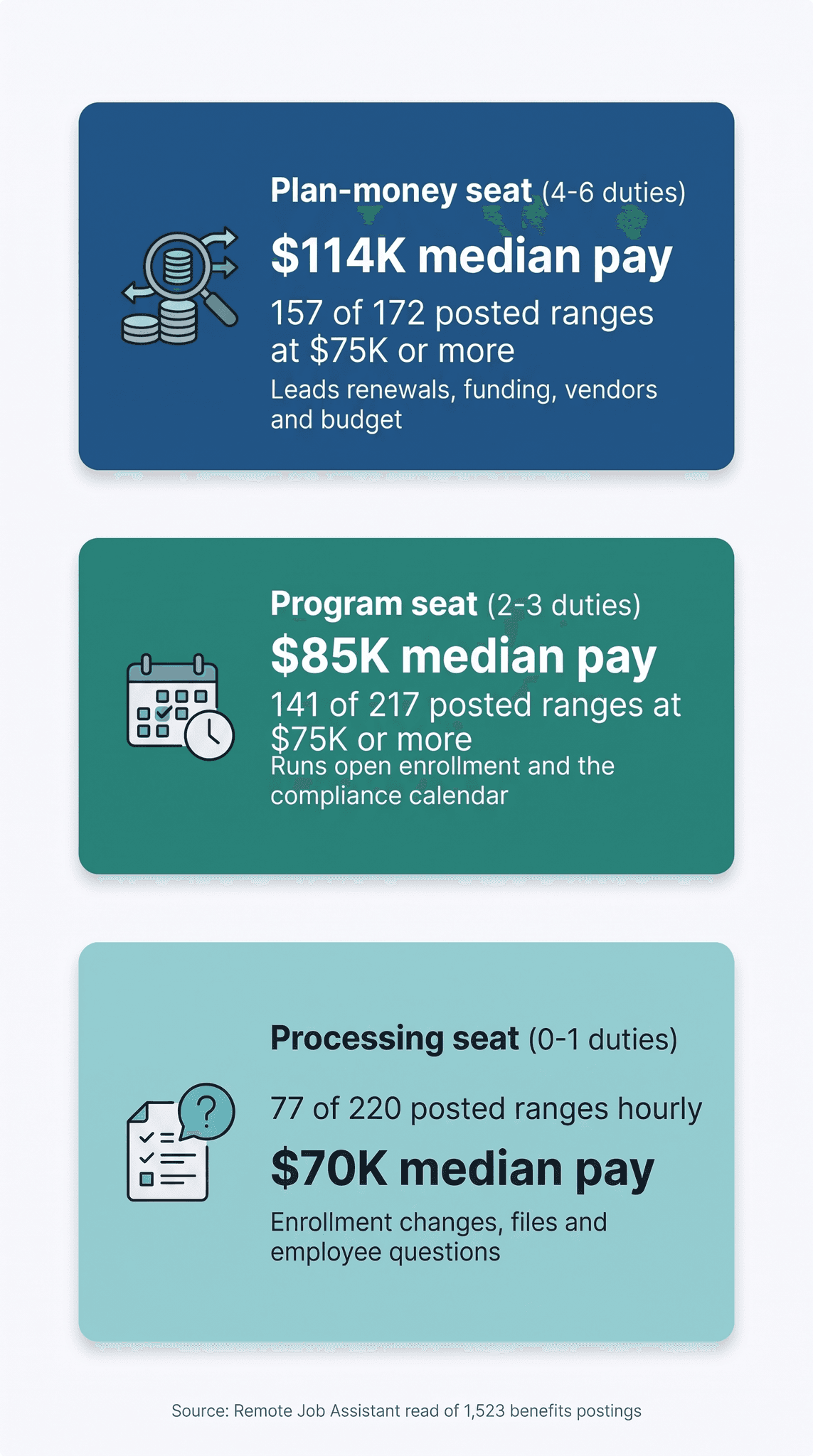
Processing seat (score 0-1): $60K to $85K, median $70K (n=220). Enrollment changes, eligibility and carrier files, deduction audits, invoices, employee or participant questions. No renewal, funding or vendor language in the posting. Hourly on 77 of 220 posted ranges. 518 postings.
Program seat (score 2-3): $70K to $108K, median $85K (n=217). Runs open enrollment end to end, owns the compliance calendar (ACA, COBRA, 5500 support), coordinates carriers and the broker, does some reporting. 141 of 217 ranges reach $75K. 537 postings.
Plan-money seat (score 4-6): $91K to $146K, median about $114K (n=172). Leads renewals, reads claims and stop-loss reports, models funding, negotiates with carriers and TPAs, owns a budget. 157 of 172 ranges reach $75K, and only 7 are hourly. 468 postings.
The full split, score by score:
| Plan Money Score | Postings | Posted median (n) | $75K+ midpoints | Fully remote of stating | Hourly ranges |
|---|---|---|---|---|---|
| 0 | 216 | $64,501 (92) | 29 of 92 | 16 of 81 | 44 of 92 |
| 1 | 303 | $73,000 (129) | 59 of 129 | 28 of 130 | 33 of 129 |
| 2 | 277 | $75,000 (116) | 61 of 116 | 26 of 112 | 21 of 116 |
| 3 | 260 | $92,500 (101) | 80 of 101 | 19 of 120 | 11 of 101 |
| 4 | 223 | $104,625 (78) | 69 of 78 | 19 of 94 | 6 of 78 |
| 5 | 173 | $116,125 (74) | 68 of 74 | 19 of 81 | 1 of 74 |
| 6 | 72 | $149,000 (20) | 20 of 20 | 5 of 27 | 0 of 20 |
It isn't just seniority wearing a costume. Inside the same title level the score still moves pay: mid-level titles post about $67K at 0-1 (n=162), $75K at 2-3 (n=119) and $86K at 4-6 (n=44). Senior titles go from about $76K to $95K to $106K. And remote odds barely change across the bands (20.5%, 19.4% and 21.3% of stating postings), so a higher score doesn't cost you the remote seat.
The titles lie in both directions. Of 91 administrator-titled postings, 50 score 0-1, but 15 score 4 or more. Of 395 specialist-titled postings, 47 score 4 or more, at an $85,000 median. Tebra's remote "Senior Benefits Administrator" posts $90,000 to $103,000, and the duties include "Coordinate stop-loss policy renewals, track claims reaching individual/aggregate stop-loss thresholds, and submit reimbursement filings to carriers." Parallel ENT & Allergy's remote benefits manager seat ($85,000 to $105,000) asks you to "review renewal projections and carrier reporting to find cost drivers and savings opportunities." Conduent's remote pension-services seat posts $16 an hour and says you "will primarily handle inbound telephone calls."
Single duties, ranked by the gap between postings that name them and postings that don't: funding and claims cost ($113K vs $78K, 383 postings), vendor ownership ($108K vs $73K), strategy or budget ($107K vs $74K), renewals ($98K vs $74K), data tools ($93K vs $80K) and compliance ($88K vs $80K).
How to use it: count the duties in a posting before you apply, then count the ones you've actually owned in your last renewal cycle. A 0-1 posting at $70K is priced correctly. A 4-6 posting with "specialist" in the title is a plan-money seat with a modest name, and it's the one to go after. Rewrite your resume bullets around the duties you've owned, with numbers attached ("ran the stop-loss reconciliation on a $14M self-funded plan" beats "supported renewals").
In benefits, the title tells you the work. The plan money in the posting tells you the pay.
If you're applying to 4-6 seats across 1,154 employers' career sites, the hard part is finding them before they close, not writing the cover letter.
Stop Applying Manually
Our AI applies to hundreds of matching jobs while you sleep. Wake up to interviews, not more applications.
Who Hires Remote Benefits Specialists: The Desk Sets the Odds
The score sets the pay. Who the seat serves sets the remote odds. Here are the five desks:
| Desk | Postings (employers) | Fully remote of stating | Posted median (n) | Hourly ranges |
|---|---|---|---|---|
| Employer HR (the company that offers the plan) | 1,015 (923) | 68 of 386 (17.6%) | $85,000 (382) | 73 of 382 |
| Broker or consultant | 305 (111) | 30 of 154 (19.5%) | $83,250 (124) | 15 of 124 |
| Benefits administrator (TPA, outsourcer, PEO, platform) | 51 (33) | 18 of 35 (51.4%) | $70,000 (25) | 9 of 25 |
| Staffing agency | 133 (86) | 11 of 59 (18.6%) | $80,000 (68) | 17 of 68 |
| Insurer client teams | 19 (15) | 4 of 10 | $100,000 (10) | 1 of 10 |
Employer HR is most of the market: 1,015 postings at 923 employers, remote in 68 of 386 stating postings. Those 68 remote seats post a $95,000 median (n=39), and 30 of the 39 ranges reach $75K. They cluster at companies that are distributed themselves. LaunchDarkly's remote Senior Benefits Manager posts $136,000 to $187,000. Armada's remote Benefits Manager posts $109,210 to $136,600, and HighLevel's Benefits Operations Manager $105,000 to $132,000. The odds drop fast inside institutions: health systems keep 14 of 63 stating seats remote, education 1 of 17 and government 0 of 18.
Brokers and consultants posted 305 seats at 111 firms, and they're hybrid shops: 108 of 154 stating postings are hybrid, 30 fully remote. "Hybrid schedule required — 3 days per week in the office," as one broker puts it. Remote broker seats post a $77,500 median (n=22), and some are remote only for now. A Houston broker's senior account manager posting says the role "is intended to transition from fully remote to hybrid in the future," and the hire "must reside within a reasonable commuting distance of Houston." Brokers also gate on a license: 186 of the 305 postings name a life and health insurance license, often with a deadline (Acrisure and Alliant: within 90 days of hire; USI: within 4 months).
Benefits administrators are the most remote desk and the lowest-paid one: 18 of 35 stating seats remote, a $70,000 median (n=25) and 9 of 25 ranges hourly. Conduent's remote participant and pension service seats post $16 an hour. Businessolver's remote Employee Benefits Advocate posts $20 an hour "taking calls regarding employee benefit enrollment," and the next sentence is the one to read: "This is an inbound call center environment with operating hours from Monday - Friday, 7 AM - 7 PM CST." That isn't one odd posting. 4 of the 18 remote administrator seats describe inbound calls, handle times or productivity targets, against 1 of the 68 remote employer-HR seats. The administrator seats that pay are client-facing: WEX's manager of client services for benefits administration outsourcing posts $92,400 to $116,100 remote, and Rippling's benefits implementation specialist $71,400 to $113,050.
Before you take a remote administrator seat, run three checks. Does the first block of duties talk about calls, queues or handle time? Is the pay hourly? Does the company also post client-services or implementation seats (WEX and Rippling do) that you could move into within a year? Two yeses on the first two and a no on the third mean you'd be trading pay for the commute.
Why the desks split this way: an administrator's unit of work is the participant call and the file feed, which centralize well and run from anywhere. A broker's unit of work is the renewal meeting and the client relationship, which brokers want people in the office for. An employer's HR seat goes remote when the company itself is distributed, and stays in the building when the company does.
The most remote benefits seats are service desks. The best-paid remote seats sit inside HR teams that own a self-funded plan.
Our read, from those counts: for a benefits pro already near $70K, a remote seat at a benefits administrator is usually a pay cut dressed as flexibility. The remote administrator seats post a median of about $68K (n=14), and the processing-band seats there about $56K (n=11). Take the remote seat that comes with a renewal, not the one that comes with a call queue.
Look-Alike Listings: Five Jobs That Share the Title
The title "benefits specialist" belongs to at least five jobs, and job boards can't tell them apart. We ran the search most readers run, "benefits specialist" in "remote" on SimplyHired (Indeed's network), on October 25, 2026. Of the 272 unique results, 70 were employee-benefits seats. Another 29 were leave, total-rewards or retirement-plan titles, 21 were look-alikes, 10 were ads with "benefits" in the title ("...with full benefits"), 11 were other jobs with a benefits word (engineers, lawyers, product managers), and 131 had no benefits word in the title at all.
Search demand shows the same tangle. In Ahrefs' October 2026 US data, "remote benefits specialist jobs" draws about 250 searches a month. Queries naming insurance-agency offices draw more: "ln group of sc benefits specialist" (300), "ao team of va benefits specialist" (300), "sellors group of dallas benefits specialist" (250), "cma partners benefits specialist" (350). So does "cvs claims benefits specialist" (350).
Here's how to tell them apart from the posting text:
Insurance-agency and sales recruiting. The posting describes life, accident or supplemental coverage for union or association members, promises "full training provided," and says experience is "helpful but not required." American Income Life's remote "Benefits Specialist" postings describe partnering "with labor unions, credit unions, associations, and their members to provide life, accident, and supplemental health benefits" and explaining options "using our guided needs-analysis system." A Globe Life Liberty National division office's ad for an "EMPLOYEE BENEFITS SPECIALIST" calls it an "ENTRY LEVEL MANAGEMENT position" with "weekly in-office agency training." WTW's Medicare "Licensed Benefit Advisor" posting says plainly that it's "a consultative sales role," at $21 an hour, temporary.
Claims and member service. Adjudication and claim-processing language. CVS Health's "Senior Claims Benefit Specialist" asks for "2+ years medical claim processing experience" and posts $18.50 to $42.35 an hour.
Patient benefits verification. Patients, payers, prior authorizations and specialty pharmacy. This is revenue-cycle work at clinics, hospitals and pharma hubs.
Public benefits. Eligibility for SNAP or Medicaid, or work-incentive counseling. Kansas's KanCare "Benefits Specialists" page sits in Google's AI overview for "benefits specialist."
Benefits sales. Producer, new business, quota. These are real benefits-industry jobs (24 in our pull, $127,500 median, n=10), but they're sales, not plan administration.
Across the full pull, we set aside 82 unique look-alikes: 21 agency or sales-recruiting ads, 24 benefits sales seats, 13 claims and member-service desks, 12 patient-verification seats and 13 public-benefits roles.
In that literal search, 57 of the 70 real benefits seats carried Indeed's remote tag, but so did 233 of all 272 results. The board's remote count is inflated by jobs you don't want. If the first three duties in a posting are inbound calls, handle time and scripts, it's a call-center job with a benefits title. Close the tab.
What Remote Benefits Specialists Earn
The posted median across all 1,523 postings is $85,000 (n=609), with the middle half between $67,500 and $112,500. For the whole occupation, the BLS Occupational Outlook Handbook puts compensation, benefits, and job analysis specialists at a $78,210 median in May 2025, with the top 10% above $128,920. That's the same series O*NET publishes as 13-1141, which lists Benefits Specialist and Benefits Analyst as sample titles.
Pay figures come from the 609 postings that print a range, at their midpoints, with hourly ranges annualized at 2,080 hours. Postings with a range skew toward pay-transparency states and larger employers, so treat these as posted asking prices. Ranges move with the market, so check current postings before a negotiation.
Remote isn't the low-paid seat in general. Remote postings with pay post an $80,000 median (n=87), hybrid $88,400 (n=173) and on site $83,200 (n=66). The low-paid remote seat is the administrator service desk.
The title word still tells you the floor:
| Title word | Postings | Fully remote of stating | Posted median (n) |
|---|---|---|---|
| Coordinator | 109 | 8 of 29 | $58,422 (42) |
| Administrator | 91 | 13 of 43 | $70,000 (43) |
| Specialist | 395 | 29 of 155 | $72,383 (162) |
| Analyst | 209 | 17 of 87 | $84,500 (66) |
| Account manager or executive (brokers) | 158 | 21 of 76 | $88,875 (67) |
| Manager | 421 | 37 of 178 | $105,000 (163) |
| Consultant | 78 | 8 of 42 | $107,500 (43) |
| Director, head or VP | 98 | 8 of 48 | $175,250 (35) |
Skills move pay too. Postings that name self-funded plans or stop-loss post about $107K against $80K for those that don't (277 postings). Vendor management: $109K vs $77K. ERISA: $98K vs $77K. Workday: $94K vs $83K. Global or international benefits: $145K (n=51). Excel is the exception. Postings that name it post about $81K against $88K for those that don't, because Excel shows up in every processing seat. It's a floor, not a lever.
How to Move From a $65K Processing Seat to $90K+
Where you start decides the first move. Pick the line that describes your current seat:
- You answer participant calls at an administrator (score 0-1). Move desk before you chase a title. The administrator desk posts a $70,000 median, and employer HR program seats (score 2-3) post about $86K (n=123). An in-house specialist seat or a broker account seat is the step, even if it's hybrid for a year.
- You run open enrollment for an employer (score 2-3). Take one plan-money duty before you move: ask the broker to walk you through the renewal analysis, then own the stop-loss reconciliation or the claims report next cycle. Funding and claims cost is the duty with the biggest gap ($113K vs $78K). Employer HR postings that score 4-6 post about $119K (n=111), and 30 of 131 stating seats are remote.
- You're a broker account manager. Your renewals already count. The $100K seats are senior broker roles (broker postings that score 4-6 post about $101K, n=45) or the employer side, where the same renewal work posts about $119K with better remote odds (30 of 131 stating seats vs 8 of 54 at brokers).
- You already read claims and stop-loss reports. You're a plan-money candidate now. Target manager titles ($118,000 median, n=118) and global benefits seats ($145,000, n=51), and lead your resume with the plan's size and what you changed at renewal.
Credentials are a tie-breaker, not a gate. CEBS appears in 320 of the 1,523 postings, and those post a median of about $102K (n=118), but 162 of the 320 call it preferred and only 14 require it. The IFEBP's CEBS designation takes five required courses drawn from its group benefits and retirement plans curricula. WorldatWork's CBP appears in 91. The BLS says certification isn't required, so treat a credential as proof of the plan-money work, not a substitute for it. Our guide to certifications for remote jobs compares the options, and BenefitsLink runs message boards for questions about "benefit plan compliance, administration and design."
Experience isn't the gate you'd expect: of the 1,084 postings that state years, the median asks for 4, and 532 ask for 1-3. The gate is the duties. If your next step is a total-rewards seat, our remote people operations guide covers it, and the remote payroll guide covers the payroll-and-benefits combination seats.
Is the medical plan self-funded, level-funded or fully insured? Who leads the renewal, and do you see the claims report? How many carriers and vendors would you own? Is remote the seat's model or an exception, and is there a state list?
Those four answers tell you the score of the seat behind the posting.
Stop Applying Manually
Our AI applies to hundreds of matching jobs while you sleep. Wake up to interviews, not more applications.
Open Enrollment Temps, Licenses and Other Small Print
The posting usually tells you the catch, if you know where to look:
If the title or job type says temporary or seasonal, it ends with open enrollment. All 11 such postings in our pull were first listed in October 2026, and all 8 that print pay are hourly, from $19.79 to $45 an hour. Gallagher's remote "Client Associate - Employee Benefits (TEMP)" posts $25 an hour.
If the posting says "data entry" or "high-volume," it's almost always a processing seat. "Data entry" appears in 50 of 518 processing-band postings and 6 of 468 plan-money postings, and "high-volume" in 35 against 12.
If it's a broker seat, expect a life and health license requirement, often within 90 days to 6 months of hire.
If remote comes with a state list or a time zone, check it before you apply. 10 of the 131 remote seats limit where you live (Rover: "FL, GA, ID, NC, TX, WA & MI") and 11 name a time zone.
If the posting says remote work "may be possible for all jobs posted," that's company policy text, not a remote seat.
If the title says administrator but the body says stop-loss, renewal or funding, price it as a plan-money seat.
Open enrollment hires temps. Renewals hire careers. The October wave is real, and it's hourly work at employers, brokers and staffing agencies that ends when enrollment closes. The renewal seats are posted all year.
If you're done sorting temps from careers by hand, let the application side run itself.
Stop Applying Manually
Our AI applies to hundreds of matching jobs while you sleep. Wake up to interviews, not more applications.
Frequently Asked Questions
Can a benefits specialist work fully remote, and which employers actually allow it?
Yes, in about one in five postings that state a work model: 131 of 644 (20.3%). Benefits administrators are the most remote desk (18 of 35 stating seats), but they pay a $70,000 median. Employer HR teams keep 68 of 386 seats remote, and those remote seats post $95,000. Brokers are mostly hybrid: 108 of 154 stating postings.
Why are so many "remote benefits specialist" listings sales or call-center jobs?
Because five different jobs share the title. In a literal SimplyHired search for "benefits specialist" in "remote," 70 of 272 results were employee-benefits seats. The rest included insurance-agency recruiting, claims desks, patient verification, public-benefits roles and ads that just mention benefits.
I'm a benefits specialist making about $65K. What gets me to $90K or more?
Plan-money duties, not years. Mid-level titles that name 4-6 plan-money duties post about $86K, and senior titles about $106K, against $67K and $76K for 0-1. Take ownership of a renewal analysis, stop-loss reconciliation or vendor RFP, then move to an employer HR team or a broker account seat.
How do I use the Plan Money Score on a job posting?
Count six duties: renewals and plan design, funding and claims cost, compliance filings and testing, data tools beyond Excel, vendor ownership, and strategy or budget. A score of 0-1 is a processing seat ($70,000 median), 2-3 a program seat ($85,000) and 4-6 a plan-money seat (about $114K, with 157 of 172 ranges at $75K or more).
Is CEBS worth it for remote benefits jobs?
It helps as a tie-breaker. CEBS appears in 320 of 1,523 postings, which post a median of about $102K where they print pay (n=118), but 162 of those 320 call it preferred and only 14 require it. The designation takes five courses, and the duties you've owned matter more to the posting than the letters.
What's the difference between a benefits specialist and a benefits analyst in pay?
About $12K at the median: specialist titles post about $72K (n=162) and analyst titles about $85K (n=66). The duties matter more than the word, though. A specialist posting that names renewals, funding and vendor work outscores an analyst posting that only names reporting.
Should I take a seasonal open enrollment job to break into remote benefits?
Only as a bridge. All 11 postings marked temporary or seasonal in our pull were first listed in October 2026, and all 8 that print pay are hourly, from $19.79 to $45 an hour. Our read: take one if it puts a carrier system and an enrollment cycle on your resume, then aim for a program seat.
Find Remote Benefits Specialist Jobs
Start with the employer HR teams that keep benefits remote. Browse current remote HR jobs and the wider HR and recruiting category, filter for remote jobs paying $75K or more or $100K or more, and read our remote HR jobs guide for the roles next to this one. If you came here for jobs that come with good benefits rather than jobs running them, our remote jobs with benefits guide is the one you want. Claims and insurer seats belong in our remote insurance jobs guide and claims adjuster guide. And if you'd rather not check 1,154 career sites by hand, Auto-Apply sends your application to the plan-money seats that match.
Every benefits seat touches the plan. The ones that pay are the ones that touch its money.
Ready to Find Your Remote Job?
Browse thousands of curated remote jobs or let AI apply for you.
Browse Remote JobsRelated Job Guides
Remote Auditor Jobs: 554 of 3,422 Postings Are Fully Remote
We read 3,422 auditor job postings. 554 are fully remote, and 244 of those are healthcare audits. See which audit seats hire remotely and what each pays.
27 min read
Remote Loan Processor Jobs: 49 of 490 Are Fully Remote
We read 490 loan processor postings. 49 are fully remote, most at non-bank lenders. See who pays hourly, who pays per file, and where $75K processor pay starts.
24 min read
Remote Treasury Jobs: Only 69 of 1,485 Are Fully Remote
We read 1,485 treasury postings and 69 say fully remote. See which of four treasury desks hire remotely, what each pays, and the small print on remote seats.
26 min read