
Last reviewed: September 2026
You've run a $3 million program, closed a six-figure foundation grant, or kept a 40-person organization's books clean through an audit. Then you search "remote nonprofit jobs" and get the same thing everyone gets: an Idealist page, a LinkedIn count that means nothing, and a Reddit thread where half the replies are "good luck." Nobody tells you which nonprofit roles actually pay $75K or more remotely, or why the posting you liked lists eighteen specific states and yours isn't one of them.
Here's what the boards won't say: nonprofit pay is not a mystery to be discovered in a third-round interview. It's public record. Every nonprofit that pays anyone $100,000 or more discloses it, by name and title, on a tax form you can read in twenty minutes. And whether a remote nonprofit job is real for you is decided by three mechanics that almost no guide explains: whether the organization is registered as an employer in your state, whether pay is set on the organization's location or yours, and whether the role is funded by general operating money or a grant with an end date.
Get Remote Job Tips in Your Inbox
Weekly strategies, salary data, and new opportunities
Unsubscribe anytime. No spam.
This guide covers all of it, with numbers. We analyzed 114 remote nonprofit job postings across 47 organizations, pulled from Greenhouse, Workable, SmartRecruiters, and Idealist between July and September 2026, and cross-referenced posted pay against Bureau of Labor Statistics wage data, the Association of Fundraising Professionals' compensation report, and Candid's analysis of Form 990 filings.
Based on our analysis of 114 remote nonprofit postings across 47 organizations (July–September 2026):
- 77% (n=88 of 114) published a salary figure or range in the posting
- 91% (n=80 of 88) of postings with pay had a range floor of $75K or higher; 40% (n=35 of 88) had range midpoints of $150K or higher
- 33% (n=38 of 114) were tech, data, or product roles; 18% (n=21 of 114) were fundraising and development; 12% (n=14 of 114) were finance, operations, or people roles
- 19% of nonprofit postings on Idealist were fully remote and 38% hybrid (n=45,891 postings, August 2022–June 2023, per the National Council of Nonprofits), yet remote postings drew roughly 9x the applications of onsite ones
- 73% of nonprofit positions were paid on the employer's location rather than the employee's (n=13,619 salary submissions, same dataset)
- $125,470 median for fundraising managers and $72,550 for fundraisers, per 2025 BLS wage data (via O*NET)
- $87,672 median US fundraiser salary in 2024, up 5.6% from $83,000, per the AFP 2025 Compensation and Benefits Report
How We Collected This Data
The figures in this post come from our review of 114 remote nonprofit job postings collected between July 2026 and September 2026. Postings were sourced from the public Greenhouse boards of 11 nonprofits (GiveDirectly, Wikimedia Foundation, Khan Academy, Code for America, GiveWell, DonorsChoose, Teach For All, Thorn, ProPublica, ActBlue, and Recidiviz), Workable's global job search for 17 more (including Zearn, ClimateWorks Foundation, Evidence Action, Echoing Green, and PowerLines), SmartRecruiters for four (including Oxfam America and World Wildlife Fund), and the first page of Idealist's remote listings. We kept only US remote-eligible positions and excluded volunteer roles, internships, short-term contracts, and roles restricted to non-US locations.
Posted pay was cross-referenced against BLS Occupational Employment and Wage Statistics for May 2025 (accessed through O*NET), the AFP 2025 Compensation and Benefits Report, Candid's 2025 Nonprofit Compensation Report (built from fiscal-year 2023 Forms 990), and the National Council of Nonprofits' analysis of Idealist posting data. Where we cite Salary.com, ZipRecruiter, or PayScale, those are their published aggregate pages, and we treat them as secondary.
Two honest caveats. Our sample skews toward nonprofits that run a public applicant tracking system, which means tech-forward and larger organizations are over-represented and small community nonprofits are under-represented. And Reddit, where a lot of candid nonprofit salary talk happens, is not accessible to our tooling, so nothing here is attributed to it. We update this analysis quarterly; data reflects September 2026 figures.
The Three Gates That Decide If a Remote Nonprofit Job Is Real
Most guides to remote nonprofit jobs start with pay. That's the wrong order. Before a nonprofit can pay you anything, three mechanical questions have to resolve in your favor, and two of them are invisible unless you know where to look.
The state gate. Zearn, a $48 million education nonprofit, posts its remote Grants Manager role with this line: "This role is remote and can be performed in any of the following states/locations: CA, CT, FL, IL, LA, MA, MD, NC, NJ, NY, OH, OR, PA, TN, TX, VA, WA, WI and Washington D.C." That's not a preference list. As the American Bar Association's Business Law Today put it in May 2026, "all states require 'foreign' (not incorporated in the state) corporations to register to do business in the state," and payroll deductions "will be specific to the location in which each employee resides and principally performs their work." Add state unemployment insurance, disability programs, and workers' compensation, and every new state is a standing compliance cost. A nonprofit lists the states where it already has employees because registering everywhere is money that would otherwise go to programs. If your state isn't on the list, you are not a candidate at any salary.
Fundraisers carry a second registration on top of that one. Per the National Council of Nonprofits, 40 states require a charitable nonprofit to register with the state before it solicits donations from that state's residents, and the rule covers "a donation app on your website, Twitter, texting, phone calls, or old-fashioned snail mail and personal 'asks'" alike. A development director working from a state where the organization has never solicited is a compliance project before they're a hire. Small organizations know this, which is why development roles at $2–10 million nonprofits often carry the narrowest state lists of any function.
The pay gate. Two questions: is a range posted, and is it set on the employer's location or yours? According to the National Council of Nonprofits' analysis of Idealist data, 73% of nonprofit positions (n=13,619 salary submissions, August 2022–June 2023) paid on employer location. Larger organizations now write the tiers into the posting. ClimateWorks Foundation lists its remote Associate Director, Donor Communications at $130,000–$140,000 for the SF Bay Area and New York City and $120,000–$130,000 for other US locations. DonorsChoose posts its remote Senior Foundation Partnerships Manager at $90,000–$110,000 in one geographic tier and $100,000–$120,000 in another. If you live in a lower-cost market and the organization pays on its own headquarters scale, that's a raise you didn't have to negotiate.
The funding gate. A general-operating-funded role exists as long as the organization does. A grant-restricted role exists until the grant does. Program and evaluation positions at smaller organizations are frequently tied to a single funder's cycle, and the posting rarely says so. The tell is on the Form 990, where revenue concentration and year-over-year trends are visible to anyone who looks.
We call the combined check The 990 Test: a three-gate, 10-point rubric that scores whether a remote nonprofit posting is real, fundable, and paid at your level, before you spend an hour on a cover letter.
- 0–3 Mission-Priced ($45K–$75K): No posted range, or a range starting under $75K; organization budget under $2 million on the 990; no non-executive staff over $100,000 listed; role tied to a single grant; state eligibility absent or a single state. Expect coordinator-scale pay with director-scale expectations.
- 4–7 Registered and Real ($75K–$125K): Posted range with a floor at or above $75K; your state is on the list; budget between $2 million and $25 million; the 990 shows at least one or two non-executive employees above $100,000; funding is general operating or a multi-year restricted grant with the term disclosed. Most remote development, program, finance, and communications director roles live here.
- 8–10 HQ-Scale Remote ($125K–$200K+): Explicit geographic pay tiers or a single national range; budget above $25 million; the 990 lists several non-executive staff between $100,000 and $150,000 or more; the organization hires in most or all states; the pay basis is stated in the posting. Tech-forward and effective-altruism-adjacent nonprofits cluster here.
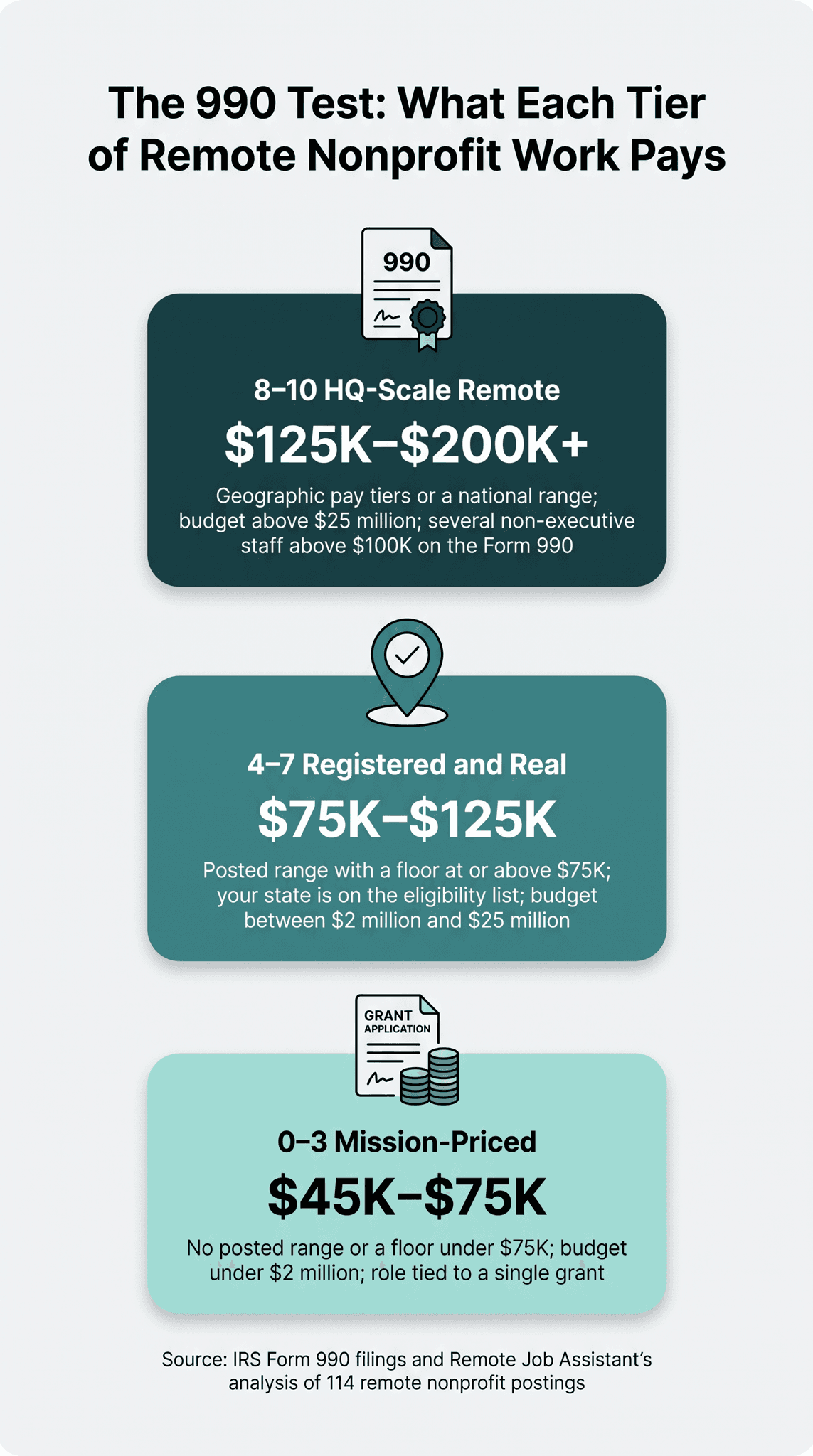
How to use it: score the three gates before you apply. A posting that fails the state gate is a zero regardless of the other two. A 4–7 is where you negotiate on pay basis and funding term. An 8–10 is where you compete on speed and volume, because everyone else can see the same numbers you can.
If the organization scores 4–7 and you want the mission anyway, de-risk it in the offer rather than talking yourself out of it: ask for the funding term in writing, ask whether the range is on headquarters scale, and if the role is grant-funded, ask what the organization did with the last grant-funded position when its grant ended. An organization that converted that person to general operating support is a different bet from one that let them go, and the answer is usually offered freely because nobody asks.
| Gate | The tell in the posting | The tell on the Form 990 | The question to ask |
|---|---|---|---|
| State | A list of eligible states, or "US remote" with no list | Schedule O or the filing address shows where staff sit | "Are you registered as an employer in my state, or willing to be?" |
| Pay | A posted range, ideally with geographic tiers | Count of non-executive employees above $100K in Part VII | "Is the range set on headquarters location or mine?" |
| Funding | "Grant-funded," "through [date]," or "contingent on funding" | Revenue concentration and year-over-year trend | "Is this role general-operating funded, and if not, through what date?" |
Worked example: Zearn's remote Grants Manager. Pay gate passes, with a posted range of $80,000–$100,000. State gate passes if you're in one of the 18 listed states or DC, and fails otherwise. Funding gate: Zearn's June 2025 filing on ProPublica's Nonprofit Explorer shows $48.4 million in revenue against $38.6 million in expenses and $75.7 million in net assets, with six officers listed between roughly $507,000 and $729,000. That's an 8–10 organization posting a manager-level range, which tells you two things at once: the role's band is set by its level, not by the organization's capacity, and there is real room inside the range because the capacity is proven. The negotiation there is about where you land in $80K–$100K, not whether the money exists.
The list of states in a remote nonprofit posting isn't a preference. It's a payroll registration map, and if your state isn't on it, you're not a candidate at any salary.
Stop Applying Manually
Our AI applies to hundreds of matching jobs while you sleep. Wake up to interviews, not more applications.
What Remote Nonprofit Jobs Pay in 2026
Remote nonprofit pay is bimodal. There is a tier of large, tech-forward, or research-heavy organizations paying corporate-adjacent salaries on national scales, and there is a mission-priced tier where a director title comes with a coordinator budget. Which tier you land in is predicted more by the organization's budget and function than by your years of experience.
| Function | Posted-range midpoint in our pull | External benchmark | Typical 990 Test band |
|---|---|---|---|
| Fundraising and development | approx. $128K (n=10 with posted pay) | Fundraising managers $125,470 median; fundraisers $72,550 (BLS 2025); AFP median $87,672 | 4–7, rising to 8–10 at $25M+ orgs |
| Program and project leadership | approx. $108K (n=10) | Social and community service managers $80,390 median (BLS 2025) | 4–7 |
| Finance, operations, and people | approx. $115K (n=10) | Nonprofit finance director $134,622 average (Salary.com) | 4–7 to 8–10 |
| Evaluation, research, and communications | approx. $236K (n=18, heavily weighted by GiveWell) | Director of monitoring, evaluation, and learning approx. $92K average (ZipRecruiter) | 8–10 at research orgs; 4–7 elsewhere |
| Tech, data, and product | approx. $149K (n=34) | Financial managers across all industries $166,570 (BLS 2025), for scale | 8–10 |
Salary ranges derive from our analysis of 114 remote nonprofit postings between July and September 2026, cross-referenced with BLS, AFP, and Candid compensation data. We excluded postings without stated pay from the midpoint calculations and flag the one function where a single employer distorts the number.
That evaluation-and-research figure needs the caveat spelled out. GiveWell posts senior researcher and senior program officer roles at $280,000–$308,000, location-adjusted, and its senior communications officers at $225,000–$247,500. Those are real, remote, and open to US and international candidates, and they are not what a director of evaluation at a $6 million youth-services nonprofit earns. Strip GiveWell out and the honest planning number for remote evaluation and communications leadership is closer to the $92K–$130K band you see at organizations like Wikimedia Foundation (Senior Procurement Specialist $91,049–$138,263) or the National Academy of Education (Communications Specialist $75,000–$85,000).
The posted examples in the middle of the market are more useful than any average. Code for America lists a remote Program Director at $121,869–$149,188. GiveDirectly posts a remote Senior Manager, Accounting at $120,800 base. The Center for Science in the Public Interest lists a remote Senior Development Officer at $111,000–$145,000, and Land Trust Alliance a remote New York Program Director at $110,000–$130,000. CommonLit posts a Director of Philanthropy at $150,000. Amazon Frontlines lists a remote Finance Director at $95,000–$115,000. That spread, roughly $95K to $150K for director-level remote work, is the practical target for this post's reader, and it's consistent with where remote roles paying $100K and up cluster on our own board.
Why the variance is so wide comes down to four things, in order of weight. First, budget size: Candid's 2025 Nonprofit Compensation Report, built from 217,556 compensation records across 130,794 organizations, puts the overall nonprofit CEO median at $110,000, but the median for science and technology research organizations is $202,490 while religion-related organizations sit at $68,958. The mission area sets the whole scale beneath the CEO. Second, headquarters metro: Candid's median executive pay is $189,088 in the District of Columbia and $85,517 in Wyoming, and since 73% of positions pay on employer location, a remote hire at a DC-based organization is often paid on DC's scale. Third, function, per the table. Fourth, pay basis, which is the one variable you can influence in the offer conversation.
One more reality check on the aggregator numbers you'll find on your own. Salary.com puts the average non-profit development director at $123,515 with a typical band of $106,566–$142,762; ZipRecruiter puts the same title at $95,708 with most between $74,000 and $114,500; PayScale's self-reported program director median is $69,000. None of them is wrong. Salary.com models employer-reported bands and skews toward larger organizations, ZipRecruiter blends posting data, and PayScale's self-reports skew toward small organizations and early-career respondents. Treat the Salary.com figure as an 8–10 organization, the PayScale figure as a 0–3, and use the 990 to find out which one you're actually talking to.
One posting-language gotcha applies across every band. BME Strategies, a remote-first public-health evaluation firm posting a Senior Consultant role at $91,520–$151,840, says the quiet part in the listing: "New employees are typically brought into the organization at a salary between the range minimum and the salary range midpoint, dependent upon internal equity and the budgeted amount for the position." Most nonprofits don't print that sentence, but most operate by it. A posted range tells you the band the role sits in, not the offer you'll get; the top third is reserved for internal promotions and equity adjustments, and an organization that can expect 200 applicants has no reason to open it for an external hire. Anchor your number at the midpoint, justify it with a comparable from the organization's own 990, and treat anything above the midpoint as a win rather than a starting point.
A nonprofit's pay ceiling is not a negotiation secret. It's on page seven of a public tax form.
Stop Applying Manually
Our AI applies to hundreds of matching jobs while you sleep. Wake up to interviews, not more applications.
How to Read a Nonprofit's Form 990 Before You Apply
The single highest-return twenty minutes in a nonprofit job search is reading the target organization's Form 990 on ProPublica's Nonprofit Explorer. The disclosure rules are set by the IRS and they are unusually generous to job seekers. Per the IRS guidance on Form 990 Part VII and Schedule J, an organization must list all current officers, directors, and trustees regardless of pay; up to 20 key employees with reportable compensation above $150,000; its five highest-compensated employees at or above $100,000 who aren't officers or key employees; and its five highest-paid independent contractors above $100,000.
Read that list again from the candidate's side. If a $20 million organization's Part VII shows the CEO, a CFO, and nobody else above $100,000, then nobody below the C-suite clears six figures there, and the "competitive salary" in the posting has a ceiling you now know. If it shows a Senior Director of Finance at $193,671 and a Principal Manager of Product at $188,563, as Code for America's 2024 filing does, you know both the ceiling and the fact that non-executive staff reach it.
The five-step 990 read, in order:
- Total revenue and total expenses, most recent year. This is the budget band, and per Candid it predicts the pay scale more than anything else. Under $2 million is a 0–3 organization on The 990 Test; $2 million to $25 million is a 4–7; above $25 million is an 8–10.
- Count the non-executive names in Part VII above $100,000. Zero means the director tier is priced below six figures. Three or more means the organization has a real professional pay scale and your range has room.
- CEO compensation against budget. A CEO at $300,000 in a $5 million organization usually means compression below them. A CEO at $110,000 in a $5 million organization means everyone else is below that.
- Revenue concentration. If one funder or one government contract is most of the revenue, every role not funded by general operating support is a funding-gate risk. Ask about it directly.
- Two or three years of trend. Expenses running ahead of revenue, as in Code for America's 2024 filing ($38.4 million expenses against $29.9 million revenue), isn't disqualifying when net assets are large ($77.2 million there), but it tells you to ask how the role is funded and for how long.
Two things the 990 won't tell you. It lags: the most recent filing is usually for a fiscal year that ended twelve to eighteen months ago, so a fast-growing organization looks smaller than it is. And it shows compensation for the people at the top of the scale, not the range for your role. Use it to score the gates and set your ceiling, then use the posting and the first-round conversation to place yourself inside the range.
Who's Hiring Remote Nonprofit Professionals in 2026
The organizations posting remote nonprofit jobs cluster into types, and the type predicts pay basis, state coverage, and where they sit on The 990 Test. Match your target to the type before you match it to the mission.
| Employer type | Examples from our pull | Typical pay basis | 990 Test band |
|---|---|---|---|
| Tech-forward and research nonprofits | GiveWell, GiveDirectly, Wikimedia Foundation, Code for America, Thorn, Recidiviz, ActBlue | National range or explicit tiers, most or all states | 8–10 |
| Education nonprofits | DonorsChoose, Zearn, Khan Academy, CommonLit | Geographic tiers; defined state lists | 8–10 |
| Climate, policy, and global development | ClimateWorks Foundation, PowerLines, Evidence Action, Echoing Green, Oxfam America, World Wildlife Fund | Tiers at larger orgs; HQ scale at mid-size | 4–7 to 8–10 |
| Mid-size mission organizations | Land Trust Alliance, Center for Science in the Public Interest, Animal Welfare Institute, Foster America, Move For Hunger, Main Street America, Murmuration | Single posted range, often HQ scale | 4–7 |
Tech-forward and research nonprofits run the most corporate hiring process in the sector and post the widest ranges. GiveWell hires remote senior researchers and program officers with posted, location-adjusted pay. GiveDirectly hires remote accounting, program, and audit roles with base salaries stated to the dollar (Senior Manager, Accounting at $120,800; Technical Program Manager at $107,070). Wikimedia Foundation posts a remote Head of Marketing at $143,478–$217,585. Recidiviz hires a remote Partnerships Growth Lead at $131,000 with 30–40% travel to state capitals. ActBlue posts a remote Senior Financial Operations Specialist at $92,700–$116,400. These are the organizations where a corporate finance, product, or partnerships background transfers with the least translation.
Education nonprofits are the clearest illustration of geographic tiers and state lists. DonorsChoose, a $150 million organization by its June 2025 filing, publishes two pay tiers on nearly every remote role, from Senior Strategic Finance Manager ($90,000–$120,000 across tiers) to VP, Marketplace Growth ($134,930–$165,000 across tiers). Zearn's 18-state list is the state gate in its purest form. CommonLit's remote Director of Philanthropy at a flat $150,000 is what an 8–10 fundraising role looks like.
Climate, policy, and global development organizations hire remote fundraisers, communicators, and program leads and frequently pay on a coastal HQ scale. ClimateWorks Foundation's tiered range above is one example. PowerLines is hiring its first full-time Director of Development, remote with up to 30% travel, to build a major-donor program targeting $5–10 million a year. Evidence Action hires a remote Senior Development Officer; Echoing Green hires a remote Manager of Institutional Giving; Oxfam America posts a remote Manager, Cybersecurity and Infrastructure at $105,000–$115,000. If your background is in remote communications work, this is the cluster most likely to pay above the sector median for it.
Mid-size mission organizations are where most remote director roles actually live, and where the state and funding gates matter most. Land Trust Alliance, the Center for Science in the Public Interest, Amazon Frontlines, and the Animal Welfare Institute all post remote roles with ranges on Idealist. Foster America hires a remote, US-based Director of Development. Move For Hunger and Murmuration hire remote development and finance staff. These organizations typically run one posted range on HQ scale and a narrower state list, which is exactly where the questions in the gates table earn their keep.
Where they post matters as much as who they are. Every organization above runs its own applicant tracking system, and the roles appear there first, sometimes weeks before they hit a board. Idealist had 412 remote jobs out of 1,787 total nonprofit listings on the day we checked, a 23% share, and its filter for postings that include a salary is worth switching on by default; in Idealist's own 2025 survey, 79% of social-impact professionals called knowing the range upfront "very important." Work for Good and the National Council of Nonprofits' career center round out the sector boards. The broader remote job boards carry the tech-forward organizations but miss most of the mid-size ones.
Red flags in remote nonprofit postings, sorted into walk and ask:
Walk:
- Contractor status for a full-time, director-titled role. The ABA article above is blunt that misclassification carries "statutory fines, back taxes and benefits, and other penalties." An organization taking that risk with you will take other risks with you.
- No salary range from an organization headquartered in a pay-transparency state. California, Colorado, Illinois, Massachusetts, Minnesota, New Jersey, New York, and Washington are among the states that require ranges in postings as of 2026, and the requirement generally follows the remote role, not the headquarters. An organization ignoring the law in its own state is telling you how it treats compliance.
- "Salary commensurate with experience" from a $20 million-plus organization. The 990 shows they know exactly what they pay. A refusal to post it is a choice, and the choice is usually made because the number is low.
Ask:
- "Remote" with a one-state eligibility list. That's often a hybrid role that hasn't admitted it yet, and the state list is the legal minimum, not the cultural expectation. Ask what "remote" means in days per month and whether the last person in the role lived near the office.
- "Contingent on funding" or "grant-funded through" buried in the last paragraph. Not disqualifying, but it sets the funding gate to a date. Get the date, and ask what the organization did with the last grant-funded role when its grant ended.
- A range wider than $40,000. Wide ranges from organizations expecting heavy applicant volume usually mean the top third is decorative. Ask where in the range the last two external hires came in.
One question per employer type sorts the rest fast. For a mid-size mission organization: "Is this role general-operating funded, and if not, through what date?" For a tiered-pay organization: "Which tier applies to my location, and is the tier reviewed if I move?" For a development role anywhere: "How many people have held this position in the last five years, and how long was it vacant before this posting?" A vague answer to any of them is the answer.
How to Land a Remote Nonprofit Role
Here's the number that reframes everything: per the National Council of Nonprofits' analysis of Idealist data, remote nonprofit postings drew roughly nine times the applications of onsite ones, and 88% of job seekers who used the location filter were looking for remote work against 19% of postings that offered it. Remote nonprofit roles draw nine times the applicants of onsite ones. Your resume isn't competing with the mission; it's competing with the volume.
That changes the playbook in four ways.
Quantify everything, with denominators, and pick the lane that matches what you've actually owned. Nonprofit hiring committees are drowning in mission statements. "Raised $1.4 million from 22 institutional funders over two cycles, up from $900,000," or "managed a $3.2 million program budget across four states with a 97% grant-compliance audit result," is the language that survives a 200-resume screen. If you're coming from the corporate side, the translation is a three-way decision, not a vocabulary swap. If you've owned a quota or a book of business, you're a development candidate: a sales pipeline becomes a donor and partnership pipeline, and closed revenue becomes contributed revenue. If you've owned a P&L, a budget, or an audit, you're a finance and operations candidate, and the operations management vocabulary transfers almost unchanged. If you've shipped something with a team and a deadline, you're a program candidate, and program management is the nearest door. Candidates who apply across all three lanes read as unfocused to a committee that is specifically screening for one of them.
For development roles, ask about the chair before you ask about the mission. CompassPoint and the Haas Jr. Fund's UnderDeveloped study, a survey of more than 2,700 executive directors and development directors, found that organizations with a vacant development director reported a median vacancy of six months, with 46% reporting longer and 16% reporting two years or more; at organizations with budgets of $1 million or less, the median vacancy was twelve months. Half of sitting development directors expected to leave within two years, 25% of executive directors said their previous development director had been fired, and 53% said their last hiring process drew too few qualified candidates. The study is from 2013 and the sector has professionalized since, but every fundraiser we know recognizes the pattern. It's why the vacancy-and-tenure question in the previous section is the single most revealing thing you can ask a small organization, and why a remote development role at a $2 million organization that's been open for a year should be scored as a funding-gate and management risk, not as a lucky find.
Run The 990 Test before the cover letter, not after the rejection. Twenty minutes on ProPublica tells you whether the range has room, whether the funding is stable, and what the people above you earn. Candidates who walk into a first screen knowing the organization's budget and its Part VII names ask better questions and get taken more seriously, because almost nobody does it.
Ask the three gate questions in the first conversation. Pay basis, funding source and term, and state registration. Nonprofit recruiters expect questions about mission fit and are often unprepared for questions about payroll registration. Asking them early signals that you've hired and managed people before, which is the actual thing a director-level screen is trying to establish.
Apply through the organization's own system, and apply wide. Roles land on Greenhouse and Workable before they land on Idealist, and the volume math means you cannot afford to submit six careful applications a month and wait. Track your follow-ups; our guide to following up on a job application covers the cadence that works when a hiring committee meets twice a month.
In Idealist's 2025 Employer Report, drawn from more than 6,500 social-impact professionals surveyed in fall 2024, 42% reported delayed or no communication after applying. That silence is structural, not personal: director-level nonprofit hires are frequently reviewed by a volunteer committee, approved by a board that meets monthly, and funded by a budget line that a finance director has to confirm. A single application can sit for six to ten weeks through no fault of yours. The candidates who land remote nonprofit roles run applications in parallel and let the committees race each other.
Parallel applications across dozens of organization-specific portals is exactly the kind of repetitive, form-heavy work that burns out a person who'd rather be building a program. That's the problem Auto-Apply exists to solve: it submits applications across hundreds of thousands of company and organization career pages on your behalf while you spend your hours on the parts only you can do, reading the 990s, scoring the gates, and preparing for the conversations that actually get scheduled. If applications are going out and interviews aren't coming back, the failure points are usually diagnosable; we broke them down in why you're not getting interviews. And if benefits are part of the calculation, note that nonprofit benefits are often better than the salary suggests: more than 96% of US fundraisers in AFP's 2025 report had employer-provided health insurance, and 21% had the entire premium covered, a stronger deal than many of the remote jobs with benefits we've reviewed in the private sector.
Stop Applying Manually
Our AI applies to hundreds of matching jobs while you sleep. Wake up to interviews, not more applications.
Frequently Asked Questions
Which nonprofit jobs can actually be done fully remotely, and which can't?
Fundraising and development, finance and accounting, communications, evaluation and research, and technology roles go remote first, because their output is documents, data, and relationships rather than physical presence. Direct-service roles, most coordinator-level positions, and anything tied to a site (shelters, clinics, after-school programs) stay onsite. In the National Council of Nonprofits' analysis of 45,891 Idealist postings, only 19% were fully remote and 38% hybrid, and the article notes that assistant, associate, and coordinator roles sit well above the average for onsite work.
I'm a corporate finance manager making $110K. Will I have to take a pay cut to go remote at a nonprofit?
Not necessarily, but it depends entirely on the organization's budget band. Salary.com puts the average nonprofit finance director at $134,622 with a typical range of $100,799–$158,761, and in our pull GiveDirectly posted a remote Senior Manager, Accounting at $120,800 while Amazon Frontlines posted a remote Finance Director at $95,000–$115,000. Same function, different bands on The 990 Test. Check the target's Form 990: if there's no non-executive name above $100,000 in Part VII, your $110K is above their ceiling.
How do I find out what a nonprofit really pays before I apply?
Search the organization on ProPublica's Nonprofit Explorer and open the most recent Form 990. IRS rules require it to list every officer and director, key employees paid above $150,000, and the five highest-paid other employees at or above $100,000, all by name and title. Pair that with total revenue and expenses to place the organization on a budget band, then compare the posted range to what the people one level up earn.
Why do remote nonprofit job postings list specific states, and what if mine isn't on the list?
Because a remote employee in a new state forces the organization to register there as a foreign employer, open withholding and unemployment insurance accounts, and often buy workers' compensation coverage. Small and mid-size nonprofits list the states where they've already done that. If your state isn't listed, ask directly whether they would register for the right hire; some will for a director-level role, and many won't. Don't spend an hour on the application before you know.
How do I score a posting on The 990 Test?
Three gates, ten points. State gate: is your state eligible, or is the organization willing to register? Pay gate: is a range posted with a floor at or above $75K, and is it set on employer or employee location? Funding gate: on the 990, is the budget above $2 million, are there non-executive staff above $100,000, and is revenue diversified enough that the role isn't tied to one grant? A posting failing the state gate scores zero. One passing all three at a $25 million-plus organization with posted tiers is an 8–10, and you should apply the same day.
Do remote nonprofit jobs pay based on where I live or where the organization is?
Mostly where the organization is: 73% of positions in the National Council of Nonprofits' analysis of 13,619 salary submissions were paid on employer location. Larger organizations increasingly publish the tiers, as ClimateWorks Foundation does ($130,000–$140,000 in the SF Bay Area and NYC, $120,000–$130,000 elsewhere) and DonorsChoose does on most roles. Ask which basis applies before you anchor on a number; a headquarters-scale range for a remote hire in a lower-cost market is one of the sector's few quiet pay advantages.
How much do remote development directors and grants managers make?
In our pull, fundraising and development roles with posted pay (n=10 of 21) had a median range midpoint of approximately $128,000, with examples from Zearn's Grants Manager at $80,000–$100,000 to the Center for Science in the Public Interest's Senior Development Officer at $111,000–$145,000 and CommonLit's Director of Philanthropy at $150,000. For scale, BLS puts fundraising managers at a $125,470 median and AFP's 2025 report puts the overall US fundraiser median at $87,672. A remote development director at a $2 million–$25 million organization should plan on $85K–$125K; above $25 million, $125K–$175K is realistic.
Start Your Remote Nonprofit Career
Remote nonprofit hiring rewards the people who treat it as a system rather than a calling: three gates that decide whether a posting is real for you, a public tax form that tells you what the organization can pay, and a volume problem that punishes anyone applying one careful cover letter at a time.
Browse remote roles paying $75K and up, compare nonprofit pay against the highest-paying remote careers, and let Auto-Apply handle the application volume while you do the twenty minutes of 990 reading that most candidates skip.
Nonprofits spent decades asking you to take the mission on faith. Their tax returns don't require it. Read the numbers, pick the tier, and apply like the volume demands.
Ready to Find Your Remote Job?
Browse thousands of curated remote jobs or let AI apply for you.
Browse Remote JobsRelated Job Guides
Remote Tax Jobs: 2026 Salary Guide and Hiring Companies
Remote tax jobs pay $55K to $180K depending on credential and calendar. See the salary ladder, CPA vs EA data, and companies verifiably hiring remote in 2026.
21 min read

Remote Underwriting Jobs: 2026 Salary and Hiring Guide
Remote underwriting jobs in 2026: posted pay from $60K to $290K+, which carriers and lenders actually hire remote, and the authority level that unlocks it.
30 min read

Remote Physician Jobs: 2026 Salary and Career Path Guide
Remote physician jobs in 2026: six career paths from telemedicine to medical director, real pay from $150K to $300K+, licensing strategy, and who's hiring.
23 min read