
Last reviewed: September 2026
Most advice on remote jobs for military spouses stops at the word "remote." Here's how that goes wrong. You land the job: senior title, a base salary that starts with a 1, a recruiter who said "fully remote" twice on the first call. Eighteen months later the orders say Joint Base Pearl Harbor-Hickam. You email HR about the move, and the answer comes back in one line: the company isn't set up to employ anyone in Hawaii.
Nothing in the posting warned you, because nothing in most postings does. In a job posting, remote means remote from the company's office. Whether the job can follow you to Hawaii, Alaska, Colorado or Germany gets decided somewhere else, in the list of states where your employer runs payroll.
Get Remote Job Tips in Your Inbox
Weekly strategies, salary data, and new opportunities
Unsubscribe anytime. No spam.
That gap costs military families real money. Active-duty spouses carry a 20% unemployment rate, and a PCS move in the past year raises a spouse's odds of being unemployed by about 136%, according to the DoD's 2024 Active Duty Spouse Survey (n=12,772). Remote work is the obvious fix, and for the jobs that actually travel, it works. You just usually find out which kind you have in the first email you send HR after orders drop, four interview rounds and a year too late.
On September 25, 2026, we pulled every live posting from 686 employer job boards on Greenhouse, Lever, Ashby and SmartRecruiters, 51,707 postings in all. We kept the fully remote U.S. roles with a posted base salary of $75,000 or more (2,753 postings from 242 employers) and read the full text of each one for state lists, exclusions, "registered employer" clauses, office-proximity rules, time-zone hours and travel. Then we checked the results against the DoD survey and against the statutes and legal-office guidance that decide a spouse's taxes, licenses and overseas telework.
Based on 2,753 fully remote U.S. postings with a posted base floor of $75,000 or more, from 242 employers (read September 25, 2026):
- 89.6% (n=2,468 of 2,753) say nothing about which states the job can be done from
- 0.8% (n=21 of 2,753) promise in writing that you can work from any U.S. state
- 9.6% (n=264 of 2,753) carry a written geographic limit, from 28 of the 242 employers
- 55 of 59 postings with a published state exclusion list shut out Alaska; 21 of 59 shut out Hawaii
- $155,000 vs. $152,150: median posted base floor with no stated limit (n=2,489) vs. with one (n=264)
- 0.04% (n=17 of 43,586) of posting descriptions mention military spouses at all
- 39% of employed active-duty spouses have an employer that offers remote work, and 54% of those work fully remote (DoD Office of People Analytics, 2024 survey, n=12,772)
Two of those numbers do most of the work in this guide. Nine in ten postings are silent on location, and the ones that do speak up tend to drop the states military families get sent to. Here's where the numbers come from.
How We Collected This Data
This dataset misses the employers most military spouses have already heard of. Amazon, USAA, Booz Allen Hamilton, Deloitte and Humana hire through Workday, iCIMS or Taleo, which have no open search endpoint, so the sample leans toward tech and growth-stage companies. Reddit, Glassdoor and Indeed block automated reads, so nothing here comes from forums or aggregator counts.
On September 25, 2026, we queried the public job-board APIs of Greenhouse, Lever, Ashby and SmartRecruiters for 2,720 employer names. 686 boards had live postings: 51,707 in total, 43,586 of them with full description text. We kept U.S.-eligible, fully remote postings and dropped anything with a hybrid schedule, an office-day count, a "this is not a remote position" line, or a city-only location whose only remote signal was an applicant-tracking-system checkbox. Deduplicating by employer, title and pay left 3,928 remote U.S. postings from 298 employers. Keeping base pay only (commission-inclusive OTE figures removed) with a posted floor of $75,000 or more left 2,753 postings from 242 employers, 95.6% of them published or updated in 2026.
We classified each posting by pattern-matching its raw text and hand-audited every category. Pay-transparency lists ("the range below applies to candidates in California, Colorado...") didn't count as restrictions. It's a one-day snapshot, re-run quarterly, and a posting that says nothing about location isn't a yes.
The PCS-Proof Score: Rate a Remote Job Before Orders Do
Portability isn't one question. It's six, and you can answer most of them from the posting plus one email to the recruiter.
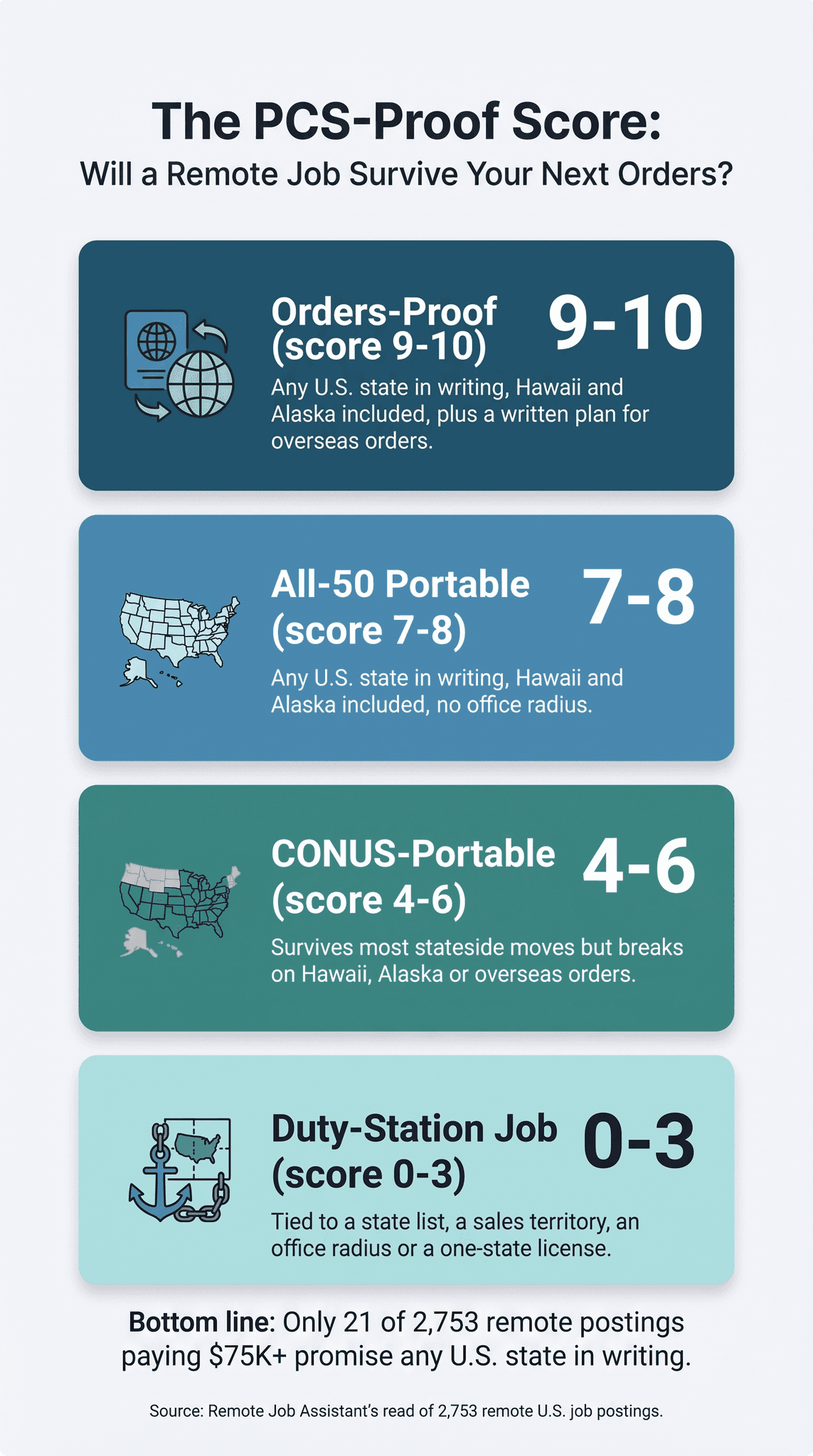
The PCS-Proof Score is a 10-point rating of whether a remote job will survive your next set of orders, and whether the employer has put that in writing.
Scoring (10 points):
- State eligibility (0–3): 3 = any U.S. state, in writing (posting, recruiter email or offer letter). 2 = a published exclusion list that misses every state on your likely orders list. 1 = the posting is silent and the recruiter says "most states" on a call. 0 = a state list, sales territory, region or "registered employer" clause that blocks, or may block, a state you could be sent to.
- Hawaii and Alaska (0–1): 1 = both allowed, in writing or confirmed by the recruiter.
- Overseas path (0–1): 1 = a written policy for working abroad, such as an employer of record, an approved-country list or a leave of absence that holds your seat.
- Office gravity (0–2): 2 = no proximity clause, no required in-person schedule and little or no travel. 1 = travel only (offsites or customer visits), with no office radius. 0 = an "if you live near an office" clause, a commute-radius rule or regular office days.
- Time-zone fit (0–1): 1 = async work or a core overlap under four hours. 0 = fixed Eastern or Pacific business hours.
- Credential portability (0–2): 2 = no license needed, or the license the job needs is tied to where your clients are rather than where you live. 1 = you need a license in your state of residence and it moves through an interstate compact or 50 U.S.C. §4025a. 0 = you need a home-state license with no compact, so every PCS means relicensing.
Bands:
- 0–3 Duty-Station Job: tied to a state list, territory, office radius or one-state license. It won't survive at least one of your likely moves. Tells: "open to candidates residing in the following states," "Remote - Colorado," "within commuting distance."
- 4–6 CONUS-Portable: survives most stateside moves but breaks on Hawaii, Alaska or overseas orders, or needs a renegotiation (hours, license). Tells: "Located in the Continental US," an exclusion list that names Alaska, fixed Eastern hours.
- 7–8 All-50 Portable: any state in writing, Hawaii and Alaska included, no office radius. Requires the Hawaii-and-Alaska point.
- 9–10 Orders-Proof: everything above plus a written path for overseas orders. Requires the overseas point.
A job that misses a band's required point drops one band.
How to use it: Score the posting before you apply. Every point the text doesn't settle becomes a question for the recruiter screen, and the five questions later in this guide cover all of them. A score under 7 isn't a no. It's a list of things to get in writing before you sign.
Here's how often the posting itself gives you those points.
| Criterion | What the posting says | Postings (n=2,753) |
|---|---|---|
| State eligibility, full 3 points | "any state," "anywhere in the US" | 21 (0.8%) |
| State eligibility, 0 points | state list, territory, region, exclusion list, "registered employer" clause, contiguous-only | 264 (9.6%) |
| State eligibility, unscored | nothing either way | 2,468 (89.6%) |
| Hawaii and Alaska, 0 points | excludes one or both | 197 of the 201 postings that name states |
| Office gravity, 0 points | proximity clause or commute radius | 34 (1.2%) |
| Time-zone fit, 0 points | fixed or preferred ET, CT or PT hours | 33 (1.2%) |
| Office gravity, capped at 1 | 10%+ travel or scheduled headquarters trips | 224 (8.1%) |
Read it top to bottom and the pattern is plain. The posting hands you the full state points 21 times out of 2,753. For the other 2,732, those points are sitting in a recruiter's inbox, which is why the score works better as a set of questions than as a filter.
Scoring real postings shows how fast the bands separate. The five below are scored for one hypothetical family: an Army household at Fort Carson, Colorado, whose likely next orders are Joint Base Lewis-McChord (Washington), Fort Bliss (Texas) or Schofield Barracks (Hawaii). Each is scored on the posting text alone.
| Posting (September 2026) | Posted base | What it says about location | Score | Band |
|---|---|---|---|---|
| Scribe, Customer Success Manager, Enterprise | $145K–$205K | "Fully remote. Open to candidates anywhere in the US"; up to 25% travel | 3+1+0+1+1+2 = 8 | All-50 Portable |
| Ophelia, Telehealth NP or PA (Delaware license) | $110K–$125K | "Remote work anywhere in the United States"; requires a Delaware license, not Delaware residence | 3+1+0+2+1+2 = 9 | All-50 Portable (no overseas point) |
| Instacart, Senior Data Analyst | $144K–$152K | "any US State except California, Connecticut, New Jersey, New York, and Washington" | 0+1+0+2+1+2 = 6 | CONUS-Portable |
| Vital Farms, VP of FP&A | $250K–$300K | "unable to employ individuals residing in… Alaska, Hawaii, Mississippi, Montana, North Dakota, South Dakota, West Virginia and Wyoming" | 0+0+0+2+1+2 = 5 | CONUS-Portable |
| Oscar Health, Associate, Actuarial | $123K–$162K | open only to residents of 18 listed states, none of them Colorado, Washington or Hawaii; hybrid if you live near its New York or Tempe offices | 0+0+0+0+1+2 = 3 | Duty-Station Job |
The Oscar role isn't even open to this family today. The Vital Farms role pays the most in the table and dies on the Schofield orders. The Ophelia role is the quiet winner: it needs a Delaware license but lets you live anywhere in the U.S., so a move never touches the credential.
A remote job's real location policy lives in the payroll system, not the job posting.
Stop Applying Manually
Our AI applies to hundreds of matching jobs while you sleep. Wake up to interviews, not more applications.
What "Remote" Excludes: The State Lists Hiding in $75K+ Postings
Most employers never publish their rules. The ones that do tell you exactly how a remote job fails a military family, because the states they drop are the states military families get sent to.
| Employer | Rule as written in live postings (Sept. 25, 2026) | Top-10 military states blocked | Alaska / Hawaii |
|---|---|---|---|
| Lemonade | "cannot consider applicants from these states: Alaska, California, Colorado, Montana, Hawaii, New Mexico and Puerto Rico" | CA, CO, HI | both blocked |
| Calendly | "If you are located in Alaska, Delaware, Hawaii, Idaho, Iowa, Montana, Nebraska, North Dakota, Rhode Island, South Dakota, and West Virginia, you will not be eligible" | HI | both blocked |
| Oscar Health | "excluding Alaska; Delaware; Hawaii; Louisiana; Montana; North Dakota; Oklahoma; West Virginia; Wyoming; and US Territories" (other Oscar roles are open only in listed states, from 3 to 19 jurisdictions) | HI | both blocked |
| Vital Farms | "unable to employ individuals residing in… Alaska, Hawaii, Mississippi, Montana, North Dakota, South Dakota, West Virginia and Wyoming" | HI | both blocked |
| Oura | "not considering candidates residing in… Alaska… Delaware… Iowa… Mississippi… Nebraska… South Dakota… West Virginia… Wisconsin" | none | Alaska blocked |
| Instacart | "any US State except California, Connecticut, New Jersey, New York, and Washington" | CA, WA | allowed |
| Samsara | some roles exclude Alaska, California, Connecticut, Maryland, Massachusetts, New Jersey, New York and Rhode Island; many exclude the San Francisco, New York City and Washington, D.C. metros | CA | Alaska blocked |
| Bestow, LaunchDarkly | "48 contiguous states only," "Located in the Continental US" | HI | both blocked |
| Airbnb, Smartsheet | "you must live in a state where Airbnb, Inc. has a registered entity"; "anywhere in the US where Smartsheet is a registered employer" | unknown | unknown |
The stakes of each blocked state are easy to size. California hosts 157,687 active-duty members, Washington 56,101, Hawaii 43,108 and Colorado 35,680, according to the DoD's 2024 Demographics Report. Across the 201 postings in our sample that name specific states, 197 (98.0%) block Hawaii or Alaska and 172 (85.6%) block at least one of the ten states with the most active-duty members.
Why the lists look like this. Every state an employer hires in means registering for state income tax withholding and unemployment insurance, following that state's wage and leave laws, and filing there every quarter. Companies register where they already have people, so thinly populated states fall off first: Alaska, Wyoming, the Dakotas, Montana. Hawaii adds its own layer. Its Prepaid Health Care Act requires employers to provide health coverage to employees who work at least 20 hours a week, through plans the state reviews, which is one more filing for a company with no one on the islands. Calendly says the quiet part out loud: it is "registered as an employer in many, but not all, states."
That also explains the silence. The state list belongs to payroll, not recruiting, and it moves as the company hires, so the person who writes "remote" in a posting often hasn't seen it. Every employer with remote staff has that list, because it can't run payroll without one. It just isn't in 2,468 of these postings.
A posting that says nothing about location isn't promising all 50 states. Airbnb's postings send you to a separate exclusion list and warn that it "is continuously evolving." Even Blue Star Families, which offers "PCS leave for Active Duty military spouses," posts some roles as "Remote/Virtual within the Continental US."
When you read a posting, these are the lines that should stop you, and what each one does to a military family:
- "Remote - California" or "Remote, Colorado; Remote, Utah" in the location field (Databricks, Pure Storage sales roles): it's a territory. The job is local by design, and a PCS out of the territory ends it.
- "Where we have a registered entity" or "where [company] is a registered employer" (Airbnb, Smartsheet): the list lives somewhere else and can change between your offer and your next orders. Ask for it in writing.
- "Continental US" or "48 contiguous states" (Bestow, LaunchDarkly): Hawaii and Alaska are out, full stop.
- "If you live within X miles of an office" (Real Chemistry, Stripe, Oscar, Monks): six employers in the sample turn remote into hybrid depending on where you land. Real Chemistry requires "in-person attendance two days per week" within "a one-hour commute" of an office; Stripe's line is "within 35 miles." Oscar's clause names its Tempe office, which shares the Phoenix metro with Luke Air Force Base.
- "Must be based in the Eastern or Central time zone" (Veeva, Sardine, Akur8): residents of Hawaii and Alaska are out by definition, and any overseas tour becomes a schedule negotiation.
- "Must be physically located in the United States" (20 postings from 8 employers): overseas orders end the job unless the employer will use an employer of record.
Alaska is the most-excluded state in remote hiring. Hawaii is excluded more often than any other top-10 military state. In our sample, 196 of the 201 state-naming postings block Alaska and 163 block Hawaii. The next most-blocked top-10 military state, South Carolina, appears in 136.
Which Remote Careers Travel Best With a Military Family
Function predicts portability better than employer does. A sales engineer and a data engineer at the same company can sit on opposite ends of the PCS-Proof Score, because one carries a territory and the other doesn't.
| Function | Postings | Written geographic limit | Median posted base range |
|---|---|---|---|
| Software and data engineering | 1,037 | 4.6% (n=48) | $172,550–$238,000 |
| Product and design | 249 | 7.6% (n=19) | $165,000–$225,000 |
| Marketing and content | 165 | 6.1% (n=10) | $140,000–$195,000 |
| Finance, legal and operations | 300 | 9.7% (n=29) | $144,000–$195,000 |
| People and recruiting | 41 | 2.4% (n=1) | $128,560–$170,000 |
| Customer success and implementation | 142 | 11.3% (n=16) | $109,740–$166,589 |
| Sales and solutions engineering | 374 | 23.0% (n=86) | $150,000–$208,000 |
| Clinical and health | 72 | 31.9% (n=23) | $122,686–$152,775 |
These ranges come from the same 2,753 remote postings with a posted base floor of $75,000 or more, grouped by job title and read on September 25, 2026. The medians are posted base pay, not total compensation, and the sample leans toward tech employers, so treat the ranges as a floor for comparison rather than a market survey.
The causes sit right in the postings. Sales roles carry territories: Samsara's mid-market account executive roles are "open for candidates residing in the following US states," and the role "requires travel approximately 25% of the time." Clinical roles carry state licenses and payer contracts: Oscar's virtual urgent-care clinicians "must reside in one of the following states," a list of 18 states plus D.C. Engineering, product and people roles have neither anchor, which is why they post the fewest limits.
Licensing is where military spouses lose the most ground. In the DoD's 2024 survey, 52% of spouses needed a state license or occupational certificate for their work, and 28% had to get a new license or credential after their last PCS. The Council of Economic Advisers found in 2018 that 35% of working military spouses were in licensed occupations, against 22% of all workers, and that military spouses earned 26.8% less than their civilian peers ($12,374 a year, using 2016 Census data).
None of this means a sales or clinical career is off the table. It means you pick the version of it that travels. In sales, that's enterprise and named-account roles with national coverage rather than regional territories; see our guide to remote account executive jobs for how those seats are structured. In clinical work, it's telehealth employers that license you for where patients live, plus compact licenses; our remote nursing jobs guide explains how the compacts work for RNs. If you're starting from a technical background, remote software engineer jobs and the engineering and technical job board are the lowest-friction path, and roles paying $150K and up skew heavily toward those functions.
A simple rule falls out of the table. If a job carries a territory or a home-state license, treat it as high PCS risk and score it before you apply. If it carries neither, the only remaining risk is the employer's state list, and the five questions below settle that. Everything else is negotiation.
The most portable remote careers aren't the ones with the most openings. They're the ones with no territory and no state license.
Engineering, product, finance and people roles carry the fewest written limits, so that's where volume pays off. Apply wide there, and save your screening time for the recruiter questions below.
Stop Applying Manually
Our AI applies to hundreds of matching jobs while you sleep. Wake up to interviews, not more applications.
Five Questions to Ask Before the Final Round
The recruiter screen is where you buy the missing PCS-Proof points. Ask early, ask in writing, and frame it as logistics. It is logistics: every remote candidate should know which states a job can be done from.
- "Which states is this role eligible in today, and are Alaska and Hawaii on the list?" This settles up to four points: state eligibility and the Hawaii-and-Alaska point.
- "If I relocate within the U.S. during employment, what's the process? Does payroll register the new state, or is that a separation?" The answer tells you whether "most states" means "most states, forever" or "most states, today."
- "Is there an office-proximity rule? If I live near one of your offices, does the role become hybrid?" Real Chemistry, Stripe, Oscar and Monks all have one.
- "What are core hours, and in which time zone?" Fixed Eastern hours are fine at Fort Bragg and brutal in Okinawa.
- "Has anyone on the team worked from outside the U.S., even temporarily? How was it handled?" This is the overseas point, and the honest answer is usually "no, but we'd look at it."
"Thanks for the time today. Before the next round, could you confirm three logistics points in writing? (1) Which U.S. states this role is eligible in, including whether Alaska and Hawaii are covered. (2) How the company handles an employee relocating to another state. (3) Whether any office-proximity or in-person requirement applies based on where the employee lives. My family relocates every few years, so I want to be sure the role works long term."
Get the answers into the offer letter or an email from HR. A recruiter's "we're fine with that" on a call is worth 1 point. The same sentence in writing is worth 3. You don't owe anyone your spouse's orders or your family's timeline, and asking about state eligibility doesn't require either. If you want a model for keeping these follow-ups short and specific, our message templates for hiring managers use the same structure.
Then decide with the score, not the salary.
- 7 or higher, in writing: accept.
- 4 to 6, and your next orders are likely stateside for 3+ years: accept, and get the relocation process in writing.
- 4 to 6, and Hawaii, Alaska or overseas orders are likely: negotiate the Hawaii-and-Alaska or overseas point before you sign, or keep searching.
- 0 to 3, and you'll PCS within 18 months: it's a bridge job. Take it only as one.
- Proximity clause near your likely next base: price the commute into the offer.
If the answer to question 1 is no, ask one more thing: "Is the list fixed, or does the company add states when it hires there?" Employers like Airbnb describe their lists as changing. A company that has added a state for one employee may do it again, and a written "we'd evaluate it" is worth more than silence.
Taking Your Current Remote Job Through a PCS
Keeping your job through a move is a payroll decision your employer makes, and it's getting rarer. In Blue Star Families' 2024 survey, only 16% of active-duty spouse respondents kept the same job with the same employer through a relocation, down from 20% in 2023. The same group's 2024 spouse employment report found that 30% believed they could take their job anywhere in the U.S.
The upside is real when it works. In a three-year Blue Star Families and Syracuse University study published in 2026 (n=308), spouses whose employer had a remote policy that let them take their job through a relocation were more likely to hold full-time work across all three years. The DoD's 2024 survey points the same way: among spouses who moved in the past year and whose employer offers remote work, 68% were fully remote.
When the new state isn't on the list, the employer has four options, and each one costs you something different:
- Register the state. Free to you, but it takes the employer paperwork and time, so ask early.
- Move you to a PEO or employer of record that's already registered there. Your job stays the same; your benefits plan may not.
- Convert you to a contractor. You keep the work but pay self-employment tax of 15.3% (both halves of Social Security and Medicare) and lose benefits. Price that before you agree.
- Separate. Then the question becomes unemployment benefits (covered below) and how fast your next search starts.
Here's the sequence that gives your employer the best chance to pick the first option:
- Check the new state against HR's registered-state list as soon as orders look likely. Not when they're cut. HR can answer this in one email, and the answer decides everything else.
- If the state isn't registered, ask which of the four options is on the table and put the registration option first. A request that arrives three months before the move is a paperwork task; one that arrives three weeks before is a separation.
- Update your state tax forms before the first paycheck from the new address (next section).
- Check for proximity clauses at the new location. A move that puts you within 35 miles of an office can turn a remote job into a hybrid one.
- Get the approval in an email before the moving truck. Managers change. Emails don't.
Benefits are the other thing that moves or doesn't. Health plans, disability coverage and state-mandated leave programs differ by state, and our guide to remote jobs with benefits covers which benefits tend to follow you and which ones reset.
State Taxes When You Work Remotely From a Duty Station
Federal law gives a military spouse a choice of tax state. Your employer's payroll system won't honor that choice until you file that state's form.
The rule is in 50 U.S.C. §4001, as amended in 2023: "For any taxable year of the marriage, a servicemember and the spouse of such servicemember may elect to use for purposes of taxation... (A) The residence or domicile of the servicemember. (B) The residence or domicile of the spouse. (C) The permanent duty station of the servicemember." A separate subsection says a spouse's wages aren't treated as income from a state where the spouse isn't a resident and is present only to be with the servicemember under military orders.
That's the law. Payroll is another matter. A remote employer registered in your duty-station state will withhold for that state by default, and it will keep doing so until the exemption certificate is on file. Maryland's employer instructions put it bluntly: the exception "applies only if you have these forms on file for the employee; it is not enough that the employee is eligible for the exemption under the Act." Three examples of what the forms ask for:
- Maryland: Form MW507 (line 8) plus Form MW507M and a copy of your spousal military ID. The MW507M must be renewed every year by February 15, or the employer can stop the exemption.
- Virginia: Form VA-4, Line 4, plus a copy of your spousal military ID.
- Hawaii: Form HW-6, question 23, plus copies of your spouse's orders, their Leave and Earning Statement and your military spouse ID card.
DD Form 2058 is the servicemember's form for military pay. It doesn't touch your civilian paycheck. If you're domiciled in a community property state (Arizona, California, Idaho, Louisiana, Nevada, New Mexico, Texas, Washington or Wisconsin, per IRS Publication 3), the domicile you elect can also change how income splits between you on separate returns.
Two limits. Some state forms, including Virginia's VA-4 and Maryland's MW507, still describe only the older "keep your domicile elsewhere" rule and haven't caught up with the 2023 option to elect the duty-station state. And the statute protects income earned where you're present "solely to be with the servicemember," so living and working in a different state from the duty station is a separate question. Your installation's tax center or legal assistance office can review your situation for free. This section explains the rules; it isn't tax advice.
Licenses, Compacts, and the $2,000 PCS Reimbursement
License portability got better in December 2024, and most official pages still describe the old rules.
The current version of 50 U.S.C. §4025a, rewritten by the FY2025 defense authorization act, says a license in good standing is valid in your new state for the same scope of practice once you apply to that state's board with proof of orders, your marriage certificate and a notarized affidavit. If the board can't act within 30 days, it may issue a temporary license with full rights. The 2023 version's requirement that you'd used the license in the past two years is gone. Military OneSource's license pages still list it.
Three limits to plan around. You have to apply; nothing is automatic. The protection covers the state you move to, not remote clients in other states. And where your profession has an interstate compact, the compact's rules govern instead. The Nurse Licensure Compact covers 43 jurisdictions. The Counseling Compact is live in nine states (Arkansas, Arizona, Georgia, Indiana, Louisiana, Minnesota, Ohio, Tennessee and Wyoming). In the DoD's 2024 survey, 64% of spouses who needed a new license after their last move weren't aware of a compact for their profession.
The money is better than most pages say, too. Under 37 U.S.C. §453(g), the service can reimburse up to $1,000 per move for relicensing costs (exams, continuing education, license and registration fees) and a separate $1,000 for business costs. SpouseWorks and Military OneSource still describe it as one $1,000 for either. The servicemember files the claim after the new license issues, and the authority covers costs incurred through December 31, 2029.
Working Remotely Overseas: Germany, Italy, Japan and Korea
Overseas orders add a second gatekeeper. The host nation's agreement with the U.S. decides whether you may telework at all. Your employer decides whether it will let you. The employer is usually the harder yes.
| Country (active-duty members, Mar. 2026) | Can a SOFA spouse telework for a U.S. employer? | Tax on private-employer pay | Time vs. U.S. Eastern | Source |
|---|---|---|---|---|
| Japan (54,868) | Yes, "regardless of whether they reside on a U.S. or off a U.S. installation" | Unsettled; claiming Japanese residency for the foreign earned income exclusion can trigger Japanese tax | +13 to +14 hours | Army JAG Legal Assistance, updated Nov. 2024 |
| Germany (37,000) | Yes; no separate labor permit under the SOFA Supplementary Agreement | "income tax is due in Germany if the stateside employer is a private company" | +6 hours | Kaiserslautern Legal Services Center, Sept. 2025 |
| South Korea (23,371) | Yes | SOFA Article XIV: no Korean tax on income from sources outside Korea, unless you claim Korean residence | +13 to +14 hours | Army JAG Legal Assistance |
| Italy (12,782) | Yes, since an August 30, 2023 exchange of letters (mission visa holders) | Italian tax law applies; treaty relief for double tax | +6 hours | U.S. Sending State Office FAQ, Aug. 2023 |
Troop counts come from the Defense Manpower Data Center's March 31, 2026 location report. The rules come from the installation legal offices and the embassy office named in each row.
Germany is the one that surprises people. The Kaiserslautern legal office's guide says a U.S. government employer keeps the taxing right with the U.S., but a private employer's wages are taxable in Germany. It also says your employer should be able to keep you on U.S. Social Security by requesting a Certificate of Coverage, that you'll need a German tax ID, and "Do not register your residence at the local Town Hall." Italy's letters allow telework for U.S. employers, including licensed professionals, "as long as the clients are located in the US."
The employer side is where most overseas plans stall. Twenty postings in our sample (from 8 employers) state outright that you must live or work in the U.S., and most of the rest assume it. Security reviews, export-control rules, benefits and payroll all key off your physical location. The asks that work: written approval from HR for the specific country, an employer-of-record arrangement, or a leave of absence that holds your seat until the return PCS. That's the overseas point on the PCS-Proof Score, and it's the rarest point to earn.
Two resources make this easier. Executive Order 14100 gives military families free help from installation legal assistance on SOFA and telework questions, and Military OneSource's spouse jobs overseas page lists the questions to bring to that appointment. And do the time-zone math before you promise anything: a 9-to-5 Eastern schedule runs 3 p.m. to 11 p.m. in Germany and Italy and 10 p.m. to 6 a.m. in Japan and Korea during daylight saving time. Hawaii sits five to six hours behind Eastern.
Overseas orders shrink your pool of employers, so the stateside search for the return move deserves a head start. Starting it 90 days before the PCS keeps the gap short.
Stop Applying Manually
Our AI applies to hundreds of matching jobs while you sleep. Wake up to interviews, not more applications.
The Federal Route: Remote Jobs Written for Military Spouses
Federal hiring has the only remote jobs with a legal path built specifically for military spouses, and that path got stronger in 2024 and 2025.
- Noncompetitive appointment. 5 U.S.C. §3330d lets agencies appoint an active-duty spouse without competition, including "to a position in which the spouse will engage in remote work." The December 2028 sunset on the broadest version of this authority was repealed by the FY2025 defense authorization act. The OPM regulation at 5 CFR 315.612 still describes limits starting in 2029; the statute is ahead of the rule.
- Return-to-office exemption. OPM's February 12, 2025 memo says military spouses on remote work are "categorically exempt" from return-to-office orders. Spouses on part-time telework aren't exempt unless converted to remote work, and locality pay follows the remote worksite, so a move from Washington, D.C. to a lower-cost area lowers your pay.
- Military Spouse Preference. DoD's preference program covers remote vacancies. The trap: if you keep working your old permanent federal job remotely after the move, you're ineligible for preference at the new duty station until you separate or go on leave without pay (DoD Priority Placement Program Handbook, chapter 14).
- Federal work overseas (DETO). Federal employees who follow a sponsor overseas need a State Department telework agreement. Reviews "can take up to 6-9 months," you can't start working from abroad before approval, and the worksite generally needs to be within 25 miles of a U.S. embassy, consulate or installation with assigned forces.
On USAJOBS, filter to remote positions and look for "Military spouses" in the hiring paths. The authority is older than most hiring managers' awareness of it: agencies didn't have to list it on their announcements until Executive Order 14100 required it "beginning with Fiscal Year 2025" for positions open outside the agency's workforce. If an announcement doesn't list it, ask the HR contact whether the path applies.
Programs Worth Your Time (and What They Won't Do)
The DoD's spouse programs help with training, fellowships and costs. None of them makes a private employer's payroll portable. In June 2026, SECO, MyCAA, the employer partnership and the Career Accelerator were folded into one name, SpouseWorks, so older guides will point you to programs that have been renamed.
- SpouseWorks Fellowship (formerly the Career Accelerator): a paid 12-week fellowship, in person or remote, with host employers in the U.S. or overseas. The pilot placed 1,000 fellows; 80% received job offers, at an average salary of $70,000, per the DoD's July 2026 factsheet. The authority runs through January 1, 2031.
- SpouseWorks Scholarship (formerly MyCAA): up to $4,000, capped at $2,000 per fiscal year, for licenses, certifications and associate degrees. DoD pages describe eligibility differently, so check your sponsor's grade in the SpouseWorks portal.
- Military Spouse Employer Partnership: 1,138 partner organizations in the public directory on September 25, 2026, and 695 of them (61%) tick "permanent remote positions" on their own profile. Those checkboxes aren't audited. In our sample, 17 of 43,586 posting descriptions mentioned military spouses at all. A partnership is an HR commitment. The job posting won't show it, but the five recruiter questions will.
- Free job-search tools: LinkedIn gives 12 months of Premium through the career services of Hire Heroes USA, Student Veterans of America or Hiring Our Heroes, first come, first served. SpouseWorks offers a limited number of free one-year FlexJobs subscriptions; our FlexJobs review covers whether the listings justify the time.
- Unemployment after a PCS: most states pay benefits when a spouse quits to follow military orders. The last Department of Labor count, from 2016, found only Idaho, Louisiana and North Dakota didn't treat it as good cause. File in the state where you worked, and list the PCS as the reason for leaving.
For a broader list of employers that hire remotely in the U.S., our best remote companies roundup is a good starting file. Score each one before you invest the interview time.
Frequently Asked Questions
Can I keep my remote job if we PCS to Hawaii or Alaska?
Only if your employer is registered to employ people there or agrees to register. In our September 2026 sample, 55 of 59 postings with a published exclusion list blocked Alaska and 21 of 59 blocked Hawaii. Ask HR for the registered-state list as soon as orders look likely, not when they're cut.
How can I tell if a remote job will let me work from any state?
Usually you can't tell from the posting: only 21 of 2,753 remote postings paying $75,000 or more (0.8%) said so in writing. Ask the recruiter which states the role is eligible in, including Alaska and Hawaii, and get the answer by email. That answer is worth 3 of the 10 points on the PCS-Proof Score.
Do I pay state income tax where we're stationed if I work remotely as a military spouse?
Not necessarily. Federal law lets you and your servicemember elect the servicemember's domicile, your domicile or the duty-station state for each tax year. Your employer will still withhold for the duty-station state until you file that state's exemption form, such as Maryland's MW507 and MW507M, Virginia's VA-4 or Hawaii's HW-6.
Can a military spouse work remotely for a U.S. company while stationed in Germany or Japan?
The host-nation rules generally allow it. Germany requires no separate labor permit but taxes private-employer wages, and Japan allows it with tax questions that installation legal should review. The harder yes is usually your employer's, so ask for written approval or an employer-of-record arrangement before you move.
What does a PCS-Proof Score of 5 mean?
It's a CONUS-Portable job. It will probably survive a stateside move but not Hawaii, Alaska or overseas orders without renegotiation. Close the gap on the state list or the Hawaii-and-Alaska point before you sign, especially if those orders are on your likely list.
What are the best remote careers for military spouses that pay over $75K?
The ones without a territory or a home-state license. In our sample, 4.6% of remote software and data engineering postings carried a written geographic limit, at a median posted base of $172,550 to $238,000, against 23.0% for sales and 31.9% for clinical roles. Product, finance, marketing and people roles also posted few limits.
Are federal remote jobs easier to get as a military spouse?
On eligibility, yes. Agencies can appoint an active-duty spouse to a remote position without competition under 5 U.S.C. §3330d, and the 2028 sunset on that authority was repealed. OPM also exempts military spouses on remote work from return-to-office orders.
Build a Remote Career That Moves With Your Orders
Most remote jobs for military spouses won't tell you whether they'll follow you: 2,468 of the 2,753 postings we read said nothing either way. So the work comes down to three habits. Score the job, ask the five questions, and get the answers in writing before you sign.
Start where portability is highest. Search remote roles paying $100K and up, check the benefits that transfer in our remote jobs with benefits guide, and let Auto-Apply handle the application volume so your time goes to the recruiter calls that decide the score.
Orders decide where your family lives. A remote job decides nothing, until you ask it where it's allowed to follow you.
Ready to Find Your Remote Job?
Browse thousands of curated remote jobs or let AI apply for you.
Browse Remote JobsRelated Job Guides
Remote Jobs for Introverts: The $75K+ Roles That Talk Least
We scored 2,737 remote jobs paying $75K+ for live talk. 58.6% ask for none. See which roles stay heads-down, what they pay, and how to spot the loud ones.
29 min read

Fractional COO Jobs: Real Pay and Borrowed Authority
Only 9 of 73 fractional COO jobs we classified were paid part-time seats. Real 2026 rates, why posted pay runs low, and how to score authority before you sign.
29 min read

Fractional CTO Jobs: Real Rates and the Custody Test
Only 12 of 90 fractional CTO jobs we classified were paid part-time roles. Real 2026 rates, the listings to skip, and how to score custody before you sign.
27 min read