
Last reviewed: October 2026
You've priced 300 jobs against a Radford cut, rebuilt the salary structure the week before merit letters went out, and told a hiring manager why the req can't open $20K over midpoint. None of that needs an office. So you search "remote compensation analyst jobs," and the first screen mixes workers' comp claims desks and commission-payout seats in with the jobs you meant, next to a job-board page promising "$31-$53/hr Entry Level Remote Compensation Analyst Jobs."
Here's what that screen hides. Real remote compensation seats exist, and the posted pay is better than most people in the field assume. But the remote seats that only run the cycle pay like operations, and the seats that clear $140K are described by the decisions they touch, not by their title. A "Senior Compensation Analyst" who models incentive plans for the CFO and one who audits merit files in Workday share a title and sit about $15K apart.
Get Remote Job Tips in Your Inbox
Weekly strategies, salary data, and new opportunities
Unsubscribe anytime. No spam.
We analyzed 1,401 US compensation job postings across 1,156 employers, first listed between January and October 2026. This guide shows where the 190 fully remote ones are, which employers keep comp work remote, what each kind of seat pays, and the one score that predicts whether a posting clears $140K.
Yes, compensation analysts work remotely, but less often than the job boards suggest: 190 of the 634 postings that state a work model (30.0%) are fully remote, and 359 are hybrid. Posted pay is high, with a median of about $129K across 503 published ranges. The catch is what the seat does. Remote senior analyst seats post a median of about $110K against $123K for hybrid ones, and postings that design plans, model costs and advise leaders post $140K to $153K while cycle-and-data seats post about $113K.
Here's the data behind that answer, each number with its denominator.
Based on 1,401 US compensation postings at 1,156 employers (January to October 2026):
- 190 of 634 postings that state a work model are fully remote (30.0%); 359 are hybrid (56.6%) and 73 on site, and 767 of the 1,401 never say
- 176 of 619 are fully remote (28.4%) once you drop postings we found only through searches with "remote" in them
- About $129K median posted pay (n=503; middle half about $100K to $160K); 472 of 503 midpoints (93.8%) reach $75K
- About $113K vs $140K vs $153K: median pay for postings that name 0-1 (n=241), 2-3 (n=220) and 4-6 (n=42) decision duties
- 49 of 115 stating seats at health systems and health companies are fully remote (42.6%), against 13 of 70 at banks and insurers (18.6%)
- 533 of 1,401 postings name the CCP certification (38.0%); 10 of 1,401 require it (0.7%)
- 75 look-alike listings (69 of them workers' compensation claims, legal and nursing seats) kept out of every count
How We Collected This Data
Start with what we couldn't see. Indeed, Glassdoor and ZipRecruiter block automated reads, and LinkedIn's public search ignores its own remote filter. More than half the postings (767 of 1,401) never state a work model, and a silent posting isn't a remote posting, so every share in this guide is given of the postings that state one.
The postings come from four places, pulled on October 26, 2026: LinkedIn's public job search (46 searches, 1,995 cards, 1,288 job pages read), SimplyHired, which carries the Indeed network's listings (36 searches, 258 job pages read), 744 employer career sites on Workday, and 2,616 Greenhouse, Lever, Ashby and SmartRecruiters boards. Most of what's live is recent: 1,046 of the 1,401 postings were first listed in October and 197 in September. The same requisition posted on several boards, in several cities or under two versions of the employer's name counts once (Greystar and "Greystar Real Estate Partners LLC," NKC Health and North Kansas City Hospital), which collapsed 206 copies.
We kept compensation analyst, specialist, consultant, partner, manager and director titles, plus total rewards, sales and incentive comp, executive comp, provider comp and Workday comp seats. We set aside 64 side titles (commissions analysts and stock plan administrators), 75 look-alikes, 229 postings outside the US (including 69 of Accenture's offshore Total Rewards Associate seats), one template posting that appeared under 10 unrelated company names, aggregator reposts, AI-training gigs and internships.
Then we read every posting the first pass called remote, about 230 in all, and fixed about 40 misreads. Sentara Health's postings end with "For positions that are available as remote work, Sentara Health employs associates in the following states," which describes a policy, not the seat. Gusto's San Francisco postings say "whether you're working in-office, hybrid, or fully remote" in an attendance paragraph. Optum's say you can work remotely from anywhere in the US and, a few lines later, that people near an office work there at least four days a week, which makes the seat remote-optional. Comp postings add a trap of their own: "build geo-pay ranges for remote employees" is a duty, not a work model.
Pay uses posted ranges only (503 of 1,401 publish one), at midpoints, with hourly ranges annualized at 2,080 hours. Which postings show a range depends on the law where they're located: 289 of 566 non-remote postings in states and cities with pay-transparency rules publish one, against 117 of 636 elsewhere. So the medians here lean toward California, New York, Washington, Colorado and Illinois pay, and toward LinkedIn's October listings. A dozen postings can move a single median by a few thousand dollars; the gaps between bands are several times that. For a baseline, the BLS Occupational Outlook Handbook puts the median for compensation, benefits, and job analysis specialists at $78,210 in May 2025, with the top 10% above $128,920. We update this analysis quarterly.
The Pay Decision Score: How Close Your Seat Sits to the Decision
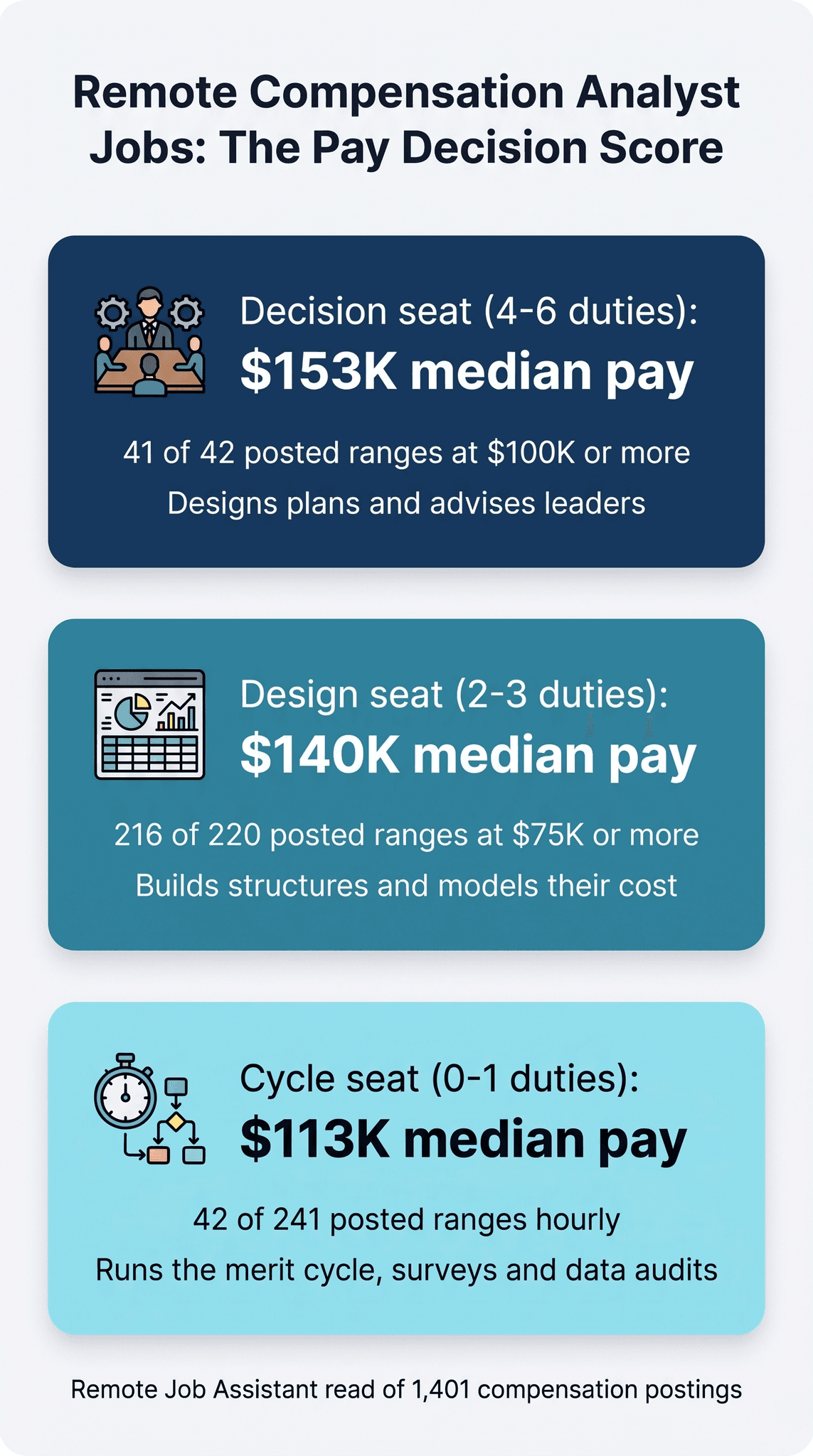
The Pay Decision Score counts how many of six decision duties a compensation posting names, from 0 to 6. The six are advising leaders or HR business partners on pay decisions and offers; designing incentive, bonus, sales-comp or equity plans; cost or scenario modeling; executive and board work (comp committee, proxy, peer groups); global scope across countries; and M&A integration.
Why it works: most comp work runs on a calendar. The merit cycle, the survey submissions, the range refresh and the data audit happen every year whether anyone is in the room or not, and they're priced like operations. The six decision duties are where a company commits money it can't easily take back: a new sales plan, an offer above the range, a structure that resets everyone's midpoint. U.S. salary increase budgets averaged 3.6% in 2026, according to WorldatWork's Salary Budget Survey. The analyst who runs that cycle executes the budget. The one who models the alternatives shapes it, and that seat is priced closer to finance.
Here's the scored rubric, using the middle half of posted pay for each band:
Cycle seat (score 0-1): $88K to $143K, median about $113K (n=241). Runs the merit and bonus cycle, submits salary surveys, prices jobs against the existing structure, audits HRIS and payroll data, answers ad hoc report requests. Hourly on 42 of 241 posted ranges. 619 postings.
Design seat (score 2-3): $110K to $167K, median $140K (n=220). Builds or refreshes structures and plans, models what they cost, partners with HR business partners on offers and promotions. 216 of 220 ranges reach $75K. 612 postings.
Decision seat (score 4-6): $135K to $184K, median about $153K (n=42). Designs incentive or equity plans, models payout scenarios for executives, works with the comp committee, covers several countries or an acquisition. 42 of 42 ranges reach $75K, 41 of them $100K, and none are hourly. 170 postings.
The full split, score by score:
| Pay Decision Score | Postings | Posted median (n) | $75K+ midpoints | Fully remote of stating | Hourly ranges |
|---|---|---|---|---|---|
| 0 | 215 | $105,000 (79) | 65 of 79 | 29 of 98 | 17 of 79 |
| 1 | 404 | $118,212 (162) | 149 of 162 | 45 of 177 | 25 of 162 |
| 2 | 358 | $140,000 (130) | 128 of 130 | 41 of 152 | 6 of 130 |
| 3 | 254 | $142,500 (90) | 88 of 90 | 51 of 128 | 2 of 90 |
| 4 | 115 | $150,000 (29) | 29 of 29 | 19 of 55 | 0 of 29 |
| 5 | 47 | $172,500 (11) | 11 of 11 | 5 of 23 | 0 of 11 |
| 6 | 8 | $143,125 (2) | 2 of 2 | 0 of 1 | 0 of 2 |
It isn't just seniority wearing a costume. Inside the same title level the score still moves pay for analysts: mid-level titles post about $85K at 0-1 (n=74) and $98K at 2-3 (n=37), and senior titles go from about $113K (n=80) to $129K (n=64) to $141K (n=9). At manager level the score stops mattering ($148K, $148K and $145K), because nearly every manager posting already advises and designs. There, the employer sets the pay: manager-level postings run about $160K at tech companies (n=35) and $170K at banks and insurers (n=17), against about $139K at health employers (n=26) and $100K in the public sector (n=8).
Half the senior titles are cycle seats. Of 376 senior-titled postings, 187 name zero or one decision duty. The title says senior; the duties describe running the calendar someone else designed.
The titles hide this in both directions. Human Interest's remote "Revenue Compensation Analyst" ($100,000 to $125,000) describes "data management, compensation calculation, ad-hoc reporting for stakeholders," a score of 0. Forbes's remote "Senior Compensation Analyst" ($80,000 to $90,000) says "Administer base salary, incentive programs, and compensation processes (merit, bonus, and salary reviews)," a score of 1. Sun Auto Tire & Service's remote "Compensation Manager" ($135,000 to $155,000) asks you to "Build and maintain incentive models, forecasts, and scenario analyses to evaluate plan design options, payout outcomes, cost implications, and business risk," a score of 4. Juniper Square's remote "Senior Compensation & Equity Manager" ($126,900 to $158,400) says "Lead the annual band refresh, including cost modeling for level and band changes." TIDI Products' remote senior analyst posting ($90,000 to $105,000) heads off the confusion directly: "This is not an HRIS administration role."
Read the verb, too. Of the 437 postings that mention incentive or bonus plan design, 60 say you'll "support" or "assist with" the design rather than own it. Those post a $135,000 median (n=19), against $150,000 for the postings that hand you the design (n=119). In those postings the design decision sits with someone else, and your job is the model behind it.
Single duties, ranked by the gap between postings that name them and postings that don't: incentive, bonus or equity plan design ($145K vs $123K, 437 postings), advising leaders ($135K vs $115K), cost modeling ($140K vs $125K), global scope ($140K vs $125K), M&A ($142K vs $128K) and executive or board work ($140K vs $128K). The cycle duties run the other way: the merit cycle ($127K with vs $135K without), market pricing ($127K vs $135K), data administration ($123K vs $137K) and compliance ($119K vs $133K).
How to use it: score a posting before you apply, then score your own last 12 months. A 0-1 posting at $105K is priced correctly. A 3-4 posting with "analyst" in the title is a design seat with a modest name, and it's the one to go after. Rewrite your resume bullets around the duties you've owned, with numbers attached: "modeled three sales-plan options for a 220-rep field team" beats "supported incentive compensation."
Running the merit cycle is the job. Designing the plan is the raise.
If you're hunting for design seats across 1,156 employers' career sites, the hard part is finding the posting before it closes, not writing the cover letter.
Stop Applying Manually
Our AI applies to hundreds of matching jobs while you sleep. Wake up to interviews, not more applications.
Who Hires Remote Compensation Analysts
Two things set your remote odds: the lane you work in and the kind of employer. Here are the lanes:
| Lane | Postings | Fully remote of stating | Posted median (n) |
|---|---|---|---|
| Broad-based (salary structures, merit, job architecture) | 1,077 | 136 of 465 (29.2%) | $127,500 (388) |
| Sales and incentive comp | 141 | 28 of 87 (32.2%) | $139,500 (57) |
| Executive and equity comp | 119 | 11 of 52 (21.2%) | $140,000 (32) |
| Provider and physician comp | 48 | 11 of 19 | $132,100 (18) |
| Comp consulting | 16 | 4 of 11 | $130,775 (8) |
And the employers:
| Employer kind | Postings | Fully remote of stating | Posted median (n) |
|---|---|---|---|
| Health systems and health companies | 256 | 49 of 115 (42.6%) | $132,500 (87) |
| Tech | 204 | 34 of 108 (31.5%) | $150,000 (84) |
| Banks, insurers, asset managers | 145 | 13 of 70 (18.6%) | $127,750 (60) |
| Public sector and universities | 82 | 3 of 32 (9.4%) | $100,274 (30) |
| Staffing agencies | 99 | 9 of 35 (25.7%) | $115,000 (29) |
| Everyone else (manufacturing, retail, services) | 556 | 72 of 241 (29.9%) | $126,753 (186) |
Health employers are the surprise. A health system's comp team already serves dozens of hospitals, clinics and physician groups spread across a region, so its analysts were working through screens and shared drives long before 2020. Mass General Brigham's postings say "Work arrangement: Remote, with flexibility to attend on-site meetings at Assembly Row in Somerville, Massachusetts, as needed." Providence titles one seat "Provider Compensation Analyst -Remote - Most states eligible." Provider comp is the most remote lane in the data (11 of 19 stating seats), partly because physician pay review runs on wRVU reports and fair-market-value files that live in systems, not offices.
Banks and insurers sit at the other end. Their comp teams sit at headquarters next to the executives they serve, and most of them now run office-attendance rules: Fidelity's postings describe "a full-time onsite working model through a phased rollout," and 51 of the 70 stating finance postings are hybrid. Public employers are the least remote (3 of 32); most government classification and compensation seats in the data are hybrid (26 of 32).
Tech pays the most and isn't as remote as its reputation. Tech companies post a $150,000 median, but only 34 of 108 stating seats are fully remote. Gusto's comp postings are listed as "San Francisco, CA - Hybrid," and SpaceX's says "This is not a remote position and will require relocation if not already local to the Hawthorne, CA area." The fully remote tech seats tend to be at companies that were distributed from the start: Chainguard's "Head of Total Rewards" ($204,000 to $240,000), Lime's "Director, Global Compensation" ($196,000 to $245,000) and Dataiku's "Global Total Rewards Lead" ($230,000 to $260,000).
If you're choosing a lane, here's the trade each one asks for:
- If remote odds matter most: go provider comp or a health system. Provider comp is fully remote on 11 of 19 stating postings, and health employers on 49 of 115. The trade is pay that trails tech at manager level (about $139K against $160K).
- If pay matters most: go sales or executive comp, or a tech employer. Sales comp posts a $139,500 median and executive comp $140,000, against $127,500 for broad-based seats. The trade: executive comp is the least remote lane (11 of 52), and sales comp ties you to quota cycles and month-end payout fire drills.
- If you want both: sales comp and provider comp both beat the overall numbers on remote share and pay. Sales comp pays more ($139,500 against $132,100); provider comp is more remote (11 of 19 stating postings against 28 of 87).
- If you're in public sector comp: expect to move employers to go remote. Only 3 of 32 stating public postings are fully remote.
Our read, and it's an opinion built on counts: a remote senior seat that only runs the cycle is a pay cut dressed as flexibility. Remote seats in the cycle band post a median of about $103K (n=36). Remote seats in the design band post about $145K (n=50). Take the remote seat that comes with a plan to design, not the one that comes with a merit file to audit.
What Remote Compensation Analysts Earn
Posted pay climbs steeply with level, and the remote discount only shows up at the analyst levels:
| Title level | Postings | Posted median (n) | Fully remote median (n) | Hybrid median (n) |
|---|---|---|---|---|
| Mid (analyst, specialist) | 308 | $89,000 (113) | $83,750 (16) | $85,452 (32) |
| Senior (senior analyst, consultant, partner) | 376 | $117,500 (153) | $109,600 (38) | $123,000 (54) |
| Manager and lead | 412 | $145,538 (176) | $147,500 (25) | $141,000 (52) |
| Director, head, VP | 270 | $188,900 (55) | $199,500 (12) | $186,386 (16) |
Salary figures come from the 503 postings that publish a range, cross-checked against the BLS median for the occupation. We excluded postings without a range rather than estimating them. Every range here was posted between January and October 2026, and we refresh the analysis each quarter.
At senior level, the remote seat is about a $13K pay cut. Why? Comp teams write the geographic pay rules, and their own remote seats get priced by them. Of the 54 hybrid senior seats that post pay, 26 sit in a big, expensive hub (San Francisco, New York, Boston, Seattle, Chicago and the like), against 1 of the 38 remote ones. A remote seat is posted on a national range and paid by where you live. Fifty of the 190 remote postings carry geo-pay language. Propelis's says "Our compensation reflects the cost of labor across several U.S. geographic markets, and we pay differently based on those defined markets." RELX/LexisNexis posts a "U.S. National Base Pay Range: $95,300 - $158,800" and adds that "Geographic differentials may apply in some locations." Remote ranges are also wider: the top of a remote range runs 28.6% above the bottom at the median (n=91), against 25% for hybrid ranges (n=151), because one range has to cover several markets. Managers and directors don't take the discount, because at that level the national talent pool sets the price, not your zip code.
Why do postings sit so far above the BLS median of $78,210? Two reasons. Postings skew senior: 1,058 of the 1,401 carry a senior, manager or director-level title. And the BLS occupation code mixes in benefits specialists and public-sector job classifiers, who earn less. The O*NET profile for compensation and benefits managers puts that occupation's median at $149,230, which lines up with the manager band here.
If $100K-plus remote HR roles are the target, our roundup of remote jobs paying $100K+ is updated daily, and the remote jobs paying $75K+ list covers the analyst band.
The comp team writes the geo-pay policy, and its own remote analysts get paid under it. If a remote posting gives one national range, ask which zone you fall in before the final round, because the answer can move your offer by more than the negotiation will.
Applying to remote design seats one career site at a time is the slow way to find out which zone you're in.
Stop Applying Manually
Our AI applies to hundreds of matching jobs while you sleep. Wake up to interviews, not more applications.
What the Postings Actually Ask For
Start with the survey. Two hundred of the 1,401 postings name a salary survey or comp platform, and the name tracks the employer's pay band:
| Survey or platform named | Postings | Posted median (n) |
|---|---|---|
| Carta | 17 | $171,250 (10) |
| Pave | 44 | $165,000 (24) |
| Radford | 110 | $144,300 (49) |
| WTW | 49 | $142,750 (18) |
| Mercer | 84 | $140,000 (37) |
| Salary.com | 30 | $120,500 (15) |
| Payscale | 30 | $93,750 (10) |
Pave and Carta show up mostly at tech and life-sciences companies that pay partly in equity (20 of the 44 Pave postings are at tech companies). Radford, Aon's survey, is the one tech teams name most: 40 of its 110 postings are at tech companies. Payscale and Salary.com show up mostly outside tech, at manufacturers, retailers and services firms (18 of the 30 Payscale postings). Chainguard asks for "Strong command of market pricing and benchmarking tools (Radford, Pave, Mercer, or similar)." AmeriSave's remote senior analyst seat ($80,000 to $125,000) "serves as the primary administrator for the company's Payscale platform." One wrinkle: the bare name "Payscale" and Payscale's enterprise tools read differently. Mintz's posting asks for "Payfactors or MarketPay by Payscale," and the 72 postings that name Payfactors or MarketPay post a $126,599 median, much closer to the Mercer and WTW group than to the $93,750 for postings that only say Payscale.
The salary survey named in a comp posting tells you the pay band before the range does.
The tools are less technical than the "data analyst" framing suggests. Excel appears in 858 postings (61.2%), and 376 spell out advanced Excel (pivot tables, lookups, VBA). Workday appears in 420 (30.0%). SQL appears in 61 (4.4%) and Python or R in 21 (1.5%). The skill that pays is building a cost model in a spreadsheet a CFO will trust, not writing code. Two postings, Savvy's and Magna Legal Services', ask for the same trait in almost the same words: "a low tolerance for unexplained variances." Sales comp is the exception: 75 of the 86 postings that name an incentive-comp platform (Xactly, Varicent, CaptivateIQ, Spiff) are sales-comp seats, and 67 of the 73 that name Salesforce are too.
The CCP shows up in 533 of 1,401 postings and is required in 10. It's a preferred line, not a gate. Postings that mention it post a $130,000 median (n=180), the same as the dataset. Several of the 10 that "require" it accept a substitute ("PHR/SPHR, SHRM-CP/SHRM SCP, or CCP required"), and 52 postings say outright that you can earn it after you're hired. Penske's asks for "CCP required or willingness to obtain within 1-2 years of entering the role." In other words, plenty of people get the comp job first and the letters later. The CCP is also a broad-based comp habit: 473 of 1,077 broad-based postings name it, against 10 of 141 sales comp postings. Sales comp asks for finance instead, with FP&A, accounting or finance experience named in 56 of 141 sales postings against 207 of 1,077 broad-based ones. WorldatWork's sales-comp (CSCP) and executive-comp (CECP) credentials show up in 11 and 25 postings. The PHR appears in 167 postings and SHRM certifications in 132. WorldatWork's CCP now takes eight courses and exams, down from 10, so it's worth doing if you're moving into comp from generalist HR, and less urgent if you already have a merit cycle and a structure refresh on your resume. Our guide to certifications that show up in remote job postings covers the HR credentials side by side.
AI is starting to appear in the duties, not just the hiring boilerplate. Of the 1,401 postings, 240 (17.1%) ask you to use AI tools in the work itself, and they pay more inside the same level: mid-level titles $105,050 (n=21) vs $87,500 (n=92), managers $163,500 (n=46) vs $140,989 (n=130). TaylorMade's analyst seat ($85,000 to $93,000) says the role "Uses approved generative AI tools, including Microsoft Copilot and Claude, to support research, analysis, documentation, and communications." Applied Intuition's comp lead seat ($180,000 to $240,000) asks for "Experience with building and implementing people solutions using AI/ Dev tools (ex. Claude, Chatgpt, Cursor)."
Experience asks are moderate. The median stated requirement is 5 years: 3 for mid-level titles, 5 for senior, 6 for managers and 10 for directors.
Title Check: Five Listings That Aren't Compensation Analyst Jobs
The word "compensation" pulls in more than one job. These came up in the searches and stayed out of every count:
Workers' compensation (69 postings). Claims examiners, claim representatives, staff attorneys and nurse case managers at Travelers (15), The Hartford (8), CNA, ICW Group and Sedgwick. It's insurance claims work, and about 1,150 searches a month for "remote workers compensation jobs" land on the same words. If that's actually your field, our remote claims adjuster guide is the better read.
Commission payout seats (64 side titles). "Commissions Analyst" and "Sales Commission Analyst" seats run monthly payout calculations and statements. They're real and adjacent (median $105,400, n=21, and 18 of 36 stating seats remote). OpenLoop's posting explains why they matter: "Commissions are the most personal number in the company. When a plan is unclear or a statement is wrong, reps stop trusting the plan." But Owner.com's contract posting says what they usually aren't: "We're not looking for plan design or comp strategy work."
Stock plan administration. Stock plan administrators and equity-plan consultants process grants, vesting and exercises. It's a back-office path into executive comp, not a comp analyst seat.
Deferred-comp and retirement-plan sales. "Internal Retirement Specialist" and deferred-compensation enrollment seats sell and enroll retirement plans. They're sales jobs.
Offshore and template listings. Accenture's "Total Rewards Associate" seats are offshore operations roles, and one "Consultant – Remuneration & Total Rewards" posting appeared under 10 unrelated company names on LinkedIn.
The commission payout seat is the one worth a second look, because it's the most common side door into sales comp design.
How to Move From a Cycle Seat to a Design Seat
Where you start decides the move. Work down the tree until a branch fits:
1. Do you calculate commissions or payouts today?
- Yes: move into sales comp design. Sales and incentive comp seats post a $139,500 median, and the step up is plan modeling: build three plan options with cost and payout curves, then show them to a sales leader. Learn the platform your target employers name (Xactly, Varicent and CaptivateIQ lead), because 75 sales-comp postings name one.
- No: go to question 2.
2. Is comp your main job, or one part of a generalist HR job?
- One part of a generalist job: target health systems first. They're the most remote employers in the data (49 of 115 stating seats). Pair the search with the CCP if your resume doesn't show a full merit cycle.
- It's my main job: go to question 3.
3. Did you come to comp from FP&A or finance?
- Yes: your modeling skills are the scarce half of the job. Cost modeling is one of the six decision duties (postings that name it post $140K vs $125K), so lead with the models you've built and learn the survey basics. Our remote financial analyst guide covers the finance side of that move.
- No: go to question 4.
4. Does your current seat already score 2-3 on the Pay Decision Score?
- No, I mostly run the cycle: own one design project before you apply. Lead a structure refresh, a job architecture cleanup or an incentive-plan cost model, then put the number on your resume. Mid-level titles at score 2-3 post about $98K against $85K at 0-1.
- Yes: the next step is advising, not more analysis. Ask to present your model to the leader who decides. One hiring manager on Hacker News described the other side of that table: the HR "compensation analyst" would only approve a lower range, then HR came back weeks later asking whether they'd "consider raising the salary range" because HR had been having trouble filling jobs. The analyst who can make that call the first time is the one who gets paid like a partner.
Before you take any remote offer, ask three questions and know what a good answer sounds like. Which pay zone applies to me? A good answer names the zone and the range for it; "we'll figure that out at offer" means the top of the posted range isn't yours. Which survey does the team buy? Radford, Pave, Mercer or WTW suggests a design-heavy team with a budget; a single self-serve platform suggests a cycle team. Will I own a plan or support one? A good answer names the plan and the leader you'll present it to.
Ask what the last plan or structure this team designed was, and who presented it to leadership. If the answer is "our VP," and the posting said "support the design," you're interviewing for a cycle seat with a design title.
Once you know which seats you want, the bottleneck is volume: finding enough of them across 1,156 employers.
Stop Applying Manually
Our AI applies to hundreds of matching jobs while you sleep. Wake up to interviews, not more applications.
The Remote Small Print
Remote comp seats carry a few conditions worth reading before you apply.
Pay zones. Fifty of the 190 remote postings carry geo-pay language. A national range with differentials usually means the top of the range is for hub locations.
State lists. Eighteen of the 190 remote postings limit the states you can live in. SullivanCotter's say "This is a remote role; however, we only operate in the following states" and list 16.
Time zones. Fourteen name a time zone or core hours.
Posted pay. Remote postings are more likely to publish a range (92 of 190) than hybrid ones (154 of 359), so you can screen remote seats on pay before you apply.
Global seats. Postings with global scope (337 of 1,401) can pick up European reporting work. The EU Pay Transparency Directive required member states to bring it into law by 7 June 2026, and employers with 150 or more workers there must report pay gaps from 7 June 2027.
For the broader HR picture, our complete guide to remote HR jobs covers the other functions, and the remote benefits specialist guide covers the benefits half of total rewards.
Frequently Asked Questions
I'm a compensation analyst making about $85K. What kind of remote role gets me to $120K or more?
A senior seat that designs, not one that only runs the cycle. Senior titles post about $129K when the posting names two or three decision duties (n=64), against about $113K at zero or one (n=80). Look for postings that ask you to model plan costs, design an incentive plan or advise leaders on offers.
Is a remote compensation analyst job worth it if it pays less than the hybrid version?
Sometimes. At senior analyst level, remote seats post a median of about $110K (n=38) against $123K for hybrid (n=54), mostly because remote seats are paid on geographic zones. At manager and director level the gap disappears, so the remote discount is mainly an analyst-level cost.
Do I need the CCP to get a remote compensation analyst job?
No. The CCP appears in 533 of 1,401 postings (38.0%) but is required in only 10 (0.7%), and several of those accept a PHR or SHRM certification instead. It helps most if you're moving into comp from generalist HR.
How do I tell if a compensation posting is a cycle seat or a design seat?
Count the Pay Decision Score duties in the posting: advising leaders, plan design, cost modeling, executive or board work, global scope and M&A. Zero or one is a cycle seat (median about $113K), two or three is a design seat ($140K) and four or more is a decision seat (about $153K).
Which employers hire the most remote compensation analysts?
Health systems and health companies: 49 of 115 stating postings (42.6%) are fully remote, including Mass General Brigham, Providence, Cleveland Clinic and Sentara Health. Banks and insurers are the least remote at 13 of 70 (18.6%), and public employers sit at 3 of 32.
Is sales compensation a better path than broad-based compensation for remote work?
Slightly, on both counts. Sales and incentive comp seats are fully remote on 28 of 87 stating postings (32.2%) against 136 of 465 broad-based ones (29.2%), and they post a $139,500 median against $127,500. The trade-off is that sales comp ties you to quota cycles and incentive platforms like Xactly or Varicent.
Are compensation analysts being replaced by AI tools?
The postings point the other way for now: 240 of 1,401 (17.1%) ask analysts to use AI tools in the work, and those postings pay more inside the same level. Mid-level titles that name AI tools post about $105K (n=21) against $88K without.
Find Your Next Remote Compensation Role
Of 1,401 postings, 190 are fully remote, and they cluster at health systems, distributed tech companies and the provider-comp desks that never needed an office. Screen them the same way every time: count the decision duties, read the verb in front of "design," note the survey name, and get the pay zone before the final round.
Browse current remote HR jobs and HR and recruiting openings, read our guide to remote people operations jobs for the generalist side, or compare notes with our remote payroll jobs guide if you're coming from payroll. When you're ready to apply at volume, Auto-Apply sends tailored applications to the seats that match.
Most companies will let you run the merit cycle from anywhere. The ones that pay $140K want you on the call when the sales plan gets rewritten.
Ready to Find Your Remote Job?
Browse thousands of curated remote jobs or let AI apply for you.
Browse Remote JobsRelated Job Guides
Remote Benefits Specialist Jobs: 131 of 1,523 Are Remote
We read 1,523 benefits specialist postings. 131 are fully remote. See which employers hire remote, which seats pay $75K+, and how to spot look-alike listings.
25 min read
Remote Auditor Jobs: 554 of 3,422 Postings Are Fully Remote
We read 3,422 auditor job postings. 554 are fully remote, and 244 of those are healthcare audits. See which audit seats hire remotely and what each pays.
27 min read
Remote Loan Processor Jobs: 49 of 490 Are Fully Remote
We read 490 loan processor postings. 49 are fully remote, most at non-bank lenders. See who pays hourly, who pays per file, and where $75K processor pay starts.
24 min read