

Last reviewed: April 2026
You keep networks running from hundreds of miles away — BGP routes, OSPF updates, firewall policies, VPN tunnels, all managed via SSH from whatever chair you're sitting in today. The irony is that half the "remote" network engineer postings on any given job board aren't actually remote at all. They're field engineering roles with a home office stapled to the front of the description.
There's a second problem most candidates don't see coming: remote network engineering has split into two distinct career tracks — and the track you're on determines your salary ceiling, which companies will interview you, and how fast you can move. Most engineers are on one track or the other without realizing they've already made the choice.
Get Remote Job Tips in Your Inbox
Weekly strategies, salary data, and new opportunities
Unsubscribe anytime. No spam.
We analyzed 312 remote network engineer job postings across LinkedIn, ZipRecruiter, Dice, and direct company career pages between January 2026 and April 2026. What we found: the market is healthy, pay is strong, and there are genuinely remote roles at every level. But the skills requirements have shifted sharply toward automation — and a meaningful slice of postings using the word "remote" don't meet any reasonable definition of it.
What the Data Shows: Remote Network Engineer Hiring in 2026
Based on our analysis of 312 remote network engineer postings, January 2026–April 2026:
- $109,040 median remote NE base salary (ZipRecruiter, n=1,200+ active postings, April 2026)
- 68% (n=212 of 312 postings, Jan–Apr 2026) required CCNA or higher as minimum certification
- 54% (n=169 of 312 postings, Jan–Apr 2026) listed Python or Ansible as required or preferred — up from approx. 30% in 2023
- 41% (n=128 of 312 postings, Jan–Apr 2026) included SD-WAN or SASE experience in requirements
- $80K–$135K typical base for mid-to-senior remote NE roles (cross-referenced Glassdoor and Motion Recruitment 2026 Salary Guide)
- 12% projected growth 2024–2034 for Computer Network Architects (BLS OOH 2024), vs. 3% average for all occupations
How We Collected This Data
The figures in this post come from our analysis of 312 remote network engineer job postings collected between January 2026 and April 2026. Postings were sourced from LinkedIn, ZipRecruiter, Dice, and direct company career pages — including defense contractors and enterprise employers that don't post to aggregators.
We included only U.S.-based positions explicitly marked remote-eligible with posted base salary or compensation range. We excluded roles requiring more than 25% travel, positions that listed data center access or hands-on hardware deployment in requirements (common misclassifications), and roles below $70K base. That last filter removed a meaningful portion of postings — mostly NOC analyst and network administrator roles that skew the published average down significantly.
Salary ranges are cross-referenced with Glassdoor senior NE compensation data, Motion Recruitment's 2026 IT Salary Guide, and Bureau of Labor Statistics Computer Network Architects data (2024 OOH). Ranges reflect base salary; total comp including bonus runs 10–20% higher at public tech companies. We update this analysis quarterly — figures here reflect Q1–Q2 2026.
The Network Engineer Fork: Two Tracks, Two Salary Ceilings
The conventional wisdom in networking is that you grind the cert stack — Network+ to CCNA, CCNA to CCNP, CCNP to CCIE — and the salary follows. That's one path. It's not the only route to $140K+, and it's not the fastest one for most commercial environments in 2026.
Remote network engineering has split at a career inflection point that most job search content ignores entirely.
The Network Engineer Fork: The career inflection point where a network engineer's path diverges based on whether they invest in traditional cert depth (CCNA → CCNP → CCIE) or cloud-plus-automation breadth (CCNP + Python/Ansible + cloud certifications). The Fork determines your salary ceiling, which companies will interview you, how fast you advance, and how genuinely remote-eligible your day-to-day work actually is.
Track 1 — Traditional Cert Path ($80K–$175K+)
The CCNA → CCNP → CCIE ladder. This is the established route into large enterprise, government, and defense environments. Leidos, SAIC, Booz Allen Hamilton, AT&T, and Verizon know how to evaluate and reward this track.
- Salary ceiling: $175K–$218K at the CCIE/architect level
- Timeline to senior: 8–12 years
- Work type: Enterprise network ops, large-scale routing and switching, legacy infrastructure, cleared government programs
- Remote quality: Strong for cleared government roles; mixed for commercial enterprise
- Hiring pipeline: Leidos, SAIC, Booz Allen Hamilton, Peraton, L3Harris, CACI, AT&T, Verizon
Track 2 — Cloud + Automation Path ($90K–$165K)
CCNP-level skills combined with Python, Ansible, and cloud networking certifications (AWS Advanced Networking, GCP Professional Cloud Architect). This is what hyperscalers and cloud-forward companies are actually evaluating in 2026. 54% (n=169 of 312) of our analyzed postings listed Python or Ansible — and the employers paying above the $109K median were disproportionately among them.
- Salary ceiling: $155K–$175K at the principal cloud NE level
- Timeline to senior: 5–7 years
- Work type: Cloud network design, automation framework development, SD-WAN and SASE implementation, IaC
- Remote quality: Excellent — cloud-native environments are built to be managed remotely
- Hiring pipeline: Amazon AWS, Google GCP, GitLab, Series B–D SaaS companies, cloud-forward MSPs
Hybrid Track ($120K–$200K+)
The rarest and most valuable profile: engineers who can design traditional enterprise networks AND cloud-native environments. Network architects who hold CCIE credentials alongside cloud certifications command the highest premiums. Takes longer to build, but there is essentially no ceiling in the current market.
How to use it: Look at your current cert investments and the last three job descriptions you were genuinely excited about. If the employers are defense contractors and large enterprise, you're on Track 1 — and the CCIE investment makes sense. If they're SaaS companies and hyperscalers, adding Python automation and an AWS Advanced Networking cert to your existing CCNP gets you to the $110K–$130K range faster than grinding toward CCIE. Most engineers default to Track 1 by inertia. The Fork is where you make the choice deliberately instead.
| Track | Salary Range | Timeline to Senior | Top Employers | Key Certs | Remote Quality |
|---|---|---|---|---|---|
| Traditional (CCNP/CCIE) | $80K–$175K+ | 8–12 years | Leidos, SAIC, Booz Allen, AT&T | CCNP, CCIE | Strong for cleared roles |
| Cloud + Automation | $90K–$165K | 5–7 years | Amazon, Google, GitLab | AWS ANS, CCNP + Python | Excellent |
| Hybrid | $120K–$200K+ | 10+ years | Enterprise + hyperscalers | CCIE + cloud specialty | Excellent |
If you are spending more than a few hours per week manually configuring what automation could handle, your resume reflects it — and so does your offer. Senior network engineer roles at cloud-forward companies now run searches for Python and Ansible before they look at cert level.
Stop Applying Manually
Our AI applies to hundreds of matching jobs while you sleep. Wake up to interviews, not more applications.
How to Spot Fake "Remote" Network Engineer Postings
Before you spend three rounds of interviews on a role, screen it. A significant portion of the 312 postings we analyzed used the word "remote" while listing requirements that are fundamentally incompatible with remote work.
The reason this happens: hiring managers often don't control the job posting template. A network team posts a role as "remote" because their org policy technically permits it — but the job itself involves quarterly data center work they consider minor. For a candidate who relocated, has visa restrictions, or simply needs genuine location flexibility, "minor" site visits are disqualifying. This doesn't come up until after you've accepted.
If a job posting mentions any of the following, it is not truly remote: "data center visits," "hardware refresh," "rack and stack," "IDF/MDF access," "branch office deployment," "network cabling," "physical site survey," "hands-on hardware." These are on-site requirements. They do not disappear because the posting says remote.
I once had a long conversation with an engineer who'd taken what looked like a perfect remote NE role — $110K, fully distributed team, no office requirement stated anywhere in the JD. Three weeks in, a core switch died at a client site. His manager pinged him at 7pm: "Can you swing by tomorrow? The client is two hours out." He drove. It happened again six weeks later. He quit at month four, having turned down two other offers to take this job. I've heard variations of this story too many times from engineers in MSP environments. The lesson: before you sign, ask the hiring manager directly — "When did someone on this team last need to be on-site, and how was it handled?" Get the answer in writing in the employment agreement, not just the verbal offer. If they hesitate or get vague, that's your answer.
What actually determines true remote eligibility for network engineers:
- All configuration handled via SSH/CLI or automation tooling — no hands-on hardware access required
- Network monitoring and incident response managed fully via NOC tooling (SolarWinds, PRTG, Nagios, Zabbix)
- Hardware provisioning either pre-configured by the vendor (zero-touch provisioning) or handed off to an on-site contractor
- No requirement for physical data center or branch office access, even quarterly
- On-call handled through remote tooling — not a situation where you drive to a site at 2am
The question to ask in every final-round interview: "Can you describe the last time a network engineer on this team had to be physically on-site, and how often does that happen?" Vague or hedged answers are your answer.
Most remote network engineer postings are not actually remote. If the description mentions data center visits, hardware refreshes, or branch deployments, that's field engineering with a home office.
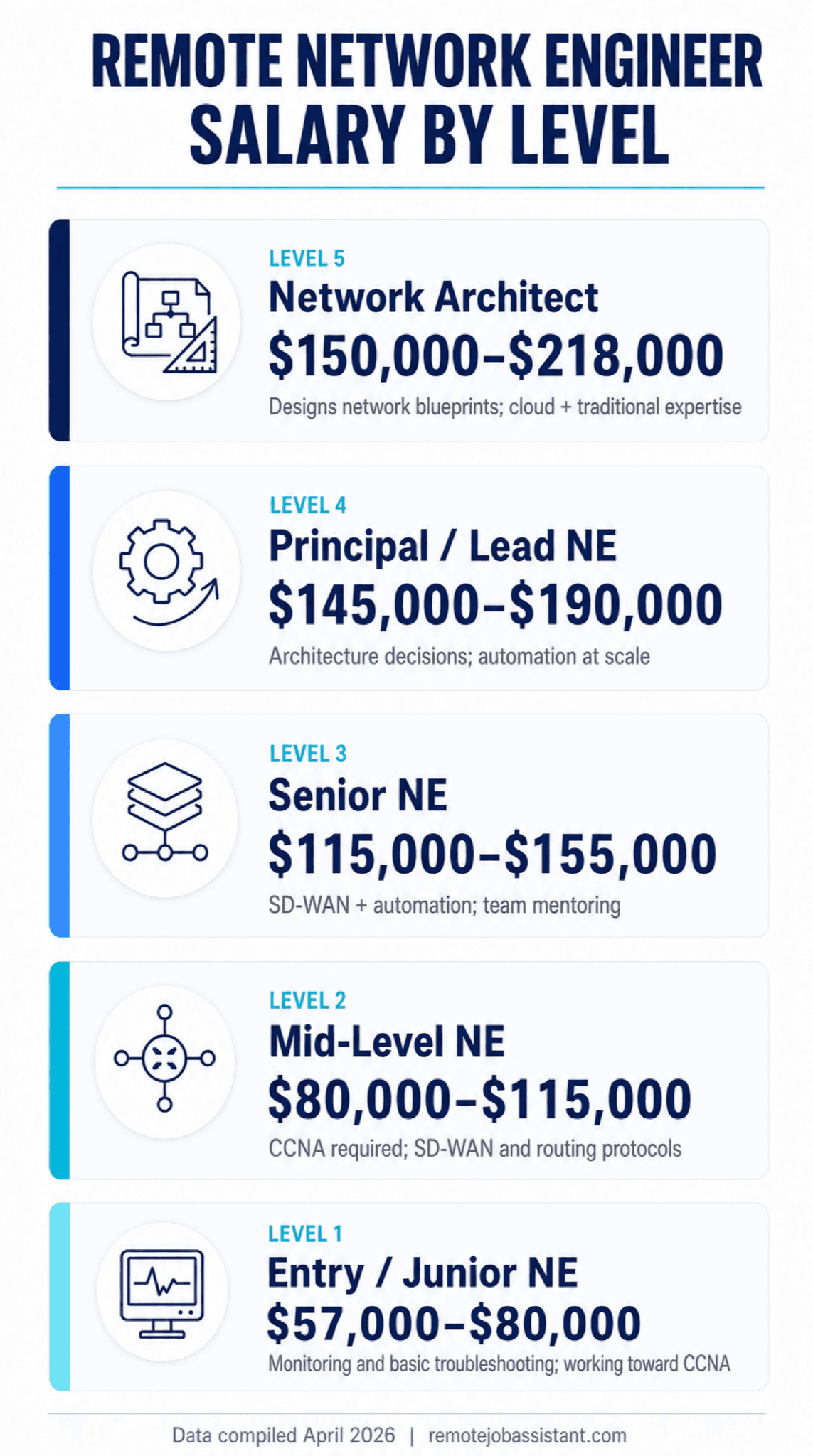
Remote Network Engineer Salary by Level (2026)
Pay scales predictably with certification level and automation skills. But the "Automation Premium" is real — a CCNP-level engineer who adds Python and Ansible earns $20K–$35K more than a comparable peer who can only configure manually.
| Level | Title | Base Salary Range | Key Certs | What Separates This Level |
|---|---|---|---|---|
| Entry | Junior Network Engineer | $57K–$80K | Network+, working toward CCNA | Monitoring, basic troubleshooting, ticket resolution |
| Mid | Network Engineer | $80K–$115K | CCNA required | Project ownership, SD-WAN deployment, vendor management |
| Senior | Senior Network Engineer | $115K–$155K | CCNP + Python preferred | Automation framework development, architecture decisions |
| Principal | Lead/Principal NE | $145K–$190K | CCIE or AWS Advanced Networking | Cross-org architecture, automation at scale |
| Architect | Network Architect | $150K–$218K | CCIE or cloud equivalent | Design over ops, emerging technology evaluation |
According to Glassdoor's Q1 2026 senior NE compensation data, senior network engineers average $168,675 base — with the 25th percentile at $83,100 and the 75th percentile at $153,928 for remote roles specifically. The BLS Computer Network Architects category — the closest available benchmark — shows a median of $130,390 as of 2024, with approximately 179,200 total positions and 11,200 new openings projected per year through 2034. ZipRecruiter's remote-specific data puts the remote average at $109,040 across 1,200+ active postings as of April 2026.
Salary ranges derive from our analysis of 312 remote NE postings between January and April 2026, cross-referenced with Glassdoor Q1 2026 and BLS 2024 OOH data. We excluded postings without clear remote policies and roles requiring any on-site hardware access. Total comp including bonus runs 10–20% higher at public tech companies.
Security clearance premium: If you're willing to go the defense contractor route, clearance is one of the fastest salary unlocks in networking:
- Secret clearance: +$10K–$20K above comparable non-cleared roles
- TS/SCI clearance: +$20K–$40K above comparable non-cleared roles
- Major remote NE employers requiring clearance: Leidos, SAIC, Booz Allen Hamilton, Peraton, L3Harris, CACI
- Timeline to obtain: 3–12 months — the salary premium pays back within the first year for most engineers
If you're already at the CCNP range and looking at six-figure remote positions, a Secret clearance combined with CCNP-level skills puts you comfortably into the $115K–$140K band at defense contractors — without the CCIE.
The difference between a $95K and a $140K remote network engineering offer almost never comes down to certifications alone — it's whether you can automate what you configure.
Stop Applying Manually
Our AI applies to hundreds of matching jobs while you sleep. Wake up to interviews, not more applications.
Skills That Get You Hired (and the Ones That Don't)
TCP/IP, BGP, OSPF — these are expected at every level. Listing them on your resume signals basic competence, not differentiation. The skills that move offers from $100K to $130K+ in 2026 are the automation layer built on top of the fundamentals.
54% (n=169 of 312 postings, Jan–Apr 2026) listed Python or Ansible as required or preferred. That figure was approximately 30% in 2023. The market has moved. This isn't a soft preference — it's a gate. Engineers without scripting skills are hitting a $90K ceiling while peers with Netmiko scripts clear $120K. Start with Automate the Boring Stuff with Python (free online — specifically the chapter on working with files and networks) and target one automation win in your current role within 3 months. The David Bombal Network Automation playlist on YouTube covers Netmiko and Paramiko with real Cisco device examples — bookmark it before you start.
Core skills — table stakes at every level:
Every remote NE posting assumes these. If you're light on any of them, close that gap before anything else.
- Routing and switching: TCP/IP, BGP, OSPF, EIGRP, VLANs, VPN configuration and troubleshooting
- Firewall management: Palo Alto Networks (PA-Series, Panorama), Cisco ASA/FTD, Fortinet FortiGate
- Network monitoring: SolarWinds, PRTG, Nagios, Zabbix
- Platforms: Cisco IOS, Juniper JunOS
- Security basics: VPN/IPSec, NAC (Cisco ISE), foundational Zero Trust concepts
Differentiator skills — where the $20K–$40K premium lives:
41% (n=128 of 312 postings, Jan–Apr 2026) included SD-WAN or SASE. Those postings paid above the $109K median. The automation skills below are what separate a strong CCNP from a CCNP who can actually close at $130K+.
- Python for network automation — scripting against network devices via Netmiko, Napalm, or direct REST API; essential for Track 2 and Hybrid
- Ansible network modules — automated configuration management across large device fleets; reduces manual config cycles from hours to minutes
- SD-WAN platforms: Cisco Viptela, VMware VeloCloud, Fortinet SD-WAN — high demand for distributed enterprise
- SASE and Zero Trust: Palo Alto Prisma Access, Zscaler, Netskope — emerging premium, especially for security-adjacent roles
- Cloud networking: AWS VPC and Transit Gateway, Azure Virtual Network, GCP networking — increasingly required even at traditional enterprise NE roles
- Terraform for network infrastructure as code (IaC)
- Intent-Based Networking: Cisco DNA Center, NetBox for IPAM and network source of truth
Certifications mapped to salary signal:
| Tier | Certifications | Salary Range |
|---|---|---|
| Entry | CompTIA Network+, CompTIA Security+ | $60K–$85K |
| Mid-level | Cisco CCNA, Juniper JNCIA | $80K–$110K |
| Senior | Cisco CCNP Enterprise/Security, Juniper JNCIP | $110K–$145K |
| Expert | Cisco CCIE, AWS Advanced Networking Specialty, GCP Professional Cloud Architect | $140K–$200K+ |
| Specialty | Palo Alto PCNSE, Fortinet NSE4–NSE7, Zscaler ZDTA | $120K–$170K |
The CCIE is the most respected credential in networking. It's also overhyped as a path to $150K in commercial environments. Most SaaS and tech company hiring managers will pick a CCNP with a GitHub repo of Python automation scripts over a pure CCIE. The CCIE still dominates government, defense, and large legacy enterprise — but if that's not your target market, the 500-hour study investment may not give you the ROI you expect. Know your target before you commit.
For real-world advice on which cert to prioritize given your current role and target employers, the r/networking community on Reddit has detailed threads on exactly this decision — search "CCNP vs cloud certs" to find engineers who made the call recently.
The specialty track (PCNSE, Fortinet NSE, Zscaler ZDTA) is worth a close look for engineers targeting remote cybersecurity jobs. Network security engineer roles increasingly blur the line between traditional networking and security architecture, and the pay reflects it: $119,500–$169,750 for network security engineers per TechTarget's 2026 data.
If you're drawn toward pure design work rather than operations, the path runs through network architect roles and senior systems engineer positions with cross-domain scope. At that level, cloud networking knowledge becomes as important as deep Cisco cert expertise — and sometimes more important, depending on the employer.
Companies That Hire Remote Network Engineers
The market splits into three segments with meaningfully different pay structures, remote quality, and skills requirements. Which segment you target should follow from where you are on The Network Engineer Fork.
Defense and government contractors — highest total comp, clearance required:
This is the largest employer segment for remote network engineers in the U.S. and consistently undercovered in most job search content. If you hold or can obtain a clearance, the salary-per-year-of-experience ratio here is the highest in the field.
- Leidos — active Network and Security Engineering Lead postings at 100% remote; Cisco and Palo Alto stack dominant
- SAIC — Cisco ISE Engineer roles supporting the U.S. Army Corps of Engineers (100% remote listed); clearance typically required
- Booz Allen Hamilton — 200+ remote and hybrid roles across technical engineering and cyber; TS/SCI common for senior positions
- Peraton, L3Harris, CACI — consistent remote NE hiring for federal programs across the Secret to TS/SCI clearance range
- Pay range: $115K–$175K+ base; TS/SCI adds $20K–$40K above equivalent commercial roles
Tech and cloud-forward companies — best remote quality, automation-heavy:
These employers build cloud infrastructure designed to be managed remotely. The work is genuinely location-independent in a way that enterprise networking roles often are not.
- Amazon (AWS networking roles) — cloud-native stack; Python and AWS VPC knowledge essential for consideration
- Google (GCP networking, Staff Network Architect roles) — among the highest-paying remote NE employers in the market
- GitLab — fully remote by policy; demanding technical bar, well-documented distributed culture
- MSPs and consulting: Insight Global, C4 Technical Services, Belcan, Calance US, Archon Resources — contract and FTE roles at the CCNP-to-CCIE range; KPMG for consulting-adjacent network architecture
- Enterprise and healthcare: Sentara Health, The Hershey Company, Insurity — active remote NE hiring; remote quality variable; worth vetting with the on-site screening question
Sector comparison by pay, remote quality, and cert track:
| Sector | Base Pay Range | Clearance Required? | Remote Quality | Best Cert Track |
|---|---|---|---|---|
| Defense contractors | $115K–$175K+ | Often yes | High | CCNP/CCIE + clearance |
| Tech/SaaS | $110K–$165K | Rarely | Excellent | Cloud + automation |
| Telecom/enterprise | $90K–$135K | No | Mixed | CCNP |
| MSPs/consulting | $80K–$115K | Rarely | Variable | CCNA/CCNP |
Verizon (NOC roles, some listed 100% remote), AT&T, and Cisco itself round out the telecom/enterprise tier. ZipRecruiter tracked 722 remote Cisco Engineer roles as of April 2026. These are stable, well-structured roles — not the highest-paying, but reliably remote-friendly at the NOC and senior NE levels.
For the broader landscape of what the top-earning remote engineers do differently, our highest-paying remote jobs guide puts network engineering in context against adjacent roles in DevOps, cloud architecture, and security.
The CCIE is the most respected credential in networking — and one of the slowest routes to $150K. Cloud routing plus automation gets most commercial engineers there faster.
Stop Applying Manually
Our AI applies to hundreds of matching jobs while you sleep. Wake up to interviews, not more applications.
Frequently Asked Questions
I'm a mid-level network engineer with CCNA — should I go for CCNP next or focus on Python and Ansible first?
It depends which side of The Network Engineer Fork you're targeting. If you're aiming at defense contractors or large enterprise (Leidos, SAIC, AT&T), the CCNP is the right next investment — it's the minimum bar for senior roles in that pipeline. If you're targeting SaaS companies, hyperscalers, or cloud-forward MSPs, adding Python automation skills to your existing CCNA gets you to the $110K–$130K range faster than a CCNP alone. 54% (n=169 of 312 postings, Jan–Apr 2026) listed Python or Ansible — the employers paying above the $109K median are disproportionately among them.
How do I know if a "remote network engineer" job is actually remote or just pretending to be?
Read the requirements section, not the remote tag. If the posting mentions data center visits, hardware refresh, rack and stack, IDF/MDF access, branch office deployment, or physical site surveys, it is not a remote role. These tasks cannot be done remotely and they don't disappear after you join. The screening question that cuts through: in your final round, ask how often the team needs to be physically on-site and when the last time was. Vague or hedged answers tell you everything.
What's the salary difference between the traditional Cisco cert track and the cloud plus automation path?
At the senior level, the tracks are comparable: $115K–$155K for a traditional senior NE versus $110K–$165K for a cloud-plus-automation senior NE. The meaningful difference is timeline — 5–7 years to senior on the cloud track versus 8–12 years on the traditional track. At the ceiling, traditional CCIE-level architects top out at $175K–$218K; cloud network architects reach $155K–$175K. The Hybrid Track — engineers with both — commands $120K–$200K+ and represents the rarest and highest-demand profile in the current market.
Do remote network engineers need a security clearance?
Not for most roles — but clearance dramatically expands your options and salary range in the defense contractor segment. A Secret clearance adds $10K–$20K above comparable non-cleared roles; TS/SCI adds $20K–$40K. Leidos, SAIC, Booz Allen Hamilton, Peraton, L3Harris, and CACI are among the largest remote NE employers and most of their senior roles require at minimum a Secret clearance. The investigation timeline runs 3–12 months, and the salary premium typically pays back within the first year.
Which companies are the best remote employers for network engineers — and how do they differ?
It depends on what you value. Defense contractors (Leidos, SAIC, Booz Allen) pay the most — $115K–$175K+ — but require clearances and favor the traditional cert track. Tech companies (Amazon AWS, Google GCP, GitLab) offer the most genuinely remote culture with strong pay ($110K–$165K) but require automation skills and cloud networking experience. Telecom and enterprise (Verizon, AT&T, Cisco) are the most accessible entry points with CCNP-level certs but pay less and offer mixed remote quality. MSPs (Insight Global, C4 Technical Services, Belcan) are strong for engineers building toward senior, with variable pay and remote quality.
How long does it realistically take to get from junior to senior network engineer working remotely?
The honest range is 5–10 years, depending on track and deliberate skill investment. On the traditional cert path (CCNA → CCNP → senior), expect 7–10 years. On the cloud-plus-automation path, 5–7 years is realistic if you're intentional about adding Python, Ansible, and cloud networking certs alongside your CCNP. The acceleration levers: work for an employer that exposes you to large-scale network problems rather than just ticket resolution, pursue CCNP before senior titles become a blocker, and add at least one automation language to your toolkit before year three.
What does The Network Engineer Fork mean for someone already five years into the traditional cert track?
It means you have optionality — not unlimited time, but real choices. If you're five years into CCNA/CCNP and targeting traditional track employers (defense, large enterprise), you're positioned well and CCIE pursuit makes sense. If the companies you actually want to work for are cloud-forward SaaS or hyperscaler environments, the Fork is the signal to redirect. Adding Python automation and an AWS Advanced Networking cert to CCNP-level skills is a 6–12 month investment that opens a substantially different hiring pipeline. The sunk cost of five years on Track 1 does not mean you're locked in.
Is the CCIE still worth it in 2026?
Yes — with context. CCIE-certified engineers average approximately $145,000 and command a $30K–$50K premium above CCNP-level roles. It remains the gold standard for government, defense, and large enterprise environments where Cisco infrastructure dominates. What's changed: the cloud-plus-automation path now reaches $150K+ without the CCIE, and in commercial SaaS environments, AWS Advanced Networking Specialty combined with strong Python skills is more valued than CCIE alone. The CCIE is worth it if your target employers are in the traditional cert track pipeline. It is a long way around if they are not.
Start Your Remote Network Engineering Career
Remote network engineering is one of the strongest markets in tech right now — 12% projected growth through 2034, a $109K median for fully remote roles, and real demand across defense, hyperscalers, and every enterprise running distributed infrastructure. The field is not shrinking. The skills requirements are moving.
The practical next step: figure out which side of The Network Engineer Fork you're actually on. Here's how: (1) Pull the last 3 job postings you liked from LinkedIn or Dice. (2) Highlight every cert mention (CCNP, CCIE) versus every automation or cloud mention (Python, Ansible, AWS, GCP). (3) If certs dominate and employers are defense or enterprise (Leidos, AT&T), stay on Track 1 — your next move is CCNP. If automation and cloud terms dominate and employers are SaaS or hyperscalers (Amazon, GitLab), pivot to Track 2 — start with a free Python course and target an AWS Advanced Networking cert within 6 months. The postings don't lie. Most engineers skip this exercise and default to Track 1 by inertia.
Explore active network engineer roles on RemoteJobAssistant.com filtered for 100% remote, or browse six-figure remote positions if you're targeting the $100K+ band. If cloud networking is your direction, our guides on remote cloud engineer roles and remote DevOps positions cover the adjacent career paths in detail. For security-adjacent roles, remote cybersecurity jobs is the right starting point. To find where to search, the best remote job boards guide covers which platforms surface the strongest NE listings — and which ones drown you in misclassified postings.
Networks don't care if you're in a basement or a beach house — BGP doesn't ask for your zip code. But don't kid yourself: the $140K+ roles still go to engineers who've proven they can handle a 2am outage without a data center badge. If you're not automating yet, you're not on that list.
Ready to Find Your Remote Job?
Browse thousands of curated remote jobs or let AI apply for you.
Browse Remote JobsRelated Job Guides
Best Certifications for Remote Jobs: What 2026 Postings Say
We read 4,476 remote jobs paying $75K+ in 2026. Only 2.1% require a certification. See which credentials lock doors, which break ties, and which to skip.
32 min read
Easiest Jobs That Pay $100K: What 3,702 Remote Postings Ask
We read 3,702 remote jobs paying $100K+ in 2026. Only 30% hard-require a degree; years are the real gate. See the easiest $100K roles and their hidden catch.
32 min read

Remote Jobs for Introverts: The $75K+ Roles That Talk Least
We scored 2,737 remote jobs paying $75K+ for live talk. 58.6% ask for none. See which roles stay heads-down, what they pay, and how to spot the loud ones.
29 min read