
You're scrolling through remote sales job listings, and you see the same alphabet soup over and over: SDR, BDR, AE, CSM. One company calls it "Sales Development Representative." Another calls the exact same job "Business Development Representative." A third just says "Inside Sales."
It's confusing. And that confusion costs you time—applying to roles that aren't what you thought, or skipping past jobs that were actually perfect.
At Remote Job Assistant, we track thousands of remote sales job postings every month. Here's what we've learned: about 60% of companies use SDR and BDR interchangeably. The titles are inconsistent, but the actual work usually falls into clear categories once you know what to look for.
Get Remote Job Tips in Your Inbox
Weekly strategies, salary data, and new opportunities
Unsubscribe anytime. No spam.
This guide breaks down every major remote sales role—what you'll actually do, what you'll earn, and which one fits your career goals.
SDR (Sales Development Representative) typically handles inbound leads from marketing. BDR (Business Development Representative) focuses on outbound prospecting to find new customers. AE (Account Executive) closes deals and carries a revenue quota. In practice, many companies use SDR and BDR interchangeably—always read the job description, not just the title.
Remote Sales Roles at a Glance
Before diving into details, here's the quick reference. This table covers the most common remote sales roles you'll encounter:
| Role | What It Stands For | Primary Job | Carries Quota? | Typical Remote OTE |
|---|---|---|---|---|
| SDR | Sales Development Representative | Qualify inbound leads, book meetings | No | $55K–$85K |
| BDR | Business Development Representative | Outbound prospecting, open new accounts | No | $60K–$90K |
| AE | Account Executive | Run demos, negotiate, close deals | Yes | $100K–$200K+ |
| Closer | High-Ticket Closer | Close warm leads on high-value offers | Yes | $100K–$400K+ |
| SDR Manager | — | Lead a team of SDRs | Team targets | $120K–$180K |
Now let's break down each role in detail.
What Is an SDR? (Sales Development Representative)
SDR stands for Sales Development Representative. An SDR's primary job is to qualify leads that come in from marketing efforts—people who downloaded an ebook, signed up for a webinar, or requested a demo.
Think of SDRs as the first filter in the sales process. When a potential customer raises their hand, the SDR reaches out to figure out if they're actually a good fit. If they are, the SDR books a meeting with an Account Executive who handles the rest.
What SDRs Do Day-to-Day
A typical remote SDR spends their day on activities like:
- Responding to inbound inquiries within minutes (speed matters)
- Making 50–80 calls or sending 100+ emails per day
- Qualifying leads using frameworks like BANT (Budget, Authority, Need, Timeline)
- Booking discovery calls or demos for Account Executives
- Logging everything in the CRM (Salesforce, HubSpot, Outreach)
SDRs don't close deals. Their job is to fill the pipeline with qualified opportunities so the closers can focus on closing.
Remote SDR Salary
According to Glassdoor's 2025 salary data, remote SDRs in the US typically earn:
- Base salary: $45,000–$60,000
- On-target earnings (OTE): $55,000–$85,000
- Top performers: $100,000+ at competitive tech companies
Entry-level SDR roles at companies like Remote.com show total compensation ranging from $60K–$85K, with base salaries around $54K.
OTE means On-Target Earnings—your total expected pay if you hit 100% of your goals. It combines base salary plus commission or bonus. A job posting showing "$50K base, $75K OTE" means you're guaranteed $50K, with an extra $25K possible if you hit your targets.
What Is a BDR? (Business Development Representative)
BDR stands for Business Development Representative. While SDRs handle inbound interest, BDRs go hunting. They proactively reach out to potential customers who haven't heard of the company yet.
BDRs build prospect lists, research target accounts, and initiate contact through cold calls, cold emails, and LinkedIn outreach. Their goal is to create interest where none existed before.
The Real Difference: Inbound vs Outbound
Here's the textbook distinction:
| Factor | SDR | BDR |
|---|---|---|
| Lead source | Inbound (marketing-generated) | Outbound (self-sourced) |
| Primary activity | Qualify existing interest | Generate new interest |
| Typical targets | MQLs, demo requests, trial signups | Cold accounts, new markets |
| Reports to | Often Marketing | Usually Sales |
The honest take: In practice, about 60% of companies use these titles interchangeably. You'll see job postings for "SDR" that describe pure outbound work, and "BDR" roles that are mostly inbound qualification.
The title matters less than the job description. When evaluating a role, ask: "Am I responding to people who already raised their hand, or am I reaching out cold?" That tells you more than the three letters in the title.
Decode Any Job Posting
Paste a job description and get instant insights: what they really want, red flags to watch, and how to stand out.
Why Companies Use Different Titles
There's no industry standard here. Companies define these roles differently based on:
- Company size: Startups often combine SDR/BDR into one hybrid role
- Sales model: Enterprise-focused companies tend to separate inbound and outbound
- Marketing maturity: Companies with strong inbound marketing need SDRs; those without need BDRs
- Historical preference: Some companies just picked one title years ago and stuck with it
When you're job hunting, ignore the title and focus on the actual responsibilities listed.
Remote BDR Salary
BDR salaries are typically similar to SDR salaries, sometimes slightly higher due to the difficulty of outbound prospecting:
- Base salary: $45,000–$65,000
- On-target earnings (OTE): $60,000–$90,000
- Top performers at tech companies: $100,000+
SDR vs AE: The Career Path
The most important distinction isn't SDR vs BDR—it's SDR/BDR vs AE.
SDRs and BDRs don't close deals. They generate and qualify leads, then hand them off. Account Executives (AEs) close deals. They own the revenue number.
This is the fundamental divide in sales careers:
- Top of funnel (SDR/BDR): Find and qualify opportunities
- Bottom of funnel (AE): Close and win revenue
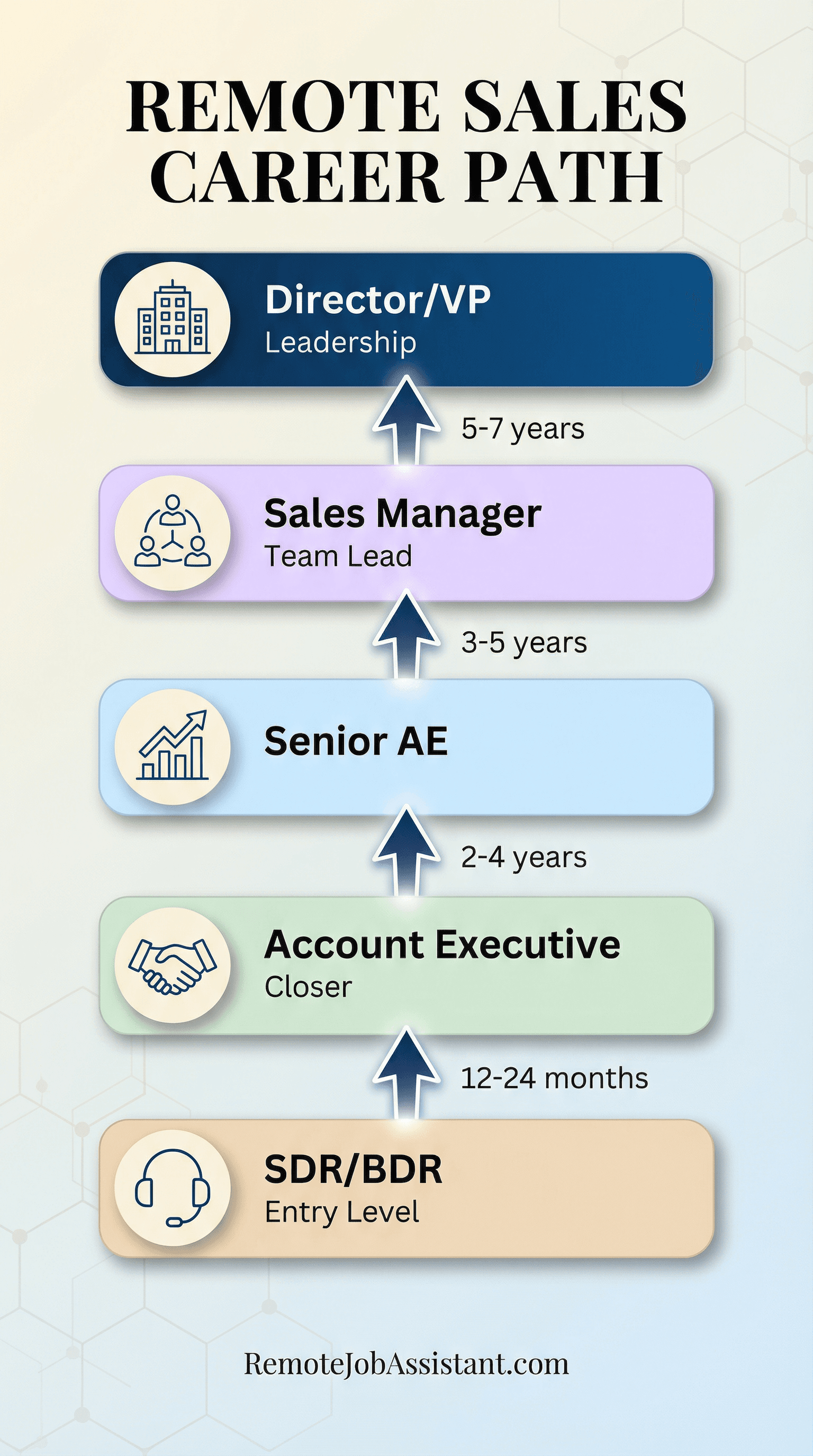
Most sales careers follow this progression:
SDR/BDR → AE → Senior AE → Sales Manager → Director → VP of Sales
   ↓
(12-24 months)   (2-4 years)    (4-7 years)
Strong SDR performers typically get promoted to AE within 12–24 months. Some fast-track programs are shorter (6–9 months), while some companies require 2+ years of tenure. Ask about the promotion path during interviews—it's one of the most important questions you can ask.
Stop Applying Manually
Our AI applies to hundreds of matching jobs while you sleep. Wake up to interviews, not more applications.
What Is an AE? (Account Executive)
AE stands for Account Executive. AEs are the closers. They take qualified leads from SDRs/BDRs and guide them through demos, negotiations, and contract signing.
AEs are quota-carrying, meaning they have a specific revenue target they're responsible for hitting. This is the key difference from SDR/BDR roles—AEs own a number.
What "Quota-Carrying" Means
When a job description says "quota-carrying role," it means you'll have a revenue target. For example:
- Annual quota: $500,000 in new business
- Quarterly quota: $125,000 per quarter
- Monthly quota: ~$42,000 per month
Your commission is directly tied to hitting (or exceeding) this number. Miss quota consistently, and you'll be managed out. Crush quota, and you can earn well above your OTE.
AE Segments: SMB, Mid-Market, Enterprise
Account Executive roles are often segmented by deal size and customer type:
| Segment | Typical Deal Size | Sales Cycle | Remote OTE Range |
|---|---|---|---|
| SMB (Small Business) | $5K–$25K | 2–4 weeks | $100K–$140K |
| Mid-Market | $25K–$100K | 1–3 months | $140K–$200K |
| Enterprise | $100K–$500K+ | 3–12 months | $200K–$350K+ |
SMB AEs handle higher volume with shorter cycles. Enterprise AEs work fewer deals but with longer, more complex sales processes.
Remote AE Salary
AE compensation is heavily weighted toward commission. According to Glassdoor and industry benchmarks:
- Base salary: $60,000–$120,000 (varies by segment)
- On-target earnings (OTE): $100,000–$300,000+
- Pay mix: Typically 50/50 (50% base, 50% commission)
A job posting showing "$80K base, $160K OTE" means half your pay is guaranteed, half depends on performance.
What Is a Closer? (High-Ticket Sales)
A closer is a salesperson who specializes in closing deals—typically high-ticket offers ranging from $3,000 to $50,000+.
Closer roles are common in the online business world: coaching programs, consulting services, info products, and high-ticket agencies. They're less common in traditional B2B SaaS.
How Closers Differ from AEs
| Factor | Account Executive | High-Ticket Closer |
|---|---|---|
| Employment type | W-2 employee | Often 1099 contractor |
| Compensation | Base + commission | Commission-only or commission-heavy |
| Lead source | SDR-generated | Usually warm/hot inbound |
| Deal size | Varies | $3K–$50K+ |
| Industry | SaaS, tech, enterprise | Coaching, consulting, courses |
Remote Closer Salary
Closer compensation is highly variable because it's commission-heavy:
- Base salary: $0–$50,000 (many are commission-only)
- Commission: 10–20% of deal value
- Total earnings potential: $100,000–$400,000+
Many "closer" roles are 100% commission with no base salary. This can work well for experienced salespeople with proven skills, but it's risky for newcomers. If you're considering a commission-only role, ask about average rep earnings—not just OTE. A $300K OTE means nothing if average reps earn $40K.
If you're interested in quota-carrying roles but want the stability of a traditional employer, browse remote sales jobs to find AE positions with base salary plus commission.
Decode Any Job Posting
Paste a job description and get instant insights: what they really want, red flags to watch, and how to stand out.
Inside Sales vs Outside Sales
You'll often see "inside sales" in remote job postings. Here's the distinction:
| Type | Where They Work | How They Sell |
|---|---|---|
| Inside Sales | Office or remote | Phone, email, video calls |
| Outside Sales | In the field | In-person meetings, travel |
Most remote sales jobs are inside sales. You're selling from your home office using digital tools.
However, some "outside sales" roles are now remote-based with occasional travel. These are sometimes called "field sales with a home office"—you work remotely most days but travel for key meetings, trade shows, or customer visits.
Understanding Sales Compensation: OTE, Base, and Commission
Sales compensation has its own vocabulary. Here's what each term means:
| Term | Definition |
|---|---|
| Base salary | Guaranteed pay regardless of performance |
| Commission | Variable pay tied to closed deals |
| OTE (On-Target Earnings) | Total expected pay at 100% quota attainment |
| Pay mix | Ratio of base to variable (e.g., 50/50, 60/40, 70/30) |
| Draw | Advance against future commissions |
| Accelerators | Higher commission rates after hitting quota |
| Uncapped commission | No limit on how much you can earn |
Draw vs Commission: What's the Difference?
A draw is an advance on future earnings, not free money. There are two types:
- Recoverable draw: You must "pay back" the draw from future commissions. If you don't earn enough commission, you owe the company.
- Non-recoverable draw: You keep the draw regardless of performance. This is essentially a guaranteed minimum.
For remote sales roles at established companies, base salary plus commission is standard. Be cautious with draw-based or commission-only structures unless you have experience and confidence in your ability to close.
Sales Ops, RevOps, and Enablement: Non-Quota Roles
Not everyone in a sales organization carries a quota. These roles support the sales team without directly closing deals:
| Role | Focus |
|---|---|
| Sales Operations | CRM management, territory planning, compensation design, reporting |
| Revenue Operations (RevOps) | Aligns sales + marketing + customer success operations |
| Sales Enablement | Training, content creation, tools to help reps sell |
These are excellent paths for people who want to work in sales without carrying a number. They're analytical, strategic, and often pay well without the pressure of individual quota.
According to Glassdoor, remote Sales Operations roles typically pay $70,000–$120,000, with senior positions reaching $150,000+.
Remote Sales Salary Guide (2026)
Based on Glassdoor salary data and industry benchmarks, here are typical remote sales compensation ranges for 2026:
| Role | Base Salary Range | OTE Range | Notes |
|---|---|---|---|
| SDR (Entry) | $45K–$60K | $55K–$85K | No quota, lead qualification |
| BDR | $45K–$65K | $60K–$90K | Outbound prospecting focus |
| Senior SDR/BDR | $55K–$75K | $80K–$110K | Team lead or top performer |
| Inside Sales Rep | $40K–$60K | $50K–$80K | Varies by industry |
| AE (SMB) | $60K–$80K | $100K–$140K | Smaller deals, higher volume |
| AE (Mid-Market) | $80K–$100K | $140K–$200K | $25K–$100K deal sizes |
| AE (Enterprise) | $100K–$140K | $200K–$350K+ | Complex, long sales cycles |
| High-Ticket Closer | $0–$50K | $100K–$400K+ | Commission-heavy |
| Sales Manager | $100K–$130K | $150K–$200K | Team quota + bonus |
| Sales Director | $140K–$180K | $200K–$300K | Multiple teams |
These ranges reflect typical US-based remote positions. Tech companies and well-funded startups often pay at the higher end. Smaller companies, agencies, and non-tech industries may pay below these ranges. Location can also affect pay—some remote roles adjust compensation based on where you live.
Which Remote Sales Role Is Right for You?
Here's a decision framework to help you choose:
| If you... | Consider... |
|---|---|
| Have no sales experience | SDR or BDR (entry point to sales) |
| Want uncapped earning potential | AE or Closer |
| Prefer steady income over commission risk | Sales Ops or Enablement |
| Want to lead a team | Sales Manager (after 3–5 years as AE) |
| Have industry expertise (medical, finance, legal) | Vertical-specific AE roles |
| Like building relationships over time | Customer Success Manager |
| Are analytical and process-oriented | Sales Operations or RevOps |
Breaking Into Remote Sales
If you're new to sales, SDR is the typical entry point. You don't need prior sales experience—companies hire based on communication skills, coachability, and work ethic.
Transferable backgrounds that translate well to SDR roles:
- Teachers: Presentation skills, patience, explaining complex concepts
- Customer service: Objection handling, product knowledge, empathy
- Retail: Closing, upselling, customer interaction
- Recruiters: Outreach, relationship building, qualifying candidates
Check out our guide on remote jobs for former teachers if you're considering a career change into sales.
Frequently Asked Questions
Is SDR the same as BDR?
At many companies, yes—the titles are used interchangeably. When there's a distinction, SDRs typically handle inbound leads (people who already expressed interest), while BDRs focus on outbound prospecting (reaching out to cold contacts). Always read the job description to understand the actual responsibilities.
Can you skip SDR and go straight to AE?
It's uncommon but possible. If you have relevant experience—like a quota-carrying role in another industry, strong consultative sales background, or domain expertise the company values—some employers will consider you for AE directly. Most prefer candidates who've proven themselves in an SDR role first.
What does quota-carrying mean?
Quota-carrying means you have a specific revenue target you're responsible for hitting. AEs are quota-carrying; SDRs typically are not. Your compensation (especially commission) is tied to hitting or exceeding this quota.
Do remote sales jobs pay less than in-office?
Generally no. Many remote sales roles pay competitively with or above in-office equivalents, especially at remote-first companies. Some companies adjust pay based on location, but this practice is becoming less common as remote work normalizes.
What's the difference between OTE and base salary?
Base salary is your guaranteed pay. OTE (On-Target Earnings) is base plus commission/bonus if you hit 100% of your targets. A role with "$80K base, $160K OTE" means you're guaranteed $80K, with an additional $80K possible if you hit quota.
Are closer jobs legitimate?
Yes, but they're different from corporate sales. Closer roles are common in coaching, consulting, and high-ticket services. Expect commission-heavy compensation (often commission-only) and a different work environment than traditional B2B sales. Verify the company and compensation structure before accepting.
How long does it take to go from SDR to AE?
Typically 12–24 months of strong performance. Some companies have fast-track programs (6–9 months); others require longer tenure. Ask about promotion paths during your interviews—it's a critical question for career planning.
Start Your Remote Sales Career
Understanding these roles is the first step. The next step is finding the right opportunity.
If you're ready to explore, browse remote sales positions to see what's available. You can filter by role type, experience level, and salary range to find roles that match your goals.
For SDR and BDR roles specifically, check out our dedicated pages for Sales Development Representative jobs and Account Executive positions.
And if applying to dozens of sales roles sounds exhausting—it is. That's why we built an auto-apply service that submits applications on your behalf while you sleep. Sales is a numbers game, and that applies to your job search too.
Ready to Find Your Remote Job?
Browse thousands of curated remote jobs or let AI apply for you.
Browse Remote JobsRelated Job Guides
Remote Ecommerce Jobs: What 1,694 Postings Show (2026)
Remote ecommerce jobs are concentrated: 322 of 1,694 US postings were remote. See which marketplace, brand, agency and SaaS seats pay $100K+ from a home office.
55 min read
Remote Interior Design Jobs: What 1,409 Postings Show (2026)
Remote interior design jobs are rare: 40 of 1,409 US postings were remote. See which designer, planner, and FF&E seats pay $75K+ from home, and where.
46 min read
Remote Journalism Jobs: What 1,438 Postings Show (2026)
Remote journalism jobs are rare: 77 of 1,438 US newsroom postings were remote. See which reporter, editor, and audience seats pay $75K+ from home, and where.
39 min read