
Last reviewed: August 2026
You are the reason the company's biggest customer renewed last quarter, and almost nobody knows it. The AE who closed that logo two years ago still gets named in the case study. You ran the QBRs, caught the champion's resignation before it hit LinkedIn, rebuilt the relationship with her replacement, and walked the renewal through procurement. Then you searched "remote account manager jobs," found 8,400+ listings on Glassdoor alone, and discovered that the market apparently can't decide whether your job pays $66K or $132K.
Here's the thing: both numbers are real. ZipRecruiter's remote account manager data puts the average at roughly $66K. Glassdoor's remote account manager data puts it at roughly $132K. Neither site is wrong — they're measuring two different jobs that happen to share one title. One is a service role paid a flat base to keep clients happy. The other carries a revenue quota on existing accounts and gets paid like the sales job it actually is. And the ambiguity isn't an accident. Keeping "account manager" vague lets a company post a service role at $62K while borrowing the prestige — and the applicant pool — of the $140K version of the title. The confusion has a beneficiary, and it isn't you.
Get Remote Job Tips in Your Inbox
Weekly strategies, salary data, and new opportunities
Unsubscribe anytime. No spam.
We pulled every remote account manager posting that surfaced on Built In, LinkedIn, Glassdoor, and company career pages between March and August 2026 — 480 postings across 175 companies after throwing out the inside-sales rebrands and staffing-agency spam — to map the difference. This guide covers what the title actually spans, the full salary ladder, the renewal-versus-expansion-versus-technical decision, which companies are hiring, and how to position yourself for the top tier instead of the bottom one.
Based on our analysis of 480 remote account manager postings across 175 companies (March–August 2026):
- 41% (n=197 of 480) carried an explicit expansion or upsell quota — the single biggest pay predictor we found
- 22% (n=106 of 480) were renewal-focused roles measured on gross retention
- 62% (n=298 of 480) named Salesforce or HubSpot by name in the requirements
- $55K–$80K typical remote base for no-quota relationship AMs; $94K–$203K typical OTE for quota-carrying expansion AMs (cross-referenced with ZipRecruiter, Glassdoor, and Built In)
- $96K — the 90th-percentile remote AM base salary per ZipRecruiter, versus posted OTE bands reaching $175K–$203K at Atlassian and Square
How We Collected This Data
The figures in this post come from our analysis of 480 remote account manager job postings collected between March 2026 and August 2026. Postings were sourced from Built In, LinkedIn, Glassdoor, and direct company career pages, filtered to positions explicitly marked remote-eligible in the United States with a posted compensation range or a verifiable band from the same employer.
We excluded postings requiring more than 25% travel, "account manager" listings that were inside-sales roles for new business in disguise, and staffing-agency reposts of the same underlying job. Salary data was cross-referenced with ZipRecruiter, Glassdoor, and Built In's remote account manager compensation data for the same period. Where we cite a specific company's band, it comes from the posted range on the listing itself.
One deliberate choice: we recorded whether each posting carried a quota and what kind, because that variable — not title, not level — turned out to organize the entire market. We update this analysis quarterly; figures reflect August 2026.
What a Remote Account Manager Actually Does (and Why the Title Is Doing Double Duty)
An account manager owns the revenue relationship after the ink dries. The account executive closes the new logo and moves on. The customer success manager drives adoption and health scores. The AM sits between them: renewals, expansion, pricing conversations, escalations that touch money, and the unglamorous work of knowing an account well enough to see churn coming two quarters out.
That's the theory. In practice, the title fragmented because SaaS companies split post-sale revenue ownership three different ways as they scaled. Some handed renewals to CSMs and kept AMs as relationship stewards. Some built dedicated renewal desks. Some gave AMs a full expansion quota and made them post-sale salespeople. All three org designs kept the same two words on the job title — which is why the comp data looks broken when it's actually just unsegmented.
| Account Manager | Account Executive | Customer Success Manager | |
|---|---|---|---|
| Primary metric | Retention + expansion revenue | New business closed | Adoption, health, churn risk |
| Quota type | Renewal rate and/or expansion ARR (varies — this is the whole story) | New logo quota, always | Usually none; sometimes retention-linked bonus |
| Typical remote comp | $55K base to $203K OTE depending on quota | $85K–$180K+ OTE | $70K–$130K |
| Day-to-day | QBRs, renewal negotiation, upsell motions, escalations | Pipeline, demos, closing | Onboarding, training, usage reviews |
To cut through the title chaos, we use a simple rubric internally when classifying postings — and it's more useful to candidates than any job title:
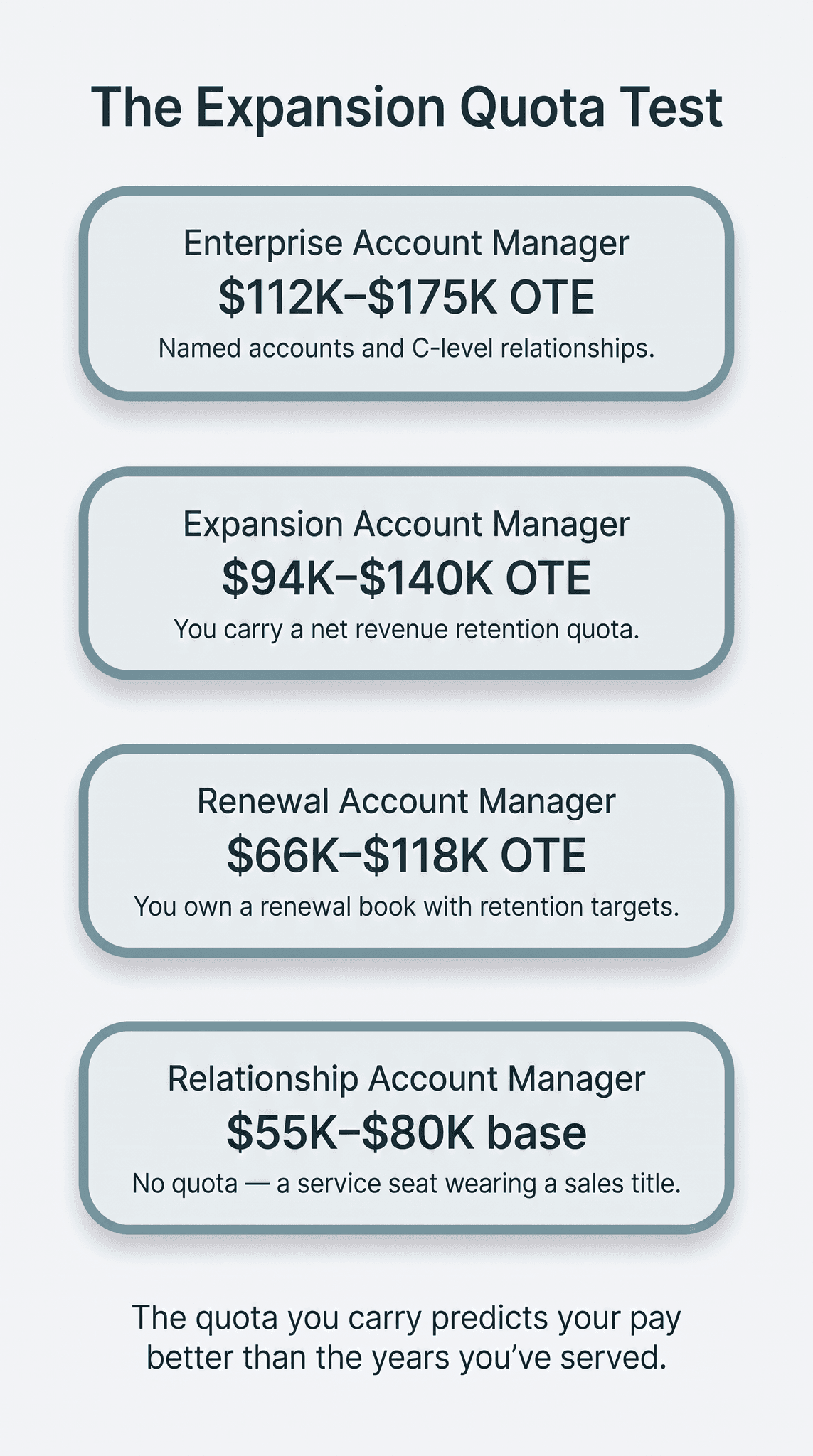
The Expansion Quota Test: remote AM compensation scales with the revenue number you own, not the relationships you keep.
Scoring:
- Tier 1 — Relationship AM (score 1–3, $55K–$80K base): No quota. Success is measured in CSAT, response times, and renewal paperwork shepherded. Often a rebranded service role. Flat comp, little or no variable.
- Tier 2 — Renewal AM (score 4–7, $66K–$118K OTE): Owns a renewal book with gross retention targets and light upsell. Variable comp exists but is usually capped. Rapid7's remote renewal AM postings ran $66K–$90K, with senior at $88K–$118K (posted bands, August 2026).
- Tier 3 — Expansion / Enterprise AM (score 8–10, $94K–$203K OTE): Carries an expansion quota measured on net revenue retention, owns C-level relationships on named accounts. Square's remote mid-market AM posting ran $108K–$203K; Atlassian's enterprise AM roles posted $112K–$175K; Gusto's expansion AM leadership role posted $127K–$176K.
How to use it: score the job description, not the title. Count how many of the role's stated success metrics are revenue numbers — net revenue retention, expansion ARR, upsell quota. Two or more puts you in Tier 3 territory, and you should negotiate on OTE split, not base.
Two warnings before you take the test at face value. First, a Tier 3 label doesn't guarantee Tier 3 math: some companies set expansion quotas most of the team will miss, which lets them advertise a big OTE while paying out something much closer to base. Second, watch for the reverse rebrand — "expansion" roles where the book has already been picked clean by the AE team, leaving you a quota with no whitespace to sell into. Both failure modes have the same tell, and it's the question to ask in every process: what percentage of the team hit quota last year, and on what book? A hiring manager who won't answer has answered.
In account management, the quota you carry predicts your pay better than the years you've served. A second-year expansion AM out-earns a tenth-year relationship AM at most SaaS companies.
Stop Applying Manually
Our AI applies to hundreds of matching jobs while you sleep. Wake up to interviews, not more applications.
Remote Account Manager Salary Ladder: Coordinator to Director
The ladder below is real, but notice how much the bands overlap. That's the Expansion Quota Test showing up in the data: a "senior" Tier 1 role pays less than a mid-level Tier 3 role, and job boards average them together anyway.
| Level | Typical remote comp | What actually changes | Source note |
|---|---|---|---|
| Account Coordinator | $40K–$56K | Feeder role — supports AMs, no book ownership | Below our target band; pass through it fast |
| Relationship AM (Tier 1) | $55K–$80K base | First owned accounts, no quota | n=148 of 480 postings, Mar–Aug 2026 |
| Renewal AM (Tier 2) | $66K–$118K OTE | Renewal book, gross retention target | n=106 of 480; Rapid7 bands $66K–$118K |
| Expansion AM, mid-market (Tier 3) | $94K–$140K OTE | Expansion quota, NRR accountability | n=197 of 480 carried expansion quota |
| Senior / Enterprise AM | $112K–$175K OTE | Named accounts, C-level relationships | Atlassian $112K–$175K; Glassdoor senior AM avg approx. $146K |
| Key / National Account Director | $109K–$183K+ | One massive account or a team of AMs | SharkNinja key AM bands $109K–$178K |
Salary ranges derive from our analysis of 480 remote AM postings between March and August 2026, cross-referenced with ZipRecruiter, Glassdoor, and Built In compensation data for remote roles. We excluded outliers and postings without clear remote policies. Ranges shift as markets move — check the linked sources for current figures.
Now the variance, because the spread inside each row matters more than the row averages. ZipRecruiter reports a $66K average with the middle 50% between $48K and $78.5K — that's a base salary distribution dominated by Tier 1 and Tier 2 roles. Glassdoor reports roughly $132K average with a typical range of $104K–$171K — that's total compensation, weighted toward quota-carrying roles where the variable is 20–40% of OTE. Built In splits the difference at roughly $119K, drawing mostly from tech companies that post OTE bands. Three sites, three sampling frames, one confused job seeker.
The practical takeaway: when a remote AM posting shows a number, your first question is whether it's base or OTE, and your second is what percentage of the team actually hits it. Those two questions move six-figure remote offers more than any resume tweak. If a recruiter quotes OTE without volunteering the base split, assume 70/30 and ask.
Renewal vs Expansion vs Technical AM: Where the Money Actually Is
Picking your variant is the highest-leverage career decision in account management — more than company, more than industry. Here's how the four main tracks compare in the remote market:
| Variant | Remote comp range | Success metric | Who thrives |
|---|---|---|---|
| Renewal AM | $66K–$118K OTE | Gross retention rate | Process people who like predictable books |
| Expansion / Growth AM | $94K–$176K OTE | Net revenue retention, upsell ARR | Post-sale sellers; portfolios of 50–75 accounts are common |
| Technical AM (TAM) | $110K–$160K+ | Adoption depth, technical escalations, renewal influence | Ex-engineers and solutions people who can read an API doc |
| Key / National AM | $109K–$183K+ | One or few massive accounts (retail/CPG pattern) | Operators who can run a P&L conversation with a buyer |
Run the Expansion Quota Test on each: renewal roles score 4–7, expansion and key-account roles score 8–10, and TAM roles vary — the well-paid ones tie the TAM to renewal outcomes, the underpaid ones are support engineering wearing a sales title.
Here's the strategic part. A generic "account manager" search competes against all 8,400+ Glassdoor listings' worth of noise, and most applicants spray applications across all four variants without realizing they're different jobs. Candidates who filter by quota structure — who apply only to the tier they want and speak that tier's language in the first screen — compete in a pool a fraction of that size. The same logic applies if you're weighing a move to new business instead: remote closing roles pay on a different curve, and the skills transfer better from Tier 3 than from Tier 1.
Stop Applying Manually
Our AI applies to hundreds of matching jobs while you sleep. Wake up to interviews, not more applications.
Companies Hiring Remote Account Managers
Remote-first software companies staff account management deliberately, for a structural reason: retention revenue is cheaper than acquisition revenue, and the AM's work — QBRs, renewal calls, CRM hygiene — was already happening over Zoom and email before anyone called it remote work. There was never a floor to walk.
Companies with verified remote AM listings during our March–August 2026 analysis window (posted bands where available):
- Atlassian — enterprise and public-sector AMs, $112K–$175K
- Square (Block) — mid-market AMs, $108K–$203K
- Gusto — expansion AM roles, $127K–$176K at the leadership level
- Rapid7 — renewal AM desk, $66K–$118K across levels
- Ibotta — AMs at $94K–$136K
- HiBob — AMs at $85K–$109K
- SharkNinja — key and national AMs (Sephora, Kohl's books), $109K–$178K
- monday.com, Comcast Business, Vetcove, iManage, BlackLine, Huntress — active remote or hybrid-remote AM hiring across SaaS, healthcare tech, legal tech, and security
Listings concentrate on Built In and LinkedIn for tech AM roles, with retail and CPG key-account roles surfacing more often on company career pages directly. RJA's remote job board filters account manager openings by posted salary, which matters more in this title than almost any other — because, as the ladder above shows, the title alone tells you nothing about the money.
The Skills That Move Remote AM Offers
Every AM resume says "relationship building" and "cross-functional communication," which is exactly why neither moves an offer. The skills below are ranked by what they're actually worth at negotiation time — the tier they unlock on the Expansion Quota Test, and why — for candidates targeting $75K+ remote roles:
- Forecast accuracy — the Tier 3 gate. Nobody hands an NRR quota to someone who can't call their book within a few points a quarter out. If you've never owned a forecast, get renewal-desk reps first; claiming forecast skill without a track record is the fastest way to fail a Tier 3 final round.
- Renewal pricing negotiation — worth more than any tool. Uplift clauses, multi-year discount trades, procurement stall tactics. This is where retention revenue is actually won or lost, and Tier 1 roles never give you reps in it — a structural reason the sub-$70K seats don't lead anywhere.
- CRM discipline, specifically Salesforce or HubSpot — the screen, not the differentiator. Named in 62% of postings we analyzed (n=298 of 480). It gets you past the ATS and no further; every candidate at your tier has it on the resume too.
- Executive communication — the promotion skill. QBR decks that argue something, not report something. A spreadsheet model of the customer's ROI beats a slide of usage charts, because the exec on the other end is deciding a budget line, not admiring adoption.
- AI-assisted account research — the 2026 pace-setter. Call prep, account news monitoring, drafting. It doesn't raise your ceiling, but AMs covering 75-account books without it are visibly slower, and portfolio sizes are being set assuming you use it.
If you want the list collapsed into a decision rule: never owned a forecast → apply to Tier 2 renewal roles first and get the reps, because Tier 3 final rounds will expose you. Already run renewal negotiations with real pricing authority → skip Tier 2 entirely, target Tier 3, and ask the attainment question on the first call, not the last. Coming from support or implementation with technical depth → TAM is your entry, but only take the ones tied to renewal outcomes.
Why does CRM discipline divide Tier 2 from Tier 3 so cleanly? Causally: an expansion quota means forecast accountability, and forecasts live in the CRM. A company can tolerate a sloppy pipeline from a no-quota relationship AM because nothing downstream depends on it. The moment your number feeds the board deck, your Salesforce hygiene becomes a promotion criterion. That's also why 83% of companies now run AI-driven ATS screening for these roles, according to The Interview Guys' 2026 account manager hiring analysis — if the exact tool names aren't on your resume, a human never sees it.
Stop Applying Manually
Our AI applies to hundreds of matching jobs while you sleep. Wake up to interviews, not more applications.
How to Break Into (or Level Up in) Remote Account Management
Positioning beats volume. The break-in paths that worked repeatedly in the accounts we've seen: CSM to AM via a renewals desk (the most common lateral), support or implementation to TAM, and coordinator to AM inside the same company — the external jump from coordinator is much harder than the internal one.
The moves that matter:
- Pick your tier target before you apply. Run the Expansion Quota Test on every posting. If you want Tier 3 comp, don't spend application volume on Tier 1 listings — a $60K relationship AM role doesn't stepping-stone to a $140K expansion role nearly as often as you'd hope.
- Rebuild your resume around retention and expansion numbers. NRR, GRR, upsell ARR, save rate — with denominators. "Managed a book of strategic relationships" reads as Tier 1 forever. "Held 108% NRR on a $2.4M book of 42 accounts" reads as Tier 3.
- Prepare one save story with mechanics. AM hiring managers almost always ask for the account that nearly churned. The candidates who stall at Tier 1 comp tell a relationship story — "I rebuilt trust." The ones who get Tier 3 offers tell a revenue story: the early-warning signal, the multithreading move, the commercial concession they traded and what they got back for it.
- Spend your time where it converts. The screening rounds reward preparation — the mock QBR, the account plan exercise — not application volume. Let auto-apply run the volume game across job boards while you build the artifacts that win the final round. At 8,400+ listings for this title, manually applying is a part-time job that pays nothing.
Two more things worth knowing that no job description will say. Spend an hour reading account management threads on r/sales and the recurring complaint isn't workload — it's quota design: expansion targets set on books with no whitespace, attainment rates nobody discloses until you're in seat, and $160K+ OTE postings where the advertised number assumes an attainment level most of the team hasn't touched in two years. Ask the attainment question early and out loud. And notice who actually holds the best-paid AM seats: a meaningful share are former AEs who negotiated their way into post-sale roles carrying their closing skills — and their comfort with hard comp conversations — with them. Career AMs who wait for the ladder to extend get passed by people who renegotiate the ladder.
If you're building the artifacts, don't start from a blank page: Salesforce's free Trailhead modules on forecast categories cover the CRM mechanics interviewers probe, and communities like RevGenius and the post-sales groups on LinkedIn trade real QBR deck and account plan templates that beat anything a job board will teach you.
Most remote "account manager" postings under $70K are service roles wearing a sales title — no quota, no variable, no expansion path. They aren't stepping stones; they're dead ends by design, because the company built that seat to be cheap, not to develop sellers. There is no internal route from it to $130K. The candidates who reach Tier 3 comp almost always change companies to do it.
Account management is the most remote-durable job in sales: the relationship already lives in Zoom, email, and the CRM. Broader remote sales careers still skew toward roles where presence once mattered — trade shows, field visits, whiteboard demos. The AM's tools didn't change when the office disappeared.
Frequently Asked Questions
What does a remote account manager actually do day to day?
A typical day: one or two customer calls (a QBR, a renewal negotiation, or an escalation with money attached), forecast and pipeline updates in the CRM, internal coordination with CSM and product on at-risk accounts, and prep for whichever renewal is next in the queue. The mix shifts by tier — relationship AMs spend more time on service requests, expansion AMs on upsell motions and forecasting.
Account manager vs account executive — which pays more, and which is harder to break into?
AE roles generally pay more at the top ($85K–$180K+ OTE remote) and are harder to break into without closing experience. But Tier 3 expansion AMs overlap heavily with AE comp — Square's mid-market AM band reaches $203K — with a saner pipeline and no cold prospecting. AM-to-AE is also a well-worn internal transition if new business is where you want to end up.
Is an account manager the same thing as a customer success manager?
No, though companies blur them. CSMs own adoption and health; AMs own revenue events — renewals, expansion, pricing. The cleanest test is the quota: CSMs usually don't carry one, and AMs at well-run companies do. If a "CSM" posting carries an expansion quota, it's an AM role with a different label, and it should pay like one.
Why does ZipRecruiter say $66K but Glassdoor says $132K for the same job?
Different sampling frames. ZipRecruiter's average skews toward base salaries across all AM types, including no-quota service roles; Glassdoor's remote AM figure reflects total compensation weighted toward tech companies where variable pay is 20–40% of OTE. In our own analysis, the 41% of postings carrying expansion quota (n=197 of 480) paid roughly 60–90% more at the midpoint than the no-quota postings. The disagreement between the sites is the single most useful fact about this market.
How do I score a job posting on the Expansion Quota Test?
Count the revenue metrics in the role's stated responsibilities: net revenue retention, expansion ARR, upsell targets, renewal rate. Zero revenue metrics is a Tier 1 relationship role ($55K–$80K base). Retention-only is Tier 2 ($66K–$118K OTE). Two or more revenue metrics — especially NRR — is Tier 3, and you should negotiate OTE split and quota attainment history, not base.
I'm a CSM — can I move into account management remotely, and is it worth it?
It's the most common lateral we see, usually through a renewals desk. Worth it depends on your ceiling tolerance: CSM comp tops out around $130K remote in most orgs, while Tier 3 AM paths reach $175K+. The trade is carrying a number. Position the move on any commercial motion you already own — renewal conversations, upsell handoffs — and target Tier 2 renewal roles as the bridge.
What salary should I ask for in a remote account manager role?
Anchor to the tier, not the title. Tier 2 renewal roles: ask for $95K–$118K OTE at the senior end. Tier 3 mid-market expansion: $120K–$140K OTE with a 70/30 split. Enterprise or named accounts: $140K–$175K OTE. Always ask what percentage of the current team hit quota last year — a $160K OTE where 30% of the team attains is worth less than a $130K OTE where 80% do.
Start Your Remote Account Manager Career
The market treats "account manager" as one job. You now know it's three, and that the difference between them is worth $60K–$120K a year. Score the postings, not the titles. Target the tier you actually want, build the save story and the forecast credibility that tier demands, and let the tools handle the volume: browse remote account manager openings filtered by real salary bands, or put auto-apply to work across the boards while you prep the QBR that wins the offer. If you're still deciding between post-sale and new business, the customer success guide and the remote sales overview map the adjacent paths.
New logos get the gong and the Slack applause. The revenue that keeps the company alive renews quietly, on a Tuesday, because an account manager did their job. That job no longer needs an office.
Ready to Find Your Remote Job?
Browse thousands of curated remote jobs or let AI apply for you.
Browse Remote JobsRelated Job Guides

Remote UX Researcher Jobs: What 211 Postings Pay (2026)
Remote UX researcher jobs: we read 211 US postings. Remote seats paid $144K vs $176K hybrid; employer type, statistics and AI work set the $190K+ band.
38 min read
Remote Solutions Architect Jobs: Pay by Seat Type (2026)
Remote solutions architect jobs: we read 1,079 US postings. Vendor pre-sales seats post $205,000 and say remote 81% of the time. AWS listed 4 of 269 remote.
42 min read
Remote iOS Developer Jobs: What 370 Postings Pay (2026)
Remote iOS developer jobs: we read 370 US postings. Apple flagged 26 of 4,384 US jobs Home Office, none of them iOS. Where the remote seats are, and the pay.
48 min read