
You want a remote job that actually matters. Not just answering tickets or hitting arbitrary metrics—but building relationships, solving real problems, and helping people succeed.
That's customer success. And right now, it's one of the fastest-growing remote career paths in tech.
At Remote Job Assistant, we track hiring patterns across 50+ remote-first SaaS companies, and customer success manager roles have exploded over the past two years. The reason is simple: companies finally realized that keeping customers happy costs less than constantly replacing them. That shift created thousands of remote CSM jobs—many paying six figures—that didn't exist five years ago.
Get Remote Job Tips in Your Inbox
Weekly strategies, salary data, and new opportunities
Unsubscribe anytime. No spam.
This guide breaks down everything you need to know about remote customer success jobs: what they actually pay, the skills that get you hired, and how to land one even if you're coming from a completely different field.
What Are Remote Customer Success Jobs?
In plain terms: A remote customer success job focuses on helping customers get ongoing value from a product after they buy it—usually through onboarding, relationship management, and renewal support—without being location-dependent.
Unlike customer service (reactive, ticket-based) or sales (closing deals), customer success is proactive. You're not waiting for problems. You're anticipating them. You're building relationships with accounts, understanding their goals, and making sure the product delivers results.
Most remote CSM roles exist in SaaS (software-as-a-service) companies, where subscription revenue depends entirely on keeping customers happy. If customers churn, revenue disappears. Customer success managers are the front line of retention.
Customer service handles problems after they happen. Account management focuses on upselling and renewals. Customer success sits in between—proactively ensuring customers achieve their goals so renewals happen naturally.
The role translates perfectly to remote work because nearly everything happens through digital tools: video calls, email, CRM systems, and async communication. Many SaaS companies are fully remote or remote-first, which means the talent pool for customer success and support roles extends worldwide.
What Remote CSMs Actually Do All Day
One of the biggest questions career switchers have: what does this job actually look like?
Here's a realistic breakdown of a typical day for a remote customer success manager:
Morning (async work) Review account health dashboards, respond to customer emails and Slack messages, check product usage data for red flags, prep for scheduled calls.
Midday (live interactions) Onboarding calls with new customers, quarterly business reviews (QBRs) with established accounts, internal syncs with sales or product teams about at-risk accounts.
Afternoon (strategic work) Document call notes in CRM, build success plans for key accounts, coordinate with support on escalated issues, update renewal forecasts, flag expansion opportunities to sales.
The tools you'll live in: CRM (Salesforce, HubSpot), customer success platforms (Gainsight, ChurnZero, Totango), video conferencing (Zoom, Google Meet), team communication (Slack), and product analytics dashboards.
Remote CSMs spend significantly more time on written communication than office-based counterparts. Strong async communication skills aren't optional—they're essential.
Decode Any Job Posting
Paste a job description and get instant insights: what they really want, red flags to watch, and how to stand out.
Remote Customer Success Jobs: Salary Breakdown
Let's talk money. Customer success salaries vary widely based on experience, company stage, and the size of accounts you manage.
According to Glassdoor's 2025 salary data, the average total compensation for customer success managers in the US is $141,781. However, base salaries tell a more nuanced story.
| Experience Level | Base Salary Range | Total Comp (with bonus) |
|---|---|---|
| Entry-level CSM | $55,000 - $75,000 | $60,000 - $85,000 |
| Mid-level CSM (2-4 years) | $75,000 - $100,000 | $85,000 - $120,000 |
| Senior CSM (5+ years) | $100,000 - $130,000 | $120,000 - $160,000 |
| Enterprise CSM | $120,000 - $150,000 | $140,000 - $200,000+ |
Based on PayScale research, the median base salary sits around $78,000, with top earners exceeding $117,000.
Salaries vary more by company maturity and book of business than by location in fully remote roles. A CSM managing $5M in enterprise accounts at a Series C startup will out-earn someone managing 200 SMB accounts at an established company—even if the titles are identical.
The compensation structure typically includes base salary plus variable pay tied to retention, expansion revenue, or customer health metrics. According to industry reports, approximately 68% of customer success professionals receive some form of bonus or variable compensation.
Remote vs. In-Office CSM: What's Actually Different?
If you're weighing remote customer success jobs against office-based roles, here's what actually changes:
| Factor | Remote CSM | Office-Based CSM |
|---|---|---|
| Communication | Async-first, writing-heavy | Meetings + hallway conversations |
| Collaboration | Documented processes, scheduled syncs | Ad-hoc, real-time teamwork |
| Customer interaction | 100% video/phone/email | May include in-person visits |
| Employer options | Global company pool | Limited to commuting distance |
| Career ceiling | Same titles, often wider opportunities | May be location-bound for advancement |
| Schedule flexibility | Often high (async culture) | Typically office hours |
| Burnout risk | Lower with strong async culture | Higher in meeting-heavy orgs |
The biggest adjustment for remote CSMs is communication discipline. You can't pop over to someone's desk to ask a quick question. Everything gets documented, which creates more work upfront but leads to better knowledge sharing long-term.
Many remote-friendly companies now prefer candidates with remote experience because they've already built the self-management skills that make distributed teams work.
Skills and Qualifications for Remote CSM Jobs
Here's the truth about customer success qualifications: the job description asks for one thing, but hiring managers evaluate something else entirely.
What Job Descriptions Say vs. What Actually Matters
| Job Description Says | What Actually Gets You Hired |
|---|---|
| "3-5 years CS experience" | Demonstrated customer-facing impact in any role |
| "Bachelor's degree required" | Strong communication + business acumen |
| "Salesforce experience" | Willingness to learn tools quickly |
| "SaaS background" | Understanding of subscription business models |
Core Skills That Transfer
Communication: You'll write hundreds of emails weekly and run dozens of calls. Clear, empathetic communication is non-negotiable.
Relationship building: CSMs manage portfolios of 20-100+ accounts. You need to build trust at scale.
Problem-solving: Every customer situation is different. You'll need to think on your feet and find creative solutions.
Organization: Juggling multiple accounts, renewal timelines, and internal projects requires serious project management skills.
Business acumen: Understanding how your customers make money—and how your product helps—separates good CSMs from great ones.
Technical skills matter less than you'd think. Most companies provide extensive product training. What they can't teach is empathy, communication clarity, and genuine customer focus.
Stop Applying Manually
Our AI applies to hundreds of matching jobs while you sleep. Wake up to interviews, not more applications.
How to Break Into Customer Success (Even Without Direct Experience)
The most common question we hear: "How do I get a CSM job if every posting wants 2+ years of CS experience?"
Here's the path that actually works.
Transfer Skills From Adjacent Roles
If you're coming from another field, your experience likely translates better than you think:
| Your Background | Why It Transfers to Customer Success |
|---|---|
| Teacher/Trainer | Onboarding, education, explaining complex concepts simply |
| Account Manager | Relationship management, renewal conversations, stakeholder navigation |
| Customer Support Rep | Product knowledge, troubleshooting, empathy under pressure |
| Project Manager | Cross-functional coordination, timeline management, stakeholder updates |
| Sales (SDR/AE) | Business acumen, discovery calls, understanding customer goals |
| Recruiter | Relationship building at scale, pipeline management, follow-up cadence |
The key is reframing your resume to highlight transferable outcomes: retention rates, satisfaction scores, account growth, successful implementations.
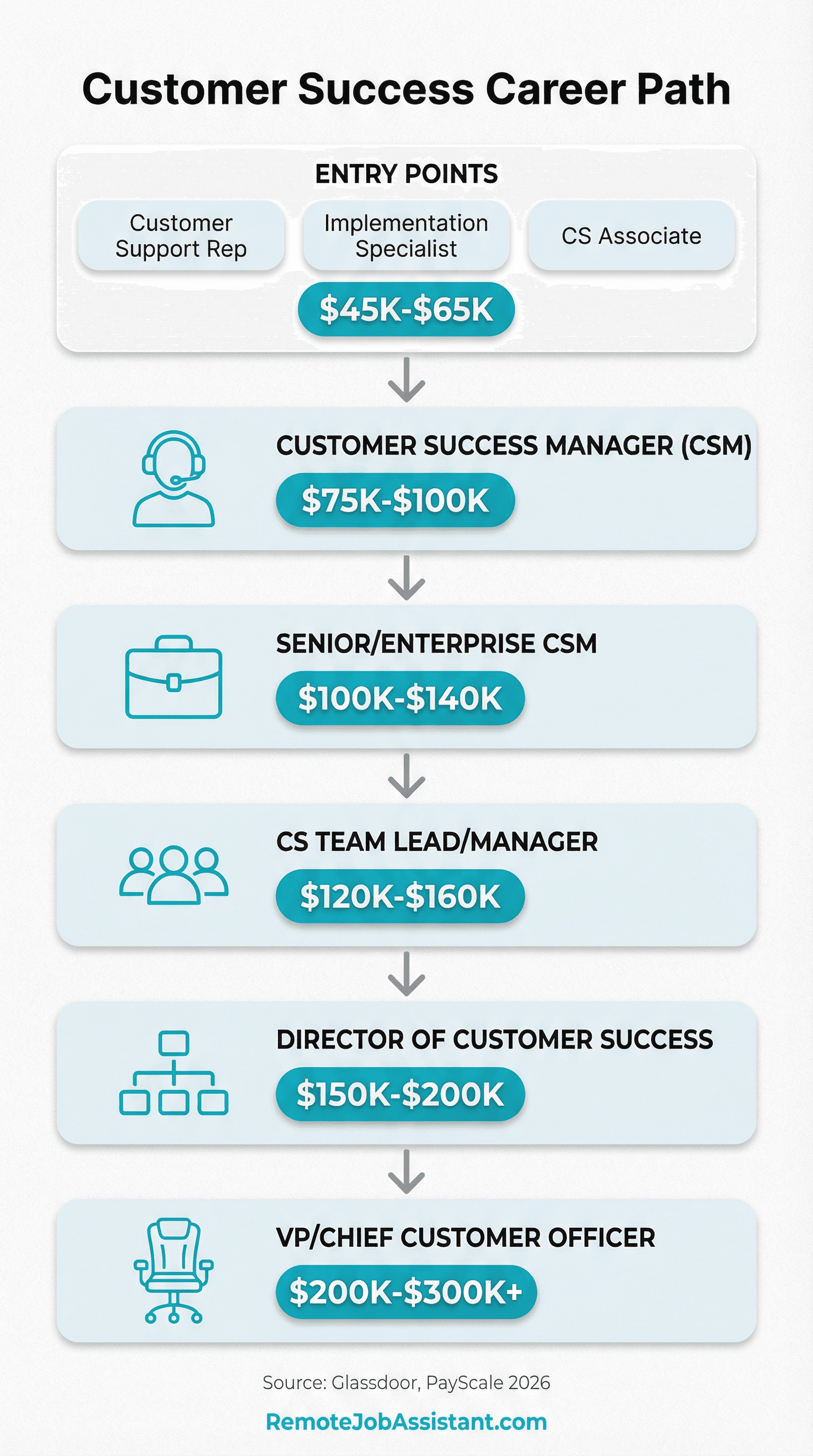
Entry Points Into Customer Success
Most people don't start as Customer Success Managers. They work into it:
-
Customer Support → CSM: Many companies promote support reps who demonstrate strategic thinking and relationship skills.
-
Implementation Specialist → CSM: If you can onboard customers successfully, you've proven you can drive adoption.
-
Customer Success Associate → CSM: Entry-level CS roles exist at larger companies with structured career paths.
-
Adjacent role at small startup → CSM: At early-stage companies, roles blur. You might do support, success, and even some sales.
Early-stage startups (under 50 employees) often hire their first CSM without strict experience requirements. They need someone who can figure it out. If you're scrappy and customer-focused, this is often the fastest path in.
Job Titles to Search For
Job boards fragment customer success under different titles. Search for all of these:
Core CS Titles:
- Customer Success Manager (CSM)
- Client Success Manager
- Customer Success Specialist
- Customer Success Associate
- Account Success Manager
Adjacent Roles (CS Entry Points):
- Onboarding Manager / Onboarding Specialist
- Implementation Manager
- Customer Experience Manager
- Client Relationship Manager
- Renewals Manager
Don't limit yourself to exact title matches. Many customer success and support positions use creative naming that won't show up in narrow searches.
Decode Any Job Posting
Paste a job description and get instant insights: what they really want, red flags to watch, and how to stand out.
Industries Hiring Remote Customer Success Managers
While SaaS dominates remote CSM hiring, customer success roles exist across multiple industries:
SaaS / Tech (Highest Volume)
Software companies live and die by retention. Every major SaaS company—from Salesforce to startups—employs customer success teams. This is where most remote CSM jobs exist.
EdTech
Companies like Coursera, Instructure, and dozens of smaller players hire CSMs to help schools, universities, and corporate L&D teams succeed with their platforms. EdTech CSMs often work with education-focused remote roles.
FinTech
Financial software companies need CSMs who can navigate compliance-heavy environments and work with enterprise clients. These roles often pay premiums.
HealthTech
Healthcare technology is booming, and companies selling to hospitals, clinics, and health systems need CSMs who understand the space. Longer sales cycles mean longer customer relationships.
MarTech / AdTech
Marketing and advertising technology companies hire CSMs to help agencies and brands maximize platform ROI. Strong analytical skills are valued here.
The Hard Parts of Remote Customer Success (Most Guides Skip This)
Let's be honest about the challenges. Customer success isn't all relationship-building and happy customers.
Emotional labor is real. You'll deal with frustrated customers, failed implementations, and accounts that churn despite your best efforts. Taking it personally will burn you out.
Churn pressure intensifies during downturns. When the economy tightens, retention becomes existential. You'll feel the pressure from leadership.
Time zones can be brutal. If you're managing global accounts, expect early morning or late evening calls. Not every company handles this well.
Metrics scrutiny is constant. Net revenue retention, health scores, NPS, expansion rates—you'll be measured on everything. Some thrive on this; others find it exhausting.
Internal politics happen. You're often caught between customer needs and product limitations. Advocating for customers while maintaining internal relationships requires diplomacy.
None of this should scare you off. Every job has downsides. But going in with realistic expectations sets you up for long-term success.
Where to Find Remote Customer Success Jobs
Ready to start your search? Here's where to look:
Specialized Job Boards
Start with boards that focus on remote work and filter for customer success roles. Generic job sites bury remote positions among location-based listings.
Browse remote customer success jobs on Remote Job Assistant to see current openings from companies actively hiring.
Company Career Pages
Target remote-first and remote-friendly SaaS companies directly. Companies like Zapier, GitLab, Buffer, Automattic, and hundreds of others post roles on their career pages before (or instead of) job boards.
Set up job alerts for "Remote Customer Success Manager" and variations. Many companies recruit directly through LinkedIn, especially for senior roles.
Networking
Customer success communities on Slack (like CS Insider, Gain Grow Retain) and LinkedIn groups often share openings before they're posted publicly.
Key Takeaways About Remote Customer Success Jobs
- Salary range: $55K-$150K+ depending on experience and account complexity
- Best path in: Adjacent roles (support, implementation, account management) or startup generalist positions
- Core skills: Communication, relationship building, organization, business acumen
- Top industries: SaaS, EdTech, FinTech, HealthTech
- Growth trajectory: Associate → CSM → Senior CSM → Team Lead → Director → VP of Customer Success
- Remote advantage: Global employer pool, often better work-life balance than office roles
Frequently Asked Questions
What skills do I need for remote customer success jobs?
Strong written and verbal communication tops the list. You'll also need relationship-building skills, organizational ability to manage multiple accounts, and enough business acumen to understand how customers measure success. Technical skills are learnable; soft skills are what get you hired.
How much do remote customer success managers make?
Entry-level CSMs typically earn $55,000-$75,000 base salary. Mid-level roles (2-4 years experience) range from $75,000-$100,000. Senior and enterprise CSMs can exceed $130,000 base, with total compensation reaching $150,000-$200,000+ including bonuses.
Can I get a customer success job with no experience?
Yes, but rarely with "Customer Success Manager" as your first title. Most people enter through adjacent roles: customer support, implementation specialist, or customer success associate positions. Transferable experience from teaching, account management, or project management counts more than you'd think. For a complete guide, see how to break into customer success without experience.
What's the difference between customer success and customer service?
Customer service is reactive—handling problems after they occur. Customer success is proactive—anticipating needs, ensuring adoption, and driving outcomes before issues arise. Service focuses on tickets; success focuses on relationships and results. For a detailed breakdown, see our guide on customer success vs account management vs support.
Is customer success a long-term career or a stepping stone?
Both. Many CSMs build entire careers in the field, advancing to Director and VP roles. Others use customer success as a springboard to product management, sales leadership, or customer experience strategy. The skills transfer broadly across business functions.
How long does it typically take to get hired for a remote CSM role?
For entry-level or associate positions, expect 4-8 weeks from application to offer. Mid-level CSM roles typically take 6-10 weeks with multiple interview rounds (often including role-plays and case studies). Senior positions can stretch to 8-12 weeks.
Start Your Customer Success Job Search
Remote customer success jobs offer a rare combination: meaningful work, strong compensation, and genuine flexibility. The field is growing, companies are hiring, and the skills transfer from dozens of adjacent careers.
Your next step? Browse remote customer success and support positions to see what's available right now. Filter by experience level, company size, and industry to find roles that match your background.
Already know you're qualified? Set up auto-apply to get your applications in front of hiring managers faster.
The companies are hiring. The roles are remote. The only question is whether you'll apply.
Ready to Find Your Remote Job?
Browse thousands of curated remote jobs or let AI apply for you.
Browse Remote JobsRelated Job Guides
Remote Ecommerce Jobs: What 1,694 Postings Show (2026)
Remote ecommerce jobs are concentrated: 322 of 1,694 US postings were remote. See which marketplace, brand, agency and SaaS seats pay $100K+ from a home office.
55 min read
Remote Interior Design Jobs: What 1,409 Postings Show (2026)
Remote interior design jobs are rare: 40 of 1,409 US postings were remote. See which designer, planner, and FF&E seats pay $75K+ from home, and where.
46 min read
Remote Journalism Jobs: What 1,438 Postings Show (2026)
Remote journalism jobs are rare: 77 of 1,438 US newsroom postings were remote. See which reporter, editor, and audience seats pay $75K+ from home, and where.
39 min read