

Last reviewed: August 2026
The return is never the slow part. The slow part is the intake: the 20-minute call where you drag a missing 1099-NEC out of a client who swore the portal upload was "everything," and the argument afterward about whether that call was billable. Anyone who has worked a season knows this. Yet search "remote tax preparer jobs" and what comes back is seven identical job-board feeds and zero honest answers about what this career pays, who hires for it, and why two preparers producing identical 1040s can earn rates that differ by half.
Here's the correction most preparers need before their next application: your pay in this field is not set by how fast or how accurate you are. It's set by which taxpayers you're legally allowed to speak for. The IRS — not the market, not your manager — defines the pay bands, and moving between them is a credential decision, not a performance review.
Get Remote Job Tips in Your Inbox
Weekly strategies, salary data, and new opportunities
Unsubscribe anytime. No spam.
We analyzed 75 tax-titled job postings pulled from Workable's global jobs feed across 12 search terms on August 29-30, 2026, deduplicated by posting ID, and cross-referenced the counts with Glassdoor's listing data and salary figures from O*NET, ZipRecruiter, and Salary.com for the same period. This guide covers what the data says about remote tax prep pay, the credential ladder that actually moves your rate, which employers hire remotely, and how to escape the seasonal trap.
Based on our analysis of 75 tax-titled postings (Workable global feed, August 29-30, 2026) and cross-referenced market data:
- 21% (n=16 of 75) of tax-titled postings were fully remote
- 31% (n=5 of 16) of those remote postings required or referenced an EA, CPA, or PTIN credential
- 323 remote tax preparer listings were live on Glassdoor in the same window (August 2026)
- $54,920 median annual wage for tax preparers ($26.40/hr, O*NET/BLS, 2025 data)
- $51,044-$82,043 is the 25th-75th percentile range for remote tax preparers, averaging $64,395 (ZipRecruiter, August 2026)
- 55% of tax preparers work seasonal schedules (O*NET occupational survey)
- Approx. 38% average pay premium for Enrolled Agents ($72,382) over non-credentialed preparers ($44,997)
How We Collected This Data
The figures in this post come from our analysis of 75 tax-titled job postings collected from Workable's global jobs feed on August 29-30, 2026. We ran 12 search terms ("tax preparer," "tax expert," "enrolled agent," "seasonal tax," and variants), deduplicated results by posting ID, and kept only postings with "tax" in the job title. We logged each posting's workplace type (remote, hybrid, on-site), country, credential requirements, software mentions, and any posted compensation.
Seventy-five is a small sample because tax prep is a narrow title; we didn't pad it with bookkeeping or general accounting roles. To check it, we cross-referenced listing volume with Glassdoor (323 remote tax preparer listings, August 2026) and salary data with O*NET's occupational data for tax preparers, ZipRecruiter's August 2026 remote tax preparer figures, and Salary.com's certified preparer hourly data. Credential, exam, and continuing-education facts come from IRS enrolled agent documentation and the IRS Special Enrollment Examination FAQ. Figures reflect August 2026; we re-pull the postings each hiring cycle.
What Remote Tax Preparers Actually Do
Strip away the software branding and the job is three things: extracting accurate information from disorganized humans, translating it into a defensible return, and doing both fast enough to be profitable during a compressed season.
The client-facing half is the part nobody warns you about. Remote prep at scale — the Intuit and H&R Block model — means video calls, chat queues, and phone reviews with do-it-yourself filers who got stuck. The independent-firm version means a portal full of documents that arrive as 14 blurry phone photos of a W-2, uploaded at 9 PM on April 12, with a note that says "I think this is everything." Your spreadsheet fluency matters less than your ability to run a tight 20-minute intake interview that surfaces the 1099 the client forgot existed. "Did you get any 1099s?" gets a no. "Did anyone pay you last year outside your paycheck: an app, a marketplace, a client, a crypto exchange, a relative who Venmo'd you for a job?" gets a pause, and the pause is the 1099-K. The question you ask decides whether that form shows up in March or in a CP2000 notice eighteen months later, and only one of those is billable to you.
Read platform job descriptions with that split in mind. When a "remote tax preparer" posting lists duties like reviewing customer-prepared returns, answering product questions, or working a chat queue, you're being hired for support with a tax license attached: on assisted-tier products the filer prepares the return and you're the safety net. That isn't a lesser job (the credentialed expert roles pay well for it), but it builds a different skill set than owning a client book. If you want to be a preparer in five years rather than a support tier, weight firm and boutique roles higher even when the platform hourly rate is better.
The software half is more specific than most listings admit. In our dataset, 11% (n=8 of 75) of postings named a professional tax suite outright — UltraTax appeared 6 times, Drake 4, ProSeries 4, and Lacerte 3. Firms hire people who already know their stack, because nobody has time to train you in February. The decision rule is short: targeting boutiques and independent firms, learn UltraTax or Drake first, in that order; targeting the platforms, learn nothing in advance, because Intuit and Block train you on their own stack and won't credit yours. And from your first season, keep a running log per return (entity type, forms, software, date). That log is the "30+ returns" line on your October application, and preparers who don't keep one end up guessing.
It's real finance-sector work, it's genuinely remote-friendly — a return prepared at a kitchen table is identical to one prepared in an office park — and demand is stable: O*NET projects 5-6% growth for the occupation through 2034, faster than average, with roughly 10,400 openings expected.
Stop Applying Manually
Our AI applies to hundreds of matching jobs while you sleep. Wake up to interviews, not more applications.
The Representation Premium: Why Credentials Set Your Pay
Here's the framework that explains almost every confusing salary number in this field.
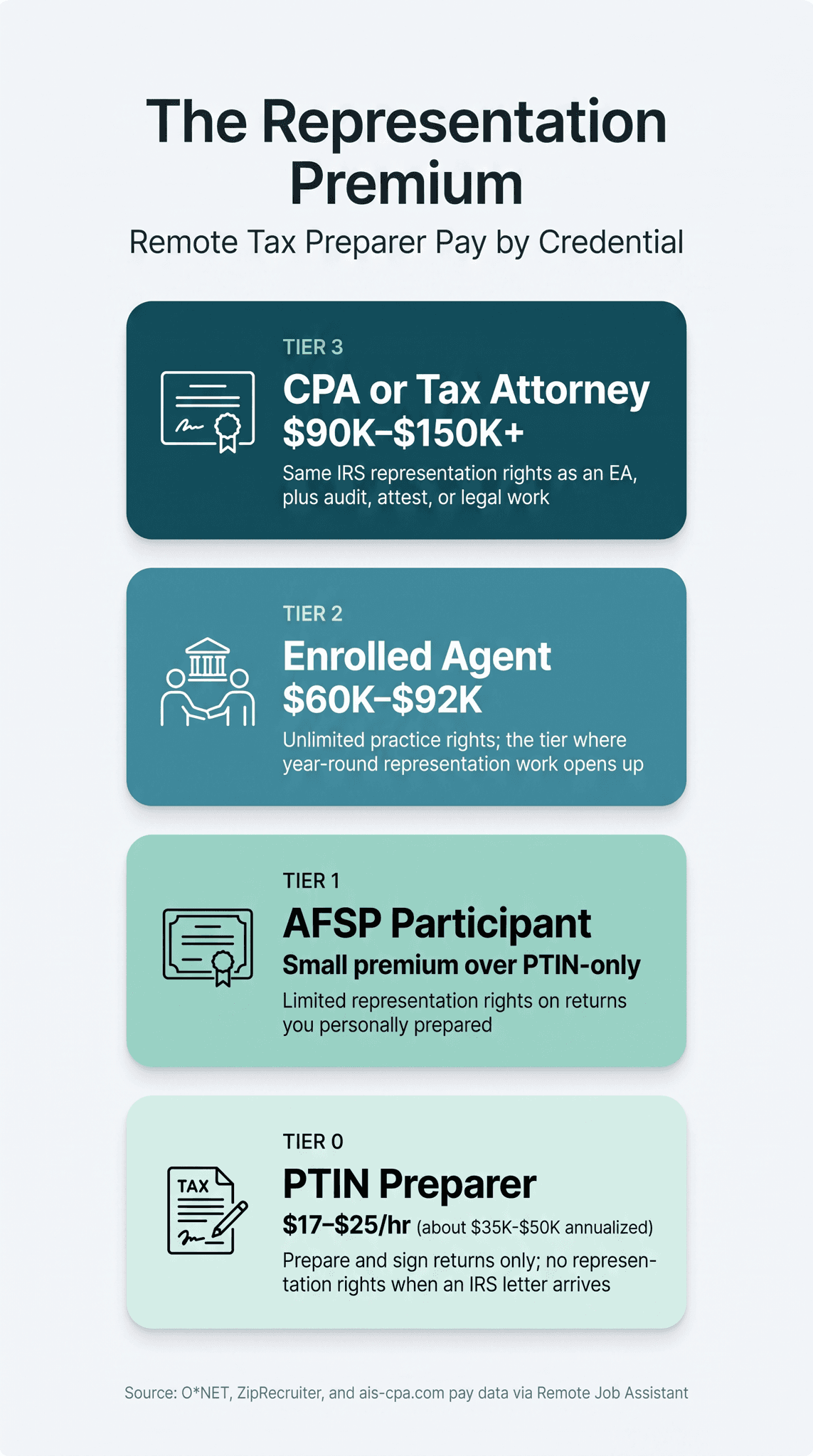
The Representation Premium: tax prep pay tracks who you're allowed to represent before the IRS, not how many returns you can prepare.
Scoring:
- Tier 0 — PTIN Preparer ($17-$25/hr; roughly $35K-$50K annualized): You hold a Preparer Tax Identification Number — legally required for anyone paid to prepare federal returns — and nothing else. You can prepare and sign returns but cannot represent a client before the IRS when a letter arrives. This tier is interchangeable labor, and it's priced like it.
- Tier 1 — AFSP Participant (modest bump over Tier 0): The IRS Annual Filing Season Program is a voluntary continuing-education track that grants limited representation rights for returns you personally prepared. It signals seriousness to employers and separates you from the PTIN-only pool, but the pay lift is real only at the margins.
- Tier 2 — Enrolled Agent ($60K-$92K; averaging $72,382): Unlimited practice rights — any taxpayer, any tax matter, any IRS office. The EA is the highest credential the IRS awards, and per ais-cpa.com's 2026 credential data, EAs average approx. 38% more than non-credentialed preparers. This is the tier where year-round work (representation, resolution, advisory) becomes available.
- Tier 3 — CPA or Tax Attorney ($90K-$150K+): Identical IRS representation rights to an EA, plus audit, attest, or legal work. The ceiling tier — but if all you want is tax practice, it's years of additional schooling for rights the EA already grants.
How to use it: find your tier, then price your next season against the tier above. If you're Tier 0 with two or three seasons behind you, the EA exam is the single highest-ROI move available in this field.
The premium exists for a structural reason, not a sentimental one. Treasury Circular 230 legally gates who may stand between a taxpayer and the IRS. Employers aren't paying EAs more because the returns are harder — they're paying for the gate. A PTIN-only preparer and an EA can produce identical 1040s, but only one of them can answer the CP2000 notice that arrives in September, which means only one of them generates billable work eleven months a year. Employers price the right, not the effort.
The EA path itself is unusually open: no degree requirement, no experience requirement. You pass the three-part Special Enrollment Exam (individuals, businesses, representation and ethics), clear a background check, and maintain 72 hours of continuing education every three years, per IRS enrollment rules. Preparers who treat the off-season as exam-prep season routinely go from Tier 0 to Tier 2 inside a year — a bigger raise than any job hop in remote accounting will produce.
Open is not the same as easy, and the exam's structure punishes casual attempts. Per the IRS SEE FAQ: each part costs $317, non-refundable, paid when you schedule. Each part can be attempted at most four times per testing window. The window runs May 1 through the end of February, with a blackout in March and April, so a February fail costs you until May, and you can't sit during the season regardless. The clock starts when you pass your first part: finish all three within three years or lose credit for the first one. One more gate that catches people who prepare other people's returns for a living: enrollment requires your own compliance, and an unfiled return in your past can hold up the application after you've passed. Budget for a review course (Gleim, Surgent, and Fast Forward Academy are the ones preparers actually use) and treat $951 in fees, three clean passes, as the floor.
When the EA is worth sitting for, and when it isn't:
- Sit for it if you've completed two seasons and intend to work a third, if you want to be paid in June, or if you want work an offshore preparer can't undercut on price alone. Any one of the three justifies the fees and the study hours.
- Skip it if tax prep is a side income you don't intend to grow, or if the season is funding something else. In that case, AFSP keeps you competitive at seasonal employers for the cost of about 18 CE hours a year, and nothing more.
Two things nobody says in the exam-prep marketing. First, the rate premium arrives the day you enroll, but the year-round work only arrives if you take representation clients. Preparers who pass the SEE for the pay bump and never answer a notice have bought the gate and left it shut, and their June looks exactly like a Tier 0 June. Second, representation pays because it's unpleasant. Resolution work is negotiating with the IRS on behalf of someone who ignored the first four letters, and a share of it is chasing that same person for your fee. If you got into this work because you like clean returns and grateful clients, know that the year-round version is not that before you spend $951 finding out.
| Credential | IRS representation rights | Cost and effort | Typical pay band | Remote demand signal |
|---|---|---|---|---|
| PTIN only | None — prepare and sign only | Annual IRS registration | $17-$25/hr seasonal | High volume, seasonal, interchangeable |
| AFSP | Limited — returns you prepared | Approx. 18 CE hours/year | Small premium over PTIN | Differentiator at seasonal employers |
| Enrolled Agent | Unlimited — any taxpayer, any matter | 3-part SEE exam + 72 CE hrs/3 yrs | $60K-$92K | Required for Intuit credentialed expert roles |
| CPA | Unlimited (plus attest work) | Degree + exam + state license | $90K-$150K+ | Senior, manager, and advisory roles |
In tax prep, the raise isn't a promotion — it's a credential. The IRS sets your ceiling, not your manager.
Remote Tax Preparer Salary: What the Numbers Actually Say
The published averages for this role look chaotic — you'll see $12/hr and $101K in the same search result — because they blend two different jobs: seasonal PTIN-tier prep work and credentialed year-round practice. Separate the tiers and the numbers behave.
| Level | Range | What the number describes |
|---|---|---|
| Occupation-wide median | $54,920/yr ($26.40/hr) | All US tax preparers, O*NET/BLS 2025 data |
| Remote preparer, 25th percentile | $51,044 | ZipRecruiter remote tax preparer data, Aug 2026 |
| Remote preparer, average | $64,395 (approx. $31/hr) | ZipRecruiter, Aug 2026 |
| Remote preparer, 75th percentile | $82,043 | ZipRecruiter, Aug 2026 |
| Top remote earners | Up to $101,458 | ZipRecruiter, Aug 2026 — credentialed, year-round |
| Enrolled Agent average | $72,382 | ais-cpa.com EA salary guide, 2026 |
| Seasonal storefront median | Approx. $39K total pay | Glassdoor H&R Block tax professional median |
Salary figures here derive from our 75-posting analysis cross-referenced with ZipRecruiter's remote tax preparer data, O*NET/BLS occupational medians, and Glassdoor employer pay reports, all pulled August 2026. Posted compensation remains rare in this niche — only 3 of our 75 postings included a dollar figure — so ranges lean on the cross-referenced sources. Ranges shift as seasons turn; check the linked sources for current numbers.
One live data point worth more than any average: a remote US contract Tax Associate posting in our dataset (SIGMA, August 2026) offered $55-$65/hr — comfortably above the occupation median — for credentialed contract work. That's the Representation Premium showing up in the wild: contract rates at the credentialed tier annualize past most financial analyst salaries even with a two-month break built in.
According to O*NET's occupational survey, 55% of tax preparers work seasonal schedules — which means every annual average you read is quietly mixing 14-week incomes with 52-week incomes. The next two sections deal with both halves: who pays what, and how the seasonal math really works. If your target is the $75K-plus bracket, the table above tells you the route: it runs through Tier 2, not through a faster keyboard.
Stop Applying Manually
Our AI applies to hundreds of matching jobs while you sleep. Wake up to interviews, not more applications.
Who Hires Remote Tax Preparers
Four employer categories dominate remote tax prep hiring, and they want different things.
| Employer type | Credential bar | Season | What the deal looks like |
|---|---|---|---|
| Intuit (TurboTax Live) | EA, CPA, or practicing attorney + active PTIN for expert roles; 2+ years paid prep, 30+ returns | Seasonal and year-round | Equipment provided, benefits, minimum 20 hrs/week |
| H&R Block | PTIN; internal training academy | Mostly seasonal | Video/chat support of DIY filers; approx. $39K median total pay |
| Jackson Hewitt | PTIN; experience preferred for remote roles | December-April | Storefront network with remote experienced-preparer roles |
| Boutique firms and startups | Varies; credentials command premium | Year-round more common | Smaller client books, deeper work, contract rates to $65/hr |
Intuit is the volume remote employer at the credentialed tier. Its expert roles require an active EA, CPA, or practicing attorney credential plus a PTIN, a minimum of two years of paid prep experience, and at least 30 federal and state 1040 returns prepared. In exchange, per Intuit's own expert-careers pages: company-provided laptop, headset, and webcam, free training, a 401(k) matching $1.25 per dollar up to 6%, an employee stock purchase discount, and both seasonal and year-round schedules with a 20-hour weekly minimum.
H&R Block and Jackson Hewitt hire remote preparers at the PTIN tier each season — Block's remote tax pros support do-it-yourself filers over video, chat, and phone, and Jackson Hewitt lists remote experienced-preparer roles for the December-April window. Both run training programs that will take you from zero, which makes them the standard on-ramp.
Boutique CPA firms and fintech startups are where the interesting year-round work lives. Our dataset caught remote US tax associate roles at venture-backed startups (Cynch AI) and contract postings at $55-$65/hr (SIGMA) in a single August week — off-season, which tells you these firms staff year-round.
Red flags in remote tax postings. Walk away, or at least ask:
- 1099 contractor status with a fixed shift schedule. A seasonal role that dictates your hours, your software, and your queue is an employee role. Contractor paperwork on top of it shifts payroll tax and equipment costs onto you.
- Per-return pay with no hourly floor. Piece rates reward speed on clean returns and punish you on the messy ones. The way it plays out: a one-W-2 return and a Schedule C with 14 blurry receipts and a home-office deduction pay the same flat fee, the firm routes the clean ones to whoever is fastest, and your queue fills with the rest. Ask what last season's median preparer actually earned per hour, and ask how returns are assigned.
- "Year-round" with no description of the off-season work. If the posting can't say what you'll do in June (quarterlies, resolution, bookkeeping, planning), the year-round part is a recruiting adjective. The typical outcome is a full-time title, a 20-hour "minimum" that becomes the maximum on May 1, and an off-season spent on the phone with the firm's slowest-paying clients.
- You supply the software or the errors-and-omissions insurance. A professional suite and E&O coverage are firm expenses. A role that pushes them onto you is a franchise pitch wearing a job title.
- Resolution work paid on collection. Tax resolution clients are, by definition, people who already didn't pay someone. If your representation hours are paid only when the client pays the firm, you're carrying the firm's collection risk. Ask whether representation is billed on retainer.
- Duties that read like sales. "Tax advisor" roles that mention quotas, lead lists, or upselling services are sales jobs that require a PTIN.
When you're comparing a platform offer against a boutique one, put them side by side on five lines: hourly floor versus per-return pay, who provides equipment and software, who owns the client relationship, whether off-season hours are guaranteed in writing, and whether representation work is retainer-paid. The platform usually wins the first two. The boutique usually wins the last three, and the last three are what compound.
One uncomfortable finding from the same dataset: US firms are already offshoring credentialed work. We found Enrolled Agent postings for US tax practice based in the Philippines and Pakistan. The EA credential has no citizenship requirement, and remote infrastructure doesn't care about borders. The durable moat for a US-based remote preparer is the combination the offshore model can't easily replicate — representation rights plus a client relationship built on trust and same-timezone availability. That's one more argument for climbing past Tier 0, where you're competing on price against the entire planet. It's also why adjacent remote finance roles with client-facing advisory components have held their rates while pure back-office processing hasn't — a pattern banking operations roles are living through right now.
The Seasonal Math: What You Really Earn January Through April
Run the honest arithmetic before you accept a seasonal offer, because the annualized number in your head is probably wrong.
A Tier 0 seasonal role at $25/hr, 40 hours a week, for a 14-week season pays about $14,000. Even stretching to 50-hour peak weeks and adding the October extension bump, PTIN-tier seasonal work rarely clears $20K a year on its own. That's the entire trick behind the scary-low medians: Glassdoor's approx. $39K figure for storefront tax professionals isn't describing a bad hourly rate — it's describing a good hourly rate multiplied by a short calendar.
Said plainly: at Tier 0, seasonal remote prep is a side income or a paid apprenticeship, not a career. Treat it as the second one. The seasons buy you the 30-return count that platform employers screen for and the pattern recognition that Part 1 of the SEE tests, and nothing else. Price your time accordingly, and don't let a firm's "full-time" label talk you out of that arithmetic.
The season is short for a structural reason: roughly nine in ten individual returns land between late January and April 15, so firms staff for a ten-week volume spike, then shed capacity. They aren't being cheap; carrying February headcount through August is math that doesn't work. The October 15 extension deadline adds a second, smaller peak — O*NET's finding that 55% of preparers work seasonally is the occupation's structure, not a market failure.
A large share of "remote tax preparer" listings are four-month gigs wearing a full-time title. If a posting doesn't say "year-round" explicitly, assume the calendar ends April 15 — and ask in the first screen, not the offer call.
Going year-round is a client-mix decision, and it maps directly onto the Representation Premium. Quarterly business filings, bookkeeping-adjacent work, tax resolution, and planning advisory all run twelve months — and all but bookkeeping effectively require Tier 2 rights, because the year-round revenue is in representing clients, not just filing for them. EAs at boutique firms stack a compressed high-rate season on top of steady off-season representation work; that's how the ZipRecruiter top decile hits six figures. The other half of that arithmetic is the floor dropping: compliance-only prep, the kind that doesn't need a same-timezone client relationship, is now being priced against the Philippines postings in our dataset, and US seasonal rates are the ones that give. Even payroll-adjacent work — steady but capped — beats an empty June if you're still building toward the exam.
Stop Applying Manually
Our AI applies to hundreds of matching jobs while you sleep. Wake up to interviews, not more applications.
How to Land a Remote Tax Preparer Job: Timing Is Everything
Tax prep hiring compresses the way tax filing does. Firms open seasonal requisitions in October, hire heavily November through early January, and are functionally done by the time returns start moving. Intuit's own hiring guidance notes demand spikes ahead of the late-January peak. Apply in November and you're a candidate; apply in February and you're a resume in a drawer marked "next year."
Tax prep hiring has a season just like taxes do. Applications sent in December get read; the same resume sent in February gets archived.
The sequence that works, in order:
- Get your PTIN now. It's the legal floor for paid prep and takes minutes on the IRS site.
- Pick your training on-ramp. H&R Block and Jackson Hewitt run seasonal academies; Intuit provides free training for its experts. Two seasons anywhere gets you past the experience screens.
- Hit the 30-return threshold. Intuit's credentialed roles want 30+ federal and state returns prepared — track your count from season one.
- Spend the off-season on the SEE exam. May through October is exactly enough runway to clear all three parts and enter the next cycle at Tier 2 pricing. Book Part 1 (individuals) for June while the season's pattern recognition is fresh, and save Part 2 (businesses), the part with the least overlap with 1040 season work, for the fall when you still have runway to retake before the March blackout.
- Apply early and wide. The window is six to eight weeks. Volume and speed decide outcomes in a compressed market — this is precisely the scenario auto-apply was built for: it keeps applications flowing to every new remote posting the week requisitions open, while you're still finishing continuing-education credits.
Where the real leads are: the National Association of Enrolled Agents runs a career center and state affiliates whose members hire seasonal help by referral, the r/taxpros community on Reddit is where preparers compare platform offers and firm pay in the open, and state EA societies are where small firms look for off-season contract help. Boutique firms hire in ones and twos, mostly by referral. Those channels are how you get in front of them.
Two blockers to clear before the window opens, because they kill late applications: employers at the big platforms run background and credit checks that take weeks, and four states — California, Maryland, New York, and Oregon — impose their own registration or licensing requirements on paid preparers beyond the federal PTIN. Sort both in September, not December. And confirm your home setup meets spec: platform roles require reliable broadband and a private workspace, since you'll be on video with clients' Social Security numbers on screen.
Frequently Asked Questions
Do I need a CPA to get a remote tax preparer job, or is an EA enough?
For prep and representation work, the EA is enough — it carries the same unlimited IRS practice rights as a CPA and is the stated credential bar for Intuit's expert roles. In our August 2026 dataset, remote postings referencing credentials named EA and CPA interchangeably (n=5 of 16 remote postings). A CPA only becomes necessary if you want audit or attest work outside tax practice.
Are platform "remote tax expert" jobs actual tax preparation or customer support?
Mostly support with a license attached. Intuit's and H&R Block's remote roles describe reviewing returns and helping do-it-yourself filers over video, chat, and phone; on assisted-tier products the filer prepares the return and you review it. The credentialed tiers pay well for that work, but if you want to own a client book, a firm or boutique role builds it faster.
I've done two seasons in a storefront office — how do I move to fully remote work?
Your two seasons likely already clear Intuit's two-year, 30-return threshold, which is the main experience gate for platform roles. Apply in October-November when requisitions open, list your return count and software stack explicitly, and target the platform employers first — they hire remote preparers in volume while boutique firms hire in ones and twos.
How much do remote tax preparers actually make per season versus per year?
A PTIN-tier seasonal role at $25/hr for a 14-week season grosses about $14,000; the same preparer working year-round at the occupation median earns $54,920 (O*NET, 2025). Remote preparers averaged $64,395 with a 25th-75th percentile spread of $51,044-$82,043 (ZipRecruiter, August 2026) — the spread is mostly the seasonal-versus-year-round split, not skill.
What tier of the Representation Premium do I need for year-round remote work?
Tier 2 — the Enrolled Agent — is the practical floor. Year-round revenue comes from quarterly business filings, resolution, and representation, and all of those require practice rights a PTIN-only preparer doesn't have. That's why EAs average approx. 38% more than non-credentialed preparers and why the top decile of remote earners clears $100K.
Is the EA exam worth it if I only prepare individual returns a few months a year?
If you intend to stay seasonal forever, marginally. But the exam has no degree or experience requirement, the off-season is long enough to pass all three parts, and the credential converts your four-month gig into a candidate profile for $60K-$92K year-round roles. It's the highest-ROI study time in the field — most alternatives (a CPA license, an accounting degree) cost years, not months.
Which tax software should I learn first for remote jobs — Drake, UltraTax, or ProSeries?
In our 75-posting dataset, UltraTax led with 6 mentions, followed by Drake and ProSeries at 4 each and Lacerte at 3. UltraTax skews toward established firms, Drake toward independent practices. If you're targeting the platform employers instead, this matters less — Intuit trains you on its own stack.
When do companies hire remote tax preparers for the upcoming season?
Requisitions open in October, hiring peaks November through early January, and the window is functionally closed once late-January filing volume hits. Background checks and state registrations (California, Maryland, New York, Oregon) add weeks, so start paperwork in September. Late applications don't get rejected — they get archived for next year.
Start Your Remote Tax Career
The route through this field is short to describe and specific to execute: PTIN this week, a training-academy season for volume, the SEE exam over the off-season, and Tier 2 rates by next January. Browse remote finance-category openings to see who's staffing early, use auto-apply to cover the whole six-week hiring window without letting it eat your study time, and if you're weighing adjacent paths, our remote accounting jobs guide maps the broader field.
Tax returns don't care where they're prepared. The IRS only cares who signs — make sure your signature is worth something.
Ready to Find Your Remote Job?
Browse thousands of curated remote jobs or let AI apply for you.
Browse Remote JobsRelated Job Guides

Remote Medical Director Jobs: 305 of 1,860 Are Remote
We read 1,860 medical director job postings: 305 are fully remote, mostly health plan and pharma seats. See which go home, what they pay, and the license rules.
31 min read

Remote Mortgage Underwriter Jobs: 55 of 165 Are Remote
We read 165 mortgage underwriter postings: 55 are fully remote, mostly at lenders that sell their loans. See pay by employer, the DE premium and contract rules.
28 min read

Remote Clinical Pharmacist Jobs: 74 of 1,587 Are Remote
We read 1,587 clinical pharmacist postings. 74 are fully remote, mostly payer and PBM claim review. See which seats go home, their pay and the license catch.
29 min read