
Last reviewed: August 2026
You keep hearing that SOC analyst is the front door to cybersecurity, and then you open the actual postings: three years of experience for an "entry-level" seat, a tools list longer than the job description, and a schedule section that quietly mentions "weekend rotation." Meanwhile ZipRecruiter is indexing more than 500 remote SOC openings and some of them pay $120K+. Both things are true, and nobody explains how they fit together.
Here's the piece that's missing: a security operations center is one of the few places in tech where the org chart is literally a pay table. Tier 1 triages alerts. Tier 2 investigates incidents. Tier 3 hunts threats and builds the detections everyone else works from. Each tier has its own salary band, its own interview, and its own exit. When you understand which tier a posting is actually describing — most don't say — the scattered $65K-to-$160K salary data suddenly makes sense, and so does your next move.
Get Remote Job Tips in Your Inbox
Weekly strategies, salary data, and new opportunities
Unsubscribe anytime. No spam.
This guide breaks down what each tier pays remotely in 2026, why the shift schedule everyone avoids is quietly the fastest promotion lane, which employers are genuinely remote versus hybrid-in-disguise, and what actually gets you hired. We analyzed 120 SOC and security operations postings across 61 companies from public ATS boards (Workable and Greenhouse) in August 2026, and cross-referenced compensation against ZipRecruiter, O*NET occupational data, and pay bands published directly in MDR job postings.
Based on our analysis of 120 SOC and security operations postings across 61 companies (August 2026):
- 62% (n=75 of 120) list incident response as a core duty — the job is investigation, not just monitoring
- 54% (n=65 of 120) mention AI, machine learning, or automation somewhere in the posting
- 46% (n=55 of 120) name SIEM experience explicitly; only 8% (n=9 of 120) name a specific certification
- 32% (n=38 of 120) name a specific EDR platform — CrowdStrike, SentinelOne, or Microsoft Defender
- 32% (n=38 of 120) contain shift, 24/7, on-call, or rotation language
- $70K–$160K — the full analyst salary span from Tier 1 triage to Tier 3 threat hunting (cross-referenced with Dropzone.ai and SecurityOperationsCost 2026 pay bands)
How We Collected This Data
The figures in this post come from our analysis of 120 SOC-titled job postings — SOC analyst, security operations analyst, threat detection, incident response, detection engineering — collected in August 2026 from Workable's global job search and the public Greenhouse boards of 37 security and technology companies. We filtered by title, then removed false positives by hand (chip designers also post "SoC" roles, which says something about keyword-matching your resume, too).
Two honest limitations. First, only 14% (n=17 of 120) of postings published a salary figure, so the tier bands below are cross-referenced against ZipRecruiter's August 2026 remote SOC analyst data, O*NET occupational data for information security analysts, and pay ranges published directly in MDR vendor postings. Second, only 30% (n=36 of 120) of the postings we collected were explicitly remote — the rest were onsite or hybrid. That's not a footnote; it's a finding, and we'll come back to why the remote share concentrates at specific employer types.
What a Remote SOC Analyst Actually Does, Tier by Tier
A SOC exists because alert volume is a funnel. A mid-sized environment generates thousands of security alerts a day. A few dozen deserve a human's attention. A handful are real. The tier system isn't bureaucracy — it's how you keep the expensive people looking at the interesting problems, and it's the clearest career ladder in security.
In our dataset, 62% (n=75 of 120) of postings listed incident response as a core duty, which is the tell: this job stopped being "watch the dashboard" years ago. What the tiers actually divide is autonomy — how much of the investigation you own before someone above you gets paged.
That's the idea behind the Alert-to-Autonomy Ladder, our rubric for locating yourself in a SOC and pricing the gap to the next rung:
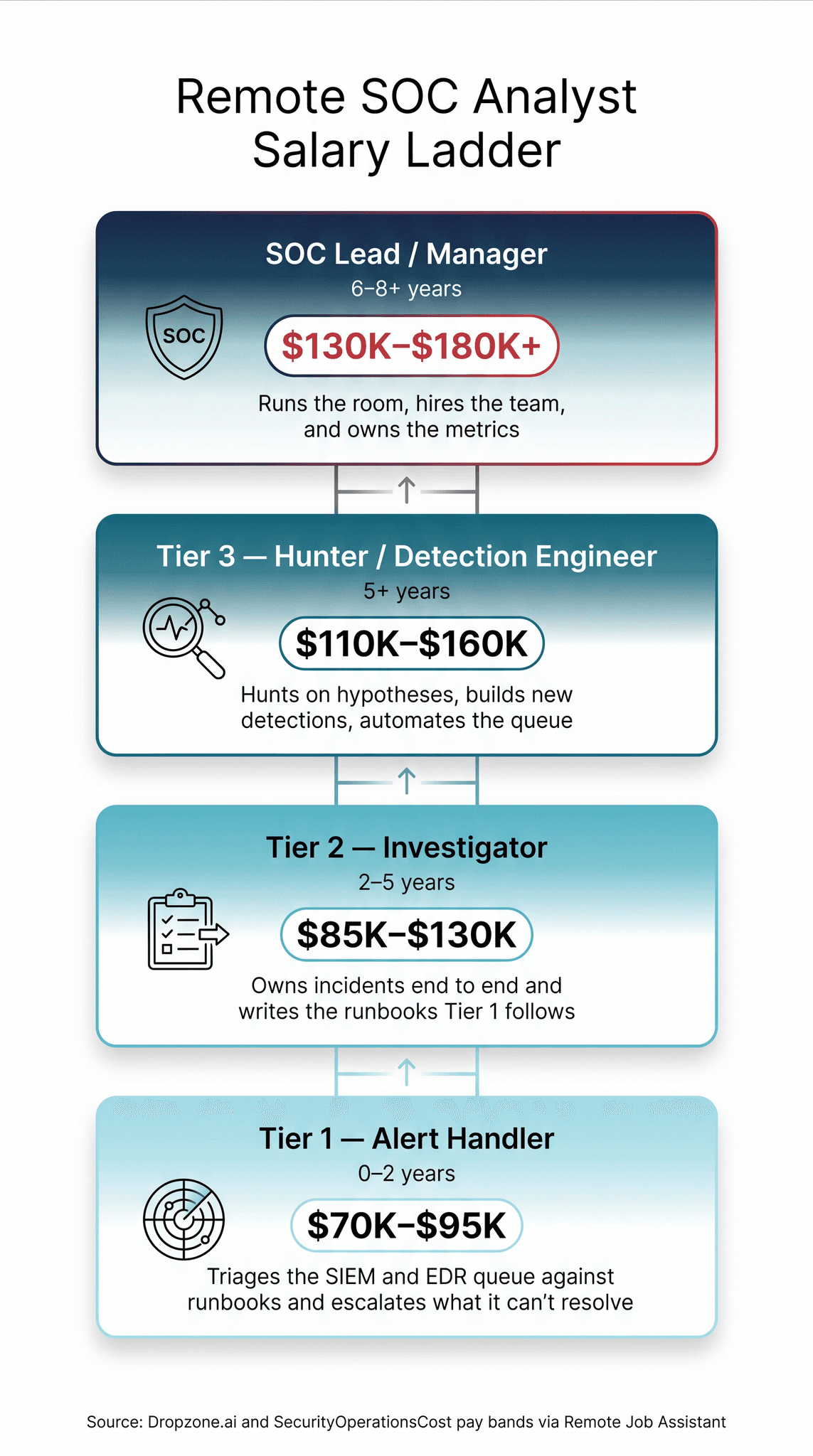
- Rung 1 — Alert Handler ($70K–$95K): You work the queue. Alerts arrive from the SIEM and EDR, you triage them against runbooks someone else wrote, close the false positives, and escalate what you can't resolve. Your success metric is time-to-triage and escalation accuracy.
- Rung 2 — Investigator ($85K–$130K): You own incidents end to end. You correlate across log sources, contain compromised endpoints, write the runbooks Rung 1 follows, and tune noisy detections so the queue shrinks. Your success metric is incidents closed and false-positive rates reduced.
- Rung 3 — Hunter/Engineer ($110K–$160K): You start without an alert. You hunt on hypotheses, build new detections, automate the boring 60% of Rung 1's queue, and set the escalation thresholds. You're the person Rung 2 wakes up at 3 a.m.
How to use it: write your resume one rung above your title. If you tuned a detection rule or wrote a runbook in a Tier 1 seat, that's Rung 2 evidence — lead with it. Hiring managers promote people who are already doing the next job; they interview the same way.
Stop Applying Manually
Our AI applies to hundreds of matching jobs while you sleep. Wake up to interviews, not more applications.
Remote SOC Analyst Salary: What Each Tier Pays in 2026
The single most misleading number in this market is the blended average. ZipRecruiter puts the average remote SOC analyst at $84,207 as of August 2026, with most earners between $65,000 and $98,500 — accurate, and nearly useless, because it blends $70K alert triage with $150K threat hunting into one number. Quote a tier, not an average.
| Tier | Typical experience | 2026 base range | Average | What moves you up |
|---|---|---|---|---|
| Tier 1 — Alert Handler | 0–2 years | $70K–$95K | $75K | Escalation accuracy, first tuned detection |
| Tier 2 — Investigator | 2–5 years | $85K–$130K | $107K | Owning incidents end to end, writing runbooks |
| Tier 3 — Hunter/Engineer | 5+ years | $110K–$160K | $130K | Detections built, hunts led, automation shipped |
| SOC Lead / Manager | 6–8+ years | $130K–$180K+ | $150K | Running the room, hiring, metrics ownership |
Tier bands combine Dropzone.ai's 2026 SOC career guide (Tier 1 $70K–$90K, Tier 2 $85K–$120K, Tier 3 $110K–$150K) with SecurityOperationsCost's 2026 pay bands, which run about $10K hotter at every level (Tier 1 $75K–$95K, Tier 2 $95K–$130K, Tier 3 $130K–$160K). Salary figures in our own posting dataset were sparse — 14% (n=17 of 120) published a range — which is why we cross-reference rather than pretend 17 data points are a market. Where postings did publish, they validated the top of the bands: Huntress listed its remote US SOC Manager role at $165K–$185K, and Gemini listed a Staff Security Engineer in Threat Detection and Response at $168K–$240K in August 2026.
Three adjustments to the table worth knowing before you negotiate:
Shift differentials are real money. Overnight and weekend rotations add $3,000–$8,000 a year on top of base, per SecurityOperationsCost's 2026 data. On a $75K Tier 1 seat, taking the unpopular rotation is a 4–10% raise nobody competes with you for.
The occupational baseline is higher than the entry band. O*NET puts the median for information security analysts overall at $129,180, with 182,800 employed in 2024 and projected growth of 7% or more through 2034. That median is senior-skewed — it covers the whole occupation, not just SOC seats — but it tells you what the field pays once you're past the queue. The $100K+ remote listings are where Tier 2 investigators land after the jump.
Progression is faster than most tech ladders. Dropzone's data has Tier 1 to Tier 2 at 1–2 years and Tier 2 to Tier 3 at 2–3 more. Four to six years from first seat to threat hunter is a compressed arc — most engineering ladders take longer to double your comp.
Who Actually Hires Remote SOC Analysts (and Who Says Remote but Isn't)
Remember the finding from our methodology: only 30% (n=36 of 120) of SOC postings were explicitly remote. The remote share isn't spread evenly across the market — it concentrates at a specific employer type, and knowing which one saves you months of applying into hybrid-in-disguise listings.
The structural reason is coverage. A 24/7 SOC in one building needs people physically present at 3 a.m. But managed detection and response (MDR) firms — companies that run security operations as the product, for hundreds of client environments — solved coverage with geography instead of night shifts in an office. Distributed analysts across time zones aren't a perk at an MDR; they're the operating model.
MDR / security vendors (remote-first): Huntress runs a fully distributed SOC and was hiring security operations analysts across three continents in August 2026, with published US pay bands. Arctic Wolf's cybersecurity analysts report median total compensation around $85K, with senior packages reported up to $155K, per levels.fyi. Expel, Red Canary, Deepwatch, and Critical Start all operate in the same managed-detection category. You'll investigate dozens of client environments, and the alert volume means you compress years of incident reps into months.
In-house SOCs (mixed remote): Banks, healthcare systems, fintech, and crypto exchanges run their own operations — Gemini's threat detection posting above is typical. You go deep on one environment instead of wide across many, pay is often higher at the senior end, but this is where hybrid creep lives. Read the schedule section before you fall in love.
The practical filter: if the company sells security monitoring, the remote posting is probably genuinely remote. If the company is protecting itself, verify. Ask directly in the first screen: "Is the SOC fully distributed, or does the team work from an office?" — the hesitation tells you as much as the answer.
Four red flags we learned to read while hand-sorting 120 postings, in rough order of how often they bit:
- "Remote" in the title, an office city in the location field, and "occasional travel to HQ" in the fine print. That's hybrid with a marketing budget. In-house SOCs did this far more often than MDR vendors in our set.
- An "entry-level" title asking for three years of experience. The team is hiring a Tier 2 on a Tier 1 budget. Either negotiate the band up or expect Rung 2 work at Rung 1 pay.
- A tools list longer than the duties list. Nobody has scoped the role; you'll inherit whatever the last analyst was avoiding. Ask what the first 90 days actually look like.
- No schedule section at all. Silence is not "business hours." A posting that doesn't mention rotation has usually decided not to lead with it. Ask before the offer, not after. The same logic applies across remote cybersecurity roles generally, but nowhere more than the SOC, where coverage schedules force the issue.
Stop Applying Manually
Our AI applies to hundreds of matching jobs while you sleep. Wake up to interviews, not more applications.
Skills and Certs: What Screens You In, What Raises Your Pay
Here's the pattern in our posting data that most cert-first career advice gets backwards: 46% (n=55 of 120) of SOC postings named SIEM experience, and 32% (n=38 of 120) named a specific EDR platform — but only 8% (n=9 of 120) named any certification at all. Postings screen for tools. Certifications price you at review time. Study accordingly, in that order.
The tool stack worth your hours:
- SIEM — Splunk and Microsoft Sentinel dominate mentions in our dataset. Dropzone's broader 2026 analysis found SIEM expertise in 78% of SOC postings, the single most demanded skill in the field. Pick one, get genuinely fast at querying it, and say so with specifics.
- EDR — CrowdStrike Falcon, SentinelOne, or Microsoft Defender. A third of postings name one outright (n=38 of 120). Triage experience in any of them transfers to the others.
- Scripting — Python or PowerShell appeared in 18% (n=22 of 120) of postings. It's the sharpest Tier 1-to-Tier 2 differentiator: the analyst who scripts the repetitive lookup is auditioning for Rung 2 of the Alert-to-Autonomy Ladder in public.
- Cloud log fluency — AWS and Azure log sources showed up in 17% (n=20 of 120). More of the alerts are coming from cloud control planes every quarter; analysts who read CloudTrail without flinching are moving toward cloud security engineering money.
Certifications, sequenced by return per SecurityOperationsCost's 2026 premium data: Security+ adds roughly $3K–$5K and mostly exists to clear HR filters and DoD-adjacent requirements. GCIH or GCIA add $5K–$10K each and actually map to Tier 2 investigation work. CISSP adds $10K–$15K but reads strange on a resume with under five years of experience — it's a senior signal, not a shortcut. None of them substitute for demonstrated triage: in our dataset, postings asked for tool experience over certifications by a factor of six.
The Shift-Work Reality Nobody Puts in the Posting Title
Let's do the uncomfortable part honestly, because it's also the opportunity. 32% (n=38 of 120) of SOC postings carry shift, rotation, or 24/7 language. Threats don't keep business hours, and unless your employer runs follow-the-sun coverage across global teams, somebody on your team is working Saturday night. Early in your career, that somebody should be you — on purpose.
Here's what an overnight actually looks like, because a perfect-day version would be fiction. You inherit a handoff note at 11 p.m. that undersells an open investigation. At 1:40 a.m. a badly tuned detection rule floods the queue with 300 identical false positives, and you spend an hour suppressing it and writing up the tuning request. At 3 a.m. you escalate a genuinely weird authentication pattern — lateral movement, or a sysadmin doing something undocumented? You page Tier 2, heart rate up. It turns out to be an unannounced penetration test. Nobody told the SOC, because nobody ever tells the SOC. You document it, slightly annoyed, secretly relieved, and the write-up you leave becomes the runbook entry the next analyst uses.
That night produced more Rung 2 evidence than a month of quiet day shifts. And the economics agree: the differential adds $3K–$8K, the promotion math runs faster because incident volume per analyst is higher and the bench is thinner, and you're not competing with every 9-to-5 applicant in the queue. The fastest-promoted SOC analysts are the ones who volunteer for the shift nobody wants.
The honest counterpart: if rotating schedules are a hard no for your health or your family, take that seriously — target Tier 2+ roles at follow-the-sun MDR firms, where global coverage means daytime hours in your own time zone, and accept that pure Tier 1 seats with banker's hours are the scarcest listings in this market.
Stop Applying Manually
Our AI applies to hundreds of matching jobs while you sleep. Wake up to interviews, not more applications.
How to Land a Remote SOC Analyst Job in 2026
The AI question first, since 54% (n=65 of 120) of postings now mention AI, machine learning, or automation: the machines are coming for the half of Tier 1 you didn't want anyway. Dropzone's 2026 research puts AI-assisted investigations at 45–61% faster than manual work, and SOC platforms are increasingly auto-closing the obvious false positives. What that eliminates is pure queue-grinding. What it creates is demand for analysts who validate the machine's verdicts, catch what it misses, and tune what it gets wrong. AI is not coming for the SOC analyst seat. It's coming for the half of Tier 1 that was never worth a salary, and for the analysts who only ever learned that half. Position yourself as the person supervising the automation, not racing it.
The playbook, in order of payoff:
Build detection evidence, not cert collections. A home lab with a free Splunk or Elastic instance, three Sigma detection rules you wrote, and two documented investigations — screenshots, timeline, verdict, what you'd tune next time — beats a second certification for every screening call we've seen. It's Rung 2 evidence produced from your desk. If your applications are disappearing into silence anyway, the problem is usually evidence, not volume.
Target MDR firms first. They hire in batches, train tiered analysts as a business model, and their postings mean remote when they say it. In-house SOC seats are better second jobs than first ones.
Apply in volume, because the funnel is brutal at the bottom. Tier 1 postings draw hundreds of applicants; response rates are a numbers game even with a strong profile. This is exactly the grind auto-apply was built for — it applies to matching remote listings across the market while you spend those hours in the lab building the evidence that actually converts screens into offers. The $75K+ remote listings are the floor worth setting.
Interview one rung up. Walk into a Tier 1 interview with a Tier 2 story: the detection you tuned, the runbook you drafted, the automation you scripted. In a SOC, your title is what you triage; your next salary is what you automate.
If you're deciding between security paths, the SOC's closest neighbors run through network engineering on the infrastructure side — and the Tier 3 exit ramps lead to detection engineering, incident response leadership, and threat intelligence, all comfortably into the six-figure remote bracket.
Frequently Asked Questions
Can I get a remote SOC analyst job coming from IT helpdesk with no security title?
Yes — helpdesk-to-SOC is the most common on-ramp in the field, because triage discipline transfers directly. Close the gap with tool evidence rather than titles: a home SIEM lab, documented investigations, and Security+ to clear HR filters. Target MDR firms, which hire Tier 1 in batches and train systematically. Expect the remote version to be more competitive than onsite; the differentiator is demonstrated triage, not the resume keyword.
Do remote SOC analysts really work night shifts, and how does the pay change if I take them?
Some do — 32% (n=38 of 120) of the SOC postings we analyzed in August 2026 carry shift, rotation, or 24/7 language. Overnight and weekend differentials add $3,000–$8,000 a year per SecurityOperationsCost's 2026 data, and the promotion math on unpopular shifts runs faster because incident volume is higher and competition thinner. Follow-the-sun MDR employers are the main exception: global teams cover nights in their own daytime.
Which SIEM should I learn first for remote SOC jobs — Splunk or Microsoft Sentinel?
Learn one deeply rather than both shallowly; query fluency transfers. Splunk still has the largest installed base and the most tutorials; Sentinel is growing fastest because it ships with Microsoft's cloud stack, which mid-market companies already own. If you're targeting MDR vendors, check which platform their postings name — in our dataset SIEM was the most-named tool category at 46% (n=55 of 120) of postings.
How do I know if I'm ready to move from Tier 1 to Tier 2 on the Alert-to-Autonomy Ladder?
Audit yourself against Rung 2 criteria: have you owned an incident end to end, written or meaningfully revised a runbook, and tuned a detection that reduced false positives? If you've done two of the three — even informally — you're interview-ready for Tier 2, and your talking track is those specific artifacts. If you've done none, pick the noisiest alert in your queue and propose a tuning fix this week; that's the fastest first rung.
Is AI going to replace SOC analysts in the next few years?
It's replacing tasks, not the seat. 54% (n=65 of 120) of the postings we analyzed already mention AI or automation, and AI-assisted investigation runs 45–61% faster per Dropzone's 2026 research — which mostly deletes repetitive Tier 1 triage. Demand is shifting toward analysts who validate AI verdicts, investigate what the machine escalates, and tune what it gets wrong. The risk isn't to SOC analysts; it's to analysts who only ever learned the part a model can do.
What certifications actually raise a SOC analyst's salary, and in what order?
Sequence by return: Security+ first ($3K–$5K premium, clears HR filters), then GCIH or GCIA ($5K–$10K each, maps to real Tier 2 investigation work), then CISSP at the senior stage ($10K–$15K, but it reads odd with under five years of experience). Keep perspective: only 8% (n=9 of 120) of postings in our analysis named any certification, while 46% named SIEM experience. Tools screen you in; certs price you up.
What salary should I ask for as a remote Tier 2 SOC analyst in 2026?
Anchor to the Tier 2 band of $85K–$130K, positioning by evidence: incidents owned, detections tuned, runbooks written. Mid-band ($100K–$110K) is defensible with two-plus years and end-to-end incident ownership; the top of band typically requires scripting-based automation or niche log-source depth. Add $3K–$8K if you're taking rotation coverage, and check current listings — published ranges moved up 8–15% year over year per Dropzone's 2026 data.
Start Your Remote SOC Career
Most people treat SOC tiers as job titles. They're compensation bands with different exit velocities, and that changes how you apply: work out which rung a posting is really describing, price yourself against that band, and build the next rung's evidence before you hold its title. Start with the employers built remote-first — the MDR firms — and let auto-apply handle the application volume while you build the detection portfolio that converts screens into offers. For the wider field beyond the SOC, our remote cybersecurity jobs guide maps the adjacent paths, and the remote job boards comparison covers where the real listings live.
The MDR firms solved 3 a.m. coverage with geography instead of an office full of night-shift analysts. That is the whole reason remote SOC seats cluster where they do, and it's why your first ten applications should go to them, not to the bank that lists "remote" and means "Tuesdays at home."
Ready to Find Your Remote Job?
Browse thousands of curated remote jobs or let AI apply for you.
Browse Remote JobsRelated Job Guides
Remote Medical Director Jobs: 305 of 1,860 Are Remote
We read 1,860 medical director job postings: 305 are fully remote, mostly health plan and pharma seats. See which go home, what they pay, and the license rules.
31 min read

Remote Mortgage Underwriter Jobs: 55 of 165 Are Remote
We read 165 mortgage underwriter postings: 55 are fully remote, mostly at lenders that sell their loans. See pay by employer, the DE premium and contract rules.
28 min read
Remote Clinical Pharmacist Jobs: 74 of 1,587 Are Remote
We read 1,587 clinical pharmacist postings. 74 are fully remote, mostly payer and PBM claim review. See which seats go home, their pay and the license catch.
29 min read