
Last reviewed: August 2026
You have run the ballroom. You know the exact moment the AV tech goes quiet in your earpiece, and you know what it costs to hold a room block you are not going to fill. So when you type "remote event planning jobs" into a search bar and get back five hundred listings, you already suspect what you will find when you open them: a job that is on site, wearing a work-from-home policy for the weeks between events.
That suspicion is correct, but the conclusion most event professionals draw from it is wrong. They decide the remote market does not exist in this field. It does. It is just not filed under the title they keep searching.
Get Remote Job Tips in Your Inbox
Weekly strategies, salary data, and new opportunities
Unsubscribe anytime. No spam.
We pulled 985 event-related job postings from the Workable and SmartRecruiters applicant tracking systems on August 29, 2026, deduplicated them to 858 unique listings, and isolated the 123 whose titles actually name an event function. Of those, 15 were listed fully remote. Not one of them was titled "Event Planner." All four postings that carried that exact title wanted someone physically accountable for a room on the day, and the title has quietly become employer shorthand for that person. Search for it and you are searching for the on-site half of the field by definition.
- 12.2% (n=15 of 123 event-titled postings, pulled 2026-08-29) were listed fully remote
- 0% (n=0 of 4) of postings titled "Event Planner" were remote
- 10.9% (n=6 of 55 US event-titled postings) were remote; 21.8% (n=12 of 55) were hybrid
- 44% (n=4 of 9) of postings with "Producer" in the title were remote, the highest rate of any title family
- $61,160 median annual wage for the occupation across all work arrangements (BLS OEWS 2025 data)
- $100,000 median for remote-only event planner roles, a difference of about $39K
That last pair of numbers is the one worth sitting with. The occupation pays a median of roughly $61K. The remote slice of it pays a median of roughly $100K. The rest of this post is about what separates the two, and how to end up in the second one.
The Room Test: Why Most Event Jobs Cannot Go Remote
The constraint here is not employer stubbornness, and it is not a hangover from 2020 return-to-office fights. It is structural, and it comes down to a single variable: how much of your deliverable is a room that has to work on the day.
At 7:40am the house left projector will not mirror the keynote's laptop. The catering captain tells you the plated service is running twenty minutes behind. A sponsor has shown up with a pull-up banner that does not fit the footprint you sold them. Every one of those is a presence problem. No amount of asynchronous tooling, shared documentation, or well-run Slack channel solves any of them, because the fix requires a person with authority standing in that room making a decision in ninety seconds.
So employers who need that person keep the role on site. That is rational, and it is why the remote rate in this field sits near one in eight rather than the one in three you see in marketing or finance.
But there is a corollary, and the corollary is the entire opportunity. When an employer contracts the on-site execution out to a venue team, a destination management company, or a production crew, the strategic half of the event job comes loose. Somebody still has to own the budget, negotiate the contracts, build the agenda, secure the speakers, and answer for the pipeline the event generated. None of that requires being in the building. That unbundled half is where the remote roles live.
The Room Test is how you tell the difference before you apply.
The Room Test: A 10-point rubric for scoring whether an event role can genuinely be done remotely, based on how much of the job requires physical presence.
Deliverable location (0–3 points). Score 3 if the output is a document, a campaign, a contract, or a program. Score 0 if the output is a room that has to work on the day.
Vendor leverage (0–3 points). Score 3 if the employer contracts on-site execution to a venue, a DMC, or a production partner. Score 0 if your own team sets the room and runs the show.
Event cadence (0–2 points). Score 2 for fewer than 6 events a year. Score 0 for 20 or more, which means you live on the road regardless of what the listing says.
Budget ownership (0–2 points). Score 2 if you own spend and negotiate the contracts. Score 0 if you own logistics and the run-of-show.
8–10, Genuinely Remote ($95K–$150K): You own strategy, budget, content, and vendors. Travel runs 4 to 8 days a quarter, and it is for the events that matter rather than all of them.
5–7, Remote With Event Weeks ($75K–$110K): Home-based between events, on site for 6 to 12 weeks a year. Those weeks are not negotiable and they are not a surprise.
0–4, On-Site With a Remote Job Title ($55K–$80K): The listing says remote because you answer email from your kitchen on non-event days. This is the category most "remote event planner" search results fall into.
How to use it: Score the posting before you apply. The two lines that tell you almost everything are the travel percentage and whether the description names a production partner or venue-side counterpart. If a listing scores under 5, the word "remote" in it is describing a commute policy, not a job.
Stop Applying Manually
Our AI applies to hundreds of matching jobs while you sleep. Wake up to interviews, not more applications.
How We Collected This Data
The figures in this post come from a pull of 985 event-related job postings collected on August 29, 2026 from the global search endpoints of two applicant tracking systems, Workable and SmartRecruiters. We ran 15 keyword queries spanning event planner, event manager, event coordinator, event marketing, events specialist, conference, trade show, meeting planner, event production, corporate events, and field marketing.
Those 985 postings deduplicated to 858 unique listings by title and company. We then filtered to titles containing event, events, conference, meeting, convention, tradeshow, or exhibition, which produced the 123 event-titled postings that all percentages in this post are calculated against. The 55 US-based postings in that set were used for the remote and hybrid split. Remote status was read from each system's structured workplace field and spot-checked against the description text, because ATS flags and description prose disagree more often than you would like.
Salary figures were cross-referenced against three sources: O*NET OnLine, which republishes the BLS Occupational Employment and Wage Statistics series for meeting, convention, and event planners; Salary.com's meeting and event planner benchmark, dated August 1, 2026; and Built In's remote event planner compensation data for 2026.
Two limitations worth stating plainly. The sample is small because event-titled roles are a narrow slice of any job market, so treat the title-level percentages as directional rather than precise. And several sources commonly cited in salary content, including BLS.gov directly, Glassdoor, ZipRecruiter, and Reddit, block automated access, so we made no claims that depend on them. There is no community sentiment section in this post because we could not verify one.
Which Event Job Titles Actually Go Remote
Sort the same 123 postings by what word appears in the title and the market stops looking random.
| Title contains | Remote / total | Rate | What the Room Test says |
|---|---|---|---|
| Planner | 0 / 4 | 0% | You are the room |
| Coordinator | 2 / 22 | 9% | Logistics ownership |
| Manager | 3 / 32 | 9% | Splits on event cadence |
| Operations | 2 / 13 | 15% | Systems, not setup |
| Marketing (in title) | 4 / 15 | 27% | Owns pipeline, not the floor |
| Director | 2 / 7 | 29% | Owns budget |
| Specialist | 3 / 10 | 30% | Narrow scope, often virtual-only |
| Producer | 4 / 9 | 44% | Owns content and speakers |
There is a reason the word "planner" scores zero, and it is not sample size alone. "Planner" has drifted in meaning. Employers now reach for it specifically when they need the person who is accountable in the building, which makes it the one title in this field that signals on-site by default. Meanwhile "producer" and "specialist" have drifted the other way, toward content and program ownership.
One caution on "specialist," because the 30% rate flatters it. A meaningful share of remote events specialist listings are virtual-event and webinar programs. That is real remote work, and it is narrower than the title suggests. If the description mentions Zoom Webinar or ON24 more often than it mentions a budget, you are reading a webinar coordinator role wearing a broader title. It can be a fine first step out of hospitality. It is not the strategy role further up this table, and you should price it accordingly.
Not one posting titled "Event Planner" was remote in either applicant tracking system. The remote work in this field exists. It just has a different job title.
The employers behind those remote listings are also not who you would guess. They were not hotels, venues, or wedding firms. EVERSANA hires remotely for meeting services leadership in the pharmaceutical space. Privia Health and DNAnexus hire remote events specialists in health tech. B2B media companies like Markets Group hire remote conference producers. The hospitality-side employers in our pull, including AccorHotel, Wynn Resorts, Auberge Collection, and Eataly, listed event roles almost entirely on site.
The pattern is worth naming because it should change where you look. Remote event roles concentrate in pharma, health tech, and B2B media, sectors where an event is a marketing line item and a compliance obligation rather than the product being sold. When the event is the product, somebody has to be standing in it.
If your background is agency or hospitality side, this is the pivot: the same skills, aimed at companies where events serve a funnel. That path runs adjacent to remote communications roles and to marketing manager positions more broadly, and the program manager track absorbs a lot of senior event operators.
Remote Event Planner Salary: What These Roles Pay
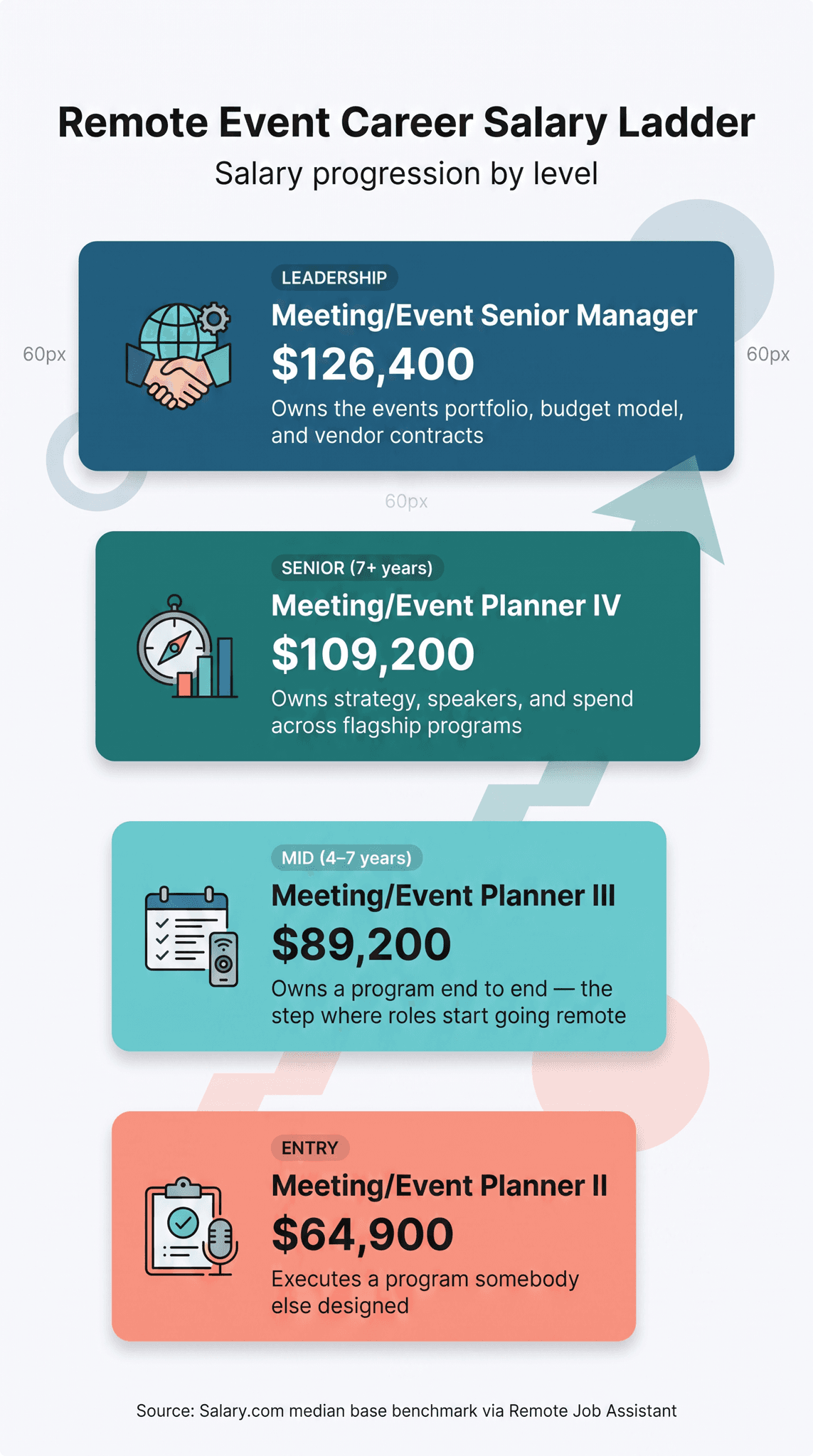
Salary.com's August 2026 benchmark gives the clearest ladder in this occupation, because it separates levels rather than averaging a title that spans $50K to $150K.
| Level | Typical title | Median base |
|---|---|---|
| Entry | Meeting/Event Planner II | $64,900 |
| Mid (4–7 years) | Meeting/Event Planner III | $89,200 |
| Senior (7+ years) | Meeting/Event Planner IV | $109,200 |
| Leadership | Meeting/Event Senior Manager | $126,400 |
Those figures come from Salary.com's benchmark data dated August 1, 2026, cross-referenced against the posted ranges in our own August 2026 ATS pull and against O*NET's republication of the BLS 2025 wage series. They are base salary and exclude bonus, which at agency and B2B media employers is frequently tied to event margin or sponsorship revenue.
For a verified remote example rather than an aggregate: EVERSANA's remote Associate Director, Meeting Services role, posted in August 2026, listed a range of $78,280 to $113,000. That is a genuine posted band on a genuinely remote listing, and it lands almost exactly where the Room Test predicts a high-scoring role should.
One thing no posted base tells you: how the employer treats the weeks you are on site. Get three answers in writing before you compare offers. Whether travel days are work days or get absorbed into your regular week with no offset. Whether the company books and pays travel up front or reimburses weeks later against a card you float. And whether there is a per diem, or you are expensing every airport meal line by line and arguing about the ones that get rejected. A remote role where you front two weeks of travel spend every quarter is a materially worse offer than one paying a few thousand less with a corporate card and a per diem, and no listing spells that difference out.
Now the number that matters most. The occupation's median across all work arrangements is $61,160, according to the BLS wage series for meeting, convention, and event planners. Built In's remote-only data for the same title puts the median at $100,000, with a range of $60,000 to $140,000 and an average of about $122K for professionals with seven or more years.
The all-settings median for this occupation is about $61K. The remote-only median is about $100K. Those are not the same job with a different commute. They are different jobs that share a keyword.
The gap has a cause, and understanding it tells you where to aim. The occupational median is dragged down by hospitality, venue, catering, and wedding-side roles, which make up a large share of employment in this field and are structurally incapable of going remote. They therefore never enter the remote sample at all. What remains in the remote slice is corporate, pharma, and B2B media, where the events budget sits inside marketing and the person managing it is compensated against a marketing band rather than a hospitality one. You are not getting a raise for working from home. You are getting a different employer type.
One more feature of the ladder deserves attention: the step from Planner III to Planner IV is worth roughly $20K, but the step from Planner II to Planner III is a 37% jump, the largest single move on the ladder. That step is where you stop executing a program somebody else designed and start owning one. It is also the step where the Room Test score of a typical role crosses from the 5–7 band into the 8–10 band, which is why it correlates so strongly with remote eligibility.
If you are benchmarking against the broader market, the senior end of this ladder sits inside remote roles paying $100K and up, while the mid-level rungs land in the $75K and above range.
Stop Applying Manually
Our AI applies to hundreds of matching jobs while you sleep. Wake up to interviews, not more applications.
The Four Remote-Friendly Event Tracks
Every remote listing in our pull fell into one of four families. If you are rewriting your search, these are the four searches to run instead of the one that returns nothing.
Event Marketing and Field Marketing
Remote rate: 27% (n=4 of 15). This role owns demand generation and pipeline rather than logistics. You report into marketing, you are measured on sourced and influenced revenue, and the on-site execution is usually handled by a field team or an agency. Typical range runs $80K to $130K.
The skills that get you shortlisted are not event skills. They are Salesforce and HubSpot fluency, attribution modeling, and the ability to defend an event's cost per opportunity in a pipeline review. If you have run trade show programs and can speak to the pipeline they generated, you are closer to this track than you think. It sits alongside the broader remote marketing job market and overlaps heavily with digital marketing careers.
Conference Production
Remote rate: 44% (n=4 of 9), the highest of any title family in our data. Conference producers at B2B media companies and trade publishers own the agenda, the speaker lineup, and the editorial content. The job is research, outreach, and booking, which is a desk job in the most literal sense. Typical range runs $70K to $115K.
This is the most underrated pivot for anyone with a content or journalism background who has also run events, and it is the track least likely to be visible if you search by the word "planner."
Meeting Services and Speaker Bureau
Concentrated in pharmaceutical and life sciences services, and the most compliance-heavy of the four. The work is healthcare professional engagement, contracting, honoraria, and transparency reporting. The deliverable is a compliant contract and a defensible payment trail rather than a room, which is precisely why it goes remote. EVERSANA's posted band of $78,280 to $113,000 is representative.
Be clear-eyed about what this is. It is not strategy work. It is contracting and reporting work that pays like strategy work because the compliance layer keeps the applicant pool small. That is a feature if you are strong on process and documentation, and a trap if what you actually want is to build programs. If you have handled speaker contracts, travel, and reimbursement at any scale, that experience maps directly, and the regulatory layer functions as a moat against casual applicants.
Events Program and Operations
Remote rate: 15% (n=2 of 13). This role owns the calendar, the budget model, and the event tech stack across a portfolio rather than any single event. Typical range runs $85K to $125K.
It rewards project management discipline, fluency in Asana or similar, and genuine spreadsheet modeling ability for budget forecasting and attrition math. This is the natural landing spot for senior operators, and it neighbors the wider remote operations job market and the operations career track.
Agency or hospitality background: aim at conference production or meeting services, where your vendor and contracting experience is the qualification. Corporate in-house background: aim at event marketing or events program management, where your budget and stakeholder experience already maps. In both cases, the pivot is lateral in seniority and vertical in pay.
What a Remote Event Week Actually Looks Like
Monday you are redlining a venue contract, refusing a force majeure clause that would leave your company holding a cancelled event's costs. Tuesday a keynote drops out fourteen days from the date, and you spend the afternoon rebuilding an entire session track around the two speakers who can move. Wednesday the room block comes in thirty short of the attrition floor, so you reforecast the budget and start the uncomfortable conversation about buying down the penalty.
Thursday the registration platform mis-maps a custom field and 400 confirmation emails go out with the wrong start time. You draft the correction, get it approved, and re-send inside two hours. Friday you are in a pipeline attribution argument with sales about whether the 60 meetings booked at last quarter's event should count as event-sourced or sales-sourced.
That is a real week and none of it required a building. But the honest version of this job includes the part that does.
Six to ten weeks a year, you are not remote at all. You are on site at 6am in a convention center in a city you did not choose, and you will be the last person to leave the room. Any events listing promising zero travel is either a virtual-only program or is not describing the job accurately.
There is a second, quieter risk: the role that was remote when you signed and is hybrid by the time your first flagship event is over. Some employers relabel an on-site events role "remote" to widen the applicant pool, then rediscover that they want someone in the building. You can usually see it coming in the listing.
Five signs a "remote" event listing will not stay remote:
- The travel percentage is missing. A genuinely remote events role states it. Silence usually means the number is high enough that printing it would cost the employer applicants.
- "Remote" comes with a geography. "Remote, must be within driving distance of our Chicago office" is a hybrid listing that has not admitted it yet.
- No production partner, venue counterpart, or agency is named anywhere. If nobody else is responsible for the room, you are.
- Twenty-plus events a year described as "fast-paced." At that cadence you live on the road whatever the workplace field says, and the Room Test already scores it at zero.
- On-site presence "as needed." Ask in the first interview how many days that meant last year, and whether this role was remote twelve months ago. If it was on site and got relabeled, assume it will drift back.
Event professionals who take remote roles and then resent the travel weeks tend to leave inside a year. The ones who last treat those weeks as the concentrated version of the job and the other forty-six as the part that finally happens on their own terms.
Stop Applying Manually
Our AI applies to hundreds of matching jobs while you sleep. Wake up to interviews, not more applications.
How to Reposition Event Experience for Remote Roles
Start with the title on your resume, because it is doing more damage than anything else on the page. If your last role was titled Event Planner but you managed a $2M budget, negotiated 30 vendor contracts, and owned a program calendar, you are not misrepresenting anything by describing yourself as an Events Program Manager or an Event Marketing Manager. Most event professionals already do the work of a title that goes remote while carrying a title that does not.
Then change what your bullets lead with. Event resumes almost universally lead with volume: events executed, attendees hosted, cities covered. Remote roles are hired to own numbers, not to produce activity, so the resume has to lead with the numbers you controlled.
Event professionals get filtered out of remote roles because their resumes lead with how many events they ran instead of how much budget they controlled.
Here is one illustrative accomplishment written both ways.
Before: "Planned and executed 24 corporate events annually across 9 cities, including a 1,200-attendee user conference."
After: "Owned a $2.1M annual events budget across 24 programs; renegotiated the flagship 1,200-attendee conference's venue contract to remove $140K of room-block attrition exposure and delivered the program 6% under budget."
Same person, same year. The first bullet describes activity, and a hiring manager staffing a remote role for budget ownership filters it out in seconds. The second names the number you controlled, the risk you removed, and the result. Lead with spend managed, contracts negotiated, savings captured against rack rates, and pipeline influenced. Keep the event count, but put it second.
Name the platforms explicitly, because the ATS is matching strings and not inferring competence. Cvent, Bizzabo, Splash, Goldcast, Salesforce, Asana, and whatever registration and badging systems you have actually administered belong in the text, not implied by a job title. The same applies to the stakeholder communication skills that senior event roles run on, which read as generic unless you attach them to a specific negotiation or escalation.
Then there is the volume problem, and it is arithmetic rather than attitude. At a 12.2% remote rate, you need to see roughly eight qualifying postings to find one that is genuinely remote, and that is before filtering for level, sector, and salary. Manual searching in a field this thin is not a discipline problem, it is a throughput problem. Auto-Apply exists for exactly this shape of search: it works through the volume so the one-in-eight actually surfaces instead of getting lost three pages deep in aggregator results.
Two places worth watching that the aggregators under-index: the PCMA (Professional Convention Management Association) career center, where employer-side meeting services and conference roles are posted directly, and the r/eventprofs community, where people who made this exact pivot talk candidly about which employers actually honored the remote arrangement. We could not pull either for this post, so read them yourself before you take a listing at its word.
For adjacent paths worth watching while you search, senior event operators frequently land in six-figure remote marketing roles and in remote program management, both of which value the same budget-and-stakeholder core.
Frequently Asked Questions
Are remote event planning jobs real, or is every listing secretly on-site?
They are real but rare, and the listings are less deceptive than mistitled. In our August 2026 pull, 15 of 123 event-titled postings (12.2%) were fully remote. The catch is that none of the 4 postings titled specifically "Event Planner" were among them, which is why the search feels like it returns nothing but on-site work.
I have run corporate events for six years. What should I search instead of "remote event planner"?
Run four searches: event marketing manager, conference producer, meeting services, and events program manager. Those four title families accounted for every fully remote role in our data. Your six years of budget, vendor, and stakeholder experience qualifies you for all four, but the keyword you are currently searching has a 0% remote rate.
Do remote event roles still require travel to the events?
Yes, for most of them. Expect 6 to 10 weeks a year on site in a genuinely remote events role, concentrated around your largest programs. The exceptions are virtual-only and webinar program roles, and roles where a production partner or venue team owns execution entirely. A listing that claims an events job requires no travel deserves a direct question in the first interview.
How do I score a job posting on The Room Test before applying?
Read the description for four things: whether the deliverable is a document or a room, whether a venue or production partner is named, the stated event cadence, and whether you would own budget or logistics. Award up to 3, 3, 2, and 2 points respectively. A score of 8 or higher is genuinely remote, 5 to 7 means real remote work punctuated by mandatory event weeks, and anything under 5 is an on-site job with a remote job title.
Why do remote event jobs pay so much more than the BLS median?
Because the remote slice is not a random sample of the occupation. The BLS median of $61,160 includes hospitality, venue, catering, and wedding-side roles that cannot go remote and never appear in remote listings. What is left is corporate, pharma, and B2B media, where events sit inside a marketing budget and are paid on a marketing band. Built In's remote-only median of $100,000 reflects a different employer mix, not a remote-work premium.
Can I move into remote event marketing without a marketing background?
Yes, if you can talk about pipeline. The hiring bar in event marketing is whether you can explain what an event cost, what it generated, and how you know. If you have run trade show or field programs and have any visibility into the meetings or opportunities they produced, build two or three bullets around that and learn enough Salesforce reporting to defend them. Attribution literacy matters more than a marketing title.
Start Your Remote Event Career
Three decisions change this search from frustrating to workable. Stop searching the one title with a 0% remote rate and run the four that convert. Score every posting on the Room Test before you spend time on an application, so you stop discovering the travel requirement in round three. And rewrite your resume to lead with the budget you controlled rather than the events you delivered, because remote roles are hired to own numbers.
From there it is a volume game, and Auto-Apply is built to absorb that volume for you. It is also worth watching remote marketing openings and roles paying $100K and above directly, since that is where most of these titles are actually posted, and remote communications roles sit close enough to be worth a parallel search.
The room still needs someone standing in it at 6am. It no longer needs that person to be the one who negotiated the contract, booked the speakers, and owns the budget.
Ready to Find Your Remote Job?
Browse thousands of curated remote jobs or let AI apply for you.
Browse Remote JobsRelated Job Guides
Remote Medical Director Jobs: 305 of 1,860 Are Remote
We read 1,860 medical director job postings: 305 are fully remote, mostly health plan and pharma seats. See which go home, what they pay, and the license rules.
31 min read

Remote Mortgage Underwriter Jobs: 55 of 165 Are Remote
We read 165 mortgage underwriter postings: 55 are fully remote, mostly at lenders that sell their loans. See pay by employer, the DE premium and contract rules.
28 min read

Remote Clinical Pharmacist Jobs: 74 of 1,587 Are Remote
We read 1,587 clinical pharmacist postings. 74 are fully remote, mostly payer and PBM claim review. See which seats go home, their pay and the license catch.
29 min read