
Last reviewed: August 2026
You've watched half the SEO subreddits declare the industry dead. AI Overviews are eating informational clicks, ChatGPT answers questions that used to be blog traffic, and every week another founder posts a screenshot of organic traffic falling off a cliff. Meanwhile, you keep seeing Head of SEO roles posted at $150K+ and "Generative Engine Optimization" titles that didn't exist two years ago.
Both things are true, and that's the part almost nobody explains. AI didn't shrink the SEO job market — it split it. The task layer of SEO — meta tags, keyword lists, monthly ranking reports — is being commoditized toward zero, because those are exactly the deliverables a language model produces in seconds. The strategy layer is being repriced upward, because someone has to figure out why AI systems cite one page and ignore its better-optimized competitor, and very few people can.
Get Remote Job Tips in Your Inbox
Weekly strategies, salary data, and new opportunities
Unsubscribe anytime. No spam.
This guide gives you the real numbers on remote SEO jobs in 2026: what each level of the ladder actually pays, which skills moved from "nice to have" to "this is the whole job," where the roles are concentrated, and how to position yourself on the right side of the split. We manually reviewed 412 remote SEO job postings across 187 companies between February and August 2026 — discarding hybrid roles dressed up as remote and junior content jobs rebranded as "SEO" — and cross-referenced what survived against ZipRecruiter, Glassdoor, and SEOjobs.com compensation data.
Based on our analysis of 412 remote SEO postings (February–August 2026):
- 72% (n=297 of 412) were fully remote; the rest were remote-flexible with occasional office expectations
- 68% (n=280 of 412) listed technical SEO — audits, crawl management, site architecture — as a core requirement
- 57% (n=235 of 412) named Ahrefs or Semrush specifically, not "SEO tools" generically
- 44% (n=181 of 412) mentioned AI tools or AI-assisted workflows in the job description
- 14% (n=58 of 412) explicitly referenced GEO, AEO, or LLM visibility — a category that barely existed in 2024
- $53K–$242K — the full advertised base range across levels, from entry specialist to Head of SEO 90th percentile (cross-referenced with ZipRecruiter, July 2026)
How We Collected This Data
The figures in this post come from our analysis of 412 remote SEO job postings collected between February 2026 and August 2026. Postings were sourced from the Remote Job Assistant listings database and public job boards (LinkedIn, Indeed, ZipRecruiter, and SEOjobs.com) and filtered to positions explicitly marked remote-eligible in the United States and Canada.
We excluded postings without a clear remote policy, roles requiring more than 25% travel, and pure freelance gigs under 20 hours per week. Two limitations worth being honest about: only 31% (n=128 of 412) of postings included a salary range, and a meaningful share of listings labeled "remote" resolved to hybrid once you read the fine print — a pattern that repeats consistently on LinkedIn in particular. Compensation figures are therefore cross-referenced with ZipRecruiter's July 2026 salary data, Glassdoor's SEO compensation estimates, and SEOjobs.com board data, which reports a median of $86,200 across its listings against a U.S. official median of $78,760 for the occupation.
Ranges reflect base salary. Total compensation at funded startups and public companies typically runs 10–20% higher once bonus and equity are included. We update this analysis quarterly; figures reflect August 2026.
What Remote SEO Jobs Actually Look Like in 2026
SEO was remote-native before remote was normal. The work happens in Ahrefs, Google Search Console, a CMS, and a spreadsheet — none of which care where you sit. That's why the supply of remote SEO roles has held up better than most marketing categories: LinkedIn alone lists over 3,000 remote SEO positions, Indeed around 1,800, and Glassdoor almost 1,300.
But the composition of those jobs is changing fast, and job titles hide it. Two postings that both say "SEO Specialist" can describe completely different careers — one that a language model is actively replacing, and one that exists because language models took over search. To tell them apart, we use a simple rubric.
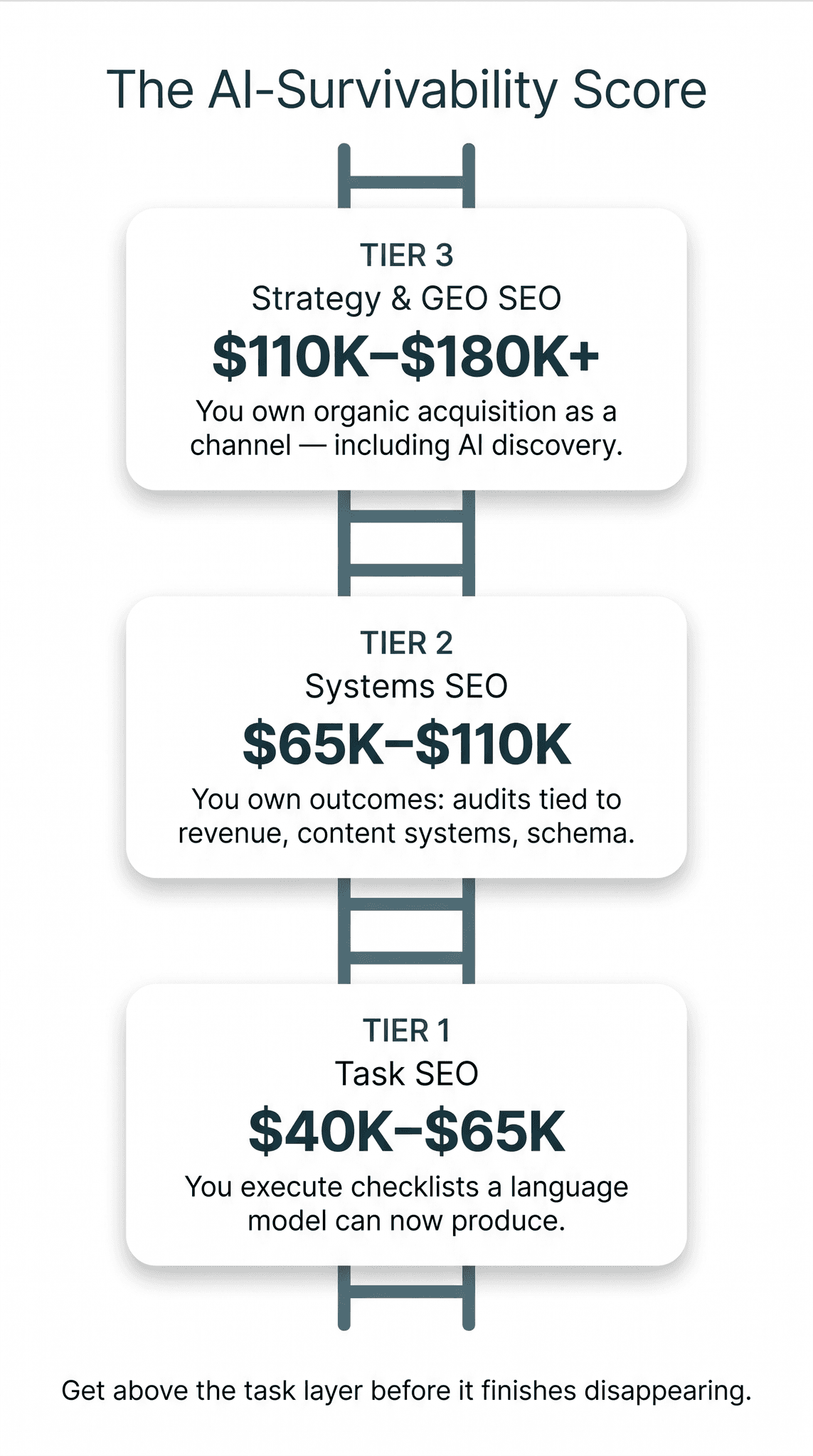
The AI-Survivability Score is a 10-point scale for how insulated a remote SEO role is from AI commoditization.
- 0–3: Task SEO ($40K–$65K). The job description is a checklist: write meta descriptions, build keyword lists, produce monthly ranking reports, "optimize content." These are deliverables an LLM produces in seconds, which is why this band faces the heaviest offshore and AI substitution pressure. If every bullet in the posting could be a ChatGPT prompt, it scores here.
- 4–7: Systems SEO ($65K–$110K). The job owns outcomes, not tasks: technical audits tied to revenue, content systems that other people execute, structured data implementation, analytics interpretation that changes decisions. AI is a tool in this band, not a threat.
- 8–10: Strategy and GEO SEO ($110K–$180K+). The job owns organic acquisition as a channel — including AI-driven discovery. GEO and AEO strategy, entity and schema architecture, forecasting, communicating traffic risk to executives. These roles are being created faster than they can be filled.
How to use it: score a posting before you apply. Count how many responsibilities are checklist items versus ownership statements. Below 4, don't apply — you'd be taking a job that's disappearing. From 4 up, the score roughly predicts the salary band you should negotiate within.
The bottom of the market isn't shrinking because companies stopped valuing search. It's shrinking because release-of-effort math changed: a $500/month AI content workflow now produces what a $45K junior specialist produced in 2022. Companies aren't being cruel — the math stopped working. Don't build a career on the band that's being automated.
The causal chain matters if you're betting your career on this field. AI Overviews and chat interfaces cut informational click-through, which cut the ROI of pure content-volume SEO, which cut demand for the people who execute it. At the same time, brands discovered their revenue now depends on whether ChatGPT and Perplexity mention them — and there is no established playbook for that. Scarcity plus urgency is why the top of the market is climbing while the bottom falls out.
If you're already spending hours a day applying to remote marketing roles manually, that's time you could spend building the GEO case study that moves you up a band. Auto-Apply handles the application volume across 500K+ company career pages while you do the work that actually raises your market price.
Stop Applying Manually
Our AI applies to hundreds of matching jobs while you sleep. Wake up to interviews, not more applications.
Remote SEO Salaries: What Each Level Pays
The ladder is real, but the rungs moved. Here's what remote SEO roles pay in 2026, by level:
| Level | Typical base range | 90th percentile | AI-Survivability band |
|---|---|---|---|
| SEO Specialist | $53K–$75K | $90K | 2–5 |
| SEO Manager | $70K–$98K | $117K | 4–7 |
| Head of SEO / Director | $113K–$175K | $242K | 7–10 |
Salary ranges derive from our analysis of 412 remote SEO postings between February and August 2026 — only 128 of which posted ranges — cross-referenced with ZipRecruiter and Glassdoor compensation data for the same period. We excluded outliers and postings without clear remote policies. Ranges shift as markets move; check the linked sources for current figures.
One honesty note the salary aggregators won't give you: the major sources disagree by $20K on the same title. According to ZipRecruiter's July 2026 data, the average SEO specialist earns about $67K base, with most between $53K and $75K. Glassdoor shows the same title at roughly $86K — because Glassdoor reports total pay estimates including bonus, and skews toward larger companies that pay above market. Both are "right." When you negotiate, anchor on the total-pay figure; when you budget, trust the base range.
The variance between companies is bigger than the variance between titles. An SEO Manager at a remote-first SaaS company owning organic as a growth channel clears $110K. The same title at a small agency, running deliverables across eight client accounts, posts at $70K. The difference isn't years of experience — it's whether the role owns a revenue outcome or a task list, which is exactly what the AI-Survivability Score measures.
The highest-paid remote SEO skill in 2026 isn't keyword research. It's knowing why ChatGPT cites one page and ignores its better-optimized competitor. Head of SEO roles that include AI-visibility ownership are the reason the 90th percentile stretches to $242K — a number that would have been fantasy for an SEO title in 2020. If you're targeting that end of the market, the $100K+ remote roles board shows which companies actually post ranges at that level, and our guide to $100K+ remote marketing careers covers how SEO compares to adjacent tracks.
The 2026 Remote SEO Skill Stack
Core SEO skills are table stakes — 68% (n=280 of 412) of postings still require technical auditing, and nobody gets hired without keyword research fundamentals. What changed is that a second layer now sits on top, and it's where the salary premium lives. The cleanest way to see it is side by side:
| Traditional skill | AI-era counterpart | Why it pays more |
|---|---|---|
| Keyword research | Query and prompt pattern analysis | Optimizing for how people ask AI, not just what they type in Google |
| Meta tag optimization | Entity and schema architecture (JSON-LD) | Structured data is how AI systems parse and trust your content |
| Link building | Citation earning | AI engines cite sources; being cited is the new ranking |
| Rank tracking | AI-visibility tracking | Brands now measure mentions in ChatGPT and Perplexity, not just SERP position |
| Content optimization | Citability engineering | Clear structure, definitive claims, and FAQ formatting get extracted verbatim |
What the postings actually require (n=412, Feb–Aug 2026):
- Technical SEO — audits, crawl management, site architecture: 68% (n=280)
- Ahrefs or Semrush named specifically: 57% (n=235)
- GA4 and Google Search Console fluency: required or strongly preferred in the majority of postings that listed tools
- AI tools and workflows — ChatGPT, AI content operations: 44% (n=181)
- Structured data / schema experience: 39% (n=161)
- GEO / AEO / LLM visibility explicitly: 14% (n=58) — the fastest-growing line item in the dataset
Which column should you invest in first? It depends on where you sit. If you're under three years in, the left column still comes first — nobody hires a GEO strategist who can't run a crawl or read Search Console, and skipping fundamentals to chase the AI layer produces candidates who can't pass a live audit. If you're mid-career with solid technical chops, invert it: every hour on the right column compounds, while another Ahrefs certification changes nothing about your market price. And if you're choosing between deepening content skills versus schema and entity work, pick schema — it serves both traditional rankings and AI visibility, so it pays twice.
The GEO layer commands a premium for a structural reason: there is no established playbook. Google published two decades of documentation about ranking; nobody at OpenAI publishes guidance on getting cited by ChatGPT. The practitioners who understand it learned by running experiments on their own sites — which means the skill can't be bootcamped yet, and scarce, unteachable skills are the ones that price highest. Dedicated GEO titles appearing in 14% of postings is the leading edge of that repricing.
If you're mid-career, this is the best skills-arbitrage window the field has offered in a decade. Your technical SEO foundation transfers directly — schema, site architecture, and crawlability matter more for AI visibility, not less. The professionals losing ground are the ones whose entire skill set lives in the left column of that table.
Building the right-column skills takes focused time — which is hard to find when you're burning 10+ hours a week on application forms. That's the trade Auto-Apply is designed for: it applies across matching roles automatically, and at a $75K+ salary target, reclaiming those hours costs less than what one week of them is worth.
Stop Applying Manually
Our AI applies to hundreds of matching jobs while you sleep. Wake up to interviews, not more applications.
Where the Remote SEO Jobs Are
Search "remote SEO jobs" and every result on page one is a job board — ZipRecruiter, Indeed, LinkedIn, Working Nomads, Wellfound, SEOjobs.com. Not one tells you what the market pays or which segment is growing. The boards also aren't interchangeable, and knowing which to use for what saves real time.
LinkedIn has the volume (3,000+ remote SEO listings) but the worst noise ratio — many "remote" listings resolve to hybrid on closer reading, which is consistent with our finding that only 72% (n=297 of 412) of analyzed postings were fully remote. Indeed (roughly 1,800 listings) is stronger for agency and mid-market roles. SEOjobs.com is the only niche board — around 197 remote listings with actual salary data on many of them. For curated remote-only boards, our review of Working Nomads covers what its curation does and doesn't catch, and our Wellfound review explains when startup-equity SEO roles make sense. The full comparison lives in our remote job boards guide.
On the employer side, remote SEO hiring concentrates in three buckets:
- In-house at tech and SaaS companies. DigitalOcean and QuillBot hire remote SEO roles; this bucket has the highest AI-Survivability Scores because the role owns a channel, not a client list. Best pay, hardest interviews.
- Agencies. Single Grain, OuterBox, Virayo, and Fire&Spark hire remote SEO positions across levels. Faster to break into, broader experience, lower ceilings — you're the deliverable engine for multiple accounts. The honest trade-off framing: take agency work when you need reps and a portfolio fast, then move in-house the moment you have one channel-ownership story to tell. Staying at an agency past year three or four usually means trading salary growth for variety — a fine trade if you know you're making it, a slow leak if you don't.
- AI-focused marketing shops. Zen Media and similar agencies now post explicitly AI-centric SEO roles. Small bucket, growing fast, and the job descriptions read like the right column of the skills table above.
A useful tell when evaluating any of these: companies that publish salary ranges skew toward genuine remote-first operations. In our dataset, postings with published ranges were disproportionately from companies that also documented their remote policies clearly — the transparency correlates.
Red Flags in Remote SEO Job Descriptions
A few patterns that job boards won't warn you about, but that show up over and over once you know to look:
- The agency "Head of SEO" that's actually account management. If the responsibilities are client calls, reporting decks, and "managing deliverables," the strategy is being set by whoever sells the retainers. You get the title without the ownership — and without the compensation trajectory the title implies.
- The GEO role at a company that can't define it. Plenty of companies posting AI-visibility roles have no playbook and no internal champion — they'll expect you to invent GEO from scratch while still hitting traditional ranking targets on the old dashboard. That can be a career-making opportunity or a setup to fail; the interview question that separates them is "what would success look like in the first two quarters?" If they can't answer, price the chaos into your offer.
- The $150K role doing the work of four people. Some of the best-paying postings exist because a company cut its content team and now wants one senior person to replace it. Ask directly how many people touched organic before the role opened. The answer changes what the salary actually buys.
- The 12-tool specialist posting. An "SEO Specialist" listing that names a dozen tools plus "content strategy" plus "social media support" is a junior task job with scope creep, whatever the title says. It scores 0–3 on the AI-Survivability Score — the band that's disappearing.
How to Land a Remote SEO Role
The interview process for remote SEO roles has converged on a pattern: portfolio review, live audit, strategy conversation. Certifications barely register — what moves offers is evidence of outcomes. Here's what actually works in 2026:
Build one public case study with real numbers. Not "increased organic traffic significantly" — "grew organic signups 34% in six months by consolidating 40 thin pages into 12 and rebuilding internal linking." One specific, verifiable story beats a resume full of tool names. If your current employer won't let you share numbers, run the experiment on a site you own. Before you publish it, score it against three questions: Does it show a business outcome, not just a traffic graph? Does it include a trade-off you decided against — something you chose not to do and why? Could a stranger replicate your method inside two weeks from your writeup alone? A case study that clears all three reads like judgment. One that clears none reads like a screenshot.
Write up a GEO experiment. This is the single highest-ROI move available right now, because almost nobody has one. Pick a topic, engineer a page for AI citability — clear structure, definitive claims, schema, FAQ formatting — and track whether ChatGPT or Perplexity starts citing it. Even a failed experiment with honest analysis puts you ahead of candidates who can only talk about the old game. It's also precisely the artifact that moves you from a 5 to an 8 on the AI-Survivability Score in a hiring manager's mental math. An open secret about the current market: a noticeable share of the people landing the $150K+ AI-visibility roles got there by running exactly this kind of experiment on their own sites and then getting hired to replicate it — not by having the best traditional resume.
Plug into the rooms where this is being figured out. The GEO playbook is being written in public, mostly in practitioner communities rather than official documentation. The r/bigseo subreddit is where salary threads and honest agency-versus-in-house debates actually happen; Ahrefs Webmaster Tools' free tier is enough to run a legitimate audit portfolio on your own sites; and Schema.org's own documentation plus open-source JSON-LD templates cover the structured-data layer that 39% (n=161 of 412) of postings now ask about. You don't need a paid course — you need reps and a public record of them.
Expect a live audit. Most remote SEO interview loops include auditing a real site on a screen share. Practice narrating your process out loud: what you check first, why crawl budget matters here, what you'd deprioritize. Hiring managers are evaluating judgment under ambiguity, not whether you find every issue. If you're getting first-round interviews but stalling after the audit, our breakdown of why qualified candidates stop getting callbacks covers the most common failure points, and these resume title fixes solve the ATS-mismatch problem for SEO titles specifically.
Respect the volume math. Remote SEO roles draw applicant pools in the hundreds because they're location-independent by nature. At typical response rates, landing interviews means sustained application volume across many companies — the kind of repetitive work that eats the hours you should spend on the case study and the GEO writeup. That division of labor is the whole argument for automation: Auto-Apply runs the volume game across company career pages directly, and you spend the reclaimed time becoming the candidate worth interviewing.
Stop Applying Manually
Our AI applies to hundreds of matching jobs while you sleep. Wake up to interviews, not more applications.
Frequently Asked Questions
Is SEO still a viable career in 2026 with AI Overviews taking over search results?
Yes — but only above the task layer. Checklist-driven SEO work is being automated away, while roles that own organic acquisition as a channel are climbing: Head of SEO positions reach $242K at the 90th percentile per ZipRecruiter's 2026 data. Be clear-eyed about what that means: the bottom half of the field really is disappearing, and the money is concentrating into fewer senior roles. Viability depends entirely on which half you're standing in.
I've been doing traditional SEO for five years — do I need to learn GEO to stay employable?
You don't need it to stay employed next year, but you need it to keep your trajectory. GEO and AI-visibility requirements appeared in 14% (n=58 of 412) of the remote SEO postings we analyzed between February and August 2026, and that share is growing every quarter. Your technical foundation — schema, architecture, crawlability — transfers directly, so the learning curve is shorter than you'd expect.
How do I score a job posting on the AI-Survivability Score before applying?
Read the responsibilities list and sort each bullet into "checklist task" or "outcome ownership." Mostly tasks (write metas, build keyword lists, produce reports) scores 0–3: don't apply. A mix where you own audits, content systems, or analytics scores 4–7. Channel ownership, GEO strategy, or executive reporting scores 8–10. The score roughly predicts the salary band, so it also tells you what to negotiate.
What's the difference between an SEO specialist and an SEO manager in pay and day-to-day work?
Specialists execute within someone else's strategy — typical remote base of $53K–$75K. Managers own the strategy and the results: they decide what gets built, coordinate content and engineering, and answer for traffic numbers, at $70K–$98K base with a $117K 90th percentile. The jump usually requires showing you can run a project through other people, not just do the work yourself.
How many remote SEO jobs are actually fully remote versus hybrid in disguise?
In our dataset, 72% (n=297 of 412) were genuinely fully remote; the rest carried hybrid or "remote-flexible" expectations that surface in the fine print. LinkedIn listings skew worst for this. Check for a stated remote policy and published salary range — companies transparent about one tend to be honest about the other.
Can I get a remote SEO job without an agency background?
Yes, and in-house hiring managers increasingly prefer it. What they want is evidence you can own an outcome: one public case study with real numbers, or a documented GEO experiment on your own site, outweighs years of anonymous agency deliverables. The portfolio replaces the pedigree in this field — it's one of the few marketing disciplines where that's genuinely true.
Is using an auto-apply tool safe for senior SEO roles, or will it hurt my candidacy?
Applying through a company's own career page — which is how Auto-Apply works — looks identical to applying manually; there's no shared applicant database that flags automation. The real risk at the senior level is the opposite: spending your differentiation hours on form-filling. Automate the volume, and put the saved time into the case study that gets you the offer.
Start Your Remote SEO Career
The remote SEO market in 2026 rewards a specific move: get above the task layer before the task layer finishes disappearing. Score roles before you apply, anchor salary negotiations on total-pay data, and build the one GEO artifact that almost no other candidate has.
Browse current remote marketing openings, compare boards in our remote job boards guide, see how SEO stacks against adjacent paths in our $100K+ remote careers guide and digital marketing career guide, or let Auto-Apply run the application volume while you build the skills the market is repricing upward.
Search didn't stop needing experts when AI started answering the questions. It stopped paying the people who only optimize for the old answers.
Ready to Find Your Remote Job?
Browse thousands of curated remote jobs or let AI apply for you.
Browse Remote JobsRelated Job Guides
Remote SQL Jobs: What 449 Postings Actually Pay (2026)
Remote SQL jobs: we read 449 US postings. SQL Server seats post $116K, cloud-warehouse seats $186K, and the best-paid SQL jobs drop SQL from the title.
45 min read
Remote Java Developer Jobs: What 1,384 Postings Pay (2026)
Remote Java developer jobs: we read 1,384 US postings. 32% of those stating a model are remote, 57% come from consultancies, and the best-paid don't say Java.
48 min read
Remote Python Jobs: What 580 Postings Actually Pay (2026)
580 US Python-titled postings read in full: who posts them, the $126K–$180K median range, which are remote, and the four-question score behind the pay gap.
65 min read