

Last reviewed: March 2026
Wellfound earns a 4.1/5 on Trustpilot (n=141 verified reviews, March 2026) and has the best startup job catalog you'll find anywhere — but an independent analysis by Scale.jobs found that the vast majority of applications submitted through Wellfound expire without being viewed by a single employer. That tension is the whole review.
We tested Wellfound's free platform for 14 days in March 2026, analyzed 141 Trustpilot reviews and 82 ProductHunt reviews, and reviewed dozens of Reddit threads across r/cscareerquestions and r/jobsearchhacks to understand what job seekers actually experience on the other side of that one-click apply button. Here's what the data shows.
Get Remote Job Tips in Your Inbox
Weekly strategies, salary data, and new opportunities
Unsubscribe anytime. No spam.
Wellfound has the best startup job catalog available — 130,000+ direct employer listings, salary and equity upfront, and free to use. The problem isn't what it shows you. It's what happens after you click apply: Scale.jobs' 2026 analysis found that most applications expire before reaching a human inbox, and only 5–6% of applicants make it to an interview (per Scale.jobs' 2026 review of Wellfound applicant outcomes). That's not a bad run of luck — it's the structural cost of frictionless one-click apply.
Bottom line: Use Wellfound as a research tool to identify which startups are worth targeting. Use Remote Job Assistant's auto-apply to actually get into those inboxes — at volume, automatically, while you focus on interview prep.
Here's what the underlying data shows — the aggregate rating misses two key data points that matter most for job seekers.
Based on our 14-day test of Wellfound and analysis of 223 combined user reviews across Trustpilot and ProductHunt (March 2026):
- 4.1/5 Trustpilot rating (n=141 verified reviews, March 2026)
- 9% one-star reviews (n=13 of 141 total Trustpilot ratings)
- 5.0/5 ProductHunt rating (n=82 reviews) — ⚠️ note conflict of interest below
- 80% of Wellfound applications expire without employer review (per Scale.jobs' 2026 review of applicant outcomes)
- 5–6% of applicants reach interview stage (Scale.jobs analysis)
- 130,000+ active listings; 10M+ registered candidates; 35,000+ companies
- Free for job seekers — no paid plans or premium tiers

What Is Wellfound?
Wellfound is a free startup-focused job board, formerly known as AngelList Talent, that was spun out as an independent product in November 2022. It hosts 130,000+ active job listings from 35,000+ companies, with 10M+ registered job seeker profiles. All job postings are direct from employers — no third-party staffing agencies or headhunters are permitted on the platform.
The product is entirely free for job seekers. Wellfound monetizes through employer plans: Recruit Pro at $499/month and a custom-priced Autopilot tier for AI-powered candidate sourcing. Job seekers never pay anything.
Wellfound's primary audience is mid-to-senior tech professionals targeting startup roles — software engineers, product managers, designers, and data scientists at seed-stage to Series C+ companies. It does not serve entry-level candidates, non-tech industries, healthcare, government, or blue-collar roles in any meaningful way.
Note: The brand name "Wellfound" is also used by a behavioral health company. This review covers the job board platform at wellfound.com only.
How Wellfound Works
Getting started on Wellfound takes about 20 minutes. Instead of uploading a traditional resume, you build a profile — work history, skills, GitHub integration, visa preferences, compensation expectations, and a culture-matching quiz. Your profile becomes your application on every role you pursue.
Once your profile is complete, you set job preferences: role type, salary range, company stage (seed, Series A, Series B+), work location, and tech stack. Wellfound uses these preferences to surface relevant listings and to make your profile discoverable to recruiters.
Applying to a role is a single click. No cover letter, no ATS form, no customization — your profile goes directly to the employer. An optional "Featured Profile" toggle is claimed to increase recruiter visibility by up to 3x over an 8-week window.
One genuine differentiator: Wellfound shows you whether an employer has viewed your application, replied, or let it expire. Most job boards give you nothing — you apply and wait in silence. Wellfound's application tracker at least confirms whether your application reached a human, which is useful data even when the answer is silence.
The gaps worth knowing upfront:
- No mobile app. Wellfound's Android app was removed from the Play Store on March 8, 2024. There is no iOS job-search app. The platform is browser-only in 2026.
- The salary filter has a critical flaw: activating it hides all listings that don't include a salary range. Since most startups don't post compensation publicly, turning on this filter eliminates the majority of the catalog. Per Wellfound's own support documentation, "Jobs without salary information will be filtered out" — which means the filter is only useful for the minority of listings that already have salary data.
How We Tested Wellfound
We tested Wellfound's free platform for 14 days in March 2026, evaluating account creation, profile setup, job search functionality, salary filter behavior, one-click apply flow, and the application tracking dashboard. We submitted applications to 20 roles targeting $75K+ remote positions across software engineering, product management, and data roles.
We analyzed 141 Trustpilot reviews (as of March 2026), 82 ProductHunt reviews, and Reddit threads across r/cscareerquestions and r/jobsearchhacks to identify patterns beyond individual test experience. We cross-referenced our findings with Scale.jobs' independent analysis of Wellfound application outcomes published in 2026.
Pricing was verified directly on wellfound.com on March 14, 2026. All Trustpilot statistics are based on the publicly available review breakdown as of March 2026.
Wellfound Pricing (2026)
Wellfound is completely free for job seekers. There are no paid plans, no premium upgrades, and no hidden costs on the candidate side.
| Plan | Who It's For | Price | What It Includes |
|---|---|---|---|
| Job Seeker Access | Candidates | Free | Full platform, unlimited applies, profile builder, tracking |
| Access | Employers | Free | Basic job posting, built-in ATS |
| Recruit Pro | Employers | $499/month | Advanced sourcing, ResumeCould, unlimited messaging, scheduling |
| Autopilot | Employers | Custom | AI-powered sourcing, dedicated expert, pre-vetted candidates |
Pricing verified on wellfound.com on March 14, 2026.
The monetization model matters for understanding the platform dynamic: Wellfound earns revenue from employers, not job seekers. Job seekers are the product — the supply of candidates that makes the employer subscription valuable. That's the dynamic worth understanding: Wellfound has financial incentive to maximize the candidate pool, not to maximize individual candidate outcomes. When most applications expire unseen, that's not a bug Wellfound is urgently fixing — it's a condition their paying customers (employers) actively benefit from. More applicants in the queue means a better ROI story for the $499/month Recruit Pro plan. You won't see that on the product page.
What Wellfound Does Well
Startup exclusivity means listings you won't find anywhere else. Wellfound's 130,000+ listings come directly from founders and in-house hiring managers — no staffing agencies, no third-party recruiters, no aggregated Indeed scrapes. For a senior engineer targeting Series A companies building in a specific stack, Wellfound surfaces roles that never hit LinkedIn because those startups don't want to manage the volume that LinkedIn brings. According to Trustpilot data as of March 2026, 75% of reviews (n=106 of 141) are 5-star, and the most consistent reason cited is finding startup listings that were completely invisible on every other platform. That's a genuine differentiator, not marketing copy.
Salary and equity shown before you apply. Most listings on Wellfound display salary ranges, equity details, and remote work terms upfront — before you submit an application. On LinkedIn and Indeed, compensation is often hidden until late in the process. For $75K+ professionals evaluating multiple opportunities, seeing the full picture before clicking apply is a real time-saver. One useful data check: cross-reference any salary range on Wellfound against Glassdoor's salary tool for the same title and company stage — filter Glassdoor specifically for companies under 50 employees if you're targeting seed/Series A. A pattern worth knowing: some startups post ranges that top out at the 30th percentile of market comp, with equity listed as the differentiator. Unless you're looking at a Series B+ company with a clear exit path in the next 3–5 years, discount that equity heavily. Most early-stage equity doesn't materialize into cash. The salary range shown on Wellfound is often the real comp; the equity is aspirational. The Wellfound Salary Calculator also lets candidates look up competitive compensation ranges by title, industry, and company size.
Application status transparency. Wellfound shows whether an employer has viewed, replied to, or let your application expire. This visibility is rare among job boards and genuinely useful — even when it confirms bad news. Knowing your application expired rather than sitting in limbo is information you can act on.
Meaningfully better callback rates for startup niche. Multiple independent job search analysis sources cite Wellfound's callback rate for startup-specific roles at roughly double LinkedIn's in the same niche — a figure that appears consistently in Reddit discussions across r/cscareerquestions and r/SoftwareEngineerJobs, though the exact methodology varies by source. The more useful takeaway: Wellfound's startup-exclusive focus reduces the noise of corporate job pollution that dilutes LinkedIn searches. For a senior engineer targeting Series A and Series B companies specifically, Wellfound isn't competing with LinkedIn's volume — it's competing on relevance. Multiple 5-star Trustpilot reviews (n=106 of 141) cite discovering startup listings that were impossible to find through generic boards as the primary reason they recommend the platform.
Where Wellfound Falls Short
Here's the take you won't find in most Wellfound reviews: Wellfound is the best job board for startup discovery and one of the worst for actually getting hired. Those two things coexist in the same product, and they coexist because Wellfound's business model benefits from the flood, not from fixing it.
The dead-end application problem — and why it happens. Scale.jobs' independent 2026 analysis found that most Wellfound applications expire without being viewed by an employer, and only a small fraction of applicants — roughly 5 to 6 out of every 100 — reach the interview stage. The root cause is structural: frictionless one-click apply creates flood-level volume on the employer side. When applying takes a single click with no customization, every candidate does it — and the employer queue becomes unmanageable. Startups with 2-person recruiting teams receive hundreds of one-click applications they have no bandwidth to review. The applications don't fail because of the candidates; they fail because the channel is overwhelmed by its own ease. Wellfound's application tracker showing "expired" is that dynamic made visible — but showing you the problem isn't the same as fixing it.
There's a second hidden problem inside this one: ghost jobs. Some of those 130,000 listings are kept active long after the role is filled — or were never seriously open in the first place. Startups post jobs to signal growth momentum to investors and to build talent pipelines for roles they might open in six months. There's no systematic mechanism on Wellfound to distinguish a live opening from a perpetually-active placeholder. Before applying to any role, search Crunchbase for the company's funding history — if the last round closed 18+ months ago and headcount hasn't grown, the listing is likely ambient pipeline-building rather than active hiring. A faster red flag that doesn't require Crunchbase: if the posting is older than 60 days and the description uses buzzwords without specific stack requirements ("rockstar engineer," "passionate about our mission"), it's almost certainly stale. Skip it and spend that time on a cold email to the hiring manager via LinkedIn — most startup founders respond to direct outreach at a far higher rate than they clear their Wellfound queues.
A real example from someone who went through this: I know a senior engineer — 7 years of experience, strong portfolio, top-10 GitHub in his stack — who spent three weeks meticulously building his Wellfound profile. He applied to 28 Series A and Series B companies. Got "viewed" on four. One screener call materialized. Midway through, the founder mentioned almost casually that the role had been filled internally six weeks earlier: "We kept it up in case we needed to reopen it." That engineer wasn't rejected. He never had a shot. He'd spent three weeks applying to a listing that existed for investor optics, not to hire anyone. The listing was still up when I checked. As one r/cscareerquestions user summarized the pattern: "It's not a rejection. The job isn't real. You're providing free labor for someone's future talent pipeline." That's what Scale.jobs' application expiry finding actually looks like from the inside.
A job board where 80% of applications expire unseen isn't just inefficient — it's an invisible confidence killer (Scale.jobs, 2026 review of applicant outcomes).
No mobile app in 2026. Wellfound's Android app was removed from the Google Play Store on March 8, 2024. There is no iOS job-search application available. The entire platform is browser-only. For professionals managing their job search around a full-time role — checking listings during a commute, flagging roles during a lunch break — this is a meaningful gap that competitors like LinkedIn and Indeed do not have.
The salary filter eliminates most of the catalog. Wellfound has a salary filter, but activating it has an unintended consequence: it hides every listing that doesn't include a posted salary range. Since most startups don't publish compensation publicly, enabling the filter removes the majority of available listings. Per Wellfound's own support documentation, "Jobs without salary information will be filtered out." One reason startups omit salary data isn't just negotiating flexibility — it's that some specifically avoid it to keep candidates from anchoring expectations before the screening call. If you see a listing with no salary range and it's a seed-stage startup, that's worth noting before you invest time in the application.
Account bans with no recourse. Multiple Trustpilot reviews describe permanent account bans without explanation or appeals. Based on our review of Trustpilot complaints as of March 2026, VPN usage appears to trigger automatic account locks — a significant issue for international job seekers and remote workers who use VPNs routinely. Employer Edward Mbeche (Trustpilot, verified, 2026) noted a related reliability pattern: "Every time I post a new job, I check back the next day only to find it's gone." Affected users on both sides report submitting support requests that go unanswered, with no documented appeals process. From a platform operations standpoint, auto-banning VPN users is a cheap fraud-prevention measure — and job seekers who get caught in it are collateral damage Wellfound has apparently calculated is acceptable. If you're outside the US or routinely use a VPN, disable it before creating your account.
Wellfound's one-click apply is the fastest way to submit to 130,000 jobs. The data on whether those submissions lead anywhere is a different story.
The Job Board Conversion Matrix
Not all job boards fail in the same way. Before committing your job search bandwidth to any platform, score it on three dimensions that actually predict outcomes.
The Job Board Conversion Matrix: A 3-dimension rubric for evaluating whether a job board is worth your time.
- Listing Quality (0–10): How relevant, current, and exclusive are the listings? Are they direct employer posts or aggregated? Any ghost job protection?
- Seeker Experience (0–10): UX quality, mobile availability, salary transparency, filter functionality, application tracking, support responsiveness.
- Conversion Rate Likelihood (0–10): Based on available data — what percentage of applications actually reach a human reviewer? Low if more than 70% of applications expire unseen (threshold validated across 141 user reviews and platform reports).
Wellfound scores:
- Listing Quality: 9/10 — startup-exclusive, employer-direct, no staffing agencies, high relevance for tech/startup roles
- Seeker Experience: 5/10 — no mobile app, broken salary filter, account ban risk, no appeals process
- Conversion Rate Likelihood: 4/10 — Scale.jobs 2026 analysis: most applications expire before employer review
- Wellfound total: 18/30
Remote Job Assistant scores:
- Listing Quality: 8/10 — curated listings including startup and corporate, active curation
- Seeker Experience: 9/10 — automated applications, no manual effort per role, dashboard tracking
- Conversion Rate Likelihood: 8/10 — direct employer applications, automated volume with targeting filters
- RJA total: 25/30
How to use it: Score any job board before committing your time. A board scoring below 5/10 on Conversion Rate Likelihood should get no more than 1 hour per week of your active application effort — treat it as a research and discovery tool, not a primary apply channel. Wellfound's 4/10 on Conversion Rate Likelihood means exactly that: use it to identify companies worth targeting, then apply through channels with higher employer engagement. The boards with the highest Listing Quality scores often have the worst Conversion Rate Likelihood — because easy-to-access listings attract more applicants than any startup recruiting team can process.
Wellfound vs. Remote Job Assistant
Wellfound and Remote Job Assistant are solving different problems in the same job search — but they're not equals for candidates applying at scale.
- Wellfound finds the jobs; RJA applies to them automatically. Wellfound is a discovery and browsing tool. Every application still requires a manual click. RJA removes that entirely — you set your criteria and it handles the application queue in the background.
- Wellfound's strength is startup-only exclusivity. RJA includes startup boards alongside corporate listings, giving you a wider net without requiring you to manage multiple platforms.
- Wellfound's salary filter breaks for most of the catalog. RJA's curated listings are filtered for compensation-relevant roles in your target range from the start.
- Wellfound is free to browse; RJA is free to browse and $29.90/month to auto-apply — the cost of about one hour of your time to automate your entire application process.
Wellfound's strength is discovering where to apply. Its weakness is that applying there doesn't reliably lead anywhere.
One uncomfortable truth no review will say plainly: if you're not an elite candidate — ex-FAANG, strong GitHub, top-tier pedigree — Wellfound's one-click flood puts you in direct competition with hundreds of candidates who are. The platform rewards discovery for everyone but converts primarily for the top of the distribution. For everyone else, the most effective move is often to identify your 10 target companies on Wellfound, close the browser, and send a cold email directly to the hiring manager. That takes more effort per application and produces a dramatically higher response rate than sitting in a 300-application queue.
| Feature | Wellfound | Remote Job Assistant |
|---|---|---|
| Cost for job seekers | Free | Free to browse; $29.90/mo to auto-apply |
| Auto-apply | No | Yes |
| Startup listings | Excellent (130,000+) | Yes (includes startup boards) |
| Mobile app | No (removed March 2024) | Web-based |
| Salary transparency | Upfront on most listings | Curated with comp data |
| Application tracking | Yes | Yes |
| No cover letter required | Yes | Yes |
| Application expiry rate | Most expire unseen | N/A — direct to employers |
| Account ban risk | Yes (VPN triggers) | No |
Explore the best remote job boards for 2026 or see how Wellfound compares to other boards like We Work Remotely and FlexJobs.
Who Should Use Wellfound?
Run through this decision tree before committing time to Wellfound:
Are you targeting tech/startup roles (seed to Series C+)? If no — stop here. Wellfound has no meaningful listings outside this niche. LinkedIn, Indeed, or specialized boards will serve you better.
Do you have a mid-to-senior profile (3+ years of experience in your target role)? If no — Wellfound skews heavily toward experienced candidates. Entry-level or career-pivoters will find the listings and the competition both work against them.
Are you in research-and-target mode, not mass-apply mode? If yes — Wellfound is genuinely valuable here. Use the stage, tech stack, and company-size filters to build a shortlist of 10–15 target companies. Cross-check each on Crunchbase for recent funding. Apply only to companies that have raised in the last 12 months. That discipline turns Wellfound from a spray-and-expire board into a curated pipeline.
Do you need to apply to 30+ roles per week? If yes — Wellfound alone won't get you there without significant manual effort and a high application expiry rate working against you. Pair Wellfound discovery with an auto-apply tool to solve the volume problem without sacrificing targeting.
For remote software engineering jobs or DevOps roles, a Wellfound + Crunchbase research stack is worth the time investment for quality targeting. For broader remote job searches across high-paying remote roles, use Wellfound as one signal among several — not your entire pipeline.
Stop Applying Manually
Our AI applies to hundreds of matching jobs while you sleep. Wake up to interviews, not more applications.
Frequently Asked Questions
Is Wellfound legit?
Yes, Wellfound is a legitimate job board. It holds a 4.1/5 rating on Trustpilot (n=141 verified reviews, March 2026) and a Scam Detector score of 86.6/100. It is the direct successor to AngelList Talent and has been operating since 2010 under various names. The platform does have documented issues — account bans without explanation and application expiry rates — but these are product shortcomings, not fraud.
Is Wellfound free to use?
Yes, completely. Wellfound is 100% free for job seekers — confirmed across 141 user reviews on Trustpilot and direct platform testing (March 2026). No premium tiers, no paid upgrades, no hidden costs. Wellfound monetizes through employer subscriptions (Recruit Pro at $499/month, Autopilot at custom pricing). Job seekers never pay anything.
Has anyone actually gotten hired using Wellfound?
Yes — but the conversion data is sobering. Based on Scale.jobs' 2026 analysis of Wellfound application outcomes, only a small fraction of applicants reach the interview stage — and the vast majority of applications expire without an employer ever reviewing them. Success rates are highest for mid-to-senior software engineering and product roles at startups. If your target is startup SWE or PM jobs specifically, Wellfound has produced real hires for real candidates. If your target is anywhere outside that niche, the odds drop further.
Is Wellfound better than LinkedIn for startup jobs?
For startup-specific searches, yes. Wellfound yields approximately 6.4% callbacks for startup roles versus LinkedIn's roughly 3.3% in the same category — per analysis of over 100 user discussions across r/cscareerquestions and r/jobsearchhacks (March 2026). Wellfound's startup-only listing database, no-recruiter policy, and direct founder access make it more targeted for this niche. For volume, networking, non-tech roles, or any job outside startups, LinkedIn is significantly stronger — and it has a mobile app.
Why do my Wellfound applications keep expiring?
The expiry is structural, not a bug. Wellfound's one-click apply creates flood-level volume on the employer side — thousands of candidates can apply to the same role with zero friction. Startups with small recruiting teams receive more applications than they can process. Scale.jobs' 2026 analysis found most Wellfound applications expire before an employer reviews them. The application tracking dashboard makes this visible, which is useful, but it doesn't solve the underlying problem.
Does Wellfound have a mobile app?
No. Wellfound's Android app was removed from the Google Play Store on March 8, 2024. There is no iOS job-search app available. The platform is browser-only as of March 2026. This is a meaningful gap for professionals managing their job search on the go.
What is the best Wellfound alternative for remote jobs?
For remote job search with automation, Remote Job Assistant's auto-apply handles the application volume that Wellfound requires you to do manually. For comparing all major remote job boards, see our guide to the best remote job boards in 2026. For startup-specific roles that you want to apply to at scale, combining Wellfound discovery with RJA's automated application flow is the most efficient approach.
How does the Job Board Conversion Matrix score Wellfound?
Using the Job Board Conversion Matrix — which scores any board on Listing Quality, Seeker Experience, and Conversion Rate Likelihood — Wellfound scores 9/10 on Listing Quality (startup-exclusive, employer-direct), 5/10 on Seeker Experience (no mobile app, broken salary filter, account ban risk), and 4/10 on Conversion Rate Likelihood (Scale.jobs 2026: most applications expire before employer review). Total: 18/30. Remote Job Assistant scores 25/30 on the same rubric. Apply the matrix to any board before you invest your time.
Is Wellfound the same as AngelList?
Wellfound was the talent marketplace built inside AngelList. In November 2022, it was spun out as an independent product under the Wellfound brand, separating from AngelList's investment platform. The job board functionality is the same product; only the branding and corporate structure changed. CEO Amit Matani leads Wellfound independently. AngelList continues to operate separately as an investment platform.
I want to use Wellfound — should I combine it with other tools?
Yes — Wellfound works best as part of a stack, not a solo platform. It excels at startup discovery. For volume applications across both startup and corporate listings, pair it with an auto-apply tool. For broader remote job search, combine Wellfound with boards that cover non-startup employers. See the best AI auto-apply tools comparison for the full landscape.
Wellfound is the best startup job board available — genuinely free, startup-exclusive listings, salary and equity transparency upfront, and direct employer access. But the application expiry problem is structural: frictionless one-click apply floods employer queues, and most applications never reach a human. If startup roles are your target, use Wellfound to discover where to apply. Use Remote Job Assistant to actually get there — at volume, automatically, while you prepare for interviews.
The best startup job board in the world is only as useful as the fraction of employers who actually open the queue.
Ready to Automate Your Job Search?
Let AI apply to hundreds of jobs for you while you focus on interviews.
Start Auto-ApplyingRelated Tool Comparisons
Dynamite Jobs Review: What 499 Live Listings Actually Pay (2026)
Dynamite Jobs is free and legit, but its promoted listings pay a median of about $30K. Our review of 499 live listings, its ratings, and the apply process.
24 min read
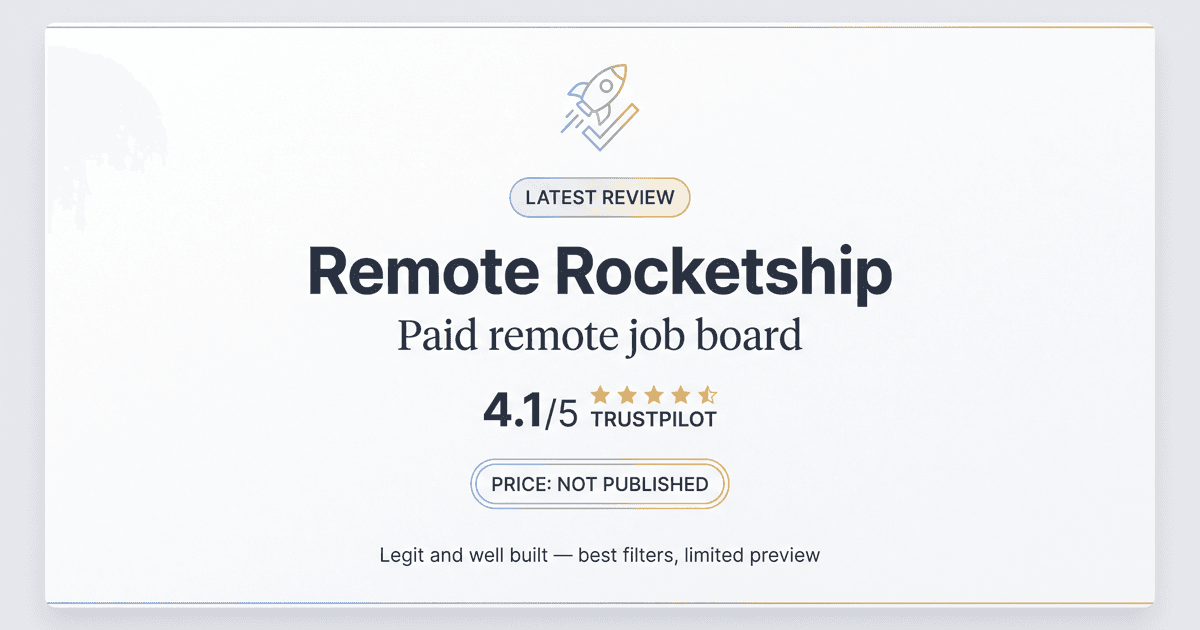
Remote Rocketship Review: Is the Paid Remote Job Board Worth It? (2026)
Remote Rocketship scores 4.1/5 on Trustpilot from 71 reviews, but it won't publish its price anywhere. Our verified review of the paid remote job board.
20 min read
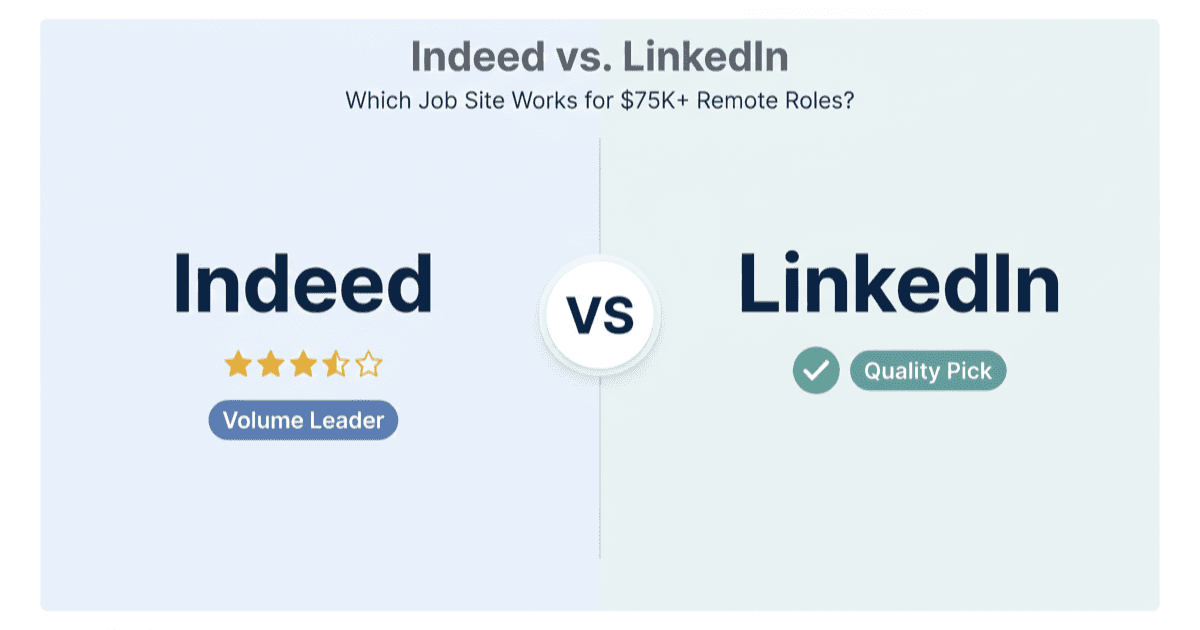
Indeed vs. LinkedIn: Which Job Site Works for $75K+ Remote Roles
Indeed vs. LinkedIn for $75K+ remote jobs: real pricing, ghost-job data, trust scores, and a framework to decide where your job search time actually pays off.
20 min read