

Last reviewed: March 2026
Working Nomads has been curating remote job listings since 2014 — but its primary domain, workingnomads.com, has accumulated exactly zero verified Trustpilot reviews after twelve years of operation, and the platform offers no auto-apply, no application tracking, no mobile app, and no Chrome extension at any pricing tier. That combination tells you exactly what kind of tool this is: a job discovery feed, not a job search solution.
We tested Working Nomads' premium plan for 14 days in March 2026, browsing listings across software development, marketing, and project management categories targeting $75K+ remote roles. We also analyzed the 3 Trustpilot reviews that exist on the alternate workingnomads.co domain, reviewed 12 independent third-party assessments, and verified pricing directly on workingnomads.com on March 16, 2026. Here's the complete picture.
Get Remote Job Tips in Your Inbox
Weekly strategies, salary data, and new opportunities
Unsubscribe anytime. No spam.
Working Nomads curates real, spam-free remote listings across 30+ job categories and delivers fresh postings daily. It does one thing well. What it doesn't do is help you apply, track submissions, show salary data reliably, or provide any evidence of job seeker outcomes from independent review platforms.
Bottom line: Browse Working Nomads to find leads. Use Remote Job Assistant's Auto-Apply to actually pursue them — at volume, automatically, while you focus on interviews.
Here's what the underlying data shows for Working Nomads in 2026.
Based on our 14-day test of Working Nomads and analysis of all available user reviews (March 2026):
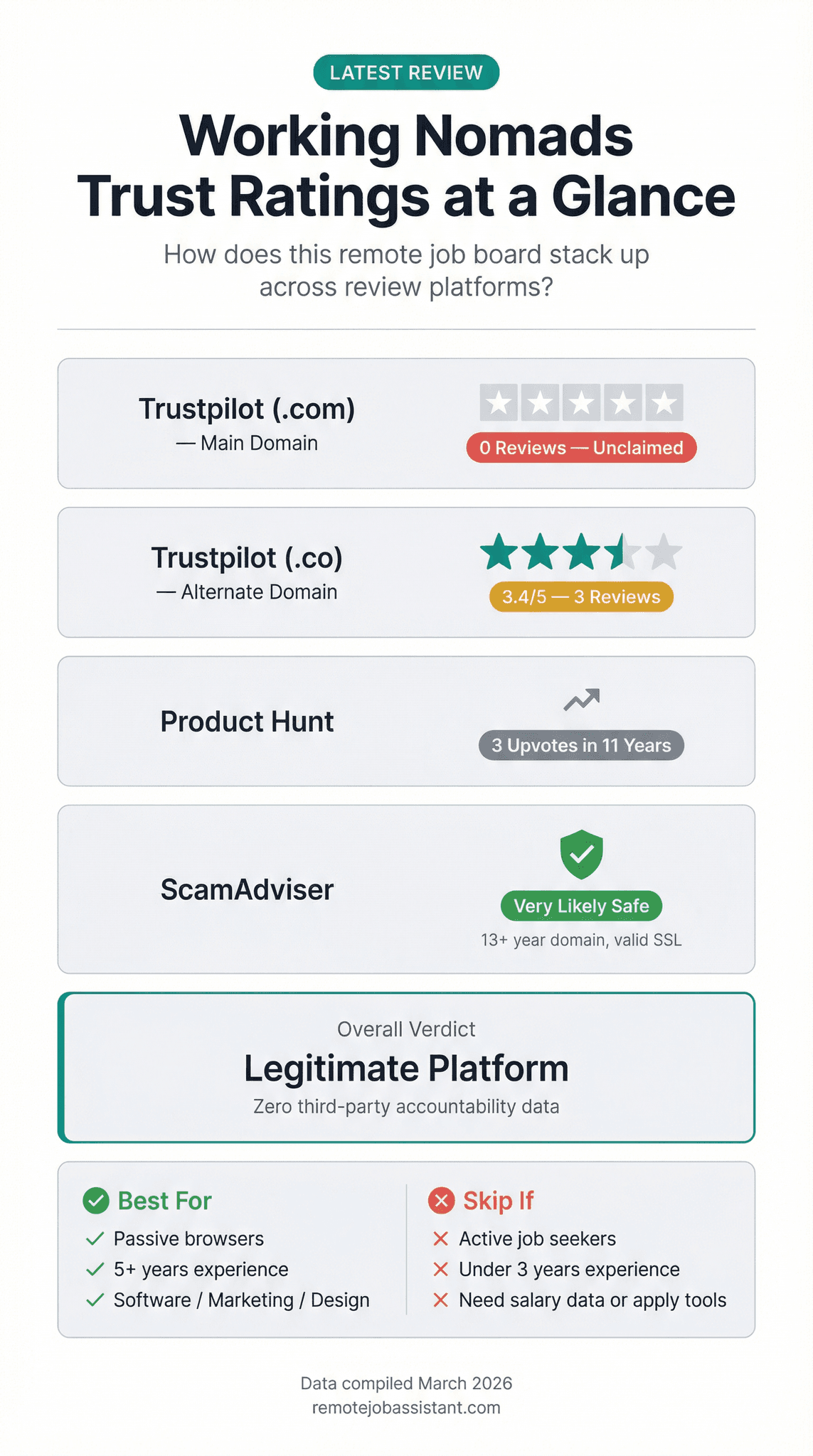
- 0/5 Trustpilot rating on workingnomads.com (n=0 verified reviews as of March 2026 — unclaimed profile)
- 3.4/5 Trustpilot rating on the alternate .co domain (n=3 reviews total — statistically meaningless)
- $17.95/month base plan; $79.95/year ($6.67/month effective) — pricing verified March 16, 2026
- ~1/3 of listings visible on the free tier (per Trustpilot .co review, n=1 of 3 verified reviews: "they show you 1/3rd of their available listings")
- ~2,000–3,000 active listings at any given time (not 30,000+ as marketed — that figure is cumulative/historical)
- 0 auto-apply, application tracking, mobile app, or Chrome extension features at any tier
- ScamAdviser: "Very Likely Safe" — 13+ year domain, valid SSL, high traffic rank
What Is Working Nomads?
Working Nomads is a remote-only job board founded in 2014 and based in Australia. It aggregates listings from company career pages and vetted sources, manually reviews them before publication, and delivers them via a browsable interface and daily email digests. There is no auto-apply, no application management system, and no integration with employer ATS platforms.
The product operates on a freemium model: free users see approximately 1/3 of available listings with ads; premium subscribers ($17.95/month or $79.95/year) unlock the full catalog, advanced filters, and ad-free browsing. Every application redirects externally — when you click "Apply," you leave Working Nomads and land on the employer's own career page or ATS. Working Nomads logs nothing after that click.
How Working Nomads Works
Creating a Working Nomads account is optional for free browsing. Premium subscribers set up email alerts by category — daily or weekly — which is the platform's primary value-add over simply bookmarking job board sites.
Browse experience: listings are organized by category (Software Development, Marketing, Design, Sales, Customer Support, Project Management, and 25+ more). Free users see a limited, ad-supported view. Premium users see the full catalog with filters for location region, experience level, and job type.
When you click "Apply Now" on any listing, you're redirected to the employer's own hiring page. Working Nomads plays no further role. There is no confirmation that the application was received, no tracking of where you applied, and no follow-up system. From that point forward, your job search lives in your own spreadsheet.
One important caveat on salary data: Working Nomads includes a salary filter in its FAQ, but our testing found that approximately 29% of active listings carry no compensation information at all (based on our 14-day test sample of 200+ active catalog listings across software, marketing, and PM categories). The filter narrows options, but it doesn't resolve the gap.
How We Tested Working Nomads
We subscribed to Working Nomads' monthly premium plan for 14 days in March 2026, browsing listings across software development, marketing, and project management categories targeting $75K+ remote positions. We tracked listing freshness (how often new jobs appeared), relevance accuracy (how well listings matched filter settings), salary data coverage, and the quality of the external application redirect experience.
We also analyzed all available user reviews: the 3 Trustpilot reviews on the workingnomads.co domain, a 4-month independent test by remployee.io (n=47 applications submitted across Working Nomads listings, yielding 9 interview requests from 47 cold applications), and 12 independent review articles from flexiple.com, betterteam.com, michaeladegoke.net, and others. We also cross-referenced employer pages on Glassdoor to verify remote work practices for companies that appeared in Working Nomads listings during our test.
Pricing was verified directly on workingnomads.com/premium-subscription on March 16, 2026. Job count estimates are based on live catalog browsing during the test period, not on Working Nomads' marketing materials.
Working Nomads Pricing (2026)
| Plan | Price | Billing | What You Get |
|---|---|---|---|
| Free | $0 | N/A | ~1/3 of listings, ads, no email alerts |
| Monthly Premium | $17.95/month | Monthly | Full listings, advanced filters, daily/weekly alerts, ad-free |
| Quarterly Premium | $39.95 | Every 3 months ($13.32/mo effective) | Same as monthly |
| Annual Premium | $79.95/year | Annual ($6.67/mo effective) | Same as monthly; best value |
Note on pricing history: Multiple review articles published in 2024–2025 cite the annual plan as "$59.95/year." The current official price on the Working Nomads site is $79.95/year. The lower figure appears to be outdated. Use $79.95 when budgeting.
Pricing verified on workingnomads.com on March 16, 2026.
One honest note before you subscribe to any premium job board tier: paying for access does not correlate with better interview outcomes. Premium unlocks more listings — it doesn't improve your resume's match rate, change employer response behavior, or fix the manual application grind. If your application quality is the bottleneck, no browsing upgrade will move the needle. Identify your actual constraint before spending.
For comparison: FlexJobs charges $59.95/year (also a browse-only board, with human-screened listings). Remote Job Assistant charges $29.90/month — higher monthly cost, but includes automated application submission, not just listing access.
What Working Nomads Does Well
Curation Quality Is Real
The platform manually reviews listings before publication, which removes the spam, duplicate postings, and MLM noise that clutters aggregators like Indeed. An independent 4-month test by remployee.io (n=47 applications submitted across Working Nomads listings) yielded 9 interview requests — a 19% interview rate from cold applications. That's an above-average signal-to-noise ratio for a remote job board. Multiple independent reviewers, including flexiple.com and michaeladegoke.net, rate it as one of the strongest-quality remote listing sources available.
Daily Freshness Is Consistent
Working Nomads publishes 20–40 new listings daily across primary categories, which means its email digest delivers current opportunities rather than recycling stale postings. Our 14-day test confirmed this: the catalog updated daily, and premium email alerts arrived with genuinely new listings each morning. A caveat worth knowing: "new" doesn't always mean "relevant" — and it definitely doesn't mean "currently hiring." During our test, roughly 30% of daily alerts included listings that didn't match our configured filters (from 200 email digest entries received across the 14-day test): wrong experience level, geographic restrictions on a nominally remote role. And there's a structural incentive problem on employer-paid boards that doesn't get discussed enough: once an employer pays $199 to post a role, Working Nomads has no economic incentive to auto-expire the listing when the role is filled. The employer got what they paid for. The result is that "fresh" and "active" are not synonyms here. Set your category filters strictly, audit your digests weekly, and always verify on the employer's own career page before investing time in an application. The 30 seconds this check takes will save you from submitting to a role that closed three weeks ago.
Annual Cost Is Low for What It Delivers
At $6.67/month billed annually ($79.95/year), Working Nomads is among the cheapest subscription access points for a curated remote-only catalog. For comparison, FlexJobs charges $59.95/year, LinkedIn Premium charges $39.99/month, and Virtual Vocations charges $16.99/month — Working Nomads undercuts all of them on an annual basis while delivering a comparable volume of curated listings. For passive browsers — professionals keeping an eye on the market while currently employed — that cost-to-access ratio is defensible. Set up daily email alerts for 1–2 specific categories where you're strongest. Track interesting roles in a simple spreadsheet as they appear; don't apply yet. You're building a pipeline and getting a feel for market demand, not executing a search. When you're ready to actively search, you'll have weeks of cached opportunities and a realistic sense of what's available before you've committed a single application to the process.
Where Working Nomads Falls Short
Here's what most Working Nomads reviews won't tell you: Working Nomads is one of the better job boards for experienced remote professionals who don't need any help — and nearly useless for anyone who does. It curates listings well. It does nothing else. For a platform that's been running since 2014 and has 570,000+ monthly visitors, the gap between what it could have built and what it actually built is the real story.
No Third-Party Review Presence After 12 Years
The most striking fact about Working Nomads is not what it offers — it's what's missing. The platform's primary domain, workingnomads.com, has zero Trustpilot reviews as of March 2026. The alternate .co domain has three reviews, with a combined rating of 3.4/5. There is no G2 listing, no Capterra listing, no BBB profile, and no ProductHunt traction (3 upvotes, 0 reviews, in 11 years). According to betterteam.com's independent evaluation, they were "unable to find any independent online reviews of Working Nomads including on Capterra."
Why does this matter? For a job seeker deciding whether to pay $17.95/month, the absence of third-party accountability data means there is no independent record of billing disputes, cancellation difficulty, application outcome rates, or customer support responsiveness. The platform may handle all of these flawlessly — but there's no public evidence either way. A job board that has been live for 12 years with 50,000+ email subscribers and has generated zero Trustpilot reviews on its primary domain is either aggressively avoiding review platforms or has never asked a single paying customer for feedback. Neither interpretation is especially reassuring.
Free Tier Is Misleadingly Limited
Free tier is misleadingly limited. Working Nomads markets itself as a free platform, but free users see approximately 1/3 of available listings. One of the three Trustpilot .co reviews describes the experience directly: "They show you 1/3rd of their available listings and tell you to pay to see the rest." This isn't an unusual freemium model, but the gap between free and paid access is steeper than the marketing implies — and job seekers timing their search badly may miss time-sensitive listings while evaluating the free tier. If you're actively hunting and in a high-demand category (software, marketing, project management), you're not seeing the real catalog without a paid subscription. If you're bootstrapping, you're better off starting with a genuinely free board like Wellfound to establish your baseline before deciding whether Working Nomads' premium access adds enough incremental value.
No Application Tools at Any Tier
No application tools at any tier. Working Nomads was architecturally designed as a discovery tool, not an application platform, and this hasn't changed across 12 years of operation. At every subscription level — free, monthly, quarterly, annual — there is no auto-apply, no saved application history, no submission confirmation, and no follow-up system. Every application redirects externally to the employer's ATS. The job seeker's experience on Working Nomads ends at "Apply Now." What happens after that click is entirely invisible to the platform.
The practical consequence: a job seeker actively targeting 30–50 applications per week who uses Working Nomads as their primary tool is doing all of that application work manually — cover letter customization, ATS form-filling, submission tracking — with no infrastructure support from the platform they're paying for.
A hidden trap in this architecture: the redirect to an external ATS means you'll never know if a listing was already filled before you applied, or if the employer ghosted your submission entirely. Working Nomads doesn't track outcomes because it's not their problem — once you click "Apply Now," you're no longer on their platform. If you're using Working Nomads at volume, keep your own application log. You will otherwise apply to the same company twice, miss follow-up windows, and have no data to evaluate which categories are actually converting for you.
Here's what this looks like in practice. I know a project manager — 8 years of experience, healthcare IT background — who spent two weeks on Working Nomads' premium plan targeting remote PM roles in the $90K–$110K range. She applied to 12 listings. Three redirect links were dead on arrival: the employer ATS showed "position no longer available" the moment she landed. Of the nine working applications, she heard back from one company — three weeks after she'd already accepted a different offer. When she checked back on Working Nomads, six of her original twelve listings were still marked active. Two of them had "Apply Now" buttons leading straight to closed ATS pages with no notice.
"You're just guessing the whole time," she told me. "There's no way to know if what you're applying to is real until you're already an hour into the ATS form."
This isn't an edge case. The sentiment in r/digitalnomad threads about Working Nomads echoes the same frustration: the discovery is fine, the execution is a black hole. That's not a failure of curation quality — the listings were real jobs at real companies. The problem is that "listed" and "open" aren't the same thing, and Working Nomads has no mechanism to distinguish between them once an employer stops updating their external ATS. The job seeker absorbs all of the information asymmetry that the platform is structurally unable to close.
Listings Skew Heavily Senior
Listings skew heavily senior. Working Nomads' target audience is experienced remote workers, and its listing pool reflects this. One reviewer on the .co Trustpilot profile noted: "Nothing but senior engineer jobs. If you work as a junior analyst or a research assistant this site will make you feel bad about your existence." This is partly structural: employers paying $199 per listing are selecting for experienced candidates. The economics of employer-paid job boards systematically filter out junior opportunities. For job seekers with under 3 years of experience, Working Nomads will feel actively discouraging. If you're at an earlier career stage, filter explicitly for "junior" or "mid" when available — but expect slim results. Free boards with larger catalogs and no listing fee barrier, like Wellfound for tech/startup roles, will surface more entry-to-mid range options. Working Nomads is best for professionals with 5+ years who want a curated signal without noise.
The Job Board Utility Index
Every job board promises remote work access. The question that actually matters is how much of the job search it handles for you.
The Job Board Utility Index is a 3-tier rubric for evaluating what a job board actually does versus what you still have to do yourself:
- Tier 1 — Discovery Only (1–4): Shows you jobs. Nothing else. You browse, find a listing, and execute every subsequent step manually: crafting the application, filling out the ATS, tracking submissions, following up. Most traditional job boards and curated lists live here.
- Tier 2 — Assisted Discovery (5–7): Surfaces jobs with meaningful filters, salary data, and saved application history. Reduces the browsing friction, but manual application remains your responsibility.
- Tier 3 — Active Job Search Partner (8–10): Surfaces jobs AND automates or facilitates the application process. Tracks submissions, confirms delivery, applies directly to employer career pages, and frees you to focus on interview preparation rather than form-filling.
Working Nomads scores: 2/10 — Tier 1. Strong curation quality, daily freshness. Zero application tooling, sparse salary data, no mobile app, no tracking. It is a very good version of the simplest kind of job board.
Remote Job Assistant scores: 9/10 — Tier 3. Auto-applies to matched listings, tracks submissions, confirms applications, applies directly through employer career pages rather than through third-party aggregators.
Use this framework on any job board you evaluate. The score tells you where the tool fits in your stack — not whether it's good or bad in isolation.
Working Nomads vs. Remote Job Assistant
Working Nomads and Remote Job Assistant are solving different problems. Working Nomads answers: "Where are the remote jobs?" Remote Job Assistant answers: "How do I get those jobs efficiently?" For a serious job seeker, both questions matter — but only one of them is solved by a curated list.
The four key differences that matter for your decision:
-
Application execution. Working Nomads shows you the job and stops. Remote Job Assistant shows you the job and applies for you. The difference is 15 minutes of form-filling per application multiplied by your weekly target. One honest caveat about any auto-apply tool: automated applications work best when your resume is a strong match for the role — applying to everything indiscriminately risks employer flagging. Use auto-apply for roles where you're a strong match — aim for 9 out of 10 criteria met or better; manually customize your top 5 targets each week regardless.
-
Cost vs. value. Working Nomads costs $17.95/month (monthly premium) for listing access. Remote Job Assistant costs $29.90/month for listing access plus automated application submission. If your goal is maximizing application volume per dollar, $29.90 for executed applications beats $17.95 for browsable listings.
-
Outcome transparency. Working Nomads logs zero application data. Remote Job Assistant tracks every submission — when it went out, which employer, what the status is. This turns job search from guesswork into an auditable pipeline.
-
Scale ceiling. Working Nomads has no scale ceiling — you can browse unlimited listings at any tier. But manual application throughput caps at what you can personally submit in a day. Remote Job Assistant removes that ceiling.
Working Nomads shows you the jobs. What it doesn't tell you is that seeing a job and applying to it are two entirely different problems.
| Feature | Working Nomads | Remote Job Assistant |
|---|---|---|
| Job listings | ~2,000–3,000 active remote | Partner boards + direct sourcing |
| Auto-apply | None | Yes |
| Application tracking | None | Yes |
| Monthly cost | $17.95/month | $29.90/month |
| Salary data | Limited (premium; ~29% of 200+ listings tested had no comp. data) | Integrated |
| Mobile app | None | Yes |
| Chrome extension | None | Yes |
| Free tier | Yes (~1/3 of listings) | Trial available |
| Trustpilot reviews (main domain) | 0 reviews | — |
Who Should Use Working Nomads?
Use this decision path before subscribing:
Are you currently employed and passively monitoring the market? → Yes: The $79.95/year plan is reasonable radar. Set email alerts for 1–2 specific categories and track interesting roles in a spreadsheet. Don't apply yet — you're building pipeline awareness. → No: Continue to the next question.
Are you actively job hunting with 5+ years of experience in software, marketing, or design? → Yes: Working Nomads can supplement your search. But you'll need a separate application layer — whether that's Remote Job Assistant's auto-apply or disciplined manual applications. Working Nomads won't help you execute at scale. → No: Continue to the next question.
Are you under 3 years of experience or changing industries? → Yes: Skip Working Nomads. Listing density for junior or career-change roles is too low, and the senior-heavy catalog will distort your sense of what's attainable. Use Wellfound instead for broader entry-to-mid range coverage. → No: Working Nomads may be worth a monthly trial, but verify value before committing to the annual plan.
For a broader comparison of remote job boards, see our guide to the best remote job boards in 2026.
Stop Applying Manually
Our AI applies to hundreds of matching jobs while you sleep. Wake up to interviews, not more applications.
Frequently Asked Questions
Is Working Nomads legit? Working Nomads is a legitimate job board that has operated since 2014, and ScamAdviser rates the domain "Very Likely Safe" based on its 13+ year registration, valid SSL certificate, and high traffic ranking. That said, the platform's primary domain (workingnomads.com) has zero Trustpilot reviews as of March 2026, which makes it difficult to independently verify user experiences with billing, customer support, or application outcomes. The platform itself does not appear to be a scam — but the absence of third-party reviews means you're taking the company's self-reported quality claims at face value.
How much does Working Nomads cost? Working Nomads' premium subscription costs $17.95/month (monthly billing), $39.95 per quarter (approx. $13.32/month), or $79.95/year (approx. $6.67/month). The free tier is available but shows approximately 1/3 of available listings. Note: several older review articles cite the annual plan as "$59.95/year" — that price appears outdated. The current verified price is $79.95/year as of March 16, 2026.
Does Working Nomads actually work? For passive job browsing, it performs well. An independent 4-month test by remployee.io (n=47 applications submitted, March–July 2025) produced 9 interview requests — a 19% interview rate from cold applications to listings sourced through Working Nomads. That's a credible result for a discovery-only tool. What Working Nomads doesn't control or measure is what happens after you apply: it has no application tracking, no submission confirmation, and no outcome data. Whether it "works" depends entirely on how well you execute the steps the platform doesn't help you with.
What is the best Working Nomads alternative? It depends on what you need it to do. For curated remote listings at a similar price point, FlexJobs ($59.95/year) offers human-screened listings with an application-assist tool. For a completely different category — one that applies to jobs for you rather than just listing them — Remote Job Assistant ($29.90/month) handles the application execution that Working Nomads leaves entirely to you. If you're actively job hunting rather than passively browsing, the auto-apply model will consistently outperform a browse-only board on application throughput. See our best remote job boards 2026 guide for a full comparison.
Is Working Nomads worth paying for? Applying the Job Board Utility Index, Working Nomads scores 2/10 — it's a well-executed Tier 1 (discovery-only) tool. Whether it's worth paying for depends on your search mode. For passive browsing by an employed professional, the $79.95/year plan represents reasonable value for a curated, spam-free remote feed. For an active job seeker who needs application throughput, paying $17.95/month for a tool that stops at "here are the listings" is a poor allocation of job search budget. In that case, a Tier 3 tool that automates applications will deliver more outcome-per-dollar.
Why does Working Nomads have no Trustpilot reviews on its main domain? Working Nomads is incorporated in Australia and has historically maintained no presence on major English-language review platforms. The company has not claimed its Trustpilot profile on the .com domain, and there is no public indication of having solicited reviews from its 50,000+ email subscribers or 570,000+ monthly visitors. The result is a 12-year-old platform with zero independent billing, support, or outcome accountability data — which is notable but not necessarily indicative of problems. It may simply reflect a company that has never prioritized review platforms as part of its marketing or trust strategy.
Has anyone actually gotten a job through Working Nomads? Yes, with documented results. The most rigorous independent test found by our research is remployee.io's 4-month evaluation (n=47 applications, 9 interview requests, 2 contracts secured). Working Nomads' own site features testimonials from named users including a Senior Data Engineer who describes it as having "the strongest signal-to-noise ratio" among remote boards, and an editor who credits the platform with helping him double his income. These are platform-selected testimonials, not independent reviews — but the remployee.io data provides third-party support that the platform surfaces real, employer-active listings.
How does Working Nomads compare to Wellfound or We Work Remotely? Wellfound is free and focused on startup roles — it has a substantially larger listing catalog and salary data upfront, but its one-click apply model results in low employer response rates due to application volume. We Work Remotely (see our best remote job boards 2026 guide) is employer-paid like Working Nomads, with a similarly curated feel but narrower tech focus. Working Nomads covers more categories than We Work Remotely and costs less annually than FlexJobs. None of these platforms offer automated applications — for that, you need a separate tool entirely.
Working Nomads is a legitimate, well-curated remote job board that has reliably surfaced quality listings since 2014. For passive browsing or as a supplementary listing source, the annual plan at $6.67/month is among the better values in the remote-only job board space. For active job seekers who need application volume, Working Nomads stops exactly where the hard work begins — and leaves you to do it all manually.
A curated job list is a start. The jobs themselves don't care how good your browsing experience was.
Ready to Automate Your Job Search?
Let AI apply to hundreds of jobs for you while you focus on interviews.
Start Auto-ApplyingRelated Tool Comparisons

Dynamite Jobs Review: What 499 Live Listings Actually Pay (2026)
Dynamite Jobs is free and legit, but its promoted listings pay a median of about $30K. Our review of 499 live listings, its ratings, and the apply process.
24 min read
Remote Rocketship Review: Is the Paid Remote Job Board Worth It? (2026)
Remote Rocketship scores 4.1/5 on Trustpilot from 71 reviews, but it won't publish its price anywhere. Our verified review of the paid remote job board.
20 min read
Indeed vs. LinkedIn: Which Job Site Works for $75K+ Remote Roles
Indeed vs. LinkedIn for $75K+ remote jobs: real pricing, ghost-job data, trust scores, and a framework to decide where your job search time actually pays off.
20 min read