
You've spent years mastering your craft—teaching teenagers, calming anxious patients, de-escalating frustrated customers—and now you're wondering if those skills matter anywhere else.
They do. Especially in remote sales.
At Remote Job Assistant, we track thousands of remote sales job postings monthly, and here's what the data shows: SDR (Sales Development Representative) roles are consistently the fastest path into the field for career changers. Companies aren't just willing to hire people without sales experience—they're actively seeking them. Teachers, nurses, customer service reps, and hospitality workers are landing remote sales jobs and earning more than they ever did in their previous careers.
Get Remote Job Tips in Your Inbox
Weekly strategies, salary data, and new opportunities
Unsubscribe anytime. No spam.
This guide breaks down exactly how to make that transition, which roles to target, and what to expect in your first year.
Yes, you can break into remote sales with no experience. SDR roles are designed as entry points, don't require a sales background, and companies like HubSpot, Salesforce, and ChartHop actively recruit career changers. Entry-level remote SDRs earn $48,000-$70,000 OTE (on-target earnings), with typical promotion to Account Executive within 12-24 months.
Can Anyone Actually Get Into Remote Sales?
The short answer: yes. The longer answer: it depends on your mindset more than your resume.
Remote sales is one of the few high-paying career paths where performance matters more than pedigree. You don't need a business degree. You don't need prior sales experience. What you need is the ability to communicate clearly, handle rejection without spiraling, and learn quickly.
According to RepVue's 2025 salary data, the average remote SDR earns $60,000 base with $85,000 in total on-target earnings. That's significantly higher than the median salary for teachers ($65,220), nurses in many specialties, and most customer service roles.
Here's why companies hire career changers for SDR positions:
SDRs don't close deals. Their job is to start conversations, qualify leads, and book meetings for Account Executives. This means you're not walking into high-stakes negotiations on day one. You're learning the product, practicing your pitch, and building fundamental skills.
Companies provide training. Most sales organizations have structured onboarding programs. They expect to teach you everything—the product, the CRM, the scripts, the objection handling. What they can't teach is work ethic, communication skills, and resilience. That's where your previous experience becomes your advantage.
Turnover is high. The average SDR tenure is 14 months according to Bridge Group research. Companies are constantly hiring, which creates opportunities for people willing to put in the work.
Remote sales isn't for everyone. You'll face rejection daily. Quotas create pressure. Some weeks, you'll question everything. But if you've survived parent-teacher conferences, code blues, or holiday retail shifts, you've already built the emotional armor this job requires.
The Best Entry Point: SDR Roles Explained
If you're changing careers into remote sales, you're almost certainly starting as an SDR (Sales Development Representative) or BDR (Business Development Representative). These titles are often used interchangeably—about 60% of companies treat them as the same role.
To understand exactly what each sales role means, here's the quick breakdown:
| Role | What You Do | Experience Needed | Typical Remote OTE |
|---|---|---|---|
| SDR/BDR | Generate leads, book meetings | None required | $48,000-$70,000 |
| Account Executive | Run demos, close deals | 1-2+ years | $80,000-$150,000 |
| Sales Manager | Lead a team of reps | 3-5+ years | $120,000-$180,000 |
Why SDR is the perfect entry point:
The SDR role is specifically designed to bring new people into sales. Your job is to reach out to potential customers through email, phone, and LinkedIn, have initial conversations, and determine if they're a good fit for your company's product. When someone is qualified, you schedule a meeting and hand them off to an Account Executive who handles the rest.
This structure means you're learning the most important sales skill—starting conversations with strangers—without the pressure of closing million-dollar deals. You'll make mistakes. You'll get hung up on. And none of it will cost the company a major contract because that's not your responsibility yet.
Decode Any Job Posting
Paste a job description and get instant insights: what they really want, red flags to watch, and how to stand out.
Transferable Skills That Actually Matter
Every career change article talks about "transferable skills," but let's get specific. Here's what your background actually gives you:
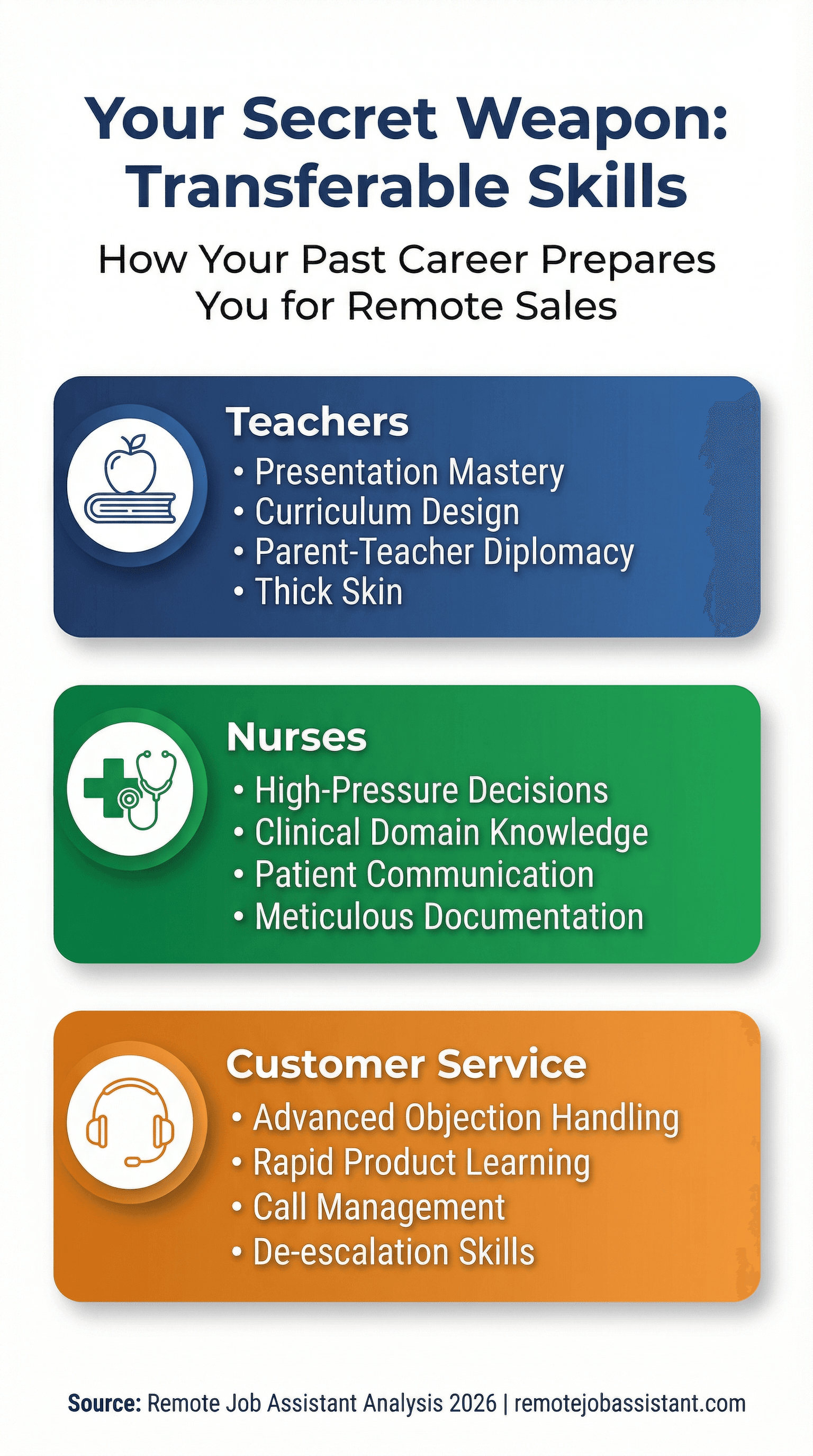
Teachers bring:
- Presentation skills — You've held the attention of disinterested teenagers. Keeping a prospect engaged on a 15-minute call is easier.
- Curriculum development — You know how to break complex information into digestible pieces. That's exactly what product pitching requires.
- Parent communication — You've delivered difficult news diplomatically. Sales objection handling uses the same muscle.
- Thick skin — Students, parents, and administrators have all criticized your work. Rejection from strangers hits differently when you've survived that.
Nurses and healthcare workers bring:
- High-pressure decision making — You've made critical calls with incomplete information. Sales requires the same rapid assessment.
- Medical terminology — If you're targeting healthcare tech or medical device sales, you already speak the language.
- Patient communication — Explaining diagnoses to anxious patients is harder than explaining software features to business buyers.
- Documentation skills — CRM hygiene is just charting for sales. You're already trained to log everything.
Customer service reps bring:
- Objection handling — You've turned angry customers into satisfied ones. That's advanced sales psychology.
- Product knowledge acquisition — You've learned new systems, policies, and offerings repeatedly. Ramping on a new product is familiar territory.
- Call management — You're comfortable on the phone. Many career changers aren't.
- De-escalation — When a prospect gets frustrated, you won't panic.
According to a ChartHop case study, the company hired eight former teachers as BDRs and was "blown away by their success." Their hiring manager noted: "Teachers are hard workers, great communicators, problem solvers, and most importantly for the BDR role—they have very thick skin."
Career Changers Who Actually Succeed
Let's look at real transitions, not hypotheticals.
Nursing to Tech Sales: A pediatric ICU nurse made the switch to BDR at Fivetran after the pandemic pushed her to reconsider her career path. She highlighted transferable skills like "working well under pressure, communicating important and complex information to various audiences, and managing multiple priorities." Within her first year, she was succeeding in tech sales.
Teaching to EdTech Sales: Former teachers are particularly well-positioned for education technology companies. They understand the buyer (other educators), know the pain points intimately, and can speak credibly about classroom needs. Companies like Canvas, Clever, and Instructure specifically recruit former educators.
Customer Service to SaaS Sales: The leap from support to sales is one of the most common—and shortest. You already know how to use CRM systems, handle difficult conversations, and learn products quickly. Many companies promote internally from support to SDR roles.
If you're currently in customer service, check if your company has an SDR team. Internal transfers are often easier than external applications, and you already know the product.
Stop Applying Manually
Our AI applies to hundreds of matching jobs while you sleep. Wake up to interviews, not more applications.
How to Position Your Resume
Your resume needs to translate your experience into sales language. Here's how:
Before (Teacher Resume):
- "Developed and delivered curriculum for 150+ students across 5 class periods"
After (Sales-Ready Resume):
- "Presented complex information to 150+ stakeholders daily, adapting communication style to diverse audiences and learning preferences"
Before (Nurse Resume):
- "Provided patient care in high-acuity ICU environment"
After (Sales-Ready Resume):
- "Made rapid decisions in high-pressure environments, communicated critical information to patients and families, documented all interactions in real-time systems"
Before (Customer Service Resume):
- "Handled inbound customer calls and resolved complaints"
After (Sales-Ready Resume):
- "Managed 50+ daily customer interactions, identified upsell opportunities, achieved 95% satisfaction rating through consultative problem-solving"
The key is quantifying everything and using action verbs that map to sales activities: presented, persuaded, negotiated, exceeded, achieved, converted.
What Companies Are Actually Hiring Career Changers?
Not every company is set up to train inexperienced reps. Target these types of organizations:
High-growth SaaS companies often have structured SDR programs with extensive training. They're scaling fast and need bodies, which means they're more willing to take chances on non-traditional candidates.
Companies with sales academies: HubSpot, Salesforce, and Oracle have formal training programs. They expect to teach you from scratch.
EdTech and HealthTech: If you're coming from education or healthcare, these verticals want your domain expertise. Your clinical or classroom background is a competitive advantage, not a liability.
SDR agencies and outsourced sales firms: Companies like memoryBlue, Punch!, and demandDrive specialize in training entry-level SDRs. They're essentially paid apprenticeships—you'll work hard, learn fast, and likely move to a direct company role within 12-18 months.
Browse current remote sales positions to see what's available right now.
Decode Any Job Posting
Paste a job description and get instant insights: what they really want, red flags to watch, and how to stand out.
What to Expect in Your First 90 Days
Let's be honest about what you're walking into:
Days 1-30: Drinking from the firehose
You'll learn your company's product, ideal customer profile, sales tools (typically Salesforce or HubSpot CRM, plus outreach tools like Outreach or Salesloft), and messaging. You'll shadow experienced reps. You'll probably make your first calls by week two, and they'll be awkward. That's normal.
Days 31-60: Finding your rhythm
You'll start developing your own cadences and scripts. Rejection becomes less personal. You'll book your first meetings—and feel a rush you haven't experienced since your first successful lesson plan or patient recovery. You'll also hit your first wall, wondering if you made the right choice.
Days 61-90: Ramping to quota
Most companies don't expect full quota attainment until month three or four. By day 90, you should be consistently booking meetings and starting to feel confident in your pitch. The mechanical parts become automatic, and you can focus on actually listening to prospects.
Expect to hear "no" more than you hear "yes." A 3-5% positive response rate on cold outreach is normal. If you're booking meetings on 5% of your calls and emails, you're doing well. Don't let the math discourage you—volume is part of the game.
The Promotion Path: SDR to Account Executive
Here's the career progression that makes remote sales worth the entry-level grind:
Based on Bridge Group research, the average SDR tenure before promotion is 14 months. Top performers can make the jump to Account Executive in 12 months; others take 18-24 months.
| Timeline | Role | Typical Remote OTE |
|---|---|---|
| Year 1 | SDR | $48,000-$70,000 |
| Year 2-3 | Account Executive (SMB) | $80,000-$120,000 |
| Year 3-4 | Account Executive (Mid-Market) | $120,000-$180,000 |
| Year 5+ | Enterprise AE or Management | $180,000-$300,000+ |
That's a realistic path from entry-level to six figures in 2-3 years—faster than almost any other career track that doesn't require advanced degrees.
The key to fast promotion: hit your numbers consistently. SDRs who exceed quota for 2-3 consecutive quarters are typically first in line for AE roles. Build relationships with your Account Executives, sit in on their demos, and make it clear you want to move up.
For a deeper dive into where each role fits, check out our complete remote sales jobs guide.
Tools You'll Need to Learn
Remote sales runs on software. Here's what you'll encounter:
CRM (Customer Relationship Management): Salesforce or HubSpot in most cases. This is where you log all your activities—calls, emails, meetings booked. Think of it as your digital brain.
Sales Engagement Platforms: Outreach, Salesloft, or Apollo. These tools help you send automated email sequences and track when prospects open your messages.
LinkedIn Sales Navigator: Premium LinkedIn for finding and researching prospects. You'll live in this tool.
Video Conferencing: Zoom or Google Meet for demos and internal meetings.
Conversation Intelligence: Gong or Chorus records and analyzes your calls so you can improve. Yes, your calls will be recorded. Yes, it feels weird at first.
The good news: every company trains you on their specific stack. You don't need to learn these before applying—just be ready to ramp quickly.
Frequently Asked Questions
Can I get a remote sales job with no experience?
Yes. SDR and BDR roles are specifically designed as entry points for people without sales backgrounds. Companies like HubSpot, Salesforce, and many SaaS startups have structured training programs that assume you're starting from zero. Focus on demonstrating transferable skills from your previous career—communication, resilience, and the ability to learn quickly.
How long does it take to get promoted from SDR to Account Executive?
The average promotion timeline is 12-24 months for consistent performers. According to Bridge Group research, the median is 14 months. Top performers who exceed quota for multiple consecutive quarters can get promoted faster, sometimes within a year. The key factor is hitting your numbers consistently, not just occasionally.
What's the realistic salary for a first-year remote SDR?
Entry-level remote SDRs typically earn $45,000-$55,000 base salary with an OTE (on-target earnings including commission) of $60,000-$85,000. According to PayScale's 2025 data, SDRs with less than one year of experience average $48,414 in total compensation. Remote roles sometimes pay slightly less than in-office positions at the same company, but you save on commuting and often have more flexibility.
Are remote sales jobs legitimate, or are they mostly scams?
Legitimate remote sales jobs absolutely exist—the industry has been growing rapidly since 2020. However, be cautious of roles that require upfront payment, promise unrealistic earnings without base salary, or conduct interviews only via WhatsApp or text message. Real companies use email, video calls, and standard interview processes. Check company reviews on Glassdoor and verify they have a real website and LinkedIn presence before accepting any offer.
What if I'm not comfortable with cold calling?
Most SDRs feel this way at first. Cold calling is a learnable skill, not an innate talent. Many roles now emphasize "multi-channel outreach"—meaning you'll use email and LinkedIn as much as or more than phone calls. That said, some phone work is almost always required. The anxiety typically fades after your first few weeks of calls when you realize rejection isn't personal. If you've worked in customer service, teaching, or healthcare, you've had harder conversations than cold calls.
Do I need a college degree for remote sales?
No. While about 65% of SDRs have bachelor's degrees, it's not a strict requirement. Companies care more about your communication skills, coachability, and work ethic. If you don't have a degree, emphasize your professional experience, any sales-adjacent achievements (like exceeding metrics in a previous role), and your motivation for entering the field.
Which industries are best for career changers entering sales?
Former teachers often thrive in EdTech and training-related SaaS. Former healthcare workers do well in HealthTech, medical devices, and pharma-adjacent tech. Customer service backgrounds translate well to almost any SaaS vertical. The key is finding a product you can genuinely get excited about—passion for what you're selling makes the job significantly easier.
Start Your Search
Breaking into remote sales from another career isn't just possible—it's happening every day. The teachers, nurses, and customer service reps who made the switch aren't fundamentally different from you. They just decided the discomfort of change was worth the upside.
The path is clear: target SDR roles, position your transferable skills effectively, and be ready to grind through the first few months of rejection and learning curves. The rewards—higher income, career growth, and the flexibility of remote work—are waiting on the other side.
Ready to start? Browse remote sales positions hiring now, or explore flexible remote positions for parents if work-life balance is your priority. If you're a former educator, check out our guide to remote jobs for former teachers for more options beyond sales.
The best time to make the switch was yesterday. The second best time is now.
Ready to Find Your Remote Job?
Browse thousands of curated remote jobs or let AI apply for you.
Browse Remote JobsRelated Job Guides
Remote Ecommerce Jobs: What 1,694 Postings Show (2026)
Remote ecommerce jobs are concentrated: 322 of 1,694 US postings were remote. See which marketplace, brand, agency and SaaS seats pay $100K+ from a home office.
55 min read
Remote Interior Design Jobs: What 1,409 Postings Show (2026)
Remote interior design jobs are rare: 40 of 1,409 US postings were remote. See which designer, planner, and FF&E seats pay $75K+ from home, and where.
46 min read
Remote Journalism Jobs: What 1,438 Postings Show (2026)
Remote journalism jobs are rare: 77 of 1,438 US newsroom postings were remote. See which reporter, editor, and audience seats pay $75K+ from home, and where.
39 min read