
Last reviewed: October 2026
You have filed from a courthouse hallway, from a hotel lobby at 11 p.m., and from the front seat of a car outside a school board meeting. Working remotely is not a skill you need to learn. Yet the posting you opened this morning, for a desk job at a national outlet, says the role "includes regular attendance in the office four days each week."
If you're a working reporter, editor, or producer with a few years behind you, earning somewhere above the $62,200 the Bureau of Labor Statistics calls the median for reporters, you want two things at once: a seat that pays like a senior one, and no commute to a building you used to only visit. The job boards say that's easy. LinkedIn's page for this search promises "2,000+ Remote Reporter Jobs in United States." JournalismJobs.com puts a "Telecommute" filter on its homepage as if it were a normal option. Neither one says how many of those jobs are actually remote.
Get Remote Job Tips in Your Inbox
Weekly strategies, salary data, and new opportunities
Unsubscribe anytime. No spam.
So we counted. Remote Job Assistant read 1,438 US newsroom postings from 276 employers in full, all live on October 1, 2026, and 1,329 of them first listed in June 2026 or later. They came from LinkedIn, from 12 Workday career sites including The Washington Post, Dow Jones, Politico, and Condé Nast, from the Hearst, Sinclair, Gray, and NBCUniversal boards, and from the Greenhouse and Lever boards of Axios, Newsweek, ProPublica, and Forbes. Seventy-seven were fully remote. Fourteen of those came from one employer, Axios, and 54 of the 77 sat at trade, digital-native, nonprofit, or audience desks, the places where the story shows up as a document instead of a scene. Three things decide it: the beat, the production chain, and one policy line in the posting. This post shows you which newsroom seats actually go remote, what they pay, and a simple score for your own job. And since the search results mix them up: court reporting, the stenography trade, is a different job and isn't covered here.
Based on our analysis of 1,438 US newsroom postings at 276 employers (all live October 1, 2026):
- 5.4% (n=77 of 1,438) were fully remote; among the 936 postings that state a work model at all, 8.2%
- 25.9% (n=372 of 1,438) were field jobs where you drive to the story, and 12.8% (n=184) were hybrid; of the hybrid postings that name a number, 45 require four office days and 27 require three
- 0.4% (n=3 of 848) of local TV and local newspaper reporting postings were remote, against 5.7% (n=19 of 333) at national newsrooms and magazines and 23.8% (n=54 of 227) at trade, digital-native, nonprofit, and audience desks
- 13.9% (n=46 of 330) of the LinkedIn postings surfaced by searches with "remote" in the query were remote once we read them; on LinkedIn's "2,000+ Remote Reporter Jobs" page, 12 of 60 cards were
- 6.9% (n=15 of 216) of JournalismJobs.com listings are marked Telecommute
- 68.5% (n=355 of 518) of postings with an annual range start at $75,000 or more, but only 27 of those 355 are remote
- $85,000–$120,000 median posted range for remote postings (n=40), against $90,000–$112,500 for hybrid (n=122) and $19–$21 an hour for field reporters (n=31)
- $62,200 median pay for reporters per BLS (May 2025), with employment projected to fall 6% by 2035; editors $77,920
If you want $75,000 or more and no commute, the postings point to four kinds of desks, and only one of them sits inside a legacy national newsroom.
The remote postings that pay $75,000 or more are reporter and editor seats at digital-native and trade newsrooms (Axios posts every job as remote-optional, from $60,000 to $230,000; Pensions & Investments, Endpoints, Upstream, and Kitces post $80,000–$150,000), research and audience desks (ProPublica's deputy research editor at $135,000–$145,000; USA TODAY's audience editors at $93,000–$95,000 from anywhere in the US except three states), and bureau correspondents hired by exception at legacy outlets (The New York Times' Midwest correspondent at $124,979–$160,000). What they share: the story reaches them as a filing, a dataset, a phone call, or a draft in the CMS, not as a scene they have to drive to.
The Byline Radius: Why the Story and the Control Room Decide
Three things keep journalism work in a building or a car, and each one hits a different part of the industry.
The story is somewhere, and the live shot is at 5 p.m. Local television is the biggest employer in our data, 776 of 1,438 postings, and it is almost entirely on the scene: 325 of those postings are field jobs and 3 are remote. Of the 325 multimedia journalist and reporter postings at local stations, 271 are field. The postings say so plainly. Gray Media wants a "Valid driver's license and ability to drive a company vehicle," and its Anchorage station adds a 35-pound carrying requirement. Nexstar says "A valid driver's license and an acceptable driving record are required" and warns that the job "often requires work in extreme outdoor temperatures." Seventeen TEGNA postings ask you to "Perform authoritative, compelling live shots in a developing story or in breaking news situations." Twenty Hearst Television postings end with "In-person attendance is required." Live shots appear in 17.7% of local-scene postings (n=150 of 848) and in none of the trade, digital, and audience postings (n=0 of 227). A driver's license: 13.8% against 0.0%.
The national desk has written its return-to-office policy into the posting. All 15 Washington Post postings carry the same sentence: "With certain exceptions for newsgathering and business travel, we work on-site five days a week." Twenty-four of 36 New York Times postings describe "an in-office position" that "includes regular attendance in the office four days each week. There may be some flexibility to work remotely per your departmental guidance." CNBC's postings are "designated as hybrid, generally contributing from the office a minimum of three days per week." The Financial Times says "FT Newsroom staff are expected to work onsite a minimum of three days per week." NPR's Justice Department correspondent must be "in the office in Washington, D.C., or at an on-site reporting location at least 3 days a week." Business Insider lists "an in-office requirement of three days a week," The Information "three days a week in-office," Condé Nast "hybrid in-office (3 days/week)." Penske Media, which owns Billboard, WWD, and The Hollywood Reporter, states that it "prioritizes in-person collaboration and does not offer remote-only roles" and that "employees work onsite 4 days a week and 1 day remotely." Vox Media's editor posting requires "Tuesday through Thursday, with remote flexibility the other days." Fortune's executive editor "will be based in NYC in our headquarters five days per week." A union or Guild is named in 22.8% of these national-desk postings (n=76 of 333), which is why the day counts are so exact: they were bargained. Whatever flexibility exists past the bargained number is a trust decision made one editor at a time, and the Times' wording, "per your departmental guidance," says exactly who makes it.
The wire, trade, and digital desk receives the story as a document. Axios writes the same line into all 14 of its postings: "Because this is a remote-optional job posting, this salary range takes into account all possible locations within the United States." Endpoints News calls its FDA reporter job "a work-from-anywhere role," and says "candidates must be confident operating independently in a digital-first environment." USA TODAY's audience editor postings are "remote and can be based anywhere in the US, except for Alaska, Hawaii and Wyoming." Newsweek's senior news editor is "United States (Remote or Hybrid in NYC)." ProPublica is "open to remote candidates, but those able to work from our New York or D.C. offices are strongly encouraged." Kitces.com's editorial director is "fully remote" and can "work from anywhere in the United States." Bisnow's deputy newsletter editor "will sit remotely within the US. A typical week runs 40–50 hours." The word newsletter appears in 29.1% of these postings (n=66 of 227) and 2.4% of local-scene postings (n=20 of 848). AI appears in 31.3% against 3.5%.
Put those together and the pattern is a radius. The further a job sits from the story and from the control room, the more often it leaves the building, and the postings tell you the distance in advance.
This is the part most career advice skips. The filter on remote newsroom work is not skill, and it is not seniority. It is whether your beat can be done from filings. A city hall reporter with fifteen years of sources has a job that is structurally incompatible with living in another state, no matter how good the clips are, because the sources, the meetings, and the live shot are in one place. A reporter who covers FDA approvals from PDFs and phone calls does not, which is why Endpoints can hire that job from anywhere and no local station can. If you want remote, you change the beat before you change the résumé.
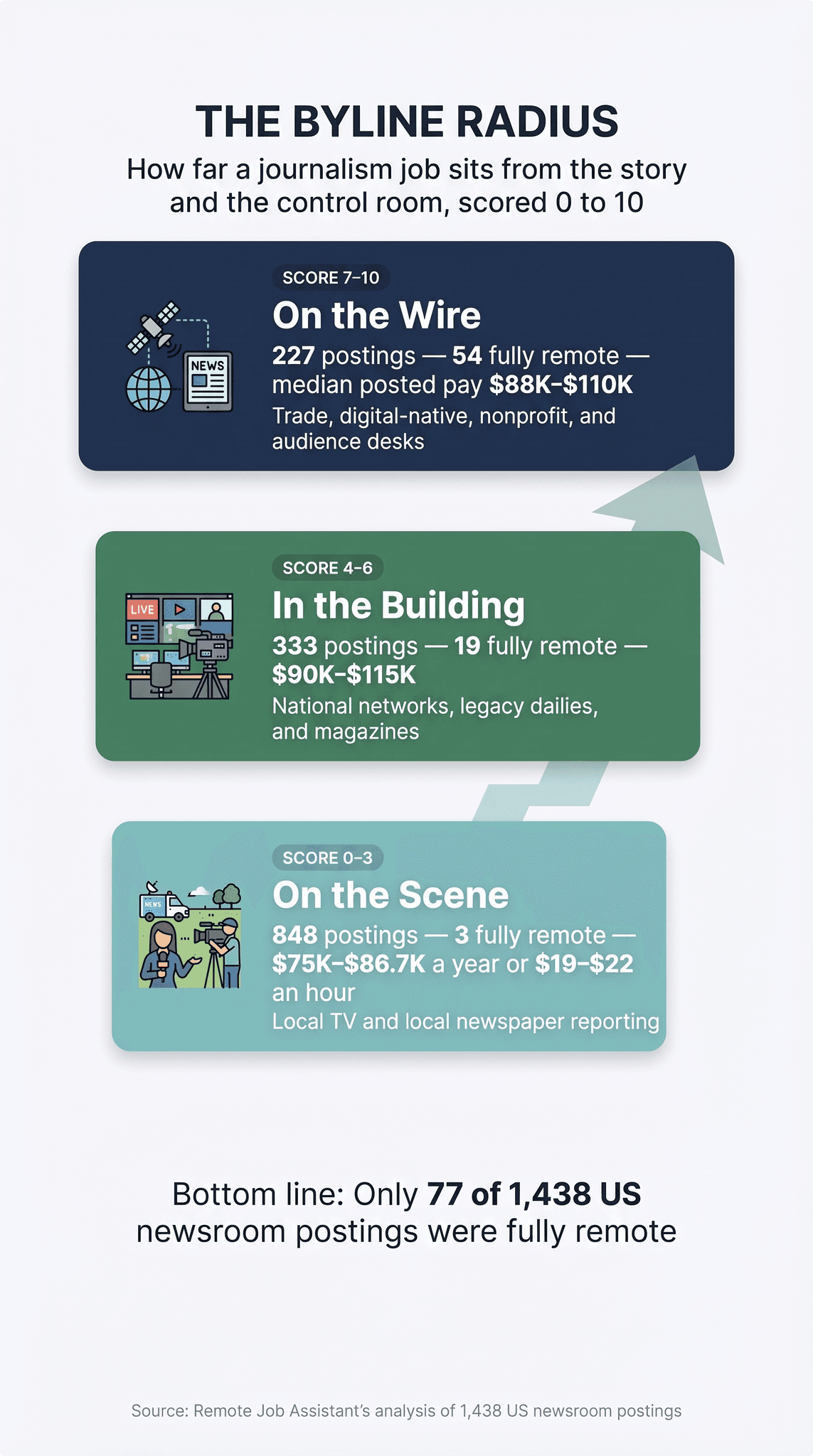
The Byline Radius: A 0–10 score for how far a journalism job can sit from the story and from the control room, and so how likely it is to be remote.
Score the job on three observable criteria and add them up:
- Where the story lives (0–4): a physical local beat you must reach, such as city hall, the courts, high-school fields, breaking news, or a live shot, scores 0; a regional beat with occasional travel scores 1–2; a national or topical beat worked from documents, filings, calls, and data scores 3–4.
- What the production chain needs (0–3): a live broadcast rundown or a control room scores 0; a daily print or digital desk with a set newsroom scores 1; a newsletter, wire, or digital-only CMS with asynchronous editing scores 2–3.
- What the employer's policy says (0–3): five days or "In-person attendance is required" scores 0; four days scores 1; two or three days scores 2; "remote-optional," "Remote or Hybrid," "work-from-anywhere," or "can be based anywhere in the US" scores 3.
Scoring:
- 0–3 On the Scene ($19–$22 an hour, n=66; $75,000–$86,700 a year, n=133): Local TV multimedia journalists, anchors, and newscast producers; local newspaper reporters; radio news. This is 59.0% of the market (n=848 of 1,438): 3 remote (0.4%), 367 field, 163 onsite, 39 hybrid. The annual median is pulled up by big-market anchors and reporters; weighted so each employer counts once, it is $72,500–$88,500 (32 employers).
- 4–6 In the Building ($90,000–$115,000, n=238): National networks, wires, legacy dailies, magazines, and public media; editors, correspondents, producers. This is 23.2% of postings (n=333): 19 remote (5.7%), 93 hybrid, 94 onsite. The remote ones are bureaus and production functions, never the main desk: the Times' Midwest correspondent is "a remote position based in the Midwest," NBCUniversal's Dallas producer "has been designated as fully remote, based in Dallas, TX," Hearst Newspapers' production editor lists "Location: Remote."
- 7–10 On the Wire ($88,000–$110,000, n=135; remote postings alone $80,000–$125,000, n=31): B2B and trade reporters and editors, digital-native national outlets, nonprofit newsroom networks, audience, newsletter, and research seats. This is 15.8% of postings (n=227): 54 remote (23.8%), 50 hybrid, 39 onsite. Trade publishers alone are 30.8% remote (n=28 of 91).
How to use it: Score the beat and the production chain first. Those two decide whether remote is physically possible. Then score the policy line in the posting, because the same title scores 0 at The Washington Post and 3 at Axios. If your work scores 6 or higher and the posting scores 0 on policy, the ask is a negotiation: raise it in the first screen. If your work scores 0–3, stop searching "remote journalism jobs" and search the beat and the employer type instead.
| Byline Radius band | Typical roles | Postings | Fully remote | Hybrid | Field | Median posted range |
|---|---|---|---|---|---|---|
| 0–3 On the Scene | Local TV MMJs, anchors, newscast producers, local newspaper reporters | 848 (59.0%) | 3 | 39 | 367 | $75K–$86.7K a year (n=133); $19–$22 an hour (n=66) |
| 4–6 In the Building | National network, wire, legacy daily, and magazine editors, correspondents, producers | 333 (23.2%) | 19 | 93 | 2 | $90K–$115K (n=238) |
| 7–10 On the Wire | Trade and digital-native reporters and editors, nonprofit networks, audience, newsletter, research | 227 (15.8%) | 54 | 50 | 3 | $88K–$110K (n=135) |
Pay rises one step out from the scene and then holds. Remote rises every step. In journalism, the live shot and the control room decide where you sit. The beat decides whether you can leave.
With 77 remote postings in 1,438, the search problem isn't qualifying. It's seeing the Axios, Endpoints, or ProPublica seat the week it opens, across hundreds of career sites that never show up on a job board's remote filter.
Stop Applying Manually
Our AI applies to hundreds of matching jobs while you sleep. Wake up to interviews, not more applications.
How We Collected This Data
Start with what we could not see. Indeed, ZipRecruiter, Glassdoor, and FlexJobs block automated reading, Gannett's and Lee's own career portals were unreadable, Muck Rack's board returns an error, and Reddit is closed to crawlers. None of their data is here. Freelance and self-employed work, which BLS says covers 17% of reporters, almost never appears as a job posting at all. That gap cuts one way. Gannett's and Lee's portals hold the small-market dailies, the places where remote is closest to nonexistent, so our remote share is more likely too high than too low. The 500 postings that say nothing about work model aren't neutral either: 263 of them are local television jobs, where silence almost always means the station.
What we could read: 1,438 unique US newsroom postings at 276 employers, all live on October 1, 2026, and 1,329 of them first listed in June 2026 or later. 742 came from LinkedIn's public job search, where we ran 26 keyword searches (seven with "remote" in the query), collected 2,776 unique cards, and fetched the full text of 1,601 postings. 205 came from 12 Workday career sites: Nexstar, Dow Jones, Politico, Condé Nast, The Washington Post, Disney and ABC, Warner Bros. Discovery and CNN, Fox Television Stations, MediaNews Group, iHeartMedia, Dotdash Meredith, and Fortune. 207 came from the Oracle career sites of Hearst's newspapers, stations, and magazines, and of Sinclair; 194 from Gray Media's board; 33 from NBCUniversal's; and 57 from the Greenhouse, Lever, and Ashby boards of Axios, Semafor, Newsweek, Business Insider, Vox, Forbes, Penske Media, ProPublica, The Baltimore Banner, Bisnow, Business Wire, and The Real Deal.
We kept newsroom titles: reporters and correspondents, editors, producers, anchors, multimedia journalists, audience, newsletter, and research editors, and news directors. We excluded internships, fellowships, volunteer and unpaid roles, court reporters and the notary "Digital Reporter" listings that share the word, communications, PR, and content-marketing jobs, and editors at corporations, consultancies, academic publishers, and government contractors. We collapsed 41 per-city copies of the same requisition and removed 13 non-newsroom employers by hand.
Every work model comes from the job text, because LinkedIn ignores its remote filter for public searches. Remote means you can work from home full time. Hybrid means required office days. Onsite means a named office or studio every day. Field means you travel to the story. Unstated means the posting says nothing, and we report those 500 postings as unstated rather than guess. Pay was parsed from 614 postings (518 annual ranges, 96 hourly) and cross-referenced with the Bureau of Labor Statistics' Occupational Outlook Handbook for reporters and its May 2025 wage survey, with JournalismJobs.com's 217 current listings, and with the Himalayas remote board. Ranges are base pay as posted. Every figure reflects postings that were live on October 1, 2026.
What Remote Journalism Jobs Pay in 2026
BLS puts the median for reporters at $62,200 and for editors at $77,920 for May 2025. Our posted medians sit higher, $85,000–$107,323 across the 518 postings with an annual range, for a reason you should keep in mind when you read any salary post: the newsrooms that print a range skew toward big markets and national desks, and the small-market station paying $19 an hour often prints nothing. A dollar figure appears somewhere in 51.5% of the postings we read (n=740 of 1,438).
Salary ranges below are base pay as published in 614 postings, collected October 1, 2026, and cross-referenced with BLS May 2025 figures. Because one or two employers can post dozens of near-identical jobs, we also report medians that count each employer once. Hourly and annual figures are kept separate; the hourly rows are mostly local television.
| Work model (from the posting text) | Postings with an annual range | Median posted range | Postings with an hourly rate | Median hourly range |
|---|---|---|---|---|
| Remote | 40 | $85,000–$120,000 | 3 | $20–$24 |
| Hybrid | 122 | $90,000–$112,500 | 13 | $36.96–$42.75 |
| Onsite | 126 | $85,535–$110,000 | 16 | $31.25–$34.25 |
| Field | 44 | $74,000–$86,000 | 31 | $19–$21 |
| Unstated | 186 | $83,000–$100,000 | 33 | $21.65–$24 |
The national spread, from BLS, shows where those numbers sit:
| BLS measure (May 2025) | Reporters and correspondents | Editors |
|---|---|---|
| 10th percentile | $36,240 | $41,250 |
| 25th percentile | $45,370 | $57,300 |
| Median | $62,200 | $77,920 |
| 75th percentile | $98,450 | $106,100 |
| 90th percentile | $144,140 | $153,700 |
| Median at newspaper publishers | $49,220 | $62,600 |
| Median at television stations | $64,150 | $75,240 |
| Median at radio stations | $50,290 | $77,060 |
The causal story is in the bottom three rows. According to BLS, newspaper publishers are the largest employer of reporters, at 28%, and they pay the least. Local television, the next biggest, pays by the hour: Sinclair's multimedia journalist postings in Chico and Redding, California, list "$17.50 to $18.84 per hour," its Amarillo station advertises "a starting salary of $50,000 ($24.04/hr)," and Nexstar's Rockford, Illinois, posting pays "$15 - $16 per hour." USA TODAY's housing reporter on Cape Cod "will range between $21.88 and $34.13" an hour. The remote postings pay more not because remote pays a premium but because they are senior desk, trade, and audience jobs: 27 of the 77 remote postings start at $75,000 or more, and 16 start at $100,000 or more. Read the remote median as a band, not a benchmark. It rests on 40 postings, and 14 of those 40 are Axios, so one employer's pay philosophy moves it. Among all 355 postings that start at $75,000, 181 are in national newsrooms, 95 at trade and digital desks, and 70 on the local scene, most of those big-market anchors.
Union contracts set the floor under the national numbers. The NewsGuild of New York's 2023 contract with The New York Times put a $65,000 minimum under every Guild job, The Atlantic's floors are $66,000 and $69,000, NBC Digital's is $65,000, and the New York Daily News deal ratified in late 2025 raises minimums to $63,000 by May 2026, with $75,000 for senior reporters, according to NewsGuild of New York contract summaries. None of those contracts guarantees a remote seat. The Times' postings say "represented by the NewsGuild of NY" and "four days each week" in the same breath.
If you're targeting remote jobs paying $75,000 or more, the number to hold onto is 27. That's how many of the 355 postings at that level let you work from home, and 14 of them are at one employer. A "remote" reporter posting on LinkedIn is a keyword match. A remote-optional posting at Axios is a policy.
Where the Remote Work Actually Is: Four Lanes
Seventy-seven remote postings came from 54 employers, and they cluster in four lanes. Each pays differently, and each has a catch written into the posting. Here is the part reporters don't like hearing: the remote jobs that pay well are mostly trade desks that newsroom people call boring, or audience and research seats that take your name off the story. The byline-first remote job at a national outlet is the rarest thing in this dataset, and it is usually a bureau.
| Lane | Remote share in our data | Posted pay | What gets you in | The catch |
|---|---|---|---|---|
| Trade and B2B newsrooms | 28 of 91 postings (30.8%) | $54K–$150K | A beat you can work from filings, data, and calls | "Remote" often still names a market |
| Digital-native national outlets | 33 of 317 national-kind postings (10.4%), 14 of them Axios | $60K–$230K | Clips on a national beat, speed, a newsletter voice | Pay banded by where you live; some "remote" jobs are state-bound |
| Nonprofit networks, audience, and research desks | 4 of 45 nonprofit and 4 of 62 audience postings | $70K–$145K | Verification, data, CMS and platform fluency | Few seats, and they fill from the inside |
| Legacy desks, by exception | 19 of 333 postings (5.7%) | $65K–$160K | A bureau region or a production specialty | The exception is never the main desk |
Lane 1: Trade and B2B newsrooms. This is the deepest pool of remote journalism work, and it's the one general job boards hide, because the titles are ordinary and the publishers are obscure outside their industries. Pensions & Investments posts a deputy editor at $120,000–$150,000 and a family office reporter at $80,000–$100,000, with a work location that "may include on-site, hybrid or remote." Kitces.com, which covers financial planning, posts a director of editorial and research at $117,000–$140,000 as "fully remote" with "work from anywhere in the United States." Upstream, the energy publication owned by DN Media Group, pays its North American energy correspondent $110,000–$130,000 and says "You will need to be based in Houston, where you will work remotely with strong support from Upstream's global news team." Ad Age posts an AI and marketing technology reporter at $90,000–$110,000, remote or hybrid. Endpoints News pays its FDA reporter $85,000–$100,000 in "a work-from-anywhere role." Modern Healthcare's politics and policy reporter is $70,000–$100,000; Ragan's reporter is $67,000–$75,000 in a "Remote role; team works on East or Central time"; Key Media's insurance journalist is "100% remote (US-based)." The cause is structural: the story arrives as a filing, a dataset, or a phone call, the reader pays a subscription that doesn't depend on a homepage, and the desk is a Slack channel with an editor in it. The catch is in Upstream's sentence. Trade "remote" jobs often still name a market, because the sources are there. Houston for energy, Detroit for Crain's commercial real estate reporter ($55,000–$65,000), Washington for Modern Healthcare's policy desk. A trade desk's whole value is the people who return your calls, and a source in the energy corridor expects to see you at the conference and the occasional lunch, so "remote" at a trade publisher usually means remote from the office and resident in the industry's capital. Read the location line twice.
Lane 2: Digital-native national outlets. Axios is the clearest case in the country: all 14 of its postings are remote-optional, from local reporters in Dallas ($65,000–$105,000), Colorado Springs ($65,000–$100,000), and Houston ($75,000–$125,000) to a defense reporter ($100,000–$150,000), a transportation reporter ($130,000–$180,000), a politics enterprise editor ($150,000–$200,000), and the head of editorial for Axios Live ($180,000–$230,000). Newsweek posts a senior news editor at $100,000–$115,000 and an associate news editor at $70,000–$80,000, both remote. Forbes posts a senior editor, social, at $125,000–$150,000: "Preference will be given to candidates based in the NY/NJ Metro area. We are also open to remote candidates based in one of the states that we actively recruit from." Daily Mail's exclusives reporter is "Remote, Los Angeles CA" at $115,000–$125,000. Money's personal finance editor is "a full-time remote position" at $80,000–$100,000, and Inc. and Fast Company's senior community editor "can be fully remote" at $89,000–$110,000. Politico, a Workday shop that is mostly silent on work model, posts one tech correspondent as remote at $145,000–$160,000. Two gotchas. First, the pay is banded by geography: Axios says its ranges take "into account cost of labor differentials across the country," so the top of the range is for New York and Washington. Second, "remote" can be state-bound. The Block's Wall Street reporter is a "fully remote role" that "is open only to candidates currently residing in New York, New Jersey, or Connecticut." Business Insider and The Information look digital-native but post three-day hybrids.
Lane 3: Nonprofit networks, audience, and research desks. ProPublica's deputy research editor, at $135,000–$145,000, is the best-paid remote newsroom job in our data outside Axios, and it's a verification job, not a byline job. These seats pay like editor jobs partly because they take your name off the story, and plenty of reporters would rather stay at $62,200 with a byline than take $135,000 without one. Decide which one you are before you apply, not after. USA TODAY's audience editors for news and sports, at $93,000–$95,000, are remote from "anywhere in the US, except for Alaska, Hawaii and Wyoming," and the same company's reporters are in-market field jobs. The Lever posts a video field reporter at $70,000–$85,000 and COURIER a senior editor at $70,000–$80,000, both remote; a nonprofit managing editor posted through Mediabistro pays $85,000–$90,000. JournalismJobs.com's Telecommute listings are mostly this lane: InvestigateWest's investigative reporter "may work from anywhere in Washington, Oregon or Idaho," CalMatters posts an education reporter, and POGO posts a social media editor. The cause: network and nonprofit newsrooms were built distributed, and audience work is CMS work. The catch is the count. Four of 45 nonprofit postings and 4 of 62 audience postings were remote, which means you apply the week the seat opens or you don't apply, and the audience seats at national outlets mostly weren't remote at all: The New York Times' weekend audience editor ($145,000–$165,000) is a four-day job. If your path runs through social and platforms, our guide to remote social media jobs covers the pay bands outside newsrooms.
Lane 4: Legacy desks, by exception. Nineteen of 333 postings at national networks, legacy dailies, and magazines were remote, and every one is a bureau or a production function. The Times' Midwest correspondent is "a remote position based in the Midwest" at $124,979–$160,000, while 24 of the Times' other postings say four days in the office. NBCUniversal's Dallas producer "has been designated as fully remote, based in Dallas, TX." Hearst Newspapers' production editor in Houston is "Location: Remote." Investor's Business Daily's markets writer, at $85,000–$100,000, "can be remote, although working at IBD's Los Angeles headquarters also can be an option." Dotdash Meredith's Allrecipes editor, at $65,000–$80,000, "is fully remote with no in-office requirements (might require coming into an office 1 or 2x a year)." The rule: when a legacy outlet goes remote, it's because the job is a region, a time zone, or a production step that was never in the main newsroom to begin with. Legacy desks go remote for coverage they can't otherwise staff, not for staff who'd rather not commute, and the posting language shows it: the Midwest job is remote because the Midwest is the beat.
Which lane, in four questions:
- Can your beat be worked from filings, data, and calls? If no, you're On the Scene. Pick the market, not the modifier, and price the job as local TV or local print. If yes, keep going.
- Do you need a Guild floor and a national byline more than you need to stay home? If yes, Lane 2 or 4: target the digital-native nationals, and at legacy desks look only at bureau and production postings. If no, keep going.
- Would you rather own the investigation than the byline? If yes, Lane 3: research, verification, and audience desks at mission newsrooms, which pay like editors and post a handful of seats a year. If no, keep going.
- Do you already know an industry? Then Lane 1. Trade and B2B desks post the most remote seats and the plainest policy lines, and the ones in our data pay $54,000–$150,000, with a median of $85,000–$110,000 (n=51), for knowing how the industry works.
One more lane exists, and it isn't a newsroom. AI companies now hire journalists to grade their models. On the Himalayas remote board, Mercor lists "Journalist - Fully Remote | Upto $110/hr," asking for four or more years as a reporter or anchor and a commitment of 20 or more hours a week, a second "Journalist" listing paid "Upto $1500/task," and a "Journalism Evaluator" at "$80–$120/hour" whose job is to "Evaluate AI-generated artifacts against domain-specific quality rubrics." micro1 runs "Journalist/Writer" and "Reporters & Correspondents" pools with no pay shown. These are contracts with no benefits, no byline, and no promise of hours, and the listings close. Treat them as bridge income between newsroom jobs, not as the remote journalism career the title implies.
The newsroom jobs that go remote are the ones where the story arrives as a document, not as a scene. The seats in lanes 1 through 3 fill in days, and the employers posting them are spread across trade publishers and nonprofit boards that no single job site indexes.
Stop Applying Manually
Our AI applies to hundreds of matching jobs while you sleep. Wake up to interviews, not more applications.
Why Most "Remote Journalist" Listings Make You Drive
Field work is the largest stated work model in journalism: 372 of 1,438 postings (25.9%), ahead of onsite (303) and hybrid (184). It is 325 of 776 local TV postings and 333 of 633 reporter postings of every kind.
When "remote" appears on a reporter posting, it usually describes your base, not your workplace. You start the day at home, drive to the story, shoot it, and write it in the car or at your kitchen table. The part that's remote is the writing.
Village Media, which runs local news sites across Illinois and Wisconsin, is the clearest example. Its reporter postings read "Work Arrangement: Remote/Work-from-Home, with a strict requirement of residing within your designated community." USA TODAY's data enterprise reporter is "remote and can be based anywhere in the US" at $58,000–$90,625, but 21 of the company's 38 postings are in-market reporting jobs, and its trending and breaking news reporter in White Plains "will range between $27.18 and $33.34" an hour. Of the 330 LinkedIn postings that surfaced for searches with "remote" in them, 24 were field jobs, 62 were onsite, and 91 were hybrid.
The cause is dispatch. A station or a local paper sells coverage of a place, so it hires by market and sends you to whatever happens there. Nexstar's multimedia journalist postings warn of "extreme outdoor temperatures." Nights, weekends, or holidays are named in 44.9% of local-scene postings (n=381 of 848). The pay matches the dispatch model: field reporters' hourly median is $19–$21 (n=31), Nexstar's San Diego reporter starts "at $33.65/hour," and its Denver posting lists "$70-80K," which is close to the top of the local market. On a reporter posting, "remote" usually means your car is the newsroom. That can be a good job if you want the beat and the market. Just don't count it as remote, and don't price it like the trade desk.
How to Search for Remote Journalism Jobs Without Wasting Applications
The word "remote" works against you here. Search by your Byline Radius score instead:
- 0–3: Search beats and markets, drop the word remote, and sort by market size, because that's what sets the hourly rate.
- 4–6: Search desk titles at national outlets and sort by office days: four at The New York Times, three at CNBC, the FT, Business Insider, and The Information, five at The Washington Post and Fortune. Then look for the bureau and production postings, which are the only remote ones.
- 7–10: Search trade publishers by industry (Crain, Endpoints, ION's Mergermarket and Debtwire, Bisnow, Industry Dive), digital-native nationals (Axios, Newsweek, Semafor, Forbes), nonprofit networks (ProPublica, Chalkbeat, States Newsroom, CalMatters, InvestigateWest), and audience and newsletter titles at any outlet.
Then read the work-model paragraph before you apply, because the same title lands in three different bands. Remote-first boards help less than you'd think. On Himalayas, a board of 98,944 remote jobs, our searches returned 90 newsroom titles, and 35 of them were Filevine's "Notary Public - Digital Reporter" court-recording jobs. JournalismJobs.com's Telecommute filter is honest but small: 15 of 216 listings, including a page designer and a membership manager. Our review of the best remote job boards covers which sites verify their remote tags.
Red flags in "remote" journalism postings. Ask, or walk:
- "Remote" plus a driver's license, "reliable transportation," or "live shots." That's a field job with a home base. Price it as local TV.
- "Remote-optional" plus a cost-of-labor line. The range is banded by your ZIP code, and the top number is for New York or Washington. Ask which band you're in before the second interview.
- "Fully remote" plus "must reside in" a state or a tri-state area. The job is remote from the office, not from the market.
- "Open to remote candidates" plus "preference will be given" or "strongly encouraged." Forbes gives preference to the New York metro, ProPublica says office-based candidates "are strongly encouraged," and Allrecipes' fully remote editor "might require coming into an office 1 or 2x a year." Remote is allowed, and the remote candidate is the tiebreaker loser. Ask how many people on the desk already work remotely.
- "Digital Reporter" at a legal-tech or court-services company. That's deposition recording with a notary commission, not journalism.
- "Journalist" at an AI company. It's a training-data contract: 20 or more hours a week, hourly or per task, no benefits, and the listing can close mid-cycle.
- "Paid freelance, remote position" for a news writer at an entertainment or tech site. Collider, CBR, Polygon, and MakeUseOf post dozens of these; they pay per article, and they are not staff jobs.
Four questions for the first screen: How many office days, and which ones? ("Per your departmental guidance" means the answer is up to the desk, so ask the desk.) Who edits my copy, and where do they sit? Is this range location-banded, and what's the band for where I live? How often does this job travel to headquarters? Few postings volunteer that last one, and the ones that do, like Allrecipes, bury it in a parenthesis. The answers put a Byline Radius score on the job faster than the posting does.
What the posting can't promise. The policy line can change under you after you're hired. The Washington Post told staff within commuting distance of Washington or New York to be in the office five days a week from June 2, 2025, managers from February 3, according to Washingtonian. NBCUniversal moved hybrid employees to four days, Monday through Thursday, from January 5, 2026, and offered a voluntary exit package to staff at vice president level and below who wouldn't comply, TVNewsCheck reported. Two things hold when a memo like that lands: a Guild contract that writes the days down, which is why the Times' postings quote four days and the Guild in the same breath, and an employer whose newsroom was built distributed, which is why Axios can put "remote-optional" on all 14 of its postings. A manager's verbal OK is neither.
For your clips, show the work the lane pays for. Trade and digital desks want document-driven stories, data work, and newsletter numbers (open rates, subscriber growth) with your name on them. National desks want editing range and deadline proof. Research desks want a correction you caught before publication. If your applications aren't converting, our breakdown of why you're not getting interviews covers the screening mistakes that sink senior candidates, and if you're weighing a move out of news, the remote writing jobs guide and the roles filed under content writer openings show what the adjacent desks pay.
Once a posting passes these checks, the clock matters more than the cover letter. Axios, ProPublica, Newsweek, Forbes, Semafor, Business Insider, and Vox Media post to their own Greenhouse boards; Bisnow, Business Wire, and The Real Deal use Lever. Set alerts on those boards directly, not on the aggregators that repost them days later. Then let the policy score decide whether to spend the application. A posting that scores 3 on policy and names your beat gets applied to the day you see it, because it competes with every market in the country. A posting that scores 2, a two- or three-day hybrid, gets applied to only if the office is a city you would move to, and you keep searching. A posting that scores 0 gets skipped when your work scores 7 or higher, because a five-day line is corporate policy, not the desk's, and the desk can't waive it; the Post's sentence appears in all 15 of its postings for a reason. Three more places worth a weekly check: JournalismJobs.com's Telecommute filter, which is small but honest; IRE's job board for investigative, research, and data desks, which is where the ProPublica-style seats tend to surface; and the NewsGuild of New York's contract summaries, which show which national desks have bargained hybrid terms before you spend an application finding out.
Stop Applying Manually
Our AI applies to hundreds of matching jobs while you sleep. Wake up to interviews, not more applications.
Is AI Replacing Journalists? What the Postings and the Unions Say
Partly, and in a specific place: the summary and aggregation shift. According to Muck Rack's 2026 State of Journalism report, 82% of the 897 journalists surveyed use at least one AI tool, up from 77% the year before, and 26% name unchecked AI as a top concern, up from 18%. Readers are slower. The Reuters Institute's 2026 Digital News Report finds that "10% of people use AI chatbots for news, up from 7% last year," that trust in those answers "is 20% globally (relative to trust in news overall at 37%)," and that the USA "reported no increase in AI chatbot use for news over the year."
The job cuts are real and so is the pushback. Press Gazette's tracker counted "at least 3,444" journalism redundancies across the US and UK in 2025, about 67% of them in the US, and recorded that "Business Insider is cutting 21% of staff amid 'ongoing volatility in traffic and distribution'" while "planning to launch more AI-driven products." In November 2025, an arbitrator found that POLITICO violated its contract with the PEN Guild when it launched an AI "Live Summaries" feature during the 2024 Democratic convention and vice-presidential debate and an AI report builder for subscribers without the notice, bargaining, and human oversight the contract required; POLITICO agreed to shut both tools down, according to the NewsGuild. The newsroom contracts that set the office-day counts above now set AI terms too.
The postings show where AI is landing. It is mentioned in 12.0% of all postings (n=172 of 1,438), but in 31.3% of trade, digital, and audience postings and 3.5% of local-scene ones. Every one of The New York Times' 36 postings carries a "Candidate Use Of GenAI Tools" notice for applicants. The Times posts a business correspondent for "Artificial Intelligence and Emerging Technologies" at $124,979–$190,000 and an editor at large for Opinion on A.I. at $160,000–$180,000, both four-day jobs. The Information posts a "Reporter, OpenAI" at $130,000–$220,000, three days in-office. Ad Age's AI and marketing technology reporter is remote at $90,000–$110,000. NJ Advance Media posts a "Data Reporter - AI & Storytelling" at $60,000–$70,000, in the field.
The take: AI is eating the rewrite desk and the live blog, and it is creating two paid jobs for journalists in their place. One is covering it, which pays national-desk money and mostly sits in the building. The other is grading it, at $80–$120 an hour on contract, with no byline. The skill both pay for, telling a true sentence from a plausible one, is worth more inside a newsroom that still publishes under your name. If you'd rather move to the other side of the pitch, our guide to remote public relations jobs covers what those desks pay and which contract clauses to read first.
Frequently Asked Questions
Can you actually work remotely as a journalist, or are "remote journalism jobs" mostly hybrid and field jobs?
Mostly hybrid and field. In our October 2026 analysis of 1,438 US newsroom postings, 5.4% (n=77) were fully remote, 12.8% (n=184) were hybrid, and 25.9% (n=372) were field jobs where you drive to the story. The remote share was 0.4% at local TV and local newspapers, 5.7% at national newsrooms and magazines, and 23.8% at trade, digital-native, nonprofit, and audience desks. Fully remote newsroom work exists, but it lives at specific kinds of employers, not under a job title.
I'm a local TV reporter making $45,000. Which journalism jobs can I do from home for $75,000 or more?
Trade and digital-native reporting on a beat you can work from documents and calls. Axios posts remote-optional reporters at $75,000–$180,000, Endpoints pays its FDA reporter $85,000–$100,000 work-from-anywhere, Pensions & Investments posts $80,000–$150,000, and Upstream pays an energy correspondent $110,000–$130,000 remote in Houston. Audience editing is the other route: USA TODAY's audience editors are $93,000–$95,000 from almost anywhere in the US. Build clips on an industry beat first, because none of the 325 local TV reporter postings we read was remote.
Does The New York Times or The Washington Post let reporters work remotely?
Not for the main desk. All 15 Washington Post postings say "we work on-site five days a week," and 24 of 36 New York Times postings require "regular attendance in the office four days each week," with "some flexibility to work remotely per your departmental guidance." The Times' one remote posting, a Midwest correspondent at $124,979–$160,000, is a bureau job "based in the Midwest." At legacy outlets, remote means a region or a production function, not the newsroom.
What does a Byline Radius score of 5 mean for my job search?
A 5 puts you In the Building: a desk editor, correspondent, or producer at a national outlet whose story comes through a daily newsroom and whose employer posts three or four office days. Of the 333 postings in that band, 19 were remote and 93 were hybrid, with a median posted range of $90,000–$115,000. To reach 7 or higher, move toward a documents-and-data beat, a newsletter or wire product, or an employer whose posting says "remote-optional," and your odds roughly quadruple, to 23.8%.
Are the "remote journalist" jobs at Mercor and micro1 real journalism jobs, and what do they pay?
They're real contracts, but they're AI training work, not newsroom jobs. Mercor's listings pay "Upto $110/hr" or "Upto $1500/task" for journalists with four or more years of experience who can commit 20 or more hours a week, and its journalism evaluator pays $80–$120 an hour to grade AI-generated text against rubrics. There's no byline, no benefits, and no guaranteed hours. Use them as bridge income, not as a career.
Is AI going to replace journalism jobs?
It is replacing some of the summary and aggregation work and creating a smaller number of jobs covering and grading it. Muck Rack's 2026 survey found 82% of journalists use AI tools, Press Gazette tracked at least 3,444 journalism job cuts in the US and UK in 2025, and POLITICO agreed to shut down two AI tools after an arbitrator found it had violated its union contract. In our postings, AI appears in 12.0% (n=172 of 1,438), concentrated at trade and digital desks, and the best-paid AI beats, such as The Information's OpenAI reporter at $130,000–$220,000, are hybrid.
What are the best alternative careers for journalists who want to stay remote?
The closest ones keep the reporting and change the reader: trade and B2B journalism, where 30.8% of postings were remote (n=28 of 91), and research, verification, and audience desks. Outside news, journalists move into communications, public relations, editing, technical writing, and medical writing, where remote shares run higher and the pay starts near a senior reporter's. Our guides to remote communications jobs and remote editing jobs show the bands.
Start Your Remote Journalism Job Search
Seventy-seven remote postings in 1,438 is the market telling you something: in journalism, remote is a beat-and-employer decision, not a job-title search. Score your work on The Byline Radius first. If you're On the Wire, go straight to the trade publishers, the digital-native nationals, and the nonprofit networks, and apply the week the seat opens. If you're In the Building, find the bureau and production postings, and ask about the fourth day before you fall in love with the byline. If you're On the Scene, decide between the market you want and the desk you want, because no local station in our data offered both. Journalists changing tracks should look at remote communications jobs, remote technical writer jobs, and the roles filed under communications specialist openings and marketing and growth jobs, where the editing skills carry over and remote is common. For the wider market, our high-paying remote jobs guide and the remote jobs paying $100,000 or more board are the next stops. When you find the 27 seats worth applying to, Auto-Apply gets your applications in while the posting is still open.
The story still happens somewhere. Whether you have to be there is written in the posting, one line below the salary.
Ready to Find Your Remote Job?
Browse thousands of curated remote jobs or let AI apply for you.
Browse Remote JobsRelated Job Guides

Remote Architecture Jobs: What 1,574 Postings Show
Remote architecture jobs are rare: 25 of 1,574 postings. See which roles go remote, what they pay, and why most firms still want you at the pin-up wall.
35 min read

Remote Photography Jobs: What 499 Postings Show (2026)
Remote photography jobs are rare: 2 of 499 US postings were fully remote. See which photo editing, retouching, and producer roles pay $75K+, and where.
29 min read

Remote Civil Engineering Jobs: What 4,770 Postings Show
Remote civil engineering jobs are rare: 165 of 4,770 postings. See which specialties hire remote, what they pay, and why most seats stop at a state line.
33 min read