
Last reviewed: June 2026
You write the announcement, manage the launch, and handle the Slack thread when something goes sideways at 4:45 on a Friday. None of that requires you to be in a building. Remote communications jobs paying $90K–$185K exist at companies in every industry — and there are more of them than most comms professionals realize.
But here's the reframe that matters more than any salary number: the comfortable belief that communications is "a people job, safe from automation" is wrong, and that's exactly why the market is splitting in two. AI now drafts the press release, the newsletter, and the first pass of your messaging. McKinsey estimates nearly half of communication-related tasks can be automated with existing tools. The roles that are getting compressed are the ones built on output volume. The roles paying $130K+ fully remote — and the ones AI labs are paying $400K+ for — are built on strategy, stakeholder trust, and judgment a machine can't replicate.
Get Remote Job Tips in Your Inbox
Weekly strategies, salary data, and new opportunities
Unsubscribe anytime. No spam.
We analyzed 1,180 remote communications job postings across 190 companies between January and June 2026. What separates the comms pros landing $120K from home from those stuck at $60K isn't years of experience or a fancy degree — it's whether their work sits on the side of the line AI is automating, or the side it can't reach.
This guide breaks down the five types of remote communications roles, what they actually pay by level, which ones survive the AI shift, the companies genuinely hiring remote-first, and how to position yourself for the work that pays.
Based on our analysis of 1,180 remote communications postings (January–June 2026):
- 84% (n=991 of 1,180) required a writing portfolio or work samples
- 58% (n=684 of 1,180) listed AI tool fluency (ChatGPT, Claude, or Jasper) as required or preferred
- 47% (n=555 of 1,180) required measurement or analytics ability tied to business outcomes
- 39% (n=460 of 1,180) named a specific platform (Cision, Muck Rack, or Staffbase)
- $74K–$118K median base range for mid-level remote roles (cross-referenced with BLS and RemoteRocketship data)
- Approximately 50% of communication tasks are automatable with current technology (McKinsey)
The 5 Types of Remote Communications Roles (and Which Survive AI)
"Communications" is a catch-all that covers five distinct tracks with different remote viability, salary ceilings, and exposure to automation. Know which track you're on before you start applying — because two of these tracks are getting bid up while one is quietly shrinking.
1. Internal Communications Manager — The most remote-native track, and one of the most durable — when it's done right. You run employee communications, change management, and culture programs across a distributed company. This is the role that all-remote companies like GitLab and Automattic treat as core infrastructure, not overhead. The trap: at companies where HR still owns the intranet, an internal comms hire turns into a glorified newsletter writer with an inflated title — high pay, zero strategic ownership, first to go in a reorg. The job is only durable when you own the messaging, not just the publishing calendar. Base range: $100K–$145K. Tools: Staffbase, Slack, Workday, intranet platforms.
2. Corporate Communications Manager — High remote viability. You own external narrative, executive positioning, and the messaging that goes out when the company makes news (good or bad). Strategy-heavy roles survive AI; the ones that are just "write the blog post" do not. Base range: $90K–$140K. Tools: Muck Rack, Cision, Asana.
3. Public Relations / Media Relations — Moderate-to-high remote viability. You pitch journalists, manage coverage, and run press cycles. The relationships are durable; the press-release drafting is exactly what AI does now. The PR pros who thrive are the ones journalists actually trust, not the ones who blast the most pitches. Base range: $70K–$120K. Tools: Cision, Muck Rack, Meltwater.
4. Communications Specialist / Generalist — High remote viability, but the most exposed to automation. You produce across channels: social, internal, web, email. Output-heavy roles like this are where AI compresses headcount first, which is why the ceiling is lower. Base range: $56K–$90K. Tools: Canva, Slack, ChatGPT, Notion.
5. Executive Communications / Speechwriter — High remote viability and high durability. You write in someone else's voice, shape thought leadership, and prep leaders for high-stakes moments. This is judgment and voice work that AI assists but cannot own — which is why it commands the top of the range. Here's the uncomfortable part nobody puts in a career guide: at this level, the real filter is whether the CEO personally trusts you, not your measurement framework. The top executive comms roles increasingly go to people who came up through product marketing or policy, not traditional PR — because those backgrounds train you to make a strategic argument, not just polish a quote. Base range: $120K–$185K (and far higher at AI labs and big tech).
| Role | Remote Viability | Median Base Range | Key Tools | AI Durability |
|---|---|---|---|---|
| Internal Communications Mgr | High | $100K–$145K | Staffbase, Slack, Workday | High |
| Corporate Communications Mgr | High | $90K–$140K | Muck Rack, Cision, Asana | High |
| PR / Media Relations | Moderate–High | $70K–$120K | Cision, Muck Rack, Meltwater | Medium |
| Communications Specialist | High | $56K–$90K | Canva, Slack, Notion | Lower |
| Executive Comms / Speechwriter | High | $120K–$185K | Docs, analytics, AI drafting | High |
If you're weighing a move into adjacent fields, the $100K remote marketing roles overlap heavily with corporate comms, and remote writing careers share the same portfolio requirements.
Stop Applying Manually
Our AI applies to hundreds of matching jobs while you sleep. Wake up to interviews, not more applications.
The Comms Durability Score (CDS): Will Your Role Survive 2026?
Most communications career advice tells you to "build a portfolio" and "learn AI tools." That's table stakes. The real question — the one that determines whether you're applying for $60K output jobs or $130K strategy jobs — is whether your work sits on the automatable side of the line.
Before building a list of companies to apply to, find your biggest gap with this decision tree:
- Can you only point to things you produced, not decisions you owned? Stop applying to manager roles. Spend a month documenting one campaign where you set the strategy, not just executed it — the messaging call, the audience decision, the measurement framework. That single story moves more senior applications forward than ten writing samples.
- No way to tie your work to a business outcome? This is the fastest fix with the highest payoff. Learn to report comms in terms of pipeline influenced, employee sentiment moved, or coverage that changed a buying conversation — not impressions. Measurement fluency appears in 47% of postings (n=555 of 1,180) and is the single most common thing that separates a specialist from a manager.
- Treating AI as a threat instead of a multiplier? The practitioners saving the most time with AI bank roughly half a working day per week — and 60%+ of comms teams have had zero formal AI training, so this is wide-open ground. Use AI to scale your judgment, then spend the reclaimed hours on the strategy work AI can't do.
Fix the biggest gap first. Then score yourself on the five dimensions below.
The Comms Durability Score: A 10-point rubric measuring how AI-resistant and remote-ready a communications professional is. Five criteria, each scored 0–2.
1. Strategic Ownership (0–2) Do you set messaging strategy, or execute briefs others write?
- 0: You produce what you're told to produce
- 1: You shape execution but don't own the strategy
- 2: You set the message, the audience, and the channel strategy
2. Stakeholder Trust (0–2) Do leaders and journalists come to you, or do you chase them?
- 0: No direct executive or media relationships
- 1: Some access, mediated through others
- 2: Leadership and/or journalists trust you directly, especially under pressure
3. Measurement Fluency (0–2) Can you tie communications to business outcomes?
- 0: You report impressions and reach
- 1: You track engagement but not business impact
- 2: You connect comms to pipeline, sentiment, or revenue conversations
4. AI Leverage (0–2) Do you use AI to scale your judgment, or compete with it on output?
- 0: You avoid AI or only fear it
- 1: You use it for drafts but haven't restructured your work
- 2: AI handles your output so you spend time on strategy
5. Async / Written Mastery (0–2) Can you operate fully in writing, without meetings?
- 0: You rely on meetings to align and decide
- 1: You document sometimes, default to verbal
- 2: Async-native — decisions and context live in writing
Scoring bands:
- 0–3 Output Operator: Your value is volume of production — the part AI is automating fastest and the first comms role cut when a company adopts AI. Build strategy and measurement before applying up.
- 4–6 Hybrid Contributor: You mix execution and strategy. Remote-compatible, but you need measurement fluency and AI leverage to clear $100K.
- 7–10 Strategic Communicator: You own narrative, leadership trusts you, you measure impact, and AI multiplies you. This is the profile companies pay $130K+ for fully remote — and the one AI labs are bidding up.
Every comms task you can fully describe in a brief is a task AI can already do. Your value is the judgment you can't write down.
A specific failure makes the score concrete. At a Series C company, the internal comms lead had built a beautiful Notion hub and ran a tight editorial calendar — genuinely good work. When the company restructured, the VP of People (who sat in the same Slack channel as the CEO) simply absorbed the function. The comms person was told her work was "great" but "not strategic enough." The real problem: she had never once been in the room when leadership decided what the message should actually be. Her Comms Durability Score was maybe a 4 — strong output, no strategic ownership, no direct executive trust. Proximity wasn't what saved the VP. Ownership was.
This is the part the optimistic guides skip: AI didn't replace the comms work, it replaced the junior and mid-level headcount that used to do the producing. The jobs that remain are harder and more political, because what's left is the strategy and the relationships — and at $150K+, the real filter isn't your portfolio at all. It's whether a senior leader will go to bat for you when the org chart gets redrawn.
How to use it: Score yourself, then score the role you're targeting. A 9/10 Strategic Communicator stuck in a 3/10 output-operator job will be the first comms hire cut when the company rolls out AI — high personal durability can't save you in a role designed to be automated.
How We Collected This Data
The figures in this post come from our analysis of 1,180 remote communications job postings collected between January 2026 and June 2026. Postings were sourced from LinkedIn, Greenhouse, Lever, and direct company career pages.
We filtered to include only positions explicitly marked remote-eligible in the United States and Canada with a posted base salary or compensation range. We excluded postings without clear remote policies, roles requiring more than 25% travel, agency contract-only gigs, and entry-level coordinator roles below $50K base (outside our target compensation range).
Salary data was cross-referenced with the Bureau of Labor Statistics Occupational Outlook Handbook (May 2024), RemoteRocketship aggregate postings (2026), Glassdoor (Q2 2026), and ZipRecruiter (Q2 2026). AI automation figures reference McKinsey and BCG 2026 analysis of communications functions.
Ranges reflect base salary. Total compensation including bonus and equity typically runs 10–20% higher at established companies and considerably higher at venture-backed firms with equity. We update this analysis quarterly. Data in this post reflects Q2 2026 figures.
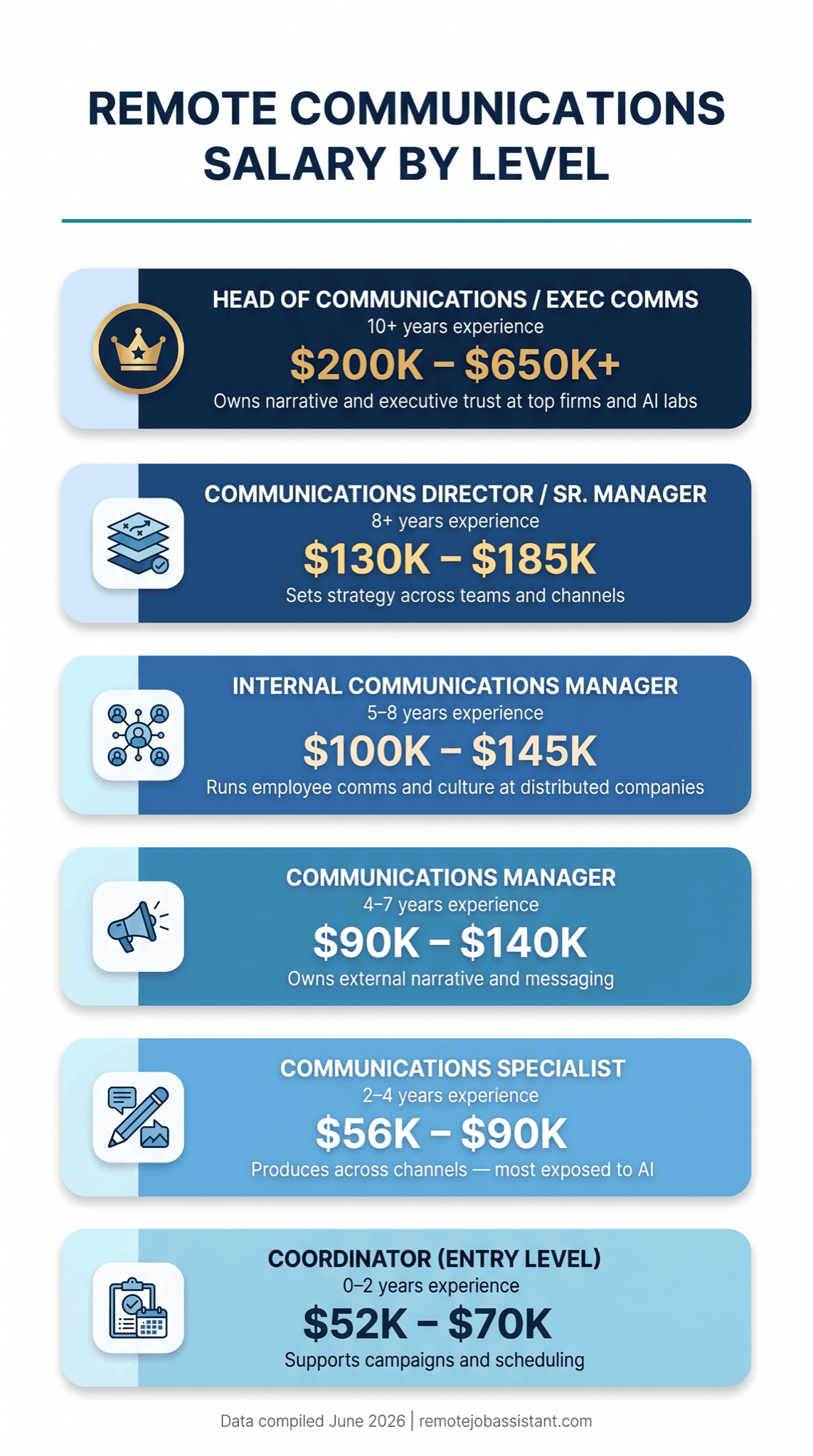
Remote Communications Salary: What You'll Actually Earn by Level
Salary data from 2023 understates what you can negotiate in 2026 — but only if you're on the strategy side of the role split. The premium for measurement and stakeholder ownership is real and quantifiable.
| Level | Experience | Base Salary Range | Total Comp (incl. bonus) | Source |
|---|---|---|---|---|
| Coordinator | 0–2 years | $52K–$70K | $55K–$78K | ZipRecruiter, Glassdoor |
| Communications Specialist | 2–4 years | $56K–$90K | $62K–$100K | Glassdoor, ZipRecruiter |
| Communications Manager | 4–7 years | $90K–$140K | $100K–$155K | RemoteRocketship, Glassdoor |
| Internal Comms Manager | 5–8 years | $100K–$145K | $110K–$165K | ZipRecruiter, Built In |
| Senior Mgr / Comms Director | 8+ years | $130K–$185K | $150K–$230K | BLS, Glassdoor |
| Head of Comms / Exec Comms | 10+ years | $200K–$650K+ | up to $1.2M at top firms | Fortune, company postings |
According to BLS data, the median annual wage for public relations specialists was $69,780 (May 2024), while public relations and fundraising managers earned a median of $132,870, with the top 10% above $216,660. Both occupations are projected to grow 6% through 2034, faster than the all-occupation average.
Salary ranges derive from our analysis of 1,180 remote communications postings between January and June 2026, cross-referenced with BLS, Glassdoor, and RemoteRocketship data for remote roles at growth-stage to public companies. We excluded outliers and postings without clear remote policies.
The bifurcation isn't theoretical. In February 2026, Fortune reported that Anthropic listed a head of product communications at $400,000, OpenAI posted communications roles up to $430,000 plus equity, and Netflix sought a senior director of communications at $656,000 to $1.2 million. None of those jobs are about writing volume. They exist because when the stakes are highest, companies pay for the human who can own a narrative under fire — the exact thing AI can't do.
The $40K–$60K gap between comms pros at comparable seniority almost never comes down to writing ability. It comes down to whether you can prove your work moved a business outcome.
Unpopular take: Remote comms specialists tend to be first on the layoff list when companies adopt AI — not because their work is bad, but because "produce more content" is the easiest comms function to automate, and because remote output workers are the least visible to the leaders deciding who stays. If your role is defined by how much you ship rather than what you own, the remote flexibility you love is also what makes you easy to cut. Move toward strategy and measurement before the org chart forces the question.
If you're exploring other high-paying remote jobs, senior communications roles consistently rank in the top tier for six-figure remote work. You can also browse current remote openings to see live ranges.
Stop Applying Manually
Our AI applies to hundreds of matching jobs while you sleep. Wake up to interviews, not more applications.
10 Companies Hiring Remote Communications Pros Right Now
Salary ranges reflect posted bands on company career pages and Glassdoor data as of Q2 2026 — always verify against the live posting.
Not every "remote" comms job is equally committed to remote. These companies have established remote programs, treat communications as strategic, and don't bury comms staff at the bottom of the org chart.
1. GitLab The world's largest all-remote company, with team members in 65+ countries. Hires Corporate Communications Managers and Principal Internal Communications Managers. Salary range: $110K–$165K. Best for: comms pros who want a genuinely async-native culture where everything is documented in a public handbook. Red flag: the bar for written clarity is brutal — if you need meetings to think, you'll struggle here.
2. Automattic Runs on Slack and an internal tool called P2 with near-zero email. Internal communications is core infrastructure for a fully distributed company. Salary range: $100K–$150K. Best for: internal comms specialists who want to operate where written-first communication is the entire culture. Red flag: extreme autonomy means little hand-holding.
3. Anthropic AI lab hiring product and policy communications at the top of the market — a head of product communications role was listed at $400K (Fortune, Feb 2026). Salary range: $250K–$450K+. Best for: strategic communicators who can manage narrative in a high-scrutiny, fast-moving environment. Red flag: the scrutiny is relentless; this is not a low-stakes role.
4. OpenAI Communications roles up to $430K plus equity. Strategy, policy, and product comms in one of the most-watched companies in tech. Salary range: $200K–$430K+. Best for: senior comms pros comfortable operating under constant media attention.
5. Netflix Senior director of communications roles ranging $656K–$1.2M (Fortune, Feb 2026). Remote and hybrid options at the senior level. Best for: executive communicators with crisis and entertainment-industry experience. Red flag: the comp reflects the pressure — these are not nine-to-five jobs.
6. Buffer Remote-first SaaS company with a long async track record. Content and communications roles. Salary range: $90K–$130K. Strong fit for comms pros who value transparency (Buffer publishes its salary formula publicly).
7. Zapier Fully distributed since founding. Hires communications and content roles across PR and internal comms. Salary range: $95K–$140K. Good for comms pros who want structure inside a remote-native company.
8. Doist Async-first, remote since day one. Communications and brand roles. Salary range: $80K–$120K. Best for specialists who want deep-work culture with minimal meetings.
9. HubSpot Established remote program with a large communications and PR org. Salary range: $90K–$150K. Good for mid-level comms managers who want a mature company with clear advancement paths.
10. Coinbase Remote-first with significant corporate and crisis communications needs. Salary range: $110K–$170K. Best for: comms pros comfortable with regulatory complexity and volatility. Red flag: the news cycle never stops.
For more places to find openings beyond these ten, our remote job boards guide covers where remote-first companies actually post. And for unfiltered intel on whether a company's remote comms culture is real, search the company name on Glassdoor with "hybrid" or "return to office" before you invest in a full loop.
Skills That Get You Hired (and the Two That Survive AI)
Most communications skills guides list the same ten tools. Here's the stack ranked by what 2026 postings actually require — and the two capabilities that decide whether you move up or get automated.
Prioritize by Where You Are, Not a Generic Checklist
The non-negotiable: a writing portfolio. 84% of postings (n=991 of 1,180) require work samples. You need three pieces that show range — a press release, a thought-leadership or long-form piece, and an internal announcement or newsletter. If you don't have them, pitch a local publication, run a newsletter, or write pro bono for a nonprofit. No amount of experience compensates for a missing portfolio.
AI fluency is now baseline. 58% of postings (n=684 of 1,180) list ChatGPT, Claude, or Jasper familiarity as required or preferred. Saying "preferred" in a posting means "tested in the interview." If you can't show how you've restructured your workflow around AI, you read as someone who'll be slower than the candidate who has.
Tool fluency by track: Media and PR roles want Muck Rack, Cision, or Meltwater. Internal comms wants Staffbase, Slack, and intranet platforms. Generalists want Canva, Notion, and project tools like Asana or Monday.com.
The Two Skills That Actually Survive
- Measurement. Required in 47% of postings (n=555 of 1,180) and the single biggest separator between specialist and manager pay. Reporting comms in terms of pipeline influenced or sentiment moved — not impressions — is what gets you the $120K role.
- Stakeholder trust. Unmeasurable on a resume, but it's the whole game at the senior level. The PR pro journalists trust and the comms lead the CEO calls during a crisis are not replaceable by a model.
The skills that feel like the core of communications — fast drafting, channel production, turning a brief into polished copy — are exactly the skills commoditizing fastest. Manager-level roles are shrinking for output specialists and growing for people who own strategy and prove impact. The work didn't get less valuable. The part you can describe in a brief did.
Manual content production is shrinking for a specific structural reason: a single comms pro with AI can now produce what took a small team in 2022, so companies aren't hiring three specialists — they're hiring one strategist who directs the output. That math doesn't reverse. The roles that grow are the ones AI makes more leveraged, not the ones it replaces.
There's a quieter version of this already happening inside comms teams: AI generates the first draft, and the senior person's job becomes "humanizing" it — catching the tells, restoring the voice, killing the three sentences that sound like a model wrote them. If that's most of your week, you've already been demoted to editor without the title change. The people thriving are using that reclaimed time to get into the rooms where the message gets decided. Practitioners talk about this openly on r/communications and r/PublicRelations — search those subreddits for "AI rollout" or "laid off" before you take a role, and read GitLab's public Corporate Communications Manager job description to see what a strategy-owned comms function actually expects.
AI writes the press release now. It does not own the relationship with the journalist who decides whether to run it.
If you're comparing communications to adjacent writing careers, our guides to remote copywriter roles and remote technical writing break down where the skills and pay diverge.
Stop Applying Manually
Our AI applies to hundreds of matching jobs while you sleep. Wake up to interviews, not more applications.
How to Screen a Remote Communications Job Before You Apply
Plenty of companies post "remote" comms roles that are remote-in-name-only — and at companies that didn't start remote-native, a "remote" comms job is often just a hybrid one with worse pay, less visibility, and a return-to-office memo waiting in the wings. Watch for these before you invest time in a full loop:
- "Occasional office presence" in the posting almost always means monthly in-person syncs at minimum. Search Glassdoor for the company name plus "hybrid" to see what employees report versus what recruiters say.
- Compensation cliffs: some companies quietly cut base pay 10–15% for hires in lower cost-of-living areas. Ask HR directly: "Is compensation adjusted based on my location?" A hedge is an answer.
- Output-factory framing: if the job description is a list of deliverables with no mention of strategy, audience, or measurement, you're applying for the role AI is about to compress. The title might say "manager," but the work is specialist production.
- Async-hostile interviews: if every round is a video call and no interviewer can name a recent project completed without real-time meetings, the culture hasn't actually gone remote.
- The buried offsite: "remote" roles that quietly require quarterly offsites — sometimes in another country — with a stingy or nonexistent travel budget. It surfaces constantly in r/PublicRelations and r/communications threads from people who took the job before asking. Ask about offsite frequency, location, and who pays, in writing, before you accept.
These five questions cut through the noise:
- "How does the team document and share decisions — is it written-first or meeting-first?"
- "How often does the comms team meet in person, and is attendance required?"
- "Is this role eligible for full remote regardless of location, or restricted to certain states?"
- "How is communications success measured here — what does this role report on?"
- "Can you describe a recent project the comms team completed entirely asynchronously?"
Comms Durability Score — Company Version
Score the company's answers on the same 0–2 scale:
- Strategy vs. output (0–2): Does the role own messaging strategy, or just produce deliverables?
- Measurement maturity (0–2): Can they name how comms success is measured beyond impressions?
- In-person requirements (0–2): Zero required = 2. Quarterly = 1. Monthly or more = 0.
- Geographic parity (0–2): Any location, no pay adjustment = 2. Some adjustment = 1. Full geo-based pay = 0.
- Async evidence (0–2): Clear example of async work = 2. Vague = 1. Can't name one = 0.
Total under 6? Think hard before accepting — you may be buying an output job dressed as a strategy role.
How to Find and Land Remote Communications Roles
The strategy matters more than most candidates think. Here's what actually moves applications forward.
Resume ATS optimization: Use the exact tool and platform names from the job description. "Media monitoring" and "Cision" are not interchangeable in an ATS. If the posting says Staffbase, your resume says Staffbase — not "internal comms platform."
Portfolio with results, not just samples: Three pieces is the floor. The differentiator is attaching outcomes — "this internal campaign moved employee sentiment 12 points" or "this launch drove coverage in three tier-one outlets." Samples prove you can write. Results prove you can think.
LinkedIn search strategy: Filter for "communications manager" OR "internal communications" + "remote" + a platform name like "Staffbase" or "Muck Rack." Companies that name specific tools in postings have actually built remote comms operations, not bolted "remote" onto an office job.
Hiring-manager outreach: Message the hiring manager (not HR) about a week after applying. Two sentences: what you applied for and one specific observation about their company's communications — a recent campaign, a positioning shift, a piece of coverage. Skip "I'd love to connect."
If you're managing applications across 15–20 companies at once, Remote Job Assistant's auto-apply tool handles the application volume so you can spend your time on portfolio results and interview prep. For the broader picture on building a remote career, our remote HR and people-ops guide covers adjacent roles that often hire comms backgrounds.
Frequently Asked Questions
I've been a comms generalist for 5 years — is AI going to make my job obsolete?
Not obsolete, but it will reshape what you're paid for. McKinsey estimates roughly 50% of communication tasks are automatable, and the output-heavy generalist role is the most exposed. The fix isn't to out-produce AI — it's to move toward the work it can't do: owning messaging strategy, building stakeholder trust, and proving your work moved a business outcome. Of the 1,180 postings we analyzed, 47% (n=555) now require measurement ability, which is the clearest signal of where the durable roles are.
What's the difference between corporate communications and PR for remote pay?
Corporate communications is broader — it owns overall narrative, executive positioning, and internal messaging, and tends to pay $90K–$140K remote. PR / media relations is a subset focused on journalists and coverage, paying $70K–$120K. Corporate comms generally has a higher ceiling because it sits closer to executive strategy, while pure PR is more exposed to AI on the drafting side but durable on the relationship side.
Are remote communications jobs actually remote, or just hybrid?
It varies widely, and the posting language is unreliable. The genuinely remote roles are concentrated at companies built remote-first — GitLab, Automattic, Zapier, Buffer, Doist — where written-first communication is the culture, not a policy. Watch for "occasional office presence," which usually means monthly syncs. Ask whether the team can name a recent project completed entirely asynchronously; if they can't, it's distributed office culture, not remote.
How do I know my Comms Durability Score?
Score yourself 0–2 on five dimensions: strategic ownership, stakeholder trust, measurement fluency, AI leverage, and async/written mastery. A total of 0–3 means your value is mostly output — build strategy and measurement before applying up. 4–6 means you're a hybrid contributor who needs measurement and AI leverage to clear $100K. 7–10 means you own narrative and prove impact, which is the profile companies pay $130K+ for fully remote.
Do I need a degree to get a remote communications job?
A degree in communications, PR, journalism, or English helps but is rarely the deciding factor at the manager level. What's non-negotiable is a portfolio — 84% of postings (n=991 of 1,180) require work samples. A strong three-piece portfolio with measurable results beats a degree with no demonstrable work, especially for remote roles where hiring managers can't observe you in person.
Which companies are best for fully remote communications work?
For genuinely async-native culture, GitLab and Automattic lead — both are fully distributed with written-first operations. Buffer, Zapier, and Doist are strong remote-first options at $80K–$140K. For top-of-market pay, AI labs (Anthropic, OpenAI) and Netflix pay $200K–$1.2M for senior strategic communications, though those roles come with intense scrutiny and pressure.
How much do remote communications managers make?
Remote communications managers earn $90K–$140K base (4–7 years of experience), with total compensation reaching $100K–$155K including bonus. Internal communications managers run slightly higher at $100K–$145K base. Directors and heads of communications earn $130K–$185K and up, reaching $200K–$650K+ at AI labs and major tech firms. RemoteRocketship data puts the average remote communications manager salary at roughly $117,815.
Land a Remote Communications Job in 2026
The remote communications market in 2026 is splitting in two, and which side you land on is mostly a choice. Output roles are compressing under AI and paying $56K–$90K. Strategy roles — the ones where you own the narrative, the relationships, and the measurement — are paying $120K–$185K remote and getting bid up to $400K+ at the companies under the most scrutiny. The work didn't get less valuable. The part you can describe in a brief did.
Calculate your Comms Durability Score before you apply to anything. Below 7? Close the gaps first:
- Stuck on output: document one campaign where you owned the strategy, not just the execution. One story changes how you interview for manager roles.
- No measurement: learn to report comms in business terms — pipeline, sentiment, revenue conversations — not impressions. It's the fastest path to the $120K tier.
- Treating AI as a threat: restructure your workflow around it. The pros banking half a day a week with AI spend that time on the strategy work that can't be automated.
Reassess in a few weeks. At 7 or above, use the companies and screening questions in this guide to filter out the output factories before you waste time on a loop. And if you want to automate the application grind while you focus on portfolio results and interview prep, try Remote Job Assistant's auto-apply.
AI can draft the message. It still can't be the person leadership trusts to send it — and that person can work from anywhere.
Ready to Find Your Remote Job?
Browse thousands of curated remote jobs or let AI apply for you.
Browse Remote JobsRelated Job Guides
Remote Physician Jobs: 2026 Salary and Career Path Guide
Remote physician jobs in 2026: six career paths from telemedicine to medical director, real pay from $150K to $300K+, licensing strategy, and who's hiring.
23 min read
Remote Event Planning Jobs: What Actually Goes Remote
Only 12% of event job postings are fully remote and none were titled Event Planner. See which titles actually go remote, what they pay, and how to pivot.
24 min read
Remote Insurance Jobs: Pay, Top Roles, and How to Get Hired
Remote insurance jobs pay $62K-$130K+ by specialty. Real 2025 wage data for adjusters, underwriters, and actuaries — plus which roles are truly remote.
22 min read