
Last reviewed: August 2026
You've seen the same three words — "Social Media Manager" — attached to a $42K job and a $110K job in the same week of scrolling. Same title, same platforms, sometimes nearly the same bullet points. And if you've been running social for a few years, you've probably had the quieter, more uncomfortable version of that experience: watching someone with a worse content instinct than you clear six figures while you're negotiating over $3K.
Here's the reframe this post is built on: social media is the most title-inflated role in marketing, and the salary difference is never creativity. It's ownership. The person making $110K isn't posting better — they're holding a paid budget, reporting revenue instead of engagement, and managing the people who do the posting. The job title hides that completely, which is exactly why remote social media jobs are so hard to price from the outside.
Get Remote Job Tips in Your Inbox
Weekly strategies, salary data, and new opportunities
Unsubscribe anytime. No spam.
This guide puts real numbers on the spread. As of August 2026, Glassdoor lists 1,238 remote social media jobs in the US, SimplyHired lists 861, and LinkedIn shows over 1,000 — and the pay across those listings runs from $20 an hour to $148K a year. Below: the salary data by level, the skills that actually move the number, the title-inflation traps to screen for in interviews, and where the roles worth applying to actually get posted.
Based on posting counts and compensation data collected August 2026 (sources and methodology below):
- 1,238 remote social media jobs listed on Glassdoor US; 861 on SimplyHired; 1,000+ on LinkedIn (August 2026)
- $76,990 average salary for remote social media marketing managers, with the middle band running $57,500 (25th percentile) to $90,000 (75th percentile) and top earners at $112,000 (90th percentile) (ZipRecruiter, February 2026)
- $56,605 → $78,129: average pay climb from 1-3 years to 5-7 years of experience (n=1,000 social marketers surveyed, Rachel Karten survey via Sprout Social)
- $30K-$125K: the full startup salary range for remote social media managers on Wellfound — the widest band of any marketing role they track
- $22.94/hour average for hourly "social media remote" listings — the execution-tier trap this post shows you how to escape (ZipRecruiter, August 2026)
That $30K-$125K startup spread isn't noise — it's the entire thesis of this post. The rest of this guide explains what separates the bottom of that band from the top, starting with how we got the numbers.
How We Collected This Data
The figures in this post come from our review of remote social media job listings and compensation data collected between February 2026 and August 2026. Posting counts were pulled from Glassdoor (1,238 US remote social media listings, August 2026), SimplyHired (861 remote listings, August 2026), and LinkedIn (1,000+ US remote listings, August 2026). We counted only positions explicitly marked remote in the United States.
Salary bands were cross-referenced across ZipRecruiter's remote social media marketing manager data (February 2026), Glassdoor's remote social media manager salary data, Wellfound's startup hiring data, and Sprout Social's 2026 salary guide, which aggregates Zippia industry data and a survey of 1,000 social marketers run by industry analyst Rachel Karten. Where platforms disagreed — and on social titles they disagree by $15K or more — we report the range and explain the variance rather than averaging it away.
Two honest limitations. First, salary platforms self-report, so they skew toward people motivated to share — usually the underpaid checking if they're underpaid. Second, social media titles are so inconsistent that the same dataset can put "manager" at $60K or $77K depending on how it buckets senior roles: PayScale's 2026 average for the title is $60,449 (range $40K-$88K) while ZipRecruiter's remote figure is $76,990. We treat the disagreement as signal, not noise — it's the title inflation this post is about.
Ranges reflect base salary for full-time US remote roles. We update this analysis as new quarterly data lands; figures here reflect mid-2026.
What Remote Social Media Jobs Actually Pay in 2026
The honest answer is a band so wide it's almost useless without a framework: $42K at the bottom, $148K+ at the top, for jobs that all say "social media" in the title.
So here's the framework. We call it The Ownership Ladder: in remote social media, pay tracks what you own, not what you produce.
Scoring:
- L1 Content Executor ($42K-$55K): You own the posting calendar. Someone else owns the strategy. Your week is scheduling, community replies, asset wrangling, and reporting engagement numbers someone above you turns into a business story. Measured on output volume. This is the tier PayScale's employee reviews for the title describe on repeat — "overworked and underpaid," with one manager reporting no raise in two and a half years. Tenure doesn't fix L1. Only moving up does.
- L2 Channel Owner ($55K-$85K): You own one or more channels end to end — strategy, content, community, and the monthly report. You run small paid boosts but not the real budget. Measured on channel growth and lead contribution.
- L3 Growth Operator ($85K-$148K+): You own budget and business outcomes. Paid social spend, attribution, agency or team management, and a seat in the revenue conversation. You report pipeline and return on ad spend to leadership, not likes. Measured on money.
How to use it: find your current tier honestly, then steal the next tier's language for your resume and interviews. The ladder move is always the same — describe the ownership you're closest to, not the tasks you perform.
One warning before the table, because the ladder gets gamed in both directions. Job listings inflate too. A recurring pattern — vented about constantly on r/socialmedia — is the "Head of Social" posting at a $100K+ band that turns out, two interviews in, to mean a few hundred dollars a month in boosted posts plus sole responsibility for all organic content across five platforms. That's an L1 job wearing an L3 title, and the tell is available in the first screen if you ask for it: "What was last quarter's paid spend, and who approved it?" A real L3 role answers in seconds. A costume role changes the subject to "growth opportunity."
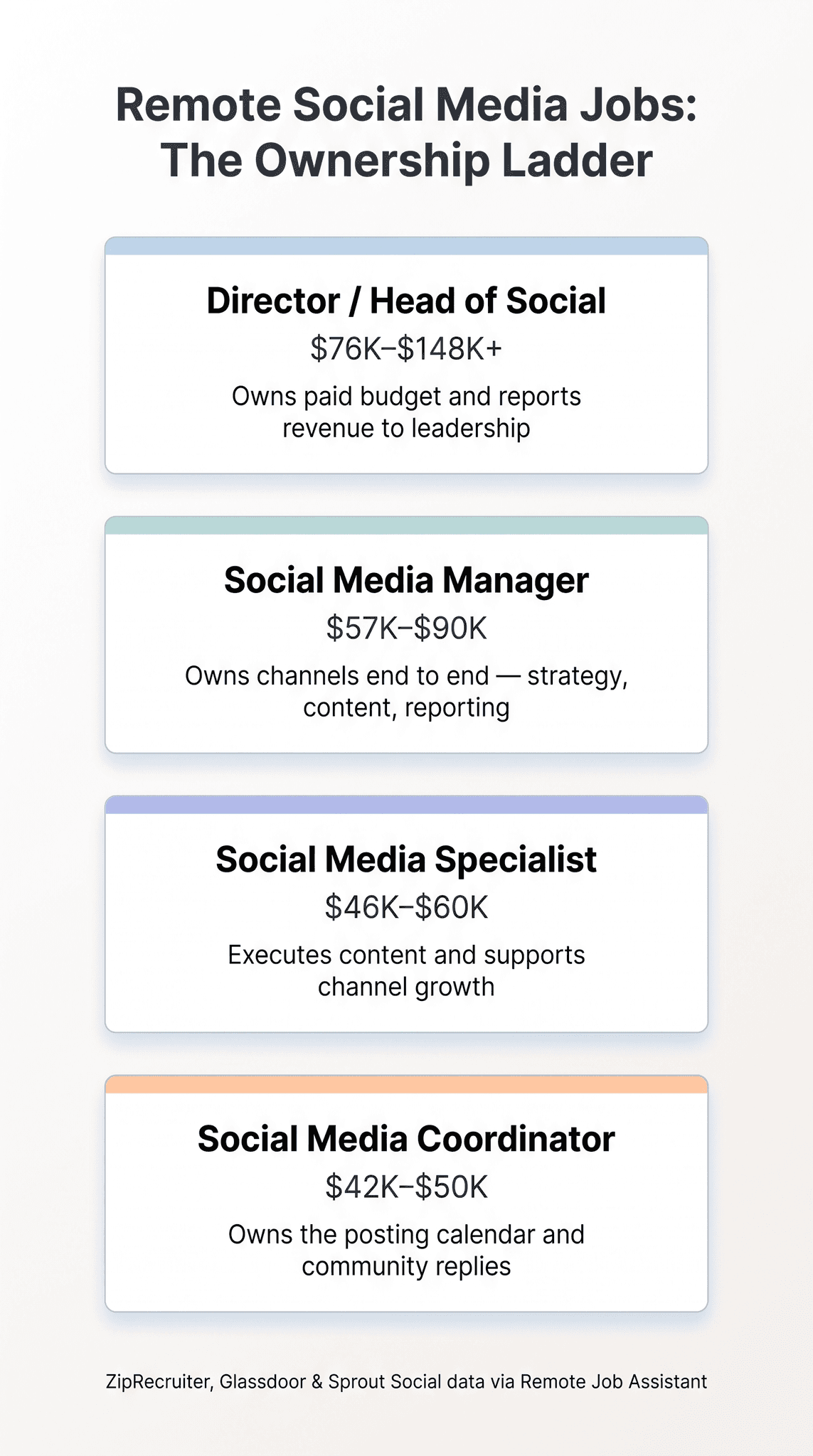
Here's how the ladder maps to published remote social media manager salary data for 2026:
| Level | Typical Titles | 2026 Remote Salary | Source |
|---|---|---|---|
| L1 Content Executor | Social Media Coordinator | $42K-$50K | Glassdoor / Indeed coordinator averages (approx. $42K) |
| L1-L2 | Social Media Specialist | $46K-$60K | Specialist avg approx. $46K; strategist avg approx. $60K |
| L2 Channel Owner | Social Media Manager | $57K-$90K | ZipRecruiter remote SMM middle band (Feb 2026) |
| L3 Growth Operator | Senior Manager / Director / Head of Social | $76K-$148K+ | Indeed director data: approx. $76K starting, approx. $148K seasoned |
Salary bands derive from the posting and compensation review described above — Glassdoor, SimplyHired, and LinkedIn posting data (August 2026) cross-referenced with ZipRecruiter (February 2026), Glassdoor salary data, and Sprout Social's aggregated survey data. Ranges shift as markets move; check the linked sources for current figures.
Industry moves the band too. Zippia's data (via Sprout Social) puts social media salaries in technology at $82,246 on average against $67,443 in hospitality — a $15K gap for the same work, before you negotiate anything. If you're optimizing for pay, remote marketing roles at tech companies are the highest floor.
Why did remote widen this spread instead of flattening it? Because remote did two opposite things at once. At L1, it nationalized the applicant pool — a coordinator role that once competed locally now competes with every coordinator in the country, which pushes execution pay toward the $22.94/hour average ZipRecruiter records for hourly remote social listings. At L3, it did the reverse: companies that finally learned to measure social revenue will pay top-of-market for the person who can grow it from anywhere. Remote didn't change social media pay. It sorted it.
Stop Applying Manually
Our AI applies to hundreds of matching jobs while you sleep. Wake up to interviews, not more applications.
The Skills That Move You Up the Ladder
Creativity gets you the interview. Budget ownership gets you the extra $40K.
That's the uncomfortable math of this field, and here's the part nobody puts in the job description: at a lot of companies the split is deliberate. The real ad budget sits with a performance marketing team that doesn't trust social people with real money — they've watched too many boosted posts with no measurement plan. So the "social media manager" is structurally a content factory: kept busy, kept visible, kept away from the spend. You don't fix that with better content. You fix it by changing companies, or by borrowing the performance team's own language — proposing one small paid test with a measurement plan attached, which is the only proposal that group ever says yes to.
The salary decision tree, compressed:
- Never spent a dollar of ad money? You're capped near $65K, whatever your title says.
- Run paid campaigns but can't connect them to pipeline or revenue? You'll interview well into the $75K-$90K band and stall there.
- Can defend a ROAS decision out loud — what you spent, what came back, what you'd change? You're in the $100K+ conversation.
And here's the bind that tree creates inside a job, because it's worth naming the trap before you're in it. It goes like this: leadership reads a "social drives revenue" deck at an offsite and comes back asking your channel to justify itself in pipeline terms. You're now measured on revenue. But the ad budget still sits with performance marketing, the CRM attribution still isn't wired to social, and your actual levers are still a content calendar and a comment section. Revenue accountability, engagement-tier tools. People in this bind either negotiate for one of the real levers within a quarter — budget or attribution access — or they spend two years explaining why the number didn't move. If you're in it now, that negotiation is more valuable than any skill on this list.
Content instinct is the entry fee — every candidate in the pile claims it, most can demonstrate it, and it stops differentiating you above $55K. Four skills actually reprice you. Work them in this order, keyed to where the decision tree just placed you:
1. Paid social. The single biggest lever. The moment a job description says "manage paid budget" or "ROAS," you've left the L1 pool. Paid skills are scarce among organic-native social people because most never get handed a budget to learn on — the chicken-and-egg problem of this career. Break it with your own money: $500 of real spend on a real project teaches you more interview-usable material than any course, and Meta Blueprint's free courses cover the mechanics before you spend a dollar. The certification matters less than being able to talk through a campaign you ran, what you'd kill, and why.
2. Analytics and attribution. The branch for people who've run paid but stall at $90K. L2 managers report what happened. L3 operators explain what caused it and what it's worth. If you can walk into an interview and connect a content series to pipeline — even imperfectly, even with caveats — you're speaking a language most social candidates never learn.
3. Video. The multiplier, not the foundation — add it once one of the first two is in motion. Short-form video is where organic reach still lives, and Sprout Social's salary analysis lists video creation among the highest-value skills for pay increases. Video that feeds a paid funnel you measure is the full L3 package.
4. AI workflow fluency. In Sprout Social's reporting, 97% of surveyed marketing leaders called AI knowledge crucial, and AI proficiency now commands premium salaries. Not "I use ChatGPT for captions" — that's table stakes. The paying version is building the workflow: brief generation, variant testing, comment triage, reporting drafts. Be clear-eyed about why this pays: companies are actively consolidating three-person social teams into one operator with AI tools and a cheap agency behind them. That consolidation is exactly what's hollowing out L1 pay — and it's also why the one operator who remains, the person running the system, is worth more than the team they replaced. You want to be the consolidator, not the consolidated.
The comparison that makes this concrete — same title, different job:
| Signal | Organic-Only Role | Paid + Organic Role |
|---|---|---|
| JD language | "create engaging content," "grow our community" | "manage paid budget," "attribution," "ROAS" |
| Metric you own | Engagement rate, follower growth | Pipeline, cost per acquisition, return on spend |
| Who you report to | Marketing manager | Head of Growth / CMO |
| Realistic band | $45K-$65K | $75K-$120K+ |
| Ceiling | Content lead | Director / Head of Social |
Read every job description through this table before you apply. If the listing doesn't mention paid budget or analytics anywhere, the salary band is capped in the $50Ks no matter what the title says.
Who's Hiring for Remote Social Media Jobs — and Where the Real Listings Are
Most of the 1,238 remote social media listings on Glassdoor are L1-band — coordinator and specialist roles dressed in manager titles. The L2 and L3 roles cluster in two places.
First, remote-first companies. GitLab, Automattic, Zapier, and Deel all hire marketing and social roles across dozens of countries, and because they're structurally remote — documented decisions, async-default communication — the social roles there come with real channel ownership rather than "be online when the boss is." Their careers pages list openings directly, and they pay against a global talent benchmark, not your zip code.
Second, curated boards. General aggregators bury social roles under content-mill listings; the better remote job boards filter for legitimacy before you ever see the post. Working Nomads runs a solid curated marketing category, and FlexJobs screens every listing — though you'll pay for access and still won't get application automation. Our own remote job board lists social and marketing roles with salary transparency, filtered to genuinely remote positions.
There's also a freelance lane, and it's worth knowing the real rates before someone lowballs you: Upwork's median hourly range for social media work runs $14-$35/hour, small-business management projects run $400-$2,000, and large-company projects run $2,500-$10,000 (Upwork data via Sprout Social). Freelance is a fine bridge and a good way to buy paid-social experience with someone else's budget — but the full-time L3 seat is where the compounding happens: budget size grows, scope grows, and the title finally starts matching the market.
One more sourcing channel that outperforms every board: the industry's own back channels. A meaningful share of senior social roles get filled through practitioner newsletters and communities before they're ever posted widely — Rachel Karten's Link in Bio newsletter runs a job board read by exactly the hiring managers you want, and Matt Navarra's Geekout community surfaces roles and salary intel daily. Being in those rooms is how you hear about the L3 role with twelve applicants instead of the public listing with four hundred.
Stop Applying Manually
Our AI applies to hundreds of matching jobs while you sleep. Wake up to interviews, not more applications.
How to Land One Without Getting Buried in the Pile
Here's the structural problem with applying to remote social media jobs: everyone believes they can do social. It's the only marketing discipline where the entire applicant pool uses the product daily and mistakes fluency for skill. Combine that with remote — no geographic filter — and a mid-level social listing at a known brand routinely pulls hundreds of applicants in the first week. You are not competing against other social strategists. You're competing against a flood.
That changes the strategy in three specific ways.
Build a portfolio of outcomes, not posts. Screenshots of clever content lose to one page per engagement in this exact format — context, ownership, numbers, business result:
[Company type] — [channels owned] — [timeframe] Situation: [one line — where the account was when you got it] What I owned: [strategy / content / paid spend / reporting — be precise about which] Result: [growth number] → [business number — leads, pipeline, revenue share]
Filled in, it reads: "B2B SaaS — LinkedIn and TikTok — 14 months. Inherited a dormant 4K-follower LinkedIn. Owned strategy, content, and a small retargeting budget. Grew to 22K followers; content-sourced leads became 18% of demo requests." Three of these beat three hundred post screenshots. If you can't share employer numbers, use ranges and percentage changes — hiring managers understand confidentiality; they don't forgive vagueness.
Mirror the ownership language. Applicant tracking systems and first-round screeners both filter on the job description's own vocabulary. If the listing says "paid social" and "attribution," those exact phrases need to appear against real work on your resume. This isn't gaming the system — it's answering the question being asked. If you're applying steadily and hearing nothing, the resume is usually the leak, not the market.
First-round screens for social roles are reporting-fluency tests in disguise. The hiring manager doesn't ask you to pitch content ideas — they ask how you measured the last thing you did. Candidates who answer with engagement metrics stall at L2 money. Candidates who answer with revenue language get the L3 conversation.
Solve the volume problem with volume — targeted volume. When every good listing draws hundreds of applicants, application count is a real variable in your outcome, and doing it manually is a part-time job stacked on your actual job. That's the trade auto-apply automation makes: it handles the form-filling at a volume you can't sustain by hand, so your evenings go to the case studies and follow-ups that actually move interviews — the work that can't be automated because it's the work that differentiates you.
The fastest raise in social media isn't a promotion — it's moving from reporting engagement to reporting revenue. Every tactic above is in service of that one repositioning.
Stop Applying Manually
Our AI applies to hundreds of matching jobs while you sleep. Wake up to interviews, not more applications.
Career Paths From Social Media
Here's the blunt version of this section: a large share of the people making real money "in social" no longer have social in their title. They took the paid and analytics skills the role taught them and moved one seat over, where the same work is priced higher. That's not a failure of the career — it's the career. Social is one of the best launchpads in marketing precisely because it touches everything: content, paid, analytics, brand, community. The common exits, with the skill that unlocks each:
- Growth marketing. The natural L3 continuation. Paid social plus attribution is most of the growth-marketer toolkit already; the step up is owning channels beyond social. This is the highest-paying exit — see our guide to remote marketing jobs that clear $100K.
- Communications and brand. Social managers who lean into messaging, PR moments, and executive voice move into remote communications roles, which trade some of the performance pressure for strategy scope.
- Content strategy and copy. If writing is your strongest muscle, remote copywriter roles and broader remote writing careers pay comparably to L2 social with far less always-on pressure.
- Head of digital / marketing leadership. The long game. Social → digital marketing lead → marketing director is a well-worn path among the highest-paying remote roles, and the social start is an advantage: you're the only director candidate who has personally operated every channel you'll oversee.
The through-line: every exit pays for the same two things — paid media literacy and revenue reporting. Build them once at L2/L3 and they compound in any direction you take.
Frequently Asked Questions
I've been a social media coordinator for three years — why am I still stuck under $50K?
Because tenure doesn't move you up The Ownership Ladder — ownership does. Three years of executing someone else's calendar is still L1 work, and L1 pay is capped by a national applicant pool willing to do it for $42K-$50K. The fix isn't waiting for a promotion; it's acquiring one L2 signal (full ownership of a channel with its monthly report) and one L3 signal (any paid budget, even $500), then interviewing externally with that language.
How do I know if a remote social media job is actually a manager role or a glorified posting job?
Read the metrics and the money, not the title. A real manager role names a budget, mentions paid social or attribution, and reports to a growth or marketing lead. A posting job says "create engaging content," lists five platforms, and measures "community growth." If the listing mentions neither budget nor analytics, it's an L1 role in a manager costume — expect $50Ks regardless of what the title implies.
How much do remote social media managers actually make in 2026?
Per ZipRecruiter's February 2026 data, remote social media marketing managers average $76,990, with the middle half of earners between $57,500 (25th percentile) and $90,000 (75th percentile) and the 90th percentile at $112,000. Experience compresses the low end: in a survey of 1,000 social marketers (Rachel Karten, via Sprout Social), pay averaged $56,605 at 1-3 years and $78,129 at 5-7 years. Directors run from roughly $76K starting to $148K seasoned.
Should I learn paid ads or video editing first if I want a raise?
Paid, and it isn't close. Video makes your content better; paid budget ownership changes what tier of job you're eligible for. The market prices scarcity: most social candidates can produce video by now, but few have run real ad spend with a return to report. Learn paid first, then add video as the thing your paid campaigns are built from.
Which tier of the Ownership Ladder am I on if I run channels but never touch budget?
You're a textbook L2 Channel Owner — you own strategy, content, and reporting for your channels, which is real ownership and prices at $55K-$85K remote. The gap between you and L3 money is specifically the budget and the revenue conversation. Ask to run one small paid campaign this quarter, even a boosted-post test with a defined goal. One measured campaign is enough to start interviewing with L3 language.
Is AI going to replace social media managers?
It's replacing L1 tasks, not the role — scheduling, first-draft captions, and comment triage are automating fastest, which is exactly why execution-only social work is drifting toward hourly rates. But 97% of marketing leaders in Sprout Social's reporting call AI knowledge crucial, and AI-fluent operators command premium pay. The judgment work — what to say, where to spend, what the numbers mean — is getting more valuable as the production work gets cheaper. Move up the ladder and AI is your leverage, not your replacement.
Can I make real money freelancing in social media instead of going full-time?
Yes, with a caveat. Upwork's median range runs $14-$35/hour, but project-based work is where it gets interesting: $400-$2,000 for small-business management and $2,500-$10,000 for large-company projects. A freelancer with three retainer clients at the top of that band out-earns most L2 salaries. The caveat: freelance rarely hands you a large paid budget, which is the L3 credential — so treat it as income plus portfolio, and keep one engagement that includes ad spend.
Start Your Remote Social Media Career
Remote social media jobs will keep spanning $42K to $148K, and the title will keep telling you nothing about which end a listing sits on. The Ownership Ladder tells you. Read every job description for what you'd own — a calendar, a channel, or a budget — and price yourself accordingly. Then fix the two things fully in your control: a portfolio that reports outcomes in revenue language, and enough application volume to survive the flood on every good listing.
Browse remote social media and marketing roles with salary transparency, or let auto-apply run the volume game while you build the case studies that win the interview.
Titles lie. Budgets don't. Find out which one you're interviewing for before you sign.
Ready to Find Your Remote Job?
Browse thousands of curated remote jobs or let AI apply for you.
Browse Remote JobsRelated Job Guides

Remote Interior Design Jobs: What 1,409 Postings Show (2026)
Remote interior design jobs are rare: 40 of 1,409 US postings were remote. See which designer, planner, and FF&E seats pay $75K+ from home, and where.
46 min read
Remote Journalism Jobs: What 1,438 Postings Show (2026)
Remote journalism jobs are rare: 77 of 1,438 US newsroom postings were remote. See which reporter, editor, and audience seats pay $75K+ from home, and where.
39 min read

Remote Architecture Jobs: What 1,574 Postings Show
Remote architecture jobs are rare: 25 of 1,574 postings. See which roles go remote, what they pay, and why most firms still want you at the pin-up wall.
35 min read