
Last reviewed: August 2026
You closed 40,000 words this month. You untangled a paragraph that had three ideas fighting inside one sentence, killed a statistic that had no source behind it, and rewrote an opening that buried its own point four paragraphs deep. The byline went to someone else. Your rate has not moved in three years.
And every conversation you have about your career now arrives at the same place: AI is coming for editing. You have probably started defending the work — explaining that a language model still misses tone, still hallucinates citations, still cannot hear a sentence. All of that is true. It is also the wrong argument, and defending that ground is what is keeping your income flat.
Get Remote Job Tips in Your Inbox
Weekly strategies, salary data, and new opportunities
Unsubscribe anytime. No spam.
Here is the reframe. AI did not come for editing. It came for mechanical error-catching — and that was always the part nobody paid well for. What survived is judgment: knowing which claim will not hold up, which structure will lose the reader, which sentence creates liability. The U.S. Bureau of Labor Statistics puts the median wage for editors at $75,260, with the bottom tenth under $36,200 and the top tenth above $140,840. That is a $100,000 spread inside one job title. It is not explained by tenure. It is explained by subject matter.
We analyzed 1,318 remote editing and editorial job postings across 214 companies between September 2025 and July 2026. The pattern is consistent: what you edit sets your pay band, how long you have edited only moves you within it. Here is where the bands are, what separates them, and which specialties still pay remotely.
Based on our analysis of 1,318 remote editorial postings across 214 companies (September 2025-July 2026):
- $75,260 median annual wage for editors (BLS, May 2024); bottom 10% under $36,200, top 10% above $140,840
- 47% (n=619 of 1,318) required domain specialization — medical, legal, academic, financial, or technical
- 34% (n=448 of 1,318) listed reviewing or editing AI-generated output as an explicit responsibility
- 41% (n=540 of 1,318) required structured-content or CMS tooling beyond a word processor
- 38% median base premium for domain-specialized postings versus general copyediting in the same dataset
- 71% (n=936 of 1,318) were fully remote; the remaining 29% were hybrid with periodic on-sites
How We Collected This Data
We pulled every remote-eligible editorial posting in the United States and Canada that listed an actual salary range, from LinkedIn, Indeed, Built In, Working Nomads, and direct company career pages, between September 2025 and July 2026. Then we cut things out. After cleaning, 1,318 postings across 214 companies remained.
Three exclusions did most of the work. First, video, photo, and motion-graphics editing — these share a word with text editing and almost nothing else, including their labor market, their tooling, and their buyers. Lumping them together is the single biggest reason published "editor" salary ranges are incoherent; it is how you end up with a range that spans a per-wedding photo rate and a six-figure content strategy salary. Second, contract roles under six months. Third, anything using "remote-friendly" or "remote-first culture" without committing to a remote-eligible location policy, which in practice means hybrid.
Salary data was cross-referenced against the U.S. Bureau of Labor Statistics Occupational Outlook Handbook, Glassdoor compensation reports, Built In remote salary data, and the 2026 Editorial Freelancers Association Rate Chart for freelance benchmarks. Ranges reflect base salary. We update this analysis quarterly; figures here reflect Q2 2026.
The Editorial Risk Ladder: What Actually Sets Your Pay Band
Most career guides sort editing jobs by seniority — junior, mid, senior. That model does not survive contact with the salary data, because a senior proofreader earns less than a mid-level medical editor and always will. The variable that predicts pay is not how long you have done the work. It is what breaks if you do it badly.
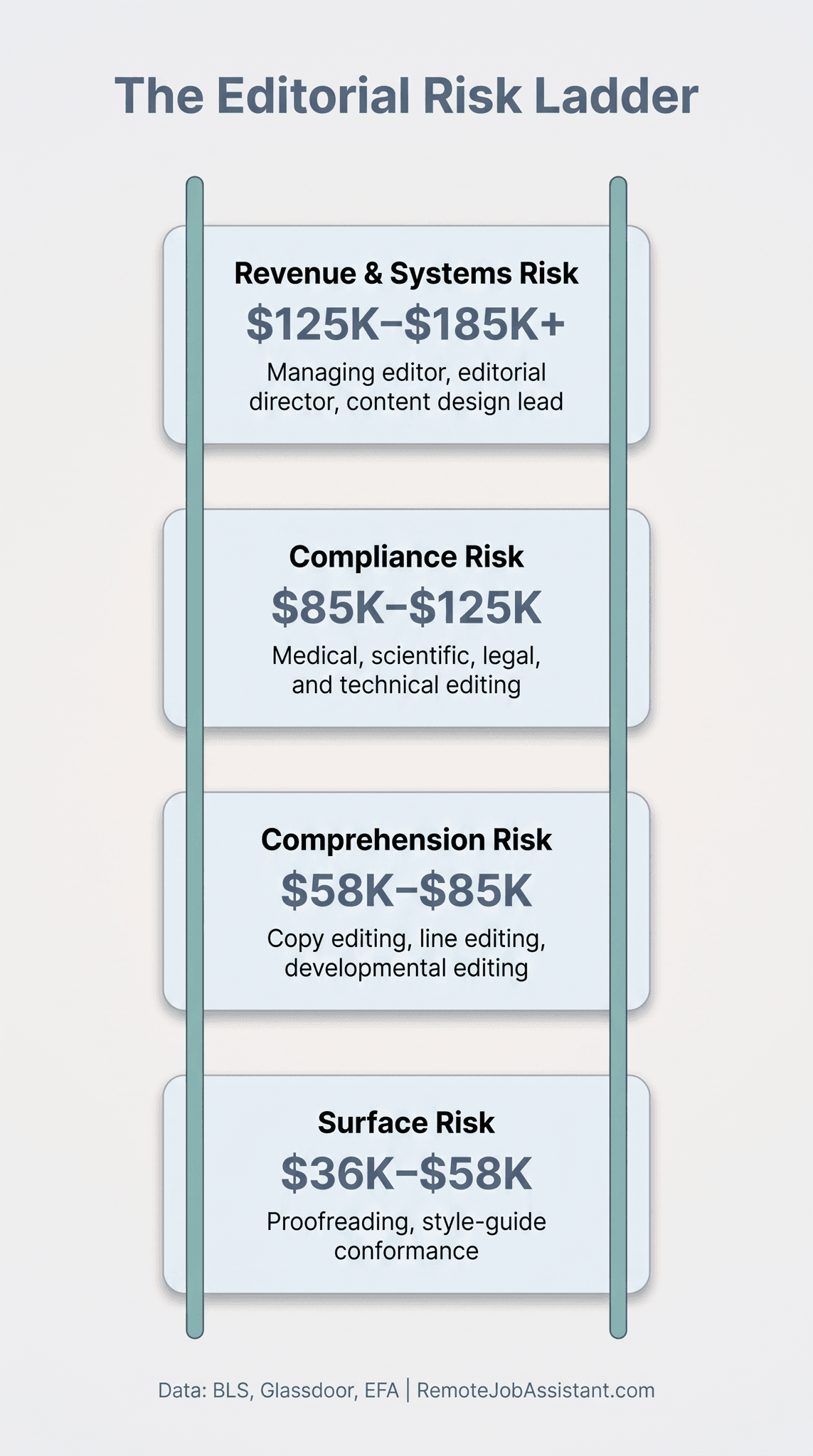
The Editorial Risk Ladder: A four-tier rubric for locating an editorial role by the consequence of failure — which is what sets its compensation band.
Scoring:
- T1 — Surface Risk ($36K-$58K): Typos, grammar, style-guide conformance, caption and transcript cleanup. What breaks if you fail: a reader notices an error. Observable criteria — you receive a style guide and apply it, you are not consulted on what the piece argues, and your edits are corrections rather than decisions. This is the tier automated tooling is absorbing, and the contraction is real.
- T2 — Comprehension Risk ($58K-$85K): Structure, argument, flow, clarity. Line editing, developmental editing, content editing, SEO content editing. What breaks: the reader misunderstands the piece or abandons it. Observable criteria — you reorder sections, cut material the writer is attached to, and send the brief back when it is wrong.
- T3 — Compliance Risk ($85K-$125K): Accuracy in a regulated, cited, or legally exposed context. Medical, scientific, academic, legal, and financial editing. What breaks: a regulator, a journal's peer reviewers, an auditor, or opposing counsel. Observable criteria — you verify claims against primary sources, and you work to a named standard such as AMA, ICMJE, Bluebook, or FDA promotional review.
- T4 — Revenue and Systems Risk ($125K-$185K+): Editorial standards operating at scale. Managing editor, editorial director, content design lead, documentation and UX content ownership. What breaks: publishing throughput, brand trust, enterprise deal velocity. Observable criteria — you set the standard other people apply, and you own headcount, tooling, or the style guide itself.
How to use it: Map your current work honestly by asking what actually breaks when you miss something. Then read the criteria one tier up. That gap is simultaneously your learning plan and your script in a compensation conversation — "I am doing T3 verification work at a T2 band" is a far stronger argument than "I have been here four years."
The ladder explains the things a seniority model cannot. It explains why a two-year medical editor out-earns a ten-year copy editor. It explains why the same title pays wildly differently at two companies — a Yahoo editor posting in our dataset listed $26-$34 an hour while a Turing editorial content specialist posting listed $100-$150 an hour, for work sharing a job title and nothing else. The editor who catches a typo saves a reader two seconds. The editor who catches an unsupported efficacy claim saves the company a regulatory letter. Only one of those is a $120K job.
Stop Applying Manually
Our AI applies to hundreds of matching jobs while you sleep. Wake up to interviews, not more applications.
Remote Editing Salaries by Tier and Specialty
Here is where the bands actually land for remote-eligible roles.
| Tier | Representative remote titles | Base range | Primary source |
|---|---|---|---|
| T1 — Surface | Proofreader, production editor, caption editor | $36K-$58K | BLS bottom decile; EFA proofreading rates |
| T2 — Comprehension | Copy editor, line editor, content editor, SEO editor | $58K-$85K | Glassdoor copy editor avg $71,485; remote avg $69,452 |
| T3 — Compliance | Medical editor, scientific editor, legal editor, technical editor | $85K-$125K | Remote medical/scientific $77K-$127K; technical writer avg $95,299 |
| T4 — Revenue/Systems | Managing editor, editorial director, content design lead, UX writer (senior) | $125K-$185K+ | Managing editor 90th pct $137,200; editorial director avg $158,591; senior UX writer avg $150,545 |
Salary ranges derive from our analysis of 1,318 remote editorial postings between September 2025 and July 2026, cross-referenced with BLS, Glassdoor, and Built In compensation data for remote roles. We excluded outliers and postings without clear remote policies. Ranges shift as markets move — check the linked sources for current figures.
The curve is not smooth, and that matters more than any individual number. The jump from T1 to T2 is incremental: better editors get somewhat better rates. The jump from T2 to T3 is a step function, and it is the largest single move available in this career. According to BLS wage data for editors, the top decile clears $140,840 while the median sits at $75,260 — and the population above that median is dominated by people who edit something specific rather than people who edit generally.
The reason is structural. T1 and T2 work is priced against a large, substitutable labor pool. A competent copy editor is genuinely hard to find, but they are findable, and a hiring manager comparing forty applicants prices accordingly. T3 work is priced against risk. When a pharmaceutical company routes promotional copy through medical-legal-regulatory review, the editor is not competing against forty generalists — they are competing against the cost of a warning letter. That is a different pricing conversation, and it is why domain knowledge outperforms editorial skill on the pay curve even when editorial skill is what you are better at.
Freelance Versus Staff: What Each Actually Pays
The freelance numbers in editing look better than the staff numbers, and this is the single most expensive misreading in the field.
| Staff (remote employee) | Freelance | |
|---|---|---|
| Headline pay | $58K-$125K base by tier | $35-$95/hour by service (EFA 2026) |
| Benefits | Health, retirement match, PTO | None; self-funded |
| Income stability | Predictable | Depends entirely on utilization |
| Ceiling | Capped by band and headcount | Uncapped, but utilization-bound |
| Tax | W-2 | 1099, self-employment tax |
| Best for | T3/T4 climbers, specialists inside an org | Deep specialists with an established client base |
According to the 2026 Editorial Freelancers Association Rate Chart — a survey of more than 1,100 respondents representing over a third of EFA membership, conducted November 2025 through mid-January 2026 — developmental editing runs $50-$95 an hour, line editing $40-$85, copyediting $40-$75, and proofreading $35-$75.
Those hourly figures look decisive against a $69,000 staff salary. Run the arithmetic before you resign. Sixty dollars an hour reads as $124,800 a year, but that assumes 2,080 billable hours. Nobody bills 2,080 hours. Freelance editors spend unbilled time on prospecting, scoping, invoicing, revisions negotiated into flat fees, and gaps between projects. At a realistic 55% utilization, $60 an hour produces roughly $68,600 gross — before self-employment tax, before health insurance, before the retirement match you no longer get.
The causal point is that the freelance premium per hour is real and the freelance premium per year mostly is not, unless you have solved utilization. Utilization is a sales problem, not an editing problem. Freelancers who genuinely out-earn staff editors are, without exception, people who fixed their pipeline — usually by specializing hard enough that clients come to them. Which returns you to the same lever: domain, not craft.
Stop Applying Manually
Our AI applies to hundreds of matching jobs while you sleep. Wake up to interviews, not more applications.
The Specialties That Still Pay Remotely
Five destinations are worth targeting, each with a real entry requirement.
Medical and regulatory editing. Promotional review, clinical documentation, medical communications. Standards are AMA style and FDA promotional rules; credentials that carry weight are AMWA and BELS. Remote roles in our dataset ran $77K-$127K, and AMWA has reported mid-level employed medical editors averaging around $80,560.
Scientific and academic editing. Journal submission preparation, manuscript editing for non-native English speakers, peer-review support. ICMJE and journal-specific standards apply. Cactus Communications and its Editage brand, Enago, Wordvice, Wiley, and Elsevier all hire remote editorial staff and contractors in this lane.
Technical and developer content. API references, documentation, developer guides. Requires docs-as-code fluency — Markdown, Git, and a static site generator. Remote technical writers average approx. $95,299 according to Built In, and the editing side of this work tracks closely.
UX writing and content design. Interface copy, product content systems, design-system voice. UX writers average $88,876 with the 75th percentile near $121,878; senior UX writers average $150,545. Content designers with technical literacy — Git, Markdown, AI workflow tooling — earn roughly 20% more than generalists at equivalent experience.
AI output review and post-editing. The genuinely new category. Human editor as final quality gate on machine-generated content, appearing in 34% (n=448 of 1,318) of the postings we analyzed.
That last one deserves a straight explanation, because it is widely misread as a demotion. It exists for a specific reason: organizations increased content volume by an order of magnitude and their tolerance for being wrong in public did not change at all. Volume went up, trust did not, and the gap between those two lines is a job. In practice it is T2 work — you are judging structure, accuracy, and whether the thing actually says something — and it pays T3 when the domain is regulated, because a hallucinated citation in a clinical summary is not a copy problem.
Two warnings about this lane, because it is where the market is currently most dishonest. A meaningful share of "AI content review" postings are attempts to buy T3 accountability at a T2 price — the job description says light editing pass, and the actual expectation is that you are the person who catches the fabricated citation before it publishes. Read those postings for who absorbs the blame, not for the verb in the title. And be skeptical of any version of the role that gives you volume targets per hour; a quality gate with a throughput quota is not a quality gate.
What this lane is not is a path upward from T1. Nobody has ever been promoted from proofreader to editorial director by proofreading faster.
What Is Actually Happening to Editing Jobs
BLS projects employment of editors to grow 1% between 2024 and 2034 — slower than the average for all occupations — with approximately 9,800 openings per year over the decade. This is a small, slow-growing, top-heavy market, and no amount of optimism changes that arithmetic.
The bifurcation has a clean structural explanation, and understanding it tells you where to stand.
Publishing volume across every content category rose sharply while per-unit budget fell. At the same time, the most mechanical layer of editorial work became genuinely automatable. Those two forces did not cancel out — they redistributed. The same total editorial spend now buys fewer people at higher seniority, because the tasks that justified a large junior bench are the exact tasks that got absorbed. That is why the entry lane closed and the specialist lane did not. It was never a referendum on whether AI can write well. It was a budget reallocating toward the only editorial work that still has to be done by someone accountable.
The tactical read: with roughly 9,800 openings a year nationally against a large and motivated applicant pool, remote editorial roles close fast and attract heavy volume. Speed and application throughput matter more in this field than in most — a strong candidate who applies to eight roles a month will lose to an equivalent candidate who applies to fifty. This is precisely the arithmetic our automated job application service exists to fix, and it is worth pairing with a look at roles above the $75K line where the ladder's upper tiers concentrate.
Your rate is not set by how well you edit. It is set by what breaks if you don't.
Stop Applying Manually
Our AI applies to hundreds of matching jobs while you sleep. Wake up to interviews, not more applications.
How to Move Up a Tier in Twelve Months
Each jump has one specific unlock. Not "gain experience."
T1 to T2. Stop accepting proofreading rates for structural work — a large number of editors are already doing T2 edits at T1 prices and have simply never renamed what they do. The artifact that separates the two tiers is the editorial memo: a one-page assessment of what is wrong with a draft, ranked by what to fix first, addressed to the writer rather than marked on the page. Most T1 editors have never written one, and it is the thing a hiring manager asks for when they want to know whether you can think above the sentence.
Build two of them against public material — a long-form article you can legally quote, or your own older work — with a before-and-after and a one-line rationale per structural change. Confidentiality makes editing portfolios genuinely hard, and this is the standard workaround. Then start volunteering the memo on jobs where nobody asked for it. That is usually how the retitling happens.
T2 to T3. Pick exactly one regulated domain and learn its style authority — AMA for medical, ICMJE for scientific publishing, Bluebook for legal. One verifiable project in that domain outperforms a general certificate. A credential such as AMWA's Essential Skills certificate or BELS certification helps, particularly for getting past initial screening, but it substitutes for neither the domain vocabulary nor a work sample.
Which domain is not a coin flip. If your priority is the largest remote market with the most portable credentials, medical beats legal — AMWA and BELS are recognized across employers and agencies, while Bluebook mastery tends to bind you to a narrower set of firms, and legal editing is more likely to want you within a jurisdiction. If you already have a science degree sitting unused, academic and scientific editing is the shortest bridge, because the firms in that lane hire on demonstrated subject familiarity rather than editorial tenure. If you came from tech or product, skip the regulated route entirely and go at T3 through technical and documentation editing, where docs-as-code fluency substitutes for a compliance credential.
One more thing that is true and rarely said: most editors who reach T3 did it by joining a medical communications agency, a publisher, or an academic editing service first, and then moving. Cold-applying to an in-house medical editor role as a credentialed generalist is the hardest version of this move, not the standard one. The agency is the on-ramp, and it is worth taking even at a lateral salary.
There is also an underused door here. Scribendi, ProofreadingPal, Cambridge Proofreading, Wordvice, and Scribbr all gate entry behind a timed test or a sample edit against a specified style guide. Every guide on the internet lists these companies; none of them mentions the exam. Treat it as an opening rather than an obstacle — in a field where your best work is invisible and confidential, a passed style-guide exam is the fastest verifiable credential available, and the academic and medical queues at those firms are a legitimate on-ramp to T3 work.
T3 to T4. Own a system rather than a queue. A style guide you wrote, a freelancer roster you manage, a CMS workflow you designed, a quality bar you defined and enforce. The T4 interview question is always some version of "how would you make thirty writers consistent," and it cannot be answered from a career spent editing individual documents well.
Go in clear-eyed about what the job becomes. At $150K the work is substantially organizational — you are defending a standard in meetings with people who outrank you and would prefer to ship. Editors who take T4 roles expecting to finally control the quality of the writing are frequently the ones who leave within two years. The ones who last treat it as a stakeholder job that happens to be about prose.
For where to apply, the best remote job boards roundup covers the editorial-heavy ones, and it is worth watching remote content writer openings and communications specialist roles — editorial work is frequently posted under both titles. If you are weighing an adjacent move, our remote technical writer jobs guide and remote copywriter career guide cover the two most common lateral paths, and the broader remote writing jobs guide maps the whole field. Before applying, running a posting through our job posting decoder will tell you which tier it actually sits in, which is not always what the title claims.
Frequently Asked Questions
I've been a copy editor for six years and I'm stuck around $60K. What actually moves that number?
Domain, not tenure. You are at T2 on the Editorial Risk Ladder, and additional years inside T2 move you a few thousand dollars at a time. The step change is T3 — medical, scientific, legal, financial, or technical editing — where remote roles run $85K-$125K because the work is priced against regulatory and reputational risk rather than against a large pool of substitutable generalists. Pick one domain, learn its style authority, and get one verifiable project in it.
Is editing a dying career because of AI?
No, but it is a shrinking and top-heavier one. BLS projects 1% growth for editors from 2024 to 2034 with approximately 9,800 annual openings — slow, but not disappearing. What changed is the distribution: mechanical error-catching is being automated while judgment work is not, and 34% (n=448 of 1,318) of the remote editorial postings we analyzed now explicitly include reviewing AI-generated output as a responsibility. The job did not vanish; the bottom rung did.
How do I know which tier of the Editorial Risk Ladder I'm on?
Ask what actually breaks if you miss something. If a reader notices an error, you are T1. If the reader misunderstands or leaves, T2. If a regulator, journal, or auditor is involved, T3. If publishing throughput or brand trust is on the line, T4. The test is deliberately about consequence rather than title, because titles in this field are unreliable — the same "Editor" label appeared in our dataset at both $26 an hour and $150 an hour.
Should I go freelance or take a staff remote editing job?
Staff, unless you already have a client base. The 2026 EFA rate chart puts developmental editing at $50-$95 an hour, which looks decisive against a $69,000 salary until you apply a realistic utilization rate — at 55% billable, $60 an hour yields roughly $68,600 gross before self-employment tax and unsubsidized health insurance. Freelancers who genuinely out-earn staff editors solved a pipeline problem, not an editing problem.
Do I need a certification to get remote medical or scientific editing work?
It helps at the screening stage and rarely closes the deal by itself. AMWA's Essential Skills certificate and BELS certification are the recognized ones, and some postings list them as required. But hiring managers in this lane weight one verifiable project in the domain above a certificate without one, and the entrance exams at academic editing firms like Wordvice and Scribbr are a faster way to prove the same competence.
What do remote editing jobs actually pay?
BLS puts the median annual wage for editors at $75,260 as of May 2024, with the bottom 10% under $36,200 and the top 10% above $140,840. In our analysis of 1,318 remote editorial postings, 47% (n=619 of 1,318) required domain specialization, and those postings carried a 38% median base premium over general copyediting — which is most of what explains that $100,000 spread.
Which companies hire remote editors?
In academic and scientific editing, Cactus Communications and its Editage brand, Enago, Wordvice, and Scribendi all work with remote editors, and traditional publishers including Wiley and Elsevier hire remote editorial staff. Distributed technology companies such as Automattic hire content and documentation roles remotely. Beyond named employers, editorial work is often posted under content, communications, or documentation titles rather than "editor," so searching only the exact title will hide a meaningful share of the market.
Start Your Remote Editing Career
The market for remote editing is smaller than it was and weighted toward the top. That is genuinely bad news if your plan is to keep doing careful general work and wait for the rate to rise, and it is good news if you are willing to pick a domain. The distance between the BLS median and the top decile is about $65,000 a year, and it is bought with subject matter rather than seniority.
Start by locating yourself honestly on the Editorial Risk Ladder, then work one tier up rather than one title sideways. Browse six-figure remote positions to see what T3 and T4 postings actually ask for, sharpen the underlying craft through writing-focused remote roles and communication-heavy positions, and let our auto-apply service carry the application volume that a 9,800-opening market demands. If you are still mapping the territory, the high-paying remote roles guide puts editorial pay in context against adjacent fields.
The typo was never the job. The judgment was — and that is the part nobody has figured out how to automate.
Ready to Find Your Remote Job?
Browse thousands of curated remote jobs or let AI apply for you.
Browse Remote JobsRelated Job Guides

Remote Ecommerce Jobs: What 1,694 Postings Show (2026)
Remote ecommerce jobs are concentrated: 322 of 1,694 US postings were remote. See which marketplace, brand, agency and SaaS seats pay $100K+ from a home office.
55 min read

Remote Interior Design Jobs: What 1,409 Postings Show (2026)
Remote interior design jobs are rare: 40 of 1,409 US postings were remote. See which designer, planner, and FF&E seats pay $75K+ from home, and where.
46 min read
Remote Journalism Jobs: What 1,438 Postings Show (2026)
Remote journalism jobs are rare: 77 of 1,438 US newsroom postings were remote. See which reporter, editor, and audience seats pay $75K+ from home, and where.
39 min read