Last reviewed: April 2026
You spent three days chasing an engineer for a one-paragraph explanation of a new endpoint. The feature shipped Friday with a placeholder doc that said "Coming soon." Support got twelve tickets by Monday. Your manager asked why the docs were not ready. Nobody asked why the engineer never replied to your Slack message. This is technical writing.
It is also one of the most naturally remote-friendly careers in tech — because nobody needs to watch you write. They need to read what you wrote. Your output is the document, not your presence in a conference room. And that dynamic means remote technical writers now earn $65K to $210K+ depending on one variable most career guides ignore: not how well you write, but what you document.
Get Remote Job Tips in Your Inbox
Weekly strategies, salary data, and new opportunities
Unsubscribe anytime. No spam.
We analyzed 1,247 remote technical writer job postings across 189 companies between June 2025 and March 2026. The data reveals a market where specialization — not experience alone — drives the biggest salary jumps, where docs-as-code proficiency has become a hard filter at competitive companies, and where the gap between product documentation and API documentation is worth $30K–$50K in base salary. Here is what the numbers actually show.
Based on our analysis of 1,247 remote technical writer postings across 189 companies (June 2025–March 2026):
- 72% (n=898 of 1,247) required Git proficiency and at least one docs-as-code tool (Markdown, Docusaurus, MkDocs, or Hugo)
- 41% (n=512 of 1,247) required API documentation experience (OpenAPI/Swagger, REST, or GraphQL)
- 29% (n=362 of 1,247) required code literacy — ability to read or write samples in Python, JavaScript, or Go
- $91,670 BLS median salary for all technical writers (May 2024); remote-eligible roles in our dataset averaged $105K–$115K base
- 38% (n=474 of 1,247) salary premium for roles requiring API documentation versus product-only documentation
- 68% (n=848 of 1,247) offered fully remote work; the remaining 32% were hybrid-remote with quarterly on-sites
How We Collected This Data
The figures in this post come from our analysis of 1,247 remote technical writer job postings collected between June 2025 and March 2026. Postings were sourced from LinkedIn, Indeed, Built In, and direct company career pages, then filtered to include only positions explicitly marked remote-eligible in the United States and Canada with a posted base salary or compensation range.
We excluded postings without clear remote policies, roles requiring more than 25% on-site presence, and contract or freelance positions under six months. Salary data was cross-referenced with the U.S. Bureau of Labor Statistics Occupational Outlook Handbook, Glassdoor compensation reports, and Levels.fyi verified compensation data for the same period. Ranges reflect base salary; total comp including equity and bonus typically runs 15–30% higher at Series B and later companies.
We update this analysis quarterly. Data in this post reflects Q1 2026 figures.
The Documentation Leverage Index: Where Your Docs Sit on the Value Chain
Not all technical writing roles pay the same because not all documentation carries the same organizational weight. The Documentation Leverage Index maps where a role sits on the value chain — from cost-center documentation that gets cut first during layoffs to revenue-adjacent developer experience that directly affects deal velocity.
The Documentation Leverage Index: A 4-tier rubric for evaluating where a technical writing role sits on the value chain — from internal cost-center docs to revenue-driving developer experience.
Scoring:
- L1 — Internal Docs ($65K–$85K): Internal wikis, process documentation, onboarding guides. The org views docs as overhead. You follow templates someone else created, write from SME interviews, and maintain existing content. AI writing tools are already handling chunks of this work — these roles are shrinking fastest. Most postings require Confluence and basic Markdown.
- L2 — Product Docs ($80K–$110K): User-facing help centers, release notes, product guides, knowledge bases. Necessary but rarely differentiated. You own the end-user documentation experience but are not involved in product decisions. The writing is solid, the comp ceiling is real. Seventy-one percent (n=886 of 1,247) of postings at this level listed "help documentation" or "user guides" as primary deliverables.
- L3 — Developer Docs ($100K–$140K): API references, SDK guides, integration tutorials, developer quickstarts. Revenue-adjacent — bad developer docs lose enterprise deals. You need to read code, understand REST APIs, and often write working code samples. This is where the salary curve bends. The technical writer who documents the API that closes enterprise deals will always out-earn the one who maintains the internal wiki — regardless of who writes better prose.
- L4 — Platform Docs ($130K–$185K+): Developer experience strategy, docs-as-code architecture, documentation that IS the product interface. You own the toolchain (Docusaurus, Mintlify, ReadMe), make infrastructure decisions, and shape how developers interact with the platform. At this level, your title might be "Staff Technical Writer," "Developer Experience Engineer," or "Content Engineer." The line between documentation and product blurs.
How to use it: Map your current role to a tier. Look at the next tier's requirements — that is your 12-month development plan and your interview talking track for higher-comp roles. If you are an L2 product doc writer earning $95K and want L3 money, the question is not "how do I write better?" It is "can I document an API?"
Stop Applying Manually
Our AI applies to hundreds of matching jobs while you sleep. Wake up to interviews, not more applications.
Remote Technical Writer Salary Breakdown
Experience matters, but specialization matters more. A technical writer with three years of API documentation experience routinely out-earns one with ten years in product documentation. The market does not reward time served — it rewards proximity to revenue and technical depth.
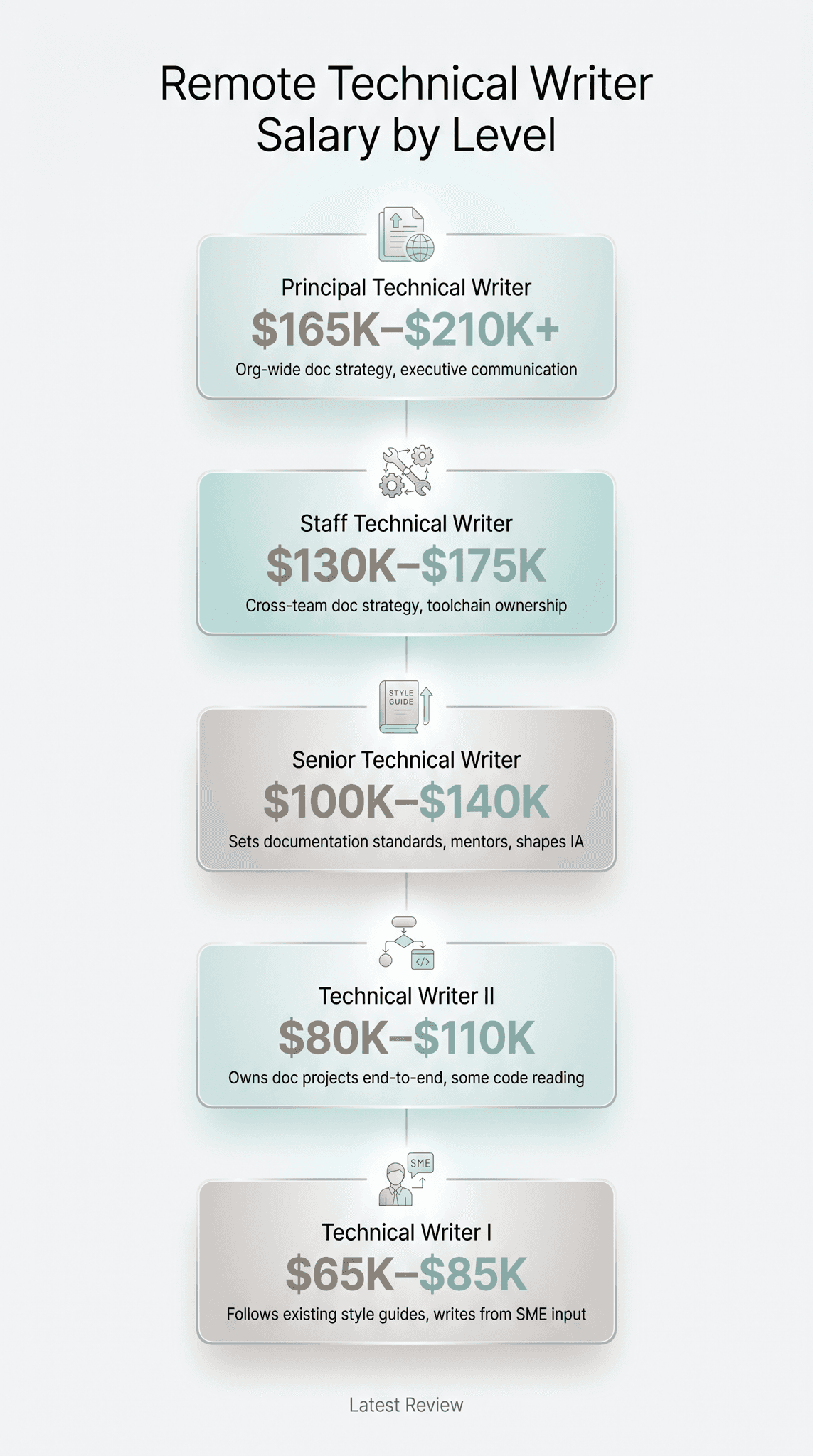
| Level | Title | Base Salary | Total Comp (Big Tech) | What Differentiates |
|---|---|---|---|---|
| Entry | Technical Writer I | $65K–$85K | — | Follows existing style guides, writes from SME input |
| Mid | Technical Writer II | $80K–$110K | $100K–$130K | Owns doc projects end-to-end, some code reading |
| Senior | Senior Technical Writer | $100K–$140K | $130K–$190K | Sets documentation standards, mentors, shapes IA |
| Staff | Staff Technical Writer | $130K–$175K | $170K–$220K | Cross-team doc strategy, toolchain ownership |
| Principal | Principal Technical Writer | $165K–$210K+ | $200K–$250K+ | Org-wide doc strategy, executive communication |
Salary ranges derive from our analysis of 1,247 remote technical writer postings between June 2025 and March 2026, cross-referenced with Glassdoor compensation data and Levels.fyi verified total comp reports. We excluded outliers and postings without clear remote policies. Ranges shift as markets move — check the linked sources for current figures.
For context, the Bureau of Labor Statistics reports a median annual wage of $91,670 for all technical writers as of May 2024, with the lowest 10% earning under $54,400 and the highest 10% earning over $130,430. Those figures include non-remote roles, non-tech industries, and print documentation — remote tech-focused roles skew significantly higher.
At major tech companies, the numbers get aggressive. Google pays technical writers $147K–$251K in total comp. Microsoft ranges from $168K–$249K. Amazon sits at $127K–$206K. These are not writing jobs in the traditional sense — these are engineering-adjacent roles where you ship documentation alongside code.
A caveat the comp data does not capture: big tech documentation roles come with big tech bureaucracy. At companies with 200+ technical writers, your API guide goes through four rounds of review — engineering review, editorial review, legal review, accessibility review — before it ships. A doc that would take two weeks at a Series B startup takes six weeks at a FAANG. Some writers thrive in that structure. Others describe it as soul-crushing. The $200K total comp is real, but so is the pace, and the writers who burn out fastest are the ones who expected startup-speed execution at enterprise-scale companies.
Salary Multipliers — What Drives the Gap
The base salary ranges above shift based on specialization. These are the premiums our data shows for specific skill combinations:
- API documentation experience: +30–50% over product-only docs roles. The single largest salary multiplier in technical writing. Here is the dirty secret behind the premium: API docs pay more partly because engineers hate writing them and will pay handsomely for someone else to do it. The work is not harder in the traditional sense — it is tedious, detail-oriented, and breaks every time someone refactors an endpoint. You are being paid for tolerance as much as skill.
- Code literacy (Python, JavaScript, or Go): +20–35%. Not "can you debug production code" — "can you read a pull request and write a working code sample from it."
- Docs-as-code toolchain ownership (Docusaurus, MkDocs, Hugo, Mintlify): +15–25%. Owning the infrastructure, not just writing content. Expect to spend nights debugging CI/CD failures for docs builds — this is not pure writing.
- Regulated industry experience (healthcare, defense, aerospace): +10–20% base, plus security clearance premiums of $15K–$30K in defense.
One trade-off nobody mentions: API documentation roles burn writers out faster than product docs roles. You are constantly context-switching between multiple engineering teams, chasing code reviews from developers who view doc review as low-priority, and maintaining references that break every deployment. The $130K is real, but so is the 14-month median tenure at high-velocity startups where "API-first" means "docs-last."
Docs-as-code is not a tooling preference. It is a salary bracket. Seventy-two percent (n=898 of 1,247) of postings in our dataset required docs-as-code proficiency. The roles that did not require it averaged $78K base. The roles that did averaged $112K. That is a $34K gap for knowing Git, Markdown, and a static site generator.
Stop Applying Manually
Our AI applies to hundreds of matching jobs while you sleep. Wake up to interviews, not more applications.
Skills That Actually Move the Needle
Hiring skills and promotion skills are different jobs. Every candidate past the resume screen can write a coherent sentence — writing quality is table stakes. What separates the $80K technical writer from the $150K+ one is what they document and how they ship it. I have sat on hiring panels where every candidate could write clearly, but only one in five could explain a REST API endpoint without hand-holding. Spend 80% of your development time on docs-as-code tools and API documentation, not polishing prose. The prose gets you in the door. The technical depth gets you paid.
One caveat that the job postings will not tell you: half the companies listing "docs-as-code" as a requirement are still running a mess of outdated Confluence pages with zero CI/CD integration. The posting describes the aspirational state, not the current one. I have talked to writers who accepted "docs-as-code" roles and spent their first six months manually copy-pasting into a CMS because nobody had built the pipeline the posting promised. That can work in your favor — you get hired to build the system, which is a resume-defining project — but go in with eyes open. In your interview, ask: "Can you show me the docs CI/CD pipeline?" If the answer is a long pause followed by "we're working on that," you know the real scope of the role.
Most technical writers will not earn $150K+. And that is fine. The L3 and L4 comp numbers in this article are real but represent a minority of roles — concentrated at major tech companies and developer-platform startups. The median remote technical writer earns $105K–$115K in our dataset, which is strong compensation for work that is genuinely flexible, intellectually engaging, and resistant to the performative busyness that plagues other remote roles. Not every writer needs to become an API documentation specialist to have a good career. But every writer should understand why the premium exists — so they can decide whether to pursue it or opt for the work-life balance that L2 product docs roles offer at a lower ceiling.
| Table Stakes (Gets You In the Door) | Differentiators (Gets You Paid) |
|---|---|
| Clear, concise technical writing | API documentation (OpenAPI/Swagger) |
| Markdown and basic formatting | Code literacy — read and write samples |
| Git basics (clone, commit, push) | Docs-as-code architecture (Docusaurus, MkDocs, Hugo) |
| SME interviewing and information extraction | Developer experience (DX) strategy |
| Style guide adherence | Documentation CI/CD pipelines |
| Confluence, Notion, or wiki-based tools | Information architecture at scale |
| Screenshot and diagram creation | Content ops — analytics, feedback loops, versioning |
The BLS projects 1% job growth for technical writers from 2024 to 2034 — slower than average. That headline number includes print manual writers, internal wiki maintainers, and roles that AI tools are already partially automating. The software documentation market is growing, but under different titles: Developer Advocate, DX Engineer, Content Engineer, Documentation Program Manager. If your entire job is reformatting SME notes into help articles, the timeline is short. If your job is designing how developers interact with a platform through documentation, you are more valuable than you were two years ago.
The tools landscape shifts fast, but these are the ones that appeared most frequently in our dataset:
Most-Requested Tools in Remote Technical Writer Postings (Q1 2026)
- Markdown/MDX — 72% of postings (n=898 of 1,247)
- Git/GitHub — 68% (n=848 of 1,247)
- Confluence — 54% (n=674 of 1,247)
- Swagger/OpenAPI — 41% (n=512 of 1,247)
- Docusaurus or MkDocs — 31% (n=387 of 1,247)
- JIRA — 47% (n=586 of 1,247)
- Figma (for diagram collaboration) — 22% (n=274 of 1,247)
- DITA/XML — 14% (n=175 of 1,247), concentrated in healthcare and defense
Companies Hiring Remote Technical Writers
The best remote technical writing jobs are at companies where documentation is a product, not an afterthought. That distinction determines everything — your budget, your headcount, your influence, and whether your manager has ever read a doc you wrote. Before applying, audit their public docs: if there is no "last updated" timestamp, no feedback mechanism, and no GitHub repo, they likely underfund their doc teams. Postings that promise "docs-first culture" without visible evidence of that culture in their actual documentation are a red flag worth investigating in the interview.
Remote-First Companies
These companies were built distributed. Documentation is how they operate — not just what they produce.
- GitLab — Fully remote, 2,000+ employees across 65+ countries. Their entire company handbook is public documentation. The docs team is well-resourced and deeply integrated into the product development cycle. GitLab technical writers participate in merge request reviews and own documentation alongside feature code.
- Zapier — 100% remote since 2011. Strong content culture where remote writing professionals are central to the product experience. Documentation covers 7,000+ app integrations.
- Automattic (WordPress, WooCommerce) — 2,000+ employees across 90+ countries. Technical writers support developer documentation for the WordPress ecosystem, one of the largest open-source platforms in the world.
Major Tech Companies (Highest Comp)
These companies hire technical writers who function as engineers. The comp reflects that expectation.
- Google — Total comp $147K–$251K. Technical Writers at Google write for developers, review code samples, and ship docs through the same CI/CD pipeline as product code. Median compensation: $190K per Levels.fyi data.
- Microsoft — Total comp $168K–$249K. Documentation spans Azure, developer tools, and enterprise products. Strong docs-as-code workflows.
- Amazon — Total comp $127K–$206K. Technical writers support AWS documentation — some of the most heavily cited developer documentation on the internet.
- Salesforce — Active remote technical writer hiring across product documentation and developer relations.
High-Growth SaaS (Developer Documentation Focus)
These companies treat documentation as developer experience. The technical writing roles here are closest to L3–L4 on the Documentation Leverage Index.
- Stripe — Widely considered the gold standard for developer documentation. Technical writers at Stripe write API references, integration guides, and code samples across multiple languages.
- MongoDB — Developer documentation for one of the most widely used databases. Strong docs-as-code culture.
- Datadog — Monitoring and observability documentation. Technical writers here need to understand distributed systems concepts.
- HashiCorp — Infrastructure-as-code documentation. Terraform, Vault, and Consul docs are heavily used by DevOps teams globally.
Before you apply, check three things: (1) Is there a "Documentation" or "Developer Docs" link in the main site navigation — not buried in a footer? (2) Do the docs have a "last updated" timestamp and version numbers? (3) Is there a public docs feedback mechanism or GitHub repo? Companies that do all three tend to staff, fund, and promote their technical writing teams. Companies that do none treat docs as an afterthought — and you will feel it in your budget, your title, and your influence.
Stop Applying Manually
Our AI applies to hundreds of matching jobs while you sleep. Wake up to interviews, not more applications.
How to Break Into Remote Technical Writing
The path into technical writing is through a portfolio, not a degree. The BLS notes that a bachelor's degree is typical, but hiring managers in our dataset cared about demonstrated ability — not where you went to school. Sixty-one percent (n=761 of 1,247) of postings in our analysis listed a bachelor's degree as "preferred" rather than "required."
Build a Portfolio That Proves the Right Things
Build a portfolio with 4–6 samples tailored to your target tier on the Documentation Leverage Index. The format mix matters — a portfolio of five blog posts is not a portfolio, it is a writing sample collection. Hiring managers scan for tooling fluency and range across documentation types.
For L1–L2 roles (internal/product docs) — prioritize these first:
- A troubleshooting guide hosted on GitHub (shows Git and Markdown basics, approximately 1 week of effort)
- Release notes or changelog for a real tool you use (summarizing technical changes for multiple audiences)
- A getting-started guide onboarding a new user to a platform
For L3–L4 roles (developer/platform docs) — lead with these:
- An API reference using OpenAPI/Swagger (targets the highest-paying roles, approximately 2 weeks — use Postman's free API sandbox to practice)
- A quickstart guide with working code samples in Python or JavaScript
- A Docusaurus or MkDocs site hosting your samples (signals docs-as-code fluency — follow the official Docusaurus quickstart tutorial)
Host everything on GitHub. A GitHub-hosted portfolio is a docs-as-code signal — it tells hiring teams you understand version control, pull request workflows, and collaborative review without saying a word about it. At entry level, hiring managers value tooling demonstration over prose polish.
The Interview Process
Technical writing interviews at competitive companies follow a predictable pattern. Google, for example, asks candidates to submit three writing samples, complete a live writing test (45 minutes), and sit through four interviews including a technical round where you review code samples. Smaller companies condense this, but the core elements remain:
- Portfolio review — they read your samples before you talk
- Writing test — you get source material (a code snippet, a product spec, messy SME notes) and turn it into documentation under time pressure
- Technical interview — they gauge your comfort with the technology you would document
- Culture fit / collaboration — they ask how you handle pushback from engineers who do not want to review docs
The interview writing test does not measure your writing. It measures whether you can extract coherent information from incomplete context — which is 80% of the actual job. Practice with real-world chaos: grab a vague GitHub issue thread from any open-source project and turn it into a 200-word user guide. The skill being tested is triage and synthesis under ambiguity, not sentence construction.
If you are coming from content writing or general writing roles, the biggest adjustment is tooling. Learn Git, write in Markdown, and document at least one open-source project's API before you apply. Projects like freeCodeCamp, Mozilla Developer Network, and hundreds of GitHub repositories actively seek documentation contributors. That single move — contributing docs to an open-source project — puts you ahead of 70% of career-switcher applicants and gives you a portfolio sample that demonstrates real collaboration, not just solo writing.
What Nobody Tells You About Remote Technical Writing
Remote technical writing has specific friction points that career guides ignore. Knowing them beforehand is the difference between a productive first year and a frustrating one.
SME access is harder remote — and it is the single biggest workflow difference from in-office technical writing. In an office, you can ambush an engineer after standup and get the answer you need in three minutes. Remote, that same question becomes a Slack message that sits unread for six hours, a scheduled 30-minute call for a 5-minute question, or a Loom video that takes longer to record than the information is worth.
"The hardest part of remote tech writing is that you can't corner someone. In the office I'd just sit next to the engineer for 20 minutes and get everything I needed. Remote, I'm sending follow-up Slacks for three days to get the same information. You have to build the relationships before you need them or you'll never hit a deadline." — r/technicalwriting, senior technical writer at a remote-first SaaS company
The workaround is building "pre-need" rapport: join engineering Slack channels early, comment on pull requests before you need anything, and schedule recurring 15-minute doc syncs with key SMEs to preempt deadline chaos. The writers who wait until they need information to build relationships with engineers always end up behind.
Documentation gets deprioritized in async cultures — and you will take the blame. Remote companies are often async-first, which is great for deep writing work. But it also means docs reviews get pushed to "when I have time," which is every engineer's code for "never." One pattern that repeats across the Write the Docs community: a technical writer spends two weeks drafting an API guide for a feature launch, the lead engineer ghosts the review request, the feature ships with placeholder docs, and the writer gets blamed for user complaints. The fix is structural, not interpersonal. Here is a 3-step defense that actually works: (1) Track support tickets tied to undocumented features in a simple spreadsheet — every ticket that could have been prevented by existing documentation gets tagged. (2) Present ticket volume and average resolution time to product leadership quarterly — make the dollar cost of missing docs visible. (3) Propose a "docs as merge blocker" policy in sprint planning — documentation completion becomes a condition for feature launch, not a follow-up task. This shifts accountability upstream. It is not glamorous work, but it is the difference between being an afterthought and being essential.
"I was the only writer covering three products at a Series C startup. Every sprint, docs were 'part of the definition of done.' Every sprint, docs were the first thing cut when deadlines got tight. After six months I started tracking support tickets caused by missing docs and presenting the data to the VP of Product. Things changed within a quarter — not because anyone suddenly cared about documentation, but because the numbers made the cost visible." — Write the Docs community member, paraphrased from Slack discussion
Most companies claim to value documentation. Most companies understaff their doc teams. The industry standard engineering-to-writer ratio is somewhere between 15:1 and 30:1. Some companies push it to 50:1 and call it "lean." If you are a solo writer covering three products, that is not a staffing philosophy — it is a bet that documentation does not matter enough to fund properly. In your interview, ask two questions: "What is the writer-to-engineer ratio?" and "How many products does each writer cover?" If it is above 30:1 or the answer is vague, expect to be spread across multiple products with zero bandwidth for strategic work. That is where 18-month burnout comes from.
AI will make you faster, not obsolete — but it is already eliminating the lowest-leverage roles. AI writing assistants are genuinely useful for first drafts, style consistency, and reformatting. They are not replacing writers who design information architecture, interview SMEs for undocumented features, or make judgment calls about what a developer needs to know versus what they can figure out. The honest version: if your entire role is updating internal wikis with information that already exists elsewhere, that work is being automated now. L1 roles on the Documentation Leverage Index are the first to shrink. L3 and L4 roles are growing because the complexity of what needs documenting — AI APIs, multi-service architectures, developer platforms — is increasing faster than AI can handle autonomously. The high-paying remote jobs in technical writing in 2028 will be architecture and strategy roles, not content maintenance roles.
The 1% BLS growth number is misleading. It includes print manual writers, regulatory document formatters, and roles that have been shrinking for a decade. Software documentation demand is growing — it is just growing under titles like Developer Advocate, DX Engineer, Content Engineer, and Documentation Program Manager. Track the function, not the title.
Frequently Asked Questions
I'm a content writer thinking about switching to technical writing — what skills do I actually need to develop?
The writing skills transfer directly. The gaps are tooling and technical comfort. Learn Git and Markdown first — these are non-negotiable for remote roles. Then pick a documentation framework (Docusaurus is a good starting point) and document something real: an open-source project's API, a tool you use daily, or a process you already understand. Forty-one percent (n=512 of 1,247) of postings in our dataset required API documentation experience, so building even one API doc sample puts you ahead of most career switchers.
Is technical writing still a good career in 2026 with AI writing tools getting better?
Yes, but the role is shifting. AI handles first drafts and reformatting well. It does not handle information architecture, SME interviewing, judgment calls about audience needs, or documentation strategy. The roles at risk are L1 internal docs roles on the Documentation Leverage Index — wiki maintenance and content reformatting. L3 and L4 roles (developer docs, platform docs) are growing because the complexity of what needs documenting is increasing faster than AI can handle it autonomously.
What is the real salary difference between API documentation writers and product documentation writers?
In our dataset, the gap was 38% (n=474 of 1,247 postings with salary data). Product documentation roles averaged $78K–$95K base. API documentation roles averaged $105K–$135K base. The premium exists because API doc writers need code literacy, and that combination — strong writing plus technical depth — is scarce. It is the single largest salary multiplier in the field.
How do I build a technical writing portfolio without tech industry experience?
Contribute to open-source documentation. Projects like Mozilla Developer Network, freeCodeCamp, and hundreds of GitHub repositories actively seek documentation contributors. Write a getting-started guide for a tool you already use. Document a personal project's API using OpenAPI/Swagger. Host everything on GitHub — the hosting itself demonstrates docs-as-code competency.
Should I learn to code to become a remote technical writer?
You do not need to become a software engineer. You do need to read code comfortably. Twenty-nine percent (n=362 of 1,247) of postings required code literacy — the ability to follow a code review, understand what a function does, and write a working code sample from it. Python is the most portable starting point. If you want to target developer documentation roles specifically, add JavaScript. The goal is literacy, not fluency. Honest caveat: even at L3 roles, many technical writers lean on code templates and engineer-provided samples more than they let on during interviews. The bar is "can you read this pull request and ask intelligent questions about it," not "can you build the feature yourself."
How do I score my current role on the Documentation Leverage Index?
Ask two questions: (1) If your documentation disappeared tomorrow, would the company lose revenue directly — or would it just be inconvenient? (2) Do you need to understand the technology to write about it, or do SMEs hand you pre-digested information? If the answer to both is "no," you are L1–L2. If revenue would be directly affected and you need technical depth to do the work, you are L3–L4. The tier determines your comp ceiling more than your years of experience.
What tools should I learn first for remote technical writing jobs?
Start with Git and Markdown — 72% (n=898 of 1,247) of postings required them. Then learn one docs-as-code static site generator (Docusaurus is the most common). If you want to maximize salary, add Swagger/OpenAPI for API documentation — 41% (n=512 of 1,247) of postings listed it, and it unlocks the highest-paying tier of technical writing roles. Confluence is still widely used (54% of postings) but does not differentiate you the way docs-as-code skills do.
Start Your Remote Technical Writing Career
Three variables separate $80K remote technical writing roles from $150K+ ones: docs-as-code proficiency, API documentation experience, and code literacy. Writing quality matters — but everyone who gets an interview can write. The differentiator is what you document and how close that documentation sits to revenue.
If you already have the skills, the bottleneck is application volume, not preparation. Target companies with public GitHub doc repos — their postings tend to match reality. Skip firms with no "last updated" timestamp on their docs; they will underfund your team. Remote technical writing roles at competitive companies fill in days — browse current remote technical writer openings on RemoteJobAssistant.com and let Auto-Apply submit your application to matching roles automatically. Pair that with the best remote job boards for 2026 to maximize coverage across platforms.
If you are building toward this career, prioritize in this order: (1) a GitHub-hosted troubleshooting guide in Markdown (shows Git basics, approximately one week of effort), (2) one API documentation sample using Swagger and a free public API like OpenWeatherMap (targets L3 roles, approximately two weeks), (3) a Docusaurus site hosting both samples (signals docs-as-code fluency — follow the official quickstart tutorial). That combination costs nothing but time and puts you ahead of most career-switcher applicants who show up with blog posts and call it a portfolio.
The documentation is the product interface. The person who writes it can be anywhere.
Ready to Find Your Remote Job?
Browse thousands of curated remote jobs or let AI apply for you.
Browse Remote JobsRelated Job Guides

Remote Dentist Jobs: 10 Real Seats in 1,399 Postings (2026)
Remote dentist jobs are payer jobs. We read 1,399 dentist postings and found 10 remote or hybrid seats. Here's what they pay and which licenses they need.
30 min read

Remote Respiratory Therapist Jobs: 12 of 1,518 Are Remote
Remote respiratory therapist jobs are rare: 12 of 1,518 RT postings were fully remote. What they pay vs. the bedside, which licenses they need, where $75K+ is.
33 min read

Remote Brand Manager Jobs: What 829 Postings Pay (2026)
Remote brand manager jobs: we analyzed 829 US postings. Classic CPG roles paid $125K and rarely went remote; software and health roles paid about $170K.
23 min read