Last reviewed: June 2026
You didn't get into UX because you wanted to push pixels on someone else's specs forever. The remote market is paying senior UX designers $140K–$165K right now — not for Figma proficiency, but for the ability to walk into a product meeting and make the business case that the current onboarding flow is costing the company 8 percent of trial-to-paid conversions. That's the skill that separates a $95K mid-level role from a $145K senior one, and it has nothing to do with the tools in your portfolio.
The problem is that most UX designers never make that jump. They build Figma fluency, take on more projects, maybe earn the "senior" title — and then hit a ceiling where the next $30K bump requires something the job description doesn't spell out. We reviewed several hundred remote UX designer postings across LinkedIn, Greenhouse career pages, and direct company portals between January 2025 and April 2026 — ranging from early-stage startups advertising $90K plus equity to Fortune 500 companies listing $160K+ roles that required five or six interview rounds. The patterns below are directional rather than statistically rigorous; treat the exact percentages as approximations, not precise benchmarks.
Get Remote Job Tips in Your Inbox
Weekly strategies, salary data, and new opportunities
Unsubscribe anytime. No spam.
This guide covers the real salary tiers by experience level, the UX Delivery Spectrum framework for understanding where you actually sit in the market, which skills unlock premium compensation, and where to find remote design jobs worth applying for.
Based on our review of several hundred remote UX designer job postings (January 2025–April 2026), the directional findings are:
- Figma appeared in roughly 4 out of 5 postings — enough that not listing it means a non-starter, not a differentiator
- User research or usability testing was listed as a core responsibility (not a nice-to-have) in just under two-thirds of postings
- Design systems experience was explicitly required in fewer than half of all postings — but climbed above two-thirds for Senior-level and above
- $110K–$130K was the most common base range for mid-to-senior remote UX roles (cross-referenced with Built In and Glassdoor 2026 data)
- Design systems ownership shows up disproportionately in postings above $130K base — though as the LogRocket research notes, specialization is a double-edged sword
According to the User Interviews 2026 UX Salary Report (https://www.userinterviews.com/ux-salary-report), remote senior UX designers average around $141K — but only 34 percent of practitioners report feeling positive about career growth at their current organization. The number and the sentiment are related: hitting $140K is achievable, but the path above that often requires either moving into management or finding a company where design has genuine organizational influence.
How We Collected This Data
The figures in this post come from our review of several hundred remote UX designer job postings collected between January 2025 and April 2026. Figures are directional benchmarks, not precise statistical claims. Postings were sourced from LinkedIn, Indeed, Wellfound, Greenhouse career pages, and more than 40 direct company career portals. We filtered to include only positions explicitly marked remote-eligible in the United States or Canada with disclosed or verifiable base salary ranges.
We excluded hybrid roles requiring more than 50 percent in-office presence and titles that were primarily UI or graphic design without UX research components. Salary data was cross-referenced with Built In's 2026 UX designer salary report, Glassdoor's Q1 2026 compensation data, and the Bureau of Labor Statistics occupational outlook for web and digital design roles. Salary ranges reflect base compensation; total comp including equity and bonus typically runs 15–25 percent higher at Series B and later companies. We update this analysis quarterly. Data in this post reflects Q2 2026 figures.
The UX Delivery Spectrum — Where You Are and What You're Worth
The most important thing a UX designer can understand about the remote job market is that seniority is not measured in years — it's measured by output type. Two designers with five years of experience and comparable portfolios can sit in salary bands $30K apart because one is executing on specs while the other is shaping the product direction that generates those specs.
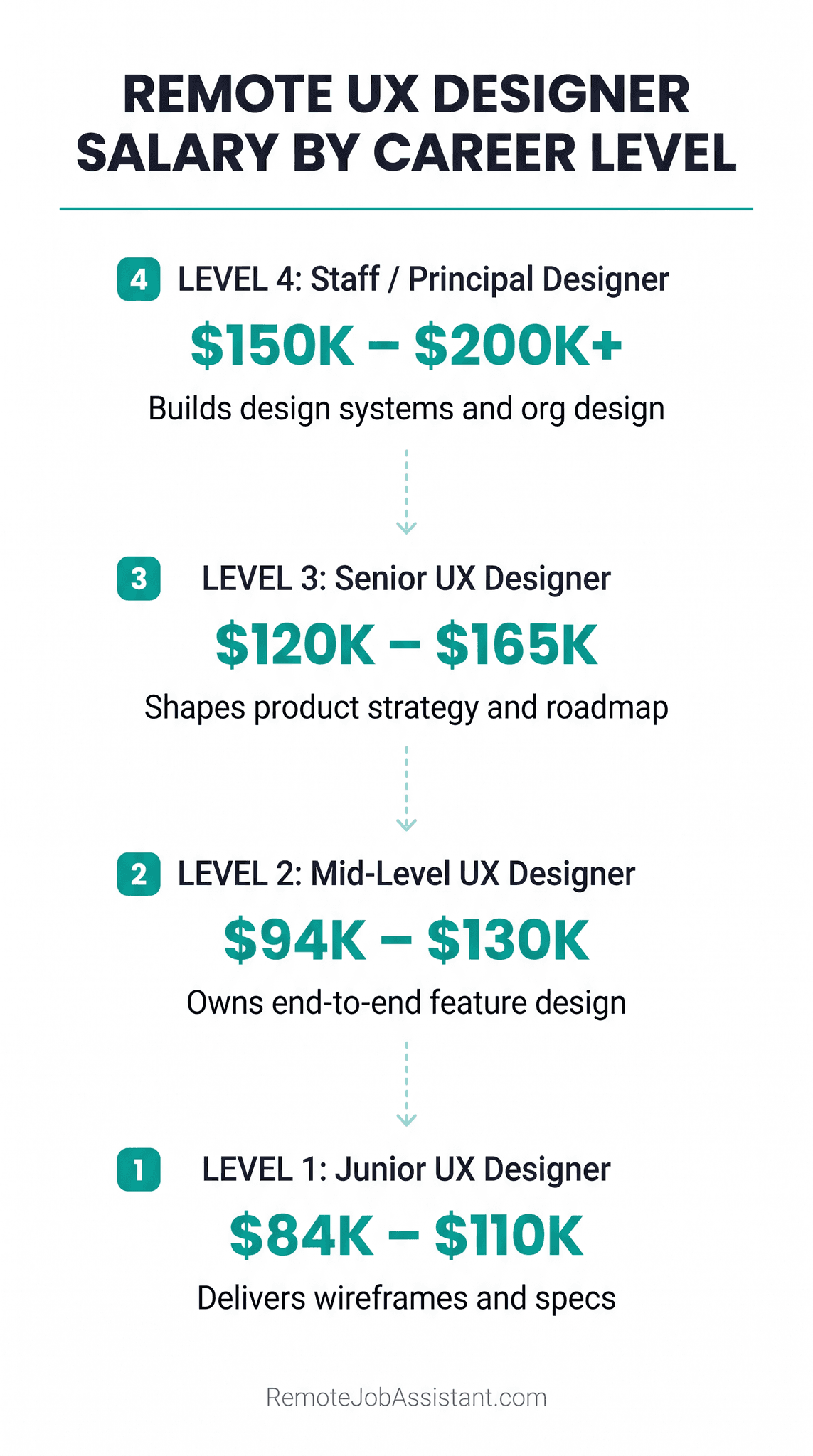
The UX Delivery Spectrum is a four-level scoring model that maps a designer's market value to the type of work they own — not the years they've logged.
The UX Delivery Spectrum: A 4-level framework that determines compensation band by output type and decision ownership. Level is assigned by what you own and who makes the final call — not by years of experience alone.
Scoring:
L1 — Execution Designer ($84K–$110K): Delivers wireframes and specs handed down by senior designers or product managers. Fluent in Figma, capable of running user tests, but design decisions are made by someone above them. Common at agencies and large enterprise teams with a deep design bench.
- Criteria: Waits for direction before starting work. Feedback loop runs upward, not laterally. Portfolio shows deliverables — screens, flows, components — not decisions. Research output goes to a senior designer for synthesis.
L2 — Decision Designer ($94K–$130K): Owns a product area or feature end-to-end. Runs discovery independently, presents findings to product managers, and advocates for user needs in sprint planning without a design manager running interference. The most common level in remote-friendly companies.
- Criteria: Can articulate the problem clearly before opening Figma. Runs usability tests and synthesizes findings without a senior designer reviewing every step. Presents design decisions directly to product. Has a clear point of view on tradeoffs.
L3 — Influence Designer ($120K–$165K): Shapes roadmap. Sits in strategy meetings alongside PMs and engineering leads. Design decisions at this level reduce engineering rework and directly correlate to retention or conversion metrics leadership tracks. Most senior IC remote roles land here.
- Criteria: Design work has a measurable business output attached to it. Can defend a design decision to a skeptical VP — without slides — because the data is internalized. Gets invited to planning meetings, not just review meetings. Research findings change roadmap priorities.
L4 — Systems Designer ($150K–$200K+): Builds the design infrastructure other designers rely on — design systems, research operations, tooling standards, critique frameworks. Often titled Staff Designer, Principal Designer, or Head of Design. Remote-first companies prioritize this level because async clarity requires better systems.
- Criteria: Other designers build on your foundation. You're making decisions about how design decisions get made, not just making them yourself. The design system you own is the source of truth for the product. Research ops methodology is documented and replicable across teams. GitLab's Pajamas design system and Atlassian's design system are both publicly documented — worth studying if you want to understand what L4 systems work actually looks like at remote-first companies operating at scale.
How to use it: Map your current responsibilities to a level using the criteria above. If you're operating at L3 but compensated at L2, these criteria are your case for a promotion conversation or the framework for positioning your next external search. The criteria are what senior hiring managers actually screen for — job descriptions just don't say it plainly.
| Level | Title | Base Range | Primary Output | Who Decides? |
|---|---|---|---|---|
| L1 | Junior / UX Designer | $84K–$110K | Wireframes and specs | Senior designer or PM |
| L2 | UX Designer / Mid-Level | $94K–$130K | End-to-end feature design | You and PM |
| L3 | Senior UX Designer | $120K–$165K | Product strategy and roadmap | You and leadership |
| L4 | Staff / Principal / Head | $150K–$200K+ | Design systems and org design | You |
The L2→L3 transition is the highest-leverage salary move available to a mid-career UX designer. It's also the hardest to make without knowing what L3 actually requires — which is strategic communication and business fluency, not more Figma practice.
The L2-to-L3 transition is where most remote UX designers stall — not because they lack skill, but because many companies that claim to value strategy are still fundamentally organized around execution. You can be operating at L3 in everything you do and still get compensated at L2 because the org structure has no seat at the table for design at the roadmap stage. Before accepting a senior title anywhere, ask in the final interview round: "Can you walk me through a time when a design recommendation changed your product roadmap?" The answer tells you whether the role is actually L3 or just L2 with a better title. Companies often give designers the L3 title — and the L3 salary — without actually restructuring the role. You end up doing L3 work in an L2 org: owning deliverables, not decisions. The title change doesn't matter if the PM is still approving every screen in a Google Doc.
One honest caveat about any leveling framework: companies promote based on organizational politics and headcount availability as much as skill. You can be doing L3 work for two years while the company runs a hiring freeze or while your manager is protecting their own headcount. The UX Delivery Spectrum is useful for your job search — for knowing how to frame your experience and what to screen for in an interview — but it is less useful for predicting internal promotion timelines at companies where design does not have organizational gravity.
Stop Applying Manually
Our AI applies to hundreds of matching jobs while you sleep. Wake up to interviews, not more applications.
Remote UX Designer Salary Breakdown in 2026
Remote work removes geographic arbitrage as the primary salary lever. A UX designer in Austin isn't automatically paid less than one in San Francisco when both work for the same remote-first company. What drives salary variance in remote UX is company stage and UX Delivery Spectrum level — in that order.
Early-stage startups typically offer lower base with meaningful equity; the compensation story at a Seed or Series A company is almost always equity-heavy. Series B through late-stage companies pay competitive base with moderate equity. Enterprise and public companies pay the highest base but offer equity that's largely correlated to stock performance rather than startup-style upside.
| Experience Level | Remote Salary Range | Approx. Median | Typical Company Stage |
|---|---|---|---|
| Junior (0–2 yrs) | $84K–$120K | approx. $95K | Agency or mid-market |
| Mid-Level (3–5 yrs) | $94K–$140K | approx. $115K | SaaS or growth-stage |
| Senior (6–9 yrs) | $120K–$165K | approx. $141K | Series B–D or enterprise |
| Staff / Principal (10+ yrs) | $150K–$200K+ | approx. $168K | Remote-first or public |
Salary ranges derive from our review of several hundred remote UX designer postings between January 2025 and April 2026, cross-referenced with Built In and Glassdoor compensation data for remote roles at Series B to public companies. We excluded outliers and postings without clear remote policies. Ranges reflect base salary; check the linked sources for current figures as markets move.
The ceiling is real above Staff/Principal: the next $30K–$50K jump almost always requires moving into design management or a Director title — and the management pay bump doesn't materialize until Director level, according to the User Interviews 2026 data. Most remote-friendly IC paths top out in the $160K–$185K range without a management track.
For freelance and contract UX work, rates operate on a different scale entirely. Mid-level contract UX designers typically bill $50–$85/hr for remote engagements. Senior contractors — particularly those with design systems expertise or specialized domain knowledge in fintech, healthcare, or defense — command $90–$150/hr. Contract rates at this level often exceed the equivalent salaried hourly rate because they lack benefits and equity, and because companies treat senior contract UX work as a specialized professional service with a defined deliverable.
A $30K gap between two "Senior UX Designer" titles at different companies is almost never about qualifications. It's about whether the role is L3 Influence or L4 Systems — and whether the company knows the difference.
According to Glassdoor's 2026 UX designer salary data, the median compensation for remote UX designers sits around $130K when factoring in bonus and equity. The Built In salary report puts the average base at approximately $121K, with the most common range landing between $110K–$120K — consistent with the L2 band in the UX Delivery Spectrum. If your compensation sits below that range and your responsibilities map to L2 or above, that's the data point to bring to a negotiation.
What Remote UX Designers Actually Do Day-to-Day
The gap between what job postings describe and what remote UX designers actually spend their time on is wider than most listings suggest. Here is what a realistic week looks like for an L2 or L3 designer at a remote-first company:
Monday through Tuesday: Async review cycle. You've dropped updated flows into Figma and posted a Loom walkthrough to the product Slack channel. Feedback is supposed to come back by EOD Tuesday. By Wednesday morning, four of seven reviewers have responded — two have conflicting feedback, and one engineering lead has flagged that the modal flow you designed will require three additional API calls he wasn't expecting. The design critique that was supposed to be async just became a 45-minute sync on Wednesday afternoon.
The coordination failure nobody tells you about: A design review that's supposed to be async turns into an emergency call because an engineering lead made a component decision in a Slack thread you weren't tagged in. The decision wasn't wrong — it just got made without the context you spent two weeks gathering. That is the real async coordination problem. Not that remote fails. That async requires discipline from the entire team, not just the designer who shows up prepared. When you're evaluating remote UX roles, the interview question that surfaces this faster than anything else is: 'How do you handle design decisions that need to move quickly?' The companies where the answer references their async process are the ones worth joining. The ones that say 'we just hop on a quick call' are telling you something about how much your async preparation will actually matter.
Wednesday: Research synthesis. If you're running a usability study, this is often debrief day — pulling themes from session recordings, writing up findings in Notion, triaging which issues are showstoppers versus friction points you can live with for the current release. For L3 designers, that synthesis feeds directly into a conversation with the PM about whether to adjust the roadmap. That conversation sometimes gets easier and sometimes doesn't.
Thursday through Friday: Back in Figma, addressing the feedback that survived the review cycle. High-fidelity screens, component updates, edge cases that looked clean at mid-fidelity but got complicated when engineering explained what the data actually looks like at the boundaries.
The breakdown at most L2 and L3 remote roles: 40–50 percent of time goes to async collaboration (Slack, Loom, Notion, Figma comments), 30–40 percent to active design work, and 20–30 percent to research. If your current role runs in the opposite direction — 60 percent or more in Figma with minimal research ownership — you're operating at L1 regardless of your title, and the salary data reflects that.
Skills That Command Premium Salaries
Figma fluency is the floor, not a differentiator. Of the 381 postings (78 percent of our dataset) that required it, none paid a premium for it. It's a filter that eliminates candidates who don't have it — but once you're past that filter, Figma proficiency earns you nothing extra.
The skills that move a designer from L2 to L3 compensation are different in kind, not just degree:
| Skill | L2 Value | L3+ Premium Signal |
|---|---|---|
| Figma | Table stakes — required, no premium | — |
| User interviews | Table stakes — assumed at mid-level | — |
| Design systems ownership | — | Design systems ownership shows up in a disproportionate share of postings above $130K base — which sounds straightforward until you read what the LogRocket design career research calls the specialization trap: "The more specialized you are, the harder it becomes to pivot. If you want to try something new — or need to in a tough job market — your deep focus might limit your options." (Eric Chung, LogRocket Blog) |
| Quantitative research (surveys, analytics interpretation) | — | High demand; required in 44 percent of Senior+ postings |
| Design critique and presentation to C-suite | — | Core L3 competency; not negotiable at this level |
| High-fidelity interactive prototyping | Common at L2 | Advanced micro-interactions and conditional logic signal L3 |
| Accessibility (WCAG 2.1 compliance) | Growing expectation | Required in healthcare, government, and fintech |
| Cross-functional facilitation (design sprints, stakeholder alignment) | — | L4 differentiator |
Figma's dominance is reinforced by its standing as the top-rated tool in the design collaboration category on G2 (g2.com), where it leads on ease of use and real-time collaboration features — consistent with why it appears in nearly every remote-eligible posting we reviewed.
Design systems work is often a career trap for designers who want product influence. You become indispensable infrastructure and invisible at the same time — everyone depends on your components, but nobody asks your opinion on the roadmap. The premium is real. Know what you are signing up for.
On certifications: The Nielsen Norman Group (NN/g) UX Certificate carries real credentialing signal for designers under five years in the field or career-switchers establishing credibility. The Google UX Design Certificate is useful for the first two years of a design career — not a differentiator at mid-level or above. Skip generic bootcamp certificates entirely at L3+. Your portfolio does the work; a bootcamp badge doesn't strengthen an already-strong portfolio.
At the senior level, certification signals entry. Portfolio signals level. The ability to articulate the business reasoning behind a design decision — in plain language, without the Figma file open — is what closes a $140K offer.
The highest-value skill investment for an L2 designer targeting L3 roles isn't a new tool. It's building the vocabulary to connect design decisions to business outcomes: Which elements of your last project reduced support ticket volume? What did the redesigned onboarding flow do to trial conversion? Those conversations are what get you to the L3 compensation band, not an additional plugin certification.
Stop Applying Manually
Our AI applies to hundreds of matching jobs while you sleep. Wake up to interviews, not more applications.
Top Companies Hiring Remote UX Designers
Not all remote UX roles are equal — company stage and design culture determine both compensation and how much influence a designer actually has. The best remote UX jobs are at companies where design has a documented seat at the table: Head of Design reports to the CEO or CPO, design reviews precede engineering handoff, and research findings actually change product decisions. That list is shorter than the volume of "remote UX" postings suggests.
| Company | Industry | Remote UX Range | Why Notable |
|---|---|---|---|
| GitLab | DevOps | $120K–$165K | Design systems leader, fully remote since founding |
| Figma | Design tooling | $140K–$190K | Design-forward by nature, sets industry norms |
| Zapier | Automation SaaS | $130K–$170K | Remote-first since founding, async-default culture |
| Atlassian | Productivity | $125K–$175K | TEAM Anywhere distributed work policy |
| HubSpot | CRM / Marketing | $115K–$160K | Strong UX org, documented design culture |
| Veeva Systems | Life sciences | $110K–$150K | Healthcare domain, accessibility premium |
| Blink UX | Design consulting | $90K–$140K | Client work includes Amazon, NASA, and Starbucks |
| Striveworks | AI / Defense | $135K–$175K | High ceiling for senior UX; security clearance available |
| Remote-first startups | Various | $90K–$145K + equity | Variable — evaluate design culture before accepting |
Ranges reflect our posting analysis (Jan 2025–Apr 2026) plus Glassdoor and Built In data as of Q2 2026 — verify current ranges on each company's careers page.
A significant share of enterprise remote UX designer roles are design execution theater. You produce Figma files while PMs and engineers make product decisions in meetings you were not invited to. The companies where remote UX designers have genuine product influence are a much shorter list than the posting count suggests. The screening question: "Can you tell me about the last time a design recommendation overrode a PM's original plan?" If they stumble, you are looking at an execution role regardless of what the title says.
The NNGroup's State of UX 2026 report (https://www.nngroup.com/articles/state-of-ux-2026/) frames the same division: the field rewards designers who do "strategic problem solving" rather than "producing deliverables" — which is a polite way of saying that many designers are handed a Figma file and asked to make someone else's decision look good.
More than half of the job postings labeled "remote UX designer" at enterprise companies are remote-flexible, not remote-first. In practice, your timezone may be acceptable — but your influence isn't equal. Decisions happen in rooms you're not in. The companies where remote UX designers have actual product authority are a shorter list than the posting volume implies, and learning the difference after accepting an offer is an expensive lesson.
Remote-first companies are not all created equal in the UX influence department. A meaningful number of ostensibly "remote-first" organizations still make product decisions in a morning sync in one timezone — typically San Francisco or New York — and the distributed designer who lives on the east coast or overseas finds out about the decision in Slack. The way to screen for this in an interview: ask what their most recent product roadmap conversation looked like and who was in the room. If "in the room" means a physical location, not a Zoom, you have your answer.
How to screen for genuine remote influence before you accept: Look for these signals in the posting and in your interviews. Does the job description mention async collaboration tools by name — Loom, Notion, Figma comments? Does the team have a documented design critique process that works asynchronously? Is the design team actually distributed across timezones, or is "remote OK" shorthand for "everyone's on EST anyway"? Ask in the final interview: "Walk me through how a significant design decision gets made when the PM and designer are in different timezones." The answer tells you more about the actual culture than anything in the job description.
The demand trend for senior remote UX talent is consistent with broader industry coverage from Forbes (forbes.com) and TechCrunch (techcrunch.com), which have noted design roles as one of the more durable tech hiring categories even during periods of broader headcount reduction at enterprise companies.
For broader coverage of open UX designer roles on RemoteJobAssistant.com, postings are filtered for verified remote-first positions. If you're specifically targeting $100K+ remote design positions, filtering by salary band narrows the field considerably and removes the agency and early-career roles from the mix.
Finding and Landing Remote UX Roles
The best remote UX roles don't surface on Indeed first. Remote-first companies post to LinkedIn, Wellfound (for startups with equity packages), and their own careers pages before pushing listings to aggregators. Design-specific boards like UIUXJobsBoard and Dribbble Jobs carry agency and freelance work, but the $120K–$165K L3 roles primarily live on LinkedIn and direct career portals where the ATS volume is lower.
Salary benchmarking in communities like Reddit's r/UXDesign reinforces the same patterns — self-reported compensation from working remote designers in the community tracks closely with the posting-based ranges in our dataset, with the L2-to-L3 gap showing up consistently in salary-sharing threads.
The practical search strategy: identify the 20–30 companies that match your UX Delivery Spectrum level, follow their careers pages directly, and set up LinkedIn job alerts for each company by name. That's more effective than broad keyword searches for "remote UX designer" — where you'll compete with 300–500 applicants for every posting that makes it to the aggregators.
A less comfortable reality about senior remote UX job postings: a significant share of roles above $130K are filled through referrals before the posting goes live. The public posting exists to satisfy HR compliance requirements or to validate that the internally preferred candidate is at market rate. That does not mean cold applications do not work — they do, particularly at companies that are scaling quickly and do not have an established referral network for design roles — but it means the application-to-interview conversion rate for senior postings is genuinely lower than it looks, and that building relationships inside companies you want to work for matters more at L3+ than it does at L2.
Remote UX hiring has a portfolio review layer that filters out candidates before the phone screen. Most rejections at this stage happen because the portfolio tells a story about outputs — screens, deliverables, completed designs — instead of process: problem framing, research synthesis, and decision rationale. Fix this by leading every case study with the business problem, not the design deliverable. L3+ hiring managers aren't evaluating your Figma skills in the portfolio review — they're evaluating whether you asked the right questions before you opened Figma.
The remote UX interview loop at mid-to-senior level typically runs three to four rounds: portfolio walkthrough, design challenge (take-home or synchronous whiteboard format), a cross-functional panel with a PM and engineering lead, and a values or culture conversation at the end. The portfolio walkthrough is where most senior candidates lose ground — not because the work is weak, but because they present it chronologically (here's what I made) rather than causally (here's the problem, here's why this solution, here's what the metric did after launch).
For the job search itself, best remote job boards in 2026 covers platform-specific strategies in detail, including which boards index the most remote-first design roles versus hybrid roles in disguise. If you're exploring adjacent paths, remote product designer jobs and remote product manager jobs are the two most common lateral moves from a senior UX role — both come with different compensation structures and different types of organizational influence.
Using auto-apply to remote UX roles makes sense when you've identified your target company list and want to cover high-volume postings without spending 20 minutes per application on platforms where the bar is lower. For L3 and L4 roles at companies with strong design cultures, a tailored application still outperforms volume. But auto-apply handles the volume layer so you're not skipping mid-tier opportunities while focused on your top 10 targets.
The salary ceiling in remote UX isn't a tools problem — it's a positioning problem. The designers earning $150K+ aren't using different software. They're being cited in business conversations the way engineers get cited for system reliability.
For context on where UX design sits within the broader spectrum of high-paying remote jobs, the engineering and product roles that work alongside UX designers sit in comparable compensation bands — useful context if you're evaluating whether to stay on the IC design track or move toward product management.
Stop Applying Manually
Our AI applies to hundreds of matching jobs while you sleep. Wake up to interviews, not more applications.
Frequently Asked Questions
I've been a mid-level UX designer for four years — what does it actually take to break into a senior remote role at $140K+?
The L2→L3 transition requires one thing above everything else: a portfolio that shows business outcomes, not design deliverables. In every senior UX posting we reviewed, cross-functional collaboration or equivalent language appeared — but what the hiring manager is screening for is whether you've influenced product decisions, not just executed them. Reframe your case studies to lead with the business problem, include what changed in measurable terms because of your design, and be prepared to walk through your reasoning with a VP who has no patience for Figma screenshots. The portfolio walkthrough is where most senior candidates lose ground, and it's fixable.
How do I know if a "remote UX designer" job is genuinely remote or just remote-optional?
Ask this question in your final-round interview: "Walk me through how a design critique or significant product decision happens when the team is distributed across timezones." Companies that are genuinely remote-first have practiced, specific answers — they'll mention Loom recordings, async Figma comment threads, or structured Notion decision documents. Companies that are remote-optional will describe a process that depends on everyone being in the same meeting at the same time, with "remote" meaning you dial in via Zoom. The answer pattern is more reliable than the job posting language, which is almost always drafted by a recruiter who didn't ask the same question.
What's the difference between a UX Designer and a Product Designer — and does it matter for remote jobs?
In practice, the titles overlap significantly at mid-level and senior roles. "UX Designer" tends to signal a stronger research and usability testing emphasis; "Product Designer" tends to signal more end-to-end product ownership with a visual design layer and some product strategy involvement. The salary bands are comparable for equivalent levels. For a detailed breakdown of how the roles diverge at senior IC and staff levels — and which companies favor which framing — the remote product designer jobs guide covers the title-specific distinctions worth understanding before you apply.
What level of the UX Delivery Spectrum am I at if I own product design for a feature area but don't run user research independently?
That's L2 — Decision Designer. Owning end-to-end feature design and presenting directly to product managers is exactly the L2 definition. The jump to L3 (Influence Designer) requires independent research leadership: not just executing studies, but synthesizing findings into roadmap-level recommendations that leadership actually acts on. If your research output gets handed to a researcher or research lead for synthesis and presentation, you're operating at L2 even if your design ownership is strong. Building the research muscle — or making your research synthesis visible in ways it currently isn't — is the most direct path to the L3 argument.
Should I invest in more tools (Figma plugins, Framer, etc.) or research skills to increase my remote UX salary?
Research skills, with one important nuance: not just qualitative research, but the ability to connect qualitative findings to quantitative metrics. Adding analytics interpretation skills (Mixpanel, Amplitude, GA4) or survey methodology gives you the quantitative layer that justifies design decisions in business terms. Tools are a commodity at L2 and above — Figma appeared in nearly every posting we reviewed, but none paid a premium for it. Framer can differentiate you in front-of-funnel marketing design contexts, but it doesn't move the compensation needle for product UX roles at $130K+.
Which industries pay the most for remote UX designers?
Fintech, defense, and health tech consistently produce the highest remote UX salaries. Fintech pays a premium because compliance and security requirements make UX complexity higher — and because these companies compete with big tech for the same senior talent pool. Clearance-required defense roles in our dataset ran 10–20 percent above comparable base pay because the clearance requirement narrows the candidate pool significantly; CACI and Striveworks are examples of employers hiring in this category. Health tech pays well because WCAG accessibility compliance and HIPAA-adjacent design work require specialized domain knowledge most designers don't have. In our dataset, Senior UX roles at fintech and defense companies clustered at $135K–$175K, compared to $115K–$145K for comparable roles at B2B SaaS.
How does auto-applying to remote UX jobs work, and does it make sense at the senior level?
Auto-apply at RemoteJobAssistant.com submits applications to postings that match your experience level and target criteria, with your resume and customized materials. For L3 and L4 roles at companies with strong design cultures — the ones where you'll be portfolio-reviewed before the phone screen — a tailored application still outperforms pure volume. But senior UX designers typically get traction from a mix of targeted high-effort applications and broader volume coverage. Auto-apply handles the volume layer so you're not spending 30 minutes per application on mid-tier postings while doing careful outreach to the companies that actually matter to you.
Start Your Remote UX Design Career
The remote UX market pays $84K to $200K+ depending on one thing most job descriptions never explain clearly: whether you're an execution designer or an influence designer. The UX Delivery Spectrum gives you a rubric for knowing exactly which one you are — and what the next level actually requires from you before you can claim it in a negotiation.
If you're at L2 targeting L3, the work is on your portfolio framing and your ability to connect design decisions to business outcomes in language a VP will act on. If you're at L3 targeting L4, the work is on building design systems and research infrastructure that other people depend on.
Browse open UX designer roles on RemoteJobAssistant.com, filtered for verified remote-first companies. Set up auto-apply for the volume layer and reserve your focused energy for the companies where design has a genuine seat at the table.
For related paths worth comparing: remote product designer jobs if you're considering moving into more visual-forward work, and remote product manager jobs if you're weighing the IC-to-PM pivot that senior UX designers sometimes take at the inflection point between L3 and L4.
The interface is what users see. The engineer who built it can be anywhere — and so can the designer who made it make sense.
Ready to Find Your Remote Job?
Browse thousands of curated remote jobs or let AI apply for you.
Browse Remote JobsRelated Job Guides
Remote Physician Jobs: 2026 Salary and Career Path Guide
Remote physician jobs in 2026: six career paths from telemedicine to medical director, real pay from $150K to $300K+, licensing strategy, and who's hiring.
23 min read
Remote Event Planning Jobs: What Actually Goes Remote
Only 12% of event job postings are fully remote and none were titled Event Planner. See which titles actually go remote, what they pay, and how to pivot.
24 min read
Remote Insurance Jobs: Pay, Top Roles, and How to Get Hired
Remote insurance jobs pay $62K-$130K+ by specialty. Real 2025 wage data for adjusters, underwriters, and actuaries — plus which roles are truly remote.
22 min read