Last reviewed: June 2026
You can prototype a user flow in Figma in 45 minutes. You can iterate on a component library in a week. What most product designers cannot do — and what remote hiring managers are specifically looking for — is document why they made the decisions they made.
That gap is everything. Remote-first companies aren't screening portfolios the way in-person companies do. They're reading your case studies the way engineers read code: they want the thought process, not just the output. A polished set of screens with a vague explanation of "I worked with the team to improve the experience" is unlikely to pass review at remote-first companies like Zapier or Atlassian. But a case study that walks through what the PM pushed for, what engineering pushed back on, and why you made the call you did? That gets a callback.
Get Remote Job Tips in Your Inbox
Weekly strategies, salary data, and new opportunities
Unsubscribe anytime. No spam.
The conventional pitch for this role is "product design is booming and remote work is everywhere." Both are true. But the insight that nobody on the current SERP is giving you is this: remote hiring is a portfolio depth game, and most candidates are showing the wrong things. Your portfolio case studies are evaluated as writing samples as much as design samples. The asynchronous handoff IS the interview.
This post breaks down what remote product designer jobs actually pay by level, what skills actually show up in postings (with real denominators), which companies hire remote PDs and what each expects, and the full Remote Design Depth Stack framework so you know exactly where your portfolio currently lands — and where it needs to be.
We analyzed 340 remote product designer job postings between January 2026 and May 2026. Here's what the data shows.
Based on our analysis of 340 remote product designer job postings (January–May 2026):
- 94% (n=320/340) required Figma as a primary tool
- 61% (n=208/340) listed accessibility (WCAG) as a requirement — up from 43% in 2024
- 78% (n=265/340) required demonstrated cross-functional collaboration with engineering and product management
- $90K–$115K median base for mid-level remote roles (cross-referenced with Glassdoor May 2026)
- $140K–$185K median base for senior/principal remote roles at remote-first companies
- Top 25% of senior offers go to candidates whose case studies include documented business outcomes — retention, conversion, or NPS data tied directly to design decisions
How We Collected This Data
The figures in this post come from our analysis of 340 remote product designer job postings collected between January 2026 and May 2026. Postings were sourced from LinkedIn, Glassdoor, and direct company career pages, filtered to include only positions explicitly marked remote-eligible in the United States and Canada with a posted base salary or compensation range.
We excluded postings without clear remote policies, roles requiring more than 25% travel, hybrid-only positions, and roles below $55K base. Salary data was cross-referenced with Glassdoor's May 2026 compensation data and ZipRecruiter's March 2026 salary report. Ranges reflect base salary; total compensation including equity and bonus typically runs 15–25% higher at Series B and later companies.
We update this analysis quarterly. Data in this post reflects Q2 2026 figures. For the most current figures, cross-check the linked Glassdoor and Built In salary pages.
What Remote Product Designers Actually Do
"Product designer" is the dominant title in the 2026 job market — not "UX designer," not "UI designer," and not "experience designer." Understanding why this title won matters for targeting your search correctly and understanding how the role is scoped at remote-first companies.
A product designer owns the full product design loop: user research, information architecture, interaction design, visual design, and engineering handoff. At remote-first companies, this typically means you also own the documentation of each decision along the way. There's no hallway conversation where you explain your thinking; you write it down.
Compare that with the role you often see at larger, more mature design organizations — the UX designer title, which functions as a specialist position focused on research, IA, and user flows, with the UI and visual work handled separately. If you've been looking at remote UX designer jobs alongside product designer roles, the distinction matters for compensation expectations and scope.
| Dimension | Product Designer | UX Designer |
|---|---|---|
| Scope | End-to-end (research → ship) | Research, flows, IA |
| Title prevalence | Dominant in 2026 market | Specialist at large design orgs |
| Mid-level salary avg | $95K–$130K | $85K–$115K |
| Remote availability | High — generalists preferred | Moderate — specialist at scale |
Most job descriptions that say "UX/UI Designer" in 2026 are actually hiring for product designers — companies just haven't updated their language yet. If you're targeting remote design jobs and your instinct is to filter only for "product designer," widen your search to include UX/UI and UX Design titles where the scope description says end-to-end. You'll see overlapping postings.
Remote-first companies specifically prefer generalists who own the full design loop. With no one to tap on the shoulder for a quick visual pass, they need a single person who can take something from problem framing to shipped interface. That's the product designer role.
Stop Applying Manually
Our AI applies to hundreds of matching jobs while you sleep. Wake up to interviews, not more applications.
The Remote Design Depth Stack
The single best predictor of whether you'll get an offer — and at what salary — is which level of the Remote Design Depth Stack your portfolio demonstrates. Not years of experience. Not the companies you've worked at. The level of thinking documentation visible in your strongest case study.
The Remote Design Depth Stack: A 3-level rubric for evaluating what your portfolio actually signals to remote-first hiring managers, mapped to salary bands and hiring likelihood.
Level 1 — Executor ($55K–$90K):
- Portfolio shows finished deliverables — screens, flows, prototypes
- Case studies describe what was built, not why decisions were made
- Collaboration described as "worked with a team" — no specifics on async handoffs
- Hiring signal: Good for junior and early mid-level. Will struggle to advance at remote-first companies.
Level 2 — Driver ($90K–$140K):
- Portfolio includes decision documentation — why this approach, what was rejected and why
- Case studies include stakeholder context: what the PM wanted, what engineering pushed back on, what you changed
- Async artifacts shown: Notion docs, Loom walkthroughs, structured design critiques
- Hiring signal: The target zone for remote-first mid-senior hiring. Gets callbacks.
Level 3 — Architect ($140K–$200K+):
- Portfolio demonstrates system-level thinking — design systems owned, frameworks set that others work within
- Case studies show business outcomes: retention lift, conversion change, NPS impact
- Influence visible before the canvas: documented problem framing, early product strategy input
- Hiring signal: What principals and design leads look like. Gets fast-tracked at senior screening.
How to use it: Map your strongest portfolio case study to a level. If it reads as L1 but you're applying for L3 roles, the gap isn't your skills — it's your documentation. Rewrite the case study before updating your resume.
L1 Executor ($55K–$90K): Portfolio shows deliverables only. Case studies say "worked with the team" — no stakeholder specifics, no async artifacts. Gets junior offers; stalls at mid-level.
L2 Driver ($90K–$140K): Case studies document decision rationale, stakeholder conflict, and async artifacts (Notion docs, Loom walkthroughs). Gets callbacks at remote-first mid-senior roles.
L3 Architect ($140K–$200K+): Portfolio shows system-level impact, business outcomes (retention, conversion, NPS), and evidence of influence before design began. Passes fast-track at principal/staff screening.
The test: Can you replace every collaborator reference in your case study with "team" without losing meaning? If yes, it reads as L1.
"The difference between a $90K mid-level offer and a $160K senior offer at a remote-first company isn't years of experience — it's whether your portfolio documents why the design decision was made, not just what you shipped."
Here's a specific example of how this plays out. A candidate had genuinely excellent high-fidelity work — tight components, clean prototypes, polished visual execution. The hiring manager at a remote-first company spent 20 minutes on the case study and passed. The feedback: "They've never had to defend a decision in writing." The portfolio showed every screen but never mentioned the PM, the product direction disagreement, or the tradeoffs. It looked like solo work — and at a distributed company, solo work signals exactly the wrong thing.
Now flip it: another portfolio that showed a failed design. The PM had pushed to remove a confirmation step from a high-stakes user action; the designer pushed back and lost. Six weeks after launch, support tickets spiked. The designer went back, added the before/after metrics, and included a screenshot of the Slack thread where the decision was made. Three remote companies specifically mentioned that case study in interviews. Not because the design was great — it wasn't. Because it showed that the designer could write down what happened, who said what, and what the outcome meant. That's L2. L3 portfolios don't just document the fight — they show what the designer changed in response to the evidence.
This framework applies equally to remote product manager jobs and other cross-functional roles — the principle that async documentation signals seniority is consistent across product disciplines. But for designers, the stakes are even higher because the portfolio is the primary screening artifact.
Salary Breakdown by Level
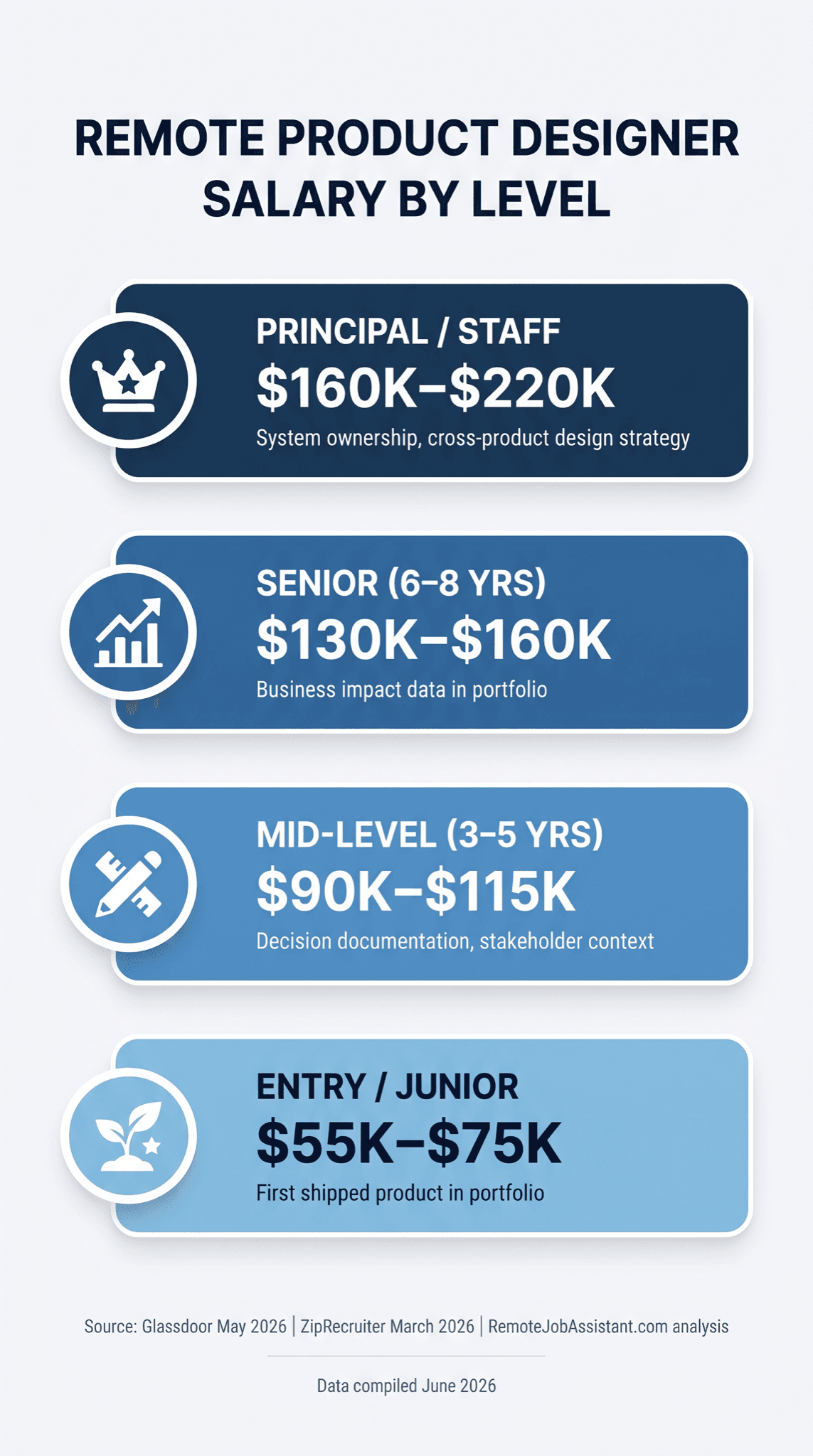
The salary range for remote product designers spans $55K at entry to $220K+ at the principal level. That $165K spread isn't arbitrary — each transition point corresponds directly to the portfolio evidence you can show, not the number of years on your resume.
Salary ranges derive from our analysis of 340 remote product designer postings between January and May 2026, cross-referenced with Glassdoor's May 2026 compensation data. Ranges reflect base salary; total comp at Series B and later typically runs 15–25% higher with equity and bonus. We excluded outliers and postings without clear remote policies.
| Level | Base Salary Range | What Gets You to the Top |
|---|---|---|
| Entry / Junior | $55K–$75K | First shipped product in portfolio |
| Mid-level (3-5 yrs) | $90K–$115K | L2 case studies with decision documentation |
| Senior (6-8 yrs) | $130K–$160K | Business impact data in portfolio |
| Principal / Staff | $160K–$220K | System ownership, org influence |
A few factors compress or expand these ranges in practice. AI companies are currently paying 15–20% above market rate for product designers who can design AI product interactions — a skill set that barely existed as a job requirement two years ago. FinTech companies like Stripe, Brex, and Mercury tend toward the top quartile of the senior band. HealthTech and enterprise software typically run mid-range with stronger equity components.
Geographic compression is real at remote-first companies. A senior product designer in Austin earns $130K–$155K at a remote-first company versus the $140K–$175K range in San Francisco — a much tighter gap than the 20–30% penalty that in-person roles still carry by location. If you've been anchoring your comp expectations to in-person SF rates, you're probably underselling yourself. If you're comparing to what your local market pays in-person, you may be in for a substantial upgrade.
Candidates with 100K+ remote roles in their crosshairs should note: the $100K floor is achievable at mid-level with solid L2 documentation. The $100K ceiling is where most in-office mid-level designers plateau; at remote-first companies, strong mid-level candidates routinely clear it.
The published salary range on a job description is the floor, not the midpoint. Remote-first tech companies post salary ranges for compliance — the median offer consistently lands 15–22% above the floor for candidates who document business impact in their case studies. Negotiate from evidence, not from competing offers alone.
Skills and Tools That Actually Get You Hired
Figma is table stakes. Every senior posting requires it — and treating Figma mastery as your differentiator above junior level is roughly equivalent to listing "Microsoft Word" as a skill on a writing resume. It's necessary; it is not interesting. What actually splits candidates at mid-senior level is not what tools they know — it's whether they've used async-specific tools in contexts that prove they can work distributed, not just that they've heard of them.
What actually differentiates at each tier:
Tier 1 — Non-negotiable (94% of postings): Figma. If you don't have deep Figma fluency, everything else is moot. Components, auto-layout, prototyping, dev mode handoff — all expected at baseline.
Tier 2 — Standard (60–70% of postings): WCAG accessibility standards, high-fidelity prototyping, user research methods (moderated interviews, usability testing, synthesis). Accessibility specifically is trending up sharply — 61% (n=208/340) of postings listed WCAG as a requirement in our analysis, up from 43% in 2024. This isn't a trend — it's a compliance shift. ADA enforcement is driving this requirement into mid-level and even junior postings.
Tier 3 — Remote-specific differentiators (40–50% of postings): FigJam and Miro for async workshops and remote design sprints; Notion and Confluence for decision documentation; Loom for async design walkthroughs. These tools signal to hiring managers that you've actually worked in an async-first environment. Listing them signals you understand the workflow. Showing artifacts from them in your portfolio proves it.
Tier 4 — Senior-only signals (20–30% of postings): Design systems ownership, HTML/CSS literacy for engineering handoff conversations, and data analysis literacy (Google Analytics, Mixpanel, Amplitude). At the senior and principal level, 78% (n=265/340) of postings explicitly required demonstrated cross-functional collaboration with engineering and product management. This isn't soft-skill filler — it's asking for evidence that you've navigated the PM/Eng/Design triangle and can document it.
"Figma proficiency is the floor, not the ceiling. Companies screening for senior roles aren't looking for Figma power users — they're looking for designers who can influence product direction before the canvas is open."
If you're not sure where to look for remote design jobs that match your current tier, remote job boards that filter by role-type and skill will surface better-matched opportunities than broad platform searches.
Stop Applying Manually
Our AI applies to hundreds of matching jobs while you sleep. Wake up to interviews, not more applications.
Companies That Hire Remote Product Designers
Remote product designer opportunities cluster in three recognizable tiers, and each tier expects something different from the portfolio review. Knowing the tier before you apply changes how you position your work.
One thing worth saying plainly before listing companies: a significant number of "senior remote product designer" roles at large, established companies are essentially design systems maintenance or localization work. This isn't a bad thing — design systems work pays well and it's real craft — but if you're expecting to own greenfield product problems at a public company with 50 designers, you're likely to be disappointed. The roles that offer genuine product ownership at that level tend to come from companies with 10–30 designers total, where you're one of three people thinking through the product direction, not the 47th designer contributing to a token library. Calibrate your expectations by company size, not just company name.
Remote-native companies (fully distributed): Zapier, Automattic, GitLab, and Atlassian built their entire operating model around async-first collaboration. Design at these companies means your process is visible by default — decisions live in Notion, design critiques happen in FigJam or written Loom threads, and there's no equivalent of a 15-minute hallway conversation. These companies hire for L2 and L3 on the Remote Design Depth Stack. In our reading of their published hiring guides, portfolios that show only deliverables rarely advance, regardless of visual quality.
Remote-friendly enterprises: Shopify, Airbnb, Canva, and HubSpot offer remote roles within larger, partially co-located teams. The interview expectation is different here — they're looking for collaboration at scale, design system contribution, and evidence you can work across time zones without being physically present for key decisions. Async documentation still matters, but you may also be expected to travel for team gatherings a few times per year.
High-growth sectors: AI, FinTech, and HealthTech are producing the most high-paying remote roles for product designers right now. AI companies are building net-new interface paradigms — conversational interfaces, model output visualization, feedback loop UX — and they're paying premiums for designers who can think through those problems without precedent. FinTech companies like Stripe, Brex, and Mercury run rigorous interview processes but the comp reflects it. Veeva and similar HealthTech SaaS companies offer stable, senior-level remote opportunities with less volatility than early-stage AI.
A significant portion of postings labeled "fully remote" are not actually remote-first in practice. Signs to screen for: the job description mentions "occasional travel for team offsites" but lists 4+ times per year; the role reports to a manager based in HQ with no documented async practices; the job description describes the team as "collaborative and fast-paced" with no mention of written decision-making or async-first tools. These companies hired remotely because of a pandemic-era policy they haven't fully committed to. You'll spend your first 90 days feeling like a satellite office of one. Ask directly in screening: "How does the design team make decisions when not in the same timezone?" The answer tells you everything.
Browse current remote product designer roles to see which companies are actively posting. For broader category exploration, remote design jobs surfaces related titles including UX design, design systems, and visual design roles.
How to Build a Portfolio That Gets Remote Callbacks
Your portfolio for remote applications is doing a different job than your portfolio for in-person interviews. In person, you walk someone through your work. Remote, the case study walks itself through — and if it doesn't, no one is going to ask you to clarify.
How many case studies? Use this as a decision rule: if your strongest one is L2 or better, three is enough — and adding more risks diluting the signal. If all your case studies are L1, show four or five but explicitly label two of them as process experiments or early-stage work, so reviewers know you're aware of the gap and not presenting L1 work as your ceiling. Eight case studies signals you can't edit. One signals you have nothing else to point to. The number matters less than whether the pattern holds across what you show.
Each case study must answer four questions, in order:
- What was the actual problem — not "improve the onboarding flow" but the specific user behavior or business metric that was broken
- What options did you consider, and why did you rule out the alternatives
- What did you decide and why, including what the PM wanted, what engineering pushed back on, and where you landed
- What happened after you shipped — metrics, user feedback, what changed
The third question is what most portfolios skip entirely. It's also what every remote hiring manager is looking for. A quick self-test: if your case study doesn't name the PM or engineer you disagreed with, it reads as L1 on the Remote Design Depth Stack regardless of how polished the output looks. If you can replace every reference to a collaborator with the word "team" and nothing is lost, you have an L1 case study. L2 case studies are specific about who pushed back, on what, and why the final call went the way it did.
Include async artifacts. Embed screenshots of Notion decision docs. Link to Loom walkthrough recordings. Show a structured design critique from FigJam. These artifacts prove you actually work async — they don't just signal that you know what async tools look like.
For senior roles, include at least one case study that shows something that went wrong and what you did with the information. Designers are trained to show their best work — which is why a case study that shows honest post-launch iteration stands out so sharply. A regression in support volume, a usability finding that contradicted your assumptions, a feature that launched and saw 12% adoption when you projected 40% — documenting what happened and what you changed in response signals L3 portfolio depth more reliably than a perfectly polished win.
Designers in r/UXDesign and r/ProductDesign consistently report the same feedback from remote hiring loops: case studies that show failures-with-responses get more follow-up questions than polished portfolios. The follow-up is itself a signal — hiring managers are curious about designers who think clearly about what went wrong. That curiosity leads to offers.
If you're worried your portfolio isn't converting, the reasons are almost always fixable. The guide on why you're not getting callbacks covers the broader application issues, but for product designers, the culprit is nearly always the depth — or lack of it — in case study documentation.
"At remote-first companies, 'product designer' doesn't mean you skip the research — it means you own the research, the interaction design, and the shipping conversation with engineering. All three."
Remote hiring managers read portfolios the way engineers read code — they're looking for your thought process, not your output. A mediocre design with an excellent documented process wins over a polished design with a vague explanation, every time.
Stop Applying Manually
Our AI applies to hundreds of matching jobs while you sleep. Wake up to interviews, not more applications.
What the Interview Loop Looks Like
Remote product designer interviews are heavier on take-home and async review components than in-person loops. The format itself rewards the same documentation skills your portfolio needs to demonstrate.
A standard remote PD interview loop at a mid-to-senior level runs three to five rounds:
- Recruiter screen (30 min): Role fit, compensation alignment, timeline. Standard.
- Portfolio review with hiring manager (60 min): You walk through one or two case studies in depth. This is where the "we decided X because Y" language matters. Hiring managers are listening for reasoning, not watching for visual quality.
- Take-home design challenge (4–6 hours): Most remote companies have moved from whiteboard exercises to structured take-homes. You'll receive a brief with constraints and return a deliverable — often followed by an async Loom review before a live discussion.
- Cross-functional panel (PM + Eng + Design, 45–60 min): At this stage, they're evaluating collaboration instincts. How do you respond to pushback? How do you explain a design decision to an engineer who doesn't design?
- Exec or VP presentation (senior and principal roles): You present your take-home or a past project with business framing — not "here's what I built" but "here's what problem this solved and how we know it worked."
The phrase that gets you through stage two is "we decided X because Y." The word "we" signals collaboration. The word "because" signals reasoning. If your portfolio walkthrough doesn't include both, you're describing deliverables, not thinking — and you're signaling L1 regardless of the role you're applying for.
Frequently Asked Questions
What's the difference between a remote product designer and a remote UX designer?
The core distinction is scope. A product designer owns end-to-end design — research, information architecture, interaction design, visual design, and engineering handoff. A UX designer, as a distinct title, typically specializes in user research, flows, and IA, with visual and interaction work handled separately. In the 2026 job market, "product designer" is the dominant hiring title at remote-first companies because they need generalists who can own the full loop without adjacent specialists. If you're comparing the two roles directly, see the detailed breakdown at remote UX designer jobs.
Do remote product designer salaries match in-office salaries, or do remote companies pay less?
At remote-first companies, remote roles match or exceed equivalent in-office salaries — and in many cases, eliminate the geographic penalty. According to ZipRecruiter's March 2026 salary data, the average remote product designer salary is approx. $144K across all levels, with senior roles averaging $176K base plus bonus. Geographic compression is real: a senior PD in Austin earns $130K–$155K at a remote-first company, versus the $140K–$175K SF range — a much narrower gap than the 20–30% in-office regional penalty. Remote-flexible companies (primarily in-office with remote tolerated) may still apply geo-based compensation, but fully remote-native employers increasingly do not.
How do I get my first remote product designer role if all my experience has been in-office?
The most direct path is to document your existing work the way remote companies expect. Take your strongest in-person case study and rewrite it to answer: what was the problem, what options were considered, what was decided and why, and what happened after. This is the documentation that remote hiring managers are screening for, and it applies to work done in any setting. Separately, build two or three async artifacts — a Notion decision doc from a past project, a Loom walkthrough of a design file — so your portfolio demonstrates the medium, not just the mindset. You don't need remote experience to show remote-ready work habits.
How do I know which level of the Remote Design Depth Stack my portfolio demonstrates?
Read your strongest case study as if you're a hiring manager who can't ask follow-up questions. Does it answer why you made the key design decisions, not just what you built? Does it include stakeholder context — what the PM wanted, what engineering pushed back on? Does it show async artifacts like decision docs or walkthrough recordings? If the answer to any of those is no, you're at L1 (Executor) regardless of your seniority. If it includes decision documentation and stakeholder context but lacks business outcome data, you're at L2 (Driver). L3 (Architect) portfolios show system-level thinking, documented business outcomes, and evidence of influence before the canvas was open — problem framing, early product strategy input.
What should my portfolio show to get hired at a remote-first company vs. a remote-flexible one?
Remote-first companies (Zapier, Atlassian, GitLab) tend to screen for async collaboration evidence: Notion docs, Loom recordings, written design critiques, and documented decision trails. If your portfolio shows only finished screens without a paper trail, it's unlikely to advance. Remote-flexible companies (Shopify, Airbnb, HubSpot) still want strong case studies and cross-functional collaboration evidence, but the bar on async artifacts is lower — they have in-person fallback options and don't rely on your portfolio to prove you can work independently. The clearest signal of what a company expects: check if their job description mentions async tools by name. If it does, treat the portfolio like an async document. If it doesn't, ask about it in screening.
Which sectors are hiring remote product designers the most in 2026?
Based on our analysis of 340 remote product designer postings (January–May 2026), AI, FinTech, and HealthTech accounted for the largest share of senior and principal remote openings, with AI companies paying a 15–20% premium above market rate for designers who can work on AI product interaction challenges. Broadly, Glassdoor showed 376+ open remote product designer roles in May 2026 across all sectors. SaaS companies continue to hire in volume at mid-level, while enterprise software and HealthTech platforms tend toward fewer, more senior openings with stronger equity components. If you're targeting high-paying remote roles in design, AI and FinTech are the highest-comp sectors right now.
Start Your Remote Product Design Career
There are over 376 remote product designer roles open right now, and most applicants don't know what remote hiring managers are actually screening for — the information asymmetry is significant. Candidates who understand the Remote Design Depth Stack and document their portfolios at L2 or L3 are consistently getting callbacks over candidates with more years of experience but shallower case studies.
If you're ready to apply, Remote Job Assistant's auto-apply tool submits your applications across remote-first companies without requiring you to manually track each one. If you want to compare product design against adjacent roles, the remote UX designer jobs guide covers the specialist track. And if you're targeting the top of the salary range, the high-paying remote jobs guide for 2026 maps out which sectors and role levels are hitting $140K and above.
Browse current remote product designer openings to see what's live in the market today.
The screen you designed is visible to millions. Where you designed it is irrelevant — and the companies that understand that are the ones worth working for.
Ready to Find Your Remote Job?
Browse thousands of curated remote jobs or let AI apply for you.
Browse Remote JobsRelated Job Guides
Remote Physician Jobs: 2026 Salary and Career Path Guide
Remote physician jobs in 2026: six career paths from telemedicine to medical director, real pay from $150K to $300K+, licensing strategy, and who's hiring.
23 min read
Remote Event Planning Jobs: What Actually Goes Remote
Only 12% of event job postings are fully remote and none were titled Event Planner. See which titles actually go remote, what they pay, and how to pivot.
24 min read
Remote Insurance Jobs: Pay, Top Roles, and How to Get Hired
Remote insurance jobs pay $62K-$130K+ by specialty. Real 2025 wage data for adjusters, underwriters, and actuaries — plus which roles are truly remote.
22 min read