
Last reviewed: October 2026
You have built a finish board on the hood of a car, measured a lobby at 6 a.m. before the tenant arrived, and talked a client out of a $40,000 sofa over FaceTime. Working remotely is not a skill you need to learn. Yet the posting you opened this morning, for a senior designer seat at a firm whose work you admire, says "This position is in-person."
If you're a working interior designer, interior architect, FF&E specialist, or interiors project manager with a few years behind you, earning somewhere above the $67,190 the Bureau of Labor Statistics calls the median for the occupation, you want two things at once: a seat that pays like a senior one, and no fourth or fifth day in a studio you used to visit for pin-ups. The job boards say that's easy. LinkedIn's page for this search promises "4,000+ Remote Interior Design Jobs in United States." RemoteRocketship headlines "$73K–$104K." Glassdoor's own page title says 74. None of them says how many of those jobs are remote design jobs at all.
Get Remote Job Tips in Your Inbox
Weekly strategies, salary data, and new opportunities
Unsubscribe anytime. No spam.
So we counted. Remote Job Assistant read 1,409 US interior-design postings from 657 employers in full, pulled between September 29 and October 3, 2026. They came from the career sites of some 60 architecture-and-interiors practices (Gensler, HOK, Perkins&Will, Corgan, DLR Group, CannonDesign and their peers), from 12 Workday tenants running from JLL and Cushman & Wakefield to The Home Depot and Floor & Decor, from 906 Greenhouse, Lever, Ashby and SmartRecruiters boards, from the AECOM, Stantec, Jacobs and Burns & McDonnell career sites, from Business of Home's job board and the Himalayas remote board, and from 1,812 LinkedIn postings pulled by 34 searches. Forty were fully remote. Thirteen of the 40 sat at a planning desk, doing occupancy and space planning or project design for corporate real-estate clients; 16 sat at a design practice; 11 sat in design-sales, where "remote" mostly means the car is the office. Three things decide it: what the deliverable is, who you have to face in person, and one policy line in the posting. This post shows you which interior design seats go remote, what they pay, and a simple score for your own job. And since the boards mix them in: aircraft and auto interiors are a different trade, and "remote interior designer" listings that hire in Latin America or the Philippines for US clients are a different market. Neither is counted here.
Based on our analysis of 1,409 US interior-design postings at 657 employers (pulled September 29 to October 3, 2026):
- 2.8% (n=40 of 1,409) were fully remote; among the 748 postings that state a work model at all, 5.3%
- 17.2% (n=242 of 1,409) were hybrid and 33.1% (n=466) onsite; of the hybrid postings that name a number, 30 require three office days, 18 require four, and 4 require two
- 3.8% (n=11 of 289) of showroom, kitchen-and-bath and in-home design-sales postings were remote, against 1.8% (n=16 of 900) at architecture-and-interiors practices and 5.9% (n=13 of 220) at planning and real-estate-services desks, which is 14.0% of the 93 planning postings that state a model
- 3.8% (n=15 of 399) of the LinkedIn postings surfaced by searches with "remote," "virtual," "online" or "work from home" in the query were remote once we read them; on LinkedIn's "4,000+ Remote Interior Design Jobs" page, 8 of the 21 interior-design postings were
- 64.5% (n=376 of 583) of postings with an annual range start at $75,000 or more, but only 6 of those 376 are remote
- $65,000–$94,395 median posted range for remote postings (n=21), against $85,000–$115,000 for hybrid (n=121), $75,000–$105,000 for onsite (n=190), and $20–$28 an hour on the 33 hourly design-sales postings
- 26.3% (n=371 of 1,409) of postings name NCIDQ; 5.5% (n=77) require it; 0 of the 40 remote postings require it
- $67,190 median pay for interior designers per BLS (May 2025); 75th percentile $85,740, 90th $114,140; employment projected to grow 3% by 2035
If you want $75,000 or more and no commute, the postings point to three kinds of desks, and none of them is the pin-up wall.
The remote postings that pay $75,000 or more are occupancy-planning and workplace-strategy seats at real-estate services firms and corporate real-estate teams (Cushman & Wakefield's Director, Global Space & Occupancy Planning at $153,000–$180,000 and Director, Spatial and Occupancy Planning at $144,500–$170,000; JLL's Senior Occupancy Planner / Design Manager at $92,000–$125,000; Sazerac's Space Planning Analyst at $92,000–$138,000), designer seats at the one national practice that writes "This position may be filled anywhere in the United States" into its postings (CannonDesign's Project Interior Designer IV at $81,955–$102,398 and Project Interior Designer V at $98,328–$122,933), a hotel brand's FF&E project management (BWH Hotels, $72,200–$90,700), and senior designer seats at boutique residential studios that post "Telecommute" on Business of Home, most without a published range. What they share: the client receives a plan, a spec, or a file, not a finish board.
The Touch Distance Score: Why the Sample Library Decides
Three things keep interior design work in a studio, a showroom, or a car, and each one hits a different part of the market.
The sample library and the pin-up wall keep the studio in the building. Gensler posted 121 of the 1,409 jobs, more than any other employer, and 79 of them carry a sentence that settles the question: "This position is in-person." (7 postings), "Ability to work in person in the office 5 days a week" (7), "This is not a remote position." (5), "Remote or hybrid work is not available for this role at this time." (3). The other 40 say nothing, and we counted them onsite because the firm's own HR lead described to Evanta how Gensler "gradually implemented a five-day, return-to-office (RTO) policy", adding that "So much of our culture is realized in person". Corgan writes it into 22 of its 24 postings: "This position is designated as full-time on-site and requires the employee to be physically present at the assigned office location Monday through Friday during standard business hours." Rapt Studio says why: "The best work happens shoulder-to-shoulder—pin-ups, workshops, model reviews—because ideas move faster in person." and "We work hybrid: three days together in the studio, with more as projects demand." The hybrid firms publish the day count. DLR Group, in all 14 of its postings: "DLR Group follows a four-day in-office work model, with employees having the flexibility to work somewhere other than the office on Fridays." HOK, in 35 of 38: "At HOK you’ll have a hybrid work environment," and three add "the option to work from home on Mondays and Fridays." AECOM: "Work Location Model: Hybrid" (10 of 11). Stantec: "This is a hybrid role expected to be in the office minimum 24 hours a week." HMC Architects: "requires 3 days in the office and the ability to work from home Mondays and Fridays." WATG: "the option to work remotely only on Friday." Hickok Cole, after naming its three office days: "All-remote candidates will not be considered." Site visits, construction administration, punch lists or installs appear in 42.6% of all postings (n=600 of 1,409). Of the 900 postings at practices and AEC firms, 196 are hybrid, 187 onsite and 16 remote; 501 say nothing about where you sit.
The showroom and the home keep design-sales on the floor or in the car. Ethan Allen posted 47 design-sales jobs. Its postings say the Design Consultant "works closely with the customer in the design center/studio, remotely, online or in the customer’s home to create individualized design solutions to sell Ethan Allen products and services", and then, "Please note this position is full time, on site, and does require weekends." Havertys: "Required to work 5 days a week, retail hours include nights and weekends as our stores are open 10 am – 7 pm Monday – Saturday and 12 pm – 6 pm Sunday." The Home Depot's in-home design sales consultants (21 postings) "will spend the majority of their working time traveling and away from a dedicated office environment." Cabinet IQ's kitchen-and-bath sales designers "Meet clients on-site to take field measurements" and "Receive support from a remote junior designer who assists with 2020 plans, allowing you to focus on client interaction and design." The remote seat exists; it's the junior one, drawing the plan. Floor & Decor's store designers post $17.12–$25.28 an hour. Commission appears in 103 of the 289 design-sales postings (35.6%). Eleven of the 289 are remote, and even there the word is doing work: Closet Factory's three remote postings say "Work Location: Remote and at clients homes", and a Budget Blinds franchise's "full-time remote role for a Design Consultant" is in-home window-covering sales.
The planning desk receives the building as data. Cushman & Wakefield's two occupancy-planning directorships carry Workday's own workplace label, "Fully Remote," and its Louisville occupancy planner is "East Coast remote eligible for the right candidate." JLL's senior occupancy planner is "Remote –Chicago, IL, Phoenix, AZ" while 18 of JLL's other 19 interiors postings read "On-site –New York, NY" and the like. Sazerac's space planning analyst: "Location: Remote (must be based in Dallas, Cincinnati, Des Moines, or Las Vegas )". Horizon Blue Cross Blue Shield's occupancy planning analyst: "The role is remote once training is fully completed." BWH Hotels' FF&E project manager: "This is a remote based position in central-US, working from your home office in the state of your current residence when not traveling for work." CannonDesign writes "This position may be filled anywhere in the United States." on two designer postings and "This role is remote within the U.S." on a third. Of the 220 planning-desk postings, 13 are remote (5.9%, or 14.0% of the 93 that state a model), and AI tools are named in 50 of them (22.7%) against 48 of the 900 practice postings (5.3%). The planner's deliverable is a test fit, a stacking diagram, a headcount forecast, or an occupancy report. It travels as a file.
Put those together and the pattern is a distance. The further a job sits from things that have to be touched, the more often it leaves the building, and the postings tell you the distance in advance.
This is the part most career advice skips. The filter on remote interior design work is not talent, and it is not the credential: 0 of the 40 remote postings require NCIDQ, and only 6 prefer it. The filter is whether the thing you hand the client can travel as a file. A workplace designer with twelve years of built projects has a job that is structurally tied to a sample library and a pin-up wall, because that is how finishes get approved at Gensler and Corgan. An occupancy planner who hands a corporate real-estate team a stacking plan and a utilization report does not, which is why Cushman & Wakefield can hire that job from anywhere and no studio-bound firm can. If you want remote, you change the deliverable before you change the résumé.
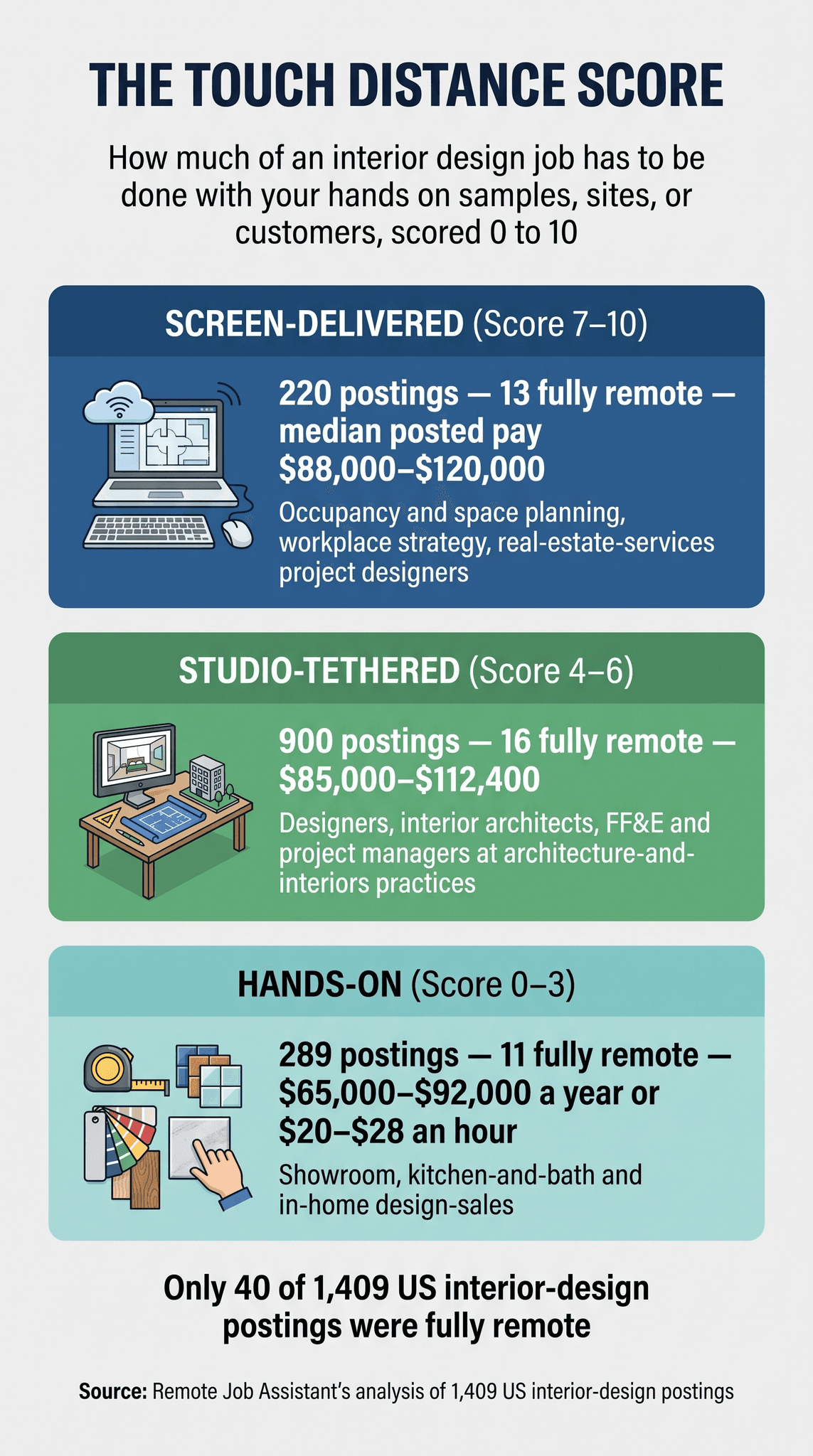
The Touch Distance Score: A 0–10 score for how much of an interior design job has to be done with your hands on something: the sample library and pin-up wall in the studio, the job site and the install, or the customer in a showroom or home.
Score the job on three observable criteria and add them up:
- What the deliverable is (0–4): a finish palette, a pin-up, a showroom sale, or a punch list scores 0; a drawing set and spec reviewed in the studio against physical samples scores 1–2; a test fit, occupancy plan, space-data report, FF&E spec, CAD or Revit production set, or e-design board delivered as a file scores 3–4.
- Who you face and where (0–3): walk-in customers, in-home visits, or weekly site walks score 0; client meetings in the firm's office score 1; client leadership on video with occasional travel scores 2–3.
- What the posting's policy line says (0–3): "in-person," "full-time on-site," or five days scores 0; four days scores 1; two or three days, or a "hybrid work environment," scores 2; "remote," "Fully Remote," "may be filled anywhere in the United States" or "Telecommute" scores 3.
Scoring, measured on 1,409 postings by employer type and segment:
- 0–3 Hands-On ($65,000–$92,000 posted median, n=105; $20–$28 an hour on the 33 hourly postings): showroom, design-center, kitchen-and-bath and in-home design-sales at Ethan Allen, Floor & Decor, The Home Depot, California Closets, Havertys and MillerKnoll's Design Within Reach stores; homebuilder design studios. 289 postings (20.5%). 11 remote (3.8%), 9 hybrid, 236 onsite (81.7%), 33 unstated. The remote ones are in-home sales (Closet Factory, a Budget Blinds franchise), virtual kitchen-and-cabinet design seats (W3Global's "Kitchen Designer - Remote" at $50,000–$120,000, Reno Source at $50,000–$90,000, Bravo Global Staffing), one manufacturer's designer (Falkbuilt, $65,000–$90,000: "THIS ROLE IS A REMOTE POSITION."), Williams-Sonoma's B2B associate designer ($60,000–$69,000) and Lennar's regional interior design assistant.
- 4–6 Studio-Tethered ($85,000–$112,400, n=367): designers, interior architects, FF&E specialists, project managers and studio leaders at architecture-and-interiors practices and multidiscipline AEC firms. 900 postings (63.9%). 16 remote (1.8%; 4.0% of the 399 that state a model), 196 hybrid (21.8%), 187 onsite (20.8%), 501 unstated. The remote 16: CannonDesign's three, Level Five Designs' four ("REMOTE POSITION : Must live in FL, GA, NC, SC, TN, VA", with a warning about "active jobsite environments"), Light and Dwell Interiors' two ("This is a remote position supporting projects from coast to coast"), six boutique residential studios on Business of Home, and one FF&E specifier.
- 7–10 Screen-Delivered ($88,000–$120,000, n=111; the 11 remote postings with a range, $70,500–$90,700): workplace strategy, occupancy and space planning, project designers and interiors project managers at real-estate services firms (Cushman & Wakefield, JLL, CBRE, Turner & Townsend), corporate real-estate and facilities teams (Amazon's GREF group, Horizon Blue Cross Blue Shield, Sazerac), hotel-brand FF&E, and remote drafting and rendering. 220 postings (15.6%). 13 remote (5.9%; 14.0% of the 93 that state a model), 37 hybrid, 43 onsite, 127 unstated. Cushman & Wakefield alone accounts for 5 of the 13.
How to use it, as a decision tree:
- Score the deliverable first. If it scores 3–4 (test fits, occupancy data, specs, production sets, e-design boards), remote is physically possible; go to the policy line. If it scores 0–2 (palettes, pin-ups, showroom sales, punch lists), stop applying to "remote interior designer" titles; change the deliverable or the employer type before you change the résumé.
- Then score the client contact. If it scores 0 (walk-ins, in-home visits, weekly site walks), the job is a field job whatever the posting calls it; price it as one.
- Score the policy line last. If your work scores 6 or more and the posting scores 0 on policy, the ask is negotiable, and the evidence is the firm's own postings: Cushman & Wakefield labels one project designer "Fully Remote" and another hybrid; CannonDesign posts hybrid designers next to ones that "may be filled anywhere in the United States." Bring the sibling posting to the call. If the posting says "in-person" and the firm's other postings say the same, as Gensler's 79 do, you are negotiating against a policy, not a manager; move on.
- If you score 7 or more in total, apply to every planning-desk posting the week it opens; there were 13 remote ones in 1,409 and five sat at one firm. If you score 4–6, pick the hybrid firm whose day count you can live with (three days at 30 postings, four at 18) and build the file-delivered half of your portfolio on their time.
The bands at a glance, with every number from the 1,409 postings:
| Band | Typical seats | Postings | Remote | Hybrid | Onsite | Median posted range (n) |
|---|---|---|---|---|---|---|
| Hands-On (0–3) | Showroom, kitchen-and-bath, in-home design-sales; dealer design specialists; homebuilder studios | 289 | 11 (3.8%) | 9 | 236 | $65,000–$92,000 (105); $20–$28/hr (33) |
| Studio-Tethered (4–6) | Designers, interior architects, FF&E, PMs and leaders at A&D practices and AEC firms | 900 | 16 (1.8%) | 196 | 187 | $85,000–$112,400 (367) |
| Screen-Delivered (7–10) | Occupancy and space planners, workplace strategists, RE-services project designers and PMs, corporate RE, hotel FF&E, remote drafting | 220 | 13 (5.9%) | 37 | 43 | $88,000–$120,000 (111) |
In interior design, the sample library and the pin-up wall decide where you sit. The deliverable decides whether you can leave.
The rest of this guide prices each band and names the employers, but if your résumé already reads like the third row, the fastest move is to get it in front of every planning-desk posting the week it opens.
Stop Applying Manually
Our AI applies to hundreds of matching jobs while you sleep. Wake up to interviews, not more applications.
How We Collected This Data
Start with what we could not see. Indeed, ZipRecruiter and Glassdoor return 403 to a crawler, Reddit blocks it outright, and firms that hire through Dayforce or ADP portals return nothing to a request. The 26% of interior designers who are self-employed, per BLS, never post a job at all. So this is a count of what employers published where it could be read, not a census of the profession.
Within that, the figures come from 1,409 unique US interior-design postings at 657 employers. The practice-board pull (275 postings) was taken September 29 and 30, 2026, from every opening on the career sites of some 60 architecture-and-interiors practices, across Avature, Dayforce, UKG, iCIMS, Lever, Greenhouse, Jobvite and a dozen smaller systems; everything else was pulled October 3, 2026: 984 LinkedIn postings (34 searches, 3,223 cards, 1,812 full bodies read), 69 Workday postings from 12 tenants (JLL, Cushman & Wakefield, SOM, The Beck Group, MillerKnoll, Floor & Decor, The Home Depot, Gap Inc., Lennar, Clayton Homes, Cleveland Clinic, Guidehouse), 35 from 906 live Greenhouse, Lever, Ashby and SmartRecruiters boards, 27 from the AECOM, Stantec, Jacobs and Burns & McDonnell career sites, 14 from Business of Home and 5 from Himalayas.
We kept interior designer, interior architect, FF&E, space and occupancy planner, workplace strategist, interiors project manager and leader, design-sales consultant and design assistant titles. We excluded interns, aircraft, auto and yacht interiors, exhibit and lighting designers, software "architects," and store planners. Eight listings that hire in Latin America or the Philippines for US clients were set aside. A requisition template posted in many stores or cities counts once, which is why Ethan Allen shows 47 postings here and not the 85 cards LinkedIn returned for it.
The work model comes from the posting text and the employer's own structured field, never from a board's remote filter (LinkedIn ignores its remote filter for logged-out searches). Remote means the posting says the job is done from home or anywhere in a stated region; hybrid means it names office days or a hybrid model; onsite means it says in-person, on-site, or describes a store or field job. 661 postings (46.9%), 565 of them LinkedIn postings from small studios, dealers and retailers, say nothing about where you sit; we report them as unstated and give shares both ways. Gensler's 40 silent postings are the one exception, assigned onsite from the firm's published five-day policy and the 79 sibling postings that say so. Pay was parsed from 583 postings (41.4%) and cross-checked against BLS Occupational Employment and Wage Statistics for May 2025. Ranges are base pay as posted; design-sales ranges include commission where the posting says so.
What Remote Interior Design Jobs Pay in 2026
Start with the government's number. BLS puts the median for interior designers at $67,190 (May 2025), with the lowest 10% under $41,420 and the highest 10% above $114,140. By industry, the median at architectural and engineering firms is $78,340; at specialized design firms $67,870; in construction $63,330; in retail trade, which holds 12% of the jobs, $50,560. Our posted medians sit higher, $80,000–$110,000 across the 583 postings with a range, because postings that print a range skew to large practices and real-estate services firms, and because 41.4% of postings print a dollar figure at all.
Salary ranges derive from our analysis of 1,409 US interior-design postings pulled September 29 to October 3, 2026, cross-referenced with BLS Occupational Employment and Wage Statistics (May 2025) and Interior Design magazine's 2026 Giants survey. Ranges are posted base pay as the employer wrote it; where a posting lists an hourly rate, it is reported separately. Ranges shift as markets move, so check the linked sources for current figures.
| Work model | Postings | Median posted annual range (n) | Hourly postings |
|---|---|---|---|
| Remote | 40 | $65,000–$94,395 (21) | 0 |
| Hybrid | 242 | $85,000–$115,000 (121) | 2 |
| Onsite | 466 | $75,000–$105,000 (190) | 35 |
| Unstated | 661 | $84,000–$112,250 (251) | 23 |
| All | 1,409 | $80,000–$110,000 (583); median midpoint $95,000 | 60, median $24–$30/hr |
Remote pays less at the median, not more, and the reason is structural rather than a discount for staying home. The roles that pass the file test at scale are occupancy planning, project design for real-estate clients and design-sales, and every pay table we have puts them below senior studio work; the senior studio seats, at $97,664–$125,000, are the ones tied to the sample library. Look at who gets hired remotely: occupancy planners at $68,000–$80,000 (Cushman & Wakefield, Louisville), project designers at $55,355–$65,124 and $63,750–$75,000 (Cushman & Wakefield), a B2B associate designer at $60,000–$69,000 (Williams-Sonoma), a hotel-brand FF&E project manager at $72,200–$90,700 (BWH Hotels), and design-sales seats that start at $50,000 and promise commission. The remote postings that start at $100,000 are two: Cushman & Wakefield's two occupancy-planning directorships at $144,500–$170,000 and $153,000–$180,000. Add the postings whose range reaches $100,000 and you get Sazerac's space planning analyst ($92,000–$138,000), JLL's senior occupancy planner ($92,000–$125,000), CannonDesign's Project Interior Designer V ($98,328–$122,933) and W3Global's virtual kitchen designer ($50,000–$120,000, commission implied by the spread).
| Level and segment | Median posted range (n) | Remote |
|---|---|---|
| Entry (assistants, junior designers) | $67,000–$80,000 (47) | 4 of 130 |
| Mid-level | $75,000–$100,000 (296) | 22 of 748 |
| Senior | $100,000–$130,000 (203) | 12 of 464 |
| Director, principal, studio leader | $140,000–$162,500 (37) | 2 of 67 |
| Designer, mid-level | $75,000–$99,275 (196) | |
| Designer, senior | $97,664–$125,000 (106) | |
| Interior architect | $95,000–$120,000 (12) | 0 of 52 |
| Interiors project manager, senior | $100,000–$132,000 (59) | |
| Workplace strategy and occupancy planning | $101,650–$132,500 (58) | 6 of 122; remote $92,000–$131,500 (6) |
| Workplace strategy, director | $150,000–$175,000 (9) | |
| FF&E | $80,000–$100,000 (13) | 1 of 33 |
| Design-sales, mid-level | $60,000–$100,000 (52) |
The shape of that table is the shape of the profession's pay problem. The studio pays its senior designers $97,664–$125,000 and its interior architects $95,000–$120,000, and 0 of the 52 interior-architect postings are remote. Design-sales advertises $60,000–$100,000 at mid-level, but 103 of the 289 Hands-On postings pay commission, Floor & Decor's store designers post $17.12–$25.28 an hour, and Havertys requires "5 days a week, retail hours include nights and weekends." The planning desk pays like the studio's senior tier ($101,650–$132,500) and is the only band where remote shows up at a double-digit rate among the postings that state a model.
| BLS, May 2025 | 10th | 25th | Median | 75th | 90th |
|---|---|---|---|---|---|
| Interior designers (71,500 wage-and-salary jobs) | $41,420 | $51,840 | $67,190 | $85,740 | $114,140 |
| Industry medians | A&E services $78,340 | Specialized design $67,870 | Construction $63,330 | Retail trade $50,560 |
The Giants survey explains the other half. Interior Design's 2026 Top 100 Giants report that fee income grew 1% to $6.38 billion while "the total roster of interior design employees is down slightly industry-wide," that "Hiring is up at the principal/partner level", and that the lower project-manager headcount "is likely an indication of how hard it is to find and hire mid-level designers rather than evidence of any widespread downsizing." Median fees per employee "jumped 12 percent to nearly $300,000". Firms are earning more per designer, hiring at the top, and struggling to fill the middle, which is the tier that a four- or five-day policy prices out of the suburbs.
Of the 583 postings with an annual range, 376 (64.5%) start at $75,000 or more: 89 hybrid, 103 onsite, 6 remote, the rest unstated. Browse remote jobs paying $75K and up and the shorter list of remote jobs at $100K and up with the planning-desk titles in mind, because that is where the overlap lives.
A remote interior design posting is more likely to be an occupancy plan than a finish board, and it is priced like the plan.
Where the Remote Work Actually Is: Four Lanes
| Lane | Remote in our data | What gets you in | The catch |
|---|---|---|---|
| Occupancy and space planning at RE-services firms and corporate RE teams | Cushman & Wakefield 5 of 15; JLL 1 of 19; Sazerac, Horizon BCBS 1 each; CBRE 0 of 12 (10 unstated) | Test fits, stacking plans, utilization data, a CAFM or IWMS tool, client-facing calm | Client-site weeks; "East Coast remote eligible for the right candidate" is a maybe; directorships are rare |
| Practices with a remote-optional line | CannonDesign 3 of 7; Level Five Designs 4 of 4; Light and Dwell 2 of 2 | Revit production, CA from a distance, a state on the list | State residency lists; "active jobsite environments"; most firms post four or five days |
| Boutique residential studios | 13 Telecommute listings on Business of Home; 6 designer or PM seats | Trade-account sourcing, FF&E procurement, CAD, client presentations by video | Pay rarely posted; install days; small teams, principal-dependent |
| Virtual design-sales and e-design | W3Global, Reno Source, Closet Factory, Budget Blinds; Havenly and Decorilla contractors | Sales close rate, 2020 or Chief Architect, speed | Commission or per-project pay; in-home visits; not a base salary |
Lane 1: the planning desk. Cushman & Wakefield's interiors postings split 5 remote, 7 hybrid, 2 onsite and 1 unstated out of 15, and all 15 print a range, from $55,355–$65,124 for a project designer to $153,000–$180,000 for the global occupancy planning director. JLL prints "On-site –New York, NY" on 18 of 19 and "Remote –Chicago, IL, Phoenix, AZ" on one, its senior occupancy planner at $92,000–$125,000. CBRE's 12 occupancy-planning and workplace-strategy postings say nothing about where you sit in 10 cases and print no pay. Amazon's GREF team posts occupancy planners and workplace strategy managers at $127,200–$185,000 with no policy line. Turner & Townsend's interiors project managers carry the lane's real catch in 7 of 14 postings: "On-site presence and requirements may change depending on our client's needs", and one is blunt: "This is not a remote role, the selected candidate will be required to report to the client's Chicago, IL offices a minimum of three days per week." The cause is simple. A planning desk's product is a stacking diagram built from badge data, headcount forecasts and floor plans, so the designer can be anywhere; the client's facilities team is in one building, so some weeks you will be too. Workplace-strategy postings in our data pay $101,650–$132,500 (n=58) and are the only segment where the remote postings ($92,000–$131,500, n=6) pay about the same as the rest. If you have run a test fit and a stacking plan and can talk about utilization data, apply here first; if the posting names a client campus and carries the client-needs clause, price in the weeks on that campus.
Lane 2: practices with a remote-optional line. CannonDesign writes "This position may be filled anywhere in the United States." into two interior designer postings ($68,265–$85,285 and $81,955–$102,398) and "This role is remote within the U.S." into a third ($98,328–$122,933). Level Five Designs, a design-build practice, posts all four of its interiors seats as "REMOTE POSITION : Must live in FL, GA, NC, SC, TN, VA" and in the same breath asks you to be "Comfortable working in active jobsite environments, which may include dust, noise, varying temperatures, use of on-site portable restrooms, or uneven surfaces". Light and Dwell Interiors: "This is a remote position supporting projects from coast to coast, working closely with our Creative Director, clients, build teams, and Design Associates." The hybrid middle is where most practice jobs actually sit: HOK's 38 (all hybrid), DLR Group's 14 (four days), Perkins&Will's 15 of 19, Ware Malcomb's 12 of 17, Perkins Eastman's "4 days in office 1 days working remotely," and Actalent's design staffing line, "most employees working remotely and coming into the office occasionally for meetings or to access our library." If a practice is your lane, the sorting question is one sentence long: does the posting name the days? If it does, that number is firm (DLR Group has posted "four-day" on all 14; HOK "hybrid" on 35 of 38). If it only talks about culture, assume Gensler's answer until the posting says otherwise. One gotcha: a perk sentence is not a policy sentence. CannonDesign's benefits paragraph promises "remote work options" in postings that are hybrid; Gensler's postings talk about studio culture at length and then say "This position is in-person." Read the sentence that names the days.
Lane 3: boutique residential studios. Business of Home's job board carried 13 interior-design listings tagged Telecommute on October 3, 2026, all from small residential practices, and 6 of them were designer or project-manager seats: Natty BLANC's senior designer for "Caribbean & East Coast" projects, Olivia Erwin Interiors, Kristin Kavanagh Interiors, Weeth Home, Keser Design ("primarily remote, with occasional site visits and in-person meetings throughout Los Angeles") and Jute Interior Design ("work fully remotely during PST or a hybrid schedule from our San Francisco studio"). None printed a range. The cause: a principal with a trade account, a procurement pipeline and a CAD or Revit workflow does not need a studio, and the install day is the one day the whole team is in the same room. The catch: pay is negotiated privately, the team is five people, and the job exists at the principal's discretion.
Lane 4: virtual design-sales and e-design. W3Global's "Kitchen Designer - Remote" pays $50,000–$120,000, "home based," but "due to limitations in our registration for employment, we are currently seeking only candidates resident in the states of Florida, Texas, Ohio or Arkansas." Reno Source: "Remote · Full-Time (35-40 hrs/week) · $50,000-$90,000/year". Closet Factory's three remote postings advertise $50,000–$200,000 and "Work Location: Remote and at clients homes". The e-design platforms hire contractors, not employees: Havenly tells applicants "Designers earn a fee per project and are also eligible for commission and performance incentives!" and invites them to "Partner with us as a fully remote E-Designer"; Decorilla's recruiting page, which ranks on Google for this very search, says "we only take a small commission from clients" and asks whether you are "Interested in Visiting Local Clients?" The last time Business of Home got the platforms to publish their math, in 2019, Havenly charged clients $19 to $169 per room and said "its highest-performing, busiest designers can make up to $7,500 per month", while Decorilla said "An average project costs the client $1,000, so designers would [usually] get $700 of that." Upwork's category page puts median rates at $15–$28 an hour. This lane is remote by construction and paid on conversion. It suits a designer who wants a portfolio or a second income. It does not suit anyone who needs a $75,000 base.
What changes after the offer. The postings also tell you how the arrangement drifts, if you read the conditional clauses. Elements, a Colorado practice, writes "In-office presence is required within the first 90 days of employment." and then "While we support a flexible work environment, this role is based in either Denver, CO or Fort Collins, CO and requires regular in-office presence." Horizon Blue Cross Blue Shield's planner is remote only "once training is fully completed." Cushman & Wakefield's Louisville planner is remote "for the right candidate." Turner & Townsend's seven postings carry the clause that governs every client-site job: "On-site presence and requirements may change depending on our client's needs." BWH Hotels' project manager works from home "when not traveling for work," and the posting budgets travel at a quarter of the time. Rapt Studio's three studio days come "with more as projects demand." And the largest employer in the data got to five days by stages: Gensler's HR lead told Evanta the policy "was implemented gradually, beginning with leadership," who "were required to be in the office two days per week," before it "expanded to include all employees, eventually reaching a five-day, in-office schedule." The rule that falls out: a remote offer is only as durable as the sentence it rests on. "Remote" in a Workday field or "may be filled anywhere" in the body survives a new principal; "remote eligible for the right candidate" and "once training is fully completed" are decisions someone can revisit.
Our read of the whole dataset, stated as opinion: the well-paid remote interior design job in 2026 is a space-planning analyst job that used to belong to facilities teams, and it is remote precisely because the pin-up culture never claimed it. The pin-up is not just how finishes get approved; it is where the good projects get handed out, which is why the hybrid firms guard the day count and why a designer who scores 6 should expect an informal cost for not being in the room.
Pick your lane by what you can't give up. If it's a base salary and benefits, it's Lane 1 or the hybrid middle of Lane 2. If it's your name on built work, it's Lane 2 or Lane 3, and you'll take the jobsite days with it. If it's never driving to a client, it's Lane 1 or the virtual half of Lane 4. If it's a studio full of samples, it isn't remote, and the data says to stop pretending otherwise.
One more market shows up when you search "remote interior designer": the offshore one. Eight listings on the remote boards and LinkedIn were tagged United States but hire abroad for US clients. The Hello Team posts a "Remote Interior Design CAD Drafter," a "Remote Senior Interior Design Architect" and a "Remote Commercial Furniture Designer & Space Planning Specialist", each promising "100% remote work" and requiring a "Professional home workstation capable of supporting uninterrupted remote work." Tahche Outsourcing Services is hiring an entry-level commercial furniture designer for a US wholesaler "in a fully remote, dedicated offshore role." My VA Support wants a virtual interior designer, "Only LATAM-based candidates". These are real jobs. They are not US jobs, and they are a large share of what a remote board shows you under this title. RemoteRocketship's "13 work from home interior designer positions" page, which ranks seventh on Google, includes a virtual designer "Remote from LATAM" at "$2.3k - $3.5k / month" and a design-team administrative assistant "Remote from LATAM on MST hours."
The interior design jobs that go remote are the ones where the client receives a file, not a finish board.
If your deliverable is already a file, the problem is volume, not eligibility: planning-desk postings open at a few dozen employers and close fast, and the hybrid middle of the practice market is where the $100K-plus designer titles sit.
Stop Applying Manually
Our AI applies to hundreds of matching jobs while you sleep. Wake up to interviews, not more applications.
Why Most "Remote Interior Designer" Listings Keep You in the Store or the Studio
LinkedIn's "4,000+ Remote Interior Design Jobs in United States" page showed us 60 cards. Twenty-one of them were interior design postings once duplicates and non-design titles were removed, and 8 of those 21 were remote: two at Level Five Designs, two at Light and Dwell Interiors, Falkbuilt's digital-construction designer, W3Global's virtual kitchen designer, a Closet Factory in-home consultant and a Budget Blinds franchise consultant. The rest of the page was closet, blinds and bath sales, store planners, exhibit designers, a lighting designer, a drafting coordinator, a marketing manager and Wayfair's "Virtual Cabinetry Sales Specialist". Across all 399 LinkedIn postings our remote-flavored searches surfaced, 15 were remote (3.8%), 116 were onsite and 198 never said.
The word "remote" on an interior design posting describes one of three things, and only one of them is a desk at home. On a design-sales posting it describes the car. Ethan Allen's consultants work "in the design center/studio, remotely, online or in the customer’s home," and the posting goes on to say the job is "full time, on site, and does require weekends." The Home Depot's consultants are "traveling and away from a dedicated office environment." Closet Factory's are "Remote and at clients homes". Of the 289 Hands-On postings, 236 are onsite outright and 103 pay commission. The second thing it describes is the junior drafter who supports a field designer, as at Cabinet IQ, where the salesperson measures and "a remote junior designer who assists with 2020 plans" draws. The third thing, the one you are searching for, is a planning or production deliverable that travels as a file, and that is 13 planning-desk postings plus 16 at practices out of 1,409.
The studio is the other place "remote" goes to die, and the postings say why without being asked. Rapt Studio: "pin-ups, workshops, model reviews—because ideas move faster in person." Corgan: "Regular, reliable on-site attendance is an essential function of this role." WATG, which designs hotels: "This role requires in-person collaboration, with the option to work remotely only on Friday." The sample library is physical, finish approvals happen on a table, and construction administration happens on a site: 496 of the 900 practice postings mention site visits, CA, punch lists or installs. The hybrid day count, where a firm publishes one, is three days at 30 postings and four at 18. Only 4 postings in the whole dataset offer two.
The causal chain matters for your search because it tells you what to change. Not the title: "Interior Designer" is remote at CannonDesign and in-person at Gensler. Not the city: Level Five Designs will hire you in six states and still send you to a jobsite. The deliverable. When the client's approval can happen on a shared file instead of a sample table, the posting can say "may be filled anywhere," and when it can't, no amount of seniority moves it.
NCIDQ, State Registration, and Working Across State Lines
A remote seat means your projects are often in a state you do not live in, and interior design is regulated by the state where the project is, not where the designer sits. The International Interior Design Association's July 2026 legislative map counts "31 states, plus Washington, DC, and Puerto Rico (for a total of 33 jurisdictions)" with "some type of legal recognition related to the regulation of interior design." Fourteen states have a title act with permitting privileges (Alaska, Connecticut, Florida, Georgia, Idaho, Illinois, Iowa, Minnesota, Missouri, Nebraska, North Carolina, Texas, Virginia and Wisconsin); Louisiana, Nevada, DC and Puerto Rico have practice acts with mandatory registration; Oklahoma has a commercial practice act; Alabama and Utah have commercial certification acts; California has a state-specific certification; eleven states protect the title without permitting privileges; Colorado grants permitting privileges without a law; and 18 states, including Arizona, Massachusetts, Michigan, Ohio, Oregon and Washington, have no interior design legislation at all. IIDA's framing of what the fights are about is the remote designer's question too: "the ability to stamp and seal their own interior, nonstructural construction plans for permitting."
The common key is NCIDQ. CIDQ, which administers it, says the credential is recognized "in over half of U.S. states and Canadian provinces", that "All require NCIDQ Certification, except California", and that there are "More than 39,000" certificate holders. The eligibility rules and the current candidate handbook put real numbers on it: 60 semester hours of interior design coursework and 3,520 hours of supervised work experience (two years full time) with an interior design degree, 5,280 or 7,040 hours on other education paths; three exam sections (IDFX, IDIX, IDPX) that must all be passed within 10 exam administrations, about five years; a $235 application fee plus $305, $470 and $365 for the three sections, so $1,375 before study materials and before any retake; $85 a year to keep the certificate active; exams in April and October, scored 200 to 800 with 500 passing; and remote proctoring, "from a secure, convenient location such as your home." The work-experience check-ins with your supervisor "must occur via phone, video chat, or in person; email-only is not sufficient", which is to say the hours can be earned remotely too.
The postings tell you where it counts. NCIDQ is named in 371 of 1,409 (26.3%), required in 77 (5.5%) and preferred in 128 (9.1%). By band it is almost entirely a studio credential: 324 of the 900 practice postings name it, 38 of 220 planning-desk postings do, and 9 of 289 design-sales postings do. None of the 40 remote postings require it; 6 prefer it. State registration or licensure is mentioned in 51 postings (3.6%). Revit appears in 703 (49.9%), and in 13 of the 40 remote postings.
The friction is in the second step, not the exam. NCIDQ is portable; the registration is not. Each regulated state registers you separately, with its own fee and continuing education: Alabama, per CIDQ's jurisdiction guide, charges a "$300 application fee" and a "$160 registration renewal," and requires "10 hours per annual reporting period" of CE, with codes and standards making up at least 4 of them. CIDQ's own caveat applies to all of it: "Always confirm requirements with the jurisdiction directly." And the permitting privilege, the thing that lets you sign your own nonstructural drawings, depends on the project's state, not yours: 22 jurisdictions grant it to qualified designers, 11 title-act states do not, and 18 states have no law, so the same remote designer can stamp a Texas tenant improvement after registering in Texas and cannot stamp a Pennsylvania one at all. For a remote seat, that means your value to a practice rises with the number of permitting states you hold, and the firm's insurance and stamp requirements, not the credential, are the real gate on who may sign.
The decision rule falls out of that. Sit for NCIDQ if you want the Studio-Tethered band at a practice, or a planning-desk seat at a firm that stamps permit drawings in a regulated state; in a title-act state with permitting privileges it is the difference between signing the drawings and handing them to an architect. Skip it, for now, if your lane is virtual design-sales or e-design, where no posting in our data asked for it. Either way, the cost is $1,375 and two supervised years, and the hours can be verified over video. If you are weighing it against other credentials for remote work, the comparison in our guide to the certifications that actually move remote offers is the place to start.
Stop Applying Manually
Our AI applies to hundreds of matching jobs while you sleep. Wake up to interviews, not more applications.
How to Search for Remote Interior Design Jobs Without Wasting Applications
Search by score, not by the word "remote."
If your work scores 0–3, search the design-sales titles directly ("design consultant," "kitchen designer," "design specialist") and read the commission line and the "customer's home" line before anything else; the virtual seats at W3Global and Reno Source exist, and they name the states they can hire in. If your work scores 4–6, search practice titles and sort by the policy sentence: five days at Gensler and Corgan, four at DLR Group and Perkins Eastman, three at HOK, HMC, Hickok Cole, Rapt Studio and Stantec, "anywhere in the United States" at CannonDesign. If your work scores 7–10, search "occupancy planner," "space planner," "workplace strategist," "project designer" and "design manager" at Cushman & Wakefield, JLL, CBRE and Turner & Townsend, and the same titles inside corporate real-estate teams (Amazon's GREF group posts them at $127,200–$185,000); search FF&E project management at hotel brands; and use Business of Home's Remote filter for residential studios. The general remote job boards worth your time will show you the same 40 postings diluted in thousands of others, so filter for the deliverable.
Four sources did the work for this post and will do it for your search. Business of Home's job board is the only one with a Remote filter that returns residential studios rather than offshore drafters; check it weekly, because it carried 13 Telecommute interior listings on the day we pulled it. Cushman & Wakefield's careers site and JLL's are Workday tenants whose postings carry the workplace label in a structured field, so a search for "occupancy" or "space planning" shows you "Fully Remote" or "On-site" before you open the posting. IIDA's legislative map tells you which project states will let you stamp, and CIDQ's candidate handbook has the fee table and the hours chart on two pages.
| Red flag in the posting | What it actually means |
|---|---|
| "Remote" plus "customer's home," "assigned stores" or "field measurements" | In-home sales with the car as the office; commission-weighted pay |
| "Remote work options" in the benefits paragraph next to "This position is in-person." | The perk sentence lost; the policy sentence governs |
| A LinkedIn location of "United States" with no policy sentence in the body | Unstated, not remote; 565 of our LinkedIn postings sit here |
| "Fully Remote" plus "On-site presence and requirements may change depending on our client's needs" | Client-site weeks on the client's schedule |
| "100% remote work" plus "US-based clients" and a LatAm or Philippines residency line | An offshore contract, not a US job |
| "Interior Designer" at an e-design platform | A contractor paid per project and on product commission |
| "Must live in FL, GA, NC, SC, TN, VA" plus "active jobsite environments" | Remote within a region, with field days |
Three questions settle a first screen. Which sentence governs, the policy line or the perk line, and how many office days does it mean? Who holds the sample library, and how do finish approvals happen when the designer is not in the building? And are construction administration and site visits yours, or a local project manager's? A firm that answers all three without hesitating has done this before. A firm that answers "we're flexible" has not.
Match the portfolio to the band. For a planning desk, lead with test fits, stacking diagrams, utilization dashboards and the tool stack (Revit, CAFM or IWMS, Excel), not finish boards. For a practice, lead with built work, construction documents you drew, and one finish board that shows you can run a palette; it will still be reviewed on a wall. For design-sales, lead with close rate, average ticket and before-and-after photos, because the hiring manager is a sales manager. If you are getting screened out before anyone sees the work, our breakdown of why applications stall before the interview covers the mechanics; for the adjacent remote markets, the guides to remote project manager jobs and remote UX designer jobs show what the file-delivered design professions look like from the inside, and the design category and operations and project-management category on our board are where the planning-desk titles land.
Frequently Asked Questions
Can you actually work remotely as an interior designer, or are "remote interior design jobs" mostly hybrid and showroom jobs?
Mostly hybrid, onsite and showroom. In our read of 1,409 US interior-design postings at 657 employers (September 29 to October 3, 2026), 40 (2.8%) were fully remote, 242 were hybrid, 466 were onsite and 661 did not say. Among the 748 that state a model, 5.3% were remote. The remote share is highest at planning desks (13 of 220 postings; 14.0% of those stating a model) and lowest at architecture-and-interiors practices (16 of 900).
I'm a mid-level interior designer and my firm just went back to five days. Which interior design jobs can I do from home for $75K or more?
Occupancy planning and workplace strategy at real-estate services firms and corporate real-estate teams, where remote postings in our data ran $92,000–$131,500 (n=6) and the Cushman & Wakefield directorships reached $144,500–$180,000; designer seats at CannonDesign, which posts "may be filled anywhere in the United States" at $81,955–$122,933 for its IV and V levels; and senior designer seats at boutique residential studios, which rarely print pay. Of the 376 postings that start at $75,000, 6 are remote, so the realistic move is a planning deliverable plus a hybrid practice seat, not a remote designer title.
Does Gensler, HOK, or Corgan let interior designers work remotely?
Not according to their postings. Gensler's say "This position is in-person." and "Remote or hybrid work is not available for this role at this time."; Corgan's say the role "is designated as full-time on-site and requires the employee to be physically present at the assigned office location Monday through Friday"; HOK's say "At HOK you’ll have a hybrid work environment," with some adding "the option to work from home on Mondays and Fridays." DLR Group publishes a four-day in-office model, Stantec "minimum 24 hours a week" in the office, and HMC three days. The large-practice exception is CannonDesign, with three remote designer postings.
What does a Touch Distance Score of 5 mean for my job search?
A 5 is the hybrid middle: your deliverable is a drawing set and spec that still gets reviewed against physical samples (1–2), your clients come to the firm's office (1), and the posting names two to four office days (2). You are not a remote candidate as the job stands, but you have two moves. Raise the deliverable score by taking on test fits, space data or FF&E specification, which is the work that scored 3–4 in our data, or change employer type to a planning desk, where 14.0% of postings that state a model are remote. Negotiating days at a four-day firm is realistic; negotiating full remote at a firm whose postings say "in-person" is not.
Are the "remote interior designer" jobs on LinkedIn, RemoteRocketship, and Himalayas real?
Some are, most are not what the title implies. LinkedIn's "4,000+ Remote Interior Design Jobs" page gave us 21 interior design postings among 60 cards, 8 of them remote, and across 399 remote-keyword LinkedIn postings 15 (3.8%) were remote. RemoteRocketship's "13 work from home interior designer positions" include contract roles "Remote from LATAM." On Himalayas, listings tagged United States included The Hello Team's "100% remote work" CAD drafter and Tahche's "fully remote, dedicated offshore role"; we set aside 8 such listings. Read the body for a residency line and a US employer before you count a listing.
Do I need NCIDQ to work remotely as an interior designer for projects in another state?
You need whatever the project's state requires, not your own; 33 US jurisdictions regulate the title or the practice per IIDA's July 2026 map, 22 of them with some permitting privilege for qualified designers, and CIDQ notes that every regulated jurisdiction except California requires NCIDQ. In our postings NCIDQ is named in 371 of 1,409 (26.3%) and required in 77 (5.5%), almost all at practices; 0 of the 40 remote postings require it. The exam costs $1,375 in application and section fees, needs 3,520 supervised hours with an interior design degree, offers remote proctoring, and lets supervisors verify your hours by video.
Is AI replacing interior designers?
Not in the postings, and not in the one survey that asked. Houzz's 2025 survey of 722 construction and design firms, as reported by Business of Home, found 31% of designers using AI, 70% of those for administrative tasks and 34% in design work, mostly mood boards and pre-project visuals. In our 1,409 postings AI tools are named in 104 (7.4%), concentrated at planning desks (50 of 220) rather than practices (48 of 900); HKS asks for "Intermediate skills in AI design tools and virtual reality such as VR headsets and Yulio." The work AI reaches first is the file-delivered work, which is also the work that goes remote.
Start Your Remote Interior Design Job Search
The decision rule is short. Score the deliverable, score the client contact, read the policy line. If you score 7 or more, apply to every planning-desk posting the week it opens, because there were 13 remote ones in a 1,409-posting market and five of them sat at one firm. If you score 4–6, pick the hybrid firm whose day count you can live with and keep building the file-delivered part of your portfolio. If you score 0–3, decide whether the car or the showroom is a problem, because the pay is better than the boards suggest and the remote version is a sales job.
Auto-Apply was built for the first two cases: it applies to matching remote and hybrid postings as they open, so the occupancy-planning seat at Cushman & Wakefield gets your résumé before it closes. For the architecture side of the same firms, read our guide to remote architecture jobs, which found 25 remote postings in 1,574. For the wider market of high-paying remote jobs and the remote jobs at $100K and up that planning titles fall into, start there; and if your clients are developers and landlords rather than homeowners, the remote real estate jobs guide covers the owner side.
The finish board still has to be touched. Whether you have to be the one touching it is written in the posting, one line below the salary.
Ready to Find Your Remote Job?
Browse thousands of curated remote jobs or let AI apply for you.
Browse Remote JobsRelated Job Guides
Remote Journalism Jobs: What 1,438 Postings Show (2026)
Remote journalism jobs are rare: 77 of 1,438 US newsroom postings were remote. See which reporter, editor, and audience seats pay $75K+ from home, and where.
39 min read
Remote Architecture Jobs: What 1,574 Postings Show
Remote architecture jobs are rare: 25 of 1,574 postings. See which roles go remote, what they pay, and why most firms still want you at the pin-up wall.
35 min read
Remote Photography Jobs: What 499 Postings Show (2026)
Remote photography jobs are rare: 2 of 499 US postings were fully remote. See which photo editing, retouching, and producer roles pay $75K+, and where.
29 min read