Last reviewed: September 2026
You can detail a curtain wall from a spare bedroom. What you can't do from there is stand at the pin-up wall on Thursday afternoon while the design principal marks up your elevations in red. If you're a project architect, designer, or spec writer with a few years in and a commute you'd like to lose, that difference decides your odds more than your license, your software, or the "remote" filter on any job board.
Search for remote architecture jobs and Google's first result is a LinkedIn page advertising more than 7,000 remote architect jobs. We read its 60 listings. Not one was for someone who designs buildings: 59 were software, cloud, data, and security architects, and one was a chip architect at NVIDIA. (If that's your field, our guide to remote cloud engineer jobs is the one you want.) For building architects the real market is far smaller, and the reason isn't the one most people assume. Licensing rules already allow remote supervision, and the licensing exam can be taken online at any hour. What keeps architects in the office is how firms review work: at a wall, in a room, with the person who's learning standing next to the person who signs.
Get Remote Job Tips in Your Inbox
Weekly strategies, salary data, and new opportunities
Unsubscribe anytime. No spam.
We pulled every live posting from the career sites of 125 architecture, engineering, and owner-side employers on September 29 and 30, 2026, including Gensler, Perkins&Will, DLR Group, HOK, Corgan, CannonDesign, HDR, Stantec, and AECOM, and isolated 1,574 US architecture postings. Then we read every one that offered remote work, because the location line and the paragraph under it often disagree. CannonDesign lists "United States - Remote" as a location on a construction administrator posting, then writes: "This position requires consistent ONSITE presence at the project site in Rochester, MN." What follows is where remote architecture work actually exists, what it pays, and a test that tells you whether your role can leave the studio.
Based on our analysis of 1,574 US architecture postings at 125 employers (all live September 29–30, 2026):
- 1.6% (n=25 of 1,574) were remote-eligible; 35.1% (n=553) were hybrid; 12.8% (n=201) were onsite; 50.5% (n=795) named an office city and said nothing else
- 22 hybrid postings for every remote one, and of the 122 hybrid postings that state an office-day count, 84 require four days
- Spec writing, BIM and design technology, data-center titles, and owner-side employers were 16.0% of postings (n=252) but 60% of the remote ones (n=15 of 25)
- 0 of 83 entry-level postings were remote; 15 of the 25 remote postings were senior, principal, or director level
- Bluebeam was named in 52.0% of remote postings (n=13 of 25), against 23.6% of all postings (n=371 of 1,574)
- $93K–$132K median posted range on remote postings (n=15); the BLS median for architects is $99,280 (May 2025)
- 74.8% (n=202 of 270) of the listings in LinkedIn's US search for "architect" were software or IT roles
Put plainly: if you're not already the person whose markups other people receive, the remote market is close to shut. None of the 83 entry-level postings were remote, and 15 of the 25 remote ones were senior, principal, or director roles.
The Pin-Up Test: Why Spec Writers Work From Home and Designers Don't
Architecture's deliverables went digital a long time ago. Revit appears in 1,223 of the 1,574 postings we analyzed (77.7%), and a model, a drawing set, and a spec book can all move by cloud link. So "could this job be remote?" is almost always yes. "Is it?" is almost always no: 25 postings out of 1,574. The gap isn't technical, and it isn't legal.
Start with the rule people assume is the problem. NCARB, which runs the national licensing path, says "direct supervision can be performed remotely" and has allowed remote supervision for experience credit since 2010, for W-2 employees and contractors alike. State rules follow the same logic. Texas defines supervision by whether the architect and the person doing the work "can document frequent and detailed communication with one another." California defines responsible control as control over the content of the drawings "during their preparation." New Jersey asks for "regular and effective supervision." None of them requires sitting in the same room.
So the fence isn't the law. It's three habits of practice.
Design review happens in a room. A pin-up, a desk crit, a charrette: the reviewing happens with the work on a wall and the team standing in front of it. AIA's reporting on how firms came back to the office put it bluntly: "many virtual pin-ups have returned to literal pin-ups."
Firms train future architects across a desk. The firms that went hybrid "cited a desire for in-person education and mentorship as the driver," according to AIA's return-to-office report, and SmithGroup's managing partner described seeing "a little bit of erosion" in staff growth before the firm set three office days. In our data, 13 of 83 entry-level postings mention the path to licensure. None of the 83 is remote.
The building is somewhere. Site visits or field observation show up in 22.7% of non-remote postings (n=352 of 1,549) and in 8.0% of remote ones (n=2 of 25).
Put those together and a pattern falls out: the remote seats go to roles whose review loop already runs as markups on a shared file, held by people senior enough to be the reviewer. That's what the test below measures.
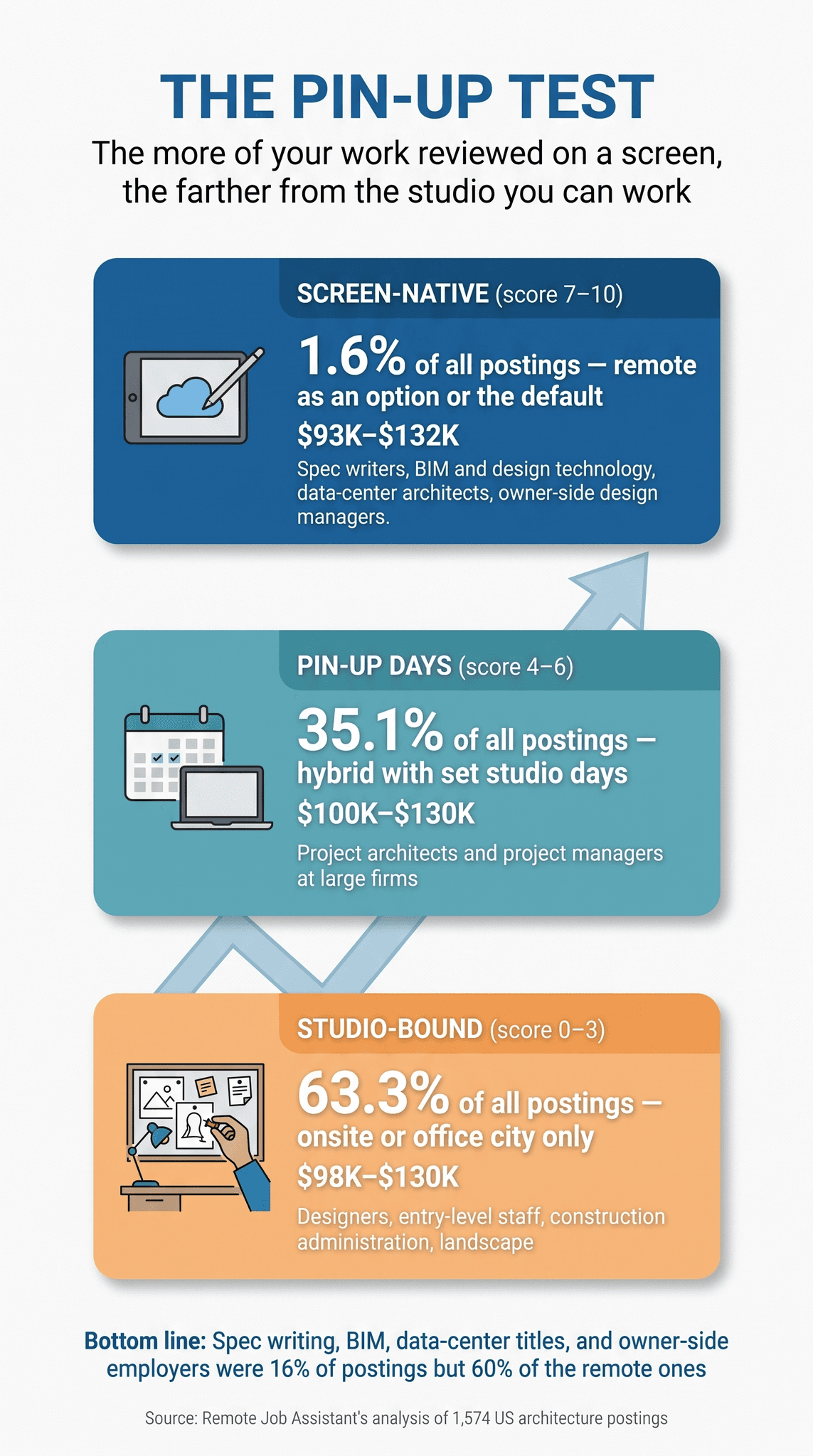
The Pin-Up Test: A 0–10 rubric that scores how much of an architecture role's review loop can run as markups on a shared file instead of pin-ups in a room. The more of your work that gets reviewed on a screen, the further from the studio the role can sit.
Score the role on three observable criteria:
- How your work gets reviewed (0–4): pin-ups, desk crits, charrettes, site walks, and owner-architect-contractor meetings score 0–1; Bluebeam sets and model reviews mixed with in-person design reviews score 2–3; work reviewed entirely as files (spec sections, model audits, BIM standards, prototype sheet sets) scores 4.
- Who is learning from whom (0–3): an AXP candidate or junior designer being trained at the desk scores 0–1; the licensed project architect who runs the team scores 2; the specialist, principal, or owner-side lead that other people send work to scores 3.
- What the posting says (0–3): an office city and nothing else, "not remote or hybrid," or "physically present ... Monday through Friday" scores 0; set office days score 1; remote as an option ("If you don't live near one of our offices," "may be filled anywhere in the United States") scores 2; remote as the stated location scores 3.
Scoring:
- 0–3 Studio-Bound ($98K–$130K median posted range): Onsite, or an office city with no statement at all. This is 63.3% of the market (n=996 of 1,574). It holds most design-phase designers, construction administration (0 of 28 remote), landscape architecture (0 of 70), production and job captain roles (0 of 24), and every entry-level posting we found. Corgan writes "physically present at the assigned office location Monday through Friday" into 43 of its 46 architecture postings.
- 4–6 Pin-Up Days ($100K–$130K): Hybrid, with set studio days. This is 35.1% of postings (n=553), mostly project architects and project managers at large firms. DLR Group follows "a four-day in-office work model" in all 61 of its postings; HOK and HMC keep Tuesday through Thursday in the office.
- 7–10 Screen-Native ($93K–$132K): Remote as an option or the default. This is 1.6% of postings (n=25): spec writers, BIM and design technology leads, data-center architects, owner-side design managers, and the CannonDesign seats that "may be filled anywhere in the United States." More than half of them name Bluebeam.
How to use it: Score the work and the posting separately. If your work scores 7 or higher but the posting names only an office city, ask about remote in the first screen and describe how you already run reviews as markups. If your work scores 0–3, stop spending applications on remote searches: negotiate the hybrid days instead, or move toward a role family whose review loop is already on screens.
| Pin-Up band | Postings | Share | Typical roles | Median posted range | Bluebeam named | Site-visit language | What holds it in the studio |
|---|---|---|---|---|---|---|---|
| 7–10 Screen-Native | 25 | 1.6% | Spec writers, BIM and design technology, data-center architects, owner-side design managers | $93K–$132K (n=15) | 52.0% | 8.0% | Travel and a first week in the office |
| 4–6 Pin-Up Days | 553 | 35.1% | Project architects and PMs at large firms | $100K–$130K (n=243) | 23.0% | 20.1% | Studio days for reviews and mentoring |
| 0–3 Studio-Bound | 996 | 63.3% | Designers, entry-level staff, construction administration, landscape | $98K–$130K (n=402) | 23.2% | 24.2% | The wall, the desk, and the site |
Our guide to remote civil engineering jobs found 3.5% of civil postings remote and traced it to The Jurisdiction Radius: civil drawings travel, but the county reviewer doesn't. Architecture is half as remote, at 1.6%, and its gate sits one step earlier. The approval isn't what keeps you close. The review inside the firm is. In architecture, the license isn't what keeps you in the office. The pin-up wall is.
If your work already scores 7 or higher, qualifying isn't the hard part. Finding 25 postings scattered across 16 employers' career sites, most of which never reach a job board, is.
Stop Applying Manually
Our AI applies to hundreds of matching jobs while you sleep. Wake up to interviews, not more applications.
How We Collected This Data
The figures in this post come from the live career sites of 125 employers, pulled in full on September 29 and 30, 2026, across 41 applicant-tracking systems and job feeds. That covers architecture firms' own boards (Gensler, Perkins&Will, HOK, DLR Group, Corgan, CannonDesign, HKS, SmithGroup, NBBJ, SOM, ZGF, and about 50 more), multidisciplinary design firms (HDR, Stantec, Jacobs, AECOM, Woolpert, Olsson, SSOE, and about 45 more), and owner-side employers with in-house design teams (Target, Hilton, and others), plus a sweep of Greenhouse, Lever, Ashby, and SmartRecruiters boards. Of the 1,312 postings that carried a date, 913 went up in June 2026 or later.
We kept building-architecture titles: architect and project architect, architectural designer, project and design managers in architecture, BIM and design technology, specifications, landscape architecture, planners, construction administration, production and job captain, and interior architecture. We excluded software, solutions, and enterprise architects, interns, drafters outside architecture, interior designers, and facilities roles. After a US filter and deduplication (one requisition posted in several office cities counts once), 1,574 postings remained. 660 of them (41.9%) published a pay range.
A posting counts as remote-eligible when it lets you work from home full time, even if only as one option. Hybrid means regular required office days. We used the employer's own workplace field first where one exists (AECOM, Workday, UKG, and Lever boards), then the posting text. We read all 25 remote postings in full, read every non-remote posting that mentioned remote work, and spot-checked the onsite and hybrid groups by hand.
Pay was cross-referenced with BLS Occupational Employment and Wage Statistics for May 2025, through the BLS Occupational Outlook Handbook for architects, and with the AIA salary calculator, which covers 13,227 positions at 817 firms as of January 1, 2025. The honest gaps: Reddit, Indeed, ZipRecruiter, and Glassdoor block automated collection, so none of their data appears here. And small practices are under-sampled. AIA counts more than 19,000 US architecture firms, 75% of them with fewer than 10 employees, and most small firms post on Archinect or their own websites rather than an applicant-tracking system. Archinect's remote region listed 41 jobs on September 29, against 634 US listings. Postings also can't show remote arrangements firms grant to people they already employ. A firm that posts zero remote roles may still let a senior architect move away; it just doesn't hire into it. Every figure reflects postings that were live on September 29–30, 2026, and we re-pull each hiring cycle.
What Remote Architects Earn in 2026
Remote doesn't pay more in architecture, and the sample is too small to call it a discount. The 15 remote postings that published pay had a median posted range of $93K–$132K, against $100K–$130K for hybrid postings (n=243) and $95K–$126K for onsite ones (n=77). The spread inside the remote group is wide, from CannonDesign's Architect II at $64,165–$80,155 to its Regional Design Director at $204,240–$255,300. Role and level move pay; the work model doesn't.
| Role family (by title) | Postings | Remote | Hybrid | Median posted range | Pin-Up band |
|---|---|---|---|---|---|
| Architect and project architect | 581 | 1.2% (7) | 37.2% | $100K–$130K | 4–6, some 7–10 |
| Project manager | 292 | 0.7% (2) | 39.7% | $112K–$148K | 4–6 |
| Architectural designer | 281 | 1.8% (5) | 29.9% | $76K–$95K | 0–3 |
| BIM and design technology | 130 | 3.1% (4) | 23.1% | $85K–$113K | 4–6, some 7–10 |
| Design leadership (principal, director, studio leader) | 83 | 3.6% (3) | 38.6% | $145K–$200K | 4–6, some 7–10 |
| Landscape architecture | 70 | 0% (0) | 25.7% | $84K–$101K | 0–3 |
| Planners (healthcare, lab, campus) | 44 | 2.3% (1) | 52.3% | $110K–$140K | 4–6 |
| Construction administration | 28 | 0% (0) | 25.0% | $99K–$139K | 0–3 |
| Specifications | 26 | 11.5% (3) | 34.6% | $112K–$142K | 7–10 |
| Production and job captain | 24 | 0% (0) | 37.5% | $76K–$92K | 0–3 |
Salary ranges come from the 660 of 1,574 postings in our September 2026 pull that published a range, cross-referenced with BLS wage data for architects. Posted ranges are employer-entered and skew toward states with pay-transparency laws; the BLS figures are the national anchor. Ranges shift as markets move.
The national anchor: BLS puts the May 2025 median wage for architects at $99,280. The middle half earned $77,960 to $126,550, the bottom tenth under $62,300, and the top tenth above $161,420. Who you work for moves it: the median was $115,920 in government and $98,440 in architectural and engineering services, which employs 74% of architects. The AIA calculator shows the ladder inside a firm. Architect I sits at a $76,500 median base, Architect II at $90,120, Architect III at $102,710, and Senior Architect at $124,540. Licensed architects out-earn unlicensed staff at the same level by 9.5% to 13.2% in AIA's figures, and AIA's 2025 compensation report said spec writers and medical planners "experienced stronger growth" while overall architect pay rose less than 3% a year from 2023 to 2025. Specifications, with a $114,000 AIA median, out-earns the Architect III median ($102,710) and is the most remote role family in our data.
Google keeps asking how an architect makes $200,000. From a posted salary in our data, only at the top: CannonDesign's remote Regional Design Director tops out at $255,300, MG2's remote Principal Architect for data centers at $200,000, and AIA's median for a managing principal is $175,000. The aggregator number on page one is a different animal. Remote Rocketship headlines its architectural designer page "$70K–$133K," averaged from 48 postings you can't see, on a page whose three highest posted ranges belong to software architects. When you compare offers, our $100K+ remote listings start where senior architecture roles do, and $150K+ positions are where principal and director seats show up.
As for whether AI is coming for the job: BLS says design work "is becoming more efficient due to improved building information modeling (BIM) software and measuring technology along with the integration of artificial intelligence," and still projects 4% growth from 2025 to 2035, about 6,900 openings a year. NCARB's April 2026 statement on AI keeps one line firm: only a licensed practitioner may seal drawings and take legal responsibility for them. The bigger near-term pressure is the market. AIA's billings index sat at 47.2 in August 2026, its reading for declining billings, with the Northeast at its weakest since 2020.
In architecture, the work model moves posted pay by a few thousand dollars. Seniority moves it by tens of thousands. Entry-level postings had a median posted range of $69K–$81K (n=49); senior ones, $115K–$150K (n=193).
If you're senior and your work already runs on markups, going remote costs you nothing on pay. The catch is that a posting like CannonDesign's or MG2's is one of 25, and it won't stay open long.
Stop Applying Manually
Our AI applies to hundreds of matching jobs while you sleep. Wake up to interviews, not more applications.
Five Places Remote Architecture Work Actually Exists
Remote architecture work isn't spread thinly across the profession. It clusters. Spec writing, BIM and design technology, data-center titles, and owner-side employers made up 16.0% of postings (n=252 of 1,574) but 60% of the remote ones (n=15 of 25). Everywhere else, remote was 0.8% (n=10 of 1,322). Here are the five lanes, each scored on The Pin-Up Test, with the condition attached to each.
Read those 25 postings closely and a second pattern shows. Remote is usually offered as a way around geography, not as the way the firm works. In 16 of the 25, remote sits next to a list of offices as one option, in words like Woolpert's "for qualified out of state candidates" or Cuningham's "If you don't live near one of our offices." Only 9 make remote the default location. The practical upshot: you're likeliest to get a remote seat as the strong candidate who lives in the wrong city, so apply to the right postings in cities you don't live in, and say in the first line that you'd work remotely.
Lane 1: Specifications (Screen-Native, 8–9; the condition is product knowledge). 3 of 26 specification postings were remote (11.5%), the highest share of any role family. LMN Architects' Specifications Writer posts $120,000–$140,000 and says "This role offers flexibility in hybrid or remote work and part-time arrangements." Jacobs titles its Architectural Specifications Writer "Remote," and the body adds that "a fully remote situation will also be considered." TVS Design lists "Remote" among the locations for its Specification Writer. The reason is in the work itself: a spec section gets reviewed as a document. Nobody pins up Division 08. If you know products, MasterSpec, and how a spec book coordinates with a drawing set, this is the most portable job in a firm. Spec writing has a reputation as back-office work that designers hand off. The pay says otherwise: the AIA calculator puts its median at $114,000, and posted ranges ran to $130,000–$160,000 at HOK and $149,671–$171,053 for STV's Senior Architect/Spec Writer. The credential rule is unusually clear. 22 of the 26 spec postings name CSI's Certified Construction Specifier (CCS) or Construction Documents Technologist (CDT) credential. The CDT is the entry ticket: CSI's only formal requirement is a high school diploma, with two years of construction experience "highly recommended."
Lane 2: BIM and design technology (7–9; the condition is that you own the standards). Olsson's BIM Manager for data centers is located "Remote" and posts $85,000–$135,000. Salas O'Brien's BIM/VDC Specialist lists "Location: Remote" and "Travel: None," at $75,000–$95,000. AECOM's BIM Specialist carries "Work Location Model: Remote." CannonDesign's Senior Project Design Technologist, at $88,600–$110,700, runs onboarding for "digital strategy, workflows, collaboration platforms, and firm standards." Coordination tools show up here at twice the market rate: Navisworks, Autodesk Construction Cloud, or clash detection in 28.0% of remote postings (n=7 of 25), against 13.4% overall. The remote BIM seat belongs to the person who writes the standards and audits the models, not the person modeling to them. If that's your target, the BIM postings tell you what to learn first: Navisworks in 77 of 130 (59.2%), a BIM execution plan in 45, and Dynamo in 34.
Lane 3: Data-center and national programs (7–8; the condition is travel and a license). 5 of 80 data-center and mission-critical postings were remote (6.2%), the highest share of any market. AECOM's "Senior Architect (Licensed Building Architect), Data Centers - Remote (U.S.)" can be "based from a variety of locations in the US where AECOM has an office," with travel "occasional and scheduled in advance." MG2's Principal Architect for data centers lists "US-Remote" first among seven locations and posts $125,000–$200,000. Woolpert's Senior Architect (Mission Critical), at $118,200–$147,800, says "Remote working opportunities are an option for qualified out of state candidates." These are one owner with sites in many states, the same pattern that made data-center site civil 28.6% remote in our civil engineering data.
Lane 4: Owner-side design management (7–9; the condition is travel and fewer drawings). Owner-side employers were remote in 4 of 27 postings (14.8%), against 1.4% at architecture firms (n=14 of 996). Target's Senior Designer for store design architecture posts $73,000–$132,000 and "may be considered for a Remote or Hybrid" arrangement; remote at Target means a team member who "does not have a desk at a Target location and may travel to HQ up to 4 times a year." Hilton's Director of Architecture, Design & Construction (Lifestyle), at $110,000–$145,000, is based in "McLean, VA, New York, NY or Remote," with travel of 40–50%. Primer, a network of K–8 schools, posts a remote Architectural Designer II and a remote Architectural Project Manager. Its description: "Every new Primer campus starts as an empty building in a city where we've never operated," and "you're the one chasing the inspector and keeping the civil engineer on schedule." On the owner side you review other architects' drawings instead of producing them, which is why the job travels. If that sounds like project management with a design eye, our guide to remote project manager jobs covers the broader track.
Lane 5: The firm that says "anywhere" and the senior exception (6–8). One firm stands out. 7 of CannonDesign's 35 architecture postings say the position "may be filled anywhere in the United States," including a Project Architect V in healthcare at $111,615–$139,545. Even there, preference can tilt local: its Project Manager IV adds that "preference will be given to candidates near to offices in St. Louis, MO, Houston, TX, and Dallas, TX." Other firms open the door for the right person. Cuningham: "If you don't live near one of our offices, remote work is an option." SSOE offers "a hybrid or fully remote work schedule option" on a Senior Architect role it posted in three cities, at $110,000–$130,000. Salas O'Brien's Architect lists "Location: Remote or in office, flexible" with travel up to 25%, at $90,000–$130,000.
There's a sixth place our data can't count: small, virtual practices that never touch an applicant-tracking system. AIA profiled Architects Fora, "a 12-person virtual firm," and Shepley Bulfinch, where "25 employees are assigned to the virtual studio." In AIA's May 2023 billings survey, 33% of smaller firms said most or all paid workdays were worked remotely, against 2% of larger ones. At Shepley Bulfinch, AIA reported, many designers "do work side by side—they just do it via video conference," and CEO Angela Watson put the rule simply: "The only important thing is that teams need to communicate and support each other." The catch is competition. AIA reported that the most recent job posting from Leah Bayer, who leads Architects Fora, "received 300 applications within 24 hours." Archinect's remote job board is where most of those small-firm listings surface.
The location line and the body disagree often enough that a remote tag is only a first filter.
CannonDesign tags two construction administrator roles "United States - Remote," and both bodies say "This position requires consistent ONSITE presence at the project site in Rochester, MN." Its healthcare PM posting is located "United States - Remote" and says "Weekly onsite presence required." LMN's remote-flexible spec writer role sits under a firm schedule where "Employees collaborate in the office on Monday, Tuesday, Wednesday, and Thursday." The location field is a recruiter's checkbox. The paragraph is the hiring manager.
What isn't remote, and won't be soon: construction administration (0 of 28), landscape architecture (0 of 70), production and job captain work (0 of 24), education projects (0 of 70), and healthcare, the biggest market by title, at 2 of 181. Those are the jobs with the most pin-ups, site walks, and user-group meetings per week. A designer sending applications to "remote" K-12 or healthcare postings is fishing in a pond that barely exists.
Find your lane in three questions:
- 1. Is your work reviewed mainly as documents: spec sections, model audits, BIM standards, prototype sheet sets? If yes, you're in Lane 1 or 2. Apply to screen-native postings now and put the standards you've written, or the spec systems you've run, in the first three lines of your resume. If no, go to question 2.
- 2. Are you licensed, or senior enough to be the reviewer rather than the reviewed? If no, stop chasing remote for now. None of the 83 entry-level postings were remote, so the fastest route to a remote seat is the license and a few years of running teams. If yes, go to question 3.
- 3. Do you work on programs with one owner and many sites: data centers, retail rollouts, hotels, schools? If yes, you're in Lane 3 or 4. Target the data-center groups at AECOM, MG2, and Woolpert, or move to the owner side. If your work is one building at a time for one client, you're in Lane 5: ask for the "anywhere" exception in the first call, and get the travel percentage in writing.
Hybrid Is the Real Market: What the Big Firms Require
For most architects, the realistic target isn't remote. It's a good hybrid schedule. Firms posted 553 hybrid jobs against 25 remote ones, and hybrid in architecture runs heavier than in most fields. Of the 122 hybrid postings that state an office-day count, 84 require four days and 36 require three. Two firms drive the four-day number, so read it as a firm policy rather than a norm: DLR Group accounts for 61 of those postings and BHDP for 21 ("In-Office Monday – Thursday; Hybrid (remote or in-office) Friday"). HMC and HOK put the home days on Monday and Friday.
| Employer | Architecture postings | Remote | Hybrid | Work-model language in the postings | Median posted range |
|---|---|---|---|---|---|
| Gensler | 178 | 1 | 0 | "This role is not remote or hybrid" or similar on 70 | $100K–$130K |
| HDR | 96 | 0 | 0 | 95 say nothing about work model | Not posted |
| Perkins&Will | 87 | 0 | 56 | Employer's own workplace field says hybrid on 54 | $98K–$138K |
| DLR Group | 61 | 0 | 61 | "a four-day in-office work model" | $97K–$145K |
| HOK | 55 | 0 | 55 | "a hybrid work environment"; 7 add home days on Mondays and Fridays | $120K–$140K |
| Corgan | 46 | 0 | 0 | "physically present at the assigned office location Monday through Friday" on 43 | $92K–$130K |
| CannonDesign | 35 | 7 | 3 | "may be filled anywhere in the United States" on 7 | $92K–$115K |
| AECOM | 29 | 2 | 24 | In-person Day 1 onboarding on 26 | Not posted |
The firms say why in their own words. HMC Architects offers "a hybrid work arrangement with flexible hours, requiring three days in the office and the option to work remotely on Mondays and Fridays." KPF: "This position requires you to be in person in our New York office 5 days per week." The logic matches what AIA heard from firm leaders: mentoring and review are the reason for the studio days, so those are the days that won't move. Don't negotiate the policy. Negotiate the day. Ask which days hold pin-ups and client meetings, and whether your home day is Monday, Friday, or a floating one.
Week one is almost never remote, either. AECOM writes "all newly hired employees are required to attend an in-person Day 1 onboarding at an AECOM office location as a condition of employment" into 26 of its 29 architecture postings, including both remote ones. Budget for an office start, and get the date remote begins in the offer letter, not in a recruiter's email.
The remote week itself isn't desk-only, either. 12 of the 25 remote postings say you'll travel; one, Salas O'Brien's BIM role, says "Travel: None." Target's remote designers "may travel to HQ up to 4 times a year." AECOM's remote data-center architect should expect travel "for client meetings, key project milestones, onsite collaboration sessions, or other business‑critical activities." Harley Ellis Devereaux asks its remote-capable mission-critical designer to travel "to and from project sites to attend client, project, and construction meetings," and Hilton's design director travels 40–50% "for owner meetings, design reviews, site inspections and openings across North America." In architecture, remote means your desk is at home. Your calendar isn't.
When you're holding a remote offer and a hybrid one, run five checks:
- Travel under 25% with a named home base is a remote job. At 40–50%, it's a traveling role with a home address. Price the time away.
- "Preference will be given to candidates near to offices" means you're the backup candidate. You can still win the seat, but get the review cadence and the start date in writing.
- In-person onboarding costs someone a flight. Ask who pays before you accept.
- A four-day hybrid seat is roughly 50 more office days a year than a three-day one. If two hybrid offers pay the same, that's the difference.
- No stated review process on a remote seat is a question, not a detail. Ask whether design reviews happen in Bluebeam, in the model, or at a wall you'd fly to.
License, AXP, and Stamps When You Work Remotely
On The Pin-Up Test, "who is learning from whom" is the criterion people misread. The rules don't stop a licensure candidate from working remotely. Firms do.
If you're earning AXP hours. NCARB's experience program requires 3,740 hours, and at least 1,860 of them must be in an architecture firm under an architect licensed in the US or Canada. NCARB's own guidelines say those hours "may be earned via in-person or remote work," that direct supervision can happen "through personal contact and/or remote communication," and that your supervisor "does not have to be registered in the jurisdiction where they or you are located." Unpaid internships don't count. The one exception to check: New York tells candidates to confirm supervisor requirements with its state board. NCARB's advice for remote supervision is to hold the check-ins on video rather than the phone. So the hours can be remote. The job offer usually won't be: 0 of 83 entry-level postings in our data were.
If you're taking the ARE. The exam has six divisions at $263 each, $1,578 in total, and you can test online "24 hours a day, 365 days a year," and not only in the state where you'll be licensed. The 2025 pass rate was 55%, and the average candidate took 9 attempts across the six divisions. Earning a license took 12.3 years on average in 2025, by NCARB's count; candidates who finished the AXP that year took 4.3 years to do it, and the exam took 2.0 years, a record low. One scheduling change matters now: from October 1, 2026, you can't cancel or reschedule within seven days of an appointment, and the cancellation fee rises from $105 to $200. A failed division can be retaken after 60 days, no more than three times in any 12 months. The AXP has its own clock. Since November 2025, experience up to a year old earns 100% credit and anything older earns 75%. If your supervisor is remote and signs off quarterly, that rule costs you nothing. If your hours sit unreported for a year, it costs you a quarter of them.
If you're licensed and want to work across state lines. A stamp is only good where you're licensed. NCARB says it plainly: "architects can only provide professional services in jurisdictions where they're licensed." The NCARB Certificate is the shortcut: all 55 US jurisdictions accept it and 25 require it for a reciprocal license. It costs $1,415 to apply and $300 a year to keep, with about 30 business days for evaluation, and 51,519 architects held one in 2025. New York is the strictest about where the project sits: architecture services for a New York site must be performed by someone authorized in New York "whether for a New York client or an out-of-state client," and practicing without authorization is a class E felony. Florida's statute has the tightest supervision wording in the states we checked, "direct personal supervision and control throughout the preparation," so if you're supervising Florida work from another state, document every review.
Which key to cut first:
- AXP candidate? Finish the hours in a hybrid seat and ask for video supervision on your home days. The rules allow it; remote offers at your level almost never exist.
- Licensed in one state, eyeing a national data-center or owner-side role? Start an NCARB Certificate before the offer, so reciprocity doesn't delay your start.
- Licensed and senior? You're the reviewer now. That's the profile behind 15 of the 25 remote postings, so ask for the remote option directly.
- Strong on specs or BIM standards? Lead with the systems you've run. Those are the two role families where the work already travels.
- Freelancing in California? It's a misdemeanor there for someone without a license to advertise to the public as an "architectural designer." Check the title before it goes on a website or a proposal.
Offshore production is the competition few job seekers see. Staffing platforms now place remote Revit and construction-document drafters with US firms, and Mississippi rewrote its rules in November 2024 to let architects use "third-party off-site drafting services," provided the service does no original design. That's the strongest argument for moving up The Pin-Up Test: remote production work is exactly the work being priced against it.
If you already hold what these postings ask for, such as a license, a CCS, or a set of BIM standards you wrote, you're competing with the short list of people who hold it too. In a market of 25 postings, getting your application in during the first week matters more than polishing it for a second.
Stop Applying Manually
Our AI applies to hundreds of matching jobs while you sleep. Wake up to interviews, not more applications.
How to Search for Remote Architecture Jobs Without Getting Software Architect Results
The word "architect" is the problem. In LinkedIn's US search for "architect," 202 of 270 unique listings (74.8%) were software, IT, or other tech roles; one consulting firm alone accounted for 61. WorkingNomads' index had 649 "architecture" matches and one building-architecture job. Specific titles clean it up: "project architect" returned 20 of 20 building roles, and "architectural designer" 16 of 20. "Specification writer" returned architecture roles in only 5 of 20 (door-hardware and proposal writers crowd it), and "job captain" returned 0 of 20: restaurant shift leads. Search the firms' own career sites and Archinect's remote region first. The best remote job boards for architects are mostly company boards, and our design listings are another place to start.
Red flags in remote architecture postings. Walk away, or at least ask:
- "Remote" in the location list and "consistent ONSITE presence" in the body. That's a site job with a remote tag.
- "Remote possible" on a title that says "On-Site." We found one on Archinect. Believe the title.
- Travel of 40–50% presented as remote. That's a traveling role with a home address, and it should be priced like one.
- A remote seat with no word on how design reviews happen. If the posting and the recruiter can't say, the reviews are in a room you won't be in.
- "Remote" tied to a preference for candidates near an office. Ask how many people on the team actually work remote today.
- A freelance gig that wants you to market yourself as an "architectural designer" in California without a license. California law restricts that title in advertising to the public.
Two questions settle most of this in the first screen. "How do design reviews happen for remote staff: Bluebeam sessions, model reviews, or a pin-up I'd fly in for?" And, if you're still earning hours: "Who supervises my AXP hours, and how often do we meet on video?" A firm that answers both without hesitating has done this before. If your applications are going out and nothing comes back, the problem is usually targeting, not qualifications, and our guide to why qualified candidates don't get interviews applies with extra force in a market this thin.
Frequently Asked Questions
Can an architect actually work fully remote, or is every remote architecture job really hybrid?
Fully remote architecture jobs exist, but they're rare: 1.6% (n=25 of 1,574) of the US architecture postings we analyzed in September 2026 were remote-eligible, against 35.1% hybrid. That's 22 hybrid postings for every remote one. The remote seats cluster in spec writing, BIM and design technology, data-center programs, and owner-side design management.
Which architecture jobs are most likely to be remote?
By role, specifications writers led at 3 of 26 postings (11.5%). By employer, owner-side design teams were remote in 4 of 27 postings (14.8%), and by market, data-center titles were remote in 5 of 80 (6.2%). Construction administration (0 of 28), landscape architecture (0 of 70), and entry-level roles (0 of 83) had no remote postings. The pattern follows how the work is reviewed: documents travel, pin-ups don't.
What does a Pin-Up Test score of 5 mean for my job search?
A 5 means your work is partly reviewed on screen but the firm still holds reviews and mentoring in the studio, so expect a hybrid seat with three or four office days. Search for hybrid roles and negotiate which days are home days rather than chasing full remote. To reach 7 or higher, move toward work that is reviewed as files, such as specs, BIM standards, or owner-side design management, or toward seniority where you do the reviewing.
I'm working toward my license. Do my AXP hours count if I work remotely?
Yes. NCARB says experience-setting hours "may be earned via in-person or remote work" and has allowed remote direct supervision since 2010, as long as your supervisor keeps control over your work. Your supervisor doesn't need to be licensed in the state where you live. The obstacle is the job market: none of the 83 entry-level postings in our data were remote, and New York candidates should confirm supervisor rules with their state board.
I'm licensed in one state. Can I work remotely for a firm in another state?
Yes, if you hold a license in each state where your projects are located. Architects "can only provide professional services in jurisdictions where they're licensed," per NCARB. The NCARB Certificate, accepted by all 55 jurisdictions and required by 25, costs $1,415 to apply and $300 a year, and evaluation takes about 30 business days, so start it before an offer.
How much do remote architects make, and can an architect earn $200K remotely?
The median posted range on remote architecture postings was $93K–$132K (n=15), close to hybrid at $100K–$130K. BLS puts the national architect median at $99,280 and the 90th percentile at $161,420. $200K+ remote pay exists only at the top: CannonDesign's remote Regional Design Director posts $204,240–$255,300 and MG2's remote data-center Principal Architect posts up to $200,000.
Why does searching "remote architect jobs" show mostly software jobs?
Because "architect" is a common software title. In LinkedIn's US search for "architect," 74.8% of listings (n=202 of 270) were software or IT roles, and the top Google result for remote architecture jobs had 0 building roles out of 60. Search "project architect," "architectural designer," or "BIM manager" instead, and check firm career sites directly.
Start Your Remote Architecture Job Search
Twenty-five remote postings across 125 employers is a thin market, and for most architects the honest target is a better hybrid seat, not a remote one. Start by scoring yourself on The Pin-Up Test. If your work already runs as markups and you're senior enough to be the reviewer, apply now: the employers are named above, and 25 postings go fast. If you're at 4–6, pick the hybrid firm whose studio days fit your life and negotiate the day. If you're at 0–3, finish the license and move toward specs, BIM standards, data-center programs, or the owner side. Our guide to remote civil engineering jobs and the broader remote engineering jobs guide show how the same question plays out next door, and our list of certifications that move remote offers covers what's worth adding. For more high-paying options, see high-paying remote work across fields. When you're ready to apply at volume, Auto-Apply gets your applications in front of the few firms that hire this way before the seats close.
A building still needs someone at the pin-up wall. The spec that holds it together can be written from anywhere.
Ready to Find Your Remote Job?
Browse thousands of curated remote jobs or let AI apply for you.
Browse Remote JobsRelated Job Guides
Remote Civil Engineering Jobs: What 4,770 Postings Show
Remote civil engineering jobs are rare: 165 of 4,770 postings. See which specialties hire remote, what they pay, and why most seats stop at a state line.
33 min read
Remote Electrical Engineering Jobs: What 2,220 Postings Show
Remote electrical engineering jobs are mostly power jobs: 56 of 127 remote postings were grid roles. See who hires, what they pay, and what gates apply.
34 min read
Remote Jobs for Seniors: What 4,435 $75K+ Postings Show
Remote jobs for seniors that pay $75K+: we read 4,435 remote postings for age signals. Pay climbs from $115K to $201K with experience. Here's where to aim.
32 min read