
Last reviewed: April 2026
You rewrote a checkout button from "Complete Purchase" to "Start My Free Trial" and watched the conversion rate climb 0.8 points overnight — roughly $14K in monthly revenue from three words. Your manager called it "a nice tweak." Meanwhile, a content copywriter at the same company wrote 12 blog posts that month and earned the same performance rating you did. You are both "copywriters." You are not doing the same job.
The word "copywriter" covers at least six distinct specializations with salary gaps of $40K or more between them. A remote content copywriter earning $55K and a remote conversion copywriter earning $120K share a job title and almost nothing else. The difference is not writing talent — it is how close your words sit to a purchase decision. And the frustrating part is that most job postings, salary surveys, and career advice collapse all six specializations into one bucket, which is why every "copywriter salary" article on the internet gives you a range so wide it means nothing.
Get Remote Job Tips in Your Inbox
Weekly strategies, salary data, and new opportunities
Unsubscribe anytime. No spam.
We analyzed 485 remote copywriter job postings across 138 companies between October 2025 and March 2026. The data reveals a market where specialization — not years on the job — drives the biggest salary jumps, where AI proficiency has become table stakes at every level, and where the gap between writing "for awareness" and writing "for revenue" is worth $30K–$50K in base pay. Here is what actually separates a $55K remote copywriter from a $130K one.
Based on our analysis of 485 remote copywriter postings across 138 companies (October 2025–March 2026):
- 61% (n=296 of 485) required SEO or keyword research proficiency
- 47% (n=228 of 485) listed AI tool proficiency (ChatGPT, Jasper, or similar) as required or strongly preferred
- 73% (n=354 of 485) offered fully remote work with no on-site requirement
- $76,400 median base salary across all remote copywriter roles; $103,000 median for conversion and UX specializations
- 35% (n=170 of 485) salary premium for roles explicitly tagged "conversion," "UX," or "product" copy versus general content copywriting
- 52% (n=252 of 485) required experience with email marketing platforms (HubSpot, Klaviyo, Marketo, or Mailchimp)
How We Collected This Data
The figures in this post come from our analysis of 485 remote copywriter job postings collected between October 2025 and March 2026. Postings were sourced from LinkedIn, Indeed, Built In, We Work Remotely, and direct company career pages, then filtered to include only positions explicitly marked remote-eligible in the United States and Canada with a posted base salary or compensation range.
We excluded postings without clear remote policies, roles requiring more than 25% travel or on-site presence, and freelance or contract positions under three months. Salary data was cross-referenced with Built In's 2026 Remote Copywriter Salary Report, Glassdoor compensation data, and the U.S. Bureau of Labor Statistics Writers & Authors occupational data (May 2024, the most recent available). Ranges reflect base salary; total comp including bonus typically runs 10–20% higher at mid-stage and public companies.
We update this analysis quarterly. Data in this post reflects Q1 2026 figures.
The Copy Specialization Ladder: Why "Copywriter" Means Six Different Jobs
The single biggest predictor of a remote copywriter's salary is not years of experience or portfolio size. It is revenue proximity — how directly your words influence whether someone opens a wallet. This is the variable every generic "copywriter salary" article ignores, and it explains why two people with the same title and similar resumes earn wildly different numbers.
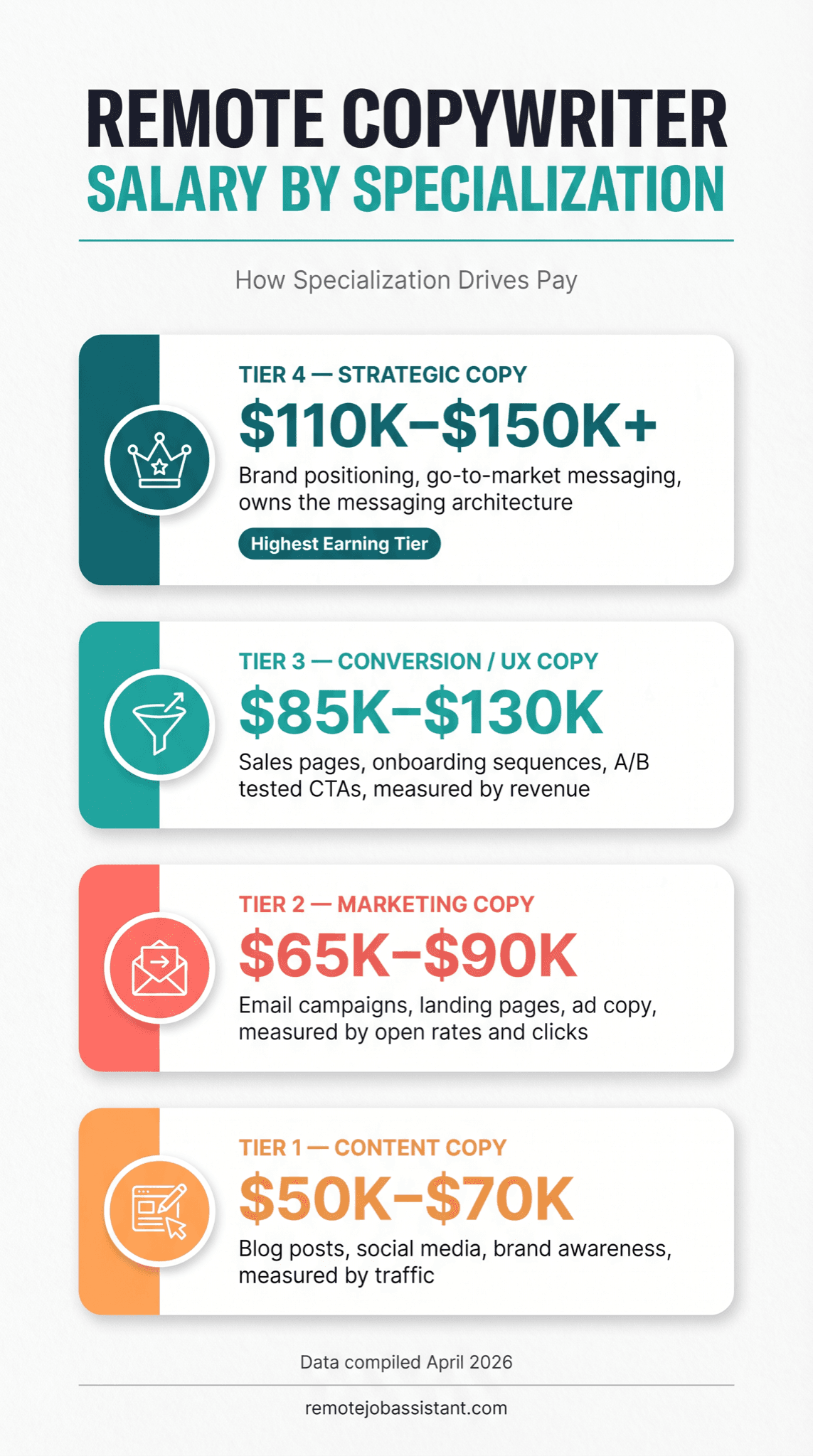
The Copy Specialization Ladder: A framework for mapping copywriting roles to salary tiers based on how directly the copy influences revenue.
Scoring:
- Tier 1 — Content Copy ($50K–$70K): Blog posts, social media captions, brand awareness articles. Measured by traffic and engagement metrics, not revenue. This is the entry point for most remote copywriters and the tier most disrupted by AI — 47% (n=228 of 485) of all postings now expect you to use generative AI tools to produce first drafts at this level. The writing is solid but interchangeable. If your manager could swap your blog post for a ChatGPT draft and nobody on the team would notice, you are Tier 1.
- Tier 2 — Marketing Copy ($65K–$90K): Email campaigns, landing pages, ad copy, newsletters. Measured by open rates, click-through rates, and lead generation. Requires channel-specific expertise plus basic analytics literacy. You are not just writing — you are optimizing. The difference from Tier 1 is accountability to a number. A Tier 2 copywriter knows their last email campaign had a 22% open rate and a 3.1% click-through. A Tier 1 copywriter knows they wrote it.
- Tier 3 — Conversion Copy ($85K–$120K): Sales pages, product copy, onboarding sequences, A/B tested CTAs, lifecycle email flows. Measured by revenue impact — trial-to-paid conversion, cart abandonment recovery, upsell rates. Requires data literacy, CRO knowledge, and an understanding of buyer psychology that goes beyond "write persuasively." This is where the salary curve bends. One senior conversion copywriter we found in the r/copywriting community described her job as "writing two sentences, testing them against each other for a week, and defending the winner to a VP with a spreadsheet."
- Tier 4 — Strategic Copy ($110K–$150K+): Brand positioning, go-to-market messaging, product-led growth copy. Owns the messaging architecture other copywriters execute against. Measured by market positioning outcomes, launch performance, and competitive differentiation. At this level your title may be "Head of Copy," "Brand Strategist," or "Director of Content." Fair warning: many "strategic" postings at this tier overpromise influence — you may be told you will own messaging architecture but spend your first six months fighting to get invited to product roadmap meetings. Ask in the interview who the copy team reports to and whether a copywriter has ever vetoed launch messaging. The answer tells you whether this is real strategic influence or a fancy title on order-taking.
How to use it: Identify which tier describes your current daily output — not your title, your actual deliverables. Then look at the next tier's requirements. That gap is your 6–12 month development plan and the talking track for your next salary negotiation. If you are a Tier 1 content copywriter who wants Tier 2 money, the question is not "how do I write better?" It is "can I write an email sequence and tell me what the open rate was?"
The difference between a $60K and a $120K remote copywriter is almost never writing quality. It is whether your copy sits next to a "Buy Now" button or a "Read More" link.
Stop Applying Manually
Our AI applies to hundreds of matching jobs while you sleep. Wake up to interviews, not more applications.
What Remote Copywriters Actually Earn in 2026
The salary "range" you see on job boards — $50K to $130K — is technically accurate and practically useless. It collapses six different specializations into one number, which is how junior copywriters end up chasing $110K "conversion copywriter" roles with zero data in their portfolio and wondering why nobody calls them back. That range hides the real story: most roles below $70K are content positions where your output is increasingly replaceable by AI, while roles above $100K expect you to prove revenue impact with numbers on day one. Here is what the data looks like when you separate the specializations and control for experience.
| Specialization | Entry (0–2 yrs) | Mid (3–5 yrs) | Senior (6+ yrs) |
|---|---|---|---|
| Content Copywriter | $48K–$60K | $60K–$75K | $75K–$95K |
| SEO Copywriter | $52K–$65K | $65K–$85K | $85K–$105K |
| Email/Marketing Copywriter | $55K–$70K | $70K–$90K | $90K–$110K |
| Brand/Creative Copywriter | $58K–$72K | $72K–$95K | $95K–$120K |
| Conversion/DTC Copywriter | $60K–$78K | $78K–$100K | $100K–$130K |
| UX Copywriter | $65K–$80K | $80K–$105K | $105K–$130K |
Salary ranges derive from our analysis of 485 remote copywriter postings between October 2025 and March 2026, cross-referenced with Built In compensation data (average base $89,970) and Glassdoor remote copywriter reports. We excluded outliers and postings without clear remote policies. Ranges shift as markets move — check the linked sources for current figures.
The BLS reports a median annual wage of $73,690 for writers and authors as of May 2024 — but that category includes novelists, screenwriters, and journalists alongside copywriters. Remote-eligible copywriting roles in our dataset averaged $76,400 base across all specializations, with conversion and UX roles pulling the average up significantly.
The floor and ceiling of copywriter pay represent fundamentally different jobs. A content copywriter earning $55K is measured by blog traffic. A conversion copywriter earning $120K is measured by revenue generated. The employer paying $120K is not paying for better sentences — they are paying for someone who understands why a three-word CTA change increased checkout completion by 12%. If your portfolio only shows writing quality and not business impact, you are competing for the bottom half of that range.
The career path from Tier 1 to Tier 4 on the Copy Specialization Ladder is not automatic — and here is the part nobody mentions in career advice posts. Many copywriters spend an entire career in Tier 1 or Tier 2 not because they lack talent but because their employers have no incentive to develop them into Tier 3. A company paying you $65K to produce blog content does not want you spending Tuesday afternoon learning CRO. They want Tuesday's blog post. The transition to Tier 3 almost always happens by switching companies, not by growing within one. You build the conversion portfolio on the side — on a friend's e-commerce site, a nonprofit's fundraising page, your own side project — and then you interview for a role at the next tier. Waiting for your current employer to "promote you into conversion copy" is how you stay at $65K for five years.
Who Is Hiring Remote Copywriters in 2026
Not all remote copywriter jobs are created equal. The companies worth targeting are the ones where copywriters have strategic influence — and where the budget reflects it. Here is where 485 postings clustered.
Remote-first companies with dedicated copy teams: Automattic (WordPress.com), GitLab, Zapier, Buffer, Deel, and Toptal run fully distributed operations where copywriters work alongside product and marketing teams without a physical office. These companies tend to hire Tier 2 and Tier 3 copywriters — they expect you to own a channel, not just fill a content calendar. Comp ranges typically run $75K–$120K base depending on specialization. One trade-off worth knowing: several remote-first companies pay 10–15% below market compared to hybrid tech companies because they factor in the flexibility premium. They know you will trade salary for the lack of commute, and they price accordingly.
A strong subset of the market comes from SaaS and B2B tech companies that have shifted to remote or hybrid-remote hiring for copy roles. Canva, HubSpot, Shopify, Stripe, Webflow, and Mailchimp (Intuit) all actively hire remote writing professionals in copywriting functions. These roles often live inside product marketing or growth teams — meaning you write product copy, launch messaging, or lifecycle emails rather than blog content.
Industries paying premium rates for remote copywriters: SaaS and B2B tech pay the highest base — 22% (n=107 of 485) of all remote copywriter postings came from software companies, with a median base of $92,000. Financial services and fintech followed at $85K median, driven by compliance-aware copy needs. Healthcare and pharma pay well for regulatory copywriting but post fewer fully remote roles. E-commerce and DTC brands hire heavily for conversion-focused email and product copy at $75K–$110K, with performance bonuses tied to campaign results.
If you are looking for openings across multiple remote job boards, start with companies where copywriters report to product or growth teams — not communications or PR. The reporting structure predicts the comp band more reliably than the job title.
Stop Applying Manually
Our AI applies to hundreds of matching jobs while you sleep. Wake up to interviews, not more applications.
Skills That Actually Get You Hired — Not Just Listed
Job descriptions for remote copywriters list 12–15 skills. Hiring managers care about 3–4 depending on which tier they are hiring for. The mismatch is not accidental — job descriptions are written by HR, hiring decisions are made by the marketing lead or creative director who needs a specific problem solved.
| Skill | Content Copy | Marketing Copy | Conversion Copy | Strategic Copy |
|---|---|---|---|---|
| SEO & keyword research | Required | Useful | Rarely relevant | Rarely relevant |
| AI tool proficiency | Required | Required | Expected | Expected |
| A/B testing literacy | Not expected | Useful | Required | Required |
| Analytics & data interpretation | Useful | Required | Required | Required |
| Brand voice development | Useful | Useful | Useful | Required |
| CRO / conversion knowledge | Not expected | Useful | Required | Required |
| Email platform expertise | Useful | Required | Required | Useful |
| UX writing & microcopy | Not expected | Not expected | Useful | Required |
The skill that shifted the most in the past 18 months is AI proficiency. It is no longer a differentiator — it is a baseline. Forty-seven percent (n=228 of 485) of postings in our dataset listed AI tool experience as required or strongly preferred. The reason is structural: companies that used to hire three content copywriters now hire one senior copywriter who uses AI for first drafts and iterates. The survivors earn more. The bar is higher. And the copywriters most at risk are the ones producing work that AI already produces well enough — generic blog content, social media posts, and basic product descriptions.
AI did not kill copywriting. It killed the job where someone paid you $55K to write blog posts that generative AI now produces in 30 seconds. The copywriters still standing are the ones whose judgment — knowing which angle converts, which objection to address first, which word choice changes a 1.8% conversion rate to a 2.6% one — is worth more than their output volume.
Here is the uncomfortable subtext behind "AI tool proficiency required": it is often a polite way of saying the company expects you to do the work of two to three people without additional headcount. The posting says "we use AI to enhance your workflow." The reality is frequently "we laid off two writers and you are absorbing their output with ChatGPT as your unpaid intern." Ask in the interview how the team's headcount changed in the past year. The answer reveals whether AI is a tool or a justification for understaffing.
For any copywriter evaluating whether their skill set is competitive, the question is not "can I write well?" The question is "can I prove that my copy moved a number?" If the answer is yes, your negotiating position is strong. If the answer is no, you are competing with AI on output speed — and you will lose that race. Start building proof now. Hotjar Academy offers a free 30-minute introduction to heatmaps and session recordings — learn it, run it on any page you have access to, and screenshot what you find. Run a Mailchimp A/B subject line test (their official A/B testing guide walks you through setup in 15 minutes) and document the result. CXL offers a conversion copywriting course that teaches buyer psychology and CRO fundamentals in about 10 hours — worth the investment if you are serious about Tier 3 money. Even a modest lift — "subject line B increased opens by 8% over 2,000 subscribers" — is a portfolio data point that separates you from every applicant who only shows prose. Building your resume around measurable impact rather than writing samples is the single highest-leverage career move for a mid-career copywriter.
The Career Path From Junior Copywriter to Creative Director
The copywriter-to-Creative-Director pipeline exists and is one of the most reliable high-earning career tracks in marketing. But most remote copywriters cannot map the steps because the path is rarely discussed outside agency culture. Here is the progression with realistic timelines and the transition skills that matter at each stage.
| Level | Typical Title | Base Salary | Years | What Gets You Promoted |
|---|---|---|---|---|
| 1 | Junior Copywriter | $48K–$65K | 0–2 | Volume, speed, ability to match a style guide |
| 2 | Copywriter | $60K–$85K | 2–4 | Owns projects end-to-end, shows measurable results |
| 3 | Senior Copywriter | $85K–$115K | 4–7 | Campaign ownership, brand voice authority, mentors juniors |
| 4 | Lead Copywriter / Copy Chief | $100K–$140K | 6–10 | Team management, cross-functional strategy, quality bar |
| 5 | Associate Creative Director | $120K–$160K | 8–12 | Creative strategy, pitch leadership, P&L awareness |
| 6 | Creative Director | $140K–$200K+ | 10+ | Department leadership, brand stewardship, executive presence |
The jump from Level 3 to Level 4 is where most careers stall — and it stalls for a reason that has nothing to do with writing ability. Senior copywriters produce excellent individual work. Lead copywriters make other writers better, and that is a fundamentally different skill set. One senior copywriter who posted about this transition on r/copywriting described it bluntly: "I spent three years being the best individual writer on my team and wondering why they promoted someone with worse copy into the lead role. Then I realized she was spending 20% of her time reviewing other people's drafts and making them better. I was spending 100% of my time on my own work. The promotion went to the person who elevated the team, not the person who elevated themselves."
If you have been a senior copywriter for three or more years and are not being considered for lead roles, the gap is almost always one of two things: you have not demonstrated team-level thinking — mentoring juniors, documenting feedback, creating style guides that save other writers time — or you have not built a portfolio that shows campaign-level work rather than individual deliverables. Start by volunteering to review one junior writer's work each week and logging the feedback you give. That log becomes evidence of leadership in your next performance review or interview.
Most Creative Director positions — especially at agencies — require agency experience on your resume. If your entire career has been in-house at one or two companies, the Associate Creative Director jump is harder without portfolio pieces showing multi-channel campaign thinking, client management, and pitch work. In-house copywriters who want CD-level comp without agency detours should target "Head of Copy" or "VP of Brand" roles at growth-stage companies — these positions value operational depth over agency breadth.
For copywriters targeting high-paying remote positions, the fastest salary acceleration happens at two transition points: moving from content copy to conversion copy (Tier 1 to Tier 3 on the Specialization Ladder), and moving from individual contributor to team lead. Each transition is worth $25K–$40K in base salary. Both require deliberate portfolio building — not more years in the same role.
Stop Applying Manually
Our AI applies to hundreds of matching jobs while you sleep. Wake up to interviews, not more applications.
How to Get Hired as a Remote Copywriter
The remote copywriter hiring process has shifted. Portfolios matter more than resumes. The test assignment matters more than the interview. And the company's evaluation criteria differ by tier.
Portfolio strategy by tier: For Tier 1 content roles, do not dump 10 blog samples into a Google Drive folder. Curate 3 strong pieces per format — blog, web, social — and host them on a free portfolio site (Carrd, Notion, or a personal domain) with a two-sentence context for each: "Wrote this product launch email for a B2B SaaS client; open rate was 28% against a 21% industry average." Context shows strategic thinking. A Tier 3 conversion copywriter needs fewer pieces — 3 to 5 case studies showing measurable results. "I rewrote this checkout page and conversion rate went from 2.1% to 3.8% over 4,200 sessions" is a portfolio piece that gets you interviews. "I wrote this landing page and it looks nice" is not. The higher the tier, the fewer pieces you need and the more each piece must demonstrate business impact.
The test assignment: Most remote copywriter roles include a paid or unpaid writing test. What companies are actually evaluating is not your prose — they already saw your portfolio for that. They are evaluating your process: Do you ask clarifying questions? Do you research the target audience? Do you explain your strategic choices? The copywriter who submits clean copy with no strategic rationale loses to the one who submits good copy with a two-paragraph explanation of why they chose that angle. Process visibility beats polished output.
Remote-specific interview signals: Hiring managers screening for remote fitness look for evidence of async communication skills, self-direction, and documentation habits. Mention how you give and receive feedback asynchronously. Talk about how you manage competing deadlines without a manager checking in. Show that you can write a message to a stakeholder that moves a project forward without scheduling a meeting. These signals differentiate remote-ready candidates from office-transplant candidates.
Red flags to watch for: A job posting that says "fast-paced environment" combined with no mention of a style guide or brand guidelines usually means disorganized — you will be rewriting everything twice because nobody agreed on the voice. A role that reports to engineering instead of marketing usually means the team views copy as functional text, not strategic content. And if the posting says "conversion copywriter" but the company has no analytics infrastructure — no Mixpanel, no Amplitude, not even basic Google Analytics goals — you are not a conversion copywriter. You are a content writer whose work will be judged on gut feel because nobody set up the tracking to measure what you actually produce. One copywriter shared a cautionary story on the Copyhackers community: she took a $95K "senior conversion copywriter" role at a Series A startup, spent two weeks writing a landing page she was proud of, then discovered the company had no conversion tracking configured. Her manager evaluated the page by reading it and saying "looks good." She spent six months producing work that might have been brilliant or might have been mediocre — there was literally no way to know because nobody measured anything. She left for a company with actual analytics infrastructure and called it the most expensive lesson of her career. Ask about data access in the interview. "What tools does the copy team use to measure performance, and can you show me a recent report?" is a question that protects you from writing in the dark.
Frequently Asked Questions
I am a content writer making $55K — what is the fastest path to conversion copywriting and higher pay?
Start by building 2–3 portfolio pieces tied to revenue metrics while still in your current role. Volunteer to write a landing page, an email drip sequence, or product onboarding copy — anything measured by conversion, not traffic. Practically: ask your manager if you can A/B test one email subject line this month using your existing platform (HubSpot, Klaviyo, and Mailchimp all have built-in A/B testing). Document the result. Even "subject line B increased opens by 8% across 1,500 subscribers" is a Tier 3 portfolio data point. Then invest 20 hours in CRO fundamentals — Hotjar Academy (free) covers heatmaps and session recordings, CXL has a conversion copywriting mini-course. Most content writers can make this transition in 6–12 months with deliberate portfolio building.
Is copywriting still a viable remote career in 2026 with AI tools producing content?
Yes, but the viable part of the market has shifted. AI eliminated the lowest tier of content copywriting — 47% (n=228 of 485) of postings in our dataset now expect AI tool proficiency because companies are hiring fewer writers who produce more. The copywriters earning $90K+ are the ones whose work requires strategic judgment, audience understanding, and conversion expertise that generative AI does not replicate. Commodity content writing is declining. Persuasive, data-informed copy that moves revenue is not.
What is the actual salary difference between a UX copywriter and a general copywriter working remotely?
At the senior level (6+ years), UX copywriters in our dataset earned $105K–$130K versus $75K–$95K for general content copywriters — a gap of approximately $30K–$35K. The premium reflects that UX copywriters are embedded in product teams, influence user experience directly, and their work is measured by product metrics (activation rates, feature adoption, churn reduction) rather than marketing metrics. The role also requires collaboration with designers and product managers, which most content copywriting roles do not.
How do I use the Copy Specialization Ladder to figure out my next career move?
Start by mapping your current deliverables — not your title — to a tier. If you mostly write blog posts and social content, you are Tier 1 regardless of what your business card says. Look at the next tier's measurement criteria: Tier 2 is measured by open rates and clicks, Tier 3 by conversion and revenue impact, Tier 4 by market positioning outcomes. The skill gap between your current tier and the next one is your development plan. Build 3–4 portfolio pieces at the next tier's level and use them in your next job search.
Should I specialize in one type of copywriting or stay a generalist?
Specialize to break the $100K barrier — generalists in our dataset cap at $75K–$85K — but choose based on your strengths, not market hype. Use this decision framework: if you are data-driven and enjoy spreadsheets more than brainstorming, target conversion copy (senior median around $100K). If you are empathetic, think in user flows, and want to collaborate with designers in Figma, aim for UX copy (senior median around $105K). If neither fits neatly, email and lifecycle marketing is the quickest path to Tier 2–3 money (senior median around $90K) because every SaaS company needs email writers and the barrier to entry is lower than conversion or UX. The trade-off nobody tells you: specialization narrows your job pool after 2–3 years. A UX copywriter with deep product experience will struggle to pivot to email marketing without essentially rebuilding their portfolio from scratch. And many copywriters stay generalists not out of laziness but because they cannot afford the 6-month income dip of repositioning into a new niche while bills keep arriving. Go deep deliberately and know that the pivot window closes faster than career advice articles admit.
What do remote copywriter interviews actually test for beyond writing samples?
Process and communication. The writing sample already demonstrated your craft — the interview tests whether you can articulate strategic rationale ("why did you choose this angle?"), give and receive feedback asynchronously, and manage projects without constant oversight. Remote-specific questions often probe documentation habits, how you handle ambiguous briefs, and your familiarity with collaborative tools (Figma for UX copy, email platforms for marketing copy). The test assignment, when included, evaluates process transparency more than writing polish.
Which industries pay the most for remote copywriters?
SaaS and B2B tech lead — 22% (n=107 of 485) of postings in our dataset came from software companies with a median base of $92,000. Fintech and financial services followed at approximately $85K median, driven by compliance-sensitive copy requirements. Healthcare and pharma pay well ($80K–$110K) for regulatory-aware copywriting but post fewer fully remote roles. E-commerce and DTC brands hire heavily for conversion email and product copy at $75K–$110K, with performance bonuses that can push total comp higher.
Land Your Remote Copywriting Role
The remote copywriting market in 2026 has plenty of openings — our dataset found 485 in six months — but hiring managers we spoke with said they reject the majority of applicants because portfolios lack revenue metrics. One SaaS marketing director put it bluntly: "Show me a landing page that lifted conversions by even 1% and you are in the top 10% of candidates I review. Most portfolios are just pretty writing with no numbers attached." If you are in a content role earning $55K–$70K, your next move is not "write better." It is "measure something." Set up a free Mailchimp account and run an A/B subject line test on even a small list — 200 subscribers is enough to produce a data point. Document the result with a screenshot. That single portfolio piece separates you from every applicant who only shows prose. If you are already at Tier 3 or Tier 4, make sure your resume quantifies the business outcomes — revenue influenced, conversion rates improved, churn reduced — not just the campaigns you worked on.
To explore open positions across remote-friendly companies hiring copywriters, check the Remote Job Assistant job board for current listings. If you want to apply at volume without spending hours on each application, RemoteJobAssistant.com's auto-apply feature submits targeted applications across hundreds of company career pages daily — so you can spend your time on portfolios and interviews instead of copy-pasting your resume into another applicant tracking system.
For related career paths, see our guides to remote writing jobs for a broader look at the writing market and remote technical writer jobs for the documentation side of the industry. For community and peer feedback, join the r/copywriting subreddit (50K+ members, active job threads and portfolio critiques) or the Copyhackers community if you are serious about conversion copy specifically.
Nobody cares how beautiful your sentences are if they cannot point to a number that moved. The copywriters earning six figures remotely figured that out — usually the hard way.
Ready to Find Your Remote Job?
Browse thousands of curated remote jobs or let AI apply for you.
Browse Remote JobsRelated Job Guides
Remote Clinical Pharmacist Jobs: 74 of 1,587 Are Remote
We read 1,587 clinical pharmacist postings. 74 are fully remote, mostly payer and PBM claim review. See which seats go home, their pay and the license catch.
29 min read

Remote Epidemiologist Jobs: 1 of 44 Public Seats Is Remote
We read 138 epidemiologist job postings: 15 are remote, and only 1 of 44 at health departments. See who hires remote epis, what they pay, and how to get there.
26 min read
Remote Health Informatics Jobs: Only 1 in 9 Is Fully Remote
Remote health and nursing informatics jobs: 49 of 453 postings were fully remote, mostly at payers and vendors. What they pay, what they ask, how to get one.
30 min read