
Last reviewed: September 2026
You negotiate the terms other people sign without reading. For the last three years your job has been a redline in Word, a flowdown matrix in Excel, a DocuSign envelope and a call with a supplier's counsel, and none of it needed a building. Then the memo arrived, or the program you supported ended, and you went looking for the next contracts seat that doesn't come with a commute.
So you type "remote contract manager jobs" into Google and get a grid. LinkedIn says "5,000+." Glassdoor says 478. ZipRecruiter prices the whole profession at "$89K–$125K." SimplyHired's first page shows 19 titles, and 4 of them are temporary contract-type jobs (a case manager, a materials estimator, a program manager and a consumer insights manager) that have nothing to do with managing contracts. Five more are health-plan network contracting roles. Not one result tells you that you're looking at three different jobs sharing one title, or that the job with the most postings is the least remote of the three.
Get Remote Job Tips in Your Inbox
Weekly strategies, salary data, and new opportunities
Unsubscribe anytime. No spam.
Here is the short version. Whether a contracts seat can be remote depends on who sits across the table. When the counterparty is a hospital system spread over six states, or forty clinical trial sites, the employer builds the job around a home office and a car. When the counterparty is the U.S. government and the file carries a clearance, the employer builds the job around a badge reader. We read 268 US contract-management postings across 63 employers on September 23, 2026, pulled from 97 Workday career sites and 681 Greenhouse, Lever, Ashby and SmartRecruiters boards. We classified every one from the description body rather than the location tag. This is what the postings say.
Based on our sweep of 268 US contract-management postings at 63 employers (September 23, 2026):
- 22% (n=58 of 268) were genuinely remote after reading the description body; 33% (n=58 of 175) among postings that state a work model at all
- 63% of all postings (n=170 of 268) came from government and defense employers, and only 6% of those (n=11 of 170) were remote
- 74% (n=29 of 39) of payer and provider-network contracting postings were remote, against 54% (n=14 of 26) of CRO and life-sciences contracts postings and 12% (n=4 of 33) of commercial ones
- 74% of the remote postings (n=43 of 58) came from health plans, PBMs, pharma payer teams or CROs
- 57% (n=153 of 268) mentioned a security clearance; 10 of the 58 remote postings did
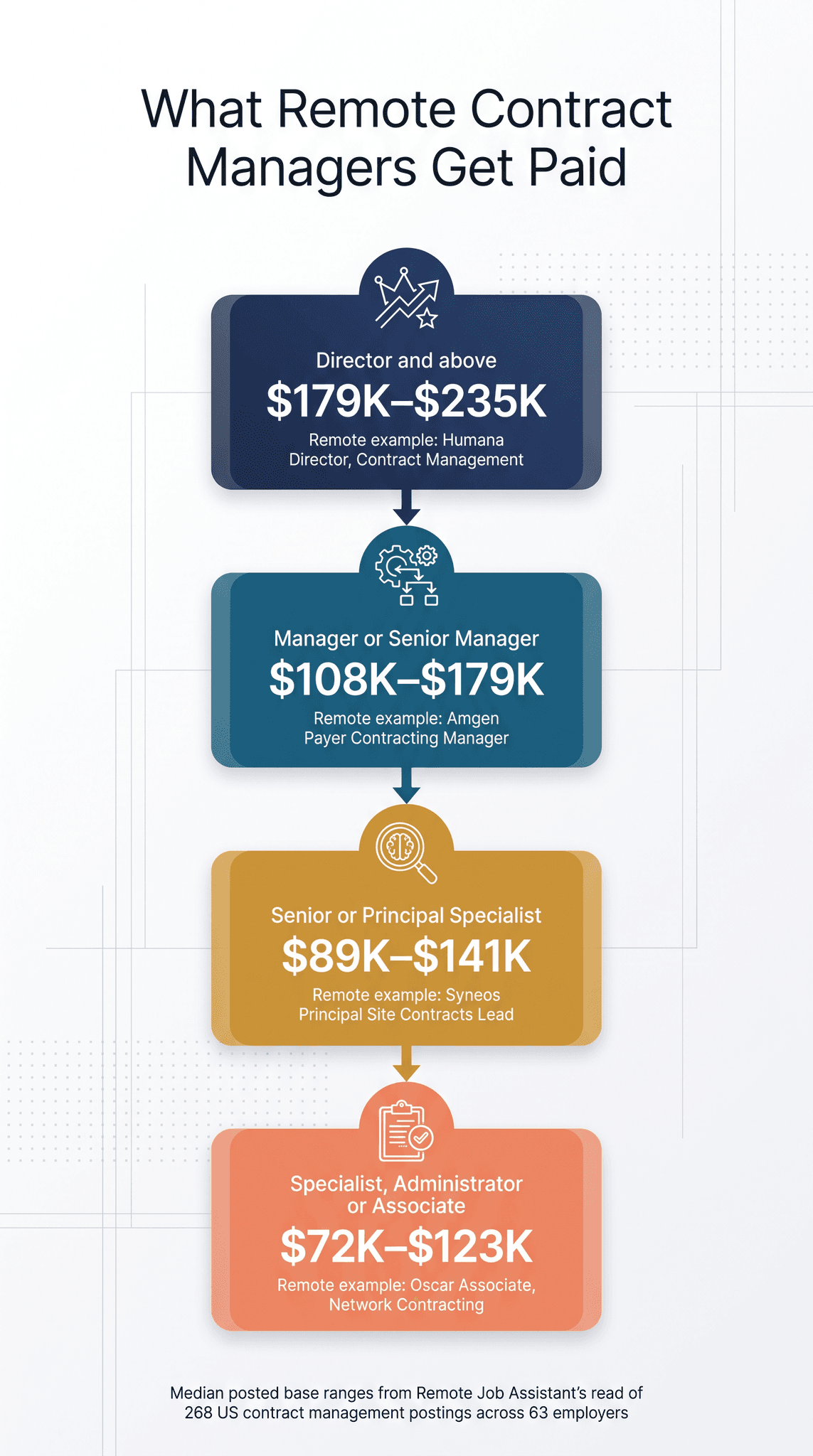
- Posted base medians: $72K–$123K for specialists and administrators (n=47), $89K–$141K for senior and principal individual contributors (n=103), $108K–$179K for managers (n=70), $179K–$235K for directors (n=13)
- 87% (n=233 of 268) published a pay range
- NCMA certification (CPCM, CFCM or CCCM) appeared in 12% (n=31 of 268); FAR or DFARS appeared in 143
- $77,710 national median for Purchasing Agents, the BLS category that includes contract administrators, and $148,080 for Purchasing Managers (BLS 2025 wage data, accessed via O*NET)
The 22% figure is real, and it comes with two catches the grids can't show you. First, remote in this field usually means remote inside a territory: 14 of the 58 remote postings carry an explicit residency sentence ("open to candidates who reside in," "you must live within the stated region"), and 13 name a travel share between 10% and 25%. Second, the remote defense seats come with fine print. RTX says remote candidates "may be asked to attend select steps of the interview process in-person," and ICF's "100% Remote" role puts anyone near Reston on a hybrid schedule. Both catches are covered below.
The Counterparty Test
A contracts seat's remote odds aren't set by the title. The same manager rung is fully remote at ICF (Manager, Contracts), 100% onsite at Northrop Grumman (Manager Contract Administration 3), and remote within six states at Oscar Health (Senior Manager, Network Contracting). The posting tells you which in the first screen if you know what to read. That is the idea behind the framework we use for the rest of this post.
The Counterparty Test: a 1–10 score for how remote-portable a contract-management seat is, read from three things the posting states: who the counterparty is and where they sit, whether the paper is classified or clearance-gated, and what the employer writes about office days.
Scoring:
- 8–10 Scattered Counterparty (remote by design; remote payer and network postings had a median posted range of $92K–$132K, n=28): The people across the table are hospitals, physician groups, trial sites or vendors spread across a region. The posting names the states you must live in, calls the role "remote position based in the field," budgets 10–25% travel to the counterparties, and talks about Medicare, Medicaid, value-based reimbursement, clinical trial agreements or investigator budgets. Oscar: "This is a remote position based in the field, open to candidates who reside in: Illinois, Kansas, Michigan or Ohio." CVS Health lists one Provider Contract Negotiation Manager requisition across 32 "Work At Home" locations. Measured: 29 of 39 payer and network postings, 14 of 26 CRO and life-sciences postings.
- 4–7 Designated Remote (a remote seat inside an office-anchored employer; remote defense postings had a median of $102K–$160K, n=10): The paper is unclassified federal or commercial work, and the employer has a named work-model field that designates this one seat remote. RTX writes "Position Role Type: Remote" and "Security Clearance Type: None/Not Required." ICF writes "This position is 100% Remote in the 48 contiguous United States." Parsons, Amentum, BD and Humana's government business post seats in this band. Measured: 11 of 170 government and defense postings.
- 1–3 Badge-Reader (office-anchored): The paper is classified or clearance-gated, the program office sits on a site, or the employer calls itself in-office. The posting shows a "CLEARANCE REQUIRED FOR START: Yes" field, a plant or program city, a relocation line, or a sentence like Northrop Grumman's "This position is 100% onsite and cannot accommodate telecommute work." CACI's DHS contract specialist lists "Minimum Clearance Required to Start: Top Secret." SpaceX: "remote work not considered." Measured: 68 explicitly on-site defense postings plus 69 that list only a site city.
How to use it: Score the counterparty first (who is across the table and where they are), then the paper (clearance, classification, export control), then the employer's written policy. A 3 at a company with a friendly remote policy is still a 3, because the file can't leave the building.
The reason defense contracts seats stay on-site, even when the daily work is a Word file and a spreadsheet, is structural. Classified program data can only be handled in accredited facilities. Program offices co-locate contracts with program management and finance, because a DCMA or DCAA audit request lands on all three at once. And the security office sets site policy for the whole program team, contracts included. The defense seats that do get designated remote are the unclassified ones: subcontracts for sustainment work, contracts systems and reporting, commercial aerospace parts.
Healthcare runs the other way. A health plan's network team has to sign enough hospitals and physician groups to cover every county in its service area, so it hires where the providers are and sends its negotiators on the road. There is no single office that sits near all of them.
A contract manager's remote odds are set by the counterparty, not the contract. Health plans can't manage hospitals in six states from one office, so they don't try. Classified programs can't leave the building, so defense primes don't let the contract manager leave either.
Stop Applying Manually
Our AI applies to hundreds of matching jobs while you sleep. Wake up to interviews, not more applications.
How We Collected This Data
Start with what we couldn't see. Reddit is closed to crawlers, so this post has no r/govcon or r/procurement sentiment. Glassdoor, ZipRecruiter and The Ladders return 403 errors, so their figures appear here only as search-snippet claims we are checking. BLS.gov also blocks automated requests, so the federal wage figures come from O*NET, which republishes the same BLS series. And several big contracts employers run career sites we couldn't query: Lockheed Martin, General Dynamics, L3Harris, SAIC, UnitedHealth Group and Kaiser Permanente among them. Defense is still the biggest segment in our data even without them. Treat the healthcare count as a floor.
What we could see was two public, unauthenticated applicant-tracking-system sweeps run on September 23, 2026. The first searched 99 Workday career sites (97 answered) across defense primes and government services firms, health plans and PBMs, pharma, CROs, device makers, tech and financial services. It used six contract-management search terms, scanned 10,427 search results and fetched 1,211 full descriptions. The second tried 2,697 company slugs against Greenhouse, Lever, Ashby and SmartRecruiters: 681 boards responded with 53,242 live postings, 489 of them with "contract" in the title.
We kept contract-management titles only: contract, contracts and subcontracts managers, administrators, specialists, negotiators, analysts, leads and directors, plus network, provider, payer, site and clinical contracting. We removed temporary "(Contract)" listings, recruiters, lawyers and paralegals, engineers, smart-contract roles, insurance "contract underwriting," interns and non-US postings (Parsons alone had more than 20 in the Gulf). After deduplication that left 268 postings at 63 employers.
Work model came from the description body first: negations like "cannot accommodate telecommute work" meant on-site, role-specific remote statements meant remote, day counts meant hybrid. We then used Workday's remote-type field or RTX's "Position Role Type" line. We stripped boilerplate that defines all three work models (Booz Allen, Centene and Humana carry it), and 93 postings that name only an office city are counted as "no statement." Pay is the employer-posted base range (n=233). We cross-referenced the pay figures with O*NET's BLS wage data for Purchasing Agents, whose reported titles include "Contract Administrator," and for Purchasing Managers. We will re-run this sweep quarterly.
Where Remote Contract Manager Jobs Actually Are
The split is by segment, and it isn't close. Here are the four segments, sorted by the Counterparty Test.
| Segment | US postings | Employers | Remote | Hybrid | On-site | No statement | Posted base median (n) | Counterparty band |
|---|---|---|---|---|---|---|---|---|
| Payer and provider-network contracting | 39 | 10 | 29 (74%) | 10 | 0 | 0 | $97K–$147K (35) | 8–10 |
| CRO and life-sciences contracts | 26 | 11 | 14 (54%) | 4 | 1 | 7 | $70K–$140K (18) | 8–10 |
| Commercial (tech, device, distribution, energy) | 33 | 23 | 4 (12%) | 7 | 5 | 17 | $95K–$156K (20) | 3–6 |
| Government and defense | 170 | 22 | 11 (6%) | 22 | 68 | 69 | $93K–$154K (160) | 1–5 |
Source: RemoteJobAssistant.com sweep of 268 US postings, September 23, 2026.
One caveat on the defense row: 69 of those postings name only a site city and say nothing about work model. We counted none of them as remote. Some hiring managers will negotiate a telework day on those, but the posting doesn't promise it, and at Northrop Grumman the header field that lists relocation assistance and clearance type is a better guide to where you'll sit than any remote search filter.
Payer and provider-network contracting (29 of 39 remote). This is the remote market. Oscar Health posted 16 network contracting roles and 13 were remote. CVS Health posted 9 and 7 were remote. Centene posted 3 Contract Negotiator roles, all tagged "Remote-TX" or "Remote-DE." Humana, Cigna, Prime Therapeutics and Amgen's payer contracting team filled out the rest. Medicare showed up in 11 of the 58 remote postings, and "value-based" in 6. The work is signing and renegotiating hospitals, physician groups and ancillary providers into a plan's network. "Remote" here almost always means remote within a territory. Oscar lists the states you must live in, Humana writes "you must live within the stated region," and Oscar's associate role budgets "Travel up to 25%." The hybrid exceptions are headquarters seats: Oscar's New York and Tempe network directors work "3 days of in-office work per week" with Thursdays required.
CRO and life-sciences contracts (14 of 26 remote). Syneos Health posted 6 US site-contracts roles and all 6 were remote. Thermo Fisher's PPD functional-service-provider unit posted three site contract specialists as "Remote, North Carolina." WCG, Parexel and Revolution Medicines added the rest. The work is clinical trial agreements (CTAs) and investigator grant budgets with dozens of sites. Syneos's principal lead "manages negotiation of clinical study agreements (CTA´s) on a study level" with "a global team of site contract negotiators." Sites are everywhere, and sponsor-dedicated models put you on the client's process rather than in anyone's office.
Commercial (4 of 33 remote). Tech, device and distribution employers mostly post their contracts roles to a city. Palantir, Crusoe, Verkada, Abbott and Cardinal Health all did. Commercial contracts usually sit in legal operations or the deal desk, and those teams follow the legal department's office policy. The redline is portable, but the team usually isn't distributed. Medtronic's Senior Contract Analyst, "remote from the U.S." with 10% travel, is the exception.
Government and defense (11 of 170 remote). Northrop Grumman posted 74 contract-management roles, more than any other employer, and none were remote. RTX posted 25 and three were remote, each with "(Remote)" in the title. Parsons and Amentum had two remote seats each; ICF, CACI, BD and Vannevar Labs had one each. Everything else was a site, a badge and a program.
Defense employers posted 63% of the contract manager jobs in our sweep and 19% of the remote ones. If you search "remote contract manager" and see mostly defense, you're looking at where the volume is, not where the remote jobs are.
Clearance, Citizenship and the "Remote" Tag
Clearance language doesn't automatically mean on-site, but it's the strongest single warning sign in the data. "Clearance" appeared in 153 of 268 postings and in only 10 of the 58 remote ones. Secret or Top Secret was named in 125 postings, and just 3 of those were remote. U.S. citizenship language appeared in 135 postings, and 134 of them were defense.
The remote-tagged defense seats follow three patterns.
Clearance plus remote exists, on the unclassified side. RTX's Contracts Manager – Advanced Structures (Remote) lists "Security Clearance Type: None/Not Required" and pays $107,500–$204,500 for US government contract experience with FAR, DFARS and ITAR. Humana's Director, Contract Management sits in its government business, is posted "Remote Nationwide," and asks you to "successfully receive interim approval for government security clearance (NBIS)." Amentum's Senior Subcontracts Administrator is remote with an "active DoD Secret Security Clearance," $125,000–$140,000. The tell is the work itself: subcontracts, contracts systems or corporate reporting for programs that don't need a secured room.
"Remote" in the title, conditions in the body. ICF says "100% Remote in the 48 contiguous United States," then adds "Candidates in the Reston, VA area will be on a hybrid schedule at our corporate headquarters." RTX warns that "candidates may be asked to attend select steps of the interview process in-person at one of our office locations, regardless of whether the role is designated as on-site, hybrid or remote." Booz Allen: "If this position is listed as remote, there may still be occasions when you are required to work in person."
Badge-reader language. Northrop Grumman puts a structured header on every posting, and 21 of them read "CLEARANCE REQUIRED FOR START: Yes." Twelve use the telecommute sentence word for word. CACI's DHS and Secret Service contract specialist lists "Minimum Clearance Required to Start: Top Secret" and pays $109,800–$241,600, on-site in Washington.
Four more red flags show up in the "remote" postings, each with a specific cause:
- A state list in the work-location line. Oscar's remote associate is "open to candidates who reside in: Illinois, Kansas, Michigan or Ohio." The plan needs negotiators near its providers, so an address outside the list gets screened out before anyone reads your negotiation history.
- A multi-state requisition with one wide range. CVS Health posts $60,300–$132,600 across 32 locations. One requisition is covering several rungs and markets, and the offer lands where your state and years put you, usually well below the top.
- "Travel up to 25%" on a remote job. Oscar and Syneos both write it. In network contracting, that's hospital CFO meetings in your territory; in site contracts, it's the occasional site or sponsor visit. Remote here means no commute, not no car.
- A remote seat at an employer whose other contracts postings all name a site. RTX posted 25 contract-management roles: 3 remote, 4 hybrid and 18 on-site. The remote three are real, but if you're rejected, the next RTX contracts opening you see will almost certainly be on-site. Save your applications for employers whose remote seats aren't one-offs.
Defense postings list a city even when the work is portable because the requisition is opened against a program and a cost center tied to a facility. The site is a security boundary and an overhead pool, not just an address. Moving a seat off-site means moving it out of that pool, and the program manager usually has no reason to.
Search the posting for "Position Role Type" (RTX's work-model field), "telecommute" (Northrop's on-site sentence), "Clearance Required to Start," "reside in" (the state lists payers use), and "48 contiguous" (ICF's remote rule). Those five strings settle the work model faster than the location tag does.
Northrop Grumman posted 74 contract-management roles and zero remote ones. Twelve of them use the same sentence: "This position is 100% onsite and cannot accommodate telecommute work."
Stop Applying Manually
Our AI applies to hundreds of matching jobs while you sleep. Wake up to interviews, not more applications.
What Remote Contract Managers Actually Get Paid
Remote doesn't mean a pay cut in this field. Level and segment move pay; the home office doesn't. The single band ZipRecruiter shows, $89K–$125K, hides a ladder that runs from $72K to $235K at the posted medians.
| Level | US postings | Posted base median (n with pay) | Remote postings | Example remote ranges |
|---|---|---|---|---|
| Specialist, administrator, associate | 58 | $72K–$123K (47) | 14 | Humana Provider Contracting Professional (Medicaid) $65,000–$88,600; Oscar Associate, Network Contracting $87,188–$114,434 |
| Senior or principal individual contributor | 112 | $89K–$141K (103) | 16 | Prime Therapeutics Contracts Analyst Sr $74,000–$118,000; Syneos Principal Site Contracts Lead $79,800–$139,600 |
| Manager or senior manager | 82 | $108K–$179K (70) | 23 | ICF Manager, Contracts $98,614–$167,644; Amgen Payer Contracting Manager $118,215–$159,938; RTX Contracts Manager (Remote) $107,500–$204,500 |
| Director and above | 16 | $179K–$235K (13) | 5 | Humana Director, Contract Management $168,000–$231,000; Revolution Medicines Director, Strategic Pricing, Contracts $201,000–$251,000 |
Salary ranges come from employer-posted base pay in the 233 of our 268 US postings that published one, collected September 23, 2026 from public Workday, Greenhouse, Lever, Ashby and SmartRecruiters boards. We used the lowest and highest figures on each posting and took medians of each. Bonus and equity are excluded, and ranges shift as employers re-post, so check the linked postings for current figures.
A few more remote rows show where the money is:
- Centene Contract Negotiator V, Remote-TX: $107,700–$199,300, asking for "8+ years of vendor and/or provider contract negotiations"
- Oscar Senior Manager, Network Contracting (Central Region), remote in six Midwest states: $122,212–$160,404
- Revolution Medicines Contract Manager, Remote (United States): $129,000–$160,000
- Parsons Senior Subcontract Administrator, Intelligence Community Programs, remote: $88,400–$154,700
- BD Sr. Contract Consultant, Government Contracting, remote: $104,700–$167,500, with FAR, DFARS and VAAR plus "FSS, GSA, DAPA, BPA, or IDIQ" vehicles
- Medtronic Senior Contract Analyst, remote: $84,000–$126,000
The remote median ($87K–$140K, n=50) sits a little under the all-postings median ($92K–$152K, n=233). That gap comes from the mix, not from a remote discount: the remote pool is heavy with healthcare associates. Compare within a segment and it flips. The 10 remote defense postings with pay had a median of $102K–$160K, above the $93K–$154K median for all defense postings.
The federal numbers sit below the posted ones for a reason. According to O*NET's BLS 2025 data, Purchasing Agents, the category whose reported titles include "Contract Administrator," earn a $77,710 median, and Purchasing Managers earn $148,080. The BLS category counts every county procurement office and hospital purchasing desk. The posted ranges here come from defense primes, national health plans and CROs.
Ranges also run wide inside a single posting. CVS Health posts $60,300–$132,600 for one Provider Contract Negotiation Manager title because that one requisition covers 32 states and several rungs. Revolution Medicines says its range "is intended to be the base pay salary range for an individual working onsite in Redwood City and will be adjusted for the local market a candidate is based in." Ask which market your address maps to before you name a number.
CPCM, CFCM or a Clean Redline: What to Learn Next
Postings reward FAR fluency in defense and a negotiation track record in healthcare. They reward certifications much less, and NCMA credentials matter almost only in defense.
Here is what the 268 postings name. Negotiation appears in 238, a bachelor's degree in 196, and FAR or DFARS in 143 (142 of them defense). Excel appears in 85, contract lifecycle management (CLM) platforms in 43 and SAP in 41. Any NCMA certification appears in 31: CFCM in 25, CPCM in 20, CCCM in 12. A JD appears in 25, Salesforce in 17, Costpoint or Deltek in 16, Medicare in 16, and Truth in Negotiations or certified cost data in 14. Among the 58 remote postings, NCMA certifications appeared in 2.
NCMA certification showed up in 31 of 268 postings and 2 of the 58 remote ones. In remote contract management, the credential that gets you hired is a closed negotiation you can describe in numbers.
If you're in defense, the certs still earn their place, and the rules are worth knowing before you pay. According to NCMA's CPCM requirements, the CPCM needs a bachelor's degree, five years of contract-management experience and 120 hours of continuing education. The application fee is $225 for members and $425 for non-members, and the exam through Kryterion is $135 in the US. Once approved, you get one year and three attempts to pass. NCMA membership isn't required. The CFCM (federal) and CCCM (commercial) need two years and 80 continuing-education hours, with a $165 or $365 application fee. Non-degreed candidates with five years of experience and 24 aligned college credits can request a waiver.
Defense contracts people also have a live advantage right now. The Revolutionary FAR Overhaul on Acquisition.gov is the "first-ever comprehensive overhaul of the FAR," meant to rewrite it "in plain language, and remove most non-statutory rules." The overhauled Part 1 was issued May 2, 2025, and agencies have issued deviations part by part since then, tracked on the FAR Overhaul part and deviation guide. A contracts administrator who can tell a program manager whether the deviation or the old FAR text governs a clause is worth more this year than last. Say that in the interview.
Pick your next skill by the segment you're aiming at:
- Defense, staying in defense: Get the CFCM if you're under five years, the CPCM at five. Target the remote-designated seats (RTX, ICF, Parsons, Amentum, BD) and keep your clearance active, since 10 of the 58 remote postings still mention one.
- Defense moving to healthcare network contracting: Certifications don't transfer, but negotiation does. Rebuild your resume around outcomes: rate, term, escalators, cycle time, dollar value. Then learn fee schedules, Medicare Advantage and value-based basics.
- Commercial or legal ops: Learn a CLM platform (Ironclad, Conga and Icertis all appear in postings) and keep a redline portfolio. CRO site contracts is the most remote-friendly adjacent move if you've negotiated MSAs and NDAs.
- Everyone: Never let a "preferred" certification line stop an application. 237 of 268 postings don't name one.
Once you know which segment you're aiming at, the job search itself is mostly volume and speed, especially in health plans, where CVS Health lists single requisitions across 13 to 32 locations at a time. Remote Job Assistant's auto-apply is built for that part: it applies to the contract-management titles you choose and skips the temporary "(Contract)" listings that clutter the grid.
Stop Applying Manually
Our AI applies to hundreds of matching jobs while you sleep. Wake up to interviews, not more applications.
Moving Across the Counterparty Line
The skill is portable; the counterparty isn't. If your current seat scores a 2 on the Counterparty Test and you want remote, the fastest route is usually to change who is across the table, not to hunt for the one remote seat at a Badge-Reader employer. Use this decision rule to pick the move.
Which move fits your background:
- You have FAR/DFARS subcontracts experience and no healthcare background: Target payer associate and analyst roles first (Oscar's associate network contracting roles post $87,188–$114,434; Prime Therapeutics' senior contracts analyst $74,000–$118,000). Manager postings at CVS ask for "5+ years of experience in provider contracting, claims management, or patient management," which you won't have yet. Take the rung cut; the manager rung comes back once you have one network cycle behind you.
- You have FAR experience and want to stay near defense: Apply only to the remote-designated seats (RTX, ICF, Parsons, Amentum, BD, CACI's one remote specialist) and keep the clearance current. Expect a hybrid rule if you live near headquarters.
- You negotiate commercial MSAs, NDAs or SOWs: Go to CRO site contracts. Clinical trial agreements are templated redlines with an investigator budget attached, and Syneos, Thermo Fisher's PPD unit and WCG post remote specialist and senior seats.
- You come from procurement or sourcing: Go to CRO vendor contracts. WCG's Vendor Contracts Manager III asks for "3-5 years of direct experience with CRO or pharmaceutical in negotiating vendor agreements" and pays $65,500–$130,500 remote. Our guide to remote procurement jobs covers the sourcing side of that bridge.
Whichever move you make, rewrite your resume bullets in the new counterparty's language. These are templates; fill them with your own numbers:
- Defense to payer. Instead of "Administered 40 subcontracts under FAR Part 44 with full flowdown compliance," write "Negotiated and administered 40 supplier agreements worth $X, including rate, term and escalator changes, with a Y-day average cycle time."
- Commercial to CRO. Instead of "Redlined MSAs and NDAs for the sales team," write "Negotiated X agreements a quarter against a standard template and fallback playbook, escalating out-of-parameter terms to counsel within Y days."
- Procurement to vendor contracts. Instead of "Ran RFPs for IT services," write "Ran X competitive bids and negotiated the resulting SOWs and change orders, holding budget variance under Y%."
Ask one question per segment before you accept:
- Payer: "How many counties does this territory cover, and what share of my week is on the road?"
- CRO: "Is this sponsor-dedicated or a shared service center, and whose templates will I negotiate from?"
- Defense: "Is the program this seat supports classified, and what is the site policy on unclassified days?"
Frequently Asked Questions
I'm a government contracts administrator with a Secret clearance. Can I find a fully remote contract manager job?
Yes, but there aren't many: 11 of the 170 government and defense postings in our September 2026 sweep were remote. They came from RTX, Parsons, Amentum, ICF, CACI, BD and Vannevar Labs, and they cluster on the unclassified side of the business: subcontracts, contracts systems and sustainment work. Keep the clearance active and search "Position Role Type: Remote" and "100% Remote."
Which industries hire remote contract managers the most?
Health plans and CROs. Payer and provider-network contracting was 74% remote (29 of 39 postings), and CRO and life-sciences contracts was 54% (14 of 26). Together they supplied 43 of the 58 remote postings in our sample, while defense supplied 11.
Is CPCM or CFCM worth it for a remote contract manager job?
Only if you're staying in defense. NCMA certifications appeared in 31 of 268 postings and in just 2 of the 58 remote ones. If you're in federal contracting, the CFCM needs two years and 80 continuing-education hours; the CPCM needs five years and 120.
How much does a remote contract manager make?
Posted base medians in our sweep ran $72K–$123K for specialists and administrators, $89K–$141K for senior individual contributors, $108K–$179K for managers and $179K–$235K for directors. Remote postings paid in line with office postings in the same segment. Remote defense seats actually posted a higher median ($102K–$160K) than defense overall.
Why do remote contract manager searches show so many temporary contract jobs?
Because job boards match the word "contract" to the employment type as well as the job function. On SimplyHired's first page, 4 of 19 results were temporary jobs unrelated to contract management. Search the segment titles instead: "provider contracting," "network contracting," "site contracts," "subcontracts administrator."
What does a Counterparty Test score of 5 mean?
It means a remote-designated seat inside an office-anchored employer: unclassified federal or commercial paper, a work-model field that says remote, and usually some in-person expectation, like an in-person interview step or a hybrid rule if you live near headquarters. These seats are real but scarce. Apply fast, because they draw the whole defense talent pool.
Find Remote Contract Manager Jobs That Are Actually Remote
Start where the counterparty is scattered. Browse legal and compliance roles for contracts and compliance seats, operations and project management jobs for program-side contracts work, and finance and accounting openings for pricing and contract-analyst roles. If your background is program-side, remote program manager jobs and project manager listings use the same negotiation and scope-control skills, and business analyst roles fit contracts-systems people. Filter to remote jobs paying $100K+ for the manager rung, or $150K+ roles for director seats.
For adjacent paths, read our guides to remote compliance jobs, remote paralegal jobs, remote supply chain jobs and remote project manager jobs.
The contract doesn't care where you sign it. The counterparty decides where you sit.
Ready to Find Your Remote Job?
Browse thousands of curated remote jobs or let AI apply for you.
Browse Remote JobsRelated Job Guides
Remote People Operations Jobs: 259 Postings, 44 Remote
We read 259 US people ops postings at 137 employers. 44 were remote, and 30 of those were comp or HRIS roles. Real pay by specialty, plus what to learn next.
23 min read
Remote Business Development Jobs: Four Jobs, One Title
We read 286 US business development postings across 138 employer boards. Four jobs share the title; only one is reliably remote. Pay by seat and the 3-day trap.
32 min read
Remote Regulatory Affairs Jobs: Who Actually Posts Them
We read 184 US regulatory affairs postings on 47 employer boards. Only 14% were remote, none at the 12 biggest posters. Pay by level, plus the hub-office trap.
32 min read