
Last reviewed: September 2026
You can design a substation foundation from your kitchen table. You can't sit in on a county's pre-application meeting from it. If you're a civil engineer with a PE, or a few years from one, and a commute you'd like to lose, that difference decides more about your odds than your title, your specialty, or the "remote" filter on any job board.
Search for remote civil engineering jobs and Google's top result is a Reddit thread asking whether high-paying remote civil jobs even exist. It ranks because nobody has answered it with numbers. The pages that try either write civil off as field work, or claim a PE license is what makes remote possible and that environmental work is the most remote niche. The postings say something else. Outside transmission-line, substation, and data-center design, remote civil work is close to a rounding error: 9 of 1,071 transportation postings and 5 of 351 water resources postings. Inside that corner it's real, and even there it usually comes with a fence: a state you have to live in, a metro you have to be near, or a utility territory you have to drive.
Get Remote Job Tips in Your Inbox
Weekly strategies, salary data, and new opportunities
Unsubscribe anytime. No spam.
We pulled every live posting from the career sites of 91 civil and infrastructure employers on September 29, 2026, including AECOM, Jacobs, Stantec, HDR, Kimley-Horn, Burns & McDonnell, Leidos, and Olsson, and isolated 4,770 US civil engineering postings. Then we read every posting that offered remote work, because the location line and the paragraph under it often disagree. Leidos posts senior transmission line engineers under a "Remote/Teleworker US" location, then writes "This position is 100% REMOTE but candidate must reside in Michigan to be considered." What follows is where remote civil work actually exists, what it pays, and the three keys that decide whether you can get it.
Based on our analysis of 4,770 US civil engineering postings at 91 employers (all live on September 29, 2026):
- 3.5% (n=165 of 4,770) were remote-eligible; 24.8% (n=1,182) were hybrid; 49.3% (n=2,350) named an office city and said nothing about work model
- Transmission, substation, data-center, and renewables titles were 6.5% of postings (n=309) but 45.5% of the remote ones (n=75 of 165)
- Transportation, the largest segment, was 0.8% remote (n=9 of 1,071)
- 35.2% (n=58 of 165) of remote postings limit where you can live to a state, metro, region, or time zone; in local public work it's 58.7% (n=27 of 46)
- A PE was explicitly required in 21.2% (n=35 of 165) of remote postings, against 5.7% (n=263 of 4,605) of the rest
- Senior and licensed postings were remote 5.8% of the time (n=88 of 1,515); entry-level and EIT postings 0.9% (n=8 of 870)
- $102K–$150K median posted range on remote postings (n=120); the BLS median for civil engineers is $100,840 (May 2025)
Put plainly: remote civil work is a market for licensed, senior engineers in a few specialties, and a third of it stops at a state line.
The Jurisdiction Radius: Why Transmission Engineers Work From Home and Roadway Engineers Don't
Every civil engineering deliverable ends up in front of someone with the authority to approve it: a county plan reviewer, a DOT district engineer, a city council, a utility's standards group, a data-center developer's program manager. Where that approver sits, and how many of them a role answers to, predicts remote-ability in civil engineering better than title, specialty, or seniority. A grading plan for a subdivision answers to one county. A transmission line answers to one utility whose service territory can cross dozens of counties and several states. The first job wants you near the county. The second doesn't care where you sleep.
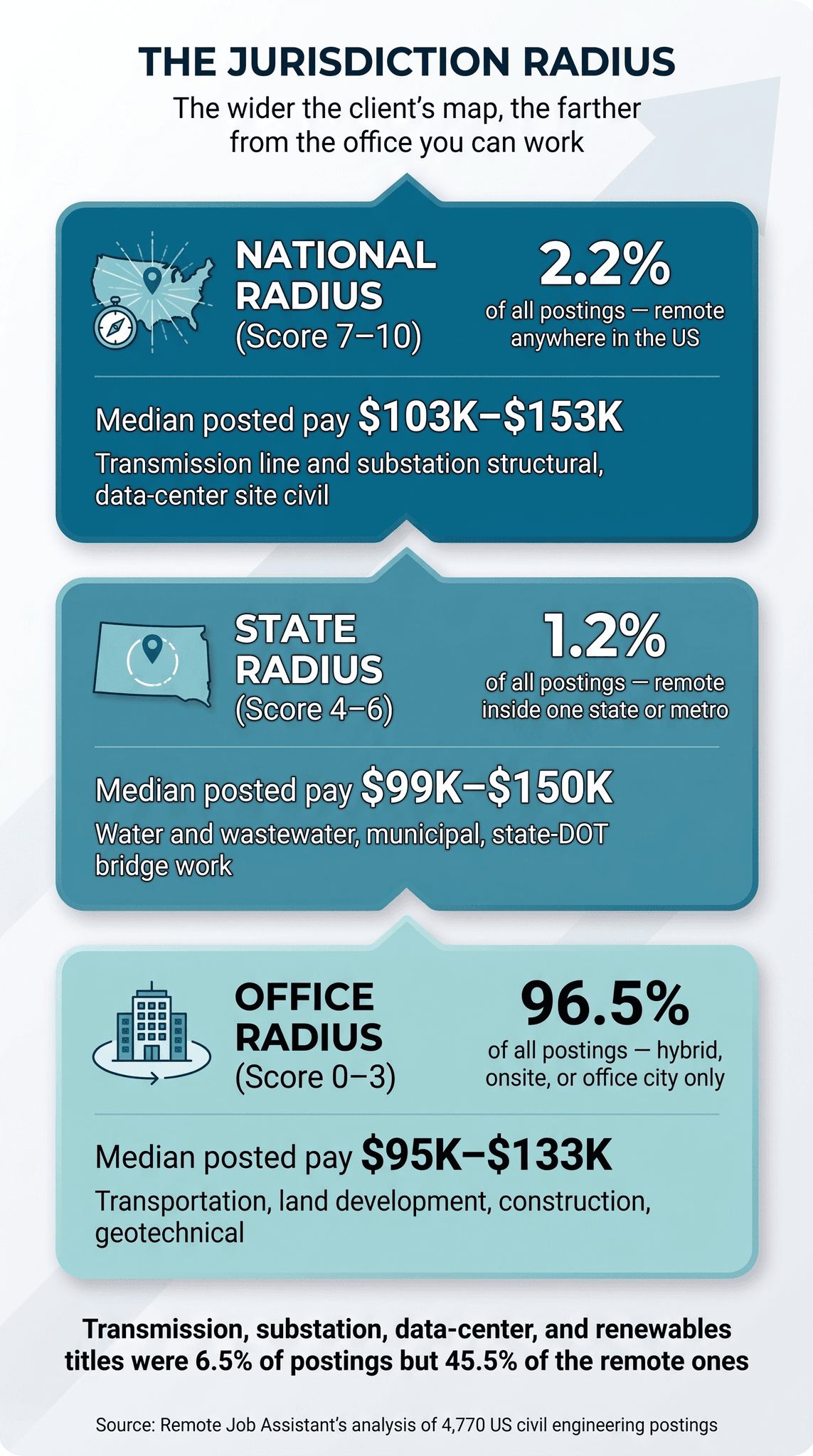
The Jurisdiction Radius: A 0–10 rubric that scores how far from an office a civil engineering role will let you live, based on where the work's approvals and clients sit. The wider the map of jurisdictions a role serves, the wider its remote radius.
Score the role on three observable criteria:
- Whose map is it (0–4): one city, county, or DOT district that reviews your plans at a counter or in public meetings scores 0–1; public or private clients inside one state score 2; a private owner with sites in many states (a utility's service territory, a data-center program, a national account) scores 4.
- What leaves your hands (0–3): construction observation, inspection, or resident engineering scores 0; drawings plus regular site visits score 1–2; models, calculations, and plan sets only score 3.
- What the posting says (0–3): an office city and nothing else, or "This is not a remote position," scores 0; remote inside named states, a metro, a time zone, or a mileage radius scores 1–2; remote anywhere in the US scores 3.
Scoring:
- 0–3 Office Radius ($95K–$133K median posted range): Hybrid, onsite, or an office city with no statement at all. Transportation, municipal and land development work for local clients, construction phase services, geotechnical fieldwork. This is 96.5% (n=4,605 of 4,770) of the market. A PE is explicitly required in only 5.7% of these postings, since most of these seats sit under a licensed engineer down the hall.
- 4–6 State Radius ($99K–$150K): Remote, but fenced. SEH tags every one of its remote water engineering seats to a state ("Remote-Florida," "Remote-Minnesota"). Michael Baker writes "Remote anywhere in Montana OK." This is 1.2% (n=58) of postings, and 29.3% of them explicitly require a PE.
- 7–10 National Radius ($103K–$153K): Remote anywhere in the US, with site travel written in. Transmission line and substation structural design is 42 of these 107 postings (2.2% of the market). ICF assigns its remote line engineers to a "Nationwide Remote Office," and Ulteig writes "This position is open to sit in any location or remote." A PE is mentioned in 65.4% of them.
How to use it: Score the posting and the work, not the title. If the work scores 7 or higher but the posting names an office city, ask in the first screen whether remote is on the table; several national-program firms write that remote is considered "for the right candidate." If the work scores 0–3, a remote badge usually means a traveling field job or a state fence. To move up the radius, move toward clients with a bigger map, such as utility transmission programs, data-center portfolios, and national private owners, and collect licenses in the states where they build.
The radius explains a pattern that looks strange from the outside. Civil design is desk work. Civil 3D, OpenRoads, HEC-RAS, and PLS-CADD all run on a laptop, and the licensing boards already allow a PE to supervise from a distance. Texas defines direct supervision as control "either through physical presence or the use of communications devices," and its board wrote in Policy Advisory Opinion EAOR 38 that if the responsible PE has sufficient oversight, "all engineering tasks could be done remotely." Florida's responsible-charge rule, updated in June 2026, lets the engineer of record be "physically present or, if not physically present, be available in a reasonable period of time, through the use of electronic communication devices." The Florida board's own article on the question says it plainly: "The rule does not prohibit working remotely."
So the fence isn't the law. It's three commercial facts. First, local public work runs through a counter and a calendar: the county reviewer, the DOT district, the planning commission, the utility board. Firms hire where the reviewer is, which is why Kimley-Horn writes "This is not a remote position." into 364 of its 419 civil postings, each tied to a named office. Second, licenses and firm registrations stop at state lines. BLS notes that "each state issues its own licenses," and states such as Texas and North Carolina license the firm as well as the engineer, so a remote seat inside one state is the cheapest remote seat a regional firm can offer. Third, national private programs have one owner and sites everywhere. A utility's transmission program or a data-center developer's portfolio has no home county, so Leidos, Ulteig, ICF, and Sargent & Lundy staff it from wherever the engineer happens to live.
| Radius | Postings | Share | Typical roles | Median posted range | PE explicitly required | What fences it |
|---|---|---|---|---|---|---|
| 7–10 National | 107 | 2.2% | Transmission line and substation structural, data-center site civil, senior specialists | $103K–$153K | 16.8% | Site travel; some territory limits |
| 4–6 State | 58 | 1.2% | Water and wastewater PMs, municipal, site design, state-DOT bridge work | $99K–$150K | 29.3% | Your state of residence and license |
| 0–3 Office | 4,605 | 96.5% | Transportation, land development, construction, geotechnical, most structural | $95K–$133K | 5.7% | The reviewer, the client, the site |
Our broader guide to remote engineering jobs introduced The Artifact Test and scored civil engineering a 2, because it scored the field side of the profession. The Jurisdiction Radius explains the design side: the drawings can travel, but the approval can't. In civil engineering, your remote radius is the radius of the jurisdiction that approves your drawings.
If your work already sits on a national map, the hard part isn't qualifying. It's finding 107 national-radius postings scattered across 24 employers' career sites before someone else does.
Stop Applying Manually
Our AI applies to hundreds of matching jobs while you sleep. Wake up to interviews, not more applications.
How We Collected This Data
The figures in this post come from the live career sites of 91 civil and infrastructure employers, pulled in full on September 29, 2026, across 18 applicant-tracking systems. That includes the big design firms' own boards (AECOM, Jacobs, Stantec, and Burns & McDonnell through their .jobs sites, HDR and Tetra Tech through Taleo, Kimley-Horn and Sargent & Lundy through iCIMS, and Parsons, HNTB, STV, Leidos, SEH, and 26 others through Workday) plus 766 Greenhouse, Lever, Ashby, and SmartRecruiters boards covering 59,406 postings of all kinds. Of the 2,543 postings that carried a posting date, 95% went up in February 2026 or later.
We kept titles in the BLS civil engineers family: civil, structural, geotechnical, transportation and traffic, bridge and roadway, water resources, water and wastewater, land development and site, construction and resident engineering, and transmission-line structural. We excluded interns, co-ops, technicians, drafters, inspectors, surveyors, estimators, aerospace "structures" roles, and transmission roles whose degree requirement names only electrical engineering. After a US filter and deduplication (one requisition cloned across several office cities counts once), that left 4,770 postings. 1,944 of them (40.8%) published a pay range.
A posting counts as remote-eligible when it lets you work from home full time, even if only as one option, only inside named states, or only "for the right candidate." Hybrid means regular required office days. We used the employer's own workplace field first where one exists (AECOM, CDM Smith, Terracon, UKG boards, Workday), then the posting text. We read all 165 remote postings in full, and every non-remote posting that mentioned remote work. The 2,350 postings that name a city and say nothing are counted separately, not assumed to be remote.
Pay was cross-referenced with BLS Occupational Employment and Wage Statistics for May 2025, through the BLS Occupational Outlook Handbook and O*NET, and with ASCE's 2025 member salary survey. The honest gaps: Reddit, Indeed, Glassdoor, and ZipRecruiter block automated collection, so none of their data appears here. WSP's career site blocks automated access, and Volkert, Hazen and Sawyer, Willdan, Pond, Garver, and Westwood publish no reachable job feed. State DOTs and city engineering departments hire through their own portals and aren't in the sweep. This is a one-day snapshot; we re-pull each hiring cycle.
What Remote Civil Engineers Earn in 2026
Remote doesn't cost you pay in civil engineering, and it doesn't add any. The median posted range on the 120 remote postings that published pay was $102K–$150K, higher than hybrid ($95K–$132K, n=633) or onsite ($92K–$130K, n=381). But that gap is seniority, not a premium. Compare like with like and it disappears: senior and licensed remote postings came in at $100K–$159K (n=66), hybrid ones at $100K–$153K (n=271), and onsite ones at $100K–$155K (n=138). Remote postings simply skew senior.
The pay differences that do matter run by specialty.
| Segment (by title) | Postings | Remote | Hybrid | Median posted range | Jurisdiction Radius |
|---|---|---|---|---|---|
| Transportation (roadway, traffic, bridge, rail, aviation) | 1,071 | 0.8% (9) | 29.6% | $100K–$142K | 0–3 Office |
| Structural (buildings, marine, nuclear) | 749 | 2.0% (15) | 34.4% | $90K–$129K | 0–3 Office |
| Water and wastewater | 393 | 3.3% (13) | 32.3% | $110K–$152K | 0–3, some 4–6 |
| Land development, site, municipal | 390 | 5.4% (21) | 5.6% | $95K–$130K | 0–3, some 4–6 |
| Geotechnical | 356 | 1.4% (5) | 18.5% | $90K–$120K | 0–3 Office |
| Water resources (stormwater, hydraulics, flood) | 351 | 1.4% (5) | 28.5% | $100K–$138K | 0–3 Office |
| Transmission line and substation structural | 243 | 23.9% (58) | 35.0% | $95K–$153K | 7–10 National |
| Construction and field | 176 | 1.7% (3) | 4.0% | $115K–$159K | 0–3 Office |
| Data center and mission critical | 49 | 28.6% (14) | 4.1% | $100K–$132K | 7–10 National |
| Generic "Civil Engineer" titles | 975 | 1.9% (19) | 20.0% | $90K–$129K | Depends on the client |
Salary ranges derive from the 1,944 of 4,770 postings in our September 2026 pull that published a range, cross-referenced with BLS wage data for civil engineers accessed through O*NET. Posted ranges are employer-entered and skew toward states with pay-transparency laws; the BLS figures are the national anchor. Ranges shift as markets move.
The national anchor looks like this. BLS puts the May 2025 median civil engineer wage at $100,840, with the middle half earning $79,930 to $129,680, the bottom tenth under $68,240, and the top tenth above $163,220. Who you work for moves that number: the median was $117,790 in the federal government, $113,640 in local government, and $100,620 in engineering services, which employs 51% of civil engineers. The remote seats sit almost entirely in engineering services, so they pay like consulting, not like a federal job.
ASCE's numbers run higher because its members run senior. Its 2025 salary survey, with 2,061 member responses counted, said PE holders (80% of respondents) "earned a median primary income of nearly $40,000 more than those with no licenses or certifications." The same survey found 10.2% of its members working fully remote and 42.3% hybrid. That fully remote share is about three times the share of postings that offer remote. The likely reason: a survey counts engineers who already have the job, and a posting is an offer to someone the firm hasn't met yet.
The aggregator figure on page one of Google is a different animal. Remote Rocketship headlines its civil engineer page "$81K–$172K." The low end is the average of its entry-level tier, built from 4 postings, and the high end is the average of its lead tier, built from 19. It isn't a range any employer posted.
As for the question Google keeps suggesting, whether a civil engineer can make $500,000: not from a posted salary in our data. The highest remote top-of-range figures were Kiewit's Technical Lead for water engineering ($160,000–$230,000, remote considered for "uniquely qualified Water Experts"), ICF's Substation Civil Structural Engineer ($130,687–$222,169), and Sargent & Lundy's remote Lead Transmission Line Engineer ($134,546–$205,557). When you're comparing offers, the $100K+ remote listings on our board are filtered to where these roles start, and $150K+ positions are where the lead and principal seats show up.
Remote civil jobs don't pay less. They just want the stamp first.
If you hold a PE and your work already sits on a national map, you give up nothing on pay by going remote. You just have to find a short list of employers before the seats close.
Stop Applying Manually
Our AI applies to hundreds of matching jobs while you sleep. Wake up to interviews, not more applications.
The Four Lanes Where Civil Engineers Actually Work Remote
Remote civil work isn't spread thinly across the profession. It sits in four lanes, and each one comes with its own condition.
Lane 1: Transmission line and substation structural (National Radius, 8–10; the condition is territory and site visits). This is the biggest lane by a wide margin: 58 of 243 transmission and substation postings were remote (23.9%), and PLS-CADD, the overhead power line design program, was named in 157 of those 243. Leidos posted 26 remote civil roles of its 38. Ulteig posted 13 of 14 as remote, including a Senior Transmission Line Engineer at $141,800–$184,400: "This position is open to sit in any location or remote." ICF's Lead Transmission Line Engineer pays $119,323–$202,850, and "This position is fully remote and can only be performed in the United States." Sargent & Lundy lists some line and structural roles with the location "City: Remote." Tetra Tech's Senior Transmission Line Engineer (Remote) posts at $150,000–$200,000.
The duties show what the remote week looks like, and it's ordinary civil and structural work. ICF's substation civil structural engineer performs "site design activities such as determining cut/fill for a grading plan, determining impervious additions and calculating water flow for erosion control and storm water control," and works in "STAAD.Pro, RISA 3D, FAD Tools, SAFE, SAG10, and LPile." Tetra Tech's remote senior structural engineer needs 10+ years of "structural steel and foundation design for high voltage substations, transmission lines," and the duties include "Prepare purchase requisition, review technical content of supplier bids." If you design grading, drainage, and foundations for subdivisions today, substation site civil is the same skill set pointed at a client with a national map. The software overlaps more than the job titles suggest. MicroStation or OpenRoads shows up in 112 of the 243 transmission and substation postings and Civil 3D in 38, and ICF asks for "AutoCAD Civil 3D and MicroStation" by name. The one program you'd need to add is PLS-CADD, which its maker says more than 1,600 organizations have adopted. A transportation designer who already lives in MicroStation (named in 681 of 1,071 transportation postings) is one program and one license away from the most remote lane in civil engineering.
The condition is the utility's territory. Leidos writes some of its line roles as "100% REMOTE based in Michigan's Lower Peninsula with regular site visits across the client's utility service territory," and a substation role says "If remote, ideally candidate would reside in either Pacific or Mountain Time Zones." Site visits are written into 17 of the 58 remote transmission and substation postings, usually in the same words ICF uses: "Occasional site-visits to client substation facilities are expected to be part of the work." For the demand side of this market, including interconnection queues and the power engineers designing the same substations, see our guide to remote electrical engineering jobs.
Lane 2: Data-center and mission-critical site civil (National Radius, 7–9; the condition is travel). 14 of 49 data-center civil postings were remote (28.6%), the highest share of any segment. Olsson says it "will consider candidates interested in being located out of any Olsson office location, hybrid, or fully remote in various locations of the US" for its data-center team, with a Project Civil Engineer at $103,000–$135,000. Stantec posts a Civil Engineer and a Civil Engineering Project Manager, both titled "Mission Critical (REMOTE)," at $90,900–$131,800, each marked "Travel: Yes." AECOM posts a "Civil Design Manager, Data Center Sites - Remote (U.S.)," with the caveat that "office attendance is encouraged if an AECOM office is proximal." Stantec's Data Center Due Diligence Water Lead ($128,600–$192,900) expects "approximately 10-30% of time for travel." Our guide to remote mechanical engineering jobs covers the construction-spending boom behind this lane.
Lane 3: State-fenced public work (State Radius, 4–6; the condition is your state's license). Water, wastewater, municipal, and some bridge work does go remote, but inside a line. Every one of SEH's 14 remote postings carries a state tag. Its Water Engineer / Project Manager is "Remote-Florida" at $130,000–$150,000, and its Senior Water Resources Engineer is "Remote-Minnesota" at $125,000–$150,000. The water role asks for "familiarity with the municipal government client base," which is exactly why the fence exists: the client is a set of utilities and cities in one state. Olsson lists municipal project managers as "Kansas - Remote." Michael Baker's Bridge Engineer II, at $80,000–$116,000, says "Remote anywhere in Montana OK." Bentley's Civil Resident Consultant is a "Remote, home-based position with full-time collaboration with Louisiana DOT," with a minimum of four on-site visits a year. Across local public work, 27 of 46 remote postings came with a geographic fence.
Lane 4: The senior exception and the part-time seat (radius varies). Eleven remote postings offer it only to "the right candidate," to "exceptional candidates," or to the "uniquely qualified." GFT's Principal EHV Transmission Line Engineer ($145,000–$200,000) lists several home offices, then says the role "could be fully remote for the right candidate." Kiewit's water Technical Lead will "consider remote options in other locations for uniquely qualified Water Experts," and adds: "If working remotely, travel may be up to 50% but would be scheduled travel." Kleinfelder's Principal Geotechnical Engineer ($124,000–$182,000) is "open to remote arrangements for the right candidate." A few employers make the senior seat remote outright: Terracon categorizes its Senior Alternate Delivery Geotechnical Engineer ($140,000–$160,000) as "Remote Only," and Tetra Tech's Senior Structural Engineer (Remote) at $140,000–$190,000 "can be performed remotely from anywhere in the US." Five postings are part-time and remote, including an AECOM "part-time, fully remote Water Treatment Engineer" and Leidos's part-time Principal Transmission Line Engineer at $116,350–$210,325. That's a real option for a late-career PE who wants to keep stamping. The decision rule on travel: under 25% is a remote job. At 50%, it's a field job with a home address, and it should be priced like one.
The location line and the body disagree often enough that a remote title is only a first filter.
Stantec lists "Virtual, USA" among the locations on two marine structural postings, and the body says "The ability to work some from home will be extended to the candidate once in-office working relationships are established." SEH's supervisor posting offers the "potential to be fully remote after a few months," with no date. Sargent & Lundy writes three office days a week into 89 postings. Kimley-Horn writes "This is not a remote position." into 364. The location field is a recruiter's checkbox. The paragraph is the hiring manager.
What isn't remote, and won't be soon: transportation (9 of 1,071), construction and field work (3 of 176), geotechnical (5 of 356), and water resources (5 of 351). Transportation also runs on federal highway money, and that money is on a short leash. The Infrastructure Investment and Jobs Act's surface transportation authority ran through September 30, 2026, and H.R. 6500, signed September 2, 2026, extends it only to December 11, 2026, with no multi-year bill enacted. Public highway spending was still up 4.5% year over year in July 2026, per the Census Bureau, so the work is there. It's just office work. A transportation engineer sending applications to "remote" roadway postings is fishing in 0.8% of the pond. If the high-paying remote work you're after has to come from a civil degree, it runs through Lanes 1 to 4.
Here's the trade nobody on page one mentions. Water resources, which sounds like pure modeling and desk work, was 1.4% remote, while the most remote civil specialty, transmission and substation structural, is one most civil engineers never consider because it sounds electrical. It isn't. It's steel, concrete, foundations, and grading for a utility whose territory covers dozens of counties.
Find your lane in three questions:
- 1. Does your work already touch a utility, a data-center developer, or another private owner that builds in many states? If yes, you're in Lane 1 or 2. Apply to national-radius postings now, and put your transmission, substation, or data-center projects in the first three lines of your resume. If no, go to question 2.
- 2. Do you hold a PE? If no, stop chasing remote for now. Remote was 0.9% of entry-level postings, against 5.8% of senior and licensed ones, so the fastest path to a remote seat is the exam, not the job board. If yes, go to question 3.
- 3. Are your clients public agencies in one state? If yes, you're in Lane 3: search your state's tag ("Remote-Florida," "Kansas - Remote") and expect the seat to stay inside that line. If your clients are spread out and you're principal level, you're in Lane 4: ask for the "right candidate" exception in the first call and get the travel percentage in writing. If you're a transportation or construction engineer below principal, none of the four fits yet: negotiate the hybrid days, or retool toward substation and data-center site work, where your MicroStation and Civil 3D hours count.
The Three Keys: Stamp, State Line, and Site Visits
At 4 and above on The Jurisdiction Radius, the remote seat is almost always gated by one of three keys. Knowing which one a posting wants tells you whether to apply now or prepare first.
The stamp. A PE was explicitly required in 21.2% (n=35 of 165) of remote postings, against 5.7% (n=263 of 4,605) of the rest, and just 8 of 870 entry-level and EIT postings were remote (0.9%). The reason is supervision. When Florida's board wrote about remote work, the first concerns it named were "maintaining responsible charge, and supervision and training of engineer interns." Training an EIT toward the PE is the part of the job firms still want to do across a desk. The PE Civil exam is 80 questions in an 8-hour exam (a 9-hour appointment), offered year-round at Pearson centers for $400, with five depth modules: construction, geotechnical, structural, transportation, and water resources and environmental. First-time pass rates in NCEES's July 2026 update ranged from 60% for construction (n=1,000) to 71% for water resources and environmental (n=2,620), and repeat takers passed at 38% to 49%. If structural is your path, note that NCEES's PE Structural exam is now four sections at $350 each, and the depth sections run only twice a year (October 27–28, 2026 and April 13–14, 2027), with first-time pass rates of 44–45% on the breadth sections.
Which key to cut first:
- EIT with two or more years? Get the PE before you chase remote. Remote was 0.9% of entry-level postings, against 5.8% of senior and licensed ones.
- PE in land development, municipal, or water? Look for your state's fenced seats, and add a second license only in states where your firm's clients build.
- PE in structural or site civil? Pick up substation and transmission work. It's the most portable civil work in the market, and PLS-CADD is the tool to learn.
- Licensed in one state and eyeing a national-radius posting? Set up an NCEES Record now, before the offer, so comity doesn't delay your start.
- Transportation engineer? Negotiate the three-day hybrid, not full remote. That's what the market is actually offering.
The state line. Every state licenses civil engineers separately, and a stamp is only good in a state where you hold the license. The NCEES Records program is the shortcut: no setup fee and no annual renewal, $175 for the first transmittal for a comity license and $100 for each one after that, with an average setup time of 2–3 weeks. Six jurisdictions, including Georgia and Massachusetts, require a Record before they'll consider a comity application. The 2–3 weeks is NCEES's side only. The state board reviews the application after the Record arrives, and NCEES says plainly that a Record "does not guarantee licensure in any jurisdiction." If an offer depends on a license you don't hold yet, ask whether the start date waits for it, and who pays. The firm needs a license too: Texas bars a business from practicing engineering unless it's registered with the board, North Carolina requires a firm license, and California requires an Organization Record naming the PE in responsible charge. That's why the state-radius seats exist. A firm that's registered in one state can let you work from anywhere inside it without adding a single registration. Our guide to remote mechanical engineering jobs covers the Texas comity trap in detail.
The site visit. Remote civil postings mention site visits or construction observation more often than office postings do: 39.4% (n=65 of 165) against 29.6% (n=1,361 of 4,605). A remote civil engineer still goes to the site; the posting just has to say how often. The 13 remote postings that stated a travel percentage ranged from 5% to 50%. Some write the rule down precisely. Bentley requires four Louisiana DOT visits a year. Amentum's remote structural designer role says "Employees who reside within 50 miles of Oak Ridge will be expected to work from the Oak Ridge office," and remote employees farther out travel there quarterly. Intersect, the power and data-center developer Google acquired in March 2026, wants its remote civil engineers located "within 60 miles of any of the listed hubs."
Then there's week one, which is rarely remote. AECOM writes "all newly hired employees are required to attend an in-person Day 1 onboarding at an AECOM office location as a condition of employment" into 209 of its 244 civil postings, including 9 of its 10 remote ones. Stantec's marine structural postings extend home days only "once in-office working relationships are established," and SEH's supervisor role reports "into the Delafield office in the beginning." Budget for an office start, sometimes a first quarter, and get the date remote begins in the offer letter, not in a recruiter's email. For a wider view of which credentials actually move remote offers, see our breakdown of certifications worth getting for remote work.
If you already hold the key a posting asks for, you're competing against a short list of licensed engineers who hold it too, and in a market this thin, being early matters more than being perfect.
Stop Applying Manually
Our AI applies to hundreds of matching jobs while you sleep. Wake up to interviews, not more applications.
Who's Hiring Remote Civil Engineers in 2026
The employers are knowable and few. 29 of the 91 employers in our pull posted at least one remote civil role, and five of them (Olsson, Leidos, SEH, Tetra Tech, and Ulteig) accounted for 62.4% (n=103 of 165) of the remote postings.
| Employer | Civil postings | Remote | Hybrid | Remote example (posted range) | Radius | The condition (from the postings) |
|---|---|---|---|---|---|---|
| Olsson | 100 | 36 | 6 | Project Civil Engineer, Data Center ($103K–$135K) | 4–10 | Half of the remote seats are tagged to a state |
| Leidos | 38 | 26 | 8 | Lead Transmission Line Engineer ($92K–$167K) | 4–10 | Utility territory or state residency on 14 of 26 |
| SEH | 33 | 14 | 3 | Water Engineer / Project Manager ($130K–$150K) | 4–6 | Every remote seat tagged to one state |
| Tetra Tech | 84 | 14 | 26 | Structural Engineer (Remote) ($100K–$150K) | 7–10 | Travel; one role limited to EST and CT time zones |
| Ulteig | 14 | 13 | 0 | Senior Transmission Line Engineer ($142K–$184K) | 7–10 | "Any location or remote" |
| Sargent & Lundy | 233 | 11 | 186 | Lead Transmission Line Engineer ($135K–$206K) | 7–10 | Hybrid is the default: three office days |
| AECOM | 244 | 10 | 189 | Structural Engineer, Data Centers - Remote (U.S.) (not posted) | 7–10 | In-person Day 1 onboarding at an AECOM office |
| GFT | 70 | 5 | 45 | Principal EHV Transmission Line Engineer ($145K–$200K) | 7–10 | "For the right candidate" |
| ICF | 3 | 3 | 0 | Substation Civil Structural Engineer ($131K–$222K) | 4–10 | One seat assigned to a "California Remote Office" |
The other half of the story is who posts a lot and offers nothing remote. HDR had 512 civil postings and 500 of them said nothing about work model. Kimley-Horn had 419, with "This is not a remote position." in 364. Langan had 231, Jacobs 173, and Burns & McDonnell 153, all with zero remote seats. Those firms may well allow remote days for people they already employ; they just don't hire into it. Go to the employer's own career site before an aggregator, because the conditions and ranges survive there. The best remote job boards for engineers are mostly company boards, and our engineering and technical listings are another place to start.
Red flags in remote civil engineering postings. Walk away, or at least ask:
- A remote title with "in-office working relationships" in the body. That's a hybrid job with a probation period.
- "Remote-[State]" on a state where you aren't licensed. The fence is the license. Ask whether the firm will sponsor comity before you apply.
- "Travel as required" with no percentage. Ask for the number in writing. Stated travel on remote civil postings ran up to 50%.
- "Potential to be fully remote after a few months" with no date. Get the date and the criteria in the offer letter.
- A remote badge on construction observation or resident engineering. That's a field role that happens to start from your house.
- A residency clause in paragraph nine. "Must reside in Michigan" and "within 60 miles of any of the listed hubs" are the real job requirements, whatever the title says.
Two questions settle most of this in the first screen. For national-program work: "Which states' licenses stamp your drawings, and how many of your civil staff are fully remote today?" A firm that answers with a list and a count has done this before. For state-fenced work: "If I moved across the state line, would this seat move with me?" If your applications are going out and nothing is coming back, the problem is usually targeting rather than qualifications, and our guide to why qualified candidates don't get interviews applies with extra force in a market where 3.5% of postings are the ones you want.
Frequently Asked Questions
Can a civil engineer actually work fully remote, or is every remote civil job hybrid in disguise?
Fully remote civil jobs exist, but they're rare: 3.5% (n=165 of 4,770) of the US civil engineering postings we analyzed in September 2026 were remote-eligible, against 24.8% hybrid. Most remote seats are in transmission line, substation, and data-center design, and 35.2% of them limit where you can live. ASCE's 2025 survey found 10.2% of its members working fully remote, likely higher because it counts engineers already in the job.
Which civil engineering specialties are most likely to be remote?
Transmission line and substation structural design leads: 58 of 243 postings (23.9%) were remote, and data-center site civil was 14 of 49 (28.6%). Transportation was the least remote large segment at 9 of 1,071 (0.8%), and water resources was 5 of 351 (1.4%). The pattern follows the client's map, not the software: national private programs go remote, and local public work stays near the office.
What does a Jurisdiction Radius score of 5 mean for my job search?
A 5 means the work is portable but the seat is fenced, usually to the state where the firm's clients sit and you hold your license. Expect a posting like "Remote-Florida" or "Remote anywhere in Montana OK," often a PE requirement, and some site visits. Apply only if you live in, or will move to, the named state; the seat won't follow you across the line.
I'm a licensed PE in one state. Can I work remotely for a firm based in another state?
Yes, if you hold a license in the states where the projects are and the firm is registered there. Texas and Florida rules both allow a PE to supervise and review work through communication devices rather than physical presence. An NCEES Record costs $175 for the first comity transmittal and $100 for each after that, with no annual fee, so set it up before the offer.
Do remote civil engineering jobs pay less than office jobs?
No. Senior and licensed remote postings in our pull had a median posted range of $100K–$159K (n=66), against $100K–$153K for hybrid and $100K–$155K for onsite postings at the same level. The raw remote median ($102K–$150K) looks higher only because remote seats skew senior. BLS puts the national civil engineer median at $100,840.
Can I get a remote civil engineering job as an EIT?
Rarely. Only 8 of 870 entry-level and EIT postings (0.9%) were remote. Florida's engineering board names supervising and training engineer interns as a core concern with remote work, and firms still prefer to train EITs in person. The faster route to remote is passing the PE, then targeting firms that already post remote seats, such as Olsson, SEH, Leidos, and Tetra Tech.
Can a civil engineer make $150,000 or more working remotely?
Yes, at the senior and principal level. Remote postings in our pull topped out at $230,000 (Kiewit's water Technical Lead), $222,169 (ICF's Substation Civil Structural Engineer), and $205,557 (Sargent & Lundy's Lead Transmission Line Engineer). BLS puts the 90th percentile for all civil engineers at $163,220, so the remote roles above $150K are lead, principal, and specialist seats.
Start Your Remote Civil Engineering Job Search
Start by scoring yourself on The Jurisdiction Radius. If your work sits on a national map (transmission, substation, data centers), apply now; the seats exist and the employers are named above. If it sits on a state map, hunt for your state's tag and keep your license current. If it sits on a county map, the move is sideways toward a client with a bigger map, and our remote engineering jobs guide and remote electrical engineering guide show how the same pattern plays out next door. If you'd rather manage projects than stamp them, our guide to remote project manager jobs covers that path. When you're ready to apply at volume, $100K+ remote listings are filtered to where these roles start, and Auto-Apply gets your applications in front of the few firms that hire this way before the seats close.
A bridge can't be inspected from a spare bedroom. A transmission line can be designed from one, as long as you're licensed where it lands.
Ready to Find Your Remote Job?
Browse thousands of curated remote jobs or let AI apply for you.
Browse Remote JobsRelated Job Guides
Remote Electrical Engineering Jobs: What 2,220 Postings Show
Remote electrical engineering jobs are mostly power jobs: 56 of 127 remote postings were grid roles. See who hires, what they pay, and what gates apply.
34 min read

Remote Jobs for Seniors: What 4,435 $75K+ Postings Show
Remote jobs for seniors that pay $75K+: we read 4,435 remote postings for age signals. Pay climbs from $115K to $201K with experience. Here's where to aim.
32 min read
Best Certifications for Remote Jobs: What 2026 Postings Say
We read 4,476 remote jobs paying $75K+ in 2026. Only 2.1% require a certification. See which credentials lock doors, which break ties, and which to skip.
32 min read