
Last reviewed: September 2026
You have eight years of SolidWorks and Ansys behind you, a PE or the hours for one, and a manager who still wants you within walking distance of the test cell. Every search for remote mechanical engineering jobs hands you the same two things: an Indeed page that says "remote" in the filter and "onsite lab time required" in paragraph four, and a Reddit thread titled "are there any actual remote jobs for mechanical engineers?" that ranks second on Google because nobody has answered it with numbers.
Here's the honest version. Most mechanical engineering cannot be done from home, and the reason isn't culture or a stubborn boss. It's that a part has to be somewhere. But a specific, knowable slice of the profession produces nothing but files, and those roles pay $100K to $350K from a home office right now. The difference between the two isn't your title. It's three gates that no job board can see and that this guide will teach you to score.
Get Remote Job Tips in Your Inbox
Weekly strategies, salary data, and new opportunities
Unsubscribe anytime. No spam.
We pulled 77 company career boards through their public ATS APIs on September 15, 2026, a total of 15,674 live postings, isolated 287 US mechanical engineering roles across 35 employers, read every posting flagged remote, and cross-referenced pay against BLS, Salary.com, and Levels.fyi. What follows is where remote mechanical engineering work actually exists, what it pays at each level, and how to move from a bench-tethered role into one that leaves your hands as a drawing.
Based on our analysis of 287 US mechanical engineering postings across 77 company career boards (pulled September 15, 2026):
- 3% (n=10 of 287) were flagged remote by the employer's ATS. Read in full, only 5 of the 10 were remote design roles (4 at Oklo, 1 at Shield AI); 4 were travel-heavy supplier or applications jobs, and 1 said "hybrid near an office" in the body
- 31% (n=47 of 152) were hybrid on the two ATS platforms that expose a workplace field; 2% (n=3 of 152) were remote
- 0 of 122 US mechanical engineering titles across 16 large employers' Workday sites (Northrop Grumman, Johnson Controls, KLA, Magna, 3M, Baker Hughes, Micron, Intel, NVIDIA and others) were remote
- 46% (n=131 of 287) posted a salary range; median posted floor $138,550, median ceiling $198,000 (140 of 287 postings are in California, so this skews high)
- Oklo: 4 of 6 mechanical postings remote-eligible at $100K–$170K. Shield AI: 1 of 31 remote, at $240K–$350K
- $104,110 median for mechanical engineers nationally; 90th percentile $164,340 (BLS, May 2025)
Those numbers say two things at once: remote mechanical engineering is rare, and where it exists it pays at the top of the profession. The rest of this guide explains why both are true.
The Three-Gate Screen: Why Most Mechanical Engineering Stays Onsite (and What Doesn't)
Every remote mechanical engineering posting, real or fake, is decided by the same three questions. Answer them and you can score a role before you spend an hour on the application.
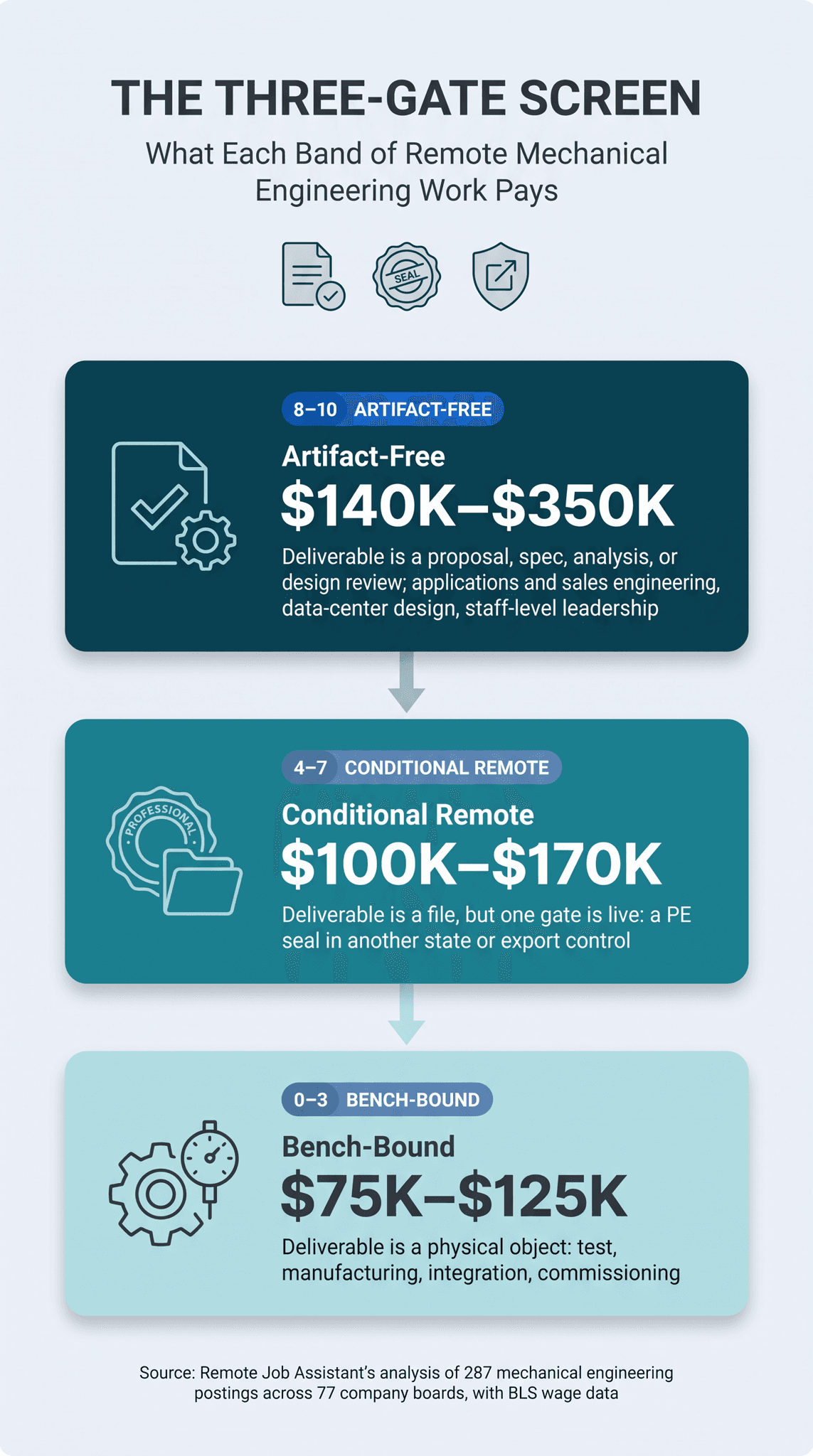
The Three-Gate Screen: A 10-point rubric that scores whether a mechanical engineering role can genuinely be done remotely, based on what your deliverable is, whether it needs a seal, and whether the data is export-controlled.
- Artifact gate: What leaves your hands: a file (CAD model, FEA report, drawing set, spec, proposal) or an object you have to touch (prototype, test rig, production line, commissioned system)?
- Stamp gate: Do the drawings need a Professional Engineer's seal in the state where the project sits, and is the firm registered there?
- Export gate: Is the technical data controlled under ITAR or the EAR, so that a foreign-person coworker or an unencrypted home laptop turns your work into an "export"?
Scoring:
- 0–3 Bench-Bound ($75K–$125K): The deliverable is a physical object. Test, manufacturing, integration, commissioning, and field service live here. No stamp required, but no file to send either. In our pull, remote was 0 of 30 at Relativity Space, 0 of 39 at Intuitive, and 0 of 122 across 16 large employers on Workday. Hybrid at best, whatever the badge says.
- 4–7 Conditional Remote ($100K–$170K): The deliverable is a file, but one gate is live: a seal in another state (MEP, HVAC, plumbing, fire protection) or export control (nuclear, defense, aerospace). Oklo's four remote-eligible mechanical postings sit here at $100K–$170K: "Santa Clara, CA or Remote," US persons only, travel to headquarters twice a quarter. Most real remote mechanical work is in this band, and the conditions are stated in paragraph nine of the posting.
- 8–10 Artifact-Free ($140K–$350K): The deliverable is a proposal, a spec, an analysis, or a design that never needs your hands on hardware, and no seal or export condition applies to you, or you already hold the license and the US-person status they require. Applications and sales engineering, data-center infrastructure design, and staff-level design leadership. Crusoe's remote data-center design role pays up to $140K–$170K plus bonus; Shield AI's one remote mechanical seat pays $240K–$350K.
How to use it: Score the artifact gate first. A 0–3 is a hybrid job no matter what the listing claims. For a 4–7, the posting will tell you which gate is live, and your job is to already hold the key: an NCEES Record, US-person status, a home office that passes the IT audit. An 8–10 is where "remote mechanical engineer" and "no asterisk" finally overlap, and it's where a mid-career engineer should aim.
To score a posting in two minutes, skip the summary and search the body for four strings. "Lab," "test," "commissioning," or "shop" in the responsibilities means the artifact gate is closed: 0–3, stop reading. "Licensed in" or "multi-state" means the stamp gate is live: 4–7, and the posting is really a licensure list. "US person" or "export" means the export gate is live: 4–7, and your residency status is the first interview question. "Travel" with a percentage tells you whether the remote badge is honest; "as required" or "based on business needs" with no number, which is the exact language in both Oklo's and Crusoe's remote postings, means the travel is uncapped and you should ask for a number before you accept.
Why do these gates exist? The artifact gate is physics. A prototype has to be built, broken, and measured by someone in the room with it; a simulation doesn't. That's the same principle our broader guide to remote engineering jobs calls The Artifact Test, which found that 61% (n=190 of 312) of "remote" hardware, electrical, and mechanical postings actually described hybrid schedules. This guide goes one level down, into mechanical engineering specifically, because that's where the other two gates start to bite.
The stamp gate is law. Every state licenses PEs separately, and the Texas Board of Professional Engineers states it plainly: "Any firm offering engineering services in Texas is required to be registered," and Texas "does not allow a true reciprocity or comity." New York's Education Law §7209 makes the seal a personal assumption of responsibility for the work. So a remote HVAC engineer in Ohio designing a Texas data center needs a Texas license, or a Texas-licensed colleague willing to review and seal, plus a Texas-registered firm. Remote MEP work doesn't mean unlicensed work. It means licensed in more states than the office job ever required.
The export gate is federal regulation, and it's the one most engineers misread. Under ITAR, a "U.S. person" (22 CFR 120.62) is a citizen, permanent resident, or protected individual; everyone else, including an H-1B or OPT coworker, is a "foreign person" under 120.63. Under the EAR, showing controlled technology to a foreign person inside the United States is a "deemed export" (15 CFR 734.13). Home-office ITAR work is legal at all only because of 22 CFR 120.54(a)(5), effective March 2020, which says sending or storing unclassified technical data is not an export if it's end-to-end encrypted to FIPS 140-2 and never routed through a restricted country. That single paragraph is why Oklo's remote postings say "US person" and why Intuitive's mention a Technology Control Plan. The "US person only" line in a remote defense posting isn't about citizenship pride. It's about where your laptop's encryption puts the data.
| Gate | The question | What the posting says when it's live | Who it bites | What clears it |
|---|---|---|---|---|
| Artifact | Does my deliverable leave my hands as a file or an object? | "Hands-on," "lab," "test cell," "commissioning," "shop floor" | Test, manufacturing, integration, field service | Moving to design, analysis, applications, or review work |
| Stamp | Must the drawings be sealed in the project's state? | "PE required," "multi-state licensure," "licensed in TX/CA/NY" | MEP, HVAC, plumbing, fire protection, structural-adjacent | A PE plus an NCEES Record and licenses in the project states |
| Export | Is the data ITAR/EAR-controlled? | "US person," "US citizen," "export control," "Technology Control Plan" | Aerospace, defense, nuclear, some semiconductor equipment | US-person status plus an employer with an encrypted remote setup |
Stop Applying Manually
Our AI applies to hundreds of matching jobs while you sleep. Wake up to interviews, not more applications.
How We Collected This Data
The figures in this post come from 77 company career boards (31 on Greenhouse, 14 on Lever, 23 on Ashby, 9 on SmartRecruiters) pulled in full through their public ATS APIs on September 15, 2026, a total of 15,674 live postings. We filtered to 287 US titles containing mechanical, HVAC, MEP, plumbing, fire protection, thermal, piping, mechanisms, FEA, or CFD, and excluded interns, technicians, installers, drafters, and electrical, RF, optics, and software titles. Remote and hybrid status comes from each ATS's structured workplace or location field, and we then read every remote-flagged posting in full, because employers mark in-office roles remote often enough to matter (one false flag is disclosed below).
We supplemented the board pull with keyword searches across 16 large employers' Workday career sites (2,235 results reviewed, capped at 200 per site) and SmartRecruiters' network-wide exact-phrase search (569 postings for "mechanical engineer"). Pay was cross-referenced with BLS Occupational Employment and Wage Statistics for May 2025 (accessed through O*NET), Salary.com benchmarks dated September 1, 2026, Levels.fyi as of September 15, 2026, and PSMJ's 2026 compensation survey as reported by ASME.
Three honest gaps. The sample is heavy on hardware, energy, and aerospace companies with public boards plus four A&E firms; the large MEP consultancies that run proprietary portals (Henderson, Salas O'Brien, WSP, Burns & McDonnell) were not pulled, and their remote policies are quoted from their own careers pages. Reddit and Glassdoor block automated collection, so no sentiment data from either appears here. Workable's global search rate-limited us and was dropped. Data reflects September 2026; we re-pull each hiring cycle.
What Remote Mechanical Engineering Jobs Pay in 2026
There is no remote premium in mechanical engineering. There is a level premium and a California premium, and the aggregator pages that advertise a "remote mechanical engineer salary" are mostly measuring the second one. Remote Rocketship's widely quoted $144,427 average, for instance, is built from 1,091 openings that include forensic engineers, process engineers, and chip physical-design engineers under the same label. That's why it lands $40K above the BLS median. It's a talking point, not a benchmark.
Here's what the posted ranges in our pull actually show, by title level, against the external benchmarks that don't depend on a scraper's definition of "mechanical."
| Level | Posted range medians (our pull, Sept 2026) | External benchmark | Where remote exists on the Three-Gate Screen |
|---|---|---|---|
| Engineer I–II | $97K floor / $141K ceiling (n=14) | Salary.com ME I $79,500, ME II $93,746; PSMJ entry median $71,110 | Nowhere. 0 of 14 remote. Bench-Bound |
| Mechanical Engineer (unleveled) | $120K / $170K (n=24) | BLS median $104,110; Salary.com ME III $108,339 | Conditional Remote (nuclear, MEP) |
| Senior / Lead | $132K / $194K (n=41) | Salary.com ME IV $129,092; PSMJ 10–14 years $119,438 | Conditional to Artifact-Free |
| Staff / Principal | $155K / $233K (n=44) | Salary.com ME V $148,531; PSMJ 20+ years $146,160; Levels.fyi 90th percentile $211K | Artifact-Free |
| Manager / Director | $170K / $255K (n=8) | BLS architectural and engineering managers median $171,270 | Artifact-Free |
Salary ranges derive from the 131 of 287 postings in our September 2026 pull that published a range, cross-referenced with BLS wage data for mechanical engineers and Salary.com's September 2026 ladder. Posted ranges are employer-entered and skew toward California hardware companies that must publish them by law; the BLS figures are the national anchor. Ranges shift as markets move.
Three things explain the spread between the $104,110 BLS median and the $138,550 median posted floor. First, geography: 140 of the 287 postings are in California, where pay transparency law requires a range and where San Jose mechanical engineers earn a $168,030 median. Second, industry: BLS data republished by ASME puts the oil and gas extraction median at $169,020, scientific R&D at $123,080, and machinery manufacturing at $96,690. The same title pays $70K differently depending on what the company sells. Third, level: 117 of the 131 posted ranges had floors at or above $100K because the companies with public boards are hiring senior, staff, and principal engineers, not graduates.
The remote postings follow the level pattern exactly. Oklo's four remote-eligible roles run $100K–$150K for fuel-manufacturing design in Idaho Falls or remote, $115K–$170K for core mechanical design, $120K–$170K for fuel-recycling equipment, and $125K–$165K for a senior reactor-module designer. Crusoe's remote data-center infrastructure design role pays up to $140K–$170K plus bonus and stock. Shield AI's single remote mechanical seat is a senior staff position at $240K–$350K, while the company's 30 onsite mechanical roles range from $90K for an Engineer II in Dallas to $400K for a principal fluid and thermal engineer in Seattle. Remote doesn't pay a premium in mechanical engineering. Seniority does, and the level that goes remote is staff.
Two more inputs belong in your number. The PE premium is real but badly dated in the public record: NSPE's often-quoted "PEs earn 20% more" ($86K versus $69K) comes from its 2007 survey, and no public NSPE median has been released since, so treat the license as a gate-opener rather than a fixed raise. And if you're pricing contract work, Cad Crowd's 2026 rate card puts senior US mechanical CAD at $110–$160 per hour with a 10–20% platform fee, which is the cleanest way to test whether your work really leaves your hands as a file. When you're ready to compare offers, the $100K+ remote listings on our board are filtered to the level where these roles start, and $150K+ positions are where the staff and principal seats show up.
Stop Applying Manually
Our AI applies to hundreds of matching jobs while you sleep. Wake up to interviews, not more applications.
The Four Lanes Where Mechanical Engineers Actually Go Remote
Remote mechanical engineering work isn't spread thinly across the profession. It sits in four lanes, and each one is defined by which gate it clears.
Lane 1: MEP and HVAC design for data centers and mission-critical buildings (Conditional Remote, stamp gate). This is the lane with the most seats, and the reason is a construction number. Census Bureau data shows data-center construction put in place hit $6,551 million in July 2026 against $4,133 million in July 2025, a 58.5% increase; the trailing twelve months came to $59.4 billion versus $44.5 billion the year before, and data centers now account for 61% of all private office construction (our arithmetic on the Census C30 file). Every one of those buildings needs mechanical, plumbing, and fire-protection drawings sealed in the state where it sits, and the firms doing that work hire distributed on purpose. Henderson Engineers tells candidates they can "work from one of our 14 offices nationwide, your home office, or the coffee shop down the street," with staff in all 50 states. Salas O'Brien advertises "remote and hybrid opportunities" across 2,400-plus employee-owners. Crusoe, which builds data centers for AI workloads, lists a Staff Infrastructure Design Engineer as "Remote – US" with "willingness to travel to data center sites as required." The catch is the stamp: remote in this lane means licensed where the buildings are, which is why these postings ask for multi-state licensure and pay for your NCEES Record. The second catch is the travel clause. Crusoe's remote role says "travel to data center sites as required," with no percentage; Oklo's says headquarters trips happen "based on business or team needs." Neither is a lie, but neither is a cap, and for an engineer who doesn't live within a flight of Northern Virginia, Texas, or Ohio, an uncapped site-visit clause is a hybrid schedule with a longer commute. Get the number in writing.
Lane 2: Nuclear and advanced-energy design (Conditional Remote, export gate). Oklo is the clearest example in our data. Four of its six mechanical postings read "Santa Clara, CA or Remote" or "Idaho Falls, ID or Remote," and every one carries the same two conditions: "Oklo requires remote employees to travel to headquarters twice a quarter," and "only applicants who meet the definition of a U.S. person under applicable laws may be eligible." The design is a file, so it goes remote; the reactor is not, so integration doesn't. One warning for anyone scanning titles: Kairos Power's "Senior Mechanical Engineer, Remote Handling" in Oak Ridge is a nuclear discipline, not a workplace.
Lane 3: Applications and sales engineering (Artifact-Free, travel instead of a lab). BLS puts the sales engineer median at $124,900, twenty thousand above the mechanical engineer median, and it's the exit where "remote" and "mechanical" overlap most cleanly because the artifact is a proposal. Veolia's Senior Application Engineer posting says it outright: "The position can be remote. This individual can work anywhere in North America," with travel up to 20%. Bosch lists an Applied HVAC Solutions Engineer flagged remote with up to 30% travel across the US and Canada, plus a Technical Sales Engineer with "Remote" in the title. Intuitive's Staff Clinical Applications Engineer shows the other end of the lane: "Primary Location: Remote," then 50–60% travel including nights and weekends. The decision rule is simple. Under 30% travel is a remote job. Over 50% is a field job with a home address, and it should be priced like one.
Lane 4: Staff and principal design leadership (Artifact-Free by seniority). Shield AI runs 31 US mechanical postings and 30 of them are onsite in Dallas, San Diego, or Seattle. The one exception is a Sr. Staff Mechanical Engineer for its BlueSky program at $240K–$350K, location: Remote. The pattern repeats across hardware companies: the person who reviews the design can be anywhere, the person who builds it can't.
CRB, a process and MEP design firm, has 32 US mechanical postings in our pull and 27 of them are hybrid. Its one remote-flagged Senior Mechanical Engineer says in the body text: "Preference would be for candidates to be located near CRB office locations and can work in the office in a hybrid capacity." Coffman Engineers runs 9 of 30 hybrid. The badge is a recruiter's checkbox; the paragraph is the hiring manager. Read the paragraph.
What is not remote, and won't be soon: design engineering at robotics, launch, EV, and medical-device companies, however good the pay looks. Relativity Space had 0 remote postings of 30, Intuitive 0 of 39, 1X 0 of 7, Apptronik 0 of 6, and Form Energy's only remote-flagged roles were supplier-industrialization jobs that travel to factories rather than sit at home. Those companies pay $185K–$277K for principal mechanical engineers precisely because someone has to be in the building where the hardware is. If your goal is the high-paying remote work those ranges suggest, the route runs through Lanes 1 through 4, not through a startup's careers page.
The PE License: The One Gate You Control
The artifact gate is set by the job. The export gate is set by your passport. The stamp gate is the one a mid-career mechanical engineer can clear in about twelve months, and it's the key to the biggest remote lane there is.
The mechanics matter, because the exam is not one exam. NCEES offers three PE Mechanical exams: HVAC and Refrigeration, Machine Design and Materials, and Thermal and Fluid Systems. Each is 80 questions in a 9-hour computer-based appointment, offered year-round, at $400 per attempt, with a hard cap of "one attempt per testing window and no more than three attempts in a 12-month period," after four years of post-degree experience. The pass rates from January through June 2026 tell you which attempt counts: HVAC and Refrigeration passed 71% of first-time takers (n=799) and 40% of repeaters (n=229); Machine Design and Materials 61% (n=401) versus 39% (n=140); Thermal and Fluid Systems 70% (n=578) versus 46% (n=109). Repeat takers fail more often than they pass on every one of the three. Prepare for the first sitting as if there is no second.
Which exam, and whether to sit at all:
- Targeting Lane 1 (MEP, HVAC, data centers)? Sit HVAC and Refrigeration. It has the highest first-time pass rate of the three and it's the discipline the remote-friendliest firms stamp every day.
- Targeting Lane 2 (nuclear, energy, thermal systems)? Sit Thermal and Fluid Systems. The license isn't usually required for design work under a licensed lead, but it's what separates the reviewer from the reviewed.
- Targeting product design at a hardware company? Sit Machine Design and Materials only if you want the consulting door open later. Nobody at a robotics startup stamps anything, and the exam won't move a $150K offer.
- Targeting Lane 3 or 4 (applications, sales, staff leadership)? Skip it for now. Your artifact is a proposal or a review, and no state seals those.
- Already licensed in one state? The next move isn't a second exam. It's an NCEES Record ($175 for the first transmittal, $100 for each after, no annual fee) so you can stack states on demand.
One state-specific trap is worth naming because it sits under the largest concentration of data-center construction in the country. Texas requires the firm itself to register with the state board, requires at least one Texas-licensed engineer in that firm, and explicitly does not offer true comity. A remote MEP engineer designing a Texas data center from Ohio is legal only if someone in the chain holds a Texas license and the firm holds a Texas registration. The remote firms know this, which is why "licensed in TX" appears in postings that never mention an office. If your longer-term path runs toward managing those projects rather than stamping them, PSMJ's 2025 survey puts the project manager median at $111,318, and our guide to remote project manager roles covers what that transition looks like from an engineering seat. Either way, the project management skills that get an engineer promoted are the ones remote firms screen for first, because a remote engineer who can't run a scope call is a cost.
Stop Applying Manually
Our AI applies to hundreds of matching jobs while you sleep. Wake up to interviews, not more applications.
Who's Hiring Remote and Hybrid Mechanical Engineers in 2026
The employers are knowable and few. These are the ones whose remote or hybrid mechanical hiring we verified directly in their ATS data or on their careers pages in September 2026, grouped by which lane they're in.
| Employer | What they hire | Workplace reality (from the posting text) | Posted range | Three-Gate band |
|---|---|---|---|---|
| Oklo | Mechanical design: core, reactor module, fuel manufacturing, fuel recycling | "Santa Clara, CA or Remote"; HQ travel twice a quarter; US person only | $100K–$170K | 4–7 Conditional |
| Shield AI | Sr. Staff Mechanical Engineer (BlueSky / V-BAT) | Remote; 30 of 31 other mechanical roles onsite | $240K–$350K | 8–10 Artifact-Free |
| Crusoe | Staff Infrastructure Design Engineer (data centers) | "Remote – US"; travel to sites as required | Up to $140K–$170K plus bonus | 8–10 Artifact-Free |
| Henderson Engineers | MEP and building-systems design | Home office option; staff in all 50 states (careers page) | Not posted | 4–7 Conditional |
| Salas O'Brien | MEP, mission-critical facilities | "Remote and hybrid opportunities" (careers page) | Not posted | 4–7 Conditional |
| Veolia Water Technologies | Senior Application Engineer | "Can work anywhere in North America"; up to 20% travel | Not posted | 8–10 Artifact-Free |
| Bosch | Applied HVAC Solutions Engineer; Technical Sales Engineer | Remote-flagged; up to 30% travel; US work authorization required | Not posted | 8–10 Artifact-Free |
| CRB | Mechanical and process design | Hybrid near an office (27 of 32) | Not posted | 4–7, hybrid |
| Coffman Engineers | Fire protection, mechanical | Hybrid (9 of 30) | Not posted | 4–7, hybrid |
| Intuitive | Mechanical design, instruments | Sunnyvale onsite or hybrid (0 of 39 remote) | Not posted | 0–3 Bench-Bound |
Three things stand out, and none of them flatter the job boards. The only employer posting multiple remote-eligible mechanical design roles is a nuclear startup, not a household name. The highest remote number in the entire dataset is a staff seat at a defense company that keeps every other mechanical engineer in the building. And the largest lane by headcount, MEP consulting, publishes almost no ranges, because those firms are headquartered in states that don't require them. Go to the company's own Greenhouse, Lever, or Ashby page before you go to an aggregator; the ranges survive there and get stripped everywhere else.
Red flags in remote mechanical engineering postings. Walk away, or at least ask:
- "Remote" in the ATS flag, "near our office" in the body. The flag is a recruiter's checkbox; the body is the manager. CRB's posting is the textbook case.
- "Remote" in the title of a nuclear or robotics posting. Remote handling is a discipline. Check the location field, not the title.
- "US person" with no mention of encryption, VPN, or a Technology Control Plan. The export gate is live and the employer hasn't built the infrastructure to clear it remotely. Expect "remote" to become "onsite, in the room next to the classified one" by month three.
- Remote plus 50% or more travel. That's a field job with a home address, and it should be paid like a field job.
- No salary range from a company headquartered in California, Colorado, New York, Washington, Illinois, or another state that requires one. A posting that doesn't comply with the law where it was written is not one you'll negotiate well against.
- "Hybrid" with no office named. Hybrid to the nearest of 14 offices is a relocation.
Two questions settle most of this in the first screen. For Lane 1: "How many of your mechanical staff are fully remote today, and which state licenses stamp the drawings?" A firm that answers with a count and a list of states has done this before. For Lane 2: "Is there a Technology Control Plan that covers remote employees, and does the home setup have to pass your IT audit?" A firm that answers "we'll figure that out" hasn't. If your applications are going out and nothing is coming back, the problem is usually targeting rather than qualifications; our breakdown of why qualified candidates don't get interviews applies with extra force in a market where 3% of postings are the ones you want.
Frequently Asked Questions
Can a mechanical engineer really work remotely, or is every "remote" listing hybrid in disguise?
Both, depending on the lane. Only 3% (n=10 of 287) of US mechanical engineering postings across 77 company boards were flagged remote in September 2026, and 31% (n=47 of 152) were hybrid where the ATS reports it. The genuinely remote roles cluster in four places: MEP and data-center design, nuclear and energy design, applications and sales engineering, and staff-level design leadership. Outside those lanes, assume hybrid.
I'm an HVAC design engineer with six years and a PE in one state. How do I get a remote MEP job?
Get an NCEES Record ($175 for the first transmittal, $100 for each additional state), then target the mission-critical and data-center firms that hire distributed: Henderson Engineers, Salas O'Brien, and the infrastructure teams at data-center developers. Lead with the states you're licensed in, because that's what the posting is really asking for. Data-center construction grew 33.5% year over year to $59.4 billion, and every one of those buildings needs a sealed mechanical set.
Why do remote aerospace, defense, and nuclear mechanical engineering postings say "US person only"?
Because the technical data is export-controlled. Under ITAR, anyone who isn't a citizen, permanent resident, or protected individual is a "foreign person," and showing them controlled data, even inside the US, counts as an export. Working from home with that data is legal only under 22 CFR 120.54(a)(5), which requires end-to-end encryption to FIPS 140-2. Employers restrict remote to US persons on US soil because that's the only configuration they can certify.
What does a Three-Gate Screen score of 5 mean for my job search?
It means your deliverable is a file but one gate is live: usually a seal in another state or export control. A 5 is a real remote job with a condition attached, like Oklo's "travel to headquarters twice a quarter" or a multi-state licensure requirement. Your move is to hold the key before you apply, whether that's an NCEES Record, documented US-person status, or a home office that meets the employer's encryption standard.
Do remote mechanical engineers make more or less than onsite ones?
Neither; level and location set pay, not the workplace. The median posted floor in our pull was $138,550 against a BLS median of $104,110, but 140 of 287 postings were in California and 117 of the 131 posted ranges started at $100K or more because companies with public boards hire senior engineers. Shield AI's $240K–$350K remote role is a senior staff seat; the same company pays $90K for an onsite Engineer II. Remote follows seniority rather than adding to it.
Which PE Mechanical exam should I take if I want a remote job?
HVAC and Refrigeration, if you're aiming at MEP or data-center design, which is the largest remote lane. It also has the best first-time pass rate of the three at 71% (n=799, January–June 2026). Thermal and Fluid Systems suits energy and nuclear design; Machine Design and Materials matters mainly if you want the consulting door open later. Whichever you pick, treat the first attempt as the only one: NCEES allows three attempts in 12 months at $400 each, and repeat-taker pass rates fall to 39–46%.
Is taking an applications or sales engineering role worth it to go remote?
Often, yes. BLS puts the sales engineer median at $124,900 versus $104,110 for mechanical engineers, and the artifact becomes a proposal, which clears the first gate entirely. Verify the travel number before you accept: Veolia's remote application engineer role caps travel at 20%, Bosch's HVAC solutions role at 30%, and Intuitive's clinical applications role runs 50–60%. Under 30% is remote work. Over 50% is a field job.
Start Your Remote Mechanical Engineering Job Search
Score the artifact gate first, because it decides whether you're looking at a hybrid job with a remote badge or a real one. Then clear the gate you can control: the license and the Record if you're heading into MEP and data-center work, the documented US-person status and a compliant home office if you're heading into nuclear or defense design. The postings that clear all three gates pay at the top of the profession, and there are few enough of them that speed and volume matter more than polish.
The best remote job boards for engineers are the company boards themselves, where the ranges survive; our guide to high-paying remote jobs maps which other fields share mechanical engineering's staff-level pattern; and the $75K+ remote listings on our board are where the Lane 3 applications roles show up first. When you're ready to apply across every board at once, automation beats a spreadsheet.
A part has to be somewhere. A drawing doesn't. The mechanical engineers who work from home are the ones whose work leaves their hands as a file, and who already hold the stamp and the passport the file requires.
Ready to Find Your Remote Job?
Browse thousands of curated remote jobs or let AI apply for you.
Browse Remote JobsRelated Job Guides
Remote Nonprofit Jobs: 2026 Salary Guide and Who's Hiring
Remote nonprofit jobs in 2026: which roles pay $75K–$200K remotely, why postings list specific states, how to check real pay on Form 990, and who's hiring.
30 min read
Remote Tax Jobs: 2026 Salary Guide and Hiring Companies
Remote tax jobs pay $55K to $180K depending on credential and calendar. See the salary ladder, CPA vs EA data, and companies verifiably hiring remote in 2026.
21 min read
Remote Underwriting Jobs: 2026 Salary and Hiring Guide
Remote underwriting jobs in 2026: posted pay from $60K to $290K+, which carriers and lenders actually hire remote, and the authority level that unlocks it.
30 min read