
Last reviewed: September 2026
You can run a load flow from your kitchen table. You can't probe a board from it. If you're an electrical engineer with a few years behind you and a commute you'd like to lose, that difference matters more than your title, your degree, or the "remote" checkbox on any job board.
Search for remote electrical engineering jobs and Google's top result is a Reddit thread titled "EE jobs that can be fully remote?" It ranks because nobody has answered it with numbers. The articles that try mostly point to embedded and FPGA work, because so much of it is software; Jobgether's guide names embedded systems, FPGA design, and EMC consulting as the most consistently remote EE work. The postings disagree. The remote EE market is a power-delivery market: substation design, protection and relay settings, transmission lines, interconnection studies, SCADA. FPGA, the specialty that sounds most like software, had zero remote postings in our pull.
Get Remote Job Tips in Your Inbox
Weekly strategies, salary data, and new opportunities
Unsubscribe anytime. No spam.
We pulled 747 company career boards through their public ATS APIs on September 28, 2026 (57,909 live postings), searched the Workday career sites of 66 large employers, and isolated 2,220 US electrical engineering postings across 133 employers. Then we read every posting marked remote, because the badge and the paragraph under it often disagree: Axon titles roles "Remote Eligible" that require four days a week at a hub, and OpenAI lists a hardware operations role as "US - Remote" whose body says candidates "must be able to sit onsite at our datacenters 5 days per week." What follows is where remote EE work actually exists, what it pays at each level, and the three keys that decide whether you can get it.
Based on our analysis of 2,220 US electrical engineering postings at 133 employers (pulled September 28, 2026):
- 5.7% (n=127 of 2,220) were remote-eligible; 11.6% (n=258) were hybrid
- Power systems and grid roles were 11.0% of all postings but 44.1% of the remote ones (n=56 of 127); 22.9% (n=56 of 245) of power and grid postings were remote
- FPGA: 0 of 82 remote. Test and manufacturing: 0 of 173. RF and analog: 2 of 265
- $109K–$180K median posted range on remote postings (n=103), against $108K–$174K on explicitly onsite ones (n=677): no premium beyond what seniority explains
- 73.2% (n=41 of 56) of remote power and grid postings named a PE license, against 46.6% (n=88 of 189) of non-remote ones
- 12.6% (n=16 of 127) of remote postings limited where you can live to a state, region, or commuting radius
- $120,630 median pay for electrical engineers nationally (BLS, May 2025)
Those numbers say three things at once: remote EE work exists, it's concentrated in one corner of the profession, and it isn't the corner the internet points you to.
The Bench Distance Score: Why Power Engineers Work From Home and FPGA Engineers Don't
Every electrical engineering posting answers one question before it answers any other: where does the work get proven? A protection engineer's settings get proven in CAPE or ASPEN, then again by a test crew in the substation. A physical-design engineer's block gets proven by static timing on a server farm. A board designer's work gets proven with an oscilloscope on a bench, and so does an FPGA image, and so does an RF front end. That single variable predicts remote-ability in EE better than title, seniority, or employer.
The Bench Distance Score: A 0–10 rubric that scores how far an electrical engineering role's proof-of-work sits from a physical bench. The farther from the bench, the more likely the role is genuinely remote.
Score the role on three observable criteria:
- Where the work is proven (0–4): a simulator, study, or model (PSS/E, CAPE, ASPEN, ETAP, RTL simulation, static timing) scores 4; a shared lab you visit for bring-up or design verification testing scores 2; your own bench, the production line, or the substation yard scores 0.
- What leaves your hands (0–3): a file (a settings file, a study report, a stamped drawing set, a netlist) scores 3; a design that comes back to you as hardware to bring up scores 1; installed or commissioned equipment scores 0.
- What the posting says (0–3): no lab vocabulary in the responsibilities scores 3; one lab term ("lab," "prototype") scores 1; "bring-up," "oscilloscope," "soldering," "hands-on testing," or "commissioning" scores 0.
Scoring:
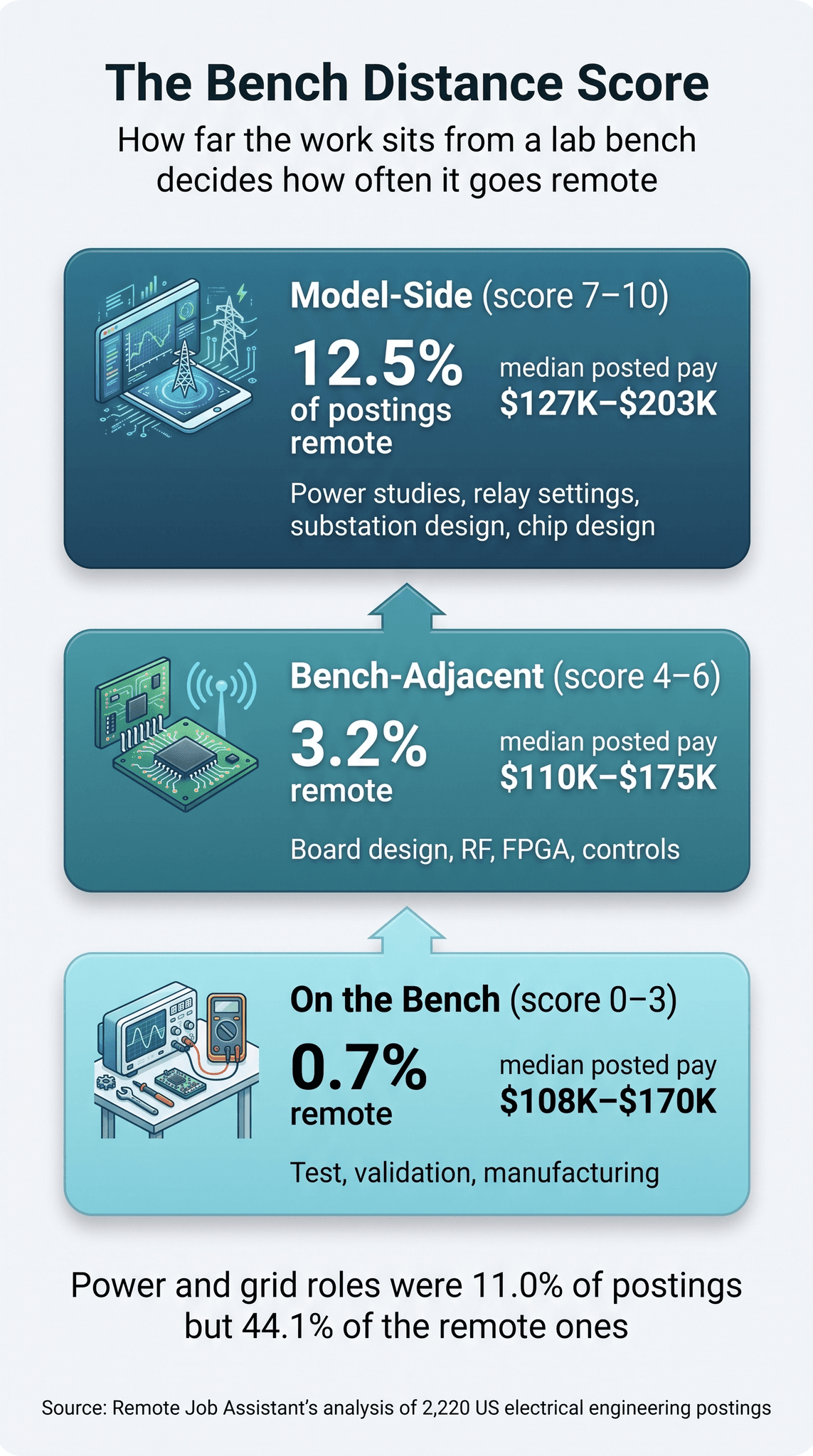
- 0–3 On the Bench ($108K–$170K median posted range): Test, validation, bring-up, post-silicon, characterization, failure analysis, manufacturing, commissioning, and field roles. In our pull, 2 of 293 were remote (0.7%), and lab vocabulary appeared in 66.6% of the posting bodies. If you see a remote badge here, you're looking at a travel job.
- 4–6 Bench-Adjacent ($110K–$175K): Board and PCB design, RF and analog, FPGA, power electronics, controls and I&C, and field applications. You design at a desk, then the hardware comes back to a bench or a customer site. Remote was 39 of 1,238 (3.2%), with lab vocabulary in 57.0% of bodies. The remote exceptions are either senior (Curtiss-Wright's principal hardware engineers, Cerebras's PCB layout lead) or travel-heavy (field applications engineers).
- 7–10 Model-Side ($127K–$203K): Power systems studies, protection and relay settings, substation, transmission, and distribution design, SCADA design, data-center electrical design, and chip RTL, verification, physical design, and DFT. The work is proven in software and the deliverable is a file. Remote was 86 of 689 (12.5%), with lab vocabulary in only 28.4%. Remote is common here, but every seat is gated by a key: a license, a security perimeter, or a passport.
How to use it: Score your current role, then score the posting you're eyeing. If you land at 4–6 and want remote work, the move is sideways into model-side work, not up the same ladder: board designer to signal and power integrity simulation, FPGA to ASIC verification, controls to SCADA design, test to protection settings.
The three bands line up with what's physically true about the work. Power studies and protection settings run entirely in software. GE Vernova's remote posting for a Lead Power Systems Engineer in grid integration lists the toolkit plainly: "PSS/E, PowerFactory, PSCAD, EMTP, ASPEN, ETAP." ICF's fully remote relay-settings engineer is expected to provide "remote field support to the relay test engineers during installation of settings." The person with the test set is in the substation. The person who wrote the settings is not, and the posting says so. Lab vocabulary appears in just 9.0% (n=22 of 245) of power and grid postings.
Chip design sits on the model side for a different reason: the bench was already a server farm. RTL simulation, verification regressions, and place-and-route run on compute clusters, and the engineer's laptop is a window into them whether it's in Santa Clara or a spare bedroom. Tenstorrent shows the split inside one company. Its physical design, DFT, and verification roles read "This role is remote based out of the United States." Its post-silicon lab manager reads "This role is hybrid, based out of Santa Clara, CA." Its high-speed signal integrity engineer reads "This role is on-site in Santa Clara, CA, Austin, TX, or Toronto, Canada." Same chips, same company, three answers, and the difference is whether the work touches silicon.
Board, RF, and FPGA work is the opposite case. The design leaves your hands as a file, but it comes back as hardware, and someone has to put a scope on it. Lab vocabulary shows up in 56.5% of board hardware postings, 67.1% of FPGA postings, 69.1% of RF and analog postings, and 74.0% of test postings. That's the remote market, drawn in one column.
| Band | Typical EE roles | Remote | Hybrid | Lab words in posting | Median posted range | What gates the remote seats |
|---|---|---|---|---|---|---|
| 7–10 Model-Side | Power studies, protection and relay settings, substation and line design, SCADA design, data-center electrical, chip RTL/DV/PD/DFT | 12.5% (86 of 689) | 19.6% (135) | 28.4% | $127K–$203K | PE license, NERC CIP access, citizenship |
| 4–6 Bench-Adjacent | Board and PCB, RF and analog, FPGA, power electronics, controls and I&C, field applications | 3.2% (39 of 1,238) | 7.8% (96) | 57.0% | $110K–$175K | Seniority or heavy travel |
| 0–3 On the Bench | Test, validation, bring-up, post-silicon, failure analysis, manufacturing, commissioning | 0.7% (2 of 293) | 9.2% (27) | 66.6% | $108K–$170K | Nothing clears it; the work is on site |
Our broader guide to remote engineering jobs introduced The Artifact Test and scored "some electrical" work at 5, remote-possible. The Bench Distance Score splits that 5 apart with EE-specific data: power delivery and chip design land at 7–10, boards, RF, and FPGA at 4–6, and test at 0–3. A relay-settings file can be emailed. A board can't be probed over Zoom. That's most of the remote EE market in two sentences.
If you're already model-side and the remote seats are the ones you want, the hard part is volume: 127 postings spread across 34 employers, many of them on Workday sites no aggregator indexes well.
Stop Applying Manually
Our AI applies to hundreds of matching jobs while you sleep. Wake up to interviews, not more applications.
How We Collected This Data
The figures in this post come from two sources pulled on September 28, 2026. First, 747 company career boards on Greenhouse, Lever, Ashby, and SmartRecruiters, pulled in full through their public APIs: 57,909 live postings of all kinds. Second, the Workday career sites of 66 large employers in semiconductors, defense, utilities, grid development, and data centers, each searched with 15 electrical engineering terms (up to 200 results per term).
We kept titles covering electrical, electronics, power systems, protection, substation, transmission, distribution, interconnection, SCADA, hardware, PCB, RF, analog, signal integrity, ASIC, SoC, verification, physical design, DFT, FPGA, controls and I&C, power electronics, and field applications. We excluded interns, co-ops, technicians, electricians, installers, software and IT titles, fire protection, civil and structural roles, sales leadership, and transmission-line roles whose degree requirement is civil engineering rather than electrical. After a US filter and deduplication (one requisition cloned across several cities counts once), that left 2,220 postings at 133 employers. 1,700 of them (76.6%) published a base salary range.
A posting counts as remote-eligible when a remote option appears in its location list or its body says so, unless the body then describes only a hybrid schedule. A body that says no remote work overrides everything else. We read all 127 remote postings in full. The 1,045 postings that list a city and say nothing about work model are treated as office-based.
Pay was cross-referenced with BLS Occupational Employment and Wage Statistics for May 2025, accessed through O*NET and the BLS Occupational Outlook Handbook, and with IEEE-USA's 2024 salary survey. The honest gaps: Reddit, Indeed, Glassdoor, and ZipRecruiter block automated collection, so none of their data appears here. The large power and MEP consultancies that run proprietary portals (Burns & McDonnell, Black & Veatch, POWER Engineers, Sargent & Lundy) aren't in the sweep, and our Workday search is keyword-based rather than a full-board pull. This is a one-day snapshot; we re-pull each hiring cycle.
What Remote Electrical Engineers Earn in 2026
Remote doesn't carry a pay premium of its own in electrical engineering. The median posted range on the 103 remote postings that published pay was $109K–$180K. On the 677 explicitly onsite postings it was $108K–$174K. The floors are the same; the slightly higher ceiling is seniority, because remote seats skew senior. Inside a single specialty the gap depends on who the remote seats are for. In chip design it flips: remote postings came in at $141K–$224K (n=16), against $147K–$230K for the rest (n=309). In power it widens at the top, for reasons covered below. The best-paid tier is hybrid, at $136K–$217K (n=190), and the reason is simple: hybrid is where chip design lives, at NVIDIA, Intel, and Cisco.
The real premium is specialty, and the specialty with the most remote seats pays the least.
| EE family | Postings | Remote | Hybrid | Median posted range | National anchor (BLS, May 2025) | Bench Distance band |
|---|---|---|---|---|---|---|
| Power systems and grid | 245 | 22.9% (56) | 17.1% (42) | $99K–$154K | EEs in power generation and T&D: $122,430 | 7–10 Model-Side |
| Chip design | 451 | 5.3% (24) | 22.4% (101) | $146K–$230K | Computer hardware engineers: $161,740 | 7–10 Model-Side |
| Facility and data-center electrical | 44 | 15.9% (7) | 9.1% (4) | $113K–$189K | Electrical engineers: $120,630 | 7–10 Model-Side |
| Field applications | 43 | 27.9% (12) | 7.0% (3) | $140K–$181K | Sales engineers: $124,900 | 4–6 (travel) |
| Board and hardware | 644 | 2.3% (15) | 10.1% (65) | $110K–$180K | Electronics engineers: $130,220 | 4–6 Bench-Adjacent |
| RF and analog | 265 | 0.8% (2) | 3.0% (8) | $110K–$176K | Electronics engineers: $130,220 | 4–6 Bench-Adjacent |
| FPGA | 82 | 0% (0) | 6.1% (5) | $108K–$165K | Electrical engineers: $120,630 | 4–6 Bench-Adjacent |
| Test and manufacturing | 173 | 0% (0) | 4.0% (7) | $105K–$165K | Electrical engineers: $120,630 | 0–3 On the Bench |
Salary ranges derive from the 1,700 of 2,220 postings in our September 2026 pull that published a base range, cross-referenced with BLS wage data for electrical engineers accessed through O*NET. Posted ranges are employer-entered and skew toward states with pay-transparency laws; the BLS figures are the national anchor. Ranges shift as markets move.
Three things explain the spread. The first is who employs power engineers. BLS counts 22% of electrical engineers in engineering services, where the median is $105,780, against $122,430 in electric power generation, transmission, and distribution and $141,160 in aerospace. The consultancies that post most of the remote power seats sit in the lowest-paying of those industries. The second is geography: 213 of the 451 chip design postings are in California, where pay-transparency law requires a range and Bay Area rates set it. The third is level. Remote work concentrates at senior grades: 8.0% (n=58 of 724) of Senior and Lead postings were remote, against 2.1% (n=5 of 234) of Engineer I and II postings. Senior and Lead roles posted a median $129K–$195K.
Inside power, remote actually lifts the ceiling. Remote power and grid postings posted a median $99K–$164K (n=50), against $100K–$149K for non-remote ones (n=153), because the remote seats are the senior ones: lead substation engineers, principal protection engineers, transmission line managers. The associate-level distribution roles that do go remote come with a preference that you live within commuting distance of the client.
The aggregator numbers aren't wrong so much as mixed. Remote Rocketship's US electrical engineer page reports "$143,801 per year ... based on data from 649 job openings," about $7,000 below our remote median midpoint of $151K. But its seniority buckets overlap (404 tags across 267 live listings), and its category includes AI-training contract listings paying $65–$120 an hour, one of them titled "Electrical Engineering Expert, PhD." An average hides the fact that 44% of the remote jobs are power jobs at power-industry pay. Our Remote Rocketship review covers what the paid board is and isn't good for.
As for the question Google keeps suggesting, whether an electrical engineer can make $500,000: once, in our data. One of 1,700 posted ranges reaches $500K, a senior director of board product development at NVIDIA ($332,000–$500,250 base, not remote), and 80 reach $300K at the top end. Among remote postings, 12 of 103 posted ceilings at $250K or more, led by Lambda's senior electrical delivery engineer ($217K–$340K), OpenAI's data-center infrastructure electrical engineer ($257K–$327K), and ICF's transmission line engineering manager ($174,701–$296,992). BLS puts the 90th percentile for electrical engineers at $184,300. IEEE-USA's 2024 survey put its members' median at $174,161, with energy and power the lowest-paid field at $155,000. When you're comparing offers, the $100K+ remote listings on our board are filtered to where these roles start, and $150K+ positions are where the lead and principal seats show up.
Remote doesn't pay extra in electrical engineering. It pays about the same, and the biggest share of it sits in the specialty that pays least.
If you're a senior power engineer, that math is fine: the ceiling on remote power roles is higher than the onsite one, and applying early to the few dozen live seats beats refreshing a job board.
Stop Applying Manually
Our AI applies to hundreds of matching jobs while you sleep. Wake up to interviews, not more applications.
The Four Lanes Where Electrical Engineers Actually Go Remote
Remote EE work isn't spread thinly across the profession. It sits in four lanes, and each one comes with its own condition.
Lane 1: Power delivery consulting (Model-Side, 8–10; the condition is territory and a license). This is the biggest lane by a wide margin. Leidos alone posted 24 remote EE roles of its 105, GE Vernova 16 of 50, and ICF 9 of 11. The work is substation physical and protection design, relay settings, transmission and distribution design, interconnection studies, and SCADA design, and the postings are direct about it. ICF: "This position is fully remote and can only be performed in the United States," at $98,614–$167,644 for relay settings. GE Vernova: "This is a remote eligible position based in the US or Canada," with travel of up to 20% "for meetings and on-site commissioning tests." Hanson Professional Services lists substation and distribution design engineers at $147,000–$175,000 across 27 locations, with "Professional Engineer (PE) Required."
The duties show what the remote week looks like. ICF's relay-settings engineer develops "relay settings and protection philosophies for distribution equipment," models systems in "CAPE, ASPEN & CYME," and needs "experience with developing settings for Schweitzer relays" plus the IEC 61850 protocol. GE Vernova's lead protection and control engineer produces "one-lines, three-lines, AC / DC schematics, and relay settings," writes "FAT, SAT, Outages and cutover plans," and supports "field testing and commissioning either from office or by on site presence." ICF's remote transmission planning engineer runs load flow and contingency analysis in "PSS/E, PSLF, PowerWorld," leads interconnection studies across "CAISO, MISO, PJM, ERCOT, WECC," builds "Python-based automation," and takes part in "business development through proposal writing." That last line is the part nobody mentions: at a consultancy, the remote senior engineer also helps sell the next study.
The demand is structural. Lawrence Berkeley National Laboratory's Queued Up report counted over 2,060 gigawatts of generation and storage waiting to connect to the US grid at the end of 2025, and a median of more than five years from interconnection request to commercial operation for projects built in 2025. FERC's Order No. 2023 made cluster studies mandatory, with a 150-day study clock and penalties for missed deadlines. Every one of those projects needs load-flow, short-circuit, and protection studies, and that's desk work. NFPA 70E adds a recurring load of its own: the incident energy analysis behind arc-flash labels has to be reviewed at intervals not exceeding five years.
The condition is where you live. 16 of the 127 remote postings limit you to a state, region, or commuting radius, and 10 of those are Leidos roles tied to specific utility clients: "Candidates must located in the Denver, CO or Minneapolis, MN area," a lead substation engineer who must be in "the client servicing territory of (Michigan, Ohio, or Indiana)," distribution engineers who "must be located within a commutable distance of Southern Louisiana." Dairyland Power titles one role "Remote from Wisconsin, Minnesota, Iowa, or Illinois." Hanson posts an "Electrical Engineer - Remote within 3 hours of Orlando." So read a power delivery posting from the bottom up. If the location paragraph names a territory, the job is remote inside that territory and nowhere else, whatever the title line says, and you should know which utility you'd be serving before the first call.
Why do consultancies post these seats more than the utilities themselves do? Part of the answer is NERC. Under CIP-005-7 Requirement R2, every interactive remote session into a high-impact BES Cyber System, or a medium-impact one with external routable connectivity, has to pass through an Intermediate System, use encryption that terminates there, and require multi-factor authentication. CIP-004-7 adds a personnel risk assessment with a seven-year criminal history check before anyone gets electronic access. Reaching a live relay from your house means going through that architecture every session. Writing its settings file doesn't. NERC or CIP is named in 22.4% (n=55 of 245) of power and grid postings.
Lane 2: Data-center electrical (Model-Side, 7–9; the condition is travel). The Department of Energy's data-center report found data centers used about 4.4% of US electricity in 2023 and projected 6.7% to 12% by 2028. Someone has to design the switchgear, UPS systems, and medium-voltage feeds, and several employers hire that someone remotely. Jabil's data-center infrastructure team lists "Location: Remote* OR Austin, TX" with the footnote "*Requires up to 25% domestic and/or international travel (rare)," at $100,100–$238,400 across its roles. Vantage Data Centers offers its principal electrical engineer a choice between an office schedule ("3 days on site required, 2 days flexible") and being "based remotely." OpenAI lists a data-center infrastructure electrical engineer as San Francisco, Seattle, or US-Remote at $257K–$327K. Anthropic lists its data-center electrical engineer as "Remote-Friendly, United States" at $320,000–$405,000, but the same posting says "we expect all staff to be in one of our offices at least 25% of the time," so we counted it as hybrid. Our guide to remote mechanical engineering jobs covers the construction-spending side of the same boom.
The trap in this lane is the field role wearing a remote badge. Crusoe's Electrical Field Engineer for data centers pays $196K–$235K and is "remote by design, with a minimum travel expectation of 50% - there may come times when this travel expectation is exceeded during critical construction phases." That's a 2 on the Bench Distance Score. The engineer lives at home and works at the site.
Lane 3: Chip design (Model-Side, 7–9; the condition is culture and citizenship). Chip design had 24 remote postings and 101 hybrid ones out of 451. The tools are remote; the teams mostly aren't. Tenstorrent posted 8 US chip design roles as remote, plus a field applications role. NVIDIA posted 11 roles that list a remote location alongside its offices, at $116K–$264.5K, while 23 others are tagged hybrid. Cisco's signal and power integrity lead is "open to remote applicants residing within the United States" at $183,800–$263,600. Intel's postings say either "This role will be eligible for our hybrid work model" or "This role will require an on-site presence," and Broadcom's say "Must work in person - no remote work allowed." In defense electronics, the remote seat comes with a passport check: RTX's Senior Principal Electrical Engineer (FPGA/ASIC) is "Position Role Type: Remote" at $132,400–$251,600, and "U.S. citizenship is required, as only U.S. citizens are authorized to access information under this program/contract."
Lane 4: Senior hardware and field applications (Bench-Adjacent, 4–6; the condition is seniority or travel). A handful of board-level roles go remote at the top of the ladder. Curtiss-Wright posts "Principal Hardware Engineer - Remote" in New Hampshire and Massachusetts at $144,100–$190,000 plus bonus. Cerebras lists its PCB Layout Engineering Lead as "Location: Remote. Sunnyvale, CA (Hybrid) is highly preferred," at $210,000–$230,000. Field applications engineers go remote because their bench is the customer's: Lumentum's field application engineers post at $149,900–$214,150, 3M's high-speed interconnect FAE "may work remote within the United States" with up to 15% travel, and Standard Bots says its senior applications engineer role is "technically remote, but you must live on the west coast," with 50% travel. The decision rule: under 25% travel is a remote job. Over 50% is a field job with a home address, and it should be priced like one.
Titles mislead in both directions, and two employers show how.
Axon titles two senior electrical engineering roles "Remote Eligible." The body says "This position offers a hybrid schedule, requiring team members to work onsite at one of our regional hubs ... Tuesday through Friday," and that "Full-time remote eligibility will be evaluated on a case-by-case basis." We counted them as hybrid. Northrop Grumman, going the other way, writes "This position has NO Hybrid or Remote work available" into postings whose ATS fields say nothing either way. The badge is a recruiter's checkbox. The paragraph is the hiring manager.
What isn't remote, and won't be soon: FPGA (0 of 82), test and manufacturing (0 of 173), RF and analog (2 of 265), and almost all of defense and space. Excluding Leidos's power group, the defense and space employers in our pull posted 1,007 EE roles and 9 were remote (0.9%), six of them at Curtiss-Wright. SpaceX posted 207 EE roles and none were remote; Northrop posted 139 and none were remote. Those employers pay well precisely because someone has to be in the building with the hardware. If your goal is the high-paying remote work that ranges like theirs suggest, the route runs through Lanes 1 to 4.
Here's the trade nobody on page one of Google mentions. The largest slice of the remote EE market is consultancy work on other people's substations, at consultancy pay: power and grid postings came in at a median $99K–$154K, against $146K–$230K for chip design. The best-paid EE work is also the most hybrid, with 22.4% (n=101 of 451) of chip design postings tagged hybrid against 5.3% remote. In this data you can have the top-paying specialty or the one with the most remote seats, and you rarely get both.
Pick your lane before you pick a posting:
- PE in hand (or eligible to sit Power within a year) and willing to live inside a utility client's territory? Lane 1. Power and grid roles are 44.1% of the remote market, and the seats worth chasing are lead and principal.
- US citizen with RTL, verification, or physical design experience? Lane 3, but aim at the employers that actually post remote (Tenstorrent, NVIDIA's remote-listed roles, Cisco) and expect a hybrid schedule everywhere else.
- Medium-voltage or switchgear design experience and fine with 25% travel? Lane 2, data-center electrical.
- Comfortable in front of customers and on the road a quarter to half the time? Lane 4, field applications.
- Board, RF, or FPGA designer below staff level? None of the four, yet. Remote was 2.3% (n=15 of 644) of board postings and zero for FPGA. Plan a sideways move to model-side work, or accept a hub schedule and negotiate the days.
The Three Keys: PE License, CIP Access, and Citizenship
At 7–10 on the Bench Distance Score, the remote seat is almost always gated by one of three keys. Knowing which one a posting wants tells you whether to apply now or prepare first.
The PE license (power and facility electrical). A PE was named in 73.2% (n=41 of 56) of remote power and grid postings, against 46.6% (n=88 of 189) of non-remote ones. One likely reason the license matters more for the remote seat: a remote engineer is often sealing drawings for a client in another state, and that state decides who can stamp them. NCEES splits the PE Electrical and Computer exam into three modules, and they don't run on the same calendar. Power is computer-based and offered year-round: 80 questions in a 9-hour appointment. Electronics, Controls, and Communications and Computer Engineering are single-day exams held once a year (the next dates are October 28, 2026 for Computer Engineering and April 14, 2027 for Electronics, Controls, and Communications). All three cost $400, and NCEES caps attempts at "one time per testing window and no more than three times during any 12-month period." The pass rates published in July 2026 say the first sitting is the one that counts: Power passed 62% of first-time takers (n=1,344) and 42% of repeat takers (n=721).
Which key to cut first:
- Power engineer, four or more years, no PE? Sit PE Power this quarter. It's year-round, it's the license 73.2% of remote power postings name, and a failed attempt costs you a testing window, not a year.
- Controls, electronics, or communications engineer? Book the Electronics, Controls, and Communications exam now. It runs one day a year, so a miss costs twelve months.
- Licensed in one state? Your next move is an NCEES Record, not another exam: $175 for the first comity transmittal, $100 for each after that, no annual fee. Our mechanical engineering guide covers the states that make comity hard.
- Board or FPGA designer who wants remote work? Skip the license and move model-side: signal and power integrity simulation or ASIC verification.
- Utility operations engineer? Target consultancies, not your own utility's remote policy. The settings work goes remote; the relay access doesn't.
CIP access (utility-side work). If a posting names NERC CIP, expect onboarding to include a personnel risk assessment with a seven-year criminal history check covering everywhere you've lived for six months or more, renewed at least every seven years, and expect remote sessions to run through a jump host with multi-factor authentication. CIP-005-8 keeps the same model when it takes effect on July 1, 2028. None of it blocks remote design work. It does mean the remote job is writing settings and studies, not operating the system.
Citizenship (defense and advanced chips). Under ITAR, a "U.S. person" is a citizen, permanent resident, or protected individual; an H-1B holder is a foreign person. Under the EAR, showing controlled chip technology to a foreign national inside the US is a "deemed export" to their home country. That's why 92.5% (n=931 of 1,007) of the defense and space postings in our pull carry US-person, citizenship, or export-control language, and why RTX's remote FPGA/ASIC role requires citizenship outright. If you're not a US person, skip those postings and put the hours into commercial chip design and power delivery, where the remote seats don't ask. For a wider view of which credentials actually move remote offers, see our breakdown of certifications worth getting for remote work.
If you already hold the key a posting asks for, you're competing against a short list of engineers who also hold it, and speed decides a lot of those searches.
Stop Applying Manually
Our AI applies to hundreds of matching jobs while you sleep. Wake up to interviews, not more applications.
Who's Hiring Remote Electrical Engineers in 2026
The employers are knowable and few. 34 of the 133 employers in our pull posted at least one remote EE role, and five of them (Leidos, GE Vernova, NVIDIA, Tenstorrent, and ICF) accounted for 54.3% (n=69 of 127) of the remote postings.
| Employer | EE postings | Remote | Hybrid | Remote posted range | Bench Distance band | The condition (from the posting) |
|---|---|---|---|---|---|---|
| Leidos | 105 | 24 | 19 | $51K–$237K | 7–10 | Client territory: Denver/Minneapolis, MI/OH/IN, listed states |
| GE Vernova | 50 | 16 | 2 | $89K–$241K | 7–10 | US or Canada; 10–20% travel for commissioning |
| NVIDIA | 86 | 11 | 23 | $116K–$264.5K | 7–10 | Remote listed alongside offices; hybrid default |
| Tenstorrent | 24 | 9 | 15 | Not posted | 7–10 | "Based out of the United States" |
| ICF | 11 | 9 | 0 | $98.6K–$297K | 7–10 | US only |
| Curtiss-Wright | 27 | 6 | 0 | $94.9K–$190K | 4–6 | Remote tied to NH, MA, or ID |
| Jabil | 11 | 5 | 0 | $100K–$238K | 7–10 | Up to 25% travel |
| SOLV Energy | 6 | 5 | 0 | Not posted | 7–10 | "This role is fully remote" |
| Hanson | 4 | 4 | 0 | $80K–$175K | 7–10 | PE required; some roles within 3 hours of Orlando |
| Oklo | 4 | 3 | 0 | $85K–$190K | 4–6 | Travel to Santa Clara headquarters twice a quarter |
Two patterns stand out. The biggest remote employer of electrical engineers isn't a tech company; it's a government services contractor's power delivery group, and 10 of its 24 remote seats are tied to a utility client's territory. And the remote chip design seats cluster at a handful of companies that decided to hire that way, which means the list above matters more than any job-board filter. Go to the employer's own Workday or Greenhouse page before an aggregator. The ranges and the conditions survive there, and the best remote job boards for engineers are mostly company boards. Our engineering and technical listings are another place to start.
Red flags in remote electrical engineering postings. Walk away, or at least ask:
- A remote badge on a job whose duties include commissioning, bring-up, or "hands-on testing." That's an On the Bench role with a travel budget.
- "Travel as required" with no percentage. Ask for the number in writing. Remote postings that did state one ranged up to 75%.
- "Remote Eligible" in the title and a hub schedule in the body. The body wins, every time.
- A residency clause in paragraph nine. "Must be located within a commutable distance" usually means client-site or office days are coming, whatever the title says.
- "US person" or "U.S. citizenship is required" when you're on a visa. It's a legal gate, not a preference, and no recruiter can waive it.
- A PE requirement in a state where you aren't licensed, with no mention of comity support. Ask who pays for the Record and the second license.
Two questions settle most of this in the first screen. For power delivery: "Which states' licenses stamp your drawings, and how many of your electrical staff are fully remote today?" A firm that answers with a list and a count has done this before. For chip and hardware: "What percentage of this team works remotely now, and when was the last time someone in this role was asked to come to the lab?" If your applications are going out and nothing is coming back, the problem is usually targeting rather than qualifications, and our guide to why qualified candidates don't get interviews applies with extra force in a market where fewer than 6% of postings are the ones you want.
Frequently Asked Questions
Can an electrical engineer really work fully remote, or is every "remote" EE job hybrid in disguise?
Some can, in specific corners. In September 2026, 5.7% (n=127 of 2,220) of US electrical engineering postings were remote-eligible and 11.6% were hybrid. The remote seats cluster in power delivery (22.9% of power and grid postings were remote), data-center electrical design, chip design at a few employers, and field applications. Most carry a condition in the body, such as a residency limit, a travel percentage, or a citizenship requirement.
I'm a protection and controls engineer with a PE in one state. How do I get a remote job?
Target the consultancies that staff utility projects across states: Leidos, GE Vernova's grid solutions group, ICF, Hanson, and SOLV Energy all posted remote protection, substation, or SCADA roles in September 2026. Get an NCEES Record so you can add states on demand, and lead with the relay platforms and study tools you know (CAPE, ASPEN, PSS/E). Expect a territory requirement: 10 of Leidos's 24 remote EE postings named a region you must live in.
Which electrical engineering specialties are most remote: power systems, embedded, FPGA, or RF?
Of those four, power systems, by a wide margin. Power and grid roles were 11.0% of EE postings but 44.1% (n=56 of 127) of the remote ones. FPGA had 0 remote postings of 82, RF and analog 2 of 265, and board-level hardware 15 of 644. The deciding factor is whether the work is proven in software or on a bench, not how much code the job involves.
What does a Bench Distance Score of 5 mean for my job search?
It means you design at a desk but your work gets proven on a bench or at a customer site: board design, RF, FPGA, power electronics, or controls. In our data only 3.2% of those postings were remote, so a 5 is a hybrid job unless you're senior or willing to travel heavily. The practical move is sideways toward model-side work, such as signal integrity simulation, ASIC verification, or SCADA design, where 12.5% of postings were remote.
Do remote electrical engineers earn less than onsite ones?
No. They earn about the same. The median posted range was $109K–$180K on remote postings and $108K–$174K on explicitly onsite ones, and the small gap at the top reflects seniority. Within chip design, remote postings actually came in slightly lower ($141K–$224K against $147K–$230K). Hybrid roles paid the most ($136K–$217K) because that's where chip design sits.
Which PE Electrical exam should I take if I want to work remotely?
PE Electrical and Computer: Power, if your target is power delivery, which holds the largest share of remote EE jobs (44.1%). It's offered year-round, and it passed 62% of first-time takers (n=1,344) in the most recent NCEES data, against 42% of repeat takers. The Electronics, Controls, and Communications and Computer Engineering modules run only once a year, so plan those a year out.
Can I do ASIC or FPGA design remotely for a defense contractor?
Rarely, and only if you're a US citizen. Defense and space employers in our pull posted 1,007 EE roles and 9 were remote (0.9%). RTX's remote Senior Principal Electrical Engineer (FPGA/ASIC) posting pays $132,400–$251,600 and states that "U.S. citizenship is required." Commercial chip companies such as Tenstorrent, NVIDIA, and Cisco offer more remote chip seats without that gate.
Start Your Remote Electrical Engineering Job Search
Score the role first. If it lands at 0–3 on the Bench Distance Score, it's a site job whatever the badge says. If it's 4–6, you're looking at hybrid unless you're senior or on the road. If it's 7–10, find the key the posting asks for (a PE, CIP access, or citizenship) and make sure you hold it before you apply.
Then work the list:
- No PE and four years in power? Book PE Power for this testing window. It runs year-round, and 73.2% of remote power postings name the license.
- Licensed in one state? Open an NCEES Record now ($175 for the first comity transmittal) so a territory requirement in a new state doesn't cost you the offer.
- Searching Workday sites? Filter locations for the employer's remote label, not the word "remote": Leidos uses "Remote/Teleworker US," Invenergy and Analog Devices use "Home Office," and GE Vernova lists plain "Remote" alongside cities.
- Found a posting? Scroll to the location and travel paragraphs before the duties. A territory, a hub schedule, or "travel as required" with no number changes what the job is.
- Ready to apply? Move fast. 127 remote postings across 34 employers is a short list, and the lead and principal seats close first.
Our guide to remote engineering jobs shows how the same bench logic plays out across other engineering fields, and the $100K+ remote listings on our board are where most of these roles start. When you're ready to apply to every one of them without rewriting the same cover letter forty times, Auto-Apply does the volume so you can do the interviews.
A settings file travels at the speed of email. A PE license travels one state at a time. The engineers who work from home planned their careers around the second fact.
Ready to Find Your Remote Job?
Browse thousands of curated remote jobs or let AI apply for you.
Browse Remote JobsRelated Job Guides

Remote Jobs for Seniors: What 4,435 $75K+ Postings Show
Remote jobs for seniors that pay $75K+: we read 4,435 remote postings for age signals. Pay climbs from $115K to $201K with experience. Here's where to aim.
32 min read
Best Certifications for Remote Jobs: What 2026 Postings Say
We read 4,476 remote jobs paying $75K+ in 2026. Only 2.1% require a certification. See which credentials lock doors, which break ties, and which to skip.
32 min read
Easiest Jobs That Pay $100K: What 3,702 Remote Postings Ask
We read 3,702 remote jobs paying $100K+ in 2026. Only 30% hard-require a degree; years are the real gate. See the easiest $100K roles and their hidden catch.
32 min read