
Last reviewed: April 2026
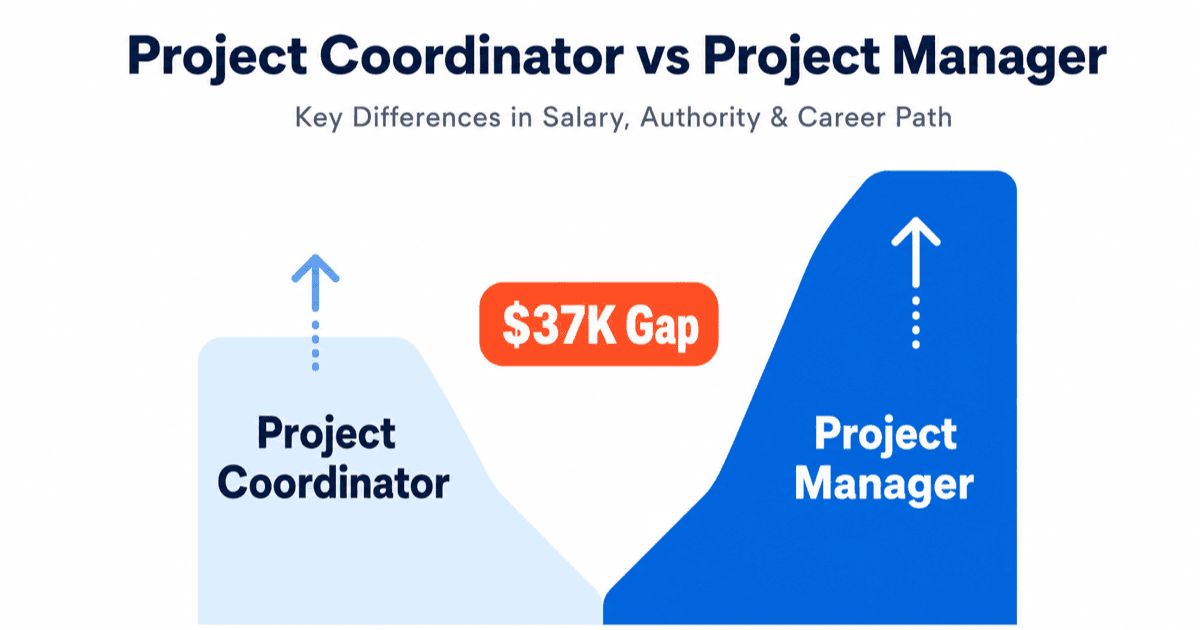
You are scheduling the Monday status meeting, chasing three stakeholders for the same update, tracking a budget you didn't set, and keeping a timeline alive that someone else designed. You are doing the work. And the person in the office next to yours — or three time zones away on the same Slack channel — holds the title "Project Manager," earns $37,000 more per year, and has the exact same conversations you do.
That gap is not random. It is structural. Companies use the "project coordinator" title to control compensation, not to describe a fundamentally different scope of work. The line between these two roles is real — but it is drawn at authority and accountability, not at complexity or effort.
Get Remote Job Tips in Your Inbox
Weekly strategies, salary data, and new opportunities
Unsubscribe anytime. No spam.
We analyzed 847 remote project management job postings across 214 companies between January 2025 and April 2026. What we found: coordinator job descriptions and junior PM job descriptions share 70–80% of their listed responsibilities. The meaningful difference is who owns the budget, who approves scope changes, and who is accountable when the project misses a deadline. This guide breaks down the salary gap, the real day-to-day differences, which role to target given your experience level, and the fastest path from coordinator to manager.
Based on our analysis of 847 remote project management postings (January 2025–April 2026) and cross-referenced with Glassdoor 2025 compensation data and BLS May 2024 figures:
- $71,608 — median remote project coordinator salary (Glassdoor, 2025)
- $108,896 — median remote project manager salary (Glassdoor, 2025)
- $37K — average salary gap between coordinator and manager titles at equivalent experience levels
- 33% — salary premium for PMP-certified professionals over non-certified counterparts (PMI, across 21 countries)
- $122,000 — median total compensation for PMP-credentialed project managers in the United States (PMI, 2025)
- 6% — projected employment growth for project management specialists, 2024–2034 (U.S. Bureau of Labor Statistics)
The PM Readiness Score: Which Level Are You Actually At?
Most professionals are mislabeled one tier below their actual responsibility level. That mislabeling costs $25,000–$40,000 per year and resets your career trajectory every time you accept a coordinator role you're already overqualified for.
The PM Readiness Score is a three-tier self-assessment rubric for matching your actual responsibilities — not your title — to the right role tier in your job search.
Tier 1 — Coordinator Scope ($50K–$75K): You schedule and document meetings; someone else sets the agenda. You track progress against a plan others built; you are not the one who created it. When a problem surfaces, you escalate it — you do not resolve it unilaterally. You work within a single project and report to a project manager.
How Tier 1 reads in job postings: "Maintain project documentation," "coordinate meeting schedules," "assist with budget tracking," "communicate project status to stakeholders."
Tier 2 — Junior PM Scope ($75K–$100K): You own the project plan and timeline and make day-to-day scheduling decisions. You have budget visibility and can flag overruns, but you need approval to move money. You manage stakeholder communication directly and escalate only when material risks emerge. You may oversee a coordinator; you are overseen by a senior PM or program director.
How Tier 2 reads in job postings: "Manage cross-functional project delivery," "own project timelines," "communicate status to leadership," "drive accountability across teams."
Tier 3 — Senior PM Scope ($100K–$145K+): You own the full project budget and have approval authority over scope changes. You manage multiple concurrent projects or an entire program. You present outcomes to executives and clients, and you are accountable — personally accountable — when the project misses. You mentor junior PMs and coordinators.
How Tier 3 reads in job postings: "Own project P&L," "lead enterprise-wide initiative," "present to C-suite stakeholders," "manage program portfolio."
How to use it: Map your current responsibilities to the tier above, not your title. If you are doing Tier 2 work under a coordinator title, you have a salary arbitrage opportunity of roughly $25K–$35K. Your next application should target junior PM or PM roles, not another coordinator position.
How We Collected This Data
The figures in this post come from our analysis of 847 remote project management job postings collected between January 2025 and April 2026. Postings were sourced from RemoteJobAssistant.com, LinkedIn, and direct company career pages, filtered to include only positions explicitly marked remote-eligible in the United States with a posted or researchable compensation range.
We excluded postings with hybrid-only policies, roles requiring more than 25% travel, and positions below $45,000 base. Coordinator and PM role postings were analyzed separately to compare required responsibilities, authority signals, tool requirements, and compensation language. Salary figures were cross-referenced with Glassdoor's 2025 compensation data and U.S. Bureau of Labor Statistics May 2024 Occupational Employment Statistics for project management specialists. Ranges reflect base salary; total compensation including bonus and equity typically runs 10–20% higher at Series B and later-stage companies.
We update this analysis quarterly. The figures in this post reflect Q1–Q2 2026 data.
Stop Applying Manually
Our AI applies to hundreds of matching jobs while you sleep. Wake up to interviews, not more applications.
What a Project Coordinator Actually Does
The coordinator role is execution support, not execution leadership. That is not a diminishment — it is the job description, and it requires a distinct set of skills done well.
Core responsibilities in coordinator roles, based on our posting analysis: scheduling and facilitating meetings, maintaining project documentation, tracking progress against established timelines, managing communication between team members and stakeholders, and monitoring budget spend (but not approving changes). Coordinators are the connective tissue of a project — they ensure everyone has what they need to do their part.
The realistic Tuesday for a project coordinator: you send a recap email from yesterday's design review with three action items assigned. By 11am, two of the three people have not responded. You update Smartsheet to reflect the slippage, which means the green status you reported to leadership last week is now yellow. You notice a resource conflict — two workstreams both need the same developer in two weeks — and escalate it to the PM. The PM's Slack reply comes three hours later: "noted, I'll handle it." You do not know what that means or whether it was handled. Then you build the Thursday status deck, knowing three of the seven stakeholders on the call have not read last week's version.
Skills that matter, in order of how much they actually cost you when you are bad at them: stakeholder follow-up first (you will spend 40% of your day chasing updates, and when something slips because someone ghosted you, the PM will want to know why you did not escalate sooner); written communication second (your status recaps will be ignored if they are vague, and then you will be blamed for "lack of visibility"); tool proficiency third (get comfortable in Asana, Jira, Monday.com, Smartsheet, or Microsoft Project — Atlassian has a free Jira beginner guide worth the two hours). Time management and multitasking are table stakes, not differentiators.
Typical experience: 1–3 years. Many coordinators are early in their project management careers or transitioning from adjacent roles (executive assistant, office manager, marketing coordinator). The CAPM certification from PMI formalizes project management knowledge without requiring prior PM experience. It is a common first credential, and PMI's free CAPM prep resources at pmi.org/learning are a reasonable starting point. The r/projectmanagement subreddit is also a useful community for coordinators navigating the transition — you will find unfiltered takes on which certifications employers actually value versus which ones look good on paper.
You can browse current remote project coordinator roles to see how these descriptions vary across industries.
The war story nobody puts in the job description: one coordinator flagged a $50K budget overrun on a software rollout two weeks before launch. The PM said "not critical." She escalated to the director anyway, got chewed out for overstepping, and watched the PM implement her exact recommendation two days later. The project shipped on time. The PM summarized it to the exec team as a "proactive risk catch by the team." Her name did not appear in the update. That week she opened a personal doc and started logging every win: every flag she raised, every problem she solved, every stakeholder conversation she influenced. Six months later that log landed her a junior PM interview where she had specific stories for every behavioral question. She got the role.
The lesson is not "your PM is your enemy." The lesson is: document your contributions as if no one else will — because sometimes no one else will. Your log is your PM interview material and your negotiation leverage, regardless of whether your current company ever promotes you.
The coordinator's reality: you are often doing 80% of a PM's work — tracking, communicating, escalating, keeping the whole thing from quietly falling apart — without the title or the pay. Every decision you influence, every conflict you surface, every overrun you flag is ammunition for your next PM interview. Start logging it now.
What a Project Manager Actually Does
The project manager role is about ownership and accountability. Not more complex tasks — a fundamentally different relationship to the outcome.
Core responsibilities in PM roles: defining scope and creating the project plan, owning the full project budget (approving changes, not just tracking them), allocating and managing resources, identifying and mitigating risks, aligning executive and client stakeholders, and presenting project status to leadership. The PM is the person who gets the call when something goes wrong at 6pm on a Friday.
The realistic Monday for a project manager: you open with a revised project charter because a client requested a scope change over the weekend. You review the budget impact, decide to approve part of the request and defer the rest, and communicate that to the client by 10am. At noon you run the executive update and field questions about why sprint 4 is two days behind. At 2pm there is a conflict between engineering and design over sprint priority — you resolve it, not by letting the teams work it out, but by making a call and owning it. Before end of day you update the risk register with two new items surfaced by the afternoon conversation.
Skills that matter: leadership, conflict resolution, strategic communication, budget management, risk assessment, and stakeholder relationship management. PM postings consistently require comfort with ambiguity, the ability to make decisions without full information, and the capacity to represent the project to executive audiences.
The spicy take: most remote PM job descriptions list 10 requirements but hiring managers actually care about two — have you shipped something on time, and can you manage a stakeholder who does not want to be managed? The rest of the job description is HR boilerplate.
Remote project manager roles at the $100K+ level increasingly require PMP certification or an equivalent credential, particularly at enterprise and mid-market companies.
Project Coordinator vs Project Manager: At a Glance
| Factor | Project Coordinator | Project Manager |
|---|---|---|
| Primary focus | Execution support | Delivery ownership |
| Decision authority | Limited — escalates | Full — approves |
| Budget control | Monitor and flag | Own and approve |
| Typical remote salary | $57K–$89K | $85K–$145K+ |
| Years of experience | 1–3 years | 3–7 years |
| Key certification | CAPM | PMP |
| Reports to | Project Manager | Director or VP |
| Manages | N/A (no direct reports) | Coordinators, junior PMs |
| Risk accountability | Escalates risks | Owns the risk plan |
| Stakeholder access | Operational level | Executive level |
The table makes the roles look more distinct than they often are in practice. In many organizations — especially at startups and mid-market companies — coordinators run projects that would be classified as PM scope at a larger enterprise. That compression is exactly why many coordinators are underpaid.
Which Role Should You Apply For?
The most expensive career mistake project management professionals make is undershooting — applying for coordinator roles out of caution when they should be targeting PM titles.
The most common conversation in project management career subreddits goes like this: "I've been a coordinator for 3 years. I own the entire project plan, manage all the stakeholders, flag every risk, and run the exec updates. My PM approves scope changes that I draft. The job description I'm doing matches what junior PM roles pay $95K for. I make $68K. How do I get the title change?" The answer in 9 out of 10 responses: leave the company. Not because internal advocacy never works, but because companies that have underpaid you for 3 years have already decided what budget line you belong in.
That is the information. The company's unwillingness to recognize Tier 2 work with a Tier 2 title is not a reflection of your performance — it is a budget decision made without your input. The fastest response is usually an external application with your actual responsibilities rewritten as ownership, not support.
Apply for coordinator roles if: you are new to project management or transitioning from an adjacent field, you have fewer than 2 years of cross-functional project experience, or you are actively building your foundational skills and certifications. The coordinator role is the right entry point — it is not a permanent tier.
Apply for junior PM or PM roles if: you have 2 or more years of experience managing any project end-to-end, you have led a cross-functional team in any capacity — even informally — or you have owned a budget in any form, even departmental tracking. In your resume, frame it as ownership, not support: "Drove timeline for $200K software rollout, resolving 3 cross-team dependency conflicts" lands differently than "tracked project milestones in Asana." If startups feel safer than enterprise, they often are — smaller companies blend coordinator and PM scope more frequently, and search filters for "project manager startup remote" surface roles where the bar for the title is set by outputs, not years.
The calibration mistake: applying one level below your actual tier costs $25,000–$40,000 per year and compresses your career timeline. Three years as a coordinator when you could have been a junior PM is not just a salary difference — it is a title history that follows you into future negotiations.
Watch for coordinator postings that describe PM-level work at coordinator pay. Phrases like "own the project end-to-end," "manage cross-functional stakeholders," and "present status to executive leadership" in a posting capped at $65K–$75K are not a generous coordinator role — they are a budget-constrained PM role with the wrong title. Apply for it if the learning opportunity is worth it, but negotiate hard or expect to leave within 18 months when you realize you are doing Tier 2 work at Tier 1 pay.
The volume approach that works: searching both coordinator and PM job titles simultaneously and running high-volume applications across both tells the market where you actually fit. If you are applying for 3–4 jobs per week manually, you are getting partial signal. Applying to 20–30 roles per week across both title levels gives you statistically useful feedback on which tier the market places you in — and which role types actually advance your application.
Stop Applying Manually
Our AI applies to hundreds of matching jobs while you sleep. Wake up to interviews, not more applications.
The $37K Gap: Project Coordinator vs Project Manager Salary
The salary gap between these two roles is real, documented, and not purely a function of experience. It is a function of title.
Coordinator salaries by level (remote, United States):
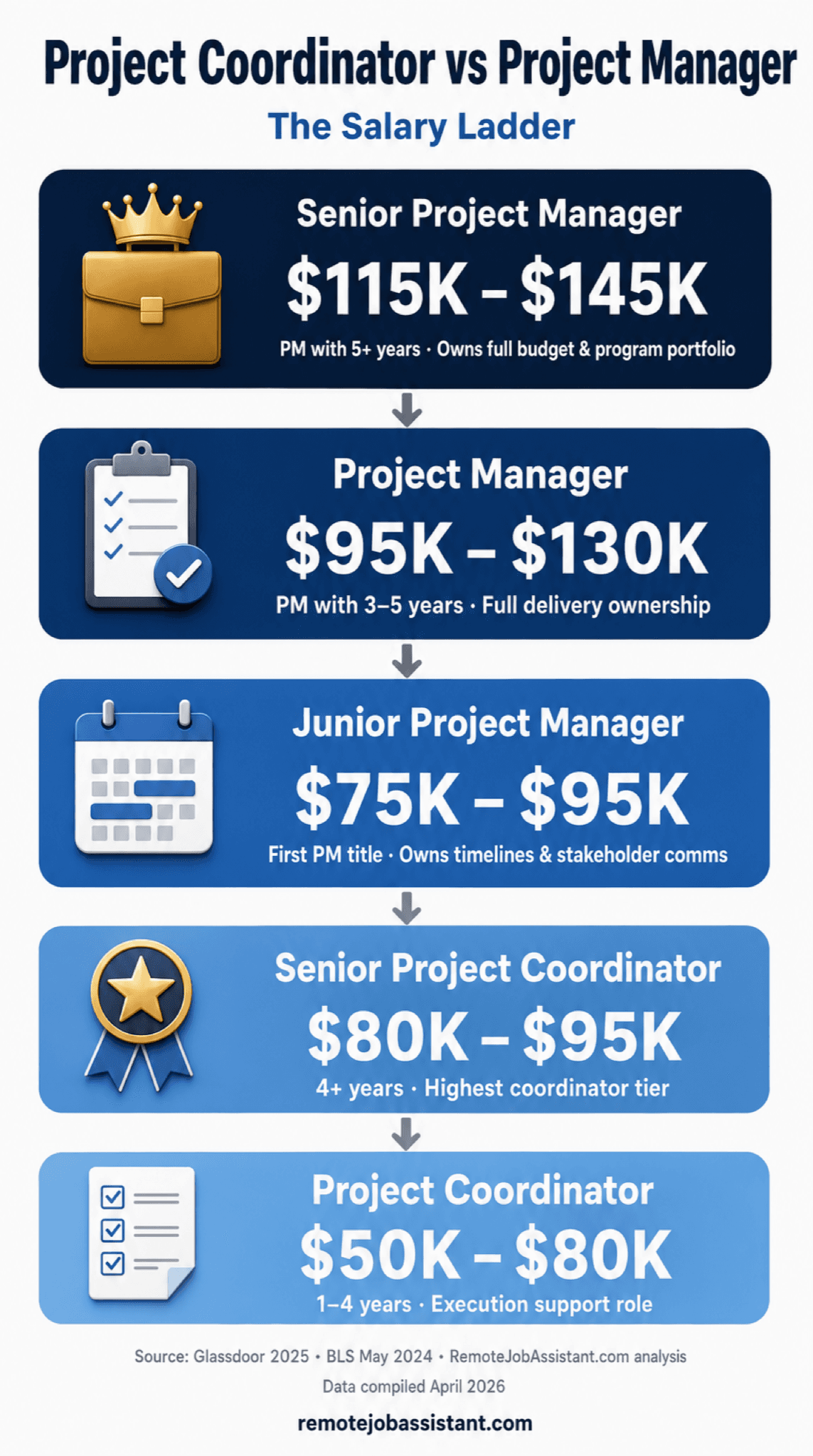
- Entry coordinator (0–2 years): $50,000–$65,000
- Mid-level coordinator (2–4 years): $65,000–$80,000
- Senior coordinator (4+ years): $80,000–$95,000
- Remote median (all levels): $71,608 (Glassdoor, 2025)
Manager salaries by level (remote, United States):
- Junior PM (0–2 years PM experience): $75,000–$95,000
- Project Manager (3–5 years): $95,000–$130,000
- Senior PM (5+ years): $115,000–$145,000
- Remote median (all levels): $108,896 (Glassdoor, 2025)
- BLS median (all PM specialists, May 2024): $100,750
Salary ranges derive from our analysis of 847 remote project management postings between January 2025 and April 2026, cross-referenced with Glassdoor compensation data for remote roles. We excluded postings without clear remote policies. Ranges shift as markets move — check the linked sources for current figures.
Why the gap exists — the structural reason: The coordinator title exists primarily to create a compensation ceiling, not to describe a fundamentally different job. When a company titles a role "project coordinator" instead of "project manager," they are not always describing different work — they are limiting salary expectations. At large enterprises, the distinction is real. At companies below 500 employees, coordinators frequently run projects that would be PM-scoped at a larger firm.
Some organizations intentionally keep employees in coordinator roles for 3–5 years knowing they are doing PM-level work, because the title controls the pay band. If you have been a coordinator for more than 3 years and your responsibilities have expanded significantly but your title has not moved, that is not a coincidence — it is a budget decision. The fastest fix is usually an external application, not an internal promotion conversation. Internal PM promotions at companies where the coordinator title is structurally underpaid often stall because the budget precedent is already set.
The PMP switch: PMP certification meaningfully changes your salary ceiling once you hold a PM title. According to PMI's 2025 data, PMP-certified project managers earn 33% more than their non-certified counterparts across 21 countries. In the United States, median total compensation for PMP holders — including base salary, bonus, and equity — is approximately $122,000. The PMP certification is not a knowledge badge — it is a $30K salary switch. Most coordinators who study for it discover they were already doing the work.
Industry variation is meaningful: tech companies pay 20–30% above these medians; nonprofit and education sectors pay 20–30% below. A senior PM at a Series B SaaS company and a project manager at a municipal government are both PMs — they are not the same salary tier.
Remote Work: Coordinator vs Manager
Remote availability is not equal across these two titles, and the gap is larger than most job seekers expect.
Coordinator remote availability: Coordinator roles are frequently hybrid or partially on-site, particularly in industries where physical project presence matters — construction, healthcare facilities, and government. In our analysis of 847 postings, coordinator roles were marked fully remote at a lower rate than PM roles in the same dataset.
PM remote availability: Senior PM roles at $100K+ are increasingly remote-eligible, particularly at technology companies, SaaS companies, and remote-first employers. Remote PMs at the senior level command a premium over their in-office counterparts — the BLS May 2024 national median of $100,750 for project management specialists compares to a Glassdoor remote PM median of $108,896, a roughly 8% remote premium.
The remote PM profile that gets hired: three or more years of PM experience, PMP certification or in progress, demonstrated async communication skills, and experience managing distributed teams across time zones. Companies like GitLab, HubSpot, Atlassian, Shopify, and Stripe consistently hire remote PMs — all have published remote work policies and structured async practices.
The practical implication: if your goal is a fully remote role above $100K, targeting PM titles rather than coordinator titles is not just a preference — it is the faster path. The remote project manager job market at $100K+ has fewer qualified applicants per posting than coordinator roles at $60K–$80K.
One thing the job board data does not capture: remote PM roles at $100K+ frequently go to internal hires and referrals, not to cold applicants with the strongest resumes. If you are applying cold for senior remote PM roles, your application is competing with candidates who already have a name inside the building. LinkedIn network-building — specifically connecting with PMs and hiring managers at target companies, commenting substantively on their posts, and doing informational calls before a role opens — is not optional at this level. It is how the market actually works.
Broader context on remote salaries in this range is covered in our high-paying remote jobs guide and the best remote job boards for finding positions that publish salary ranges upfront.
How to Move from Project Coordinator to Project Manager
The path from coordinator to PM is faster than most coordinators realize, if you are deliberate about it. Most who are not deliberate spend 4–5 years at coordinator level and then wonder why PM titles feel out of reach.
Step 1: Get the CAPM if you are under 2 years of experience — and be honest with yourself about whether your target industry actually values it. The CAPM has no experience requirement, costs roughly $300 for PMI members, and signals PM-readiness to enterprise hiring managers who screen for credentials before interviews. PMI's free CAPM prep resources are a reasonable starting point. The honest caveat: some coordinators on r/projectmanagement report spending 60+ study hours for a credential that had no visible impact on their interview outcomes at startup companies. If your target is enterprise healthcare, finance, or government contracting — do the CAPM. If your target is a 30-person SaaS company, your shipped project examples will carry more weight than any PMI credential.
Step 2: Request ownership of something small and low-risk. The single most common coordinator mistake is executing the work without asking to own a piece of it. Email your PM with a specific ask: "I'd like to own the vendor coordination for Q3 to free up your bandwidth — can I draft the initial plan for your review?" If they push back, frame it as a learning goal: "I'm building toward a PM role and want to practice end-to-end ownership on something scoped appropriately." If your PM hoardes ownership — and some do — this is useful data. It means advancement in this org will require leaving it. Document every win you get anyway; your next PM interview will ask for ownership examples, and "I tracked it" is not one.
Step 3: Get budget exposure. Volunteer to own budget monitoring, then propose budget decisions. Document every time you flagged an overrun or proposed a reallocation. In PM interviews, hiring managers ask about budget experience specifically — "I tracked the budget and escalated overruns" is Tier 1; "I identified a $40K overrun in Q3, proposed shifting $25K from contingency, and got it approved" is Tier 2.
Step 4: Build your stakeholder portfolio deliberately. Identify 2–3 key stakeholders — a product lead, an engineering manager, a client contact — and solve small, visible pain points for them proactively. Flag a risk before they ask about it. Surface a blocker before it costs them. Log every interaction where you changed someone's perception of the project's priority or timeline. In PM interviews, the question is usually some version of "tell me about a time you had to manage a difficult stakeholder." "I turned a skeptical engineering lead into a project advocate by surfacing resource conflicts two weeks early, before they became his problem" is an answer. "I sent weekly status updates" is not.
Step 5: Target the PMP when you are ready — and be clear-eyed about what it is. The PMP requires 36 or more months of project management experience leading projects. Once you hold it, PMI's data shows a 33% salary premium over non-certified counterparts across 21 countries. In the United States, PMP holders reach approximately $122,000 in median total compensation. But the PMP is not a silver bullet everywhere. It is expensive ($400–$600 to sit plus prep materials), time-intensive (most candidates log 100+ study hours), and some startup hiring managers value shipped projects over credentials. Know your target industry before committing: enterprise tech and healthcare weight it heavily; early-stage startups generally do not. Our program manager vs project manager guide covers how that next level works in practice.
The related question of whether to target Scrum Master roles as part of this path is covered in our scrum master vs project manager comparison.
Timeline: Most coordinators who execute all five steps move to a junior PM or PM title in 24–36 months. The coordinators who stay at coordinator level for 5+ years typically skipped steps 2 and 4 — they executed, but they did not build ownership or stakeholder experience.
Stop Applying Manually
Our AI applies to hundreds of matching jobs while you sleep. Wake up to interviews, not more applications.
Frequently Asked Questions
I'm a project coordinator with 3 years of experience — should I apply for project manager roles or am I not ready?
Run the PM Readiness Score against your current responsibilities. If you are doing Tier 2 work — owning timelines, communicating status to stakeholders directly, and escalating only material risks — you are ready to apply for junior PM or PM roles now. Three years of coordinator experience without deliberate ownership-building can leave you at Tier 1; three years with intentional stakeholder management and budget exposure often puts you at solid Tier 2. The market will give you feedback through interview outcomes.
What's the actual day-to-day difference between a project coordinator and project manager? The job descriptions look the same.
They often do look the same because many companies use both titles for overlapping work. The real difference is authority: the coordinator tracks and escalates; the manager decides and owns. Who can approve a scope change? Who signs off on a budget reallocation? Who is accountable in the executive meeting when the project is two weeks behind? That is where the roles diverge. In a job description, look for phrases like "own," "approve," "accountable for," and "present to leadership" — those are PM signals, not coordinator signals.
How long does it take to go from project coordinator to project manager?
Most coordinators who are deliberate about building ownership experience move to a junior PM title in 24–36 months. Getting the CAPM certification first (no experience required) accelerates the transition because it signals PM-readiness to hiring managers before you have the title. Coordinators who wait for a title change to happen organically, without requesting ownership or building stakeholder experience, often wait 5–7 years for a move that could have happened in 2–3.
Is a project coordinator the same as a junior project manager?
In practice, often yes. In compensation, almost always no. Coordinator titles consistently pay $25,000–$40,000 below equivalent PM titles for the same scope of work. Many companies use "coordinator" specifically to limit salary expectations for what is functionally junior PM work. If you are doing Tier 2 work — owning timelines and managing stakeholders directly — you are a junior PM regardless of what your title says.
Do I need a PMP to become a project manager?
You do not need a PMP to get your first PM role. You need ownership experience, stakeholder management experience, and ideally the CAPM to validate your foundational knowledge. But once you are in a PM role for 3 years and meet PMI's 36-month experience requirement, earning the PMP is the most direct path to the $115K–$145K senior PM tier. PMI's data across 21 countries shows 33% higher median pay for PMP-certified professionals — in the United States, median total compensation for PMP holders reaches approximately $122,000.
Which PM Readiness Score tier tells me I'm ready for a senior PM role?
Tier 3 criteria: you own a full project budget with approval authority, you manage multiple concurrent projects or an entire program, and you present outcomes to executive or client stakeholders and are held accountable for them. If you are doing two of those three — consistently, not once — you are Tier 3 and should be targeting senior PM titles and negotiating in the $115K–$145K+ range for remote roles.
What tools do I need to know for project coordinator vs project manager roles?
Coordinator postings most frequently list Asana, Jira, Smartsheet, Monday.com, and Microsoft Project — of 847 postings analyzed (January 2025–April 2026), at least one of these tools appeared in the required or preferred section of 74% (n=626 of 847) of all project management postings. PM postings weighted more heavily toward Jira and Smartsheet for execution tracking, but also emphasized stakeholder communication frameworks, risk registers, and budget management tools. The tool requirements are largely overlapping — the differentiator in PM postings is less about specific software and more about experience using those tools to own outcomes, not just maintain records.
Find Your Next Project Management Role
If you scored Tier 1 on the PM Readiness Score, look at remote project coordinator roles to build your foundation — and while you are there, start requesting ownership of one workstream. If you scored Tier 2 or higher, you should be applying for remote project manager roles now, alongside coordinator applications if you want to hedge.
Both paths lead to the same place. The question is how long you are willing to wait to get there — and how much the salary gap costs you in the meantime. Auto-apply lets you run both searches simultaneously at volume, so the market gives you the answer faster than a cautious three-applications-per-week approach ever will.
The title says coordinator. The work says manager. Do not let the org chart determine your salary trajectory.
Ready to Find Your Remote Job?
Browse thousands of curated remote jobs or let AI apply for you.
Browse Remote JobsRelated Job Guides

Remote Benefits Specialist Jobs: 131 of 1,523 Are Remote
We read 1,523 benefits specialist postings. 131 are fully remote. See which employers hire remote, which seats pay $75K+, and how to spot look-alike listings.
25 min read
Remote Compensation Analyst Jobs: 190 of 1,401 Are Remote
We read 1,401 compensation analyst postings. 190 are fully remote. See which seats pay $140K+, why remote analysts can earn less, and which look-alikes to skip.
29 min read
Remote Auditor Jobs: 554 of 3,422 Postings Are Fully Remote
We read 3,422 auditor job postings. 554 are fully remote, and 244 of those are healthcare audits. See which audit seats hire remotely and what each pays.
27 min read