
Last reviewed: September 2026
You searched for fractional CTO jobs and got a big number back. ZipRecruiter puts "$132k-$280k" and "1,000+" in the title of its results page. LinkedIn shows "1,000+" for the same search. The market looks deep, well paid, and open to anyone who has run an engineering team.
We read the listings behind those numbers. On September 23, 2026, we pulled 103 fractional CTO listings from three boards and sorted each one by what it actually offered. After removing reposts, 90 were distinct. Twelve were a company directly paying a part-time technology leader. The rest were founders looking for an unpaid co-founder, dev shops recruiting a senior face for their sales calls, Upwork clients buying a developer at $30 to $150 an hour, CIO and interim roles, and full-time jobs that matched the keyword.
Get Remote Job Tips in Your Inbox
Weekly strategies, salary data, and new opportunities
Unsubscribe anytime. No spam.
The pattern held on all three boards. CTO is the one executive title that costs nothing to print and nothing to verify. A fractional CFO is expected to put their name on financial statements. A CTO needs a LinkedIn headline. So every early-stage founder, agency, and freelance marketplace attaches the title to whatever they need that week.
Below: how to sort a fractional CTO listing in about a minute, what the real rate data says once you stop averaging incompatible numbers, and The Custody Test, a scoring rubric for the engagements that are real. The variable that decides whether a real engagement is a good job is not hours. It is how many production keys end up held by you alone.
- 12 of 90 distinct fractional CTO listings (13%) were a company directly hiring a paid part-time technology leader (RJA classification of 3 boards, September 23, 2026)
- 2 of 59 distinct listings in LinkedIn's first 60 remote US "fractional CTO" results were paid part-time CTO roles; 11 of 59 were founding CTO or technical co-founder asks
- 6 of 23 distinct HireAFractionalExec CTO listings were Upwork gigs; the 4 that showed an hourly rate ranged from $30 to $150/hr
- $217/hr average fractional CTO rate, middle 50% at $170-$250/hr, around 15 hours a week and $10,200-$15,000/month (Go Fractional CTO benchmark, accessed September 2026)
- $229/hr average for the engineering function across fractional executives (Fractional Work Report 2026, n=546 rate subsample)
- $124,576 is Glassdoor's average fractional CTO "salary," built from 5 self-reported entries
- 2 of 13 distinct Fractional Pulse CTO listings disclosed any compensation
Every figure above was either counted by us on a stated date or published with a sample size. Here is how, and what we refused to use.
How We Collected This Fractional CTO Listing and Rate Data
On September 23, 2026, we read three sources. HireAFractionalExec's fractional CTO page advertised 32 open roles in its header; we parsed 29 listing URLs from it and retrieved the full body text for 23 of them. Fractional Pulse's board showed 14 listings tagged CTO out of 603 live fractional roles. LinkedIn's public job search for "fractional CTO," filtered to the United States and remote, reported "1,000+" results; we classified the first 60. That is 103 listings in total. We treated the same employer posting the same role as one listing, both within a board and across boards, which left 90 distinct listings.
Each listing went into one of seven categories: paid part-time CTO, founding CTO or co-founder ask, consultancy or dev-shop bench, Upwork gig, adjacent title (CIO, vCISO, Chief AI Officer), interim full-time CTO, or keyword noise. Where the body text was available we classified on it. For LinkedIn and Fractional Pulse, we classified on title and employer alone, so those two boards carry more error than HireAFractionalExec. A handful of LinkedIn "Chief Technology Officer" listings with no fractional language could conceivably be part-time; we counted them as noise because nothing in the listing said otherwise.
Rates come from sources that disclose what they measure. The Go Fractional CTO rate benchmark is derived from live postings and updates continuously, so it is quoted with a September 2026 access date. The Fractional Work Report 2026 is built on 1,733 survey responses, of which 810 are active fractional workers and 688 are aspiring ones who have not yet done the work; its rate figures use a 546-person subsample. Both are run by companies selling into this market and both draw self-selected samples. Glassdoor and ZipRecruiter figures are reported side by side, not averaged. The full-time anchor is the BLS Occupational Outlook Handbook entry for computer and information systems managers, May 2024.
We excluded two claims that circulate on fractional CTO pages: that the fractional executive market "grew 46% YoY" and that "72% of CEOs plan to increase fractional usage." Neither came with a source. We also found no published figure for how long it takes to land a first fractional CTO client that discloses a sample size, so this post doesn't give one. This is a one-day snapshot of three boards. It is not a census, and the next quarter's numbers will differ.
What Fractional CTO Jobs Actually Are: The Seven Listing Types
The phrase "fractional CTO job" is doing the work of seven different offers. Five of them are not a paid part-time CTO engagement, and each of the five has a tell you can find in the first paragraph of the listing.
| Listing type | Count (of 90) | What it actually is | The tell | Worth your time? |
|---|---|---|---|---|
| Paid part-time CTO | 12 | A company pays you to lead its technology part-time | Retainer or rate, stated hours, named deliverables | Yes |
| Founding CTO / co-founder | 12 | Equity for building the product | "Founding," "co-founder," "compensation TBD" | Only as an investment decision |
| Consultancy or dev-shop bench | 12 | You front their client work; they own the relationship | Represent the firm to its key accounts; upsell duties | Only if you want a sales role |
| Upwork gig | 6 | A senior developer at developer rates | $30-$150/hr; "Fractional CTO / Senior Software Engineer" | Only priced as developer work |
| CIO, vCISO, Chief AI Officer | 7 | An adjacent function | ERP, internal IT, managed-services language | Different job |
| Interim CTO | 6 | Full-time and temporary while they recruit | Roughly 3-6 months while they search for a permanent CTO | Different job |
| Keyword noise | 35 | Full-time CTOs, architects, unrelated roles | No part-time or fractional language at all | No |
The tells are usually explicit. One consultancy listing asks its fractional CTO to "represent IUNGO Technology at an executive level for key accounts" and to "identify expansion opportunities — spot upsell and cross-sell needs." That is an account executive role with architecture knowledge attached. An early-stage consumer startup's listing appeared on the board with a displayed range of $75,000 to $100,000 a year, while the listing body said "Compensation: TBD" and described pay that would "scale as the company grows, rather than treating this as a short-term consulting project." The board's number and the employer's words disagree, and the employer's words are the ones in the contract. On Upwork, one posting is titled "Fractional CTO / Senior Software Engineer" at $50 to $90 an hour for four to five hours a week.
Why does CTO attract this more than other fractional titles? Four reasons, and each maps to a category in the table.
First, there is no credential gate. A fractional CFO is usually a CPA or has run audited books; a CMO has a portfolio of campaigns someone can check. Nobody verifies a CTO title, so it costs nothing to print. Second, non-technical founders value a technical co-founder more than any other executive, because without one they cannot build the product at all. That demand shows up as equity asks, and it clusters here: 11 of the 59 distinct LinkedIn results we read were founding CTO or technical co-founder roles. Third, software agencies sell engineering hours, and a CTO title on the sales call makes the hours easier to sell. Fourth, on freelance marketplaces "CTO" has drifted to mean "the one engineer who makes the decisions," which is a real need but a developer's job.
The title "fractional CTO" costs nothing to print, so a listing tells you nothing until you find the payment line.
In practice the sort takes four questions, asked in order, and you stop at the first one that disqualifies the listing:
- Who pays you, and in what? No rate, retainer, or stated budget, plus words like "founding," "co-founder," or "TBD" means an equity ask. Decide on it as an investment or skip it.
- Whose clients will you talk to? If the employer is a consultancy, dev shop, or managed-services firm and the listing mentions "key accounts," "pre-sales," or "our engineering organization," you are on their bench.
- Is the rate a developer's rate? Anything under $150 an hour sits below the bottom of the market's middle band. Price it as development work or pass.
- Is it part-time? "Interim," "3-6 months while we search," or no hours stated at all usually means a full-time temporary role.
A listing that survives all four is one of the 12. That is when The Custody Test, below, starts to matter.
If you are running a parallel search for full-time engineering leadership while you test the fractional market, the noise problem is the same on both sides. Most people end up screening remote engineering and technical roles by hand, reading past the same keyword matches over and over. Our guide to remote engineering jobs covers how the full-time side is structured.
Stop Applying Manually
Our AI applies to hundreds of matching jobs while you sleep. Wake up to interviews, not more applications.
Fractional CTO Rates: Why the Salary Numbers Disagree
Search for fractional CTO pay and you will find numbers from $80 an hour to $600 an hour, and annual "salaries" from $124,576 to $280,000. They are not errors. They are measurements of different jobs that happen to share a title.
| Source | Figure | What it measures | Sample / caveat |
|---|---|---|---|
| Go Fractional CTO benchmark | $217/hr avg; middle 50% $170-$250; about 15 hrs/week; $10.2K-$15K/month | Rates in live fractional postings | Rolling; accessed September 2026 |
| Fractional Work Report 2026 | $229/hr, engineering function | Self-reported rates | n=546 rate subsample |
| HireAFractionalExec CTO page | $5K-$9K/month at 10 hrs/week; $8K-$13K at 15; $11K-$17K at 20 | Board's own market bands | No sample size published |
| ZipRecruiter | $166,511/yr ($80.05/hr); 25th-75th percentile $132,000-$195,000 | Postings matching the title | No sample size; hourly x 2,080 hours |
| Glassdoor | $124,576/yr; 25th-75th percentile $93,432-$172,091 | Self-reported pay | n=5 |
| Upwork CTO-titled gigs (our sample) | $30-$60 up to $100-$150/hr | Client-posted gig rates | 4 gigs with an hourly rate |
| BLS, computer and information systems managers | $171,200 median, full-time | Employed managers | May 2024 |
Rates were cross-referenced across the sources in this table on September 23, 2026. We treated Fractional Pulse's published tier table as a claim rather than data, because the same page discloses that its hourly evidence rests on five usable observations. Its central assertion, that strategic CTOs who don't write code bill more than hands-on coding CTOs, is directionally consistent with what we saw in the listings, but five data points cannot carry a rate band.
Three things explain most of the spread.
The widgets annualize an hourly rate at full-time hours. ZipRecruiter's $80.05 an hour multiplied by 2,080 hours gives $166,504, within a few dollars of its $166,511 headline. That is the arithmetic of a full-time job, and a 15-hour-a-week engagement is never one. The fractional CFO market has the same problem; we worked through why salary widgets misread fractional pay in that guide, and the logic transfers directly.
Glassdoor's figure is five people. Five self-reports can't tell you what a market pays. They tell you what five people typed.
The Upwork band sits below the market. The highest Upwork rate in our sample, $150 an hour, is lower than the bottom of Go Fractional's middle 50%, which starts at $170. When a listing prices a "fractional CTO" under $150 an hour, it is pricing a developer and using the CTO title as the job's description of seniority.
Now the useful arithmetic. At Go Fractional's $217 average and about 15 hours a week, one client comes to roughly $14,100 a month. The BLS median for a full-time computer and information systems manager, $171,200, is about $14,300 a month. One client roughly matches one salary, before you pay your own health insurance, self-employment tax, and the unbilled hours spent finding the next client. Two clients is about $28,200 a month gross, which is where the model starts beating a salary. Take the self-employment side seriously when you run this: the IRS self-employment tax is 15.3% (12.4% Social Security plus 2.9% Medicare), and an employer used to pay half of it for you. The two-client math also depends on the clients staying. According to the Fractional Work Report, 60% of fractional engagements last six months or longer (n=1,733), which means a meaningful share don't.
If your honest target is a full-time package in the same range, remote roles paying $150K and up and $200K-plus remote jobs are the comparison set, and you should run that comparison before quitting anything.
The Custody Test: Scoring a Fractional CTO Engagement Before You Sign
Once you have filtered down to the paid listings, the obvious next question is hours. It is the wrong one. Hours matter, and fractional work of every kind tends to run over what the posting says; we covered that execution drift in fractional CMO work, where it is the dominant risk. For a CTO, the dominant risk is custody: how much of the company's production responsibility ends up held by you and nobody else.
A fractional CFO's work terminates on a calendar. The month closes, the audit ends, the raise finishes. A CMO's campaign can pause for a week. A production database that goes down at 2 a.m. does not wait for your Tuesday hours, and if you are the only person with the credentials to fix it, your part-time job has a full-time pager attached.
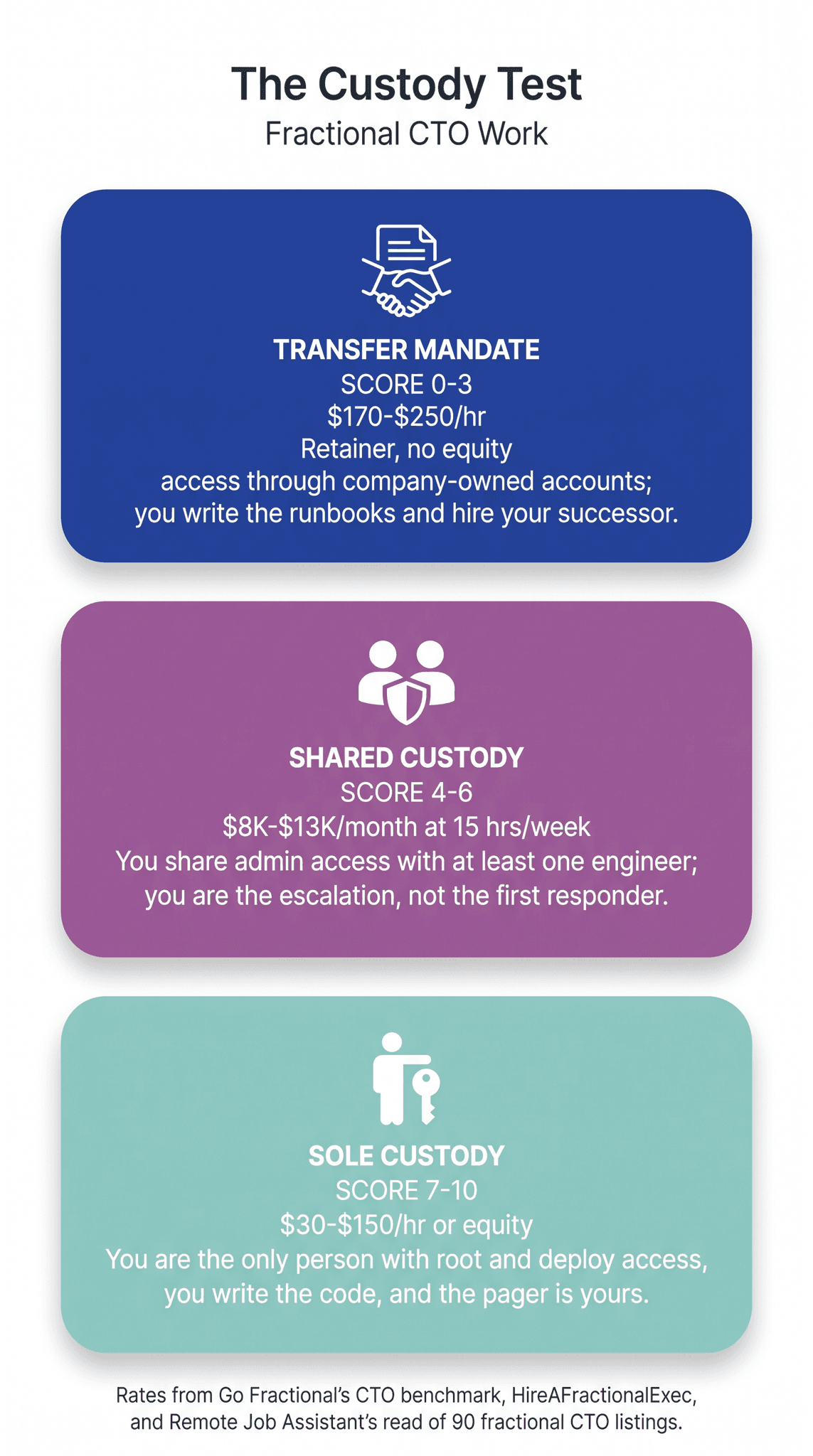
The Custody Test is a 10-point score of how much production responsibility an engagement concentrates in you, and whether the engagement is built to hand that responsibility back.
C0-3 Transfer Mandate — $170-$250/hr; $10.2K-$15K/month at about 15 hrs/week. You are paid a retainer, with no equity in lieu of cash. You access production through organization-owned accounts, never personal ones. Your deliverables include runbooks, an on-call rota with other people's names on it, and usually hiring the person who replaces you. Technical due diligence and architecture reviews also sit here, because you hold nothing.
C4-6 Shared Custody — $8K-$13K/month at 15 hrs/week; $11K-$17K/month at 20 hrs/week. You hold admin access alongside at least one in-house or partner engineer. You are the escalation point, not the first responder. You manage the people who ship, and you ship occasionally yourself.
C7-10 Sole Custody — $30-$150/hr Upwork rates, or equity and "TBD." You are the only person with root and deploy access. You write most of the code. The pager is yours. Nobody else could restore the system if you disappeared for a week.
The dollar bands come from the rate sources above: Go Fractional's middle 50% for the first band, HireAFractionalExec's published hours-based bands for the second, and the Upwork rates and equity-only asks in our listing sample for the third. To score an engagement, add a point for each answer that is yes:
- Would you be the sole holder of the cloud root account, the domain registrar, or the app-store and payment-processor logins? (One point each, up to three.)
- Is there nobody else who can deploy to production? (Two points.)
- Would you be primary on-call? (Two points.)
- Would you write production code most weeks? (One point.)
- Is there no written handoff deliverable in the scope? (One point.)
- Is part of your pay equity in place of cash? (One point.)
How to use it: score the listing before the first call and again at signing, because scope moves during negotiation. At 7 or higher, you have two honest options: price the work as what it is, which is an engineering team of one, or make moving credentials into organization-held accounts and writing the runbooks your first 30-day deliverable, so the score falls as the engagement runs.
Custody hides in places a scoping call rarely reaches. Five to check before signing:
- The cloud root account is registered to your personal email. AWS's own root user best practices tell companies to use a group email address managed by the business and to restrict access to account recovery. If recovery lands in your inbox, you hold the company whether you want to or not.
- You get the root password but the MFA device stays with the founder. Now neither of you can act alone during an incident, and you carry the blame for the outage anyway.
- The Apple developer account is enrolled in someone's name. Apple's developer account roles documentation gives the Account Holder sole authority to accept legal agreements, renew the membership, and approve banking changes. If that is you, the company cannot ship an app update without you.
- The domain registrar or DNS sits on a personal account and card. Whoever pays for the domain controls email and the website. When a fractional engagement ends badly, this is the first thing both sides fight over.
- The founder keeps a personal admin account nobody mentions. Ask for a full list of admin users on day one. An unmanaged admin account means your runbooks and access controls cover part of the system, and you can't vouch for the rest.
None of these are exotic. They are the default state of a company that got to launch without an engineering leader, which is exactly the company hiring a fractional CTO.
That second option isn't hypothetical. The best-structured listing in our sample, a Go Fractional role at a litigation-data platform handling protected health information, reads like it was written by someone who had been burned. It runs six to nine months, starts at about three days a week and drops to two, pays a monthly retainer, and states there is no equity in the fractional engagement. It opens with a paid one-week assessment. It requires a Business Associate Agreement before any production access. And its first-month deliverables include "Inventory and transfer single-person credentials to organization-held accounts" and runbooks for every production component, each with an "exit test (runbook exercised by someone who did not build it)." The listing's own summary of the role: "transfer ownership rather than accumulate it." That engagement scores a 1 or 2. It is also one of the better-paid shapes of work in this market.
Why does custody concentrate at the bottom of the pay scale? Follow the money. A pre-seed company with no engineers needs a custodian more than anyone, and it has the least cash, so it offers equity. An Upwork client posts one role because it wants one person to do everything. A funded company with an engineering team already has people who can hold the keys, so it buys judgment instead of hands, and judgment is what the $200-plus rates pay for.
In fractional CTO work, pay and liability run in opposite directions: the listings that hand you every key are the ones that pay in equity or Upwork rates.
The practical consequence is that the exit clause matters more than the rate. A C8 engagement at a good hourly rate can still be a bad job if you can't leave it without taking the company's production access with you. Before signing anything that scores high, ask the client one question: "If I stopped on Friday, who would deploy on Monday?" If the answer is a name, you are negotiating a role. If the answer is silence, you are negotiating a liability. The skills that make you good at lowering the score are the ones covered in our guides to remote DevOps roles, cloud engineering, and security work: infrastructure as code, access control, and incident process.
Stop Applying Manually
Our AI applies to hundreds of matching jobs while you sleep. Wake up to interviews, not more applications.
Where Paid Fractional CTO Work Actually Comes From
The 12 paid listings in our sample are few, but they are informative, because they cluster around four situations. Knowing the situations matters more than knowing the boards, since the situations are what you listen for in your network.
Stabilizing a product that works in demos and breaks in production. One listing describes a platform that is "functionally complete but technically fragile—crashing frequently and largely built through informal development practices and ad-hoc AI patches," and asks for a fractional CTO at five to ten hours a week to harden it before investors look closely. HireAFractionalExec's CTO page separately names "transitions from agency-built MVPs to in-house engineering teams" as a peak demand moment. As more first products get built quickly with AI coding tools or by outside agencies, this engagement shape looks likely to grow. It scores high on The Custody Test unless you scope the handoff from the start.
Investor readiness and due diligence. Two of the paid listings are explicitly about preparing a company's technology for fundraising, and one consultancy bench listing mentions leading technical diligence for M&A and private equity work. Diligence is the lowest-custody work in the market: you read, assess, and write, and you hold no keys at the end.
Building and handing off an engineering organization. The transfer-mandate listing above asks its CTO to recruit roughly a dozen roles over about three months, define levels and scorecards, and leave behind a Head of Product who can lead engineering. That is the classic fractional CTO engagement, and it asks for hiring experience more than coding.
Managing a small or outsourced team. A point-of-sale software company wants someone to direct its two remote developers "with clear deliverables, deadlines, and acceptance criteria," and asks candidates whether they would personally perform the work. An edtech startup wants 10 to 15 hours a week to manage outsourced developers through an MVP. Both are real, and both need a clear answer to the custody questions before signing. Tools matter less here than rhythm, but a clean Jira workflow and written acceptance criteria are how you manage developers you see for an hour a week.
The listings still aren't the main channel. In the Fractional Work Report 2026, 72% of respondents found their very first fractional client through someone in their personal network, and 94% had won clients through referrals (n=1,733, all functions). A survey of fractional executives at the Frak Conference, cited by Rational Partners in its guide to becoming a fractional CTO, found 92.8% got clients through referrals and word of mouth, against 19.2% through cold outreach.
Read the paid listings for their trigger language: fragile MVP, investor diligence, first engineering hires, outsourced team. Then tell the people who see those triggers before a listing exists (seed and Series A investors, fractional CFOs preparing a raise, and agencies handing off a finished MVP) exactly which one of the four you fix.
Bench roles at consultancies deserve a separate word. They are not scams. A dev shop that needs a senior technical face on its client calls can give you steady deal flow without any prospecting on your part. The trade is that the client belongs to them, your role partly involves selling their engineering hours, and you cannot take the relationship with you when you leave. If that trade suits you, take it with open eyes. If you want your own practice, a bench role is a detour.
One more uncomfortable point. Some founders hire a fractional CTO precisely because they don't want to hire a full-time engineering leader who would expect authority, equity, and a seat in every decision. A part-time title can be cancelled in 30 days and argues less. That isn't a reason to refuse the work. It is a reason to notice when a client describes you as "the CTO" but routes every architecture decision through the founder, and to price that engagement as senior staff augmentation, because that is what it is.
Who Should Not Take Fractional CTO Work
Four profiles tend to lose money or reputation in this market, and none of them is "not senior enough." Each comes with a test you can run on yourself tonight.
You have never owned hiring. The paid listings ask you to hire. The transfer-mandate role wants about a dozen hires in three months, with levels, scorecards, and interviewer calibration. The test: can you name the last three engineers you hired, the scorecard you used, and one you rejected who went on to do well somewhere else? If you can't, your leadership has been technical direction without headcount, and a fractional client will find that out in the first month.
You want to write code most of the week. That is a legitimate career, and it pays well, but priced as fractional CTO work it lands in the Upwork band. The test: look at your last two weeks and count the hours you spent in an editor versus in hiring, planning, and decision meetings. If the editor wins by a wide margin and you like it that way, a senior or staff contract role, or a full-time role from our guide to remote software engineer jobs, will pay you more for the same hours.
You can't afford a year of equity. Eleven of the 59 distinct LinkedIn results we read were founding CTO or co-founder asks. The test: write down the monthly amount you need, multiply by twelve, and check whether you'd be comfortable investing that sum in cash into this specific company today. If not, don't invest it in labor either. An equity-only CTO role is that investment, made in the least diversified way possible, while you also hold their production keys.
You don't want to be anyone's only pager. Anything scoring 7 or higher on The Custody Test makes you the on-call rotation. The test: imagine a Saturday outage while you're at a family event. If your honest reaction is resentment, say so in the first call, and walk away from any engagement that can't be restructured so someone else answers first.
If two or more of those describe you, the better move is usually a full-time engineering leadership search in parallel with one or two advisory engagements. That search includes VP of Engineering and Head of Engineering roles, and adjacent paths through technical program management and data and analytics leadership.
Stop Applying Manually
Our AI applies to hundreds of matching jobs while you sleep. Wake up to interviews, not more applications.
Frequently Asked Questions
I'm a VP of Engineering. How do I tell if a fractional CTO listing is a real paid role?
Look for the payment line first: a retainer, an hourly rate, or at least stated hours and named deliverables. In our September 2026 classification, only 12 of 90 distinct fractional CTO listings (13%) were a company directly paying a part-time technology leader. The rest were equity asks, consultancy bench roles, Upwork gigs, adjacent titles, interim full-time roles, or keyword matches.
Should I take a fractional CTO role that pays only in equity?
Treat it as an investment decision, not a job. You are trading cash for a small stake in a company that is likely to fail, and equity-only roles often make you the only engineer, which scores 7 or higher on The Custody Test. If you take one, cap the hours, set a date to convert to cash, and keep all credentials in accounts the company owns.
What should I charge as a fractional CTO when every salary site shows a different number?
Anchor on rate data from actual fractional postings, not salary widgets. Go Fractional's CTO benchmark showed a $217 hourly average with the middle 50% at $170 to $250 in September 2026, and the Fractional Work Report 2026 put the engineering function at $229 an hour (n=546). Widgets like ZipRecruiter annualize an hourly figure across 2,080 hours, and Glassdoor's figure rests on five self-reports.
A startup wants me as its fractional CTO, but I'd be the only engineer. Is that a red flag?
It is a pricing and exit problem more than a red flag. Being the only engineer usually means sole custody of production, primary on-call, and weekly coding, which puts the engagement at 7 or higher on The Custody Test. Either price it as a full engineering function or make moving credentials to company-owned accounts and writing runbooks your first 30-day deliverable.
How do I score an engagement on The Custody Test?
Add points for sole ownership of the cloud root account, domain registrar, or app-store and payment logins (up to three), no one else able to deploy (two), being primary on-call (two), writing production code most weeks (one), no written handoff deliverable (one), and equity in place of cash (one). A score of 0 to 3 is a Transfer Mandate, 4 to 6 is Shared Custody, and 7 to 10 is Sole Custody. Score the listing before the first call and again at signing.
Do fractional CTOs write code?
Some do, but the better-paid engagements rarely center on it. In our sample, the listings built around hands-on coding were mostly Upwork gigs paying $30 to $150 an hour, while retainer-based listings asked for hiring, architecture decisions, investor readiness, and handoff. Coding a little is normal; coding most of the week means you are being hired as a developer.
Is a fractional CTO role at a dev agency the same as independent fractional CTO work?
No. An agency bench role has you represent the agency to its clients, often with explicit upsell or pre-sales duties, and the client relationship stays with the agency. It can supply steady work without prospecting, but it builds their book of business rather than yours.
Start Your Fractional CTO Search
Fractional CTO jobs are real, but there are fewer of them than the search results suggest, and the title hides seven different offers. Find the payment line before anything else. Match the rate against postings-based data, not salary widgets. Then score the engagement for custody, because a well-paid engagement that leaves you as the only person who can deploy is still a bad job.
If you want the broader pay picture across senior remote work, our guide to high-paying remote jobs covers the full-time side. The fractional guides for CFOs and CMOs show how the same model plays out in other functions. And if you are running a full-time search in parallel, Remote Job Assistant's Auto-Apply handles the applications while you do the screening that matters.
A good fractional CTO engagement ends with nobody needing your password.
Ready to Find Your Remote Job?
Browse thousands of curated remote jobs or let AI apply for you.
Browse Remote JobsRelated Job Guides

Fractional COO Jobs: Real Pay and Borrowed Authority
Only 9 of 73 fractional COO jobs we classified were paid part-time seats. Real 2026 rates, why posted pay runs low, and how to score authority before you sign.
29 min read
Remote Contract Manager Jobs: 268 Postings, 58 Remote
We read 268 US contract manager postings at 63 employers. 58 were remote, 43 at health plans, pharma or CROs. Pay by level, clearance rules, what to learn.
26 min read
Remote People Operations Jobs: 259 Postings, 44 Remote
We read 259 US people ops postings at 137 employers. 44 were remote, and 30 of those were comp or HRIS roles. Real pay by specialty, plus what to learn next.
23 min read